Robot stories worth opening.
A cleaner reading hub for buyer guides, robot-market analysis, and short news signals.
Latest analysis
Newest long-form stories for quick triage before you jump into specs, maker pages, or comparisons.
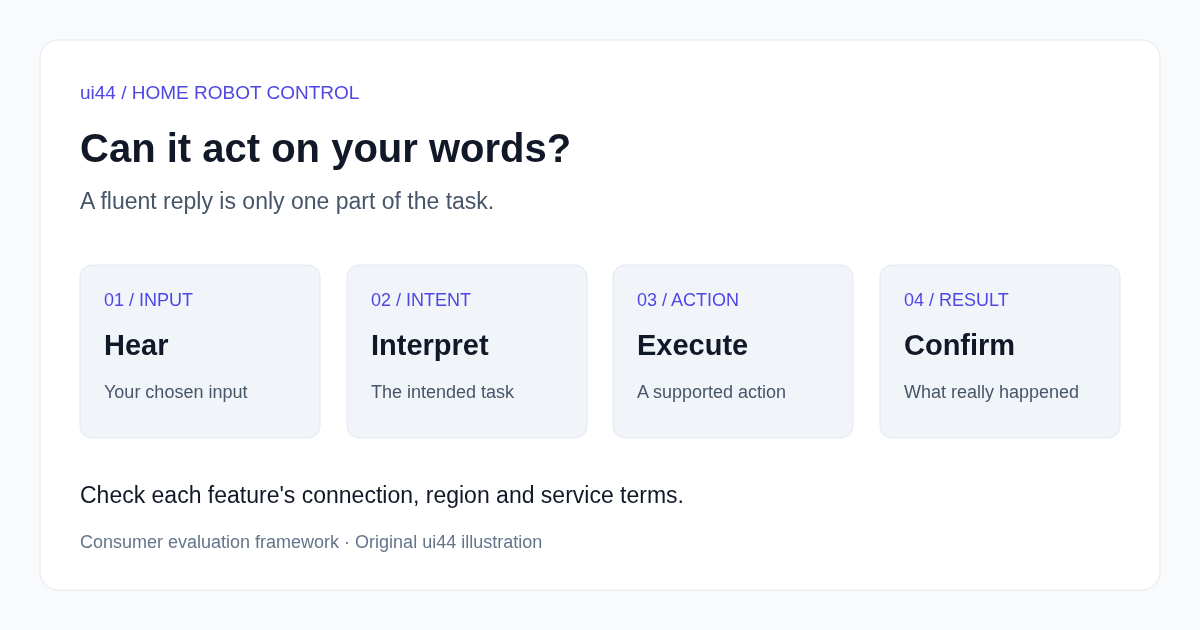
Natural Language Robot Control: What Can It Actually Do?
A robot can answer a question fluently without being able to carry out the request inside it. Before buying for voice control, separate the conversation from the action: what can you say, what will the robot actually do, and which connection, account or service makes that possible?
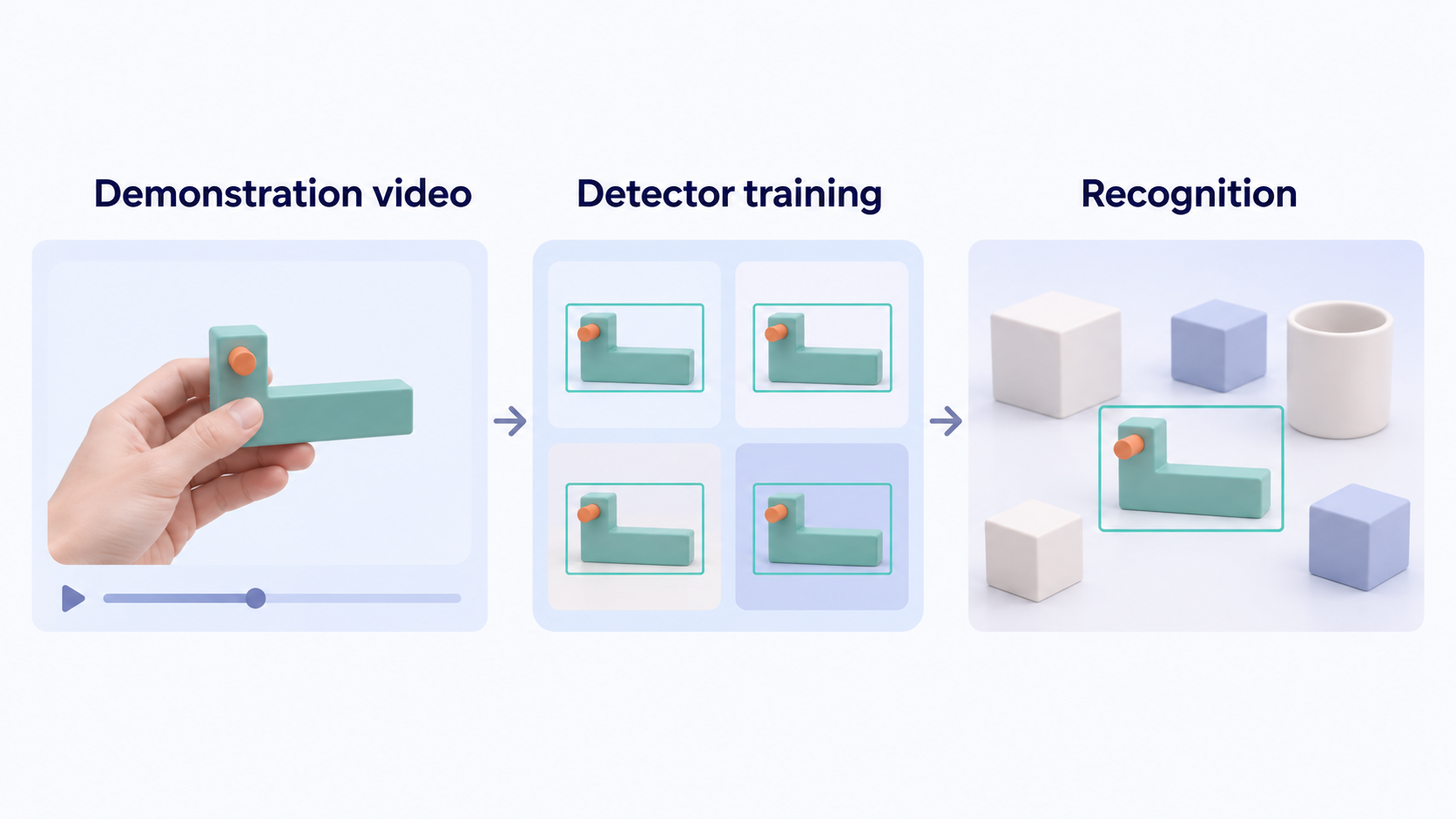
Can a Robot Recognize an Unfamiliar Object From One Video?
A demonstration can teach a robot's vision system which unfamiliar objects to look for. That is a useful, narrower claim than teaching a robot to complete a new household chore. RAI Institute's Show, Don't Tell research is worth reading through that distinction: the result being adapted is an object recognizer, while executing a task still depends on other capabilities.
Figure Helix 2.5: What Unseen-Home Tests Show Buyers
A useful home-robot test should ask whether a skill survives a change of room, objects and furniture. This explainer examines that question through Figure's latest published home evaluation, then separates the research result from the evidence a household would need before buying.

Digit 5: Planned Safety Systems and Deployment Evidence
On September 15, 2026, Agility Robotics unveiled Digit 5, its next-generation industrial humanoid. Agility describes a design for working near people without physical safety barriers. That is a development claim, not evidence that every configuration or worksite is approved for operation without barriers.
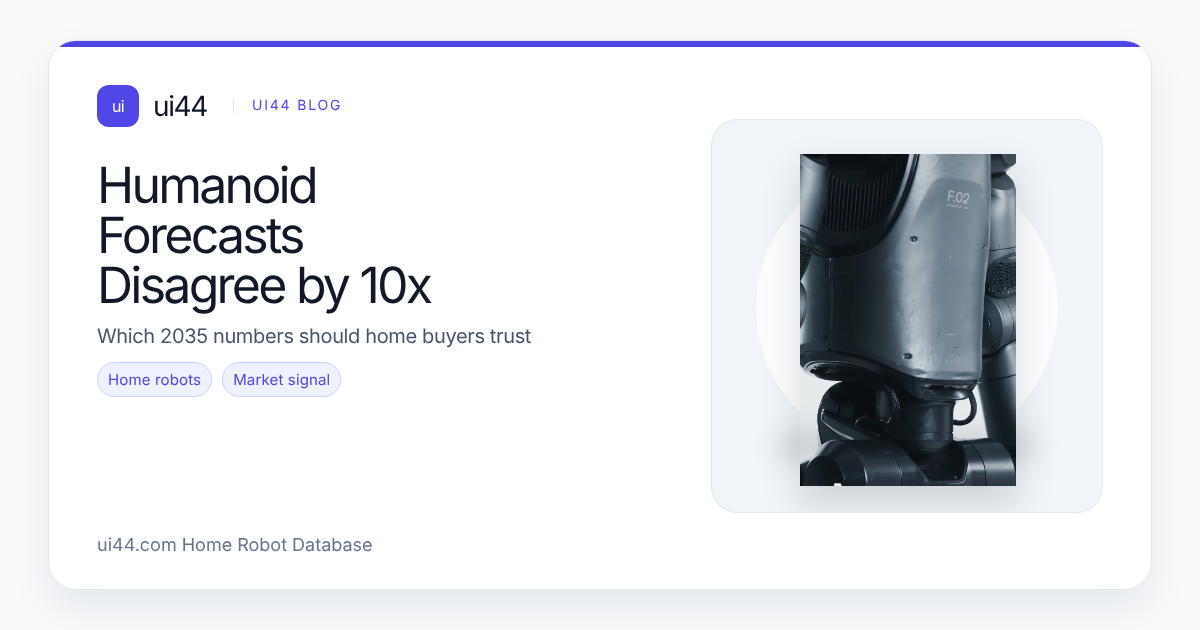
Humanoid Robot Forecasts Differ 10x: Who Should You Trust?
Humanoid robot market forecasts for 2035 disagree by roughly 10x. Interact Analysis (May 2026) projects about $15 billion in revenue and 700,000+ annual shipments by 2035. Goldman Sachs counters with $38 billion and 1.4 million units in its central scenario, plus an explicitly labelled $154 billion blue-sky scenario. Barclays, meanwhile, estimates roughly 60,000 humanoids deployed in 2026 versus 15,000 in 2025, scaling toward millions of units per year by the mid-2030s.

The $500M Handshake: Who Owns Your Robot Training Data
Your future home robot will only be as good as someone else's motion library. That sentence sounds strange until you look at where the money went this month: two startups that own no robot hardware are suddenly worth a combined $1.7 billion, and a third just raised $100 million by promising to close the loop between deployment and retraining.
Article archive
Guides, verification pieces, and market explainers in a simple scan-friendly grid.

OpenAI Builds a Humanoid, Google Licenses the Brain
Two AI labs just split on the biggest question in home robotics: do you build the body, or license the brain?

Samsung Ballie Remains Unreleased: What the Shelving Reports Mean
Unreleased; consumer launch reportedly shelved. That is the defensible summary of Ballie's position in the sources reviewed for this update. Bloomberg reported indefinite shelving on January 7, 2026. That report should not be stretched into a prediction that Ballie can never launch, or a claim that Samsung has formally confirmed permanent cancellation. We have not verified either claim from a primary Samsung announcement.
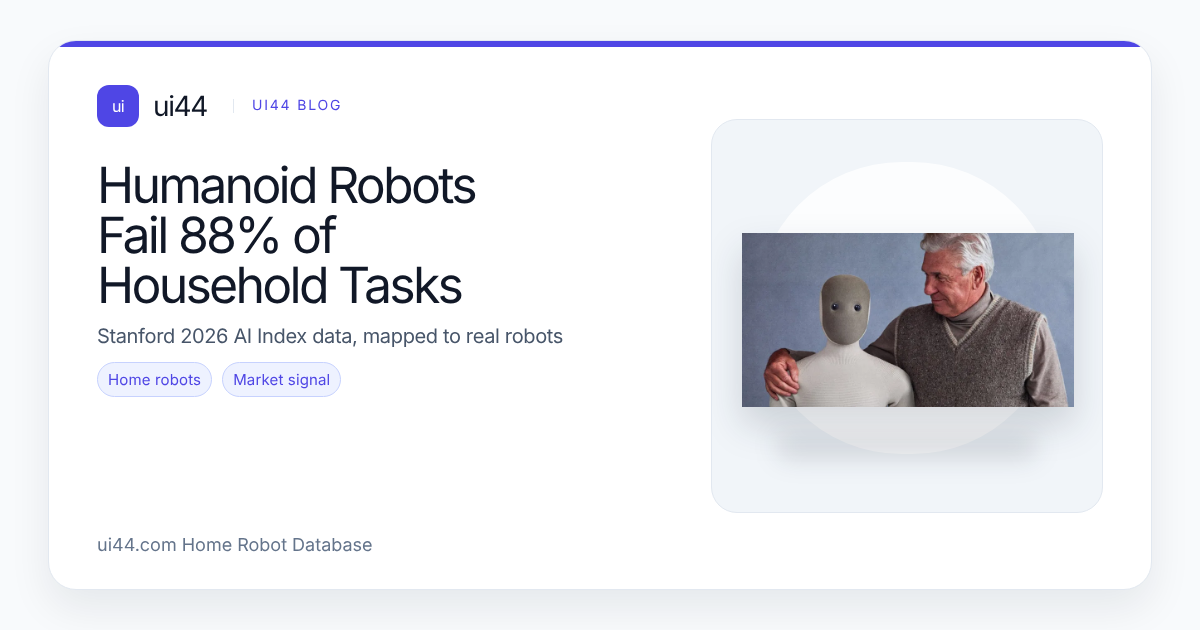
Humanoid Robots Fail 88% of Household Tasks: Stanford Data
Humanoid robot demos are getting good enough to fool a lot of smart buyers. You watch a robot fold a shirt, hand over a cup, or walk through a spotless kitchen and it feels like home robotics is one product cycle away from being normal.
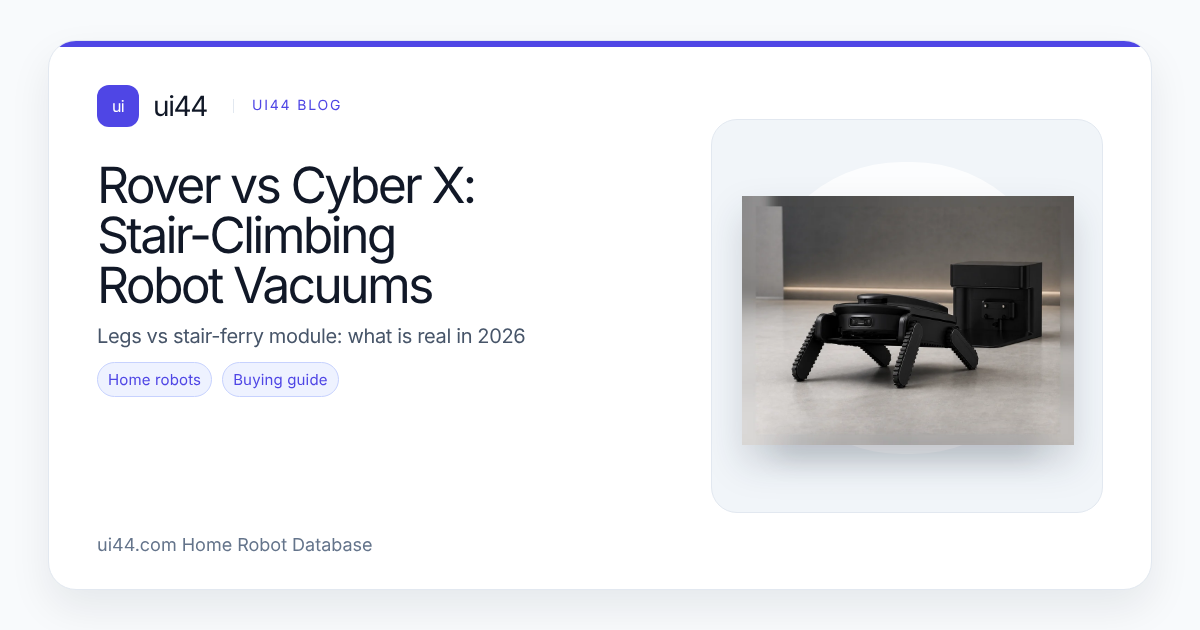
Rover vs Cyber X: Stair-Climbing Robot Vacuums Tested
A stair climbing robot vacuum has been the dream of multi-story homes for a decade: Cliff sensors stop the bot at the edge, and a human carries it upstairs. For anyone in a multi-story home — which is most of suburban America and Europe — the "autonomous" cleaner has always needed a porter.
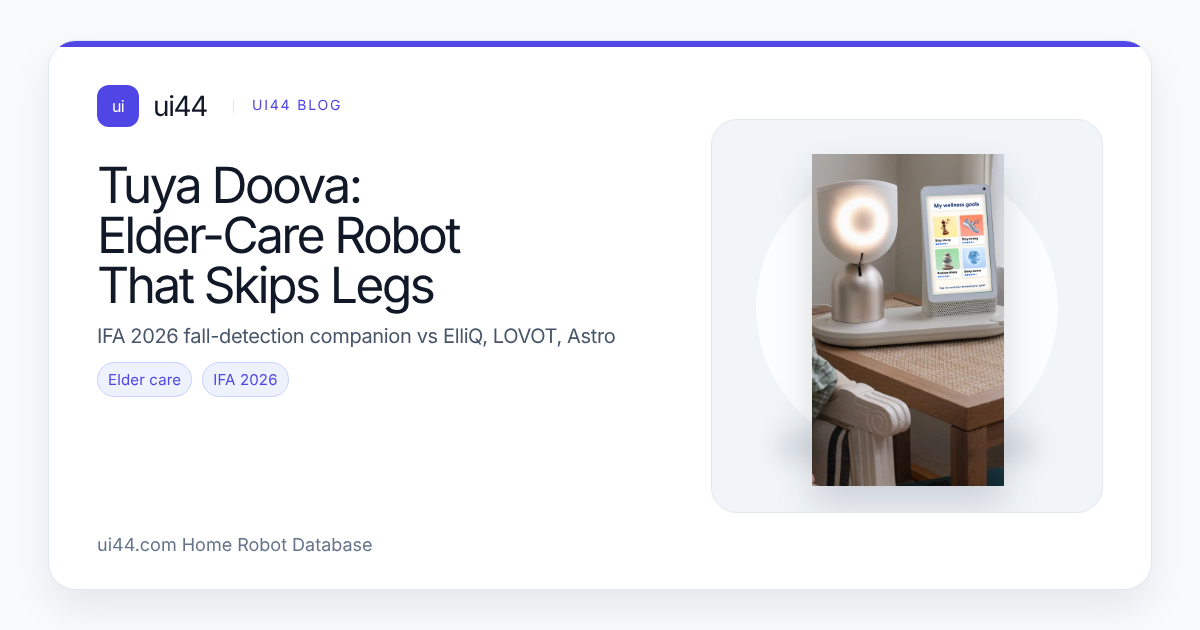
Tuya Doova: Elder-Care Robot That Skips Legs Entirely
While humanoid robot makers race to put legs on everything, Chinese IoT giant Tuya Smart went the opposite direction at IFA Berlin 2026: Doova, an elder-care companion robot that deliberately skips legs entirely. Wheeled, fall-detection-first, and powered by a multimodal LLM, Doova is a bet that the most urgent home robot problem isn't walking — it's aging in place safely.

UBTech U1 Preorder Reality Check for Homes
UBTECH's UWORLD U1 is exactly the kind of home-robot announcement that needs a reality check. It is not another desktop companion, robot vacuum, or research kit with a vague consumer story. It is a full-size bionic humanoid companion line that UBTECH says is designed for mass production, with public preorders, published launch prices, and first-batch delivery targets.

Unitree IPO Boom to Bust: What It Means If You Want a G1
Unitree went public on Shanghai's STAR Market on August 19, 2026, and what happened next belongs in a finance textbook. Shares spiked as much as 629% intraday on debut (Forbes), with Fortune reporting a ~460% surge — pushing the Chinese humanoid maker's valuation toward the $50–66B range. Then gravity arrived: within days, Reuters reported a roughly 45% slump from the debut peak, and The Robot Report later put the drawdown at 53%, wiping tens of billions in paper value and sparking open bubble fears.
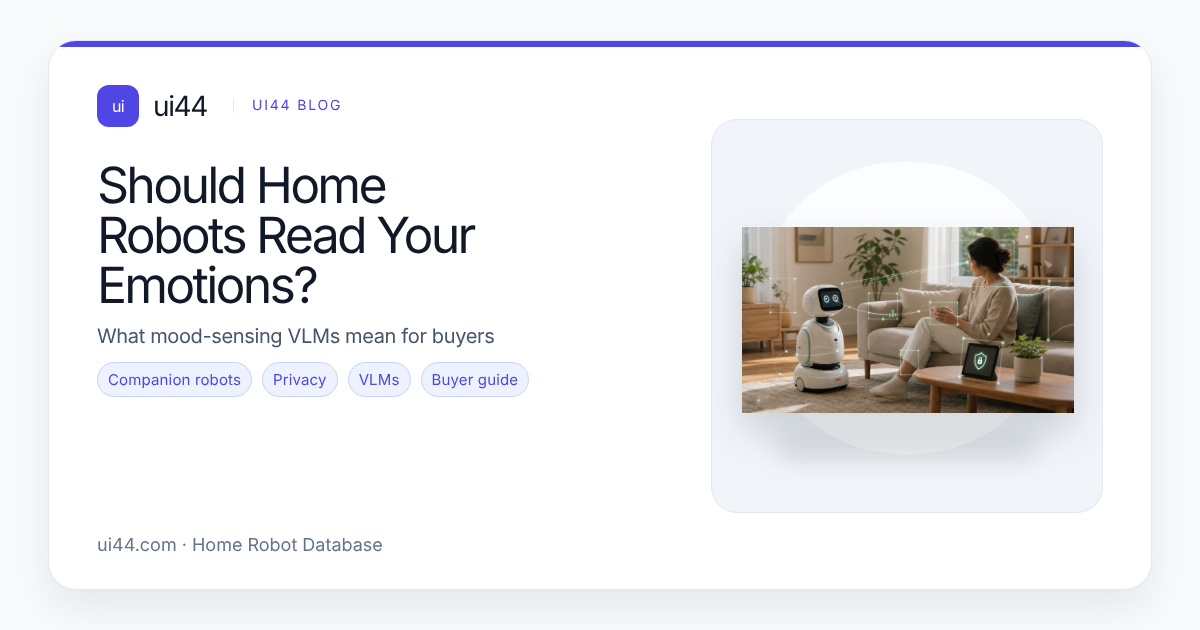
Should Home Robots Read Your Emotions?
A home robot that can notice frustration sounds useful. If it hands you the wrong object, interrupts a video call, or scares a pet, a better response than a flat "sorry" would be welcome. The catch is that "reading emotions" is not the same as understanding what a person feels.

Korea's Physical AI Push and Home Humanoids
South Korea's newest humanoid push is easy to misread as another government technology slogan. It is more useful to read it as a map of what still has to exist before humanoid robots become dependable household products.
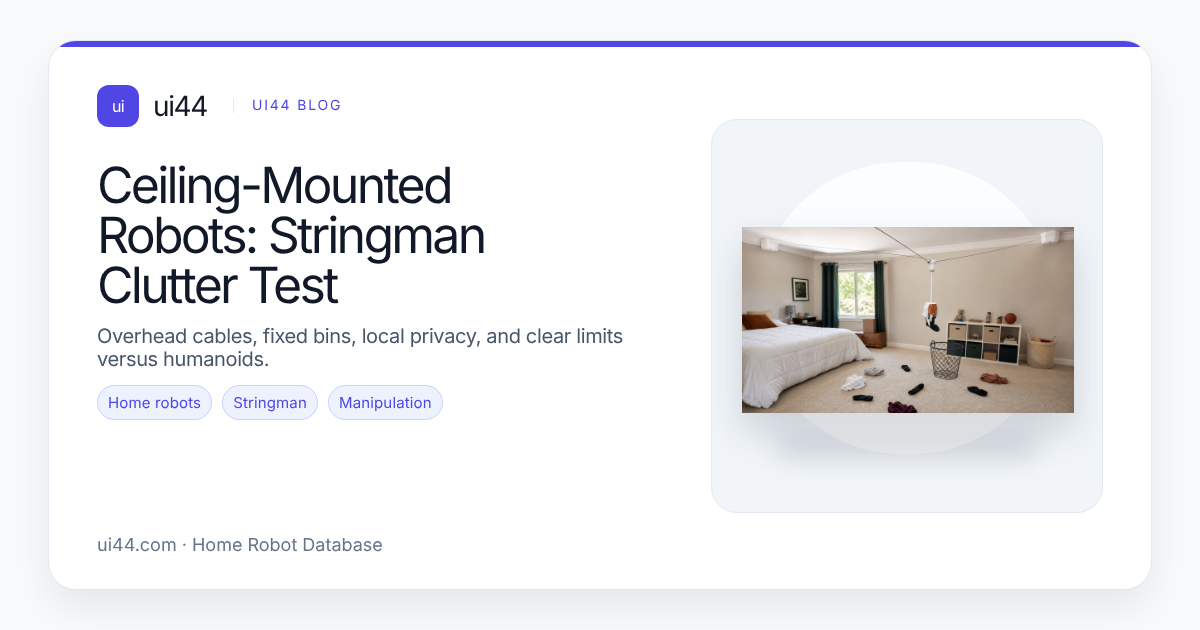
Ceiling-Mounted Robots: Stringman Clutter Test
The home robot market keeps circling the same promise: someday a mobile humanoid will walk through a messy room, recognize every sock, toy, shirt, and cable, then put each item where it belongs. Stringman asks a more awkward but useful question: what if the first robot that actually reduces floor clutter is not a walking robot at all?
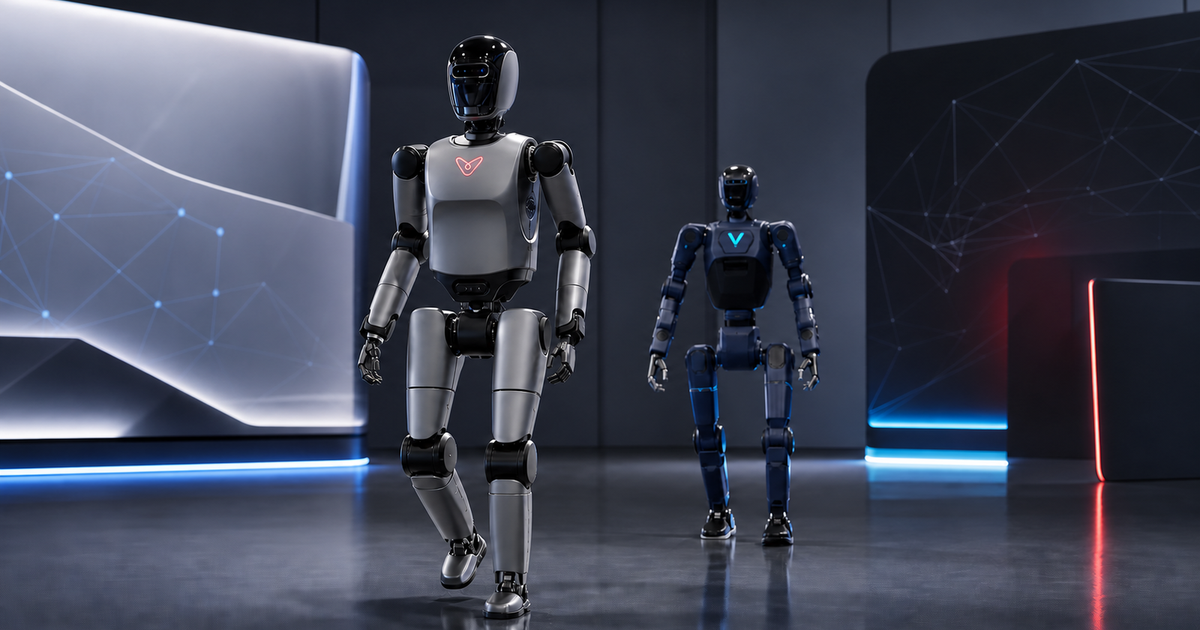
Vietnam's Humanoid Robot Push: Home-Robot Watchlist
Vietnam is not the first country most home-robot buyers think of when they hear "humanoid robot." The current shortlist usually starts with China, the United States, Japan, and South Korea. But Vingroup's recent humanoid push is worth watching because it is not a single lab demo. It is a cluster of companies, public event appearances, factory-adjacent use cases, and deployment infrastructure arriving at roughly the same time.

Honor and JD.com Test a Home Robot Sales Channel
Honor's robot story is no longer just a stage demo. The more important signal is that Honor and JD.com have put retail, logistics, service, and robot pilots into the same strategic partnership.
More buyer guides and analysis
Boston Dynamics' Ghost Rabona / School of Football demo is easy to misread. A humanoid doing a crossed-leg football kick looks like entertainment firs…
The next privacy question in home robotics is not just "does it have a camera?" It is "where does the robot's understanding of my home live, who can o…
Galaxea R1 Pro is one of the more useful reality checks in home robotics because it looks like the future and documents the present. The robot has dua…
The most important home robot demo is not the one where a humanoid folds a shirt perfectly. It is the one where the robot drops the shirt, notices the…
Used companion robots are becoming a real buyer category. That is a bigger deal than it sounds. A robot vacuum can be judged by suction, battery healt…
The first hard problem with a home humanoid robot is not whether it can fold laundry. It is where the robot goes when the demo is over.
NEURA Robotics has a rare home-robotics signal: serious capital, a broad robot lineup, and products that are at least priced close enough for buyers t…
The next useful home robot may not learn its hardest lessons in a living room. It may learn them in a campus, hospital, business park, or public distr…
WIRobotics' WIM Premium looks small at first glance: an app subscription for owners of the company's WIM S wearable walking-assist robot in Korea. But…
Eye-controlled home robots sound like a future feature: look at an object, blink, and the robot helps. The more useful version is less cinematic and m…
MechatroMate Q, also called Q-chan, is not another stationary smart speaker with a face. Living Robot describes it as a moving "physical AI" family ro…
Booster K1 is one of the clearest signals that small humanoid robots are moving from research-lab procurement into hobbyist, classroom, and serious ma…
China's 2026 real-scene humanoid program has already been covered as a policy story. The more useful buyer question is narrower: what kind of evidence…
Hotels may be the closest commercial test lab the home robot industry has.
China's latest humanoid robot policy is easy to misread if you only look for a consumer launch date. The exact buyer-relevant phrase is "China humanoi…
Mirokaï has crossed an important line: Enchanted Tools is no longer presenting the French social humanoid as only a prototype, research platform, or p…
Navel Robotics is one of the more useful social-robot signals to watch because it is not selling a vague "AI friend" story from a demo booth. The Muni…
Alibaba's Qwen-Robot Suite is easy to overread. It is not a new home humanoid, not a robot you can preorder, and not proof that a general-purpose hous…
Spiritify Joy is one of the more interesting companion-robot launches because it is not trying to be a general home helper. It is a tabletop AI carebo…
Weave Robotics has moved from a stationary laundry-folding robot to something much more ambitious: Isaac 1, a mobile home robot now open for preorder.…
Most home humanoid pitches start with the same promise: one day, an autonomous robot will fold laundry, make meals, tidy rooms, and help older adults…
Home robots are starting to promise the hard part: touching the world. Not just mapping rooms, avoiding chair legs, or speaking through an app, but re…
A home humanoid does not only need to know where the sofa is. It needs to know where its elbow will be in half a second, whether its knee is about to…
HONOR's Robot Phone is becoming more interesting, but not for the simple reason most camera headlines imply.
Humanoid robot fights are fun to watch because they compress the whole robot story into one noisy scene: a body that looks human, a cheering crowd, a…
NVIDIA's new Halos for Robotics announcement is easy to misread as another compute story. It is not. The interesting part is not simply that a humanoi…
Stanford's SOAR project is a useful reality check for the next wave of assistive home robots. SOAR, short for Stanford Older Adult Robotics, frames ro…
Bear Robotics buying Kinisi Robotics is easy to read as another humanoid headline: service-robot company adds a humanoid startup, shows KR1 at Automat…
China's elder-care robot push is not one product category. It is a stack of very different jobs: reminder calls, vital-sign checks, meal delivery, reh…
Faraday Future's FX Navi is not the usual home robot pitch. It is not promising to fold laundry, empty the dishwasher, or become a perfect mobile butl…
Genesis AI's Eno is interesting because it refuses the default humanoid script. It has a wheeled base, an adjustable tower-like body, proprietary dext…
The impressive stair demo is becoming a rite of passage for legged and humanoid robots. A robot steps up, balances, turns, and makes the clip look rou…
Genesis AI's Eno is not being positioned as a normal home robot yet. Genesis says targeted customer deployments are planned by the end of 2026, starti…
Europe's new toy-safety regime is going to make a boring-sounding object much more important: the digital product passport. For ordinary toys, that ma…
OpenAI robotics is back in the home-robot conversation, but the useful question is not whether a "ChatGPT robot" will suddenly appear in a living room…
WHILL's latest autonomous mobility news is easy to file under airport accessibility, but it is also one of the better reality checks for home assistiv…
When humanoid robots walk onto a runway, the easy reaction is to laugh at the costume. A shirt on a robot can look like theater before it looks like e…
The dream version of a home humanoid is easy to describe: show the robot a chore once or twice, give it a plain-language instruction, and watch it add…
NVIDIA's Isaac GR00T reference humanoid is exactly the kind of announcement that can make home-robot buyers either excited or confused. It combines a…
Nvidia's June 2026 Korea robotics moment matters less as a stock-market story and more as a test of whether "physical AI" can move from slide decks in…
Pudu Robotics is no longer talking about its robots as separate machines with separate software stories. Its newer announcements describe PuduFM 1.0 a…
Most home robot demos still hide the hardest part: the moment when one physical action turns into another. Picking up a cup is not a smooth blob of mo…
Foxconn and Nvidia are a better signal for home robot buyers than another humanoid stage demo.
The next home humanoid sales pitch will not just be "it has an AI model." It will be "it has a brain for movement."
The important question in the Bot Company Airbnb lawsuit is not whether one startup had a messy short-term rental stay. It is whether a company that s…
Home humanoid reliability is not proven because a robot can fold one shirt in a launch video. It is proven when the manufacturer can explain how many…
The INFFNI Rover X1 is one of the more interesting robot dog preorders because it does not sound like a lab-only quadruped pretending to be a househol…
The robot-tax debate used to sound like a thought experiment: if machines do human work, should the tax system treat some of that output like labor in…
UBTECH's Uworld launch is one of the clearest signs yet that a major humanoid maker wants to move from factories and demos toward ordinary buyers. The…
ALTER-EGO is not a consumer robot. That is the important starting point. It is a research and clinical platform from the Istituto Italiano di Tecnolog…
Beni is not the home robot that folds laundry, unloads a dishwasher, or carries groceries upstairs. That matters, because judging every new robot by t…
Enactic's Ena is not being pitched as a toy, a demo torso, or a robot vacuum with a friendlier face. The Japanese startup describes Ena as a humanoid…
Familiar Machines & Magic is making a specific bet about the next home robot: the useful robot is not only the one that vacuums, carries a tray, or an…
Humanoid robot demos are getting better at looking natural. A robot picks up a box, walks through a doorway, folds a shirt, or hands over a drink. The…
Robot training data is becoming one of the most important hidden costs in home robotics. A humanoid can look polished in a launch video, and a mobile…
Updated October 11, 2026: Added Sharp’s service-plan and mobile-service limitations, and clarified the historical anniversary and app-migration dates.…
Crowdfunded home robots sit in an awkward middle ground. They are marketed like consumer products, funded like startups, and delivered like complex ha…
Hugging Face's LeRobot Humanoid is not a home robot you can buy, unbox, and ask to fold laundry. That is the first thing to get clear. It is an open,…
LimX Luna is the kind of humanoid that looks closer to a product than a lab rig. It is full size, fabric wrapped, built for interaction, and presented…
The next wave of robot-chef demos will make cooking look like a software problem. Ask for dinner, watch a robot arm move, and let the AI figure out th…
LLM robot brains are already showing up in demos as the part that talks, interprets instructions, and turns messy human requests into plans. That is u…
YOR is one of the more interesting home-robot signals of 2026 because it does not start with the humanoid assumption. Instead of asking whether a low-…
Robot arms are moving from lab demos into the messy category that matters for buyers: products, developer kits, and early home-adjacent platforms. The…
Wandercraft Eve is not a robot vacuum, not a social companion, and not a general-purpose humanoid that tidies a kitchen. It is more interesting than t…
GigaAI's SeeLight S1, listed in the ui44 database as Shiguang S1, is one of the more interesting household humanoid claims of 2026 because it is tied…
Updated October 11, 2026: This May 31 article now includes Astribot's September 29 US announcement. The China launch price and later US offer are sepa…
Robot companies love to show a humanoid picking up a cup, folding a shirt, or moving a plastic bin. Those clips are useful, but they can also hide the…
Figure's Catalyst Brands deal is more important than another humanoid demo, but less conclusive than a home robot launch. That distinction matters. Th…
Google DeepMind's Gemini Robotics page now reads less like a lab demo and more like an ecosystem map. The named partners and trusted testers include A…
Google's new Street View grounding for Project Genie is easy to overread. It is not a shortcut from public maps to a robot that can fold laundry. It i…
LG CLOiD is the rare home-robot demo that is interesting for the right reason: it is not just a humanoid shape looking impressive on stage. LG is tryi…
A humanoid robot app store is no longer just a metaphor. Unitree's UniStore now lists downloadable actions for the G1 Edu family, including dances, ma…
The next confusing phase of home robots will not be whether a humanoid can walk. It will be whether the name on the chest actually tells you who built…
Figure's living-room tidy video is already a useful robotics benchmark. We have covered that broader benchmark separately in why tidying a living room…
SmolVLA matters because the robot brain race cannot only be a contest of who has the largest private model, the biggest data center, and the most expe…
A robot that can pick up an object is not automatically a robot that can hand it to you safely.
South Korea's newest humanoid push is easy to misread as another national race to put a walking robot in your living room. The more useful reading is…
Mirokaï is one of the more interesting social humanoids because it does not ask buyers to believe a private-home chore robot has already arrived. Ench…
Samsung's most interesting humanoid bet may not look like the humanoid most people picture.
Seven-Eleven Japan's planned Astra humanoid is interesting for a reason that is easy to miss. The headline is not simply "a robot may work in a conven…
MATRIX-3 is interesting because it does not frame home robotics as a bigger chatbot on legs. Matrix Robotics is pitching a humanoid with 3D woven biom…
MolmoAct 2 is one of the more useful robot-AI releases to watch if you care about home robots, because it is not just another chatbot layer. Ai2 descr…
Faraday Future is not the first name most home-robot buyers would put next to humanoids and robot dogs. That is what makes its robotics push worth che…
Gatsby is not selling a home robot. It is selling a clean apartment.
Humanoid's Bosch partnership is not a home-robot launch. That is exactly why it matters.
A humanoid robot's most important spec is often hidden in plain sight. The headline may be price, height, walking speed, or an impressive video, but t…
The most useful home robot may not look like a person. Kachaka is a smart furniture robot from Japan that does one narrow thing: it docks with shelves…
Cinnamon Mini is not the kind of humanoid robot announcement that should be judged by the usual "can it do my laundry?" standard. Donut Robotics descr…
A home robot that can help someone eat sounds like a simple promise: pick up a bite, bring it to the person, repeat. In practice, feeding is one of th…
NAO7 is interesting because it is not a random humanoid render chasing the home-robot boom. It is the proposed next generation of NAO6, one of the few…
WIRobotics' ALLEX is not the usual humanoid launch story. The interesting part is not that another company has shown a white humanoid torso with dexte…
You probably should not try to roll a humanoid robot through airport security and hope for the best. The short answer is simple: tiny companion robots…
Papergames is not selling a home robot yet. That matters. The interesting part is the direction of travel: a major game company built around emotional…
Home humanoids are starting to sound like self-driving cars did a decade ago: powerful demos, ambitious timelines, and one uncomfortable question unde…
A home robot demo is not a promise. A humanoid can fold one shirt on stage, a companion robot can answer one charming question, and a mobile base can…
Realbotix is one of the strangest price signals in home robotics right now. A buyer can spend $20,000 on a robotic AI bust, $95,000 on an upper-body m…
An anti-tangle robot vacuum sounds simple until long hair and pet hair expose a weakness that spec sheets often hide. A robot can advertise 30,000 Pa…
Most "best robot vacuum for seniors" advice starts in the wrong place. It asks which model is powerful, cheap, or popular. For an older adult living a…
Romi Lacatan is easy to dismiss as another cute tabletop companion robot. That would miss the useful part. The interesting question is not whether Rom…
Dyson's Spot+Scrub Ai is the robot vacuum Dyson needed after the 360 Vis Nav: it finally vacuums and mops, empties itself, washes the roller, uses LiD…
Fourier GR-3 is one of the more interesting humanoid announcements because it tries to move the category away from the usual factory-worker pitch. Fou…
The hard part of home robotics is not walking across a room. It is touching the world without making a mess. A robot that looks impressive while wavin…
A useful home robot should eventually answer a very ordinary question: "Where are my keys?" Not just by searching your calendar, checking a Tile tag,…
A safe home robot is not just a robot that avoids walls. It is a robot that knows what to do when a person reaches into the same drawer, a child runs…
The humanoid robot market is full of demos. The useful question for buyers is narrower: which humanoid robots are already doing paid work for real cus…
Dexterous robot hands are starting to look less like rare lab equipment and more like a real hardware supply chain. That matters for home humanoids be…
Robot vacuum privacy is not about choosing the model with the weakest app. The most private robot vacuum is the one whose camera, map, voice, and clea…
Rotaku Domo is interesting because it lands in the awkward middle of the 2026 humanoid market. It is much more robot than a desktop toy, much cheaper…
The next home-robot question is not just “does it understand me?” It is “what is it allowed to do after it understands me?”
China is testing a simple idea that could matter far beyond China: give each humanoid robot a durable digital identity, then attach its service histor…
The next serious home robot claim will probably not be “our robot watched more YouTube.” It will be “our robot learned from people doing chores from t…
The next hard problem in home robots may not be building one smarter robot. It may be making five different robots from five different brands cooperat…
HONOR's humanoid robot story is more interesting than a single viral race clip. The smartphone company now has an official global page for HONOR Robot…
The most important question in humanoid robotics is no longer "can a prototype walk across a stage?" It is whether a company can build, repair, update…
iRobot did not disappear after Chapter 11. That matters. The company that made Roomba a household word is now private, owned by Picea, and still shipp…
Loona DeskMate is interesting because it is not trying to vacuum a floor, mow a lawn, or carry laundry. KEYi is pitching it as a screen-aware AI co-wo…
Low-profile robot vacuums used to be the boring end of the category: shorter bodies, weaker navigation, fewer premium features. In 2026, that tradeoff…
A premium robot vacuum is no longer a fixed appliance. It is a moving software platform with motors, sensors, maps, cloud services, local voice comman…
The most believable future home-robot demo will not be a polished voice command like “clean the kitchen.” It will be messier and more human: “pick up…
AGIBOT's new Hong Kong plan is a useful signal for anyone waiting for Chinese humanoid robots to become available outside mainland China. It is not a…
EngineAI T800 is interesting because it does something most humanoid robot launches still avoid: it puts real edition prices on official pages. The ca…
The EU AI Act delay sounds like good news for robot makers. It gives companies more time before the toughest high-risk AI obligations bite, especially…
Updated October 11, 2026: Added Samsung’s primary exhibition evidence and shared-household evaluation questions. Ballie remains unreleased; its consum…
A 24-hour humanoid robot livestream is not the same thing as a home robot being ready. It is still a useful kind of evidence.
A houseplant is a surprisingly good home-robot test. It looks simple: check the soil, water the pot, remove dead leaves, maybe rotate it toward the li…
Communication robots are easy to dismiss as cute classroom props until a child uses one as a low-pressure first step into conversation. That is the in…
Hello Robot Stretch 4 is easy to underestimate because it does not look like the robot future people keep sharing online. It is not a biped. It does n…
Home robot noise is about to become a buying spec. Not because most robots are loud enough to damage hearing, but because a robot that shares your kit…
Humanoid robot battery swapping sounds like a factory feature, not a home robot feature. That is exactly why it matters.
The most important number in a companion robot purchase is often not the number on the product page. It is the number you keep paying after the robot…
Updated October 11, 2026: Added Nanoleaf’s May follow-up statements and practical integration questions. The original publication date is May 15. Ball…
Unitree G1 looks like the rare humanoid robot that an individual buyer can actually price out. The public shop listing says $13,500 before tax, shippi…
AGIBOT A3 is one of the clearer examples of where humanoid robots are becoming useful before they become household appliances. It is a full-size human…
Home robot memory sounds like a software detail until you picture the chore. A useful robot has to remember where the mug was before someone moved a t…
A home robot scam prevention feature sounds useful the moment you hear it. Older adults are targeted by fake bank calls, government impersonators, rom…
A home robot that can fold one towel on a clean lab bench is not automatically a home robot that can open a sticky kitchen drawer, avoid a dog bowl, p…
A home humanoid robot is not finished when the preorder opens. It is finished when someone can fix it after a fall, diagnose a battery fault, replace…
AI coding agents are starting to matter for home robots, but not in the way most buyers imagine. The near-term question is not whether an agent can te…
Neuralink's CONVOY study makes the phrase "mind-controlled robot" sound suddenly close to home. The official clinical-trial record describes an early…
China's AI robot strategy is not a simple promise that humanoids will suddenly move into apartments. It is a much more important signal: Beijing is te…
A home humanoid data policy should be as easy to compare as height, payload, or battery life. If a robot will roll or walk through private rooms, list…
Updated October 11, 2026: clarified the current U.S. price display and the cloud-feature boundary, and difference between lifetime software access and…
Voice-controlled robot arms sound like the most natural version of a home robot: "pick up the cup," "open the drawer," "tap that button," "bring me my…
Addverb ELIXIS-W is not the humanoid robot most people imagine when they picture a future home helper. It has a wheeled base, an industrial rollout pl…
Home robot cybersecurity used to sound like a smart-home footnote. Change a password, keep the app updated, move on. That is no longer enough when the…
A robot mower cloud outage is not just an app annoyance. It can decide whether a $800 to $5,000 yard robot starts on schedule, reports its location, a…
Robot pets are easy to dismiss as expensive toys until you look at where they are actually being tested: dementia day programs, senior-living communit…
Two humanoid robots cleaning the same bedroom sounds like a near-future home robot fantasy: opening doors, moving clothes, handling headphones and tra…
Donut Robotics' Cinnamon 1 is interesting for a reason most humanoid robot demos are not: the headline feature is not a backflip, a dance, or a vague…
Dreame NEXT 2026 was easy to remember and hard to categorize. Dreame showed a future where robotic arms appear on vacuums, laundry machines, lawn robo…
Home robot conversation is becoming a product claim again. Not just "ask the vacuum to clean the kitchen," but actual back-and-forth interaction: a ro…
AI robot toys are no longer just plush animals with canned voice lines. The new category blends microphones, cameras, cloud accounts, large language m…
Care robots are easiest to overestimate when they appear in a home demo. A robot that reminds someone to take medicine, carries a tray across a staged…
The home-humanoid preorder market has entered its small-deposit phase. A buyer can now put down money for 1X NEO, NEURA's MiPA Home, the NEURA 4NE-1 M…
A humanoid robot launch usually gets judged by the machine: height, speed, payload, dexterous hands, and whether the demo looked staged. The more usef…
Kinetix AI KAI is exactly the kind of humanoid robot that can make a home-robot buyer lean forward: 115 degrees of freedom, 72 degrees of freedom acro…
Self-driving car AI is starting to sound like the next home robot brain. The pitch is tempting: if a model can understand roads, pedestrians, traffic…
The first useful home robot may not be the humanoid that figures out your house from scratch. It may be the robot that walks into a home where the was…
A home robot can understand your command and still move like it is thinking in hiccups. The pause before a hand closes, the little shake at the wrist,…
A companion robot is not just hardware once people start naming it, dressing it, and treating its reactions as part of family life. That is why compan…
The next useful home robot may not be decided by legs, face design, or chatbot personality. It may be decided by the last 10 centimeters of hardware:…
A home robot that can learn chores from YouTube sounds like the cleanest possible answer to the home-robot problem. Instead of hiring teleoperators, b…
A robot data factory sounds like investor jargon until you translate it into something a buyer can use. It means a company is not just filming one imp…
RobotEra STAR1 sits in the awkward middle of the 2026 home-robot market. On paper, it has the ingredients buyers want to see in a serious humanoid: fu…
If you want the factory tour, start with our earlier breakdown of 1X's NEO Factory in Hayward. If you want the broad product verdict, read our 1X NEO…
Updated October 11, 2026: Expanded the evaluation guidance and checked the linked Google DeepMind and Boston Dynamics announcements. Ballie remains un…
The phrase robot self-improvement sounds like marketing until you make it boringly specific. A home robot will not wake up one morning and discover ho…
“Level 3” sounds reassuring. In cars, autonomy levels have trained buyers to think in a ladder: driver assistance, conditional autonomy, full autonomy…
The Unitree H2 vs G1 vs R1 question looks simple: spend $4,900, $13,500, or $29,900 and pick the humanoid that fits your budget. For home-robot buyers…
Unitree's new R1-A5/R1-A7 dual-arm robot line is easy to miss if you only watch humanoid videos for flips, kicks, and fast walking. It is not the most…
MagicLab's new MagicBot X1 is exactly the kind of humanoid announcement that is easy to over-read. It has the right buzzwords: flagship humanoid, worl…
Silent companion robots are a real design bet, not a missing feature. On May 4, 2026, Colin Angle — the co-founder whose team scaled iRobot to more th…
When the world's largest appliance maker builds a humanoid robot for your home, it's worth paying attention. When that robot has no confirmed price, n…
Figure AI CEO Brett Adcock recently revealed something no major humanoid maker had said out loud before: the company is targeting a car-like lease mod…
Colin Angle helped define the first mainstream home robot with Roomba. His next bet is almost the opposite of a vacuum: Familiar, a small companion qu…
NEURA Robotics has opened reservations for the 4NE-1 Mini, a compact humanoid that makes one of Europe’s most ambitious robot programs look suddenly m…
On April 30, 2026, something quietly unprecedented happened in a warehouse district in Hayward, California. A factory started producing humanoid robot…
You know Midea for air conditioners, Haier for refrigerators, and Hisense for TVs. What you may not know is that all three are now building humanoid r…
When you buy a home robot, you probably think about the hardware — how tall it is, how much it can carry, how long the battery lasts. But in 2026, a q…
A home robot does not need every AI model to run inside the robot. It probably should not. Cloud models can answer harder questions, learn from fleets…
"Self-aware robots" sounds like a science-fiction headline. For home-robot buyers, it is better to translate the phrase into something more concrete:…
Xiaomi doesn't just make phones. The company behind over 150 million smartphones a year, a fast-growing EV brand, and a sprawling smart-home ecosystem…
On April 29, 2026, something happened that would have sounded like science fiction two years ago: a humanoid robot company opened a direct-to-consumer…
ElliQ 3 is one of the few companion robots that is actually aimed at older adults living at home, not kids, hobbyists, or robotics labs. That makes it…
Humanoid robots are moving from investor decks into preorder pages, research labs, and early pilot deployments. That changes the buyer question. It is…
If you live in a multi-level home, one of the most practical humanoid robot questions is also one of the easiest to oversimplify: can it climb the sta…
The first useful home humanoid may not start in the living room. It may start in the garage, on the porch, beside a trash bin, or in the wet utility s…
The first useful home humanoid robot may not arrive as one neat, vertically integrated product from a single famous brand. A more likely path is messi…
The most important home humanoid company may not look like a home-robot company yet.
A robot app store sounds obvious until you ask what the app is allowed to move. Downloading a new calendar widget is one thing. Downloading a "clear t…
The first humanoid robot you actually use at home may not belong to you. It may belong to your apartment building.
Japan never stopped being a robotics country. It just stopped looking like the center of the home-humanoid race for a while.
NEURA's MiPA Home is interesting because it does not try to win the humanoid beauty contest. The official reservation page puts MiPA at €9,999 for pri…
Pepper+ is the most interesting kind of robot announcement: not because it makes an old humanoid suddenly home-ready, but because it admits what the o…
The companies most likely to make useful home robots may not be the ones with the best humanoid demo video. They may be the companies that already kno…
A robot that picks up cups, resets chairs, wipes tables, and calls for help when it gets stuck sounds like a home robot. The first serious buyers, how…
The robot chef is one of the oldest home-robot promises: press a button, walk away, and return to dinner. The useful version is finally getting closer…
The first useful home robots may not walk through our existing homes like small people. They may arrive with the house.
Vision-force-action is a new phrase for an old robotics problem: cameras can see the mug, language can understand "pick up the mug," but the robot han…
The hardest home-robot question may not be whether the robot can walk, talk, or pick up a cup. It may be whether people actually want a moving machine…
Companion robots are starting to cross an important line: they are no longer just cute devices that react when someone talks to them. The best ones ar…
If you want one practical test for whether a home robot is close to useful, do not start with dancing, running, or chatting. Ask whether it can open a…
Yes, a humanoid robot can load a dishwasher in a lab demo. The harder question is whether that demo says anything useful about the robot you could buy…
The most useful autonomy lesson for home robots may come from a robot that does not live in the home at all.
A home robot with a chatbot inside is not automatically a useful home robot. It may answer questions beautifully and still fail at the thing that matt…
Most home-robot hype still assumes the winning product will look like a small person: two legs, two arms, and enough dexterity to fold laundry. That m…
The most useful home robot may not arrive as a silent servant that does every chore end to end. It may arrive as a teammate: a machine that can plan p…
A face can make a home robot easier to talk to. It can also make the robot feel worse.
HONOR Robot Phone is one of those products that makes the home-robot category feel blurrier overnight. HONOR describes it as a new kind of smartphone…
The important question about humanoid robots is changing. For years, the market asked whether these machines could walk, wave, dance, or survive a dem…
The next useful humanoid robot may not walk into a private kitchen first. It may clock in at an airport.
The next useful home robot may not be a pure humanoid at all. It may be a robot that changes shape: arms when it needs to manipulate, wheels when it n…
Robot guide dogs are no longer just a cute lab demo. In 2026, research groups are putting large language models, 3D mapping, route planning, and scene…
A VLA model is one of the most important new phrases in home robotics, because it sits exactly where the hard part begins. A camera can recognize a mu…
A wheeled robot dog sounds like a contradiction until you picture a real home. Most rooms are flat. Most of the annoying parts are not: thresholds, st…
The most useful home robot benchmark is not a backflip, a factory tote lift, or a perfect tabletop pick-and-place clip. It is a messy living room at 9…
Yes — AGIBOT is now meaningfully easier to buy in North America. RobotShop's April 2026 announcement says it has become AGIBOT's value-added distribut…
Assistive home robots are finally becoming more than a feel-good demo category. The useful models are not all humanoids, and most are not general-purp…
A useful home robot will not be perfectly autonomous on day one. That is the uncomfortable but practical truth behind home robot Expert Mode: when the…
Home robot gesture control sounds like a small interface detail until you imagine actually living with a robot. Do you want to say every instruction o…
Sony AI's Ace table-tennis robot is not a home robot. It is not coming to your kitchen, it is not a consumer product, and nobody should read a sports…
A useful home robot should not behave like a perfectly obedient appliance. If it has wheels, cameras, a gripper, or arms near people and pets, the saf…
Humanoid robot reliability is not mainly a chatbot problem. Better AI helps a robot choose a task, talk through a failure, and try a different grasp.…
Mirumi is almost the opposite of the home robot most people imagine. It does not vacuum, fold laundry, patrol the house, carry a tray, or promise to b…
A robot world model is one of those phrases that sounds like robotics lab jargon until you picture the home version. Before a robot grabs a glass, pul…
Tesla's latest Optimus update sounds huge: factory preparation in Fremont, a second-generation line planned for Texas, and Elon Musk telling investors…
The Bot Company home robot story is interesting precisely because there is not much product to judge yet. The official site says the San Francisco sta…
An Apple home robot is plausible. I would not base a purchase plan on a rumored Apple humanoid folding laundry soon. The serious question is not wheth…
A companion robot should not agree with everything you say.
Reachy Mini is a $299 open-source desk robot, which immediately raises the useful question: is it actually a home robot, or just another AI toy with m…
A home robot maid is no longer just a sci-fi phrase, but X Square Robot's new claim needs a careful translation. The company is not saying you can wal…
You can build your own humanoid robot in 2026, but the important word is build. This is not a flat-pack appliance that becomes a laundry-folding home…
China humanoid robot production is no longer just a demo-stage story. TrendForce expects China's humanoid robot output to grow up to 94% in 2026, with…
The Lume robot lamp is one of the more interesting home-robot ideas of 2026 because it does not start with a humanoid body, a rolling screen, or a vac…
A robot vacuum water hookup is one of the clearest signs that premium robot mops are turning from movable appliances into small home infrastructure. T…
A robot vacuum with arm is no longer a CES joke. The Roborock Saros Z70 is a real consumer product with a foldable five-axis OmniGrip arm, a current u…
ROBOTIS AI Sapiens K0 is one of the more credible open-source humanoid robot announcements of 2026, but not because it is ready to unload a dishwasher…
SwitchBot onero H1 is the kind of home robot announcement that sounds absurd until you remember who is making it. SwitchBot is not starting from zero.…
The social companion robot is the most emotionally appealing product in home robotics, and one of the hardest to keep alive. Jibo made people feel som…
The next useful tactile sensing home robot may not be the one that walks fastest. It may be the one that knows, in real time, whether a mug is slippin…
Amazon's back-to-back robotics acquisitions do not mean an Alexa humanoid is about to roll into your kitchen. They do mean Amazon is buying pieces of…
Compact humanoid robots are likely to enter homes first; full-size humanoid robots are more likely to do the chores people actually imagine later. Tha…
A home humanoid robot that works all day sounds simple: charge it overnight, let it handle chores, then plug it back in. The spec sheets tell a differ…
Robot success detection is the quiet difference between a home-robot demo and a machine you can trust. Most demos show the exciting part: a robot star…
Home robot sensors are becoming a buying question, not just an engineering detail. A camera can recognize a sock, a person, or a pet. It can also be c…
Humanoid robot payload specs look simple until you compare two robots side by side. One company says its robot can lift 154 lb. Another says its robot…
The next useful home robot probably will not win you over by lifting the heaviest box. It will win by bumping a chair leg without drama, handing over…
The Unitree R1 is the first humanoid that can make an early adopter pause and ask a very practical Unitree R1 AliExpress question: could I just buy on…
The proposed Chinese robot ban in Washington has an obvious headline: Chinese humanoids and robot dogs could face new federal-government restrictions.…
Can you teach a home robot new chores in 2026? That is the most tempting promise in home robotics: not that a robot can do one chore, but that you wil…
Home robot insurance is no longer a silly edge case. A robot vacuum with a small arm can move objects. A stationary laundry robot can work around fabr…
Noetix Bumi deserves a configuration check before a price comparison. Its current documentation describes several versions with different development…
Quadruped robots for home are finally useful in narrow roles, but they are not general household helpers. In 2026, the strongest robot-dog use cases a…
How hard is it to unbox a humanoid robot, charge it, and get value from the first task?
No, humanoid robot valuations do not cleanly match real 2026 shipment evidence.
The fastest humanoid at Beijing's 2026 half-marathon did something that sounds absurd until you look at the stopwatch: Honor's Lightning officially wo…
The honest answer is yes, sometimes, but not in the way robot marketing usually implies.
If you are shopping the current wave of home humanoids, the core humanoid robot regulation question is simple: what rules actually apply before a robo…
Are home humanoid robots really autonomous? In 2026, usually not in the fully independent way most buyers imagine.
If you are trying to figure out whether Sunday Memo is a real home robot or just another polished robotics trailer, the short answer is this: it looks…
In the Unitree vs AGIBOT comparison, TrendForce thinks Unitree and AGIBOT could capture nearly 80% of China's humanoid shipments in 2026. That makes t…
If you have been waiting for a home robot that does more than vacuum, Weave Robotics' Isaac 0 is one of the first products in 2026 that deserves real…
When people talk about car companies building humanoid robots, they usually mean Tesla. But if you're asking a buyer question instead of a hype questi…
If you live in a two-story home, you already know the most annoying limit of robot vacuums. They can map multiple floors, remember multiple floors, an…
If you care about what will actually work in a home first, wheels currently look like the more practical answer.
Most humanoid robots you hear about, from Tesla Optimus Gen 2 to Figure 03, 1X NEO, and Unitree G1, follow the same basic formula. Electric motors mov…
If you are searching for a real 1X NEO review before putting down a deposit, the short answer is simple: most people should wait.
Can a robot vacuum replace your regular vacuum? The honest answer is simple: on hard floors, mostly yes. In homes with carpets, stairs, or upholstery,…
Update, October 11, 2026: Ballie remains unreleased; its consumer launch was reportedly shelved. See the updated launch evidence.
Update, October 11, 2026: Ballie remains unreleased; its consumer launch was reportedly shelved. See the updated launch evidence.
If you are searching for the Zeroth M1 robot, the big story is not just that it is small. It is that Zeroth is trying to bring a human-shaped home rob…
When Figure 03 showed up at the White House in late March, it did something bigger than win attention. It pushed humanoid robots into a political and…
This humanoid robot home survey is one of the clearest reality checks in consumer robotics right now. Buyers are not rejecting home robots outright, b…
On April 19, 2026, more than 300 humanoid robots will line up alongside human runners for a half-marathon in Beijing. Twenty-six robot brands. Over 10…
Your robot vacuum just stopped mid-run and is flashing an error code. Before you start shopping for a replacement, try this: according to field diagno…
Two years ago, renting a humanoid robot for your business cost $250,000 per year. Today, you can buy one outright for $13,500. That's a 95% price coll…
Every week, a new humanoid robot demo goes viral. A robot folds laundry. A robot pours coffee. A robot walks a dog. The comments are always the same:…
When you watch a sleek humanoid robot smoothly fold a shirt or load a dishwasher in a promo video, it looks like magic. Artificial intelligence has ar…
Here's the short version: if your home has hard floors — tile, hardwood, laminate, vinyl — a vacuum-mop combo is now genuinely worth it. If your home…
Many robot-vacuum listings summarize support with short labels like “30-day return” and “1-year warranty.”
“1-year warranty” sounds straightforward, but official warranty pages in 2026 often split coverage by product condition (new vs refurbished) and part…
Many wire-free mower pages now promise “centimeter-level accuracy.”
Cutting width is one of the first numbers people compare on robot-mower pages.
When buyers compare robot vacuums, they usually compare suction, dock features, and obstacle avoidance. But mapping features can also change your data…
When buyers check privacy terms before buying a robot vacuum, many stop at one policy link on the brand website.
If you buy a robot vacuum because it supports “no-go zones,” the feature only helps when setup behavior matches your home routine.
Buying a home robot is not only a suction-power or feature decision. It is also a network-compatibility decision.
If your robot vacuum avoids a dark rug, it may be responding as its safety system was designed to respond.
Docking-station placement is one of the easiest robot-vacuum details to underestimate.
A "1-year warranty" headline sounds simple. The fine print is not.
If you are shopping for a “home companion robot” in 2026, the biggest risk is buying based on demo videos instead of shipping reality.
Home-robot marketing can make very different availability states sound the same. “Launching,” “available this summer,” “request an invite,” and “pre-s…
families, and caregivers evaluating connected robots.
For several high-interest robots, the key question is not just “What does the robot cost?” but also:
Matter is now common in robot-vacuum marketing, but buyers still run into a gap between “supports Matter” and “supports the exact workflow I want in m…
If you compare robot mowers by a single “2-year” or “3-year” badge, you can still make a bad purchase.
If you stopped following robot vacuums for a year or two, the 2025–2026 cycle looks like a jump.
If you are shopping premium robot vacuums in 2026, you are not only buying a robot—you are buying a dock workflow.
If you are comparing robot vacuums in 2026, the biggest pricing differences are often justified by bold words: "100%", "0 entanglement", "up to", and…
If you have pets, the most expensive robot vacuum failure is usually not weak suction. It is a navigation mistake around cords, toys, or pet accidents…
If you are shopping robot vacuums in 2026, you are seeing stronger claims than ever: robotic arms, high threshold numbers, anti-tangle guarantees, and…
Wire-free mowing is now real, but it is not magic.
Latest robotics updates
Most recent update: September 15, 2026.
Agility Unveils Digit 5, First Cage-Free Humanoid for Work Beside People
Tau Robotics Cleans Real SF Homes at $30 an Hour — With a Human Driving
TrendForce Sees Companion Humanoid Market at $1.1B
MIT SceneSmith Generates Indoor Training Worlds for Robots
MIT CSAIL introduced SceneSmith, an agentic system that uses vision-language agents to generate simulation-ready 3D indoor scenes such as kitchens, bedrooms, restaurants, and hotels. The team says the generated scenes contain up to six times more items than prior methods, were preferred by users over 90% of the time…
RoboCup Holds First Full Humanoid 11-vs-11 Match
IEEE Spectrum's July 10 Video Friday led with RoboCup 2026's milestone in Incheon: for the first time, two full teams of humanoid robots played an 11-vs-11 soccer match on physical hardware. RoboCup's official announcement says B-Human defeated HTWK Robots 4-0, with both teams using Booster Robotics humanoids, and…
Mistral Releases Robostral Navigate for Single-Camera Robot Navigation
Mistral AI introduced Robostral Navigate, an 8B embodied-navigation model that uses a single RGB camera and plain-language instructions to guide robots through complex spaces. Mistral says the model reaches 76.6% success on the unseen R2R-CE benchmark, trains on roughly 400,000 simulated trajectories across 6,000…
1X Details 25-DoF Hands for NEO Home Robot
Its new NEO hands combine 25 degrees of freedom, tendon-driven actuation, force-transparent backdrivable joints, tactile and shear sensing, food-safe IP68 sealing, and up to 45 N of distal flexion force. WIRED reports that the hands are intended for NEO's $20,000 or $500-per-month home robot, while noting that Expert…
UC San Diego Tests Humanoid Robots in Surgery
The Robot Report covered a UC San Diego Nature study in which teleoperated humanoid robots completed two preclinical laparoscopic surgeries on large non-primate mammals, including a gallbladder removal by a human-robot team and another procedure by two robots working side by side. UC San Diego says the 5-foot…
UMA Shows Humanoid Robot With Real-Time Learning
Paris-based UMA unveiled the design of its first AI-powered humanoid robot at Machina Summit alongside a Real-Time Learning architecture for acquiring skills from human demonstrations instead of manual programming. UMA is aiming the human-scale platform first at factories, warehouses, and logistics centers in Europe…
China Daily Spotlights Home Robot Ethics Boundaries
Chinese industry experts and regulators are calling for clearer ethical boundaries around emotional-companionship humanoids after UBTECH's UWORLD U1 launch. The article says a China Humanoid Robotics Committee of 100 and China Machinery Industry Federation initiative urges 'technology for good' principles, while…
NVIDIA Adds GR00T 1.7 and Isaac Teleop to LeRobot
NVIDIA says Isaac GR00T 1.7 and Isaac Teleop are now available through Hugging Face's LeRobot framework for open robot learning and humanoid development. The update makes NVIDIA's latest open VLA model and teleoperation data-collection workflow usable inside LeRobot, with the company reporting stronger LIBERO…
Sonair Ships Certified 3D Safety Sensor for Robots
Sonair's ADAR One ultrasonic 3D sensor has received functional-safety certification and is now available for autonomous robots and machine-safety applications. The sensor is designed to provide 180-by-180-degree 3D awareness for people and obstacles at different heights, with SIL 2 and PL d ratings under IEC 61508 and…
iRobot Adds Five Roombas and Electro Plus Cleaner
It has launched Roomba Electro Plus, a user-operated 5-in-1 hard-floor cleaner, alongside five new Roomba robot models entering the North American market. The new robot lineup spans the Roomba Max 775, Max 715, Plus 575, Plus 515, and Plus 415, with ClearView LiDAR, PrecisionVision AI obstacle avoidance, auto-wash or…
Realbotix and Bloom Launch UK Elder-Care Robot Pilot
Realbotix says it has partnered with Bloom Procurement Services to pilot socially assistive humanoid robots in elderly care settings in Northeast England. The announced program will use the robots for companionship, cognitive stimulation, emotional support, and routine wellbeing check-ins while evaluating resident…
Simplexity Ships 100 i7 Pro Robots to Production Lines
Simplexity Robotics has delivered the first 100 units of its i7 Pro all-scenario robot to multiple real-world deployments, less than a year after the embodied-AI startup was founded. The reported deployments span robot component manufacturing, power-battery production lines, AI infrastructure manufacturing, research…
How the ui44 blog works
Use the blog for context, the news desk for speed, and the database for structured comparisons and specs.
Frequently Asked Questions
What kind of content does the ui44 blog publish?
The ui44 blog publishes two types of content: in-depth articles (321 currently) covering buyer guides, verification frameworks, and technology analysis, and industry news updates (328 currently) tracking product launches, company developments, and market shifts across the home robotics industry.
How are blog articles different from the robot database pages?
Database pages (robot profiles, manufacturer pages, category listings) present structured, factual data - specs, prices, and features. Blog articles go deeper: they analyze trends, compare approaches, verify marketing claims, and provide practical buying guidance. Think of the database as the reference library and the blog as the editorial layer that helps you interpret the data.
How often is new content published?
New articles and news updates are published regularly as the home robotics market evolves. Major product launches, significant firmware updates, and emerging technology trends all trigger new coverage. Check article dates in the cards above to see the publication cadence.
Can I use blog content for purchasing decisions?
Yes - many articles are specifically designed for buyers. Look for verification frameworks, reality checks, and buyer guides. These articles break down marketing claims, explain what specs actually mean in practice, and highlight the fine print that manufacturers sometimes downplay. Always cross-reference with the latest robot detail pages for current pricing and availability.
What does 'reality check' mean in the context of ui44 articles?
Reality check articles examine manufacturer claims and marketing language against verifiable evidence. They look at whether spec-sheet promises hold up in typical home conditions, whether warranty terms match marketing messaging, and whether feature descriptions align with actual product behavior. The goal is to help buyers distinguish genuine capabilities from aspirational marketing.
How can I find articles about a specific topic or robot type?
Use the category filter buttons in the news section to narrow by topic (Cleaning, Humanoid, Lawn & Garden, etc.). For articles, scan the cards - titles are descriptive and include the robot type or topic. You can also use the site search to find content across the entire database and blog.
Go from reading to comparing.
The blog gives context. The database lets you act on it, with structured specs, feature filters, and side-by-side comparisons across the market.