That distinction matters for home buyers. A robot that can play chess in a senior-care station is not the same thing as a robot that can safely lift a parent from a bathroom floor at 2 a.m. The useful question is not "will robots care for seniors?" It is "which care tasks are leaving the demo stage first, and which still need supervised pilots?"
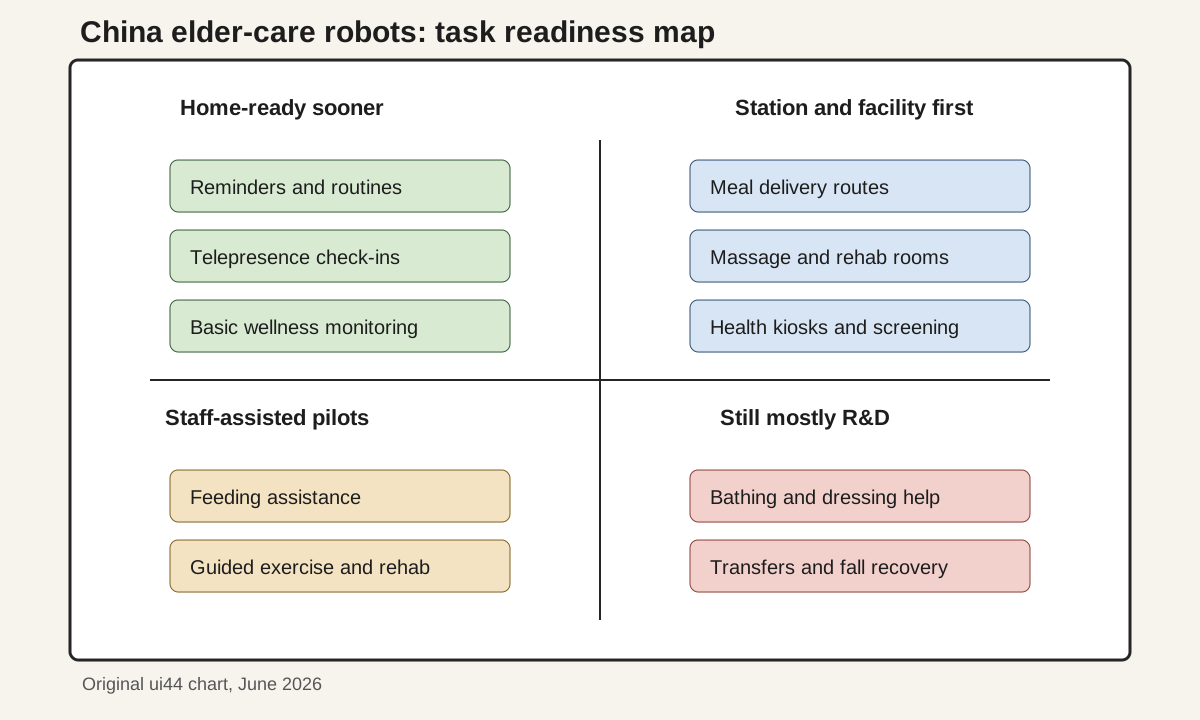
The policy signal is real. In June 2025, China's Ministry of Industry and Information Technology and Ministry of Civil Affairs launched a national pilot program for smart elderly-care robots, with trial tracks across home, community, and institutional settings. The program asks home elder-care robot projects to validate deployments in at least 200 households and deploy at least 200 robot sets; community or institutional projects must validate deployments in at least 20 communities or at least 20 elder-care institutions, with at least 20 deployed sets. It also asks pilot teams to develop standards and evaluation frameworks, according to South China Morning Post's summary of the notice.
The market signal is also clear. Chinese media and robotics trade coverage have pointed to a smart elder-care robot market that could pass 10 billion yuan, roughly $1.4 billion, in 2026, including coverage from iRobotNews. Treat that as a direction-of-travel number, not a buying guide: it blends care robots, service robots, monitoring devices, facility equipment, and early humanoid trials. For a household, the meaningful question is still task fit.
The First Scalable Layer: Monitoring, Reminders, and Companionship
The most mature elder-care robot tasks are not the most cinematic ones. They are the voice, screen, sensor, and routine-support tasks that reduce loneliness, surface risk, and help caregivers keep context without asking a humanoid to manipulate the physical world.
The clearest ui44 database comparison is ElliQ 3. It is not a Chinese humanoid, but it shows why socially assistive care robots are ahead of physical-assistance robots. ElliQ is designed for older adults, with proactive conversation, wellness programs, medication reminders, video calling, and generative AI features. It is available in the United States as a membership product, with ui44 tracking official membership pricing at a $249 lease initiation fee plus monthly subscription tiers.
PARO, the therapeutic seal robot from AIST, is another useful reference point. It does not cook, clean, or carry a person. Its value is narrower: calming interaction for dementia care and clinical or social-care settings where live animals are not practical. That narrowness is a strength. The risk surface is lower, the behavior is easier to validate, and the care outcome is easier to observe than with a general-purpose home humanoid.
China's near-term home pilots are likely to resemble this layer more than a full domestic worker. A device that prompts medication, checks in by voice, measures basic health signals, connects to family, and escalates anomalies can be useful before it ever opens a cabinet. Official China-facing coverage has already shown elderly-care robots that measure heart rate, blood pressure, and temperature without physical contact in short check-ins, such as the robot described by China's State Council Information Office.
Community Stations May Scale Before Private Apartments
Beijing's E-Town gives a practical clue about where deployment may happen first. In March 2026, Beijing's official English site reported that Ronghua Sub-district opened a smart senior-care service station with more than 40 robot types across roughly 1,100 square meters. The station included kitchen robots, meal-ordering and meal-delivery robots, chess-playing robots, tea-making robots, massage and moxibustion robots, health monitoring devices, and staff-supported home-service visits with portable equipment.
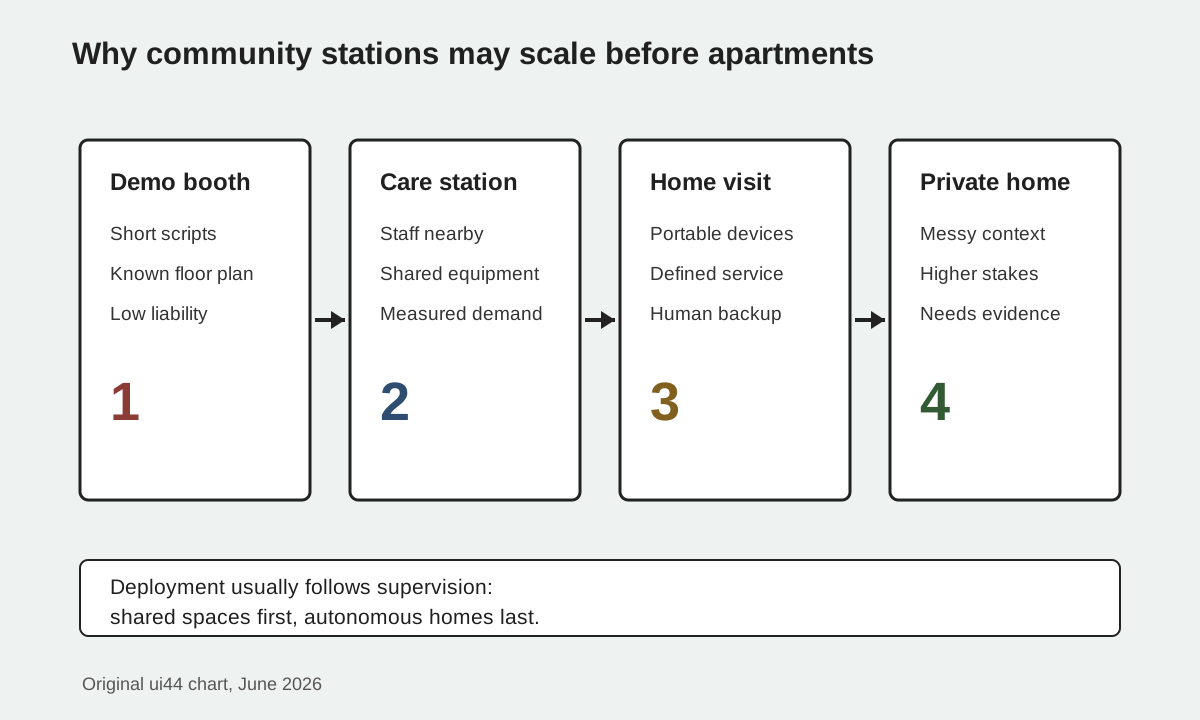
That model is less dramatic than "one humanoid per apartment," but it is more believable. A community station gives robots a designed environment, trained staff, insurance coverage, known service boundaries, and enough utilization to justify equipment that a single household might not buy. It also lets operators test which tasks seniors actually return for.
For buyers, this is the pattern to watch. Facility and community deployments often precede home deployment because they concentrate demand and supervision. Meal delivery, guided exercises, massage, health checks, and social activities are easier to operate in a station than in a cluttered private kitchen. If those services prove reliable, portable or home-visit versions can follow.
That does not make the home irrelevant. The national pilot explicitly includes home settings, and the most important long-term market is helping older adults remain independent. But early "home" success may look like a narrow service package: monitoring, reminders, telepresence, smart-home control, emergency detection, and a few safe physical routines.
Physical Care Tasks Split Into Three Risk Bands
The hardest mistake is treating all physical care as one bucket. Feeding, dressing, bathing, transfer support, mobility help, rehab, and fall recovery have very different consequences when something goes wrong.
Task
Reminders, check-ins, telepresence
- Near-term scale chance
- High
- Why
- Mostly software, voice, sensors, and escalation workflows.
Task
Vitals and wellness screening
- Near-term scale chance
- High
- Why
- Useful in stations and homes when validated against medical devices.
Task
Meal delivery inside facilities
- Near-term scale chance
- High
- Why
- Structured routes and staff supervision reduce risk.
Task
Rehab coaching and guided exercise
- Near-term scale chance
- Medium
- Why
- Valuable, but needs personalization and clinical guardrails.
Task
Feeding assistance
- Near-term scale chance
- Medium
- Why
- Repetitive but intimate; failure affects dignity and safety.
Task
Dressing and bathing help
- Near-term scale chance
- Low to medium
- Why
- Requires dexterity, force control, privacy, and edge-case handling.
Task
Transfers and fall recovery
- Near-term scale chance
- Low for homes
- Why
- High force, high liability, and unpredictable environments.
Task
General household chores
- Near-term scale chance
- Low for near-term elder care
- Why
- Homes are unstructured, and chores are not the same as care.
| Task | Near-term scale chance | Why |
|---|---|---|
| Reminders, check-ins, telepresence | High | Mostly software, voice, sensors, and escalation workflows. |
| Vitals and wellness screening | High | Useful in stations and homes when validated against medical devices. |
| Meal delivery inside facilities | High | Structured routes and staff supervision reduce risk. |
| Rehab coaching and guided exercise | Medium | Valuable, but needs personalization and clinical guardrails. |
| Feeding assistance | Medium | Repetitive but intimate; failure affects dignity and safety. |
| Dressing and bathing help | Low to medium | Requires dexterity, force control, privacy, and edge-case handling. |
| Transfers and fall recovery | Low for homes | High force, high liability, and unpredictable environments. |
| General household chores | Low for near-term elder care | Homes are unstructured, and chores are not the same as care. |
This is where humanoids enter the story, but not as instant substitutes for caregivers. Fourier GR-1 is relevant because Fourier began in medical and rehabilitation robotics before building a general-purpose humanoid. ui44 tracks GR-1 as a 1.65-meter, 55 kg humanoid with up to 44 degrees of freedom, a stated 5 km/h walking speed, and service and rehabilitation ambitions. That background makes it more credible in care contexts than a pure entertainment humanoid, but it still needs task-specific validation.
UBTECH Walker S and Walker S2 show the other side of the path. They are more mature in industrial and logistics settings, with Walker S deployed in automotive factory contexts and Walker S2 positioned around near-continuous industrial operation with autonomous battery swapping. Those capabilities matter because elder care will need robust autonomy, navigation, uptime, and manipulation. But a factory floor is not a bedroom, and production readiness is not the same as care readiness.
What China's Humanoid Ecosystem Adds
China's advantage is not that every humanoid is ready for elder care. It is that the country has a dense mix of manufacturers, government pilots, robot malls, factory deployments, and service demonstrations that can produce rapid iteration.
RobotEra STAR1 is a good example of technical breadth. ui44 tracks STAR1 as a Chinese general-purpose humanoid from a Tsinghua-linked startup, with 55 degrees of freedom, fast bipedal locomotion claims, direct-drive dexterous hands, and target applications that include home care. Those specs are promising for mobility and manipulation research. They do not, by themselves, answer whether STAR1 can reliably assist with dressing, fall recovery, or bathroom safety in a private home.
NEURA 4NE-1 Mini is not Chinese, but it is a useful buyer reference because it gives a public price anchor for the lower end of serious humanoids. ui44 tracks the Standard version at EUR 19,999 and Pro at EUR 29,999, with a 132 cm body, 36 kg weight, 25 degrees of freedom, roughly 2.5 hours of battery life, and optional dexterous hands on the Pro tier. Even at that "accessible" humanoid price point, a family would still need service support, safety certification, and clear care outcomes before buying for elder care.
Mirokai, from Enchanted Tools, points to a different design path. It is a social humanoid for hospitals, hotels, and public environments, moving on a rolling globe rather than legs and focusing on expressive interaction, autonomous navigation, and arm-based service tasks. That may be closer to the first wave of care deployments than a full biped: more stable movement, friendlier interaction, and less ambition to solve every household task at once.
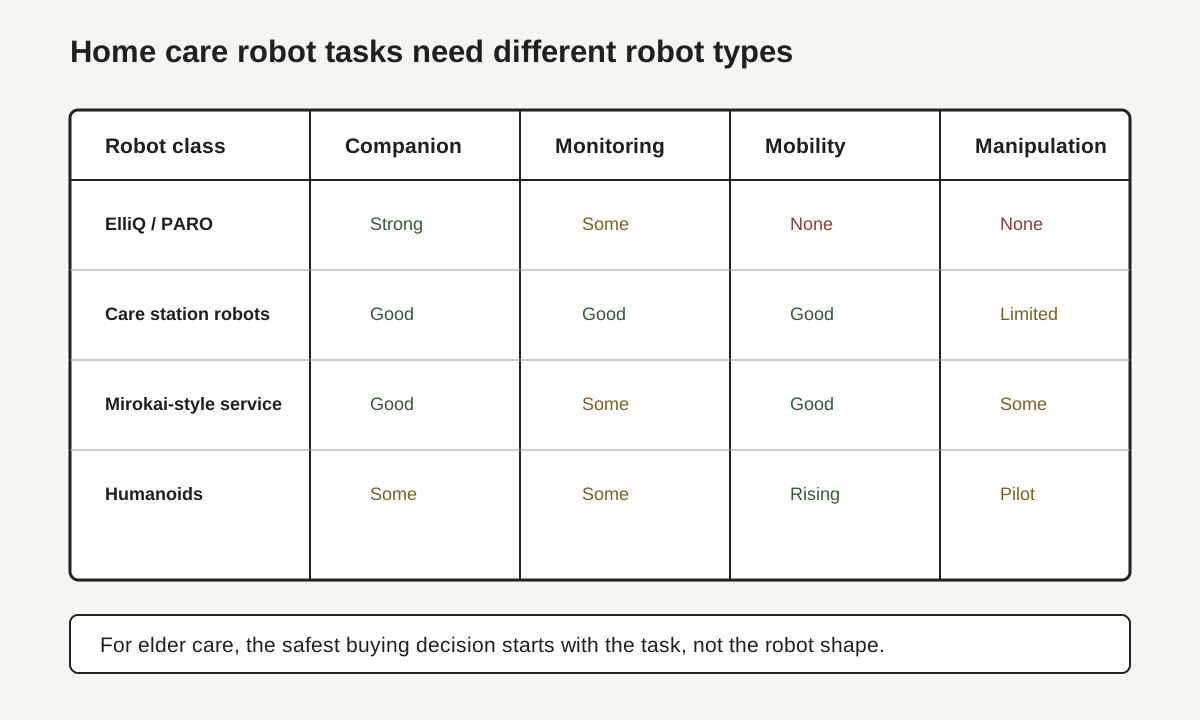
The practical takeaway is that elder-care robots are likely to scale as a portfolio. Companion robots cover loneliness and routines. Monitoring stations cover health checks. Mobile service robots cover delivery and wayfinding. Rehabilitation robots cover exercise and therapy. Humanoids and mobile manipulators take the riskiest physical-assistance tasks last.
What Should Home Buyers Watch?
If you are evaluating an elder-care robot in 2026, ignore the broadest promises first. Ask for the task list, the deployment setting, and the failure plan.
Start with the care workflow. Who receives alerts? What happens after a fall detection? Can a family member join by video? Does the robot support the language, hearing, vision, and mobility needs of the older adult? Can it operate without a perfect Wi-Fi connection? Does it require daily charging or staff setup?
Then ask for evidence in the same setting you intend to use. A robot that works in a supervised Beijing service station may be useful, but it has not proven it can handle a narrow hallway, a wet bathroom floor, a pet, changing medication routines, or a senior who refuses prompts. Home trials matter because private homes contain the edge cases that public demos avoid.
Finally, separate dignity tasks from convenience tasks. A robot that delivers meals or starts a video call can fail gracefully. A robot that helps someone bathe, transfer from bed, or recover from a fall has to meet a much higher bar. The closer a task gets to body support, medical decision-making, or privacy, the more human oversight and certification should be expected.
Bottom Line
China's elder-care robot push is best understood as a task-by-task deployment curve, not a single humanoid moment. The near-term winners are likely to be monitoring, companionship, reminders, facility delivery, guided wellness, and community-station services. The medium-term frontier is rehab, feeding, and staff-assisted physical support. The hardest home tasks: bathing, transfers, fall recovery, and general chores still need careful pilots before they become products a family should rely on alone.
That is still important progress. If China's pilots convert robotics hype into measured service outcomes, they could give home robot buyers something more valuable than another demo video: evidence about which robots actually reduce caregiver burden, improve safety, and help older adults stay independent.
Related in the database
Use this article as a privacy verification workflow
Turn the article into a privacy verification pass grounded in the robots, manufacturers, and components it actually references.
China Elder-Care Robots: Which Tasks Scale First? already points you toward 8 linked robots, 7 manufacturers, and 5 countries inside the ui44 database. That matters because strong buyer guidance is easier to apply when you can move immediately from a claim or warning into concrete product pages, manufacturer directories, component explainers, and country-level context instead of treating the article as an isolated opinion piece. The fastest next step is to turn the article into a shortlist workflow: open the linked robot pages, verify which specs are actually published for those models, then compare the surrounding manufacturer and component context before you decide whether the underlying claim changes your buying plan.
For this topic, the useful discipline is to separate the editorial lesson from the catalog evidence. The article gives you the framing, but the robot pages tell you what each product actually ships with today: sensor stack, connectivity methods, listed price, release timing, category, and support-relevant compatibility notes. The manufacturer pages then show whether you are looking at a one-off launch, a broader lineup pattern, or a company that spans multiple categories. That layered workflow reduces the risk of buying on a single marketing phrase or a single support FAQ.
Use the robot pages to confirm which products actually expose cameras, microphones, Wi-Fi, or voice systems, then use the manufacturer pages to decide how much of the privacy question seems product-specific versus brand-wide. On this route cluster, ElliQ 3, PARO, and GR-1 form the fastest reality check. If you want a quick working shortlist, open Compare ElliQ 3, PARO, and GR-1 next, then keep this article open as the reasoning layer while you compare structured data side by side.
Practical Takeaway
Every robot, manufacturer, category, component, and country reference below resolves to a real ui44 page, keeping the follow-up path grounded in database records rather than generic advice.
Suggested next steps in ui44
- Open ElliQ 3 and note the listed sensors, connectivity methods, and voice stack before you interpret any policy claim.
- Cross-check the wider brand context on Intuition Robotics so you can see whether the privacy question touches one model or a broader lineup.
- Use the linked component pages to confirm how common the relevant sensors and connectivity layers are across the database.
- Keep a short note of which policy layers you checked, which device features are actually present on the robot page, and which items still depend on region- or app-level confirmation.
- Finish with Compare ElliQ 3, PARO, and GR-1 so the policy reading sits next to structured product data.
Robot profiles worth opening next
Use the linked product pages as the evidence layer
The linked robot pages are where this article becomes operational. Instead of asking whether the headline is interesting, use the robot entries to inspect the actual mix of sensors, connectivity options, batteries, pricing, release timing, and stated capabilities attached to the products mentioned in the article. That is the easiest way to see whether the warning or opportunity described here affects one product family, a specific design pattern, or an entire buying lane.
ElliQ 3
Intuition Robotics · Companions · Available
ElliQ 3 is tracked on ui44 as a available companions robot from Intuition Robotics. The database currently records a listed price of Price TBA, a release date of 2024-01, Mains powered battery life, N/A (plugged in) charging time, and a published stack that includes 4-mic array, 12 MP camera for images, and 1080p HD video at 30 fps with 120° horizontal FoV plus Wi-Fi 802.11b/g/n/ac (2.4 GHz and 5 GHz) and Bluetooth 5+.
For privacy-focused reading, this page matters because it shows the concrete device surface behind the policy discussion. Use it to verify whether ElliQ 3 combines sensors and connectivity in a way that could change the in-home data footprint, and compare the listed capabilities such as Proactive Conversation, Medication Reminders, and Health & Pain Tracking with any cloud, app, or voice layers, including ElliQ Voice AI.
PARO is tracked on ui44 as a active companions robot from AIST. The database currently records a listed price of Price TBA, a release date of 2003, Not officially disclosed battery life, Not officially disclosed charging time, and a published stack that includes Tactile sensors, Light sensor, and Audition (audio) sensor plus Not publicly detailed.
For privacy-focused reading, this page matters because it shows the concrete device surface behind the policy discussion. Use it to verify whether PARO combines sensors and connectivity in a way that could change the in-home data footprint, and compare the listed capabilities such as Therapeutic companionship, Responds to touch, voice direction, and handling, and Learns preferred user interactions with any cloud, app, or voice layers.
GR-1 is tracked on ui44 as a active humanoid robot from Fourier. The database currently records a listed price of Price TBA, a release date of 2023, 2 hours (Humanoid.Guide; not manufacturer-published) battery life, Not disclosed charging time, and a published stack that includes 1 RealSense Camera, 1 ring-shaped microphone sensor, and 6 RGB cameras (pure vision perception solution) plus Wi-Fi and Ethernet.
For privacy-focused reading, this page matters because it shows the concrete device surface behind the policy discussion. Use it to verify whether GR-1 combines sensors and connectivity in a way that could change the in-home data footprint, and compare the listed capabilities such as Bipedal Walking, Object Manipulation, and Uneven Terrain Navigation with any cloud, app, or voice layers.
Walker S is tracked on ui44 as a active humanoid robot from UBTECH. The database currently records a listed price of Price TBA, a release date of 2023, Not disclosed battery life, Not disclosed charging time, and a published stack that includes Vision System, LiDAR, and Force Sensors plus Wi-Fi and Bluetooth.
For privacy-focused reading, this page matters because it shows the concrete device surface behind the policy discussion. Use it to verify whether Walker S combines sensors and connectivity in a way that could change the in-home data footprint, and compare the listed capabilities such as Bipedal Walking, Object Manipulation, and Factory Tasks with any cloud, app, or voice layers.
Walker S2 is tracked on ui44 as a active humanoid robot from UBTECH. The database currently records a listed price of Price TBA, a release date of 2025-07-17, Designed for 24/7 continuous operation with autonomous battery swapping battery life, Autonomous battery swap in about 3 minutes charging time, and a published stack that includes Pure RGB Binocular Stereo Vision System, Stereo Depth Estimation System, and Real-Time Battery Monitoring plus Gigabit Ethernet Port and USB 3.0.
For privacy-focused reading, this page matters because it shows the concrete device surface behind the policy discussion. Use it to verify whether Walker S2 combines sensors and connectivity in a way that could change the in-home data footprint, and compare the listed capabilities such as Autonomous Battery Swapping, 24/7 Continuous Operation, and Industrial Handling and Assembly with any cloud, app, or voice layers.
Manufacturer context behind the article
Check whether this is one product story or a broader company pattern
Manufacturer pages add the privacy context that individual product pages cannot show on their own. They help you check whether cameras, microphones, cloud accounts, app controls, and policy assumptions appear across a broader lineup or stay tied to one specific product story.
Intuition Robotics
ui44 currently tracks 1 robot from Intuition Robotics across 1 category. The company is grouped under Israel, and the current catalog footprint on ui44 includes ElliQ 3.
That wider brand context matters because privacy questions rarely stop at one FAQ page. A manufacturer route helps you see whether the article is centered on one premium model or on a company that has several relevant products and therefore more than one place where the same policy or app assumptions might matter. The category mix here currently points toward Companions as the most useful next route if you want to see whether this article reflects a wider pattern inside the brand.
AIST
ui44 currently tracks 3 robots from AIST across 2 categorys. The company is grouped under Japan, and the current catalog footprint on ui44 includes HRP-4C, HRP-5P, PARO.
That wider brand context matters because privacy questions rarely stop at one FAQ page. A manufacturer route helps you see whether the article is centered on one premium model or on a company that has several relevant products and therefore more than one place where the same policy or app assumptions might matter. The category mix here currently points toward Research, Companions as the most useful next route if you want to see whether this article reflects a wider pattern inside the brand.
Fourier
ui44 currently tracks 3 robots from Fourier across 1 category. The company is grouped under China, and the current catalog footprint on ui44 includes GR-2, GR-1, GR-3.
That wider brand context matters because privacy questions rarely stop at one FAQ page. A manufacturer route helps you see whether the article is centered on one premium model or on a company that has several relevant products and therefore more than one place where the same policy or app assumptions might matter. The category mix here currently points toward Humanoid as the most useful next route if you want to see whether this article reflects a wider pattern inside the brand.
UBTECH
ui44 currently tracks 5 robots from UBTECH across 2 categorys. The company is grouped under China, and the current catalog footprint on ui44 includes Walker S, Walker S2, Alpha Mini.
That wider brand context matters because privacy questions rarely stop at one FAQ page. A manufacturer route helps you see whether the article is centered on one premium model or on a company that has several relevant products and therefore more than one place where the same policy or app assumptions might matter. The category mix here currently points toward Humanoid, Companions as the most useful next route if you want to see whether this article reflects a wider pattern inside the brand.
Broaden the scan without leaving the database
Categories, components, and countries add the wider context
Category framing
Category pages are useful when the article touches a buying pattern that shows up across brands. A category route helps you confirm whether the linked products sit in a narrow niche or whether the same question should be tested across a larger field of alternatives.
Companions
The Companions category page currently groups 53 tracked robots from 48 manufacturers. ui44 describes this lane as: Social robots, robot pets, and elderly-care companions designed for emotional connection and everyday support at home.
That makes the category route a practical follow-up when you want to check whether the products linked in this article are typical for the lane or whether they sit at one edge of the market. Useful starting examples currently include PARO, Abi, Next-Generation Companion Robot.
Humanoid
The Humanoid category page currently groups 129 tracked robots from 92 manufacturers. ui44 describes this lane as: Full-size bipedal humanoid robots built to work alongside people — from factory floors to household tasks. Compare the cutting edge of humanoid robotics.
That makes the category route a practical follow-up when you want to check whether the products linked in this article are typical for the lane or whether they sit at one edge of the market. Useful starting examples currently include NEO, EVE, Mornine M1.
Country and ecosystem context
Country pages give extra context when support practices, launch sequencing, regulatory posture, or manufacturer mix matter. They are not a substitute for model-level verification, but they do help you see which ecosystems cluster together and which manufacturers sit in the same regional field when you broaden the search beyond the article headline.
Israel
The Israel route currently groups 5 tracked robots from 5 manufacturers in ui44. That gives you a useful regional lens when the article points toward support practices, launch sequencing, or brand clusters that may share similar ecosystem assumptions.
On the current route, manufacturers like Flytrex, Intuition Robotics, Maytronics make the page a good way to broaden the scan without losing the regional context that often shapes availability, documentation style, and adjacent alternatives.
Japan
The Japan route currently groups 26 tracked robots from 17 manufacturers in ui44. That gives you a useful regional lens when the article points toward support practices, launch sequencing, or brand clusters that may share similar ecosystem assumptions.
On the current route, manufacturers like AIST, SoftBank Robotics, Toyota make the page a good way to broaden the scan without losing the regional context that often shapes availability, documentation style, and adjacent alternatives.
China
The China route currently groups 189 tracked robots from 87 manufacturers in ui44. That gives you a useful regional lens when the article points toward support practices, launch sequencing, or brand clusters that may share similar ecosystem assumptions.
On the current route, manufacturers like AGIBOT, Dreame, Unitree Robotics make the page a good way to broaden the scan without losing the regional context that often shapes availability, documentation style, and adjacent alternatives.
Questions to answer before you move from reading to buying
A follow-up FAQ built from the entities already linked in this article
Frequently Asked Questions
Which page should I open first after reading “China Elder-Care Robots: Which Tasks Scale First?”?
Start with ElliQ 3. That gives you a concrete product anchor for the article’s main claim. From there, branch into the manufacturer and component pages so you can tell whether the article is describing one specific model, a repeated brand pattern, or a wider technology issue that affects multiple shortlist options.
How do the manufacturer pages change the buying decision?
Intuition Robotics help you zoom out from one article and one product. On ui44 they show lineup breadth, category spread, and the neighboring robots tied to the same company. That context is useful when you are deciding whether a risk belongs to a single model, whether it shows up across a brand’s portfolio, and whether you should keep looking at alternatives before committing.
When should I switch from reading to side-by-side comparison?
Move into Compare ElliQ 3, PARO, and GR-1 as soon as you understand the article’s main warning or promise. The article explains what to watch for, but the compare view is where you can check whether price, status, battery life, connectivity, sensors, and category fit still make the robot a good match for your own home and budget.
Where to go next in ui44
Keep the research chain inside the database
If you want to keep going, these follow-on pages give you the cleanest expansion path from article to research session. Open the comparison route first if you are deciding between products today. Open the manufacturer, category, and component routes if you still need to understand the broader pattern behind the claim.
Written by
ui44 Team
Published July 3, 2026
Share this article
Open a plain share link on X or Bluesky. No embeds, no widgets, no cookie baggage.