Most home robot buyers compare battery life, cameras, microphones, voice features, and price. Companion robots need one more line on the spec sheet: how long the relationship can realistically last.
Sharp's RoBoHoN is useful because it is not a concept video. It is a small Japanese communication robot with a real ownership history. RoBoHoN was born on May 26, 2016, and Sharp published official 10th-anniversary activity for 2026. That decade matters. It shows that a companion robot's service life is not just a hardware question. It depends on software updates, cloud migrations, app compatibility, account binding, paid services, repair paths, and whether the company keeps giving owners reasons to keep the robot on the table.
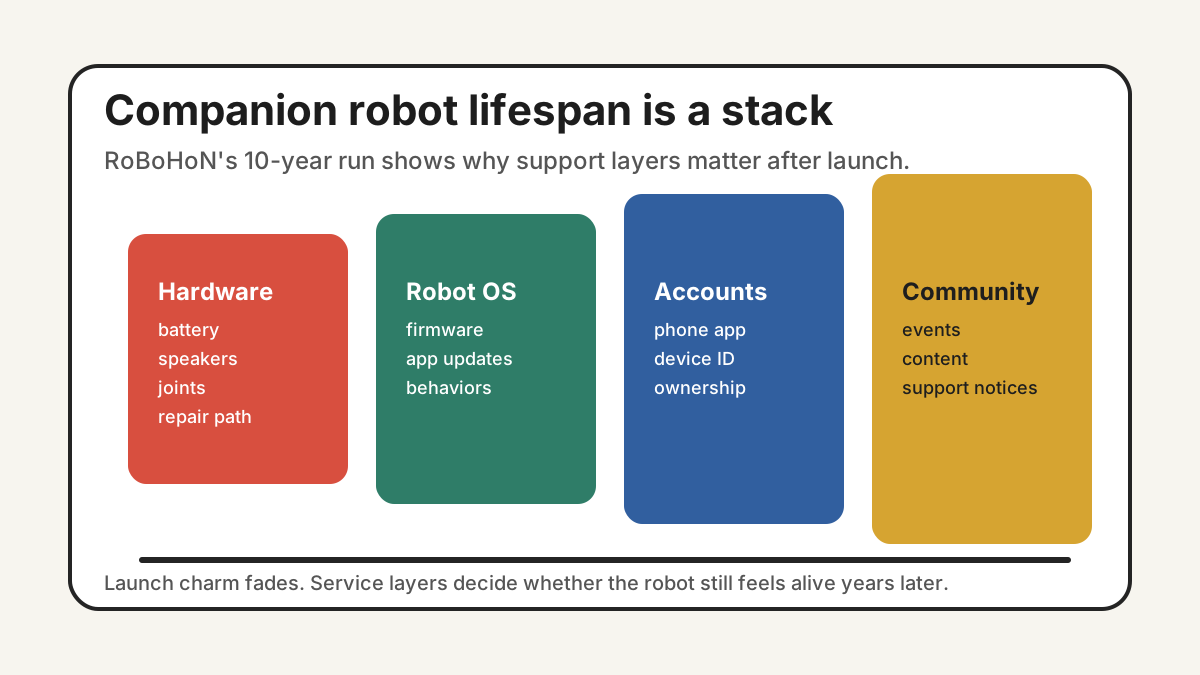
The lesson for buyers is simple: a companion robot that feels charming on day one can become frustrating years later if the service layer disappears. A robot with modest specs can age better if the company keeps the software, app ecosystem, and owner support alive.
RoBoHoN is not currently in the ui44 robot database, so this guide uses RoBoHoN as the longevity case study and compares it with companion and social robots that are tracked on ui44: GROOVE X LOVOT, Sony aibo, ElliQ 3, Loona, Miko 3, and Amazon Astro.
Why 10 years is a serious companion-robot milestone
Ten years is a long time for any connected consumer device. It is especially long for a social robot because the product is more than a box of electronics. Owners give it a name, build routines around it, teach family members how to interact with it, and often expect it to keep a recognizable personality.
That is why RoBoHoN's 2026 anniversary is more than a nostalgia story. Sharp's official anniversary page frames the robot around its birth date, May 26, 2016, and lays out in-person, traveling, and online owner events. The online event was scheduled for June 13, 2026, with robot participation planned through around September 30. Those dates are historical as of this October update; the page is not evidence that paid robot participation remains available. The same page also ties parts of the paid experience to robot ownership details such as IMEI and COCORO ID.
That is the hidden architecture of a long-lived companion robot:
Layer
Hardware
- What has to survive
- Battery, speakers, microphones, joints, display, cameras
- Why buyers should care
- Physical parts decide whether the robot can still feel present
Layer
Device software
- What has to survive
- OS updates, robot firmware, bundled apps
- Why buyers should care
- A decade-old robot still needs patched behavior and compatibility
Layer
Phone and web apps
- What has to survive
- Account login, pairing, content management
- Why buyers should care
- Many companion features depend on another device
Layer
Cloud services
- What has to survive
- Voice, conversations, events, subscriptions
- Why buyers should care
- The robot may lose value if remote services disappear
Layer
Owner community
- What has to survive
- Events, support notices, repair guidance
- Why buyers should care
- A community can keep the robot emotionally and practically alive
| Layer | What has to survive | Why buyers should care |
|---|---|---|
| Hardware | Battery, speakers, microphones, joints, display, cameras | Physical parts decide whether the robot can still feel present |
| Device software | OS updates, robot firmware, bundled apps | A decade-old robot still needs patched behavior and compatibility |
| Phone and web apps | Account login, pairing, content management | Many companion features depend on another device |
| Cloud services | Voice, conversations, events, subscriptions | The robot may lose value if remote services disappear |
| Owner community | Events, support notices, repair guidance | A community can keep the robot emotionally and practically alive |
This is where ordinary reviews often miss the point. Companion robots are not just "good" or "bad" in the launch window. They age.
RoBoHoN shows why updates matter more than novelty
Sharp's 2026 RoBoHoN notices show ongoing maintenance work, not just anniversary marketing. A March 2026 official notice asks owners to update apps as part of a system migration. The target apps include RoBoHoN robot apps such as Robo Conversation 2 and home-watching, plus the RoBoHoN Link smartphone app for Android and iOS. The notice says the existing apps would continue working through the end of April 2026.
That is exactly the kind of detail buyers should look for. A vendor that tells owners what is changing, which apps are affected, and when older versions stop being supported is giving the robot a chance to stay usable.
Sharp's April 2026 app update page is smaller in scope but just as revealing. It adds anniversary-themed content, including a birthday-song dance, a harmonica solo-play behavior, a reading-story addition, new Robo Conversation 2 scenarios, and May wallpaper downloads. The same page says RoBoHoN needs a communication environment for update notifications and points owners toward keeping software current.
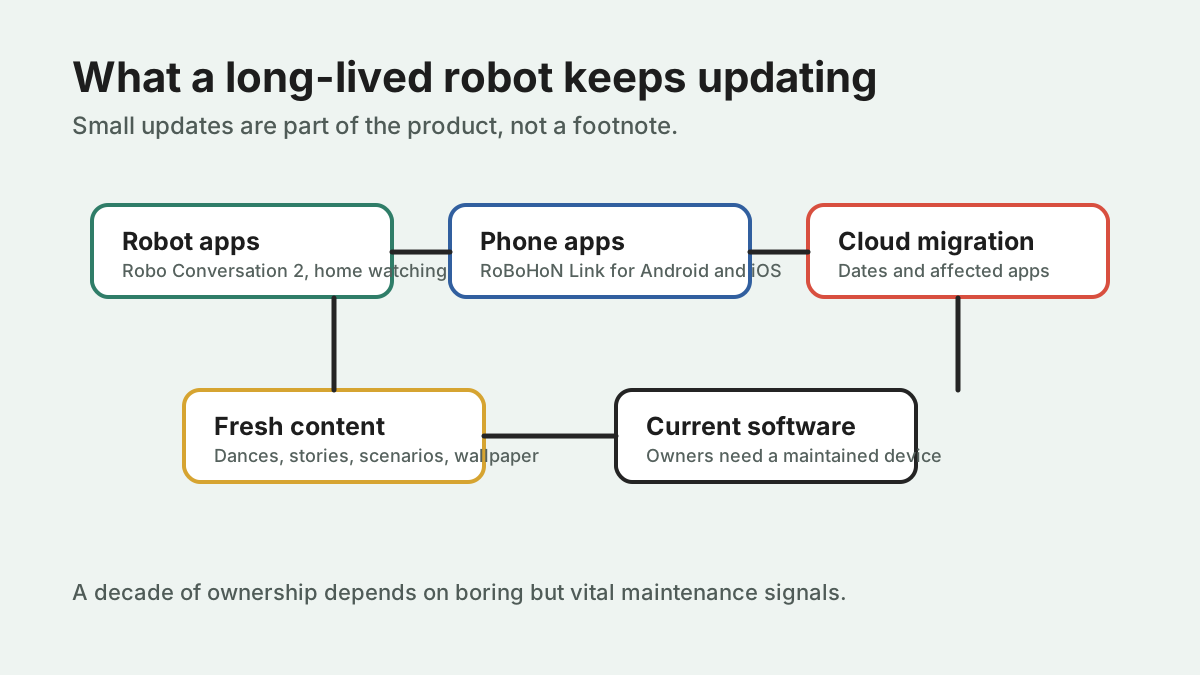
None of those features sound like a huge robotics breakthrough. That is the point. For a companion robot, small recurring updates are part of the product. A new dance, story, scenario, or event behavior tells owners the robot is still being cared for.
What should companion-robot buyers ask before buying?
If you are buying a companion robot in 2026, the product page is only the start. Ask the questions that decide the next five years.
1. What keeps working without the cloud?
A companion robot can be emotionally convincing because it talks, recognizes patterns, reacts to people, and delivers new content. Some of that may happen locally. Some may require cloud services. Before buying, look for a clear answer to what still works if the subscription ends, the app server changes, or the company exits your region.
This matters for low-cost robots such as Miko 3, listed in ui44 at EUR 269, and Loona, listed at $442 for the Premium bundle. The purchase price can look manageable, but the long-term value depends on the update and service model. It also matters for premium emotional companions such as Sony aibo, listed at $2,899, and LOVOT, listed at JPY 577,500 in ui44's database. At those prices, buyers should expect a more serious support story.
2. Is the account binding owner-friendly?
RoBoHoN's anniversary ticket rules show why account and device identity matter. The official page says applications can require RoBoHoN's IMEI and the COCORO ID used for the robot's plan. That makes sense for paid robot-specific content, but it also shows how deeply a companion robot can depend on account infrastructure.
For buyers, the question is not whether account binding is bad. It is whether it is documented and recoverable. Can ownership transfer? What happens after a family member changes email addresses? Can the robot be repaired, resold, inherited, or reactivated? A robot that feels like a family device needs a path through ordinary family-device problems.
3. Are updates only bug fixes, or do they add rituals?
RoBoHoN's April 2026 update included birthday content because the robot's anniversary is part of the owner relationship. That is a different style of maintenance from patch notes on a vacuum cleaner. For social robots, rituals can be product features: birthday dances, seasonal lines, owner events, new stories, or group performances.
LOVOT is a good comparison because it is also built around emotional presence rather than chores. It has no arm, no cleaning function, and no practical manipulation task. Its value is warmth, reaction, and daily attachment. If that is what you are buying, the vendor's willingness to keep creating moments is part of the value.
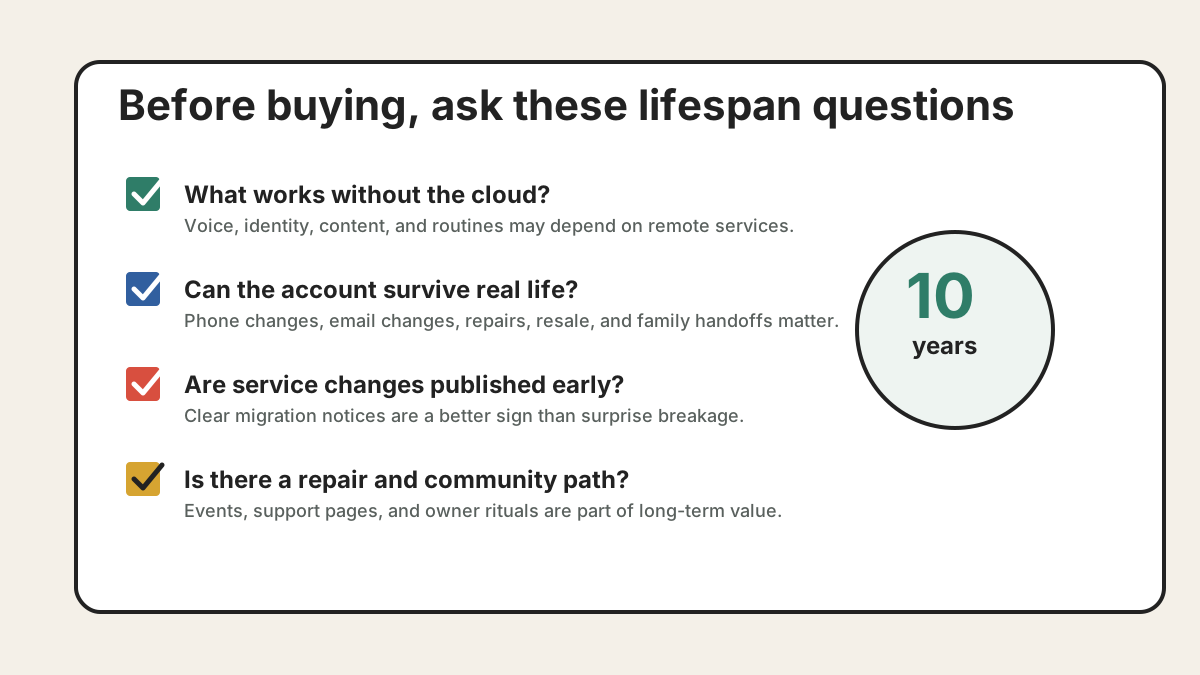
4. Does the company publish service changes before they hurt owners?
The March 2026 RoBoHoN notice is a good model because it names affected apps and a transition period. Buyers should look for that kind of behavior before purchase. A company that publishes support notices, app requirements, update windows, and migration instructions is less likely to leave owners guessing.
That is especially important for robots with cameras, microphones, and mobile bases. Amazon Astro, listed in ui44 at $1,599, is not a plush companion robot, but it still depends on household trust, accounts, remote features, and security behavior. For mobile robots, a sloppy service transition is more than annoying. It can affect privacy and daily use.
The ui44 companion-robot comparison
RoBoHoN's decade-long case study helps separate companion robots into two buying categories.
The first category is lower-cost, app-forward robots. Miko 3, Miko Mini, Loona, and Loona DeskMate are easier to buy as gifts or experiments. They can be great if the buyer understands that the future depends on content updates, app support, and the manufacturer's ability to keep children and families engaged.
The second category is premium companion hardware. Sony aibo and LOVOT cost far more upfront. Their appeal is not that they do chores. Their appeal is a more persistent robot identity. That makes service life even more important. A JPY 577,500 LOVOT or $2,899 aibo should be evaluated more like a long-lived connected pet device than a toy.
Then there are care-oriented companions such as ElliQ 3. ElliQ is stationary, not a roaming home robot, but it makes the longevity problem sharper because older-adult support depends on reliability and continuity. If a companion robot becomes part of a daily routine for medication reminders, social prompts, or family check-ins, abrupt service changes are not a minor inconvenience.
Robot
- ui44 price snapshot
- JPY 577,500
- Longevity question to ask
- Is the care plan, repair path, and content support clear for years?
Robot
- ui44 price snapshot
- $2,899
- Longevity question to ask
- What happens to cloud features, identity, and repairs after warranty?
Robot
- ui44 price snapshot
- Subscription model varies
- Longevity question to ask
- How stable is the service for older-adult daily routines?
Robot
- ui44 price snapshot
- $442 Premium bundle
- Longevity question to ask
- How often do app, AI, and behavior updates arrive?
Robot
- ui44 price snapshot
- EUR 269
- Longevity question to ask
- Which features require ongoing plans or app support?
Robot
- ui44 price snapshot
- $1,599
- Longevity question to ask
- How transparent are security, account, and remote-service changes?
| Robot | ui44 price snapshot | Longevity question to ask |
|---|---|---|
| LOVOT | JPY 577,500 | Is the care plan, repair path, and content support clear for years? |
| Sony aibo | $2,899 | What happens to cloud features, identity, and repairs after warranty? |
| ElliQ 3 | Subscription model varies | How stable is the service for older-adult daily routines? |
| Loona | $442 Premium bundle | How often do app, AI, and behavior updates arrive? |
| Miko 3 | EUR 269 | Which features require ongoing plans or app support? |
| Amazon Astro | $1,599 | How transparent are security, account, and remote-service changes? |
The exact prices will change. The questions should not.
A decade of a product line is not a ten-year warranty
The anniversary establishes how long RoBoHoN has existed as a product. It does not tell us how many first-generation units remain working, their repair history, average battery life after years of use, or the fraction of owners who still subscribe. Those would require different evidence: a defined group of units, their purchase dates, failures, repairs and continued use. Sharp’s event and update pages do not provide that dataset.
This distinction prevents an expensive misunderstanding. A shopper considering a used robot should not treat the age of the brand as the remaining life of the individual device. The relevant starting point is its exact model, condition, service eligibility and account status. A newer unit from a long-running family and an original unit can have different ownership constraints even when both appear in the same anniversary celebration.
Sharp’s support portal organizes help by model and provides manuals, questions and answers, and a repair-estimate form. Use that model-specific route when asking whether a particular unit is still serviceable. The existence of a support page is useful, but it is not a repair quote or confirmation that a part is in stock. Ask for the terms that apply to the actual unit before treating a secondhand listing as a working alternative to a new purchase.
Three different service changes, three different consequences
The RoBoHoN record contains examples that should not be grouped together as “the cloud shutting down.” They affect different parts of ownership.
An app migration can temporarily interrupt a feature. Sharp’s March notice, revised in April, specifies that the linked home-watching function needed updates on both the robot and phone. Updating only one side was insufficient. It also says owners who missed the end-of-April deadline could use the apps again after updating. This was a compatibility transition with a stated recovery route, not an announcement that the robot had permanently stopped working.
The practical question is therefore narrower than “does it have updates?” Ask which parts must be updated together and how to recover an out-of-date device. For a family buying a robot as a gift, identify who will maintain the phone app and the robot. If those belong to different people, both need to receive the instructions. A device that is physically in one home can depend on an app maintained by someone elsewhere.
Closing enrollment is different from ending existing service. Sharp’s February 2025 mobile-service notice says new enrollment in its COCORO-store voice and data SIM services ended on February 27, 2025, while existing subscribers could continue. That does not establish that all cellular operation ended. Equally, an existing owner’s working plan does not prove that a new buyer can obtain the same offer today. Ask about new activation for the model and region, especially when buying used or importing.
A required plan affects the value of the hardware itself. Sharp’s COCORO Plan page says paid membership is necessary to use RoBoHoN’s functions. It describes server-connected conversation and server storage of learned preferences and friends’ names. That makes it inappropriate to assume that canceling a plan merely removes optional new stories while leaving the full companion experience intact. The same page limits COCORO Plan use to residents of Japan. Readers elsewhere should not assume that importing the hardware makes them eligible for the required service.
The planning implication is to separate three costs: the robot, access to its services, and its network connection. A Wi-Fi connection does not by itself answer whether a paid account is needed. A paid account does not answer whether a mobile data plan is included. For any companion robot, ask the supplier to explain those dependencies in ordinary language before comparing the total with a device whose core interactions work under a different arrangement.
Repair coverage needs its own timeline
Sharp’s maintenance-pack description includes discounts on eligible repairs and consumable parts such as batteries. Its monthly-service overview describes repair and replacement-part discounts for five years from purchase. That is a more specific statement than the product family’s ten-year anniversary. It should not be expanded into a promise of ten years of free repairs, unlimited parts availability or an identical entitlement for a later owner.
For a repair inquiry, keep four dates separate: original purchase, plan start, current fault and the end of applicable coverage. Ask whether the quotation includes diagnosis, shipping, parts and labor, and whether declining a repair still incurs a charge. These are questions to obtain a complete quotation, not fees this article claims Sharp charges. Also ask what happens to stored settings and learned information if the device must be reset or replaced.
There are two different outcomes to consider. A repair can restore the physical robot while requiring setup again; preserving familiar behavior is a separate question. Conversely, an account can remain active while the hardware is away for service. Ask whether service charges continue during that absence and whether any pause is available. Do not assume either answer from the existence of a maintenance plan.
For a household that uses the robot in a daily routine, the repair route also has a practical cost beyond the bill. Someone needs to arrange collection, respond to an estimate and set up the returned unit. Recording the model, account-recovery method and support contact in an accessible household note makes those tasks easier without sharing passwords or publishing the robot’s identifiers. That preparation is especially useful when the person who bought the robot is not the person who uses it every day.
A practical lifespan checklist for companion robots
Before buying a robot whose main job is companionship, check these points:
- Update history: Look for dated app updates, firmware notes, and support pages. Dated maintenance is more useful evidence of continued support than an unchanged launch page, but does not establish security or safety.
- Cloud dependency: Ask which features work offline and which require active service.
- Subscription clarity: Calculate the first-year and third-year cost, not just the checkout price.
- Account recovery: Check whether the robot can be re-linked after a phone change, email change, repair, or ownership transfer.
- Repair route: Look for official battery, part, and service information before assuming the robot is repairable.
- Owner community: Events, official forums, newsletters, and update rituals are not fluff. They are signs that the robot has an owner base worth supporting.
- Exit plan: Decide what value remains if the company stops adding content.
The bottom line
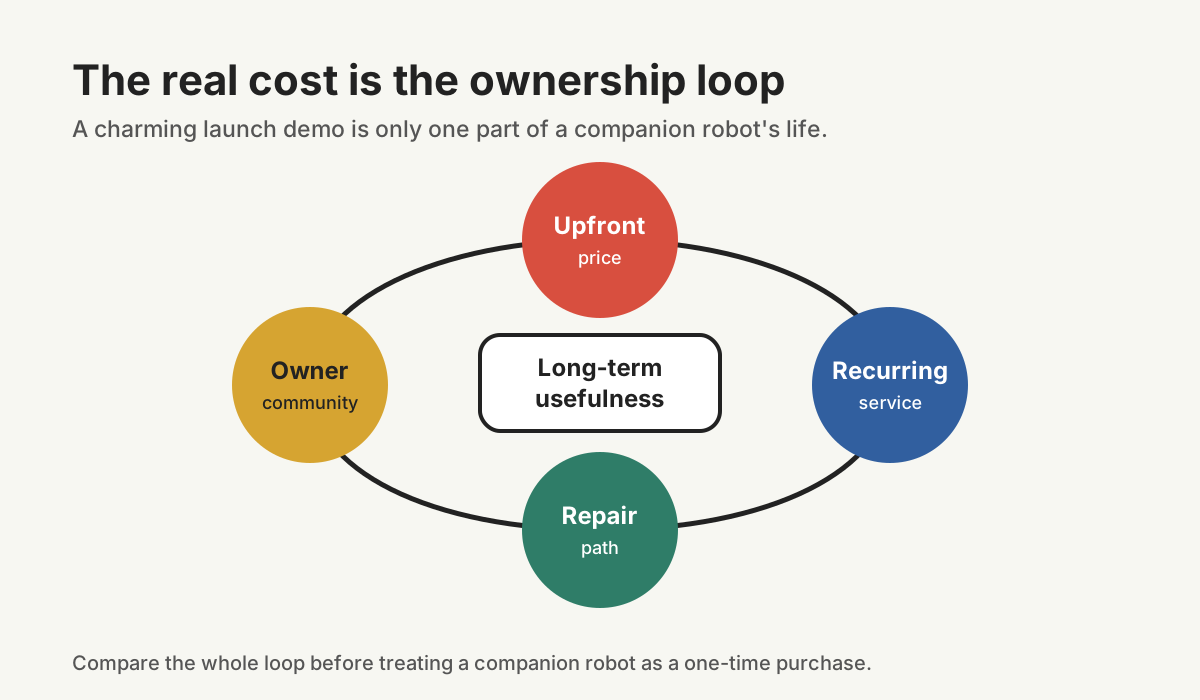
RoBoHoN's 10-year anniversary is a useful reminder that companion robots are not judged only by launch specs. They are judged by the life around the robot: updates, events, app migrations, account systems, repairs, and owner rituals.
For a home buyer, that changes the decision. The best companion robot is not automatically the newest one, the cheapest one, or the one with the most expressive launch video. It is the one whose manufacturer has a credible plan to keep the robot useful after the novelty fades.
If you are comparing companion robots, start with the robot profiles, then open the support pages. Use ui44's companion robot category and comparison tool to narrow the shortlist, but do not stop there. A companion robot's real spec is not just what it can do today. It is what the company is still willing to support years from now.
Sources & References
- Sharp RoBoHoN system migration notice, March 2026: https://robohon.com/news/260323.php
- Sharp RoBoHoN April 2026 app update: https://robohon.com/apps/index260416.php
- Sharp RoBoHoN 10th anniversary owner event: https://robohon.com/anniversaryevent/10th/
- Sharp COCORO Plan requirements: https://robohon.com/service/cocoro.php
- Sharp maintenance pack: https://robohon.com/service/care.php
- Sharp monthly-service overview: https://robohon.com/service/index.php
- Sharp mobile-service enrollment notice: https://robohon.com/news/250226.php
- Sharp model-specific support: https://jp.sharp/support/robohon/
Written by
ui44 Team
Published June 7, 2026
Share this article
Open a plain share link on X or Bluesky. No embeds, no widgets, no cookie baggage.