Article 20 min read 4,496 words

Are LLM Robot Brains Safe Enough for Homes?

LLM robot brains are already showing up in demos as the part that talks, interprets instructions, and turns messy human requests into plans. That is useful. It is also not the same thing as a safe robot brain.

ui44 Team All articles

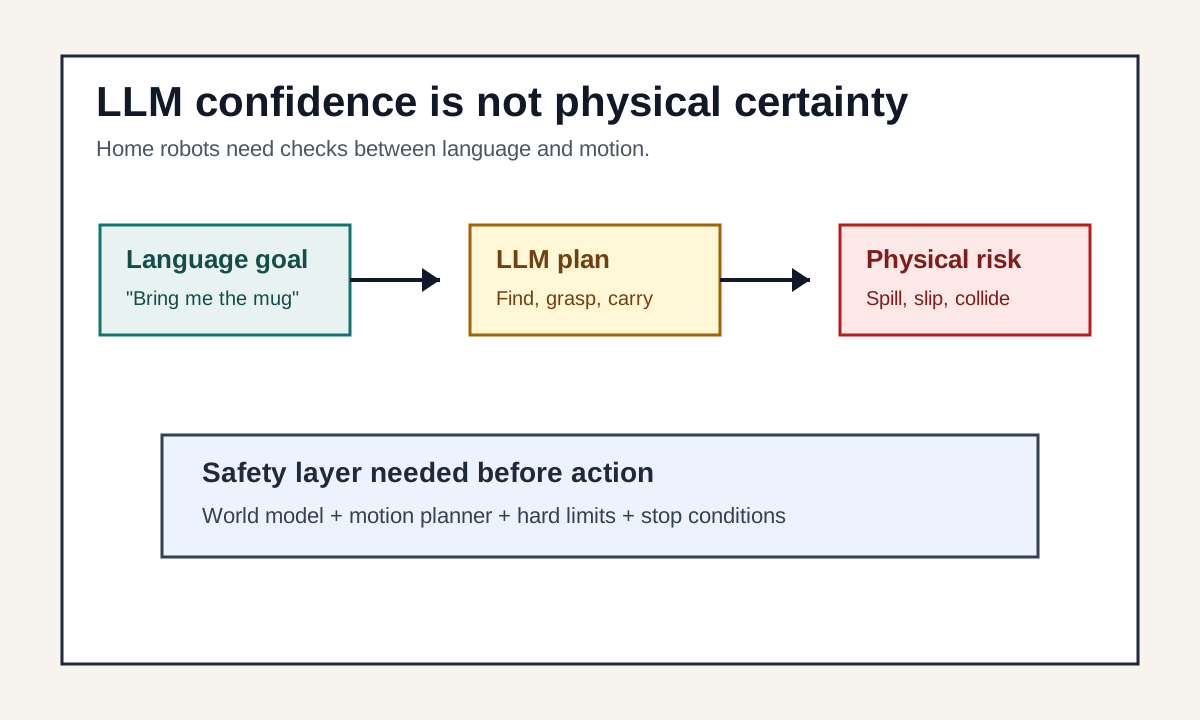
Yann LeCun's critique is simple enough for home robot buyers to care about: an LLM is trained to predict symbols, not to simulate physical consequences. A chatbot can say "I will carry the glass around the dog" without knowing, in the grounded sense, how slippery the glass is, where the dog might move, whether its wrist can recover, or what happens if a child steps into the path.
LLM robot brain risk map for home humanoid robots
Scroll sideways to inspect the full chart.

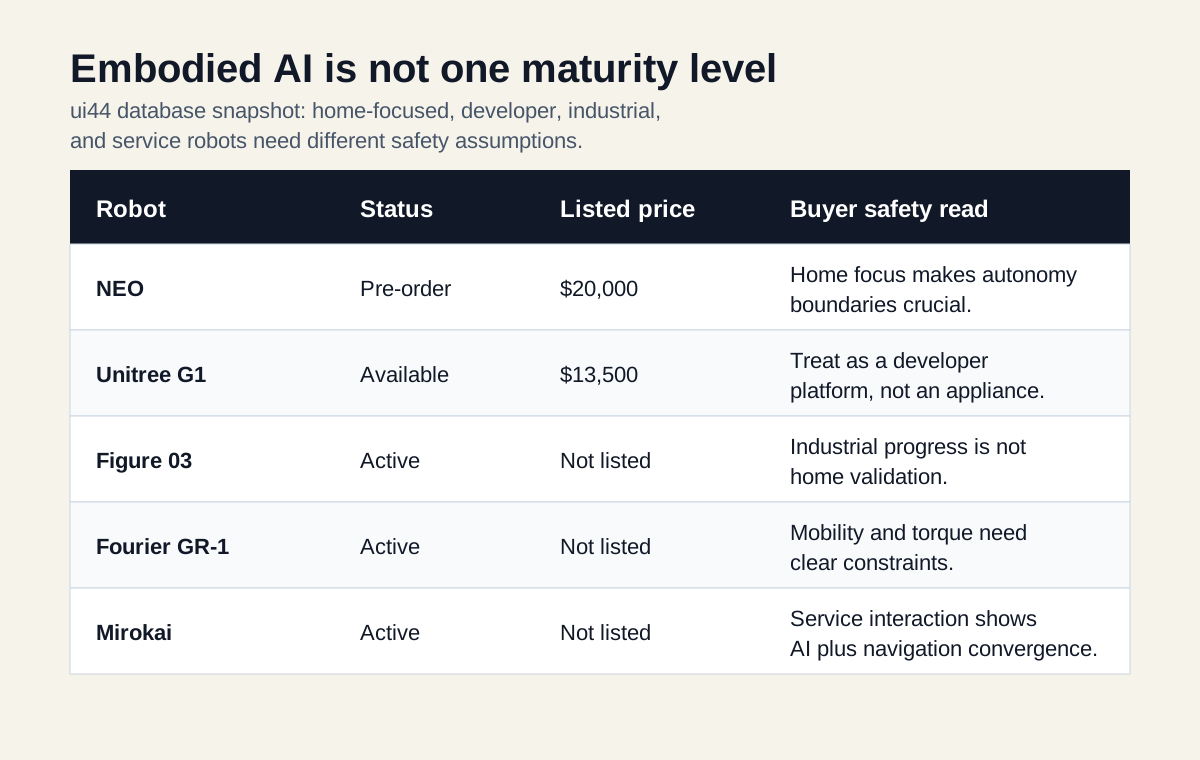
That distinction matters because the home robot category is moving from cute assistants toward embodied machines with arms, mobility, microphones, cameras, and direct access to kitchens, bedrooms, pets, stairs, fragile objects, and people. In the ui44 database, NEO is a home-focused humanoid listed at $20,000 and in pre-order status, Unitree G1 is an available research humanoid at $13,500, and Figure 03 is an active industrial humanoid rather than a consumer product. These are not just speakers with faces. They are platforms where software mistakes can become physical events.

The buyer question is not "does the robot use an LLM?" The better question is: where is the LLM allowed to act, and what checks sit between language and motion?

Are LLM robot brains safe enough without world models?

A world model is an internal representation that lets an agent predict how the world changes when it acts. For a home robot, that means more than naming objects. It means estimating positions, forces, obstacles, timing, object state, and possible future outcomes before the robot commits to a movement.

LeCun has argued for years that language-only systems are incomplete for autonomous intelligence because they do not learn the physical world the way humans and animals do. His 2022 position paper, "A Path Towards Autonomous Machine Intelligence," frames intelligence around perception, world modeling, planning, and cost-driven action rather than next-token prediction alone. More recent public comments have sharpened that into a robotics safety argument: agentic LLMs are not reliable enough when they lack a grounded predictive model of the world.

That does not make LLMs useless in robots. It makes their safest role narrower.

An LLM can help with:

  • Turning natural language into a structured goal.
  • Asking clarifying questions when an instruction is ambiguous.
  • Explaining what the robot is about to do.
  • Retrieving manuals, schedules, recipes, or household preferences.
  • Choosing between high-level routines that have already been validated.

An LLM should not be the only component deciding:

  • How close an arm can move to a person.
  • Whether a cup is stable enough to lift.
  • Whether a stair edge is safe.
  • Whether a blocked path should be negotiated, nudged, or abandoned.
  • Whether a tool can be used near skin, pets, cables, heat, or water.

The home is full of states that are obvious to people and hard for text models: a chair that is usually there but not today, a wet floor, a toddler who changed direction, a blanket hiding a charger cable, a glass that is too full to carry quickly, or a family member who said "put it there" while pointing somewhere off camera.

The Safe Architecture Is Layered

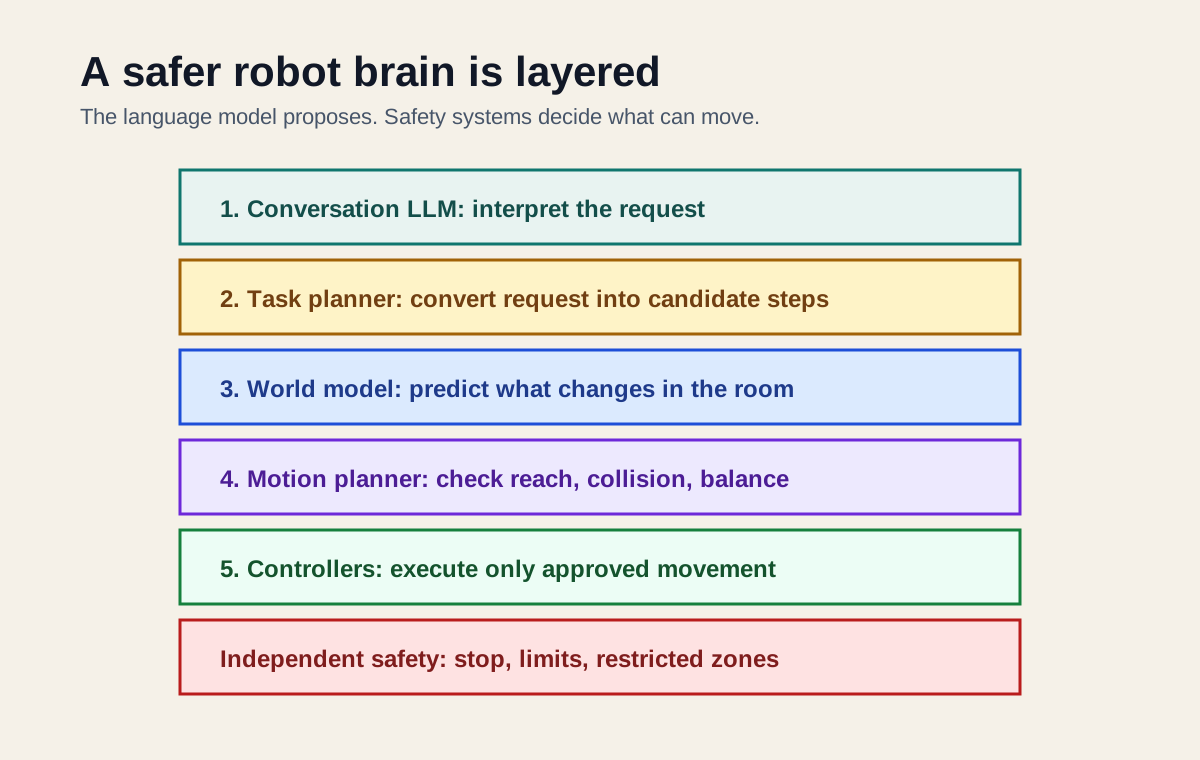
The safest near-term home robot architecture looks less like one big AI brain and more like a layered control stack.
Layered AI control stack for safe home robot brains
Scroll sideways to inspect the full chart.

At the top, the LLM handles conversation and intent. Under that, a task planner converts the request into steps. A world model or scene model predicts what those steps mean in the current room. A motion planner checks reachability, collision risk, balance, torque, and path constraints. Low-level controllers execute only approved movements. Independent safety systems watch for stop conditions.

The key safety idea is permission. The LLM can propose, but it should not have unrestricted authority to execute. The robot should reject plans that violate hard limits even if the language model is confident.

That distinction is especially important for humanoids because their marketing often compresses several systems into one phrase like "AI powered." A buyer needs to know whether that means a voice assistant attached to deterministic robotics, a vision-language-action model trained for manipulation, a teleoperated system with AI assistance, or an experimental autonomy stack.

The phrase "robot brain" is too vague. Ask for the stack.

What ui44's Robot Database Shows

The current consumer and near-consumer humanoid market is still early. Prices, availability, and intended use cases vary wildly, which changes the safety question.

Robot

NEO

ui44 status
Pre-order
Listed price
$20,000
Why it matters for LLM safety
Home-focused humanoid, so language-to-action boundaries matter directly in domestic spaces.

Robot

Unitree G1

ui44 status
Available
Listed price
$13,500
Why it matters for LLM safety
Research and development platform; buyers should expect developer responsibility, not appliance-level autonomy.

Robot

Figure 03

ui44 status
Active
Listed price
Not consumer-priced
Why it matters for LLM safety
Industrial humanoid with in-house Helix VLA focus; useful signal, but not proof of home readiness.

Robot

Fourier GR-1

ui44 status
Active
Listed price
Not listed
Why it matters for LLM safety
Service and research humanoid where mobility, torque, and interaction claims need careful validation.

Robot

Mirokai

ui44 status
Active
Listed price
Not listed
Why it matters for LLM safety
Social/service robot with arms and navigation, showing how conversational AI and physical assistance can converge.
Home humanoid robot comparison chart for LLM safety buyers
Scroll sideways to inspect the full chart.

The important pattern is not that one robot is "safe" and another is "unsafe." It is that the systems are aimed at different levels of maturity. A $13,500 development humanoid is not the same buying proposition as a finished home appliance. A factory-tested humanoid is not automatically ready for pets, kitchen clutter, uneven lighting, bedrooms, bathrooms, and unscripted family behavior.

For home buyers, the safer reading is conservative: treat current embodied AI as assistive and supervised unless the manufacturer documents otherwise.

Why A Language Model Alone Is The Wrong Safety Boundary

LLMs are strong at plausible language. They are weaker at guarantees. That mismatch shows up in several home robot failure modes.

1. Language Can Hide Physical Uncertainty

If you tell a robot, "bring me the mug from the counter," the words sound simple. The physical task is not simple. The robot has to identify the correct mug, estimate whether it is empty, understand the counter edge, avoid nearby objects, grasp without crushing or slipping, carry without spilling, route around people, and recover if anything changes.

An LLM can produce a clean plan for that task. The question is whether another system checks the plan against the actual scene.

2. Plausible Plans Are Not Always Executable

Text models often produce steps that make social sense but do not respect geometry, force, timing, or hardware limits. A home robot may have limited reach, grip strength, walking speed, payload, battery, or dexterity. It may know the sentence "fold the towel" but lack the manipulation skill to do it reliably.

This is why Unitree G1 being listed as a research platform matters. It may be available and relatively affordable for a humanoid, but a development platform still depends heavily on the software stack, environment, and operator. The robot's body is only one part of the buying decision.

3. Homes Are Adversarial Without Trying

Factories can mark floors, standardize bins, isolate work cells, control lighting, and repeat tasks. Homes do the opposite. They change constantly. The same room contains soft objects, hard objects, pets, cables, mirrors, glass, clothing, food, water, and people who do not follow a script.

Figure's industrial progress is relevant because it shows how fast humanoid software is moving. But Figure 03 is still not a consumer home robot. If a system is trained and validated in structured commercial workflows, buyers should not assume that validation transfers unchanged to a cluttered apartment.

4. Conversation Can Create False Trust

A robot that speaks fluently feels competent. That is useful for accessibility and comfort, but it can also cause overtrust. A robot may explain a plan in calm language while its perception is uncertain or its manipulation policy is outside the conditions where it was tested.

The best consumer interfaces should expose uncertainty. "I am not confident I can pick that up safely" is better than a confident attempt. For home robots, refusal is a feature.

What Buyers Should Ask Before Trusting An LLM Robot

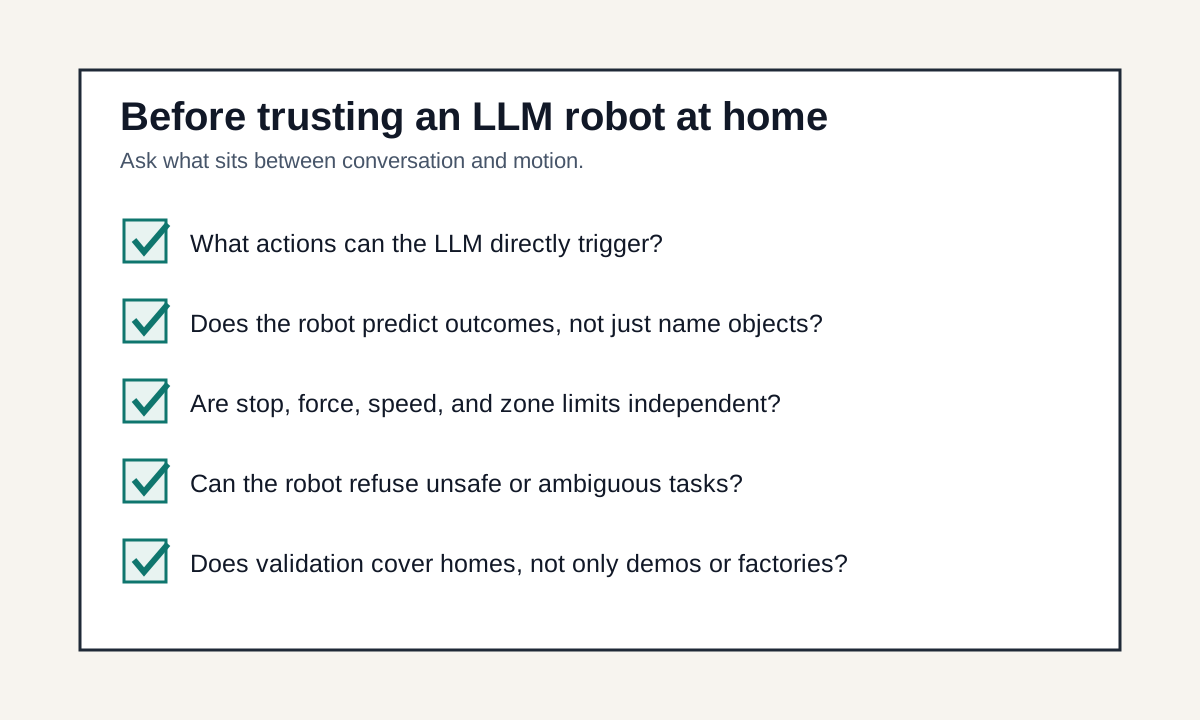
A good spec sheet should answer more than "does it have AI?" When evaluating a home robot, especially a humanoid or mobile manipulator, ask these questions.

What Actions Can The LLM Directly Trigger?

Look for the boundary between language and actuation. Can the LLM directly command movement, or does it send requests to a separate planner? Can it open doors, use appliances, handle sharp objects, or approach people? Are those actions enabled by default?

For a home-focused robot like NEO, this boundary is central. The database lists it as a pre-order humanoid at $20,000, which puts it in a very different category from a novelty desk robot. A buyer should expect clear answers about what autonomy is live at launch, what is teleoperated or supervised, and what remains future roadmap.

Does The Robot Have A World Model Or Only Recognition?

Object recognition tells the robot what it sees. A world model helps it predict what happens next. Those are different capabilities.

Ask whether the robot predicts collisions, object stability, human motion, scene changes, and task outcomes before acting. Ask whether it can simulate alternatives, not just label the room.

What Safety Systems Are Independent Of The AI Model?

The safest systems do not rely on one model to both generate actions and decide whether those actions are safe. Look for independent emergency stop, speed limits, torque limits, collision detection, restricted zones, geofencing, supervised modes, and conservative fallback behavior.

If a manufacturer says "the AI handles safety," that is not enough.

Can The Robot Say No?

The robot should refuse tasks it cannot execute safely. It should ask for help when the scene is ambiguous. It should stop if perception confidence drops. It should degrade gracefully rather than improvising around missing information.

This is one of the places where LLMs can help: not by controlling motion, but by making refusals understandable. A good robot can say, "I cannot pick up the pan because it may be hot," or "I need you to move the cable before I continue."
Home robot buyer checklist for LLM safety and world models
Scroll sideways to inspect the full chart.

The Best Near-Term Role For LLMs In Home Robots

The practical answer is not to ban language models from robots. It is to put them in the right place.

LLMs are a natural fit for the human-facing layer. They can make robots easier to instruct, personalize routines, summarize what they did, and translate vague requests into candidate goals. For many households, that interface layer may be the difference between a robot that feels programmable and one that feels usable.

But the physical layer needs other machinery: perception, localization, mapping, motion planning, tactile feedback, policy learning, simulation, constrained controllers, and safety monitors. LeCun's world-model critique is a reminder that physical intelligence is not just language with wheels and hands attached.

This distinction also helps buyers interpret demos. A robot answering questions in a showroom is not the same as a robot making safe autonomous decisions in a kitchen. A robot completing one impressive task is not the same as a robot knowing when not to try.

Bottom Line

LLM robot brains are useful, but they are not enough for unsupervised home autonomy. The safer architecture treats the language model as an interface and planner, then routes physical action through grounded perception, predictive world modeling, motion constraints, and independent safety checks.

For buyers, the most important question is not whether a robot talks like a capable assistant. It is whether the robot can predict, verify, refuse, and stop before a language mistake becomes a physical mistake.

That is why LeCun's critique matters for home robotics. It turns "AI powered" from a marketing phrase into a set of testable questions. Until manufacturers answer those questions clearly, the smart position is to treat home humanoids as supervised systems, impressive prototypes, or developer platforms - not autonomous household staff.

Compare current humanoid and companion robots in the ui44 robot database or start with NEO, Unitree G1, and Figure 03 to see how different the category already is.

Database context

Use this article as a buyer workflow

Turn the article into a real verification pass

Are LLM Robot Brains Safe Enough for Homes? already points you toward 5 linked robots, 5 manufacturers, and 4 countries inside the ui44 database. That matters because strong buyer guidance is easier to apply when you can move immediately from a claim or warning into concrete product pages, manufacturer directories, component explainers, and country-level context instead of treating the article as an isolated opinion piece. The fastest next step is to turn the article into a shortlist workflow: open the linked robot pages, verify which specs are actually published for those models, then compare the surrounding manufacturer and component context before you decide whether the underlying claim changes your buying plan.

For this topic, the useful discipline is to separate the editorial lesson from the catalog evidence. The article gives you the framing, but the robot pages tell you what each product actually ships with today: sensor stack, connectivity methods, listed price, release timing, category, and support-relevant compatibility notes. The manufacturer pages then show whether you are looking at a one-off launch, a broader lineup pattern, or a company that spans multiple categories. That layered workflow reduces the risk of buying on a single marketing phrase or a single support FAQ.

The fastest win is to keep the article’s editorial framing tied to real product pages. That way you can test whether NEO, G1, and Figure 03 still make sense once price, category, release timing, and surrounding manufacturer context are visible in one place. If you want a quick working shortlist, open Compare NEO, G1, and Figure 03 next, then keep this article open as the reasoning layer while you compare structured data side by side.

Practical Takeaway

Every robot, manufacturer, category, component, and country reference below resolves to a real ui44 page, keeping the follow-up path grounded in database records rather than generic advice.

Suggested next steps in ui44

  1. Open NEO first so the article’s main point is anchored to a real robot page.
  2. Use 1X Technologies to see the broader company context around the products linked in the article.
  3. Open the linked component pages when you want to separate a shared technology pattern from a single-brand story.
  4. Build a working shortlist with Compare NEO, G1, and Figure 03.
  5. Keep a short note of what is already verified in the article and what still needs live confirmation from current vendor documentation.

Database context

Robot profiles worth opening next

Use the linked product pages as the evidence layer

The linked robot pages are where this article becomes operational. Instead of asking whether the headline is interesting, use the robot entries to inspect the actual mix of sensors, connectivity options, batteries, pricing, release timing, and stated capabilities attached to the products mentioned in the article. That is the easiest way to see whether the warning or opportunity described here affects one product family, a specific design pattern, or an entire buying lane.

NEO

1X Technologies · Humanoid · Pre-order

$20,000

NEO is tracked on ui44 as a pre-order humanoid robot from 1X Technologies. The database currently records a listed price of $20,000, a release date of 2025-10-28, ~4 hours battery life, Not disclosed charging time, and a published stack that includes RGB Cameras, Depth Sensors, and Tactile Skin plus Wi-Fi and Bluetooth.

For general buyer research, this route gives you the concrete profile that the article alone cannot. Compare the published capabilities of Household Chores, Tidying Up, and Safe Human Interaction with the linked alternatives so the final decision is based on actual product fit, not just the framing of the article.

G1

Unitree · Humanoid · Available

$13,500

G1 is tracked on ui44 as a available humanoid robot from Unitree. The database currently records a listed price of $13,500, a release date of 2024-05-13, ~2 hours battery life, Not disclosed charging time, and a published stack that includes Depth Camera, 3D LiDAR, and 4 Microphone Array plus Wi-Fi 6 and Bluetooth 5.2.

For general buyer research, this route gives you the concrete profile that the article alone cannot. Compare the published capabilities of Bipedal Walking, Object Manipulation, and Dexterous Hands (optional Dex3-1) with the linked alternatives so the final decision is based on actual product fit, not just the framing of the article.

Figure 03

Figure AI · Humanoid · Active

Price TBA

Figure 03 is tracked on ui44 as a active humanoid robot from Figure AI. The database currently records a listed price of Price TBA, a release date of 2025-10-09, ~5 hours battery life, Not disclosed charging time, and a published stack that includes Stereo Vision, Depth Cameras, and Force Sensors plus Wi-Fi and Bluetooth.

For general buyer research, this route gives you the concrete profile that the article alone cannot. Compare the published capabilities of Complex Manipulation, Warehouse Work, and Manufacturing Tasks with the linked alternatives so the final decision is based on actual product fit, not just the framing of the article.

GR-1

Fourier · Humanoid · Active

Price TBA

GR-1 is tracked on ui44 as a active humanoid robot from Fourier. The database currently records a listed price of Price TBA, a release date of 2023, 2 hours (Humanoid.Guide; not manufacturer-published) battery life, Not disclosed charging time, and a published stack that includes 1 RealSense Camera, 1 ring-shaped microphone sensor, and 6 RGB cameras (pure vision perception solution) plus Wi-Fi and Ethernet.

For general buyer research, this route gives you the concrete profile that the article alone cannot. Compare the published capabilities of Bipedal Walking, Object Manipulation, and Uneven Terrain Navigation with the linked alternatives so the final decision is based on actual product fit, not just the framing of the article.

Mirokaï

Enchanted Tools · Commercial · Active

Price TBA

Mirokaï is tracked on ui44 as a active commercial robot from Enchanted Tools. The database currently records a listed price of Price TBA, a release date of 2025, ~4 hours battery life, Not disclosed charging time, and a published stack that includes 2 RGBD Cameras, 2 Infrared Cameras, and 9 Time-of-Flight Cameras plus Wi-Fi and Bluetooth.

For general buyer research, this route gives you the concrete profile that the article alone cannot. Compare the published capabilities of 26 Degrees of Freedom, Omnidirectional Rolling Globe Locomotion, and Expressive Animated Face (projector-based) with the linked alternatives so the final decision is based on actual product fit, not just the framing of the article.

Database context

Manufacturer context behind the article

Check whether this is one product story or a broader company pattern

Manufacturer pages add the market context that individual product pages cannot show on their own. They help you check whether the article is centered on a brand with a deep lineup, whether that brand spans several categories, and how much of its ui44 footprint depends on one flagship model versus a broader product strategy.

1X Technologies

ui44 currently tracks 2 robots from 1X Technologies across 1 category. The company is grouped under Norway, and the current catalog footprint on ui44 includes NEO, EVE.

That wider brand context matters because the best buying decision usually depends on lineup depth and adjacent options, not just the one model featured most prominently in the article. The category mix here currently points toward Humanoid as the most useful next route if you want to see whether this article reflects a wider pattern inside the brand.

Unitree

ui44 currently tracks 2 robots from Unitree across 1 category. The company is grouped under China, and the current catalog footprint on ui44 includes H1, G1.

That wider brand context matters because the best buying decision usually depends on lineup depth and adjacent options, not just the one model featured most prominently in the article. The category mix here currently points toward Humanoid as the most useful next route if you want to see whether this article reflects a wider pattern inside the brand.

Figure AI

ui44 currently tracks 2 robots from Figure AI across 1 category. The company is grouped under USA, and the current catalog footprint on ui44 includes Figure 03, Figure 02.

That wider brand context matters because the best buying decision usually depends on lineup depth and adjacent options, not just the one model featured most prominently in the article. The category mix here currently points toward Humanoid as the most useful next route if you want to see whether this article reflects a wider pattern inside the brand.

Fourier

ui44 currently tracks 3 robots from Fourier across 1 category. The company is grouped under China, and the current catalog footprint on ui44 includes GR-2, GR-1, GR-3.

That wider brand context matters because the best buying decision usually depends on lineup depth and adjacent options, not just the one model featured most prominently in the article. The category mix here currently points toward Humanoid as the most useful next route if you want to see whether this article reflects a wider pattern inside the brand.

Database context

Broaden the scan without leaving the database

Categories, components, and countries add the wider context

Category framing

Category pages are useful when the article touches a buying pattern that shows up across brands. A category route helps you confirm whether the linked products sit in a narrow niche or whether the same question should be tested across a larger field of alternatives.

Humanoid

The Humanoid category page currently groups 108 tracked robots from 78 manufacturers. ui44 describes this lane as: Full-size bipedal humanoid robots designed to work alongside humans. From factory floors to household tasks, these machines represent the cutting edge of robotics.

That makes the category route a practical follow-up when you want to check whether the products linked in this article are typical for the lane or whether they sit at one edge of the market. Useful starting examples currently include NEO, EVE, Mornine M1.

Commercial

The Commercial category page currently groups 36 tracked robots from 30 manufacturers. ui44 describes this lane as: Delivery robots, warehouse automation, hospitality service bots, and other robots built for business operations.

That makes the category route a practical follow-up when you want to check whether the products linked in this article are typical for the lane or whether they sit at one edge of the market. Useful starting examples currently include G2 Air, aeo, Pepper.

Country and ecosystem context

Country pages give extra context when support practices, launch sequencing, regulatory posture, or manufacturer mix matter. They are not a substitute for model-level verification, but they do help you see which ecosystems cluster together and which manufacturers sit in the same regional field when you broaden the search beyond the article headline.

Norway

The Norway route currently groups 2 tracked robots from 1 manufacturers in ui44. That gives you a useful regional lens when the article points toward support practices, launch sequencing, or brand clusters that may share similar ecosystem assumptions.

On the current route, manufacturers like 1X Technologies make the page a good way to broaden the scan without losing the regional context that often shapes availability, documentation style, and adjacent alternatives.

China

The China route currently groups 170 tracked robots from 78 manufacturers in ui44. That gives you a useful regional lens when the article points toward support practices, launch sequencing, or brand clusters that may share similar ecosystem assumptions.

On the current route, manufacturers like Dreame, AGIBOT, Unitree Robotics make the page a good way to broaden the scan without losing the regional context that often shapes availability, documentation style, and adjacent alternatives.

USA

The USA route currently groups 75 tracked robots from 59 manufacturers in ui44. That gives you a useful regional lens when the article points toward support practices, launch sequencing, or brand clusters that may share similar ecosystem assumptions.

On the current route, manufacturers like iRobot, Boston Dynamics, Faraday Future make the page a good way to broaden the scan without losing the regional context that often shapes availability, documentation style, and adjacent alternatives.

Database context

Questions to answer before you move from reading to buying

A follow-up FAQ built from the entities already linked in this article

Frequently Asked Questions

Which page should I open first after reading “Are LLM Robot Brains Safe Enough for Homes?”?

Start with NEO. That gives you a concrete product anchor for the article’s main claim. From there, branch into the manufacturer and component pages so you can tell whether the article is describing one specific model, a repeated brand pattern, or a wider technology issue that affects multiple shortlist options.

How do the manufacturer pages change the buying decision?

1X Technologies help you zoom out from one article and one product. On ui44 they show lineup breadth, category spread, and the neighboring robots tied to the same company. That context is useful when you are deciding whether a risk belongs to a single model, whether it shows up across a brand’s portfolio, and whether you should keep looking at alternatives before committing.

When should I switch from reading to side-by-side comparison?

Move into Compare NEO, G1, and Figure 03 as soon as you understand the article’s main warning or promise. The article explains what to watch for, but the compare view is where you can check whether price, status, battery life, connectivity, sensors, and category fit still make the robot a good match for your own home and budget.

Database context

Where to go next in ui44

Keep the research chain inside the database

If you want to keep going, these follow-on pages give you the cleanest expansion path from article to research session. Open the comparison route first if you are deciding between products today. Open the manufacturer, category, and component routes if you still need to understand the broader pattern behind the claim.

UT

Written by

ui44 Team

Published June 6, 2026

Share this article

Open a plain share link on X or Bluesky. No embeds, no widgets, no cookie baggage.

Explore the database

Go beyond the headlines

Compare specs, features, and prices across 100+ robots from leading manufacturers worldwide.