That matters because the home humanoid market is moving into a strange middle period. Robots are getting cheaper, more expressive, and more capable, but the things buyers need to trust are not always the things shown in launch videos. A robot carrying groceries across a kitchen is not just a perception demo. It is a moving machine near pets, children, glass doors, stairs, loose rugs, and people who do not read release notes.
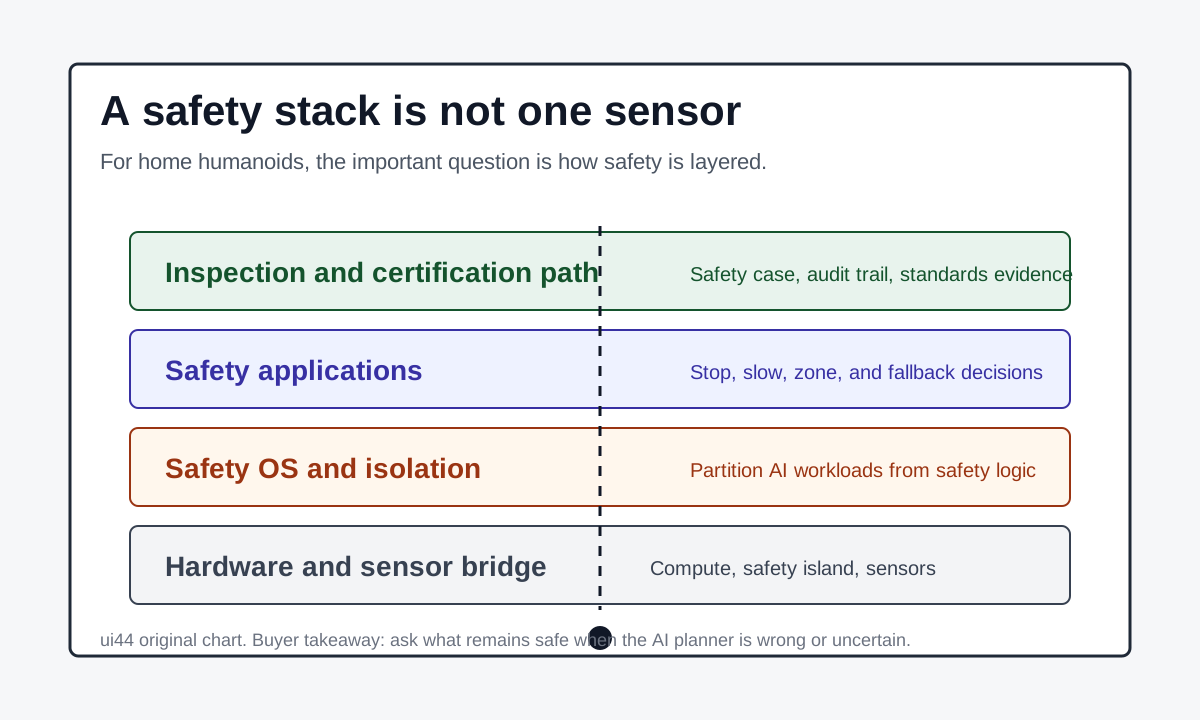
The short version: Halos is a sign that humanoid safety is becoming a platform problem, not a feature checkbox. For home buyers, that is good news, but it also raises the standard for what a serious robot maker should be able to explain.
What NVIDIA Halos Actually Adds
NVIDIA describes Halos for Robotics as a comprehensive safety system for physical AI. The official technical post breaks it into layers: IGX Thor compute and safety at the hardware level, NVIDIA Holoscan Sensor Bridge for sensor connectivity, Halos OS and Halos Core as the safety software foundation, safety applications such as the Outside-In Safety Blueprint, and the Halos AI Systems Inspection Lab for inspection and certification support.
The details are industrial first. NVIDIA says Agility Robotics is incorporating IGX Thor and Halos OS into a safe human detection system for Digit, and joining the Halos AI Systems Inspection Lab. That is about warehouses and factories before it is about kitchens. Still, industrial deployments often become the proving ground for technology that later shows up in consumer-facing products.
The shift is important because humanoid safety cannot depend only on the main AI model "being careful." A vision-language-action model can plan a task, but a safety architecture has to decide what happens when the model is uncertain, late, overconfident, or operating outside its training conditions. In home terms, that means the robot should have an answer for more than "I recognized the cup." It needs an answer for "I lost track of the toddler," "the floor is wet," "the gripper force changed," and "the network camera is no longer trustworthy."
NVIDIA's Outside-In Safety Blueprint is aimed at facilities, using external cameras and AI agents to reason about people, vehicles, regions of interest, and safe operating states. A home version would look different. Few households will install a warehouse-style camera grid just to let a humanoid move faster. But the concept is useful: the robot does not have to rely only on its own onboard sensors. A future home system could combine onboard perception, room sensors, smart-home state, and a certified stop or slow-down pathway.
Why This Is Different From "More Sensors"
Robot spec sheets already list cameras, depth sensors, LiDAR, microphones, tactile skin, force sensors, and emergency stops. Those are necessary, but they are not the same as a safety stack.
A stack answers harder questions. Which software partition is allowed to command a stop? What happens if the AI app crashes but the robot is still balanced? Can the robot detect that a sensor is blocked or producing out-of-distribution data?
It also asks where the boundary sits between safety signals and entertainment, voice, or cloud features. Just as important: is there a test record that a third party can inspect?
This is why NVIDIA's use of autonomous-vehicle language matters. Cars forced the industry to think in safety cases, redundancy, diagnostics, monitoring, and certification evidence. Home robots are smaller than cars, but a 30 kg to 80 kg humanoid still deserves more than a friendly face and a promise.
For buyers, the right takeaway is not "buy the robot with NVIDIA inside." The right takeaway is: ask whether the shipped robot has a safety architecture that can be described clearly. If a company only talks about the foundation model, the demo task, or the number of TOPS, the safety story is incomplete.
The ui44 Robot Database Makes The Risk Visible
The home humanoid category is not one category. The safety problem changes with size, weight, purpose, and sales model.
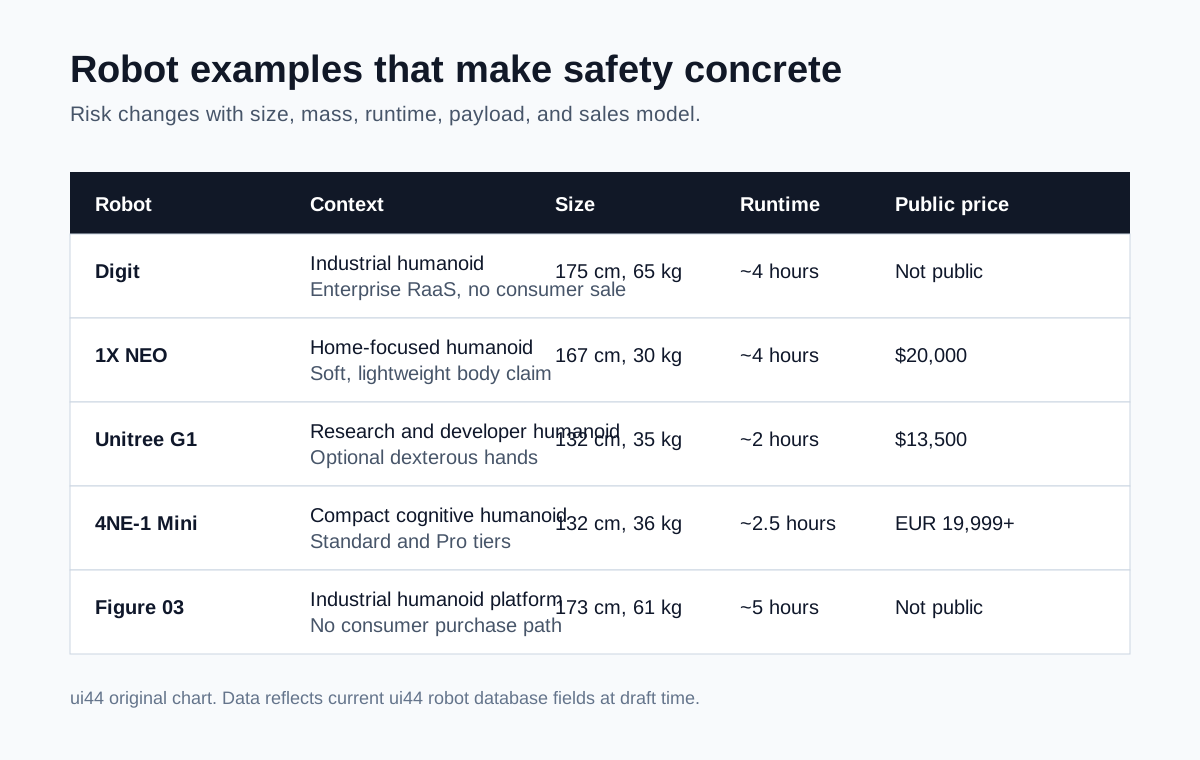
Digit is a 175 cm, 65 kg humanoid with roughly four hours of battery life, but it is not a consumer purchase. ui44 tracks it as an enterprise deployment and RaaS product with no public consumer price. That makes sense for early safety maturation: controlled sites, trained staff, mapped workflows, support contracts, and clearer operational boundaries.
1X NEO is the more home-relevant counterpoint. ui44 lists NEO at $20,000 for early adopters, with a 167 cm, 30 kg body and roughly four hours of battery life. Its pitch is explicitly about safe coexistence in homes, including a soft, lightweight body. That design direction is exactly where a safety stack becomes buyer-visible. A lighter body reduces some hazards, but it does not remove the need for reliable perception, contact limits, task boundaries, and transparent teleoperation policy.
Unitree G1 sits in a different lane. At $13,500, 132 cm, and 35 kg, it is one of the most accessible humanoids in the database, but it is positioned for research and development more than normal household use. The danger for buyers is assuming "available" means "ready to share an apartment." For a developer robot, the safety expectation should be explicit: what is enabled out of the box, what is experimental, and what responsibility shifts to the buyer?
NEURA 4NE-1 Mini is another useful comparison. ui44 lists the Standard tier at EUR 19,999, with a 132 cm, 36 kg body, roughly 2.5 hours of battery life, and a 3 kg payload. NEURA's broader positioning around cognitive robots and human interaction makes safety architecture central, especially if the same family of technology moves between research, education, light service, and domestic environments.
Figure 03 shows the high-end industrial side. The database tracks it as a 173 cm, 61 kg humanoid with roughly five hours of battery life and a 20 kg payload, with no public consumer price. A robot like this can be impressive in a factory and still not be a home product. The safety case for a production cell, pilot line, or logistics workflow is not the same as the safety case for a kitchen.
The pattern is simple: the closer a humanoid gets to unstructured home use, the more buyers should care about safety architecture rather than isolated specs.
What Would A Home Version Of Halos Need To Prove?
NVIDIA's launch is aimed at developers and industrial partners, so it does not instantly solve consumer trust. A credible home humanoid safety story would still need to prove several things in plain language.
First, the robot needs separated safety behavior. If the conversational assistant, task planner, or cloud service fails, the robot should still be able to stop, slow down, lower force, avoid falls, and keep hands away from people. A household should not have to trust that the same model making breakfast suggestions is also the final authority on motion safety.
Second, the robot needs published operating limits. Weight, height, runtime, speed, payload, gripper force, stair behavior, fall recovery, emergency stop access, and battery fault handling should not be buried. When a product page says "safe around people," it should also say under what conditions.
Third, teleoperation has to be disclosed. Teleoperation can make early home robots more useful, especially for complex tasks and care scenarios, but it changes the privacy and safety contract. Buyers should know when a remote human can see through cameras, when they can control motion, how sessions are logged, and what local override exists.
Fourth, updates need a safety story. A robot that changes behavior through over-the-air updates is not like a smart speaker getting a new playlist feature. A policy change can alter navigation, grip strategy, voice response, or escalation behavior. Owners need update notes that distinguish feature changes from safety-critical changes.
Finally, certification claims need configuration detail. "Built on a certified component" is not the same as "the whole robot in this shipped configuration is certified for this use case." Halos could make certification easier by preassessing stack elements, but the end product still has to prove its own integration, application logic, and environment assumptions.
Buyer Checklist: The Questions To Ask
What This Means For The Next Wave Of Home Humanoids
In the near term, Halos will matter most in industrial humanoids, AMRs, and service robots that operate near trained workers. That is where certification budgets, controlled environments, and high-value tasks already exist. Agility Digit is the clean example: real deployments first, then broader platform learning.
For homes, the effect will likely be indirect. Buyers may not see a "Halos for Home" badge on the next robot they compare. But they will see the market adopt some of the same expectations: safety monitoring separated from task planning, better diagnostics, clearer update controls, richer simulation and validation, and more explicit certification language.
This could also sharpen the difference between categories. A compact social robot, a wheeled helper, and a full humanoid should not be judged by the same safety claims. A 10 kg companion robot that mostly speaks and rolls slowly through a room has a different risk profile from a 65 kg humanoid carrying a box. ui44's database already shows that spread, and it will only get wider as prices come down.
The best future for home robots is not the fastest possible arrival of humanoids into apartments. It is the arrival of robots whose limits are clear enough that normal people can trust them. NVIDIA Halos is not that future by itself, but it is a strong signal that the robotics industry is beginning to treat safety as infrastructure.
For buyers watching humanoid robots and companion robots, that is the real story. The question is no longer just "what can this robot do?" It is "what keeps it safe when the demo ends?"
Related in the database
Use this article as a privacy verification workflow
Turn the article into a privacy verification pass grounded in the robots, manufacturers, and components it actually references.
NVIDIA Halos: Safety Stack for Home Humanoids already points you toward 5 linked robots, 5 manufacturers, and 4 countries inside the ui44 database. That matters because strong buyer guidance is easier to apply when you can move immediately from a claim or warning into concrete product pages, manufacturer directories, component explainers, and country-level context instead of treating the article as an isolated opinion piece. The fastest next step is to turn the article into a shortlist workflow: open the linked robot pages, verify which specs are actually published for those models, then compare the surrounding manufacturer and component context before you decide whether the underlying claim changes your buying plan.
For this topic, the useful discipline is to separate the editorial lesson from the catalog evidence. The article gives you the framing, but the robot pages tell you what each product actually ships with today: sensor stack, connectivity methods, listed price, release timing, category, and support-relevant compatibility notes. The manufacturer pages then show whether you are looking at a one-off launch, a broader lineup pattern, or a company that spans multiple categories. That layered workflow reduces the risk of buying on a single marketing phrase or a single support FAQ.
Use the robot pages to confirm which products actually expose cameras, microphones, Wi-Fi, or voice systems, then use the manufacturer pages to decide how much of the privacy question seems product-specific versus brand-wide. On this route cluster, Digit, NEO, and G1 form the fastest reality check. If you want a quick working shortlist, open Compare Digit, NEO, and G1 next, then keep this article open as the reasoning layer while you compare structured data side by side.
Practical Takeaway
Every robot, manufacturer, category, component, and country reference below resolves to a real ui44 page, keeping the follow-up path grounded in database records rather than generic advice.
Suggested next steps in ui44
- Open Digit and note the listed sensors, connectivity methods, and voice stack before you interpret any policy claim.
- Cross-check the wider brand context on Agility so you can see whether the privacy question touches one model or a broader lineup.
- Use the linked component pages to confirm how common the relevant sensors and connectivity layers are across the database.
- Keep a short note of which policy layers you checked, which device features are actually present on the robot page, and which items still depend on region- or app-level confirmation.
- Finish with Compare Digit, NEO, and G1 so the policy reading sits next to structured product data.
Robot profiles worth opening next
Use the linked product pages as the evidence layer
The linked robot pages are where this article becomes operational. Instead of asking whether the headline is interesting, use the robot entries to inspect the actual mix of sensors, connectivity options, batteries, pricing, release timing, and stated capabilities attached to the products mentioned in the article. That is the easiest way to see whether the warning or opportunity described here affects one product family, a specific design pattern, or an entire buying lane.
Digit is tracked on ui44 as a active humanoid robot from Agility. The database currently records a listed price of Price TBA, a release date of 2023, ~4 hours battery life, ~2 hours charging time, and a published stack that includes LiDAR, RGB-D Cameras, and IMU plus Wi-Fi and 5G.
For privacy-focused reading, this page matters because it shows the concrete device surface behind the policy discussion. Use it to verify whether Digit combines sensors and connectivity in a way that could change the in-home data footprint, and compare the listed capabilities such as Box Carrying (16kg), Stair Navigation, and Warehouse Operations with any cloud, app, or voice layers.
NEO
1X Technologies · Humanoid · Pre-order
NEO is tracked on ui44 as a pre-order humanoid robot from 1X Technologies. The database currently records a listed price of $20,000, a release date of 2025-10-28, ~4 hours battery life, Not disclosed charging time, and a published stack that includes RGB Cameras, Depth Sensors, and Tactile Skin plus Wi-Fi and Bluetooth.
For privacy-focused reading, this page matters because it shows the concrete device surface behind the policy discussion. Use it to verify whether NEO combines sensors and connectivity in a way that could change the in-home data footprint, and compare the listed capabilities such as Household Chores, Tidying Up, and Safe Human Interaction with any cloud, app, or voice layers.
G1 is tracked on ui44 as a available humanoid robot from Unitree. The database currently records a listed price of $13,500, a release date of 2024-05-13, ~2 hours battery life, Not disclosed charging time, and a published stack that includes Depth Camera, 3D LiDAR, and 4 Microphone Array plus Wi-Fi 6 and Bluetooth 5.2.
For privacy-focused reading, this page matters because it shows the concrete device surface behind the policy discussion. Use it to verify whether G1 combines sensors and connectivity in a way that could change the in-home data footprint, and compare the listed capabilities such as Bipedal Walking, Object Manipulation, and Dexterous Hands (optional Dex3-1) with any cloud, app, or voice layers.
4NE-1 Mini
NEURA Robotics · Humanoid · Pre-order
4NE-1 Mini is tracked on ui44 as a pre-order humanoid robot from NEURA Robotics. The database currently records a listed price of €19,999, a release date of 2026-01-05, ~2.5 hours battery life, Not disclosed charging time, and a published stack that includes Multi-camera Array, Force/Torque Sensors, and 3D Vision plus Wi-Fi 6 and Gigabit Ethernet.
For privacy-focused reading, this page matters because it shows the concrete device surface behind the policy discussion. Use it to verify whether 4NE-1 Mini combines sensors and connectivity in a way that could change the in-home data footprint, and compare the listed capabilities such as 25 Degrees of Freedom, Autonomous Navigation, and Object Manipulation (Pro tier: 12-DOF dexterous hands) with any cloud, app, or voice layers, including Built-in Multi-language Voice Recognition.
Figure 03 is tracked on ui44 as a active humanoid robot from Figure AI. The database currently records a listed price of Price TBA, a release date of 2025-10-09, ~5 hours battery life, Not disclosed charging time, and a published stack that includes Stereo Vision, Depth Cameras, and Force Sensors plus Wi-Fi and Bluetooth.
For privacy-focused reading, this page matters because it shows the concrete device surface behind the policy discussion. Use it to verify whether Figure 03 combines sensors and connectivity in a way that could change the in-home data footprint, and compare the listed capabilities such as Complex Manipulation, Warehouse Work, and Manufacturing Tasks with any cloud, app, or voice layers.
Manufacturer context behind the article
Check whether this is one product story or a broader company pattern
Manufacturer pages add the privacy context that individual product pages cannot show on their own. They help you check whether cameras, microphones, cloud accounts, app controls, and policy assumptions appear across a broader lineup or stay tied to one specific product story.
Agility
ui44 currently tracks 1 robot from Agility across 1 category. The company is grouped under USA, and the current catalog footprint on ui44 includes Digit.
That wider brand context matters because privacy questions rarely stop at one FAQ page. A manufacturer route helps you see whether the article is centered on one premium model or on a company that has several relevant products and therefore more than one place where the same policy or app assumptions might matter. The category mix here currently points toward Humanoid as the most useful next route if you want to see whether this article reflects a wider pattern inside the brand.
1X Technologies
ui44 currently tracks 2 robots from 1X Technologies across 1 category. The company is grouped under Norway, and the current catalog footprint on ui44 includes NEO, EVE.
That wider brand context matters because privacy questions rarely stop at one FAQ page. A manufacturer route helps you see whether the article is centered on one premium model or on a company that has several relevant products and therefore more than one place where the same policy or app assumptions might matter. The category mix here currently points toward Humanoid as the most useful next route if you want to see whether this article reflects a wider pattern inside the brand.
Unitree
ui44 currently tracks 2 robots from Unitree across 1 category. The company is grouped under China, and the current catalog footprint on ui44 includes H1, G1.
That wider brand context matters because privacy questions rarely stop at one FAQ page. A manufacturer route helps you see whether the article is centered on one premium model or on a company that has several relevant products and therefore more than one place where the same policy or app assumptions might matter. The category mix here currently points toward Humanoid as the most useful next route if you want to see whether this article reflects a wider pattern inside the brand.
NEURA Robotics
ui44 currently tracks 4 robots from NEURA Robotics across 3 categorys. The company is grouped under Germany, and the current catalog footprint on ui44 includes 4NE-1, 4NE-1 Mini, MiPA.
That wider brand context matters because privacy questions rarely stop at one FAQ page. A manufacturer route helps you see whether the article is centered on one premium model or on a company that has several relevant products and therefore more than one place where the same policy or app assumptions might matter. The category mix here currently points toward Humanoid, Home Assistants, Quadruped as the most useful next route if you want to see whether this article reflects a wider pattern inside the brand.
Broaden the scan without leaving the database
Categories, components, and countries add the wider context
Category framing
Category pages are useful when the article touches a buying pattern that shows up across brands. A category route helps you confirm whether the linked products sit in a narrow niche or whether the same question should be tested across a larger field of alternatives.
Humanoid
The Humanoid category page currently groups 129 tracked robots from 92 manufacturers. ui44 describes this lane as: Full-size bipedal humanoid robots built to work alongside people — from factory floors to household tasks. Compare the cutting edge of humanoid robotics.
That makes the category route a practical follow-up when you want to check whether the products linked in this article are typical for the lane or whether they sit at one edge of the market. Useful starting examples currently include NEO, EVE, Mornine M1.
Companions
The Companions category page currently groups 53 tracked robots from 48 manufacturers. ui44 describes this lane as: Social robots, robot pets, and elderly-care companions designed for emotional connection and everyday support at home.
That makes the category route a practical follow-up when you want to check whether the products linked in this article are typical for the lane or whether they sit at one edge of the market. Useful starting examples currently include PARO, Abi, Next-Generation Companion Robot.
Country and ecosystem context
Country pages give extra context when support practices, launch sequencing, regulatory posture, or manufacturer mix matter. They are not a substitute for model-level verification, but they do help you see which ecosystems cluster together and which manufacturers sit in the same regional field when you broaden the search beyond the article headline.
USA
The USA route currently groups 89 tracked robots from 69 manufacturers in ui44. That gives you a useful regional lens when the article points toward support practices, launch sequencing, or brand clusters that may share similar ecosystem assumptions.
On the current route, manufacturers like Faraday Future, iRobot, Boston Dynamics make the page a good way to broaden the scan without losing the regional context that often shapes availability, documentation style, and adjacent alternatives.
Norway
The Norway route currently groups 2 tracked robots from 1 manufacturers in ui44. That gives you a useful regional lens when the article points toward support practices, launch sequencing, or brand clusters that may share similar ecosystem assumptions.
On the current route, manufacturers like 1X Technologies make the page a good way to broaden the scan without losing the regional context that often shapes availability, documentation style, and adjacent alternatives.
China
The China route currently groups 189 tracked robots from 87 manufacturers in ui44. That gives you a useful regional lens when the article points toward support practices, launch sequencing, or brand clusters that may share similar ecosystem assumptions.
On the current route, manufacturers like AGIBOT, Dreame, Unitree Robotics make the page a good way to broaden the scan without losing the regional context that often shapes availability, documentation style, and adjacent alternatives.
Questions to answer before you move from reading to buying
A follow-up FAQ built from the entities already linked in this article
Frequently Asked Questions
Which page should I open first after reading “NVIDIA Halos: Safety Stack for Home Humanoids”?
Start with Digit. That gives you a concrete product anchor for the article’s main claim. From there, branch into the manufacturer and component pages so you can tell whether the article is describing one specific model, a repeated brand pattern, or a wider technology issue that affects multiple shortlist options.
How do the manufacturer pages change the buying decision?
Agility help you zoom out from one article and one product. On ui44 they show lineup breadth, category spread, and the neighboring robots tied to the same company. That context is useful when you are deciding whether a risk belongs to a single model, whether it shows up across a brand’s portfolio, and whether you should keep looking at alternatives before committing.
When should I switch from reading to side-by-side comparison?
Move into Compare Digit, NEO, and G1 as soon as you understand the article’s main warning or promise. The article explains what to watch for, but the compare view is where you can check whether price, status, battery life, connectivity, sensors, and category fit still make the robot a good match for your own home and budget.
Where to go next in ui44
Keep the research chain inside the database
If you want to keep going, these follow-on pages give you the cleanest expansion path from article to research session. Open the comparison route first if you are deciding between products today. Open the manufacturer, category, and component routes if you still need to understand the broader pattern behind the claim.
Written by
ui44 Team
Published July 4, 2026
Share this article
Open a plain share link on X or Bluesky. No embeds, no widgets, no cookie baggage.