That is a manufacturing question, but not only a manufacturing question. A factory that can assemble thousands of robots per year is necessary. It is not sufficient. Homes also require low failure rates, quiet operation, safe batteries, responsive service, data controls, spare parts, software updates, and a clear answer to what happens when a 60 kg machine falls, jams a finger, loses calibration, or cannot finish a chore.
The short version: humanoids can scale, but "millions of homes" is still a much harder claim than "thousands of robots." The strongest near-term signals are coming from companies that talk about factories, yield, field service, fleet management, batteries, and end-of-line testing as much as they talk about AI demos.
Can humanoid robots scale to millions of homes?
Yes, eventually. But the first useful wave will probably look less like a phone launch and more like a managed robotics deployment.
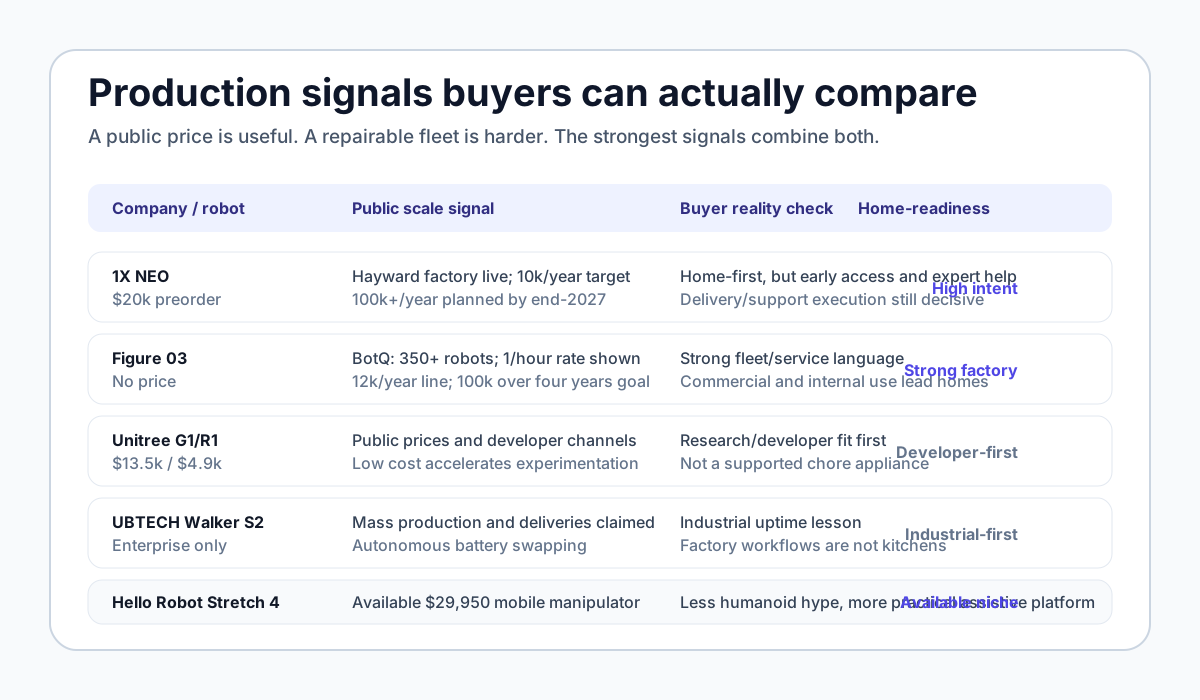
1X NEO is the clearest home-first case in the ui44 database. It is listed as a $20,000 preorder home humanoid with a soft body, roughly 30 kg weight, about 4 hours of runtime, and a 2025 preorder launch. 1X says its NEO Factory in Hayward, California is a 58,000 sq ft vertically integrated humanoid factory with more than 200 employees, current full-scale production, capacity for up to 10,000 NEOs per year, and a planned path toward 100,000+ units annually by the end of 2027 as automation increases and a San Carlos facility comes online.

Those are serious numbers for a home robot company. They also prove how early the category is. A 10,000-unit annual capacity would be huge for home humanoids, yet tiny compared with mature consumer electronics, appliances, or cars. A 100,000-unit annual target would make 1X one of the first real home-humanoid manufacturers, not a mass-market appliance supplier.
Figure 03 makes the same point from the other direction. Figure says BotQ, its high-volume manufacturing facility, has delivered 350+ Figure 03 robots, moved from one robot per day to one robot per hour, uses more than 150 networked workstations, has 50+ in-process inspection points, has achieved more than 80% end-of-line first-pass yield, produced 9,000+ actuators, shipped 500+ battery packs, and runs 80+ functional verification tests per robot.

That is the language buyers should want to see. It is not just "watch our robot fold laundry." It is supplier qualification, inspection, burn-in, fleet health, OTA updates, recall campaigns, and field service. Those are the boring systems that make a robot less likely to become an expensive stranded object.
What does "scale" actually mean for a home robot?
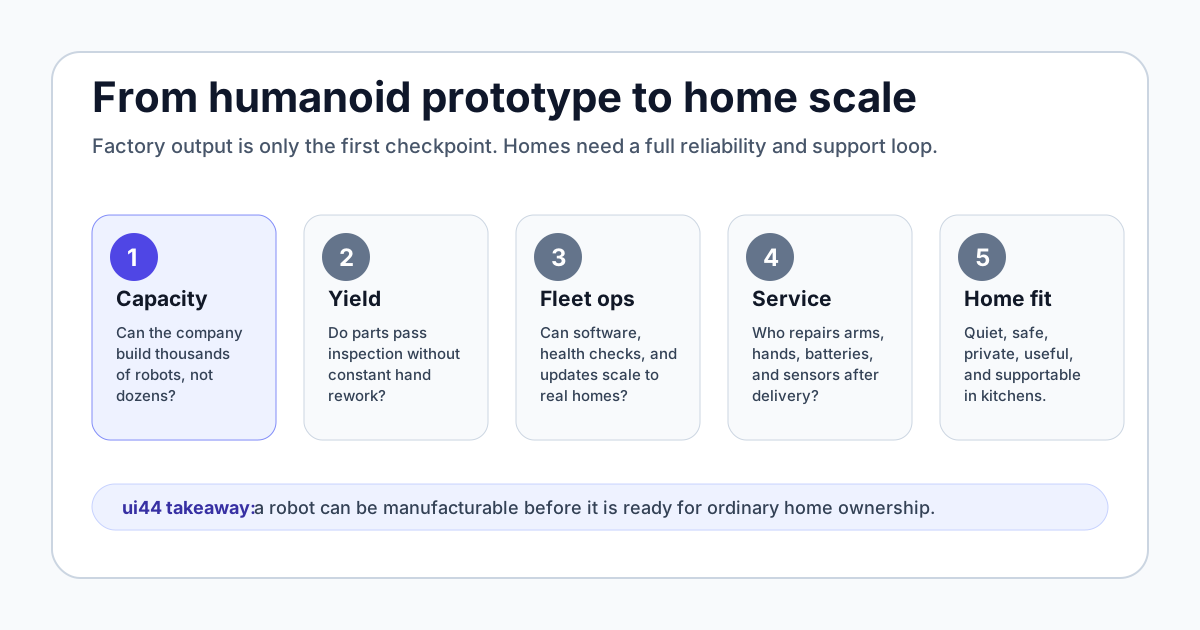
A humanoid robot reaches home scale only when five gates are open at the same time.
Scale gate
Manufacturing capacity
- What buyers should ask
- Can the company build thousands of identical units, not hand-finished demos?
- Why it matters at home
- Delivery promises mean little if every robot is a prototype.
Scale gate
Yield and quality
- What buyers should ask
- Does the company disclose inspection, first-pass yield, burn-in, or reliability testing?
- Why it matters at home
- A home robot has many motors, sensors, hands, batteries, and covers that can fail.
Scale gate
Fleet operations
- What buyers should ask
- Are OTA updates, diagnostics, logs, rollback, and health monitoring part of the plan?
- Why it matters at home
- A robot that learns and changes after purchase needs safe software operations.
Scale gate
Service network
- What buyers should ask
- Who repairs it, where, how fast, and at what cost?
- Why it matters at home
- Shipping a humanoid back for every fault will not feel like appliance ownership.
Scale gate
Home fit
- What buyers should ask
- Is it quiet, safe, private, physically small enough, and useful without constant expert help?
- Why it matters at home
- Homes are cluttered, emotional, and unforgiving; reliability is personal.
| Scale gate | What buyers should ask | Why it matters at home |
|---|---|---|
| Manufacturing capacity | Can the company build thousands of identical units, not hand-finished demos? | Delivery promises mean little if every robot is a prototype. |
| Yield and quality | Does the company disclose inspection, first-pass yield, burn-in, or reliability testing? | A home robot has many motors, sensors, hands, batteries, and covers that can fail. |
| Fleet operations | Are OTA updates, diagnostics, logs, rollback, and health monitoring part of the plan? | A robot that learns and changes after purchase needs safe software operations. |
| Service network | Who repairs it, where, how fast, and at what cost? | Shipping a humanoid back for every fault will not feel like appliance ownership. |
| Home fit | Is it quiet, safe, private, physically small enough, and useful without constant expert help? | Homes are cluttered, emotional, and unforgiving; reliability is personal. |
This is why a single impressive spec is not enough. Unitree G1 starts around $13,500, stands 132 cm tall, weighs 35 kg, offers around 2 hours of battery life, and is actually available as a developer/research platform. Unitree R1 pushes the entry price even lower, with an R1 Air presale from $4,900 and a standard R1 at $5,900. Those prices matter because lower-cost hardware creates more developers, more experiments, and more real-world failures to learn from.
But low price is not the same as supported home autonomy. G1 and R1 are exciting because they make humanoid experimentation more accessible. They are not evidence that a normal buyer can outsource dishes, laundry, and elder care next quarter.
Which manufacturing claims matter most?
The best claims are specific enough to be checked later.
1X is making a home-first promise: NEO is marketed for chores, expert-assisted learning, and early access in actual homes. The company says preorders filled the next year of production capacity in five days, equal to 10,000 NEOs, and that the current production ramp prioritizes internal team use, home testing, and eventual customer delivery. That tells buyers two things at once: demand is real, and the early product is still being staged carefully.
Figure is making a fleet-first promise: Figure 03 is designed for Helix, home use, mass manufacturing, and commercial deployments, but the company is unusually explicit that scale is useful because more robots produce more data, more failure cases, and more operational feedback. BotQ matters less as a brag about output and more as a data engine. More robots mean more broken parts, more service tickets, more OTA updates, and more chances to discover what fails outside a lab.
The International Federation of Robotics is more cautious. In its 2026 robotics trends, IFR says humanoids moving beyond prototypes must prove reliability and efficiency against industrial requirements such as cycle times, energy consumption, maintenance costs, safety, durability, and consistent performance. In its China strategy note, IFR is even blunter: broad adoption of universal humanoid factory helpers or private-household humanoids is not expected in the near- or medium-term future.
That caution is not anti-humanoid. It is the difference between a technology that can work and a product category that ordinary people can own.
What does the ui44 database say about price and readiness?
The ui44 database shows a market splitting into three lanes: low-cost developer humanoids, industrial/commercial humanoids, and a small number of home-intent robots.
Robot
- Status in ui44
- Pre-order
- Public price signal
- from $4,900
- Useful scale lesson
- Low-cost humanoids will expand developer testing before they solve chores.
Robot
- Status in ui44
- Available
- Public price signal
- from $13,500
- Useful scale lesson
- Accessible research hardware is not the same as home support.
Robot
- Status in ui44
- Pre-order
- Public price signal
- $20,000 early-adopter price
- Useful scale lesson
- The clearest home-first scaling bet, but early access is still a managed rollout.
Robot
- Status in ui44
- Pre-order
- Public price signal
- €19,999 standard tier
- Useful scale lesson
- Western-made compact humanoids are appearing, but support and use cases matter.
Robot
- Status in ui44
- Pre-order
- Public price signal
- from 180,000 yuan
- Useful scale lesson
- Full-size humanoid pricing is falling, especially in China.
Robot
- Status in ui44
- Available
- Public price signal
- $29,900 base model
- Useful scale lesson
- Full-size pricing can be lower than expected, but home autonomy is not implied.
Robot
- Status in ui44
- Available
- Public price signal
- $29,950
- Useful scale lesson
- A non-humanoid mobile manipulator may be more practical for assistive pilots.
Robot
- Status in ui44
- Active
- Public price signal
- enterprise pricing
- Useful scale lesson
- Autonomous battery swapping is a serious uptime idea, but aimed at factories first.
| Robot | Status in ui44 | Public price signal | Useful scale lesson |
|---|---|---|---|
| Unitree R1 | Pre-order | from $4,900 | Low-cost humanoids will expand developer testing before they solve chores. |
| Unitree G1 | Available | from $13,500 | Accessible research hardware is not the same as home support. |
| 1X NEO | Pre-order | $20,000 early-adopter price | The clearest home-first scaling bet, but early access is still a managed rollout. |
| NEURA 4NE-1 Mini | Pre-order | €19,999 standard tier | Western-made compact humanoids are appearing, but support and use cases matter. |
| EngineAI T800 | Pre-order | from 180,000 yuan | Full-size humanoid pricing is falling, especially in China. |
| Unitree H2 | Available | $29,900 base model | Full-size pricing can be lower than expected, but home autonomy is not implied. |
| Hello Robot Stretch 4 | Available | $29,950 | A non-humanoid mobile manipulator may be more practical for assistive pilots. |
| UBTECH Walker S2 | Active | enterprise pricing | Autonomous battery swapping is a serious uptime idea, but aimed at factories first. |
There is a pattern here. Prices are moving down faster than reliability evidence is moving up. That is normal. Hardware becomes purchasable before the service model becomes boring.
For buyers, the most important row may be Hello Robot Stretch 4. It is not a humanoid, but it is an available mobile manipulator with an 8-hour light-load runtime, a 45 cm footprint, ROS 2/Python tooling, 3D SLAM, self-charging, and in-home assistive pilot positioning. It is less cinematic than a walking humanoid, but it shows why form factor matters. The shortest path to useful home help may not always be a human-shaped body.
Why are homes harder than factories?
Factories are structured. Homes are personal.
A factory robot can be surrounded by trained staff, mapped workflows, known objects, marked floors, safety cages, fixed stations, and maintenance windows. A home robot has to deal with pets, children, half-open drawers, wet floors, socks under tables, bad Wi-Fi, family privacy expectations, fragile heirlooms, and a buyer who does not want to become a robotics technician.
That difference changes the definition of success. For a home humanoid, scale means:
- enough battery life to finish useful work without becoming a charging chore;
- a hand and arm design that can survive thousands of awkward grasps;
- service that covers motors, tendons, sensors, batteries, covers, and calibration;
- clear privacy controls for cameras, audio, maps, remote help, and training data;
- software updates that improve ability without breaking known routines;
- support staff who can diagnose problems remotely without taking over the home;
- safety behavior that works when humans behave unpredictably.
This is where UBTECH Walker S2 is worth watching even if it is not a home product. Its autonomous hot-swappable dual-battery system is designed for near-continuous industrial operation, with a battery swap in about three minutes and a 15 kg payload. That is not a kitchen feature today. But uptime thinking is exactly what future home robots will need if buyers expect them to do more than perform short demos.

What should buyers watch before placing a deposit?
If you are considering a home humanoid preorder, ignore the most viral demo and look for operational proof.
Ask these questions:
- How many robots have shipped outside the company? Internal fleet size matters, but external customers reveal support problems faster.
- Is there a service plan? Look for repair locations, swap programs, parts pricing, warranty scope, and response times.
- What happens after a failed chore? 1X talks openly about Expert Mode for tasks NEO does not know. That is more honest than pretending full autonomy is solved.
- Are software updates described as a fleet process? Figure's language around OTA updates, recall campaigns, fleet management, and field-service loops is a useful benchmark.
- Does the company publish boring reliability metrics? Inspection points, first-pass yield, battery certifications, burn-in tests, and cycle counts are better signs than another dance video.
- Is the robot actually aimed at homes? Apptronik Apollo, EngineAI T800, AGIBOT A2 Ultra, and AGIBOT X2 are important humanoids, but much of their public positioning is industrial, logistics, service, research, or commercial interaction first.
The best buyer posture in 2026 is optimistic skepticism. The manufacturing curve is real. The public prices are getting more serious. The AI systems are improving. But a home robot is not finished when it leaves the assembly line. It is finished when the company can keep it useful, safe, repaired, updated, and understandable for years.
The realistic timeline
For the next couple of years, expect three different markets to coexist.
First, developer and research humanoids will keep getting cheaper. Unitree R1, Unitree G1, NEURA 4NE-1 Mini, and similar platforms will put more hardware into labs, universities, startups, and advanced hobbyist spaces. That is good for the whole field, but most buyers should not confuse it with an appliance market.
Second, industrial and commercial humanoids will absorb the first serious production lessons. Figure 03, UBTECH Walker S2, Apptronik Apollo, EngineAI T800, AGIBOT A2 Ultra, and Unitree H2 all point toward factories, logistics, inspection, services, and data collection before broad domestic use. These deployments are less emotionally exciting than a robot folding laundry at home, but they are where uptime, service, liability, and workflow integration can mature.
Third, home-first robots will arrive in controlled waves. 1X NEO is the clearest example: it has a home message, a preorder, a factory story, and explicit acknowledgement that expert help and ongoing learning are part of the early product. That is probably what responsible home scale looks like at first: limited, expensive, assisted, and updated frequently.
The conclusion is not that home humanoids are fake. It is that scale is a stack, not a slogan. The winners will not be the companies with the flashiest walking demo. They will be the companies that can make the hundred-thousandth robot feel less risky than the hundredth.
For now, use ui44's robot database, comparison tools, and category pages like Humanoid robots to separate three things that are often blurred together: a robot you can buy, a robot that can be manufactured, and a robot that is truly ready to live in your home.
Related in the database
Use this article as a privacy verification workflow
Turn the article into a privacy verification pass grounded in the robots, manufacturers, and components it actually references.
Can Humanoid Robots Really Scale to Homes? already points you toward 12 linked robots, 10 manufacturers, and 4 countries inside the ui44 database. That matters because strong buyer guidance is easier to apply when you can move immediately from a claim or warning into concrete product pages, manufacturer directories, component explainers, and country-level context instead of treating the article as an isolated opinion piece. The fastest next step is to turn the article into a shortlist workflow: open the linked robot pages, verify which specs are actually published for those models, then compare the surrounding manufacturer and component context before you decide whether the underlying claim changes your buying plan.
For this topic, the useful discipline is to separate the editorial lesson from the catalog evidence. The article gives you the framing, but the robot pages tell you what each product actually ships with today: sensor stack, connectivity methods, listed price, release timing, category, and support-relevant compatibility notes. The manufacturer pages then show whether you are looking at a one-off launch, a broader lineup pattern, or a company that spans multiple categories. That layered workflow reduces the risk of buying on a single marketing phrase or a single support FAQ.
Use the robot pages to confirm which products actually expose cameras, microphones, Wi-Fi, or voice systems, then use the manufacturer pages to decide how much of the privacy question seems product-specific versus brand-wide. On this route cluster, NEO, Figure 03, and G1 form the fastest reality check. If you want a quick working shortlist, open Compare NEO, Figure 03, and G1 next, then keep this article open as the reasoning layer while you compare structured data side by side.
Practical Takeaway
Every robot, manufacturer, category, component, and country reference below resolves to a real ui44 page, keeping the follow-up path grounded in database records rather than generic advice.
Suggested next steps in ui44
- Open NEO and note the listed sensors, connectivity methods, and voice stack before you interpret any policy claim.
- Cross-check the wider brand context on 1X Technologies so you can see whether the privacy question touches one model or a broader lineup.
- Use the linked component pages to confirm how common the relevant sensors and connectivity layers are across the database.
- Keep a short note of which policy layers you checked, which device features are actually present on the robot page, and which items still depend on region- or app-level confirmation.
- Finish with Compare NEO, Figure 03, and G1 so the policy reading sits next to structured product data.
Robot profiles worth opening next
Use the linked product pages as the evidence layer
The linked robot pages are where this article becomes operational. Instead of asking whether the headline is interesting, use the robot entries to inspect the actual mix of sensors, connectivity options, batteries, pricing, release timing, and stated capabilities attached to the products mentioned in the article. That is the easiest way to see whether the warning or opportunity described here affects one product family, a specific design pattern, or an entire buying lane.
NEO
1X Technologies · Humanoid · Pre-order
NEO is tracked on ui44 as a pre-order humanoid robot from 1X Technologies. The database currently records a listed price of $20,000, a release date of 2025-10-28, ~4 hours battery life, Not disclosed charging time, and a published stack that includes RGB Cameras, Depth Sensors, and Tactile Skin plus Wi-Fi and Bluetooth.
For privacy-focused reading, this page matters because it shows the concrete device surface behind the policy discussion. Use it to verify whether NEO combines sensors and connectivity in a way that could change the in-home data footprint, and compare the listed capabilities such as Household Chores, Tidying Up, and Safe Human Interaction with any cloud, app, or voice layers.
Figure 03 is tracked on ui44 as a active humanoid robot from Figure AI. The database currently records a listed price of Price TBA, a release date of 2025-10-09, ~5 hours battery life, Not disclosed charging time, and a published stack that includes Stereo Vision, Depth Cameras, and Force Sensors plus Wi-Fi and Bluetooth.
For privacy-focused reading, this page matters because it shows the concrete device surface behind the policy discussion. Use it to verify whether Figure 03 combines sensors and connectivity in a way that could change the in-home data footprint, and compare the listed capabilities such as Complex Manipulation, Warehouse Work, and Manufacturing Tasks with any cloud, app, or voice layers.
G1 is tracked on ui44 as a available humanoid robot from Unitree. The database currently records a listed price of $13,500, a release date of 2024-05-13, ~2 hours battery life, Not disclosed charging time, and a published stack that includes Depth Camera, 3D LiDAR, and 4 Microphone Array plus Wi-Fi 6 and Bluetooth 5.2.
For privacy-focused reading, this page matters because it shows the concrete device surface behind the policy discussion. Use it to verify whether G1 combines sensors and connectivity in a way that could change the in-home data footprint, and compare the listed capabilities such as Bipedal Walking, Object Manipulation, and Dexterous Hands (optional Dex3-1) with any cloud, app, or voice layers.
R1
Unitree Robotics · Humanoid · Pre-order
R1 is tracked on ui44 as a pre-order humanoid robot from Unitree Robotics. The database currently records a listed price of $4,900, a release date of 2025, ~1 hour (mixed activity) battery life, Not officially disclosed charging time, and a published stack that includes Monocular camera (R1 Air); binocular camera (R1/R1 EDU), 4-Mic Array, and Dual 6-Axis IMU plus Wi-Fi 6 and Bluetooth 5.2.
For privacy-focused reading, this page matters because it shows the concrete device surface behind the policy discussion. Use it to verify whether R1 combines sensors and connectivity in a way that could change the in-home data footprint, and compare the listed capabilities such as Bipedal Walking & Running, Cartwheels & Handstands, and Push Recovery with any cloud, app, or voice layers, including UnifoLM (voice + image commands).
4NE-1 Mini
NEURA Robotics · Humanoid · Pre-order
4NE-1 Mini is tracked on ui44 as a pre-order humanoid robot from NEURA Robotics. The database currently records a listed price of €19,999, a release date of 2026-01-05, ~2.5 hours battery life, Not disclosed charging time, and a published stack that includes Multi-camera Array, Force/Torque Sensors, and 3D Vision plus Wi-Fi 6 and Gigabit Ethernet.
For privacy-focused reading, this page matters because it shows the concrete device surface behind the policy discussion. Use it to verify whether 4NE-1 Mini combines sensors and connectivity in a way that could change the in-home data footprint, and compare the listed capabilities such as 25 Degrees of Freedom, Autonomous Navigation, and Object Manipulation (Pro tier: 12-DOF dexterous hands) with any cloud, app, or voice layers, including Built-in Multi-language Voice Recognition.
Manufacturer context behind the article
Check whether this is one product story or a broader company pattern
Manufacturer pages add the privacy context that individual product pages cannot show on their own. They help you check whether cameras, microphones, cloud accounts, app controls, and policy assumptions appear across a broader lineup or stay tied to one specific product story.
1X Technologies
ui44 currently tracks 2 robots from 1X Technologies across 1 category. The company is grouped under Norway, and the current catalog footprint on ui44 includes NEO, EVE.
That wider brand context matters because privacy questions rarely stop at one FAQ page. A manufacturer route helps you see whether the article is centered on one premium model or on a company that has several relevant products and therefore more than one place where the same policy or app assumptions might matter. The category mix here currently points toward Humanoid as the most useful next route if you want to see whether this article reflects a wider pattern inside the brand.
Figure AI
ui44 currently tracks 2 robots from Figure AI across 1 category. The company is grouped under USA, and the current catalog footprint on ui44 includes Figure 03, Figure 02.
That wider brand context matters because privacy questions rarely stop at one FAQ page. A manufacturer route helps you see whether the article is centered on one premium model or on a company that has several relevant products and therefore more than one place where the same policy or app assumptions might matter. The category mix here currently points toward Humanoid as the most useful next route if you want to see whether this article reflects a wider pattern inside the brand.
Unitree
ui44 currently tracks 2 robots from Unitree across 1 category. The company is grouped under China, and the current catalog footprint on ui44 includes H1, G1.
That wider brand context matters because privacy questions rarely stop at one FAQ page. A manufacturer route helps you see whether the article is centered on one premium model or on a company that has several relevant products and therefore more than one place where the same policy or app assumptions might matter. The category mix here currently points toward Humanoid as the most useful next route if you want to see whether this article reflects a wider pattern inside the brand.
Unitree Robotics
ui44 currently tracks 9 robots from Unitree Robotics across 3 categorys. The company is grouped under China, and the current catalog footprint on ui44 includes B2, B1, Go2.
That wider brand context matters because privacy questions rarely stop at one FAQ page. A manufacturer route helps you see whether the article is centered on one premium model or on a company that has several relevant products and therefore more than one place where the same policy or app assumptions might matter. The category mix here currently points toward Quadruped, Humanoid, Research as the most useful next route if you want to see whether this article reflects a wider pattern inside the brand.
Broaden the scan without leaving the database
Categories, components, and countries add the wider context
Category framing
Category pages are useful when the article touches a buying pattern that shows up across brands. A category route helps you confirm whether the linked products sit in a narrow niche or whether the same question should be tested across a larger field of alternatives.
Humanoid
The Humanoid category page currently groups 129 tracked robots from 92 manufacturers. ui44 describes this lane as: Full-size bipedal humanoid robots built to work alongside people — from factory floors to household tasks. Compare the cutting edge of humanoid robotics.
That makes the category route a practical follow-up when you want to check whether the products linked in this article are typical for the lane or whether they sit at one edge of the market. Useful starting examples currently include NEO, EVE, Mornine M1.
Home Assistants
The Home Assistants category page currently groups 16 tracked robots from 14 manufacturers. ui44 describes this lane as: Arm-based household helpers — laundry folders, kitchen robots, and mobile manipulators that take on hands-on physical tasks around the home.
That makes the category route a practical follow-up when you want to check whether the products linked in this article are typical for the lane or whether they sit at one edge of the market. Useful starting examples currently include Robody, Futuring 2 (F2), Stretch 3.
Country and ecosystem context
Country pages give extra context when support practices, launch sequencing, regulatory posture, or manufacturer mix matter. They are not a substitute for model-level verification, but they do help you see which ecosystems cluster together and which manufacturers sit in the same regional field when you broaden the search beyond the article headline.
Norway
The Norway route currently groups 2 tracked robots from 1 manufacturers in ui44. That gives you a useful regional lens when the article points toward support practices, launch sequencing, or brand clusters that may share similar ecosystem assumptions.
On the current route, manufacturers like 1X Technologies make the page a good way to broaden the scan without losing the regional context that often shapes availability, documentation style, and adjacent alternatives.
USA
The USA route currently groups 89 tracked robots from 69 manufacturers in ui44. That gives you a useful regional lens when the article points toward support practices, launch sequencing, or brand clusters that may share similar ecosystem assumptions.
On the current route, manufacturers like Faraday Future, iRobot, Boston Dynamics make the page a good way to broaden the scan without losing the regional context that often shapes availability, documentation style, and adjacent alternatives.
China
The China route currently groups 189 tracked robots from 87 manufacturers in ui44. That gives you a useful regional lens when the article points toward support practices, launch sequencing, or brand clusters that may share similar ecosystem assumptions.
On the current route, manufacturers like AGIBOT, Dreame, Unitree Robotics make the page a good way to broaden the scan without losing the regional context that often shapes availability, documentation style, and adjacent alternatives.
Questions to answer before you move from reading to buying
A follow-up FAQ built from the entities already linked in this article
Frequently Asked Questions
Which page should I open first after reading “Can Humanoid Robots Really Scale to Homes?”?
Start with NEO. That gives you a concrete product anchor for the article’s main claim. From there, branch into the manufacturer and component pages so you can tell whether the article is describing one specific model, a repeated brand pattern, or a wider technology issue that affects multiple shortlist options.
How do the manufacturer pages change the buying decision?
1X Technologies help you zoom out from one article and one product. On ui44 they show lineup breadth, category spread, and the neighboring robots tied to the same company. That context is useful when you are deciding whether a risk belongs to a single model, whether it shows up across a brand’s portfolio, and whether you should keep looking at alternatives before committing.
When should I switch from reading to side-by-side comparison?
Move into Compare NEO, Figure 03, and G1 as soon as you understand the article’s main warning or promise. The article explains what to watch for, but the compare view is where you can check whether price, status, battery life, connectivity, sensors, and category fit still make the robot a good match for your own home and budget.
Where to go next in ui44
Keep the research chain inside the database
If you want to keep going, these follow-on pages give you the cleanest expansion path from article to research session. Open the comparison route first if you are deciding between products today. Open the manufacturer, category, and component routes if you still need to understand the broader pattern behind the claim.
Written by
ui44 Team
Published May 17, 2026
Share this article
Open a plain share link on X or Bluesky. No embeds, no widgets, no cookie baggage.