The more interesting part is the software stack. Enactic says it is launching Japan's first real-world validation of NVIDIA Isaac GR00T N1.7 for nursing care, and its own site positions Ena Beta for late 2026 with more than 70 Japanese care facilities involved in shaping the program. This is still a facility trial, not a retail home robot. But it is one of the clearest signals that the next serious home-robot leap may come from care environments before it comes from apartments.
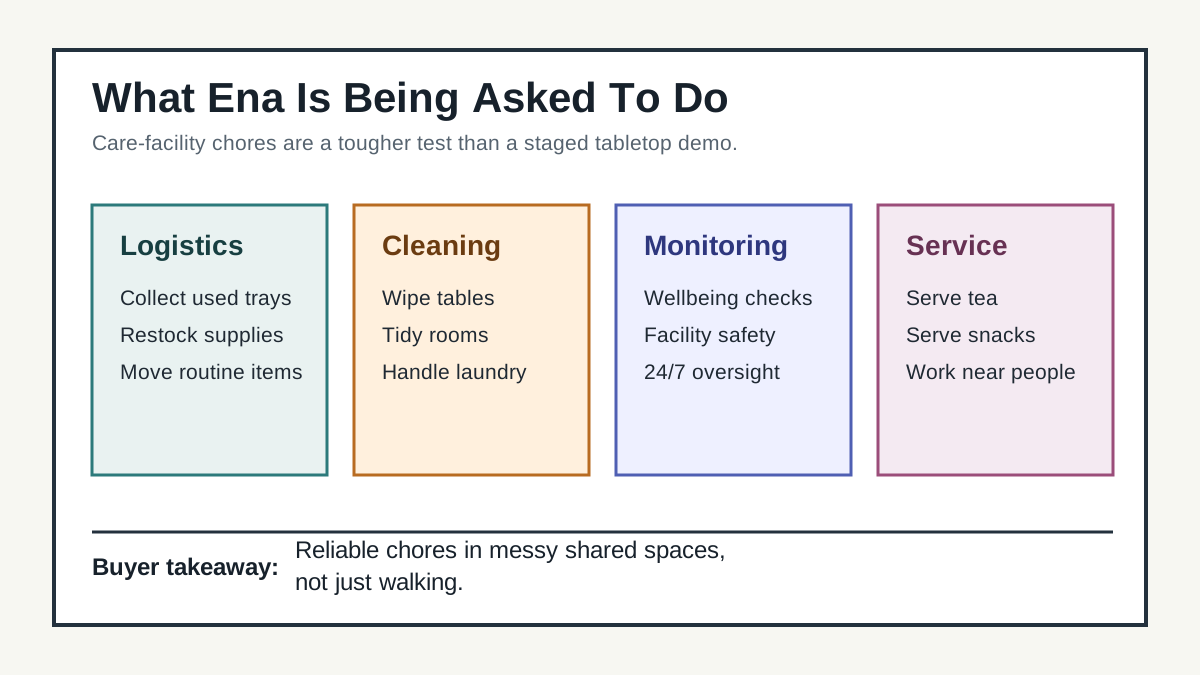
The buyer takeaway is simple: do not judge Ena by whether it can walk across a stage. Judge it by whether it can do boring, repeated, interruptible chores around fragile people and cluttered objects.
Why a care facility is a serious test
Most home-robot demos are too clean. A robot picks up one object from a table, waves, opens a door, or follows a scripted voice command. A care facility is less forgiving. Meal trays move at different times. Laundry is soft and deformable. Tables are wet or sticky. Supplies run low. People walk into the robot's path. A resident may need attention before the robot has finished its task.
That makes Ena's initial market more relevant to future homes than it may look at first. A care facility is not a private apartment, but it shares several home-robot problems: narrow hallways, human unpredictability, non-standard objects, social expectations, and a very low tolerance for risky motion. If a humanoid can prove value there, the evidence is more meaningful than a lab clip.
It also changes the kind of questions buyers should ask. "Can it walk?" is the least interesting one. A facility-grade care robot has to answer:
- Can it understand a multi-step chore without a human micromanaging every motion?
- Can it recover when an item is not where it was expected?
- Can it work near people without creating more supervision burden?
- Can staff audit what it did and override it quickly?
- Can the operator maintain the robot over years, not weeks?
Those questions map directly to home adoption. A household robot that saves 15 minutes but needs 20 minutes of setup is a novelty. A robot that reliably handles the same low-glamour chores every day becomes infrastructure.
What GR00T N1.7 adds
NVIDIA describes Isaac GR00T N1.7 as an open, commercially licensed vision-language-action model for humanoid robots. The important phrase is not "foundation model." It is "vision-language-action." For a physical robot, intelligence has to end in motor commands, not just text.
GR00T N1.7 uses a two-layer approach: a higher-level vision-language model for task reasoning and a lower-level diffusion transformer that turns robot state and visual observations into continuous actions. NVIDIA says the model is 3 billion parameters, supports fine-tuning with the LeRobot dataset format, and has been validated across locomotion-plus-manipulation and bimanual tasks on platforms including Unitree G1 and AGIBot Genie 1.
The most relevant detail for care and home robots is the training source. NVIDIA says N1.7 uses more than 20,000 hours of human egocentric video across task categories including healthcare and home environments. The bet is that first-person human video can teach useful manipulation priors faster than collecting every skill through robot teleoperation. If that works, a care robot could learn the shape of tasks like wiping, carrying, and folding before each facility trains it on local details.
That does not make Ena ready for your kitchen. It does make the trial worth watching because it tests whether a general humanoid policy can survive contact with repetitive care work.
The ui44 comparison: facility robot, home robot, or research platform?
Ena sits between three categories already visible in the ui44 database.
First are home-facing humanoids such as 1X NEO. NEO is listed at $20,000 in the ui44 database and is aimed at household chores, tidying, safe human interaction, adaptive learning, and gentle manipulation. That is the direct consumer dream: a robot sold for the home, with chores as the product.
Second are affordable humanoid research platforms such as Unitree G1. The database lists Unitree G1 at $13,500 with bipedal walking, object manipulation, optional dexterous hands, secondary development, and OTA upgrades. G1 matters because GR00T N1.7 is explicitly connected to Unitree G1 validation and fine-tuning examples. It is a developer bridge, not a finished care product.
Third are deployed service robots such as Diligent Moxi. Moxi is a hospital logistics robot, not a home humanoid, but its capabilities are instructive: indoor navigation, medication and lab-sample delivery, supply transport, elevator and door workflows, and site-specific adaptation. Moxi shows what real institutional deployment often looks like: modest tasks, clear workflows, and heavy integration with staff routines.
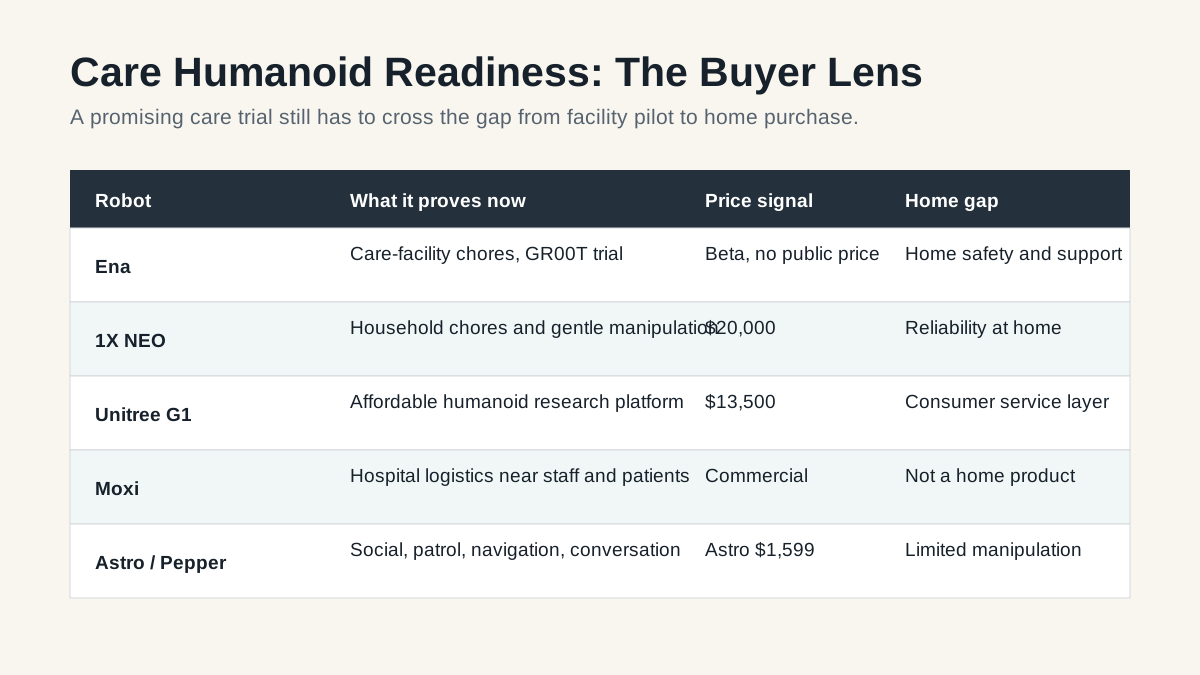
There are also cautionary examples. Amazon Astro, listed at $1,599, can patrol, video call, recognize people, integrate with Alexa and Ring, and navigate room to room. It is home-relevant but not manipulation-heavy. Pepper proved that social presence and conversation do not automatically create durable household utility. Figure 02, Fourier GR-1, and AGIBOT G1 show how much humanoid capability is still aimed at factories, research, or commercial pilots before ordinary homes.
That is the frame for Ena. The headline is not that a humanoid exists. The headline is that a company is trying to connect a modern VLA model, open-source arm research, and real care-facility workflows.
What would make the trial meaningful?
The public claims are promising, but the useful evidence will be operational. A care robot trial should not be judged only by a highlight reel. It should publish or at least be able to explain:
- Task completion rate by chore, not one blended success number
- Human intervention rate per hour
- Near-miss and emergency-stop events
- Time saved for staff after setup and supervision are included
- How often the robot needs charging, cleaning, recalibration, or remote support
- What happens when objects, rooms, and schedules change
For future home buyers, the intervention rate may be the single most important metric. A robot that fails gracefully and asks for help once a shift is different from a robot that requires constant shadowing. The same is true at home: a robot that folds three towels but knocks over one glass has not solved laundry.
The other key metric is local adaptation. Homes are not standardized. Neither are care facilities. If Ena can move from one site to another with limited retraining, that would say something meaningful about GR00T-style models. If each deployment requires months of custom engineering, the technology may still be valuable, but it is not close to consumer scale.
What this means for home robot buyers
If you are waiting for a home humanoid, Ena is a reason to be interested, not a reason to preorder blindly. The likely path is not "facility trial today, home robot tomorrow." It is more likely:
- Prove repetitive care-facility chores under supervision.
- Turn the best chores into reliable service packages.
- Reduce hardware cost and maintenance burden.
- Add stronger user controls, audit logs, and household safety rules.
- Only then move toward private-home pilots.
That path is slower than the hype cycle, but healthier. Homes need boring reliability. Care facilities can expose problems earlier because staff, schedules, and workflows are more structured than a private household while still being much more realistic than a lab.
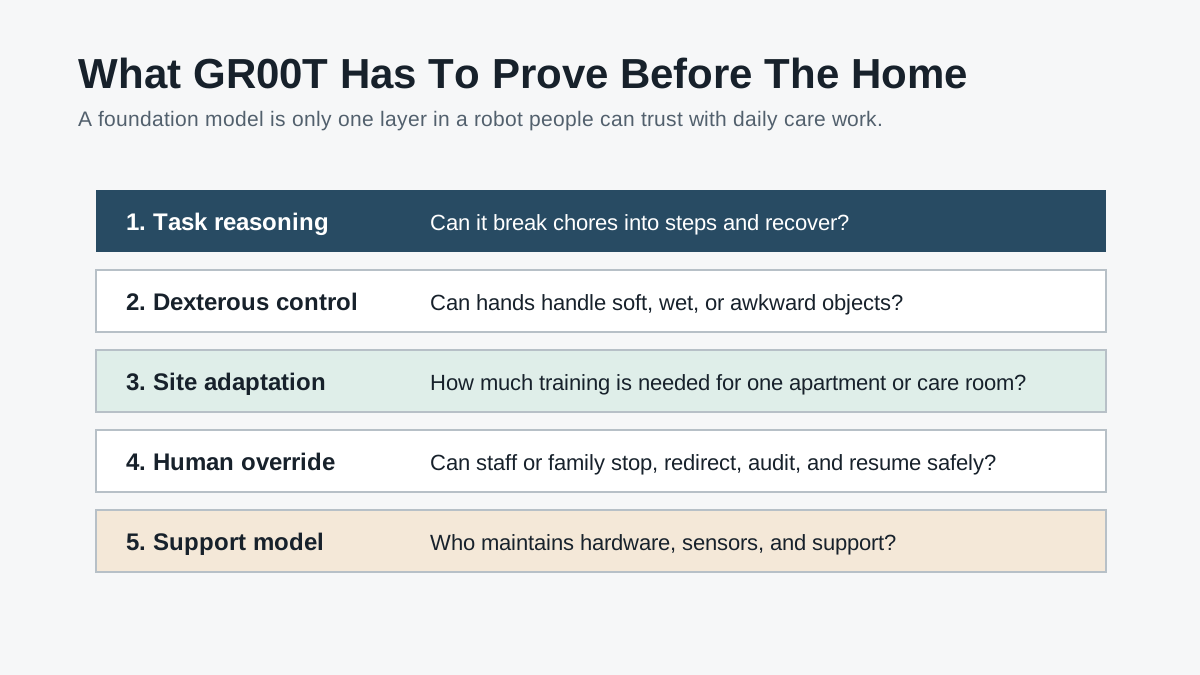
There is also a buying lesson here: separate the body from the service. A humanoid body with a strong model is still not a product unless someone can install it, maintain it, insure it, update it, and support the human workflow around it. This is where companies with care-facility relationships may have an advantage over pure demo-first humanoid teams.
The bottom line
Enactic's Ena trial is worth watching because it asks the right question: can a humanoid handle practical care work in a real environment, not just perform an isolated robot trick? NVIDIA GR00T N1.7 gives the software story more weight, especially because it focuses on reasoning, dexterous manipulation, and scaling from human egocentric video. Enactic's open-source OpenArm work also suggests the company is building from a research ecosystem rather than treating the robot as a closed prop.
For home robot buyers, the honest conclusion is measured optimism. If Ena succeeds, the first win may be care-facility logistics, cleaning, monitoring, and service tasks. The home version would still need better price visibility, safety certification, support, and proof that it can work in a private household without turning the owner into a robot technician.
That is still progress. The home robot market does not need another humanoid promise. It needs proof that robots can take over ordinary chores in ordinary spaces. A care facility is a good place to start finding out.
Database context
Use this article as a buyer workflow
Turn the article into a real verification pass
Enactic Ena: What GR00T Means for Home Robots already points you toward 8 linked robots, 8 manufacturers, and 4 countries inside the ui44 database. That matters because strong buyer guidance is easier to apply when you can move immediately from a claim or warning into concrete product pages, manufacturer directories, component explainers, and country-level context instead of treating the article as an isolated opinion piece. The fastest next step is to turn the article into a shortlist workflow: open the linked robot pages, verify which specs are actually published for those models, then compare the surrounding manufacturer and component context before you decide whether the underlying claim changes your buying plan.
For this topic, the useful discipline is to separate the editorial lesson from the catalog evidence. The article gives you the framing, but the robot pages tell you what each product actually ships with today: sensor stack, connectivity methods, listed price, release timing, category, and support-relevant compatibility notes. The manufacturer pages then show whether you are looking at a one-off launch, a broader lineup pattern, or a company that spans multiple categories. That layered workflow reduces the risk of buying on a single marketing phrase or a single support FAQ.
The fastest win is to keep the article’s editorial framing tied to real product pages. That way you can test whether NEO, G1, and Moxi still make sense once price, category, release timing, and surrounding manufacturer context are visible in one place. If you want a quick working shortlist, open Compare NEO, G1, and Moxi next, then keep this article open as the reasoning layer while you compare structured data side by side.
Practical Takeaway
Every robot, manufacturer, category, component, and country reference below resolves to a real ui44 page, keeping the follow-up path grounded in database records rather than generic advice.
Suggested next steps in ui44
- Open NEO first so the article’s main point is anchored to a real robot page.
- Use 1X Technologies to see the broader company context around the products linked in the article.
- Open the linked component pages when you want to separate a shared technology pattern from a single-brand story.
- Build a working shortlist with Compare NEO, G1, and Moxi.
- Keep a short note of what is already verified in the article and what still needs live confirmation from current vendor documentation.
Database context
Robot profiles worth opening next
Use the linked product pages as the evidence layer
The linked robot pages are where this article becomes operational. Instead of asking whether the headline is interesting, use the robot entries to inspect the actual mix of sensors, connectivity options, batteries, pricing, release timing, and stated capabilities attached to the products mentioned in the article. That is the easiest way to see whether the warning or opportunity described here affects one product family, a specific design pattern, or an entire buying lane.
NEO
1X Technologies · Humanoid · Pre-order
NEO is tracked on ui44 as a pre-order humanoid robot from 1X Technologies. The database currently records a listed price of $20,000, a release date of 2025-10-28, ~4 hours battery life, Not disclosed charging time, and a published stack that includes RGB Cameras, Depth Sensors, and Tactile Skin plus Wi-Fi and Bluetooth.
For general buyer research, this route gives you the concrete profile that the article alone cannot. Compare the published capabilities of Household Chores, Tidying Up, and Safe Human Interaction with the linked alternatives so the final decision is based on actual product fit, not just the framing of the article.
G1 is tracked on ui44 as a available humanoid robot from Unitree. The database currently records a listed price of $13,500, a release date of 2024-05-13, ~2 hours battery life, Not disclosed charging time, and a published stack that includes Depth Camera, 3D LiDAR, and 4 Microphone Array plus Wi-Fi 6 and Bluetooth 5.2.
For general buyer research, this route gives you the concrete profile that the article alone cannot. Compare the published capabilities of Bipedal Walking, Object Manipulation, and Dexterous Hands (optional Dex3-1) with the linked alternatives so the final decision is based on actual product fit, not just the framing of the article.
Moxi
Diligent Robotics · Commercial · Active
Moxi is tracked on ui44 as a active commercial robot from Diligent Robotics. The database currently records a listed price of Price TBA, a release date of 2019, Not publicly disclosed battery life, Not publicly disclosed charging time, and a published stack that includes Vision and perception sensor suite (details not publicly disclosed) and Hospital navigation and obstacle-avoidance sensing plus Wi-Fi (hospital network deployment).
For general buyer research, this route gives you the concrete profile that the article alone cannot. Compare the published capabilities of Autonomous indoor navigation in hospitals, Medication and lab sample delivery, and Patient-supply transport with the linked alternatives so the final decision is based on actual product fit, not just the framing of the article.
Astro is tracked on ui44 as a active security & patrol robot from Amazon. The database currently records a listed price of $1,599, a release date of 2021, Not officially disclosed battery life, Not officially disclosed charging time, and a published stack that includes 5MP Bezel Camera, 1080p Periscope Camera (132° FOV), and Infrared Vision plus Wi-Fi 802.11ac and Bluetooth.
For general buyer research, this route gives you the concrete profile that the article alone cannot. Compare the published capabilities of Autonomous Home Patrol, Visual ID (face recognition), and Remote Home Monitoring with the linked alternatives so the final decision is based on actual product fit, not just the framing of the article.
Pepper
Aldebaran Robotics · Commercial · Available
Pepper is tracked on ui44 as a available commercial robot from Aldebaran Robotics. The database currently records a listed price of Price TBA, a release date of 2014-06, ~12 hours (shop use) battery life, ~8 hours 20 minutes charging time, and a published stack that includes RGB Camera ×2 (forehead + mouth), 3D Depth Sensor, and Microphone ×4 plus Wi-Fi 802.11 a/b/g/n (2.4/5 GHz) and Ethernet.
For general buyer research, this route gives you the concrete profile that the article alone cannot. Compare the published capabilities of Emotion Recognition, Facial Expression Analysis, and Natural Conversation with the linked alternatives so the final decision is based on actual product fit, not just the framing of the article.
Database context
Manufacturer context behind the article
Check whether this is one product story or a broader company pattern
Manufacturer pages add the market context that individual product pages cannot show on their own. They help you check whether the article is centered on a brand with a deep lineup, whether that brand spans several categories, and how much of its ui44 footprint depends on one flagship model versus a broader product strategy.
1X Technologies
ui44 currently tracks 2 robots from 1X Technologies across 1 category. The company is grouped under Norway, and the current catalog footprint on ui44 includes NEO, EVE.
That wider brand context matters because the best buying decision usually depends on lineup depth and adjacent options, not just the one model featured most prominently in the article. The category mix here currently points toward Humanoid as the most useful next route if you want to see whether this article reflects a wider pattern inside the brand.
Unitree
ui44 currently tracks 2 robots from Unitree across 1 category. The company is grouped under China, and the current catalog footprint on ui44 includes H1, G1.
That wider brand context matters because the best buying decision usually depends on lineup depth and adjacent options, not just the one model featured most prominently in the article. The category mix here currently points toward Humanoid as the most useful next route if you want to see whether this article reflects a wider pattern inside the brand.
Diligent Robotics
ui44 currently tracks 1 robot from Diligent Robotics across 1 category. The company is grouped under USA, and the current catalog footprint on ui44 includes Moxi.
That wider brand context matters because the best buying decision usually depends on lineup depth and adjacent options, not just the one model featured most prominently in the article. The category mix here currently points toward Commercial as the most useful next route if you want to see whether this article reflects a wider pattern inside the brand.
Amazon
ui44 currently tracks 1 robot from Amazon across 1 category. The company is grouped under USA, and the current catalog footprint on ui44 includes Astro.
That wider brand context matters because the best buying decision usually depends on lineup depth and adjacent options, not just the one model featured most prominently in the article. The category mix here currently points toward Security & Patrol as the most useful next route if you want to see whether this article reflects a wider pattern inside the brand.
Database context
Broaden the scan without leaving the database
Categories, components, and countries add the wider context
Category framing
Category pages are useful when the article touches a buying pattern that shows up across brands. A category route helps you confirm whether the linked products sit in a narrow niche or whether the same question should be tested across a larger field of alternatives.
Humanoid
The Humanoid category page currently groups 111 tracked robots from 81 manufacturers. ui44 describes this lane as: Full-size bipedal humanoid robots designed to work alongside humans. From factory floors to household tasks, these machines represent the cutting edge of robotics.
That makes the category route a practical follow-up when you want to check whether the products linked in this article are typical for the lane or whether they sit at one edge of the market. Useful starting examples currently include NEO, EVE, Mornine M1.
Commercial
The Commercial category page currently groups 37 tracked robots from 31 manufacturers. ui44 describes this lane as: Delivery robots, warehouse automation, hospitality service bots, and other robots built for business operations.
That makes the category route a practical follow-up when you want to check whether the products linked in this article are typical for the lane or whether they sit at one edge of the market. Useful starting examples currently include G2 Air, aeo, Pepper.
Country and ecosystem context
Country pages give extra context when support practices, launch sequencing, regulatory posture, or manufacturer mix matter. They are not a substitute for model-level verification, but they do help you see which ecosystems cluster together and which manufacturers sit in the same regional field when you broaden the search beyond the article headline.
Norway
The Norway route currently groups 2 tracked robots from 1 manufacturers in ui44. That gives you a useful regional lens when the article points toward support practices, launch sequencing, or brand clusters that may share similar ecosystem assumptions.
On the current route, manufacturers like 1X Technologies make the page a good way to broaden the scan without losing the regional context that often shapes availability, documentation style, and adjacent alternatives.
China
The China route currently groups 171 tracked robots from 79 manufacturers in ui44. That gives you a useful regional lens when the article points toward support practices, launch sequencing, or brand clusters that may share similar ecosystem assumptions.
On the current route, manufacturers like Dreame, AGIBOT, Unitree Robotics make the page a good way to broaden the scan without losing the regional context that often shapes availability, documentation style, and adjacent alternatives.
USA
The USA route currently groups 78 tracked robots from 62 manufacturers in ui44. That gives you a useful regional lens when the article points toward support practices, launch sequencing, or brand clusters that may share similar ecosystem assumptions.
On the current route, manufacturers like iRobot, Boston Dynamics, Faraday Future make the page a good way to broaden the scan without losing the regional context that often shapes availability, documentation style, and adjacent alternatives.
Database context
Questions to answer before you move from reading to buying
A follow-up FAQ built from the entities already linked in this article
Frequently Asked Questions
Which page should I open first after reading “Enactic Ena: What GR00T Means for Home Robots”?
Start with NEO. That gives you a concrete product anchor for the article’s main claim. From there, branch into the manufacturer and component pages so you can tell whether the article is describing one specific model, a repeated brand pattern, or a wider technology issue that affects multiple shortlist options.
How do the manufacturer pages change the buying decision?
1X Technologies help you zoom out from one article and one product. On ui44 they show lineup breadth, category spread, and the neighboring robots tied to the same company. That context is useful when you are deciding whether a risk belongs to a single model, whether it shows up across a brand’s portfolio, and whether you should keep looking at alternatives before committing.
When should I switch from reading to side-by-side comparison?
Move into Compare NEO, G1, and Moxi as soon as you understand the article’s main warning or promise. The article explains what to watch for, but the compare view is where you can check whether price, status, battery life, connectivity, sensors, and category fit still make the robot a good match for your own home and budget.
Database context
Where to go next in ui44
Keep the research chain inside the database
If you want to keep going, these follow-on pages give you the cleanest expansion path from article to research session. Open the comparison route first if you are deciding between products today. Open the manufacturer, category, and component routes if you still need to understand the broader pattern behind the claim.
Written by
ui44 Team
Published June 8, 2026
Share this article
Open a plain share link on X or Bluesky. No embeds, no widgets, no cookie baggage.