That does not make X1 a robot you should expect to order for your kitchen next week. In the ui44 database, MagicBot X1 belongs in the same bucket as many serious 2026 humanoids: technically interesting, strategically important, and still missing the buyer facts that matter most.
The short version: MagicBot X1 is a credible signal that MagicLab wants to move beyond robot demos into real deployment categories. But for home buyers, the most useful reading is not "when can I buy it?" It is: what evidence would make this more than a summit prototype?
What MagicLab actually announced
MagicLab used its Global Embodied Intelligence Summit in Silicon Valley to announce three linked pieces: Magic-Mix, its foundational world model; H01, an advanced dexterous hand; and MagicBot X1, a flagship humanoid robot designed for real-world application integration.
The company-issued launch release says MagicLab has a full-stack product ecosystem across humanoid and quadruped robots, spanning manufacturing, commercial services, and home environments. It also says MagicLab operated in more than 50 countries and regions in 2025, with international markets accounting for 60% of sales. That matters because home robotics is not only a robot problem. It is also a distribution, service, compliance, and support problem.
The bigger strategic claims are ambitious. MagicLab says it is targeting a path toward $14 billion in annual revenue by 2036 and plans to invest $1 billion over five years in a robotics developer ecosystem through its "Co-Create 1000 Initiative." Partners named in the launch materials include Openmind, PrismaX AI, Cosmicbrain AI, and Physis.
For a buyer, those numbers should not be treated as proof that a home robot is ready. They are useful because they show how MagicLab wants X1 to be read: not as a one-off humanoid, but as the top of a broader hardware, software, and developer stack.
What MagicBot X1 specs matter for home buyers?
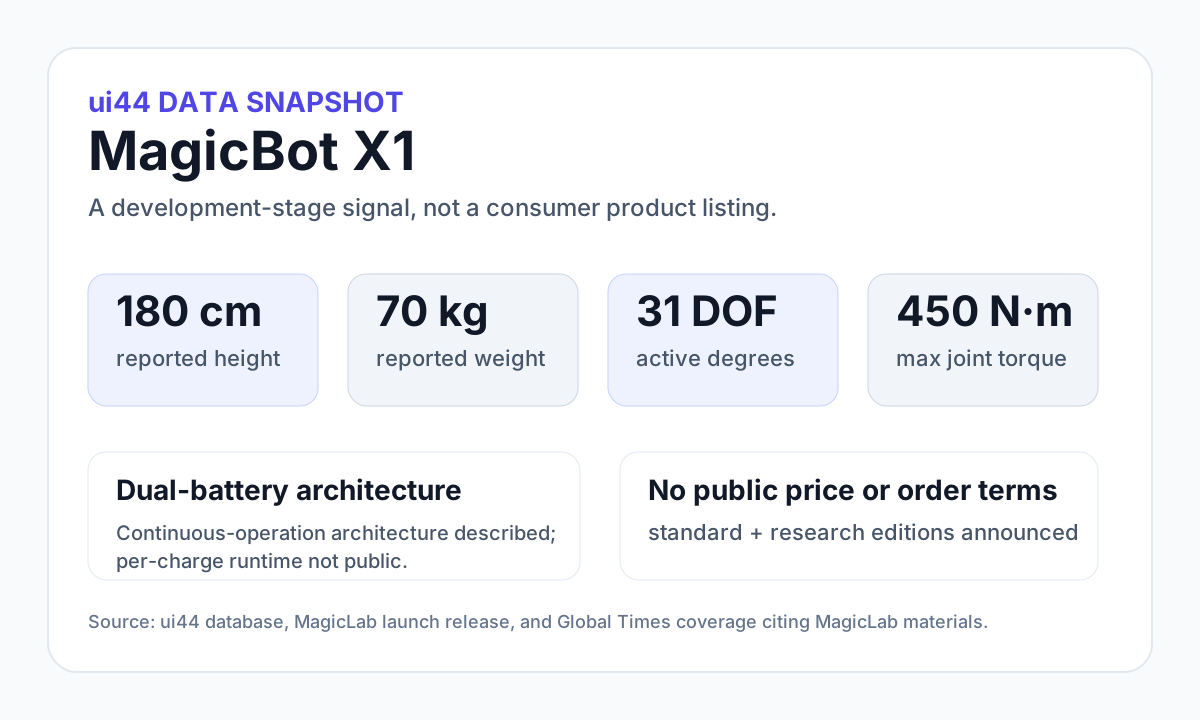
The ui44 database currently tracks MagicBot X1 as a development-stage humanoid, not a consumer product. Public pricing, order terms, shipping regions, detailed sensor specs, and per-charge runtime have not been disclosed.
The disclosed and reported X1 numbers are still worth comparing:
Robot
- Height
- 180 cm
- Weight
- 70 kg
- DOF / motion
- 31 active DOF; 450 N·m max joint torque
- Price status
- Not public
- Home-buyer takeaway
- Serious full-size humanoid signal, but not buyable yet
Robot
- Height
- 174 cm
- Weight
- ~70 kg
- DOF / motion
- 42 active DOF; 7.5 kg single-arm load
- Price status
- Not public
- Home-buyer takeaway
- Earlier MagicLab platform with clearer spec sheet
Robot
- Height
- 136.9 cm
- Weight
- ~40 kg
- DOF / motion
- 24 DOF standard; up to 50 DOF dev version
- Price status
- Not public
- Home-buyer takeaway
- Smaller research and education humanoid
Robot
- Height
- 56 cm standing
- Weight
- 15.8 kg
- DOF / motion
- 13 DOF quadruped; 3.0 m/s
- Price status
- Not public
- Home-buyer takeaway
- Companion-style quadruped, closer to consumer framing
| Robot | Height | Weight | DOF / motion | Price status | Home-buyer takeaway |
|---|---|---|---|---|---|
| MagicBot X1 | 180 cm | 70 kg | 31 active DOF; 450 N·m max joint torque | Not public | Serious full-size humanoid signal, but not buyable yet |
| MagicBot Gen1 | 174 cm | ~70 kg | 42 active DOF; 7.5 kg single-arm load | Not public | Earlier MagicLab platform with clearer spec sheet |
| MagicBot Z1 | 136.9 cm | ~40 kg | 24 DOF standard; up to 50 DOF dev version | Not public | Smaller research and education humanoid |
| MagicDog | 56 cm standing | 15.8 kg | 13 DOF quadruped; 3.0 m/s | Not public | Companion-style quadruped, closer to consumer framing |
Global Times coverage citing MagicLab materials reports X1 at 180 cm, 70 kg, 31 active degrees of freedom, and 450 N·m maximum joint torque. It also reports motion speed more than 30% faster than MagicBot Gen1, with range of motion increased by more than 50% versus Gen1. Those are meaningful engineering claims, but they are not the same as household task reliability.
The dual-battery claim needs similar care. MagicLab materials describe a battery system intended for continuous operation and 24/7 deployment. That does not tell a buyer whether one battery lasts 90 minutes, three hours, or five hours under real household manipulation. Until per-charge runtime is published, ui44 treats this as an architecture claim, not a runtime guarantee.
Why Magic-Mix is the real story
The most interesting part of the X1 announcement may not be the robot body. It may be MagicLab's Magic-Mix world model.
Global Times describes Magic-Mix as combining WAM, a decision engine, with Creator, a data engine. The idea is a closed loop: generate or collect training data, use it to improve embodied decisions, execute through robot hardware, and feed results back into the system. MagicLab's president Gu Shitao was quoted saying the company collects about 16,000 data entries per day and has a high-quality dataset exceeding 1 million hours.
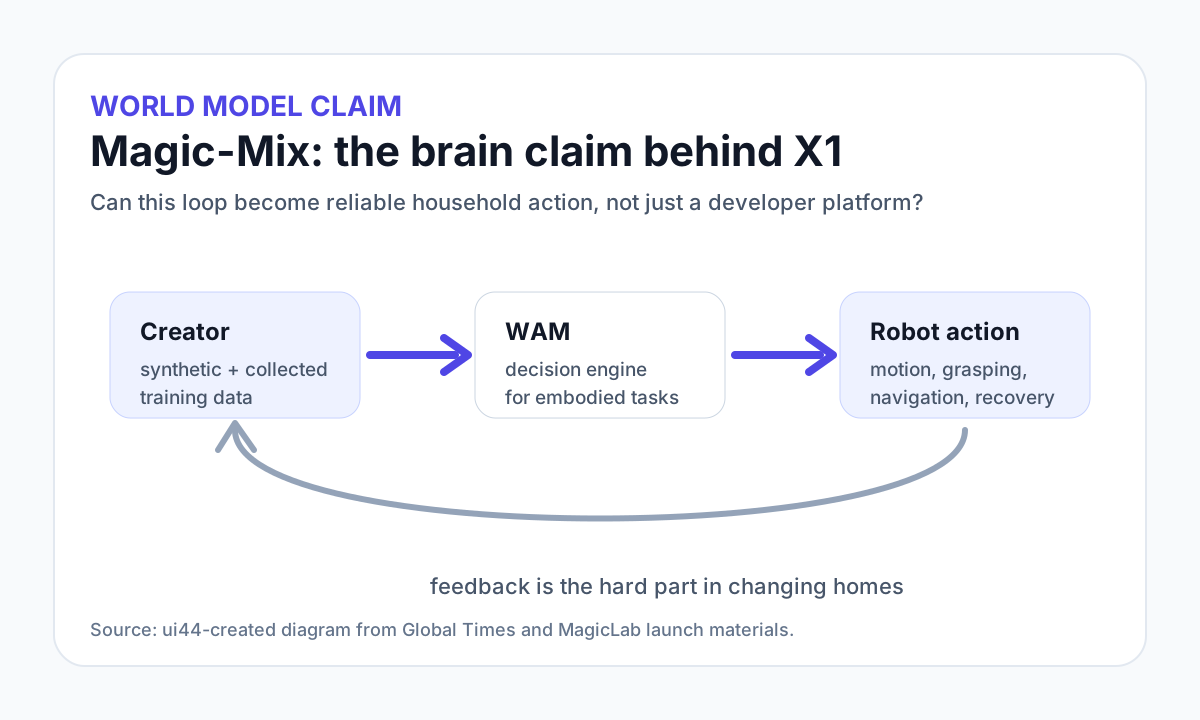
That is important because home robots fail in the messy middle. They do not fail because they cannot say "I see a mug." They fail because the mug is near the edge of a crowded counter, the lighting is poor, the handle faces the wrong way, the cabinet is half-open, and the person expects the robot to recover gracefully when the first grasp fails.
A world model is supposed to help connect perception, planning, action, and feedback. In plain English: the robot should not merely recognize a scene; it should understand enough about physical consequences to choose safer next moves.
But the same caveat applies here as with VLA models. A model name is not a chore result. The buyer evidence would be repeated, uncut demonstrations of home-like multi-step tasks: pick up mixed objects, open doors or drawers, avoid pets and people, ask for help when uncertain, and verify that the job was actually done.
H01 is the hand clue
MagicLab also announced the H01 dexterous hand, and that may be the most practical clue for home use. Global Times says H01 has 20 degrees of freedom and 44 high-precision tactile sensors, with millimeter-level closed-loop response and safety features for close-range interaction.
That is the right direction. For homes, hands matter more than stage walking. Walking gets a humanoid into the room. Hands let it pick up socks, hold a mug, turn a handle, pull a drawer, or avoid crushing a paper bag.
The current X1 public spec does not yet explain whether H01 is the default X1 hand, an option, a research accessory, or a separate platform component. That distinction matters. A humanoid with a sophisticated hand in a lab demo is very different from a household robot that ships with tactile manipulation, warranty coverage, replacement parts, and clear safety limits.
ui44's bias here is simple: if a company wants home buyers to take manipulation claims seriously, it should publish boring details. Payload at the wrist. Grip force limits. Tactile resolution. Failure recovery. What happens when it drops something. How it handles wet objects, soft objects, sharp objects, and unknown objects.
How X1 compares with the current home-humanoid field
MagicBot X1 is entering a crowded, uneven field. Some competitors are priced. Some are home-focused. Some have stronger industrial evidence. Almost none are ordinary household products yet.
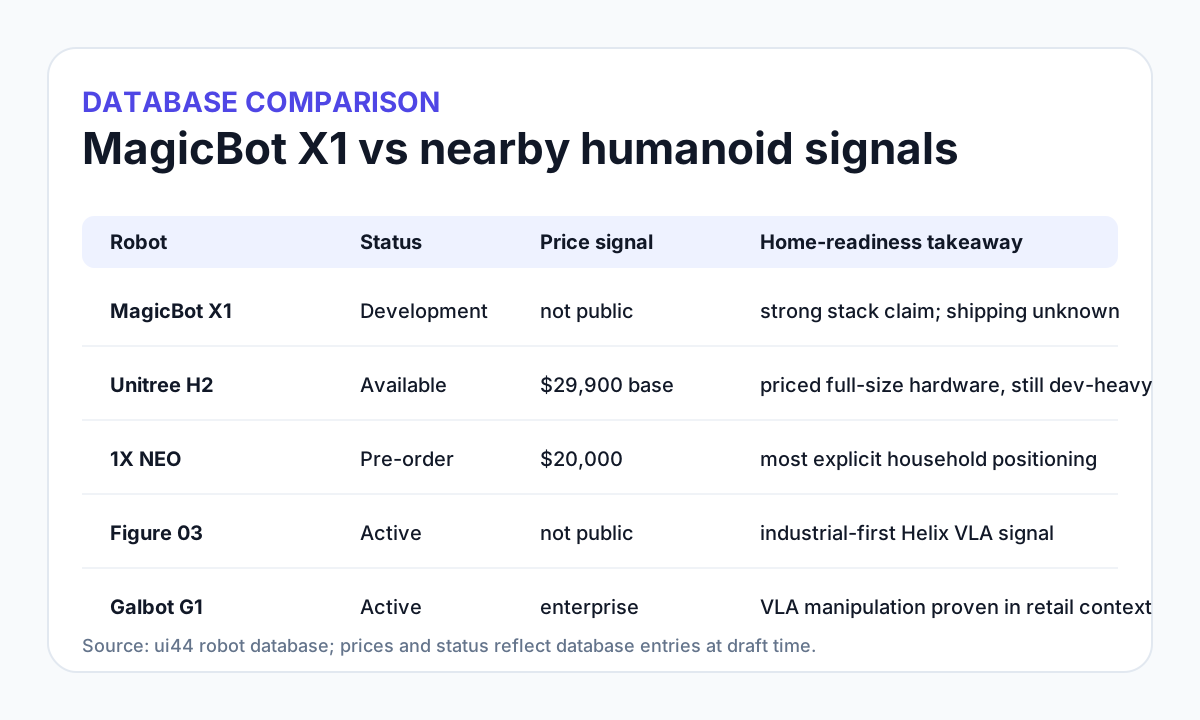
A few comparisons make the state of the market clearer:
- 1X NEO is the most explicitly home-positioned humanoid in the database, with a listed early-adopter price of $20,000, a soft lightweight body, and roughly 4 hours of battery life. It is still a pre-order product, so the risk is fulfillment and real-world capability.
- Unitree H2 is one of the strongest price signals for a full-size humanoid: the database lists a $29,900 base model, 182 cm height, about 70 kg weight, 31 degrees of freedom, and optional high compute. That makes MagicBot X1's missing price especially important.
- Figure 03 is not a home product, but its Helix VLA stack is relevant because it frames humanoid progress around embodied intelligence, not just hardware. Figure's strongest evidence remains industrial evaluation, not household availability.
- Galbot G1 is a wheeled commercial manipulator rather than a home humanoid, but its proprietary VLA models and 10-hour battery life show why retail and logistics may prove manipulation before homes do.
- NEURA 4NE-1 Mini shows the other direction: a smaller humanoid with a published pre-order price, developer tools, and a research/education entry point.
That comparison makes X1 look credible but incomplete. The height, weight, and torque put it in the full-size humanoid conversation. The world-model and hand announcements make it strategically interesting. The missing price, runtime, sensor sheet, safety documentation, and order path keep it out of the practical buyer shortlist for now.
The home-living claim needs proof
MagicLab says its application portfolio spans nine scenarios: healthcare services, industrial manufacturing, inspection and security, smart guidance, public safety, smart logistics, events and entertainment, scientific research and education, and home living.
That breadth is a strength and a warning. A broad platform can learn from many settings. But a robot optimized for guided tours, factory material handling, and public events is not automatically ready for private homes.
Homes have a different failure cost. In a showroom, a human operator can reset the scene. In a factory, the process can be standardized. In a home, the robot meets pets, stairs, cables, wet floors, clutter, children, closed doors, weak wireless coverage, and people who do not want to debug autonomy after dinner.
MagicLab's own lineup hints at a more realistic path. MagicDog already uses companion language, emotional interaction, voice/vision/touch interaction, target following, obstacle avoidance, and 1.5-3 hours of battery life. That does not make it a household worker, but it may be closer to a consumer-style product than a 70 kg flagship humanoid.
For X1, the first practical deployments are more likely to be research labs, commercial pilots, events, guided service roles, and controlled environments. Those can still matter for homes. They create data, expose failure modes, and fund iteration. But they are stepping stones, not proof that a humanoid should share your apartment.
A buyer checklist for MagicBot X1
- Public price and order terms. A contact-sales humanoid is not the same as
- Real per-charge runtime. Dual-battery architecture is promising, but
- Default hand configuration. H01 sounds important; MagicLab should clarify
- Support model. A 70 kg home robot needs delivery, setup, repair,
- Privacy and training rules. World-model learning raises camera,
Bottom line
MagicBot X1 is not a home robot recommendation yet. It is a serious market signal from a company that already has humanoids, a quadruped companion line, international sales reach, and an explicit home-living category in its roadmap.
That makes X1 worth tracking on ui44. It does not make it worth treating as a near-term household purchase.
The honest read is this: MagicLab has shown the ingredients buyers should care about — a full-size humanoid body, a world-model claim, a dexterous hand, and a developer ecosystem. Now it has to show the boring proof: price, shipping, safety, service, runtime, and repeated home-like task success.
Until then, MagicBot X1 belongs on the watchlist, not in the shopping cart. For side-by-side context, use the ui44 comparison tool and compare it with 1X NEO, Unitree H2, Figure 03, and Galbot G1.
Related in the database
Use this article as a privacy verification workflow
Turn the article into a privacy verification pass grounded in the robots, manufacturers, and components it actually references.
MagicBot X1: Home Robot Signal or Summit Demo? already points you toward 9 linked robots, 6 manufacturers, and 4 countries inside the ui44 database. That matters because strong buyer guidance is easier to apply when you can move immediately from a claim or warning into concrete product pages, manufacturer directories, component explainers, and country-level context instead of treating the article as an isolated opinion piece. The fastest next step is to turn the article into a shortlist workflow: open the linked robot pages, verify which specs are actually published for those models, then compare the surrounding manufacturer and component context before you decide whether the underlying claim changes your buying plan.
For this topic, the useful discipline is to separate the editorial lesson from the catalog evidence. The article gives you the framing, but the robot pages tell you what each product actually ships with today: sensor stack, connectivity methods, listed price, release timing, category, and support-relevant compatibility notes. The manufacturer pages then show whether you are looking at a one-off launch, a broader lineup pattern, or a company that spans multiple categories. That layered workflow reduces the risk of buying on a single marketing phrase or a single support FAQ.
Use the robot pages to confirm which products actually expose cameras, microphones, Wi-Fi, or voice systems, then use the manufacturer pages to decide how much of the privacy question seems product-specific versus brand-wide. On this route cluster, MagicBot X1, MagicBot Gen1, and MagicBot Z1 form the fastest reality check. If you want a quick working shortlist, open Compare MagicBot X1, MagicBot Gen1, and MagicBot Z1 next, then keep this article open as the reasoning layer while you compare structured data side by side.
Practical Takeaway
Every robot, manufacturer, category, component, and country reference below resolves to a real ui44 page, keeping the follow-up path grounded in database records rather than generic advice.
Suggested next steps in ui44
- Open MagicBot X1 and note the listed sensors, connectivity methods, and voice stack before you interpret any policy claim.
- Cross-check the wider brand context on MagicLab so you can see whether the privacy question touches one model or a broader lineup.
- Use the linked component pages to confirm how common the relevant sensors and connectivity layers are across the database.
- Keep a short note of which policy layers you checked, which device features are actually present on the robot page, and which items still depend on region- or app-level confirmation.
- Finish with Compare MagicBot X1, MagicBot Gen1, and MagicBot Z1 so the policy reading sits next to structured product data.
Robot profiles worth opening next
Use the linked product pages as the evidence layer
The linked robot pages are where this article becomes operational. Instead of asking whether the headline is interesting, use the robot entries to inspect the actual mix of sensors, connectivity options, batteries, pricing, release timing, and stated capabilities attached to the products mentioned in the article. That is the easiest way to see whether the warning or opportunity described here affects one product family, a specific design pattern, or an entire buying lane.
MagicBot X1
MagicLab · Humanoid · Development
MagicBot X1 is tracked on ui44 as a development humanoid robot from MagicLab. The database currently records a listed price of Price TBA, a release date of 2026-04-29, Dual-battery system described for 24/7 continuous operation; per-charge runtime not officially disclosed battery life, Not officially disclosed charging time, and a published stack that includes Not officially disclosed plus Not officially disclosed.
For privacy-focused reading, this page matters because it shows the concrete device surface behind the policy discussion. Use it to verify whether MagicBot X1 combines sensors and connectivity in a way that could change the in-home data footprint, and compare the listed capabilities such as Bipedal Humanoid Locomotion, 31 Active Degrees of Freedom, and 450 N·m Maximum Joint Torque with any cloud, app, or voice layers.
MagicBot Gen1
MagicLab · Humanoid · Active
MagicBot Gen1 is tracked on ui44 as a active humanoid robot from MagicLab. The database currently records a listed price of Price TBA, a release date of 2025 (Q1), 3-5 hours battery life, 3 hours charging time, and a published stack that includes 3D LiDAR, 2 × Depth Cameras, and 3 × Fisheye Cameras plus Wi-Fi 6 and 5G.
For privacy-focused reading, this page matters because it shows the concrete device surface behind the policy discussion. Use it to verify whether MagicBot Gen1 combines sensors and connectivity in a way that could change the in-home data footprint, and compare the listed capabilities such as Bipedal Walking, Multi-robot Collaboration, and Autonomous Navigation with any cloud, app, or voice layers.
MagicBot Z1
MagicLab · Humanoid · Active
MagicBot Z1 is tracked on ui44 as a active humanoid robot from MagicLab. The database currently records a listed price of Price TBA, a release date of 2025-07-08, Approximately 2 hours battery life, Not officially disclosed charging time, and a published stack that includes 3D LiDAR, Depth Camera, and Binocular Fisheye Camera plus Wi-Fi 6 and Bluetooth 5.2.
For privacy-focused reading, this page matters because it shows the concrete device surface behind the policy discussion. Use it to verify whether MagicBot Z1 combines sensors and connectivity in a way that could change the in-home data footprint, and compare the listed capabilities such as Bipedal Walking, High-Dynamic Humanoid Motion, and Wide-Range Joint Motion up to 320° with any cloud, app, or voice layers.
MagicDog is tracked on ui44 as a active companions robot from MagicLab. The database currently records a listed price of Price TBA, a release date of 2026-01, 1.5-3 hours battery life, Not officially disclosed charging time, and a published stack that includes 2D LiDAR, Dual Camera, and Depth Camera plus Real-time transmission support; wireless standards not officially disclosed.
For privacy-focused reading, this page matters because it shows the concrete device surface behind the policy discussion. Use it to verify whether MagicDog combines sensors and connectivity in a way that could change the in-home data footprint, and compare the listed capabilities such as Autonomous Emotional Expression, Voice, Vision, and Touch Interaction, and Target Detection and Following with any cloud, app, or voice layers.
NEO
1X Technologies · Humanoid · Pre-order
NEO is tracked on ui44 as a pre-order humanoid robot from 1X Technologies. The database currently records a listed price of $20,000, a release date of 2025-10-28, ~4 hours battery life, Not disclosed charging time, and a published stack that includes RGB Cameras, Depth Sensors, and Tactile Skin plus Wi-Fi and Bluetooth.
For privacy-focused reading, this page matters because it shows the concrete device surface behind the policy discussion. Use it to verify whether NEO combines sensors and connectivity in a way that could change the in-home data footprint, and compare the listed capabilities such as Household Chores, Tidying Up, and Safe Human Interaction with any cloud, app, or voice layers.
Manufacturer context behind the article
Check whether this is one product story or a broader company pattern
Manufacturer pages add the privacy context that individual product pages cannot show on their own. They help you check whether cameras, microphones, cloud accounts, app controls, and policy assumptions appear across a broader lineup or stay tied to one specific product story.
MagicLab
ui44 currently tracks 4 robots from MagicLab across 2 categorys. The company is grouped under China, and the current catalog footprint on ui44 includes MagicDog, MagicBot Gen1, MagicBot Z1.
That wider brand context matters because privacy questions rarely stop at one FAQ page. A manufacturer route helps you see whether the article is centered on one premium model or on a company that has several relevant products and therefore more than one place where the same policy or app assumptions might matter. The category mix here currently points toward Companions, Humanoid as the most useful next route if you want to see whether this article reflects a wider pattern inside the brand.
1X Technologies
ui44 currently tracks 2 robots from 1X Technologies across 1 category. The company is grouped under Norway, and the current catalog footprint on ui44 includes NEO, EVE.
That wider brand context matters because privacy questions rarely stop at one FAQ page. A manufacturer route helps you see whether the article is centered on one premium model or on a company that has several relevant products and therefore more than one place where the same policy or app assumptions might matter. The category mix here currently points toward Humanoid as the most useful next route if you want to see whether this article reflects a wider pattern inside the brand.
Unitree Robotics
ui44 currently tracks 9 robots from Unitree Robotics across 3 categorys. The company is grouped under China, and the current catalog footprint on ui44 includes B2, B1, Go2.
That wider brand context matters because privacy questions rarely stop at one FAQ page. A manufacturer route helps you see whether the article is centered on one premium model or on a company that has several relevant products and therefore more than one place where the same policy or app assumptions might matter. The category mix here currently points toward Quadruped, Humanoid, Research as the most useful next route if you want to see whether this article reflects a wider pattern inside the brand.
Figure AI
ui44 currently tracks 2 robots from Figure AI across 1 category. The company is grouped under USA, and the current catalog footprint on ui44 includes Figure 03, Figure 02.
That wider brand context matters because privacy questions rarely stop at one FAQ page. A manufacturer route helps you see whether the article is centered on one premium model or on a company that has several relevant products and therefore more than one place where the same policy or app assumptions might matter. The category mix here currently points toward Humanoid as the most useful next route if you want to see whether this article reflects a wider pattern inside the brand.
Broaden the scan without leaving the database
Categories, components, and countries add the wider context
Category framing
Category pages are useful when the article touches a buying pattern that shows up across brands. A category route helps you confirm whether the linked products sit in a narrow niche or whether the same question should be tested across a larger field of alternatives.
Humanoid
The Humanoid category page currently groups 129 tracked robots from 92 manufacturers. ui44 describes this lane as: Full-size bipedal humanoid robots built to work alongside people — from factory floors to household tasks. Compare the cutting edge of humanoid robotics.
That makes the category route a practical follow-up when you want to check whether the products linked in this article are typical for the lane or whether they sit at one edge of the market. Useful starting examples currently include NEO, EVE, Mornine M1.
Companions
The Companions category page currently groups 53 tracked robots from 48 manufacturers. ui44 describes this lane as: Social robots, robot pets, and elderly-care companions designed for emotional connection and everyday support at home.
That makes the category route a practical follow-up when you want to check whether the products linked in this article are typical for the lane or whether they sit at one edge of the market. Useful starting examples currently include PARO, Abi, Next-Generation Companion Robot.
Country and ecosystem context
Country pages give extra context when support practices, launch sequencing, regulatory posture, or manufacturer mix matter. They are not a substitute for model-level verification, but they do help you see which ecosystems cluster together and which manufacturers sit in the same regional field when you broaden the search beyond the article headline.
China
The China route currently groups 189 tracked robots from 87 manufacturers in ui44. That gives you a useful regional lens when the article points toward support practices, launch sequencing, or brand clusters that may share similar ecosystem assumptions.
On the current route, manufacturers like AGIBOT, Dreame, Unitree Robotics make the page a good way to broaden the scan without losing the regional context that often shapes availability, documentation style, and adjacent alternatives.
Norway
The Norway route currently groups 2 tracked robots from 1 manufacturers in ui44. That gives you a useful regional lens when the article points toward support practices, launch sequencing, or brand clusters that may share similar ecosystem assumptions.
On the current route, manufacturers like 1X Technologies make the page a good way to broaden the scan without losing the regional context that often shapes availability, documentation style, and adjacent alternatives.
USA
The USA route currently groups 89 tracked robots from 69 manufacturers in ui44. That gives you a useful regional lens when the article points toward support practices, launch sequencing, or brand clusters that may share similar ecosystem assumptions.
On the current route, manufacturers like Faraday Future, iRobot, Boston Dynamics make the page a good way to broaden the scan without losing the regional context that often shapes availability, documentation style, and adjacent alternatives.
Questions to answer before you move from reading to buying
A follow-up FAQ built from the entities already linked in this article
Frequently Asked Questions
Which page should I open first after reading “MagicBot X1: Home Robot Signal or Summit Demo?”?
Start with MagicBot X1. That gives you a concrete product anchor for the article’s main claim. From there, branch into the manufacturer and component pages so you can tell whether the article is describing one specific model, a repeated brand pattern, or a wider technology issue that affects multiple shortlist options.
How do the manufacturer pages change the buying decision?
MagicLab help you zoom out from one article and one product. On ui44 they show lineup breadth, category spread, and the neighboring robots tied to the same company. That context is useful when you are deciding whether a risk belongs to a single model, whether it shows up across a brand’s portfolio, and whether you should keep looking at alternatives before committing.
When should I switch from reading to side-by-side comparison?
Move into Compare MagicBot X1, MagicBot Gen1, and MagicBot Z1 as soon as you understand the article’s main warning or promise. The article explains what to watch for, but the compare view is where you can check whether price, status, battery life, connectivity, sensors, and category fit still make the robot a good match for your own home and budget.
Where to go next in ui44
Keep the research chain inside the database
If you want to keep going, these follow-on pages give you the cleanest expansion path from article to research session. Open the comparison route first if you are deciding between products today. Open the manufacturer, category, and component routes if you still need to understand the broader pattern behind the claim.
Written by
ui44 Team
Published May 6, 2026
Share this article
Open a plain share link on X or Bluesky. No embeds, no widgets, no cookie baggage.