The short version: the European Commission says the updated toy-safety rules are expected to apply from August 1, 2030, and the new framework includes digital product passports for toys. The Commission's broader digital product passport program is meant to make product information easier to access across a product's life. That matters more when the product is not just plastic and batteries, but cameras, microphones, apps, cloud accounts, AI models, and firmware updates.
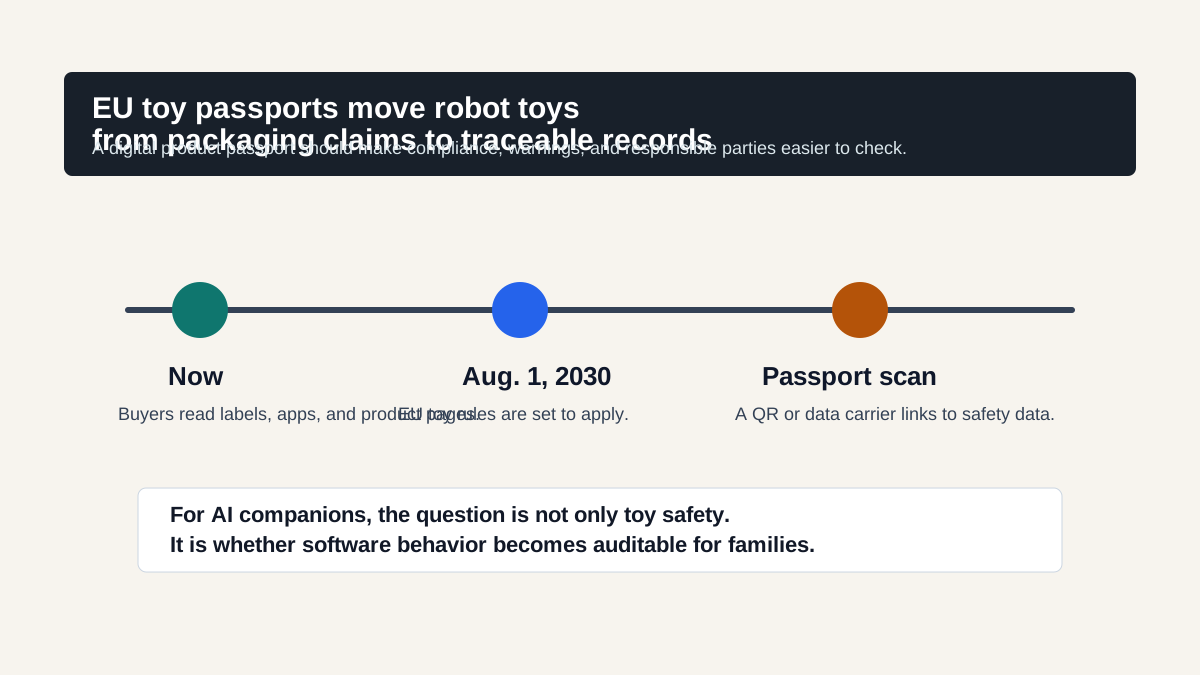
This is not legal advice, and a final classification will depend on the product, claims, importer, and age targeting. But it is already a practical buyer question. If an AI companion is marketed as a children's toy in Europe, a passport-style record could become part of how families compare safety, support, and accountability.
Why AI robot toys are different from normal toys
A traditional toy can be unsafe because of small parts, sharp edges, batteries, chemicals, magnets, or poor instructions. A robot toy can have those risks too, but it adds a software layer.
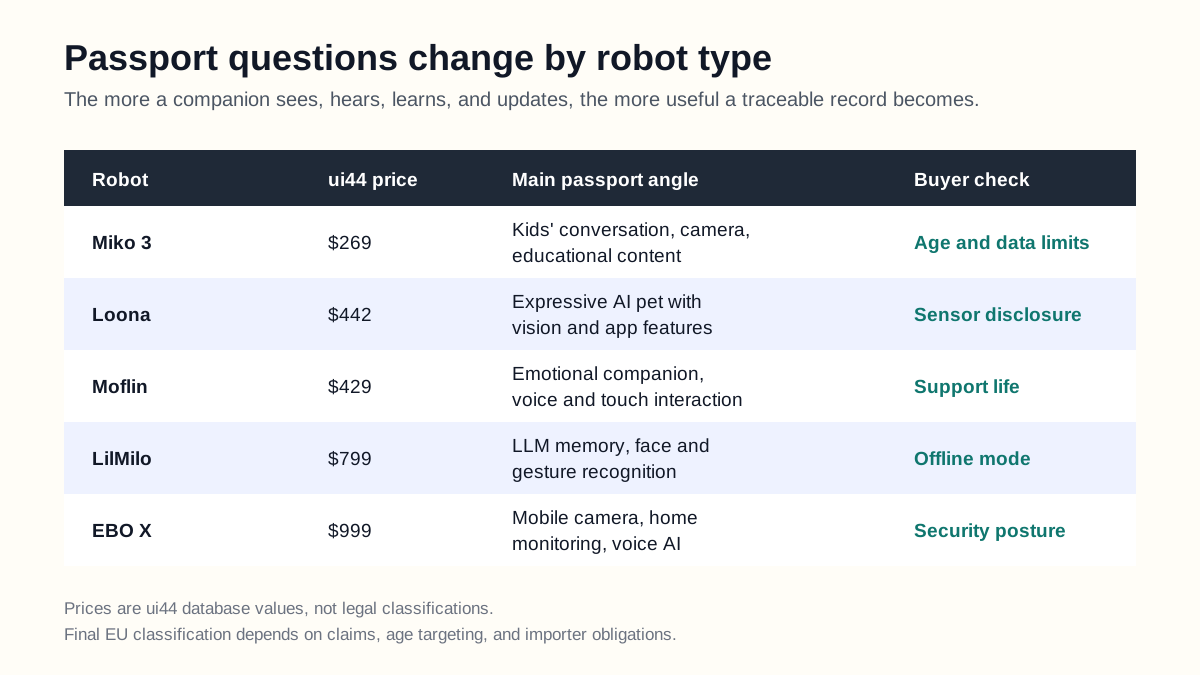
Look at the robots already in the ui44 database. Miko 3 is a kids' AI companion priced at €269 in our database. Miko Mini is a smaller €169 companion for children aged 5 to 10. Loona is a $442 expressive wheeled pet robot with a camera, time-of-flight sensing, app features, and emotion-driven interaction. Casio Moflin is a $429 palm-sized emotional companion. Ecovacs LilMilo, listed at $799, goes further with a large language model, long-term memory, face and gesture recognition, touch sensors, and an offline everyday-command mode.
Those are not all the same kind of product. Some are clearly child-focused. Some are pet-style companions. Some are family monitoring devices that may be used around children without being sold as toys. But they show the real issue: the safety record buyers need is no longer only about the shell. It is also about what the robot can sense, where the data goes, how long the software is supported, and what changes after an update.
What Should a Useful Toy Passport Tell Buyers?
A digital product passport should not become a decorative QR code. For robot toys, it is useful only if it answers questions that packaging cannot answer well. The best version would let a parent compare the robot's physical safety, connected features, app requirements, and support status before creating an account or handing the device to a child.
At minimum, buyers should expect clear identification of the manufacturer, importer, model, and version. That sounds basic, but it matters when robots are sold through marketplaces, bundles, regional distributors, and crowdfunded preorders. The family should be able to tell whether the exact robot in front of them matches the compliance record.
The passport should also make warnings and instructions easy to find. For a simple toy, that may be age range and battery warnings. For a robot toy, it may include supervision requirements, camera or microphone behavior, app-account requirements, wireless connectivity, and whether some features change when subscriptions expire.
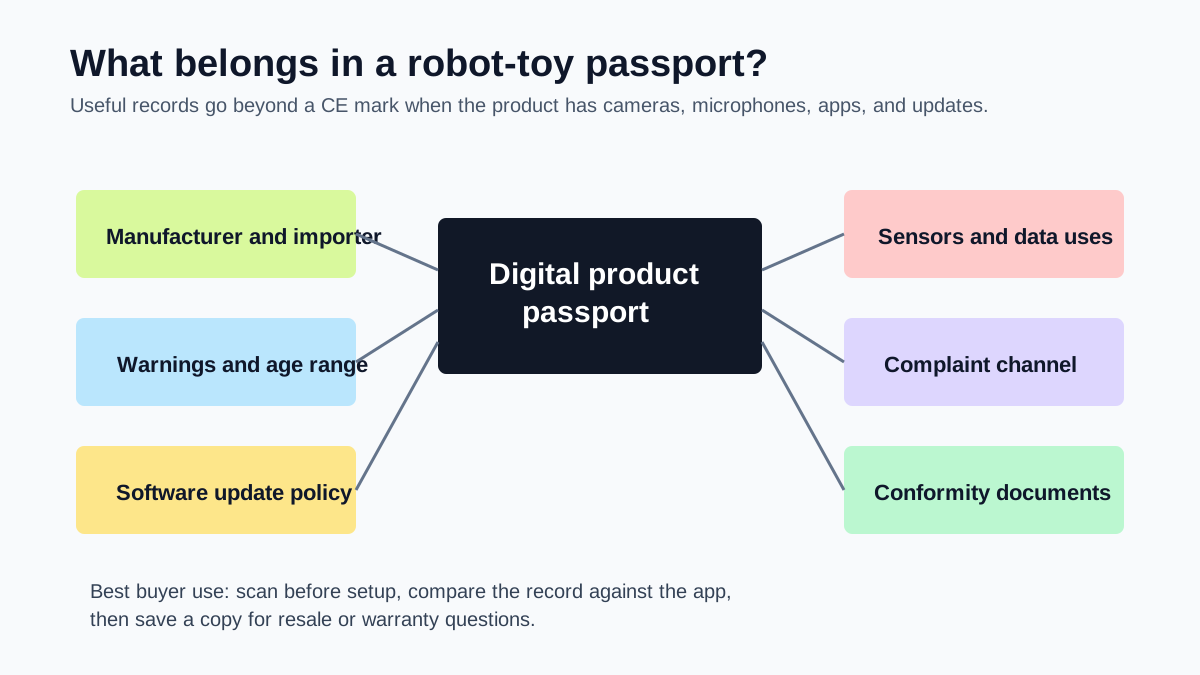
The more ambitious version would include software-support information. That is not always treated as a toy-safety issue, but it is central to robot ownership. A buyer should know whether a companion robot still receives security updates, whether core functions work offline, whether a company promises app availability, and who handles complaints if the product changes behavior after a firmware update.
The buyer test: scan before setup
By 2030, a good buying habit may be simple: scan the passport before creating the child's account or connecting the robot to Wi-Fi.
Here is the practical checklist we would use:
Passport question
Who is the responsible EU manufacturer or importer?
- Why it matters for AI robot toys
- Marketplaces blur accountability. The passport should make the responsible party obvious.
Passport question
What age range is the robot designed for?
- Why it matters for AI robot toys
- A companion for 5 to 10 year olds should be judged differently from a desktop AI pet for adults.
Passport question
What sensors are active?
- Why it matters for AI robot toys
- Cameras, microphones, touch sensors, and motion sensors change the privacy and supervision picture.
Passport question
Does it require cloud AI?
- Why it matters for AI robot toys
- Offline modes are different from products that need remote speech, memory, or moderation services.
Passport question
How long are updates promised?
- Why it matters for AI robot toys
- A robot with a dead app can become useless, insecure, or misleadingly advertised.
Passport question
How can a family complain or report a defect?
- Why it matters for AI robot toys
- A passport should shorten the path from problem to responsible company.
| Passport question | Why it matters for AI robot toys |
|---|---|
| Who is the responsible EU manufacturer or importer? | Marketplaces blur accountability. The passport should make the responsible party obvious. |
| What age range is the robot designed for? | A companion for 5 to 10 year olds should be judged differently from a desktop AI pet for adults. |
| What sensors are active? | Cameras, microphones, touch sensors, and motion sensors change the privacy and supervision picture. |
| Does it require cloud AI? | Offline modes are different from products that need remote speech, memory, or moderation services. |
| How long are updates promised? | A robot with a dead app can become useless, insecure, or misleadingly advertised. |
| How can a family complain or report a defect? | A passport should shorten the path from problem to responsible company. |
This does not replace reading privacy policies, but it gives families a better starting point. The passport is the stable record; the app store listing and marketing page are not.
How this changes robot comparisons
Today's robot comparisons usually emphasize price, personality, sensors, navigation, and AI features. A passport requirement would add a new comparison column: evidence quality.
For example, Miko 3 and Miko Mini are the obvious child-focused examples in the ui44 database because the product positioning is directly educational and kid-oriented. Their buyer questions are age range, content moderation, parental controls, camera and microphone use, and update policy.
Loona and Moflin are more pet-like. The buyer questions shift toward emotional attachment, app dependence, sensor disclosure, and what happens if the cloud service or companion subscription changes. A plush or pet-style robot can still collect sensitive household context if it sees, hears, or remembers interactions.
LilMilo is a useful stress test for future passports because its feature list is exactly where compliance records become interesting. The ui44 entry lists bionic eyes, a wide-angle camera nose for face, gesture, and emotional-cue recognition, a three-microphone array, touch sensors, an LLM with long-term memory, and up to 360 minutes of use. A family comparing LilMilo against a simpler companion should not have to guess which features work offline, what memory is stored, or how to get support.
Enabot EBO X, listed at $999, is another edge case. It is a family companion and home-monitoring robot with a 4K stabilized camera, night vision, Visual SLAM navigation, voice AI, and Alexa-based assistant features. It may not be a toy, but it can operate in family spaces where children are present. That is why digital records should not be treated as a toy-only curiosity. They point toward the kind of disclosure that many home robots will eventually need.
What sellers and importers should prepare for
The biggest operational change is version control. A robot toy is not a static object. Hardware revision, firmware version, app version, AI-service region, and accessory bundle can all affect the buyer experience.
That means the passport should avoid vague model names. If a robot has a camera-equipped version, a non-camera version, a subscription bundle, and different regional AI features, the buyer-facing record should make those differences visible. Otherwise the passport will be technically present but practically weak.
Importers should also prepare for evidence requests. A small robot brand selling into the EU through marketplaces may need clearer documentation than it has historically maintained: conformity assessments, warnings, support channels, battery information, and a way to keep the passport available even if a supplier relationship changes.
For buyers, this is good. A charming robot with no clear responsible party is a risk. A less flashy robot with clear documentation, realistic age claims, local support, and an update policy may be the better purchase.
What families should do before 2030
You do not need to wait for passports to ask passport-style questions now.
Before buying an AI robot for a child or shared family space, check whether the company says who the product is for, what data the robot collects, whether the robot can be used without cloud features, how updates are delivered, and whether the support channel is real. Look for the exact model number, not just the brand name. Save the product page and manual because listings can change.
Use ui44's robot pages as a starting point for price and feature comparison, then verify current manufacturer terms before purchase. For example, compare child-focused companions like Miko 3 and Miko Mini separately from pet-style robots like Loona and Moflin, and from family-monitoring robots like EBO X.
The deeper lesson is that AI toy safety is becoming a lifecycle question. The safest robot is not only the one with rounded corners and a friendly face. It is the one whose maker can explain what it is, who is responsible for it, what it senses, how it updates, and what happens when something goes wrong.
Digital product passports will not make every AI robot toy safe by themselves. But if they are implemented well, they could make the hidden parts of robot ownership much harder to ignore.
Related in the database
Use this article as a privacy verification workflow
Turn the article into a privacy verification pass grounded in the robots, manufacturers, and components it actually references.
Will AI Robot Toys Need Digital Product Passports? already points you toward 8 linked robots, 6 manufacturers, and 4 countries inside the ui44 database. That matters because strong buyer guidance is easier to apply when you can move immediately from a claim or warning into concrete product pages, manufacturer directories, component explainers, and country-level context instead of treating the article as an isolated opinion piece. The fastest next step is to turn the article into a shortlist workflow: open the linked robot pages, verify which specs are actually published for those models, then compare the surrounding manufacturer and component context before you decide whether the underlying claim changes your buying plan.
For this topic, the useful discipline is to separate the editorial lesson from the catalog evidence. The article gives you the framing, but the robot pages tell you what each product actually ships with today: sensor stack, connectivity methods, listed price, release timing, category, and support-relevant compatibility notes. The manufacturer pages then show whether you are looking at a one-off launch, a broader lineup pattern, or a company that spans multiple categories. That layered workflow reduces the risk of buying on a single marketing phrase or a single support FAQ.
Use the robot pages to confirm which products actually expose cameras, microphones, Wi-Fi, or voice systems, then use the manufacturer pages to decide how much of the privacy question seems product-specific versus brand-wide. On this route cluster, Miko 3, Miko Mini, and Loona form the fastest reality check. If you want a quick working shortlist, open Compare Miko 3, Miko Mini, and Loona next, then keep this article open as the reasoning layer while you compare structured data side by side.
Practical Takeaway
Every robot, manufacturer, category, component, and country reference below resolves to a real ui44 page, keeping the follow-up path grounded in database records rather than generic advice.
Suggested next steps in ui44
- Open Miko 3 and note the listed sensors, connectivity methods, and voice stack before you interpret any policy claim.
- Cross-check the wider brand context on Miko so you can see whether the privacy question touches one model or a broader lineup.
- Use the linked component pages to confirm how common the relevant sensors and connectivity layers are across the database.
- Keep a short note of which policy layers you checked, which device features are actually present on the robot page, and which items still depend on region- or app-level confirmation.
- Finish with Compare Miko 3, Miko Mini, and Loona so the policy reading sits next to structured product data.
Robot profiles worth opening next
Use the linked product pages as the evidence layer
The linked robot pages are where this article becomes operational. Instead of asking whether the headline is interesting, use the robot entries to inspect the actual mix of sensors, connectivity options, batteries, pricing, release timing, and stated capabilities attached to the products mentioned in the article. That is the easiest way to see whether the warning or opportunity described here affects one product family, a specific design pattern, or an entire buying lane.
Miko 3 is tracked on ui44 as a available companions robot from Miko. The database currently records a listed price of €269, a release date of 2021, 5–7 hours active use, up to 12 hours standby battery life, ~4 hours (15W USB-C adapter) charging time, and a published stack that includes Time-of-Flight Range Sensor, Odometric Sensors, and Dual MEMS Microphones plus Wi-Fi and Bluetooth.
For privacy-focused reading, this page matters because it shows the concrete device surface behind the policy discussion. Use it to verify whether Miko 3 combines sensors and connectivity in a way that could change the in-home data footprint, and compare the listed capabilities such as AI-Powered Conversations, Face Recognition, and Voice Recognition with any cloud, app, or voice layers.
Miko Mini is tracked on ui44 as a available companions robot from Miko. The database currently records a listed price of €169, a release date of 2023-09-18, Up to 1 hour active gameplay; up to 15 hours standby on Miko's global comparison page (India FAQ lists up to 7 hours standby) battery life, ~90 minutes charging time, and a published stack that includes Microphone Array, Wide-Angle HD Camera, and Time-of-Flight Range Sensor plus Wi-Fi.
For privacy-focused reading, this page matters because it shows the concrete device surface behind the policy discussion. Use it to verify whether Miko Mini combines sensors and connectivity in a way that could change the in-home data footprint, and compare the listed capabilities such as Conversational Learning, Educational Games and Stories, and Music and Dance Activities with any cloud, app, or voice layers.
Loona is tracked on ui44 as a available companions robot from KEYi Tech. The database currently records a listed price of $442, a release date of 2023, 2 hours continuous playtime; 1350 mAh, 11.1 V lithium-ion rechargeable battery battery life, Not officially disclosed charging time, and a published stack that includes 3D Time-of-Flight (ToF) Sensor, 720p RGB Camera, and Touch Sensor plus Wi-Fi (Dual-band 2.4G/5.8G, 802.11a/b/g/n) and USB Type-C (charging).
For privacy-focused reading, this page matters because it shows the concrete device surface behind the policy discussion. Use it to verify whether Loona combines sensors and connectivity in a way that could change the in-home data footprint, and compare the listed capabilities such as Face Recognition, Voice Commands, and Emotion Expression (LCD face) with any cloud, app, or voice layers.
Moflin is tracked on ui44 as a available companions robot from Casio. The database currently records a listed price of $429, a release date of 2025-10-01, Up to 5 hours battery life, Approx. 3.5 hours charging time, and a published stack that includes Microphone, Illuminance sensor, and Touch sensors plus its listed connectivity stack.
For privacy-focused reading, this page matters because it shows the concrete device surface behind the policy discussion. Use it to verify whether Moflin combines sensors and connectivity in a way that could change the in-home data footprint, and compare the listed capabilities such as Emotional companionship, Touch response, and Voice recognition with any cloud, app, or voice layers.
LilMilo is tracked on ui44 as a available companions robot from Ecovacs. The database currently records a listed price of $799, a release date of 2026-05-15, Up to 360 minutes battery life, 30 minutes to 50%; full charge not officially disclosed charging time, and a published stack that includes Wide-angle camera nose, Three-microphone array, and Multi-point touch sensors plus its listed connectivity stack.
For privacy-focused reading, this page matters because it shows the concrete device surface behind the policy discussion. Use it to verify whether LilMilo combines sensors and connectivity in a way that could change the in-home data footprint, and compare the listed capabilities such as Emotional AI companionship, Evolving personality shaped by daily interaction, and Seven emotion types / 21 emotional states with any cloud, app, or voice layers, including Built-in offline voice control.
Manufacturer context behind the article
Check whether this is one product story or a broader company pattern
Manufacturer pages add the privacy context that individual product pages cannot show on their own. They help you check whether cameras, microphones, cloud accounts, app controls, and policy assumptions appear across a broader lineup or stay tied to one specific product story.
Miko
ui44 currently tracks 2 robots from Miko across 1 category. The company is grouped under India, and the current catalog footprint on ui44 includes Miko 3, Miko Mini.
That wider brand context matters because privacy questions rarely stop at one FAQ page. A manufacturer route helps you see whether the article is centered on one premium model or on a company that has several relevant products and therefore more than one place where the same policy or app assumptions might matter. The category mix here currently points toward Companions as the most useful next route if you want to see whether this article reflects a wider pattern inside the brand.
KEYi Tech
ui44 currently tracks 2 robots from KEYi Tech across 1 category. The company is grouped under USA, and the current catalog footprint on ui44 includes Loona, Loona DeskMate.
That wider brand context matters because privacy questions rarely stop at one FAQ page. A manufacturer route helps you see whether the article is centered on one premium model or on a company that has several relevant products and therefore more than one place where the same policy or app assumptions might matter. The category mix here currently points toward Companions as the most useful next route if you want to see whether this article reflects a wider pattern inside the brand.
Casio
ui44 currently tracks 1 robot from Casio across 1 category. The company is grouped under Japan, and the current catalog footprint on ui44 includes Moflin.
That wider brand context matters because privacy questions rarely stop at one FAQ page. A manufacturer route helps you see whether the article is centered on one premium model or on a company that has several relevant products and therefore more than one place where the same policy or app assumptions might matter. The category mix here currently points toward Companions as the most useful next route if you want to see whether this article reflects a wider pattern inside the brand.
Ecovacs
ui44 currently tracks 7 robots from Ecovacs across 3 categorys. The company is grouped under China, and the current catalog footprint on ui44 includes Deebot X8 Pro Omni, Deebot X12 OmniCyclone, Deebot T90 Pro Omni.
That wider brand context matters because privacy questions rarely stop at one FAQ page. A manufacturer route helps you see whether the article is centered on one premium model or on a company that has several relevant products and therefore more than one place where the same policy or app assumptions might matter. The category mix here currently points toward Cleaning, Lawn & Garden, Companions as the most useful next route if you want to see whether this article reflects a wider pattern inside the brand.
Broaden the scan without leaving the database
Categories, components, and countries add the wider context
Category framing
Category pages are useful when the article touches a buying pattern that shows up across brands. A category route helps you confirm whether the linked products sit in a narrow niche or whether the same question should be tested across a larger field of alternatives.
Companions
The Companions category page currently groups 53 tracked robots from 48 manufacturers. ui44 describes this lane as: Social robots, robot pets, and elderly-care companions designed for emotional connection and everyday support at home.
That makes the category route a practical follow-up when you want to check whether the products linked in this article are typical for the lane or whether they sit at one edge of the market. Useful starting examples currently include PARO, Abi, Next-Generation Companion Robot.
Research
The Research category page currently groups 49 tracked robots from 39 manufacturers. ui44 describes this lane as: Academic and research robotics platforms pushing the boundaries of what machines can learn and do in the lab and beyond.
That makes the category route a practical follow-up when you want to check whether the products linked in this article are typical for the lane or whether they sit at one edge of the market. Useful starting examples currently include HRP-4C, HRP-5P, NAO6.
Country and ecosystem context
Country pages give extra context when support practices, launch sequencing, regulatory posture, or manufacturer mix matter. They are not a substitute for model-level verification, but they do help you see which ecosystems cluster together and which manufacturers sit in the same regional field when you broaden the search beyond the article headline.
India
The India route currently groups 6 tracked robots from 5 manufacturers in ui44. That gives you a useful regional lens when the article points toward support practices, launch sequencing, or brand clusters that may share similar ecosystem assumptions.
On the current route, manufacturers like Miko, Addverb Technologies, iHub Robotics make the page a good way to broaden the scan without losing the regional context that often shapes availability, documentation style, and adjacent alternatives.
USA
The USA route currently groups 89 tracked robots from 69 manufacturers in ui44. That gives you a useful regional lens when the article points toward support practices, launch sequencing, or brand clusters that may share similar ecosystem assumptions.
On the current route, manufacturers like Faraday Future, iRobot, Boston Dynamics make the page a good way to broaden the scan without losing the regional context that often shapes availability, documentation style, and adjacent alternatives.
Japan
The Japan route currently groups 26 tracked robots from 17 manufacturers in ui44. That gives you a useful regional lens when the article points toward support practices, launch sequencing, or brand clusters that may share similar ecosystem assumptions.
On the current route, manufacturers like AIST, SoftBank Robotics, Toyota make the page a good way to broaden the scan without losing the regional context that often shapes availability, documentation style, and adjacent alternatives.
Questions to answer before you move from reading to buying
A follow-up FAQ built from the entities already linked in this article
Frequently Asked Questions
Which page should I open first after reading “Will AI Robot Toys Need Digital Product Passports?”?
Start with Miko 3. That gives you a concrete product anchor for the article’s main claim. From there, branch into the manufacturer and component pages so you can tell whether the article is describing one specific model, a repeated brand pattern, or a wider technology issue that affects multiple shortlist options.
How do the manufacturer pages change the buying decision?
Miko help you zoom out from one article and one product. On ui44 they show lineup breadth, category spread, and the neighboring robots tied to the same company. That context is useful when you are deciding whether a risk belongs to a single model, whether it shows up across a brand’s portfolio, and whether you should keep looking at alternatives before committing.
When should I switch from reading to side-by-side comparison?
Move into Compare Miko 3, Miko Mini, and Loona as soon as you understand the article’s main warning or promise. The article explains what to watch for, but the compare view is where you can check whether price, status, battery life, connectivity, sensors, and category fit still make the robot a good match for your own home and budget.
Where to go next in ui44
Keep the research chain inside the database
If you want to keep going, these follow-on pages give you the cleanest expansion path from article to research session. Open the comparison route first if you are deciding between products today. Open the manufacturer, category, and component routes if you still need to understand the broader pattern behind the claim.
Written by
ui44 Team
Published June 24, 2026
Share this article
Open a plain share link on X or Bluesky. No embeds, no widgets, no cookie baggage.