That is a much higher bar than voice control. A smart speaker can answer while staying on a shelf. A useful home robot has to listen while moving through a messy room, decide whether a correction changes the task, and sometimes stop its body before the next sentence finishes.
Two 2026 signals make this worth watching. AGIBOT says its upcoming WITA Omni model is an end-to-end embodied multimodal interaction system that keeps more of the emotion, tone, context, and environmental cues that are usually lost when speech is first converted into plain text. The company says it is targeting interaction latency under 500 ms, with mid-sentence interruption, correction, and real-time tone response.
Separately, KB Financial Group and GENON demonstrated a senior-care humanoid called GenP in Korea. The demo was not a consumer launch, but the scenario is exactly where conversation becomes physical: greeting a person, reading emotional and physical state, explaining rehabilitation schedules, recognizing medication, picking it up, handing it over, prompting rehab movement, and assisting a person standing up.
Those examples do not prove that a home robot can converse like a person. They show what buyers should test for next.
Can home robots hold a real conversation?
Some can hold useful conversations. None should be treated as a general-purpose human replacement.
The important distinction is conversation about a task versus conversation as companionship. A companion robot can be warm, proactive, and emotionally useful without having arms. A mobile humanoid can have arms and cameras but still be bad at the social timing of a normal conversation. A smart-home robot can understand appliance context but fail when you interrupt it with a correction.
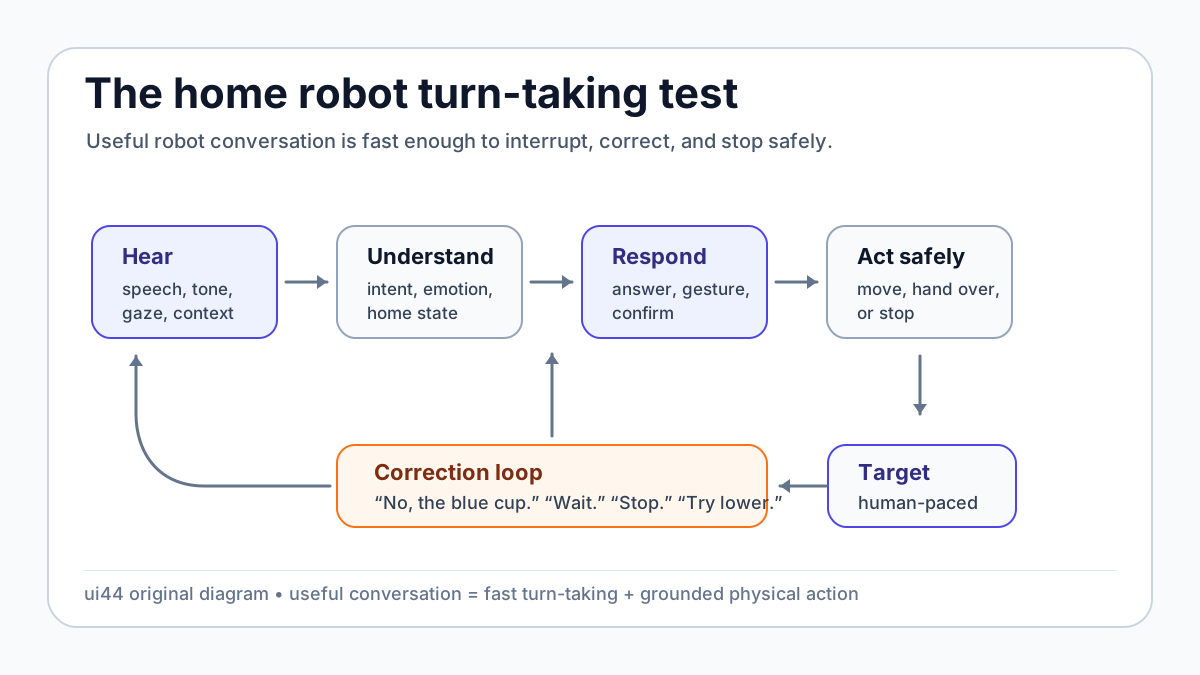
For home buyers, the practical test is not whether the robot has a large language model. It is whether the robot can keep a turn-taking loop alive:
- hear speech, tone, and interruption;
- connect the words to the room and the current task;
- answer briefly enough that the human does not have to wait;
- change or stop a physical action when corrected;
- remember useful preferences without turning the home into a surveillance dataset.
That last step matters. The more a robot uses conversation to personalize help, the more it may store routines, health hints, names, room maps, object locations, and caregiver relationships. A good conversation robot needs memory controls, not just memory.
The 500 ms target is a clue, not a guarantee
AGIBOT's under-500-ms WITA Omni target is interesting because it moves the discussion from "the robot has voice" to "the robot has turn-taking speed." In human conversation, long delays change the feel of an interaction. A small pause can be thoughtful; a repeated one-second lag makes people start talking over the machine.
For a robot, latency has more layers than speech. The system may need to:
- listen through a microphone array;
- identify who is speaking;
- read whether the person is pointing, looking worried, or stepping closer;
- update the task plan;
- decide whether the arm or base should keep moving;
- generate speech, expression, or gesture;
- preserve safety margins while the human is still talking.
That is why a conversation benchmark for home robots should include interruptions. If you say "wait" while a robot is handing over a cup, it cannot finish the sentence first and then think about stopping. It has to map language to motion quickly enough to matter.
AGIBOT's announcement is also a reminder to read claims carefully. The company says WITA Omni will be provided as a cloud service first, with future movement toward edge deployment. Cloud service can be powerful, but it raises three buyer questions: what happens when the network is slow, what data leaves the home, and which commands are handled locally for safety.
What current robots actually do well
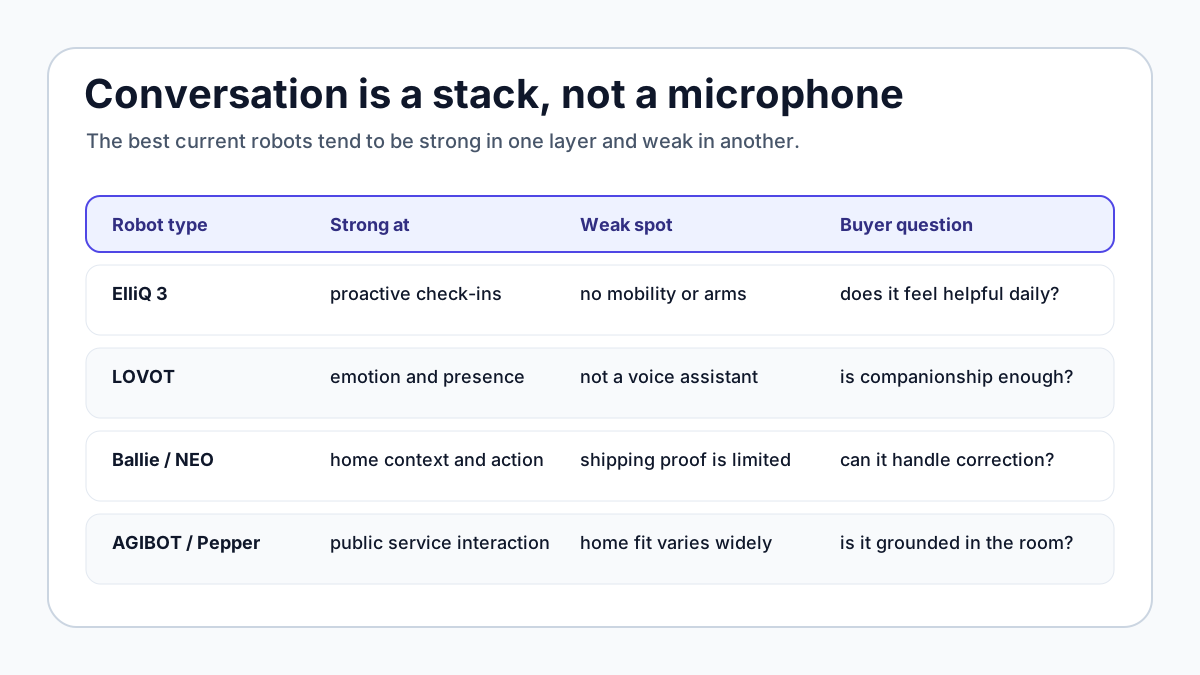
ui44's database makes the current gap clear. Today's best conversational and home-adjacent robots are not all solving the same problem.
Robot
- What conversation is for
- proactive companionship and care routines
- ui44 data points
- Available in the US; $249 lease initiation plus subscription options; 4-mic array, camera, screen, wellness programs, medication reminders, video calling
- Honest limitation
- Stationary; no arms or home navigation
Robot
- What conversation is for
- emotional presence more than command-and-control
- ui44 data points
- ¥577,500 for LOVOT 3.0 plus monthly care plan; 43 cm, 4.6 kg, 50+ sensors, thermal/person detection, full-body touch response
- Honest limitation
- Not a chore robot; not a general voice assistant
Robot
- What conversation is for
- smart-home context and mobile companion behavior
- ui44 data points
- Development status; SmartThings, projector, camera/spatial/environmental sensors, Gemini plus Samsung language models
- Honest limitation
- Repeatedly delayed; no confirmed price or release date
Robot
- What conversation is for
- public-facing social interaction
- ui44 data points
- 120 cm, 29.6 kg, 10.1-inch display, two RGB cameras, 3D depth sensor, four microphones, emotion-recognition history
- Honest limitation
- Commercial/reception lineage, not a modern home assistant
Robot
- What conversation is for
- home humanoid assistance with conversation and physical tasks
- ui44 data points
- $20,000 pre-order; 167 cm, 30 kg, about 4 hours battery, RGB cameras, depth sensors, tactile skin, microphone array
- Honest limitation
- Pre-order; real autonomy and service model still need proof
Robot
- What conversation is for
- compact humanoid interaction, research, and commercial deployment
- ui44 data points
- $24,240 official store price; 131 cm, 35-39 kg, up to 30 DOF, microphone array, RGB cameras, optional LiDAR/RGB-D on Ultra
- Honest limitation
- More research/commercial than household-ready
Robot
- What conversation is for
- cognitive humanoid interaction and light service tasks
- ui44 data points
- €19,999 Standard, €29,999 Pro; 132 cm, 36 kg, ~2.5 h battery, voice recognition, force/torque sensors, 3 kg payload
- Honest limitation
- Pre-order; strongest hands/SDK features require Pro tier
| Robot | What conversation is for | ui44 data points | Honest limitation |
|---|---|---|---|
| ElliQ 3 | proactive companionship and care routines | Available in the US; $249 lease initiation plus subscription options; 4-mic array, camera, screen, wellness programs, medication reminders, video calling | Stationary; no arms or home navigation |
| LOVOT | emotional presence more than command-and-control | ¥577,500 for LOVOT 3.0 plus monthly care plan; 43 cm, 4.6 kg, 50+ sensors, thermal/person detection, full-body touch response | Not a chore robot; not a general voice assistant |
| Samsung Ballie | smart-home context and mobile companion behavior | Development status; SmartThings, projector, camera/spatial/environmental sensors, Gemini plus Samsung language models | Repeatedly delayed; no confirmed price or release date |
| Pepper | public-facing social interaction | 120 cm, 29.6 kg, 10.1-inch display, two RGB cameras, 3D depth sensor, four microphones, emotion-recognition history | Commercial/reception lineage, not a modern home assistant |
| 1X NEO | home humanoid assistance with conversation and physical tasks | $20,000 pre-order; 167 cm, 30 kg, about 4 hours battery, RGB cameras, depth sensors, tactile skin, microphone array | Pre-order; real autonomy and service model still need proof |
| AGIBOT X2 | compact humanoid interaction, research, and commercial deployment | $24,240 official store price; 131 cm, 35-39 kg, up to 30 DOF, microphone array, RGB cameras, optional LiDAR/RGB-D on Ultra | More research/commercial than household-ready |
| NEURA 4NE-1 Mini | cognitive humanoid interaction and light service tasks | €19,999 Standard, €29,999 Pro; 132 cm, 36 kg, ~2.5 h battery, voice recognition, force/torque sensors, 3 kg payload | Pre-order; strongest hands/SDK features require Pro tier |
The pattern is obvious: the more a robot is genuinely social, the less it tends to manipulate the home. The more it can move and manipulate, the less proven its everyday conversation is.
That does not make the category fake. It means buyers should stop asking one binary question — "can it talk?" — and ask what the conversation is connected to.
The real test is correction
The best demo prompt is not "What can you do?" It is "Actually, I changed my mind."
Try these examples in any serious home-robot demo:
- "Bring me the mug" followed by "not that one, the blue one."
- "Remind me to take the pill" followed by "wait, did I already take it?"
- "Come here" followed by "stop, the dog is behind you."
- "Start my evening routine" followed by "skip the lights in the bedroom."
- "Help me stand" followed by "my knee hurts today."
A scripted assistant can answer the first command. A conversational robot has to handle the second turn without losing the first context. An embodied robot has to decide whether the second turn changes speech, motion, safety, or all three.
This is where multimodal systems are promising. If the robot can preserve tone, gaze, emotion, and environmental context, it can notice that "wait" said calmly while choosing a playlist is different from "wait" said sharply while an arm is moving toward a person.
But the proof is not a model name. The proof is behavior: did the robot pause, confirm, correct course, and explain what changed?
Care robots make conversation safety-critical
Senior-care demos show why this matters beyond novelty. KB and GENON's GenP demo included emotional and physical-state responses, medication recognition and handoff, rehab movement support, and standing assistance. KB described a roadmap that starts with emotional/cognitive digital care, then non-contact physical tasks, then partial body-contact assistance, and eventually higher-difficulty full physical care.
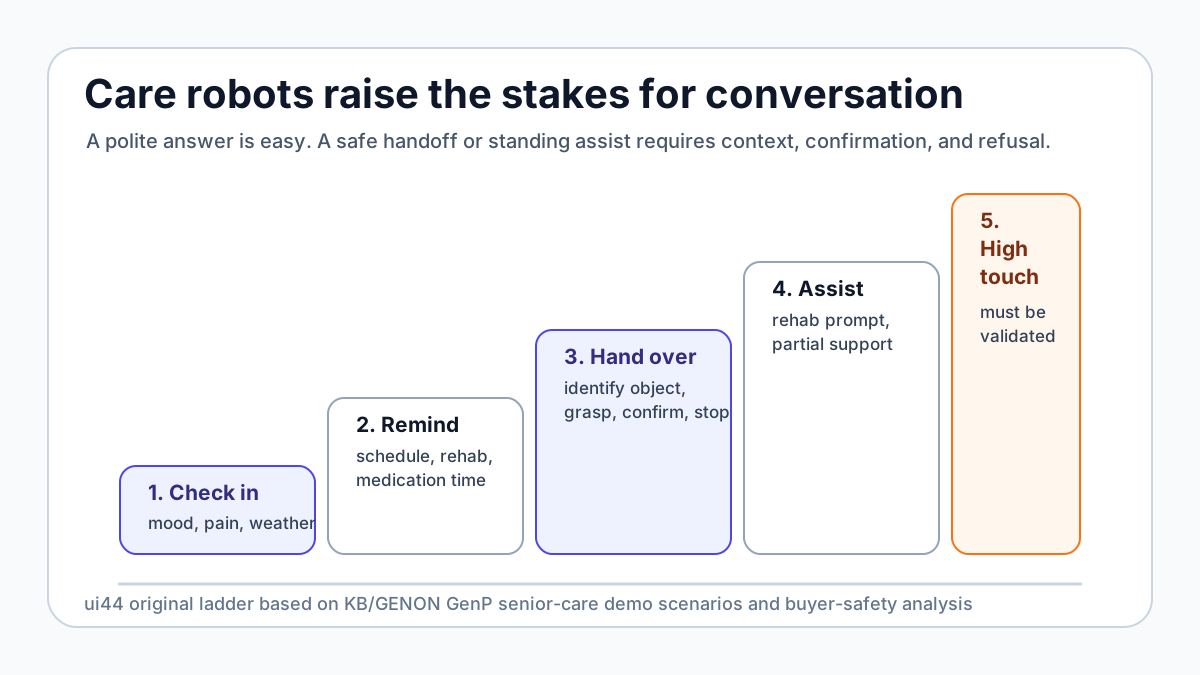
That ladder is sensible. It is also a warning. Each step requires more than a pleasant voice.
A medication reminder can be wrong in a low-risk way if it is clearly labeled as a reminder and the human remains in control. A medication handoff is different: the robot must recognize the object, avoid dropping it, know when not to hand it over, and handle uncertainty. Standing assistance raises the bar again because a misread posture or delayed stop can create physical harm.
This is where a robot's conversation system should include refusal and escalation. A trustworthy care robot should say things like:
- "I am not sure this is the correct medication. Please check the label."
- "I can remind you, but I cannot confirm whether you should take it."
- "I need a caregiver nearby before helping you stand."
- "I stopped because your hand moved into my path."
Those lines sound less exciting than a fluent chatbot answer. They are much more important.
What to watch in product pages and demos
Most robot marketing will keep saying "natural conversation" because it sounds friendly. Buyers should translate that into testable claims.
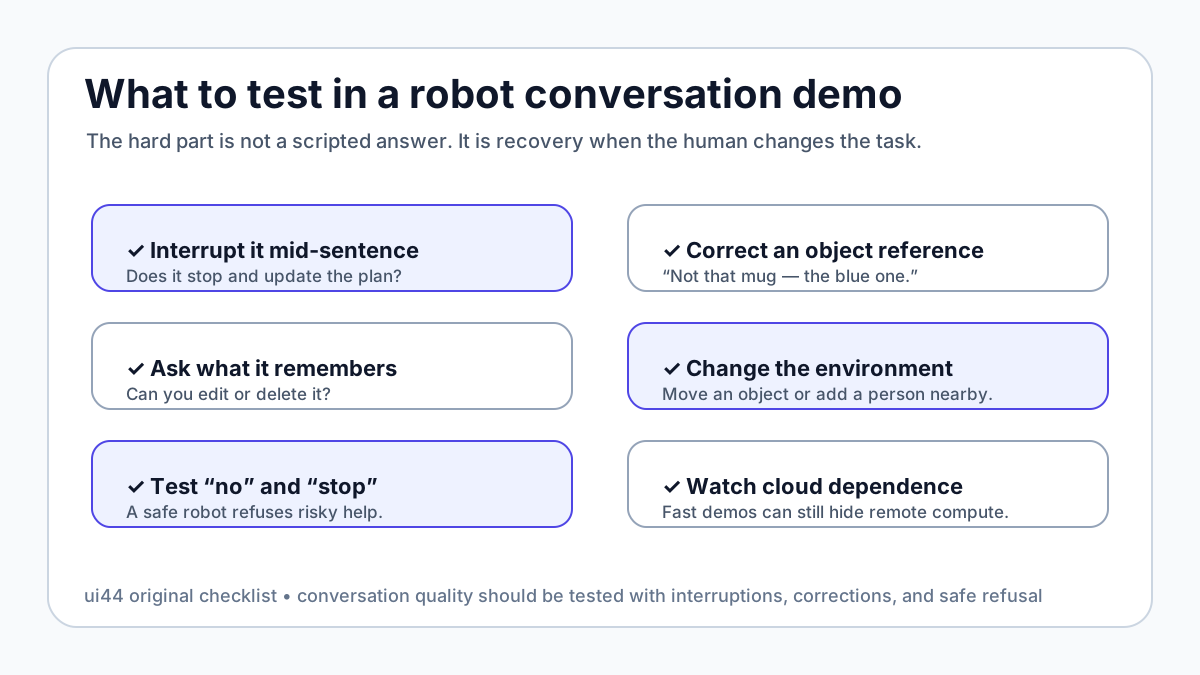
Look for six specifics:
1. Interruption handling
Can the robot be interrupted while speaking? More importantly, can it be interrupted while moving? A companion that stops talking is nice. A robot arm that stops moving safely is essential.
2. Grounded references
Can it resolve "that one," "the blue cup," or "the charger under the chair" from vision and room context? If not, it may be a voice assistant in a robot shell.
3. Short confirmations
Useful robots confirm briefly before risky actions. They should not narrate a paragraph before handing over an object, opening a door, or approaching a person.
4. Memory controls
Ask what the robot remembers, where that memory is stored, how long it lasts, and whether you can delete it. For companion and care use, this is not optional.
5. Local safety layer
Even if the conversation model is cloud-based, stop commands, collision response, and emergency behavior should not depend on a distant model response.
6. Failure behavior
A good robot should fail plainly. "I do not know," "I cannot safely do that," and "please move this object first" are better than confident nonsense.
So, are conversational home robots ready?
They are ready in narrow forms. ElliQ 3 is already a real product for proactive older-adult companionship. LOVOT is a real product for non-chore emotional presence. Pepper proved that social robots can operate in public settings, even if its original business arc also shows how hard that market is.
For mobile home assistants with arms, the answer is still more cautious. 1X NEO, NEURA 4NE-1 Mini, and AGIBOT X2 show pieces of the future: microphones, cameras, hands or end-effectors, mobility, and increasingly capable embodied-AI stacks. But a product page that lists voice interaction is not the same as a robot that can handle a messy, interrupted, safety-sensitive household conversation.
The right buyer question for 2026 is not "does it have an AI voice?" It is:
Can the robot keep up when the conversation changes the physical task?
If the answer is yes, you should see it in demos: quick interruptions, grounded references, short confirmations, safe stops, clear refusal, and memory controls. If the answer is no, the robot may still be useful — but probably as a companion, monitor, entertainment device, or scripted assistant rather than a general home helper.
For now, the most credible path is split. Companion robots will keep improving at emotional timing and proactive check-ins. Humanoids and mobile manipulators will keep improving at perception and physical task execution. The interesting moment comes when those two lines meet: a robot that can talk just enough, listen fast enough, and stop moving when the human says, "Wait — not that one."
Until then, conversation is not a feature checkbox. It is a stress test for the whole robot.
Compare the robots mentioned
Use ui44's database pages for the current specs and availability behind this article:
- ElliQ 3 — proactive companion for older adults.
- LOVOT — touch-first emotional companion robot.
- Samsung Ballie — delayed rolling smart-home robot.
- Pepper — public-facing social robot lineage.
- 1X NEO — home-focused humanoid pre-order.
- AGIBOT X2 — compact humanoid platform with voice interaction.
- NEURA 4NE-1 Mini — compact cognitive humanoid pre-order.
You can also use /compare to put current price, availability, sensors, and capabilities side by side before treating any conversation demo as a buying signal.
Related in the database
Use this article as a privacy verification workflow
Turn the article into a privacy verification pass grounded in the robots, manufacturers, and components it actually references.
Can Home Robots Hold a Real Conversation? already points you toward 7 linked robots, 7 manufacturers, and 7 countries inside the ui44 database. That matters because strong buyer guidance is easier to apply when you can move immediately from a claim or warning into concrete product pages, manufacturer directories, component explainers, and country-level context instead of treating the article as an isolated opinion piece. The fastest next step is to turn the article into a shortlist workflow: open the linked robot pages, verify which specs are actually published for those models, then compare the surrounding manufacturer and component context before you decide whether the underlying claim changes your buying plan.
For this topic, the useful discipline is to separate the editorial lesson from the catalog evidence. The article gives you the framing, but the robot pages tell you what each product actually ships with today: sensor stack, connectivity methods, listed price, release timing, category, and support-relevant compatibility notes. The manufacturer pages then show whether you are looking at a one-off launch, a broader lineup pattern, or a company that spans multiple categories. That layered workflow reduces the risk of buying on a single marketing phrase or a single support FAQ.
Use the robot pages to confirm which products actually expose cameras, microphones, Wi-Fi, or voice systems, then use the manufacturer pages to decide how much of the privacy question seems product-specific versus brand-wide. On this route cluster, ElliQ 3, LOVOT, and Ballie form the fastest reality check. If you want a quick working shortlist, open Compare ElliQ 3, LOVOT, and Ballie next, then keep this article open as the reasoning layer while you compare structured data side by side.
Practical Takeaway
Every robot, manufacturer, category, component, and country reference below resolves to a real ui44 page, keeping the follow-up path grounded in database records rather than generic advice.
Suggested next steps in ui44
- Open ElliQ 3 and note the listed sensors, connectivity methods, and voice stack before you interpret any policy claim.
- Cross-check the wider brand context on Intuition Robotics so you can see whether the privacy question touches one model or a broader lineup.
- Use the linked component pages to confirm how common the relevant sensors and connectivity layers are across the database.
- Keep a short note of which policy layers you checked, which device features are actually present on the robot page, and which items still depend on region- or app-level confirmation.
- Finish with Compare ElliQ 3, LOVOT, and Ballie so the policy reading sits next to structured product data.
Robot profiles worth opening next
Use the linked product pages as the evidence layer
The linked robot pages are where this article becomes operational. Instead of asking whether the headline is interesting, use the robot entries to inspect the actual mix of sensors, connectivity options, batteries, pricing, release timing, and stated capabilities attached to the products mentioned in the article. That is the easiest way to see whether the warning or opportunity described here affects one product family, a specific design pattern, or an entire buying lane.
ElliQ 3
Intuition Robotics · Companions · Available
ElliQ 3 is tracked on ui44 as a available companions robot from Intuition Robotics. The database currently records a listed price of Price TBA, a release date of 2024-01, Mains powered battery life, N/A (plugged in) charging time, and a published stack that includes 4-mic array, 12 MP camera for images, and 1080p HD video at 30 fps with 120° horizontal FoV plus Wi-Fi 802.11b/g/n/ac (2.4 GHz and 5 GHz) and Bluetooth 5+.
For privacy-focused reading, this page matters because it shows the concrete device surface behind the policy discussion. Use it to verify whether ElliQ 3 combines sensors and connectivity in a way that could change the in-home data footprint, and compare the listed capabilities such as Proactive Conversation, Medication Reminders, and Health & Pain Tracking with any cloud, app, or voice layers, including ElliQ Voice AI.
LOVOT is tracked on ui44 as a available companions robot from GROOVE X. The database currently records a listed price of ¥577,500, a release date of 2019, 30-45 minutes active, then returns to nest battery life, 15-30 minutes (on charging nest) charging time, and a published stack that includes Horn Top Camera (half-sphere), Horn Front Camera, and Depth Camera plus Wi-Fi and Bluetooth.
For privacy-focused reading, this page matters because it shows the concrete device surface behind the policy discussion. Use it to verify whether LOVOT combines sensors and connectivity in a way that could change the in-home data footprint, and compare the listed capabilities such as Emotional Companionship, Person Recognition, and Touch Response (full body sensors) with any cloud, app, or voice layers.
Ballie is tracked on ui44 as a development companions robot from Samsung. The database currently records a listed price of Price TBA, a release date of TBD, Not officially disclosed battery life, Not officially disclosed charging time, and a published stack that includes Camera, Spatial Sensors, and Environmental Sensors plus Wi-Fi and SmartThings.
For privacy-focused reading, this page matters because it shows the concrete device surface behind the policy discussion. Use it to verify whether Ballie combines sensors and connectivity in a way that could change the in-home data footprint, and compare the listed capabilities such as Autonomous Home Navigation, Built-in Projector (Wall & Floor), and Smart Home Control via SmartThings with any cloud, app, or voice layers, including Bixby.
Pepper
Aldebaran Robotics · Commercial · Available
Pepper is tracked on ui44 as a available commercial robot from Aldebaran Robotics. The database currently records a listed price of Price TBA, a release date of 2014-06, ~12 hours (shop use) battery life, ~8 hours 20 minutes charging time, and a published stack that includes RGB Camera ×2 (forehead + mouth), 3D Depth Sensor, and Microphone ×4 plus Wi-Fi 802.11 a/b/g/n (2.4/5 GHz) and Ethernet.
For privacy-focused reading, this page matters because it shows the concrete device surface behind the policy discussion. Use it to verify whether Pepper combines sensors and connectivity in a way that could change the in-home data footprint, and compare the listed capabilities such as Emotion Recognition, Facial Expression Analysis, and Natural Conversation with any cloud, app, or voice layers, including Multilingual Speech Recognition & Synthesis.
NEO
1X Technologies · Humanoid · Pre-order
NEO is tracked on ui44 as a pre-order humanoid robot from 1X Technologies. The database currently records a listed price of $20,000, a release date of 2025-10-28, ~4 hours battery life, Not disclosed charging time, and a published stack that includes RGB Cameras, Depth Sensors, and Tactile Skin plus Wi-Fi and Bluetooth.
For privacy-focused reading, this page matters because it shows the concrete device surface behind the policy discussion. Use it to verify whether NEO combines sensors and connectivity in a way that could change the in-home data footprint, and compare the listed capabilities such as Household Chores, Tidying Up, and Safe Human Interaction with any cloud, app, or voice layers.
Manufacturer context behind the article
Check whether this is one product story or a broader company pattern
Manufacturer pages add the privacy context that individual product pages cannot show on their own. They help you check whether cameras, microphones, cloud accounts, app controls, and policy assumptions appear across a broader lineup or stay tied to one specific product story.
Intuition Robotics
ui44 currently tracks 1 robot from Intuition Robotics across 1 category. The company is grouped under Israel, and the current catalog footprint on ui44 includes ElliQ 3.
That wider brand context matters because privacy questions rarely stop at one FAQ page. A manufacturer route helps you see whether the article is centered on one premium model or on a company that has several relevant products and therefore more than one place where the same policy or app assumptions might matter. The category mix here currently points toward Companions as the most useful next route if you want to see whether this article reflects a wider pattern inside the brand.
GROOVE X
ui44 currently tracks 1 robot from GROOVE X across 1 category. The company is grouped under Japan, and the current catalog footprint on ui44 includes LOVOT.
That wider brand context matters because privacy questions rarely stop at one FAQ page. A manufacturer route helps you see whether the article is centered on one premium model or on a company that has several relevant products and therefore more than one place where the same policy or app assumptions might matter. The category mix here currently points toward Companions as the most useful next route if you want to see whether this article reflects a wider pattern inside the brand.
Samsung
ui44 currently tracks 2 robots from Samsung across 2 categorys. The company is grouped under South Korea, and the current catalog footprint on ui44 includes Ballie, Bespoke AI Jet Bot Steam Ultra.
That wider brand context matters because privacy questions rarely stop at one FAQ page. A manufacturer route helps you see whether the article is centered on one premium model or on a company that has several relevant products and therefore more than one place where the same policy or app assumptions might matter. The category mix here currently points toward Companions, Cleaning as the most useful next route if you want to see whether this article reflects a wider pattern inside the brand.
Aldebaran Robotics
ui44 currently tracks 1 robot from Aldebaran Robotics across 1 category. The company is grouped under France, and the current catalog footprint on ui44 includes Pepper.
That wider brand context matters because privacy questions rarely stop at one FAQ page. A manufacturer route helps you see whether the article is centered on one premium model or on a company that has several relevant products and therefore more than one place where the same policy or app assumptions might matter. The category mix here currently points toward Commercial as the most useful next route if you want to see whether this article reflects a wider pattern inside the brand.
Broaden the scan without leaving the database
Categories, components, and countries add the wider context
Category framing
Category pages are useful when the article touches a buying pattern that shows up across brands. A category route helps you confirm whether the linked products sit in a narrow niche or whether the same question should be tested across a larger field of alternatives.
Companions
The Companions category page currently groups 53 tracked robots from 48 manufacturers. ui44 describes this lane as: Social robots, robot pets, and elderly-care companions designed for emotional connection and everyday support at home.
That makes the category route a practical follow-up when you want to check whether the products linked in this article are typical for the lane or whether they sit at one edge of the market. Useful starting examples currently include PARO, Abi, Next-Generation Companion Robot.
Commercial
The Commercial category page currently groups 44 tracked robots from 38 manufacturers. ui44 describes this lane as: Delivery robots, warehouse automation, and hospitality service bots — robots built for business and commercial operations.
That makes the category route a practical follow-up when you want to check whether the products linked in this article are typical for the lane or whether they sit at one edge of the market. Useful starting examples currently include G2 Air, aeo, Pepper.
Country and ecosystem context
Country pages give extra context when support practices, launch sequencing, regulatory posture, or manufacturer mix matter. They are not a substitute for model-level verification, but they do help you see which ecosystems cluster together and which manufacturers sit in the same regional field when you broaden the search beyond the article headline.
Israel
The Israel route currently groups 5 tracked robots from 5 manufacturers in ui44. That gives you a useful regional lens when the article points toward support practices, launch sequencing, or brand clusters that may share similar ecosystem assumptions.
On the current route, manufacturers like Flytrex, Intuition Robotics, Maytronics make the page a good way to broaden the scan without losing the regional context that often shapes availability, documentation style, and adjacent alternatives.
Japan
The Japan route currently groups 26 tracked robots from 17 manufacturers in ui44. That gives you a useful regional lens when the article points toward support practices, launch sequencing, or brand clusters that may share similar ecosystem assumptions.
On the current route, manufacturers like AIST, SoftBank Robotics, Toyota make the page a good way to broaden the scan without losing the regional context that often shapes availability, documentation style, and adjacent alternatives.
South Korea
The South Korea route currently groups 9 tracked robots from 7 manufacturers in ui44. That gives you a useful regional lens when the article points toward support practices, launch sequencing, or brand clusters that may share similar ecosystem assumptions.
On the current route, manufacturers like ROBOTIS, Samsung, GenON make the page a good way to broaden the scan without losing the regional context that often shapes availability, documentation style, and adjacent alternatives.
Questions to answer before you move from reading to buying
A follow-up FAQ built from the entities already linked in this article
Frequently Asked Questions
Which page should I open first after reading “Can Home Robots Hold a Real Conversation?”?
Start with ElliQ 3. That gives you a concrete product anchor for the article’s main claim. From there, branch into the manufacturer and component pages so you can tell whether the article is describing one specific model, a repeated brand pattern, or a wider technology issue that affects multiple shortlist options.
How do the manufacturer pages change the buying decision?
Intuition Robotics help you zoom out from one article and one product. On ui44 they show lineup breadth, category spread, and the neighboring robots tied to the same company. That context is useful when you are deciding whether a risk belongs to a single model, whether it shows up across a brand’s portfolio, and whether you should keep looking at alternatives before committing.
When should I switch from reading to side-by-side comparison?
Move into Compare ElliQ 3, LOVOT, and Ballie as soon as you understand the article’s main warning or promise. The article explains what to watch for, but the compare view is where you can check whether price, status, battery life, connectivity, sensors, and category fit still make the robot a good match for your own home and budget.
Where to go next in ui44
Keep the research chain inside the database
If you want to keep going, these follow-on pages give you the cleanest expansion path from article to research session. Open the comparison route first if you are deciding between products today. Open the manufacturer, category, and component routes if you still need to understand the broader pattern behind the claim.
Written by
ui44 Team
Published May 10, 2026
Share this article
Open a plain share link on X or Bluesky. No embeds, no widgets, no cookie baggage.