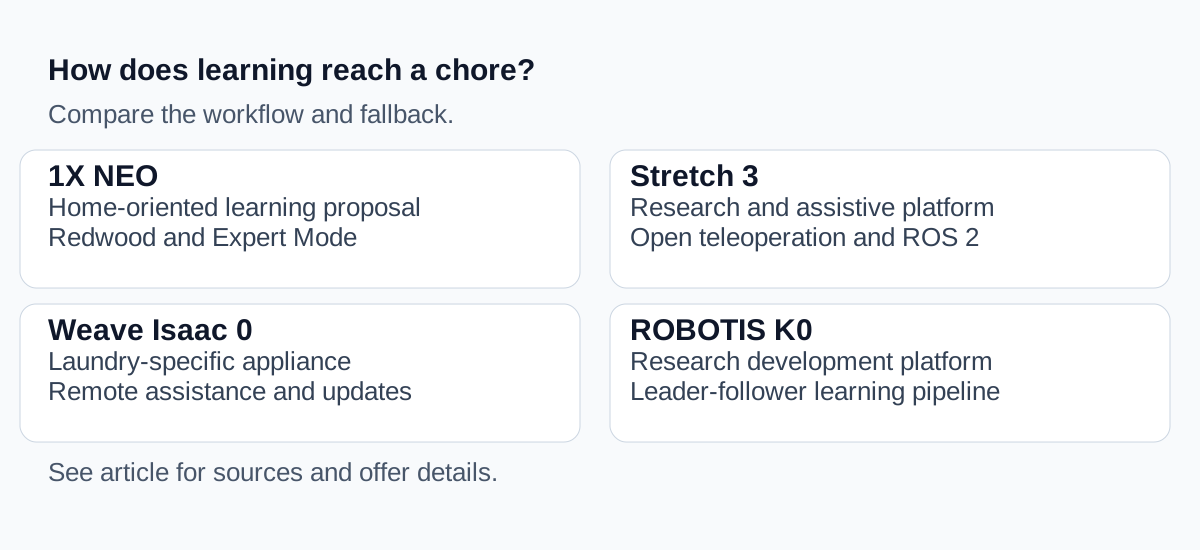
That promise is starting to show up in real product language. 1X says NEO can learn from guided chores. ROBOTIS documents leader-follower imitation-learning pipelines. Hello Robot sells a home-sized mobile manipulator that researchers use for teleoperation and data collection. Weave Robotics says its laundry robot learns from corrections.
The practical answer depends on the product. Supported developer platforms let researchers train limited tasks from demonstrations. Consumer claims about learning from corrections or updates do not establish an owner-accessible way to teach a new chore. Showing a robot a sink full of dishes is not enough to establish that it can handle your kitchen.
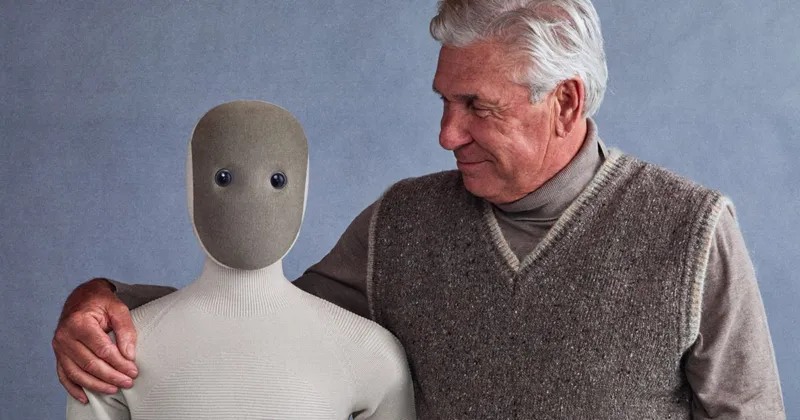
Can You Teach a Home Robot New Chores in 2026?
When a robot company says a home robot can learn from demonstration, it usually means one of four things:
- Teleoperation: a human remotely drives the robot through the task.
- Leader-follower control: a human moves one device while the robot mirrors or records the motion.
- Corrective learning: the robot attempts a task, fails, and a human fixes the mistake so the system can learn from the correction.
- Policy training: software turns many demonstrations into a reusable action model that can run without a human controlling every move.
Those are related, but they are not the same buyer promise. Teleoperation can make a robot useful today, but it may mean a person is effectively doing the hard part through the robot. Imitation learning is the longer-term goal: after enough good examples, the robot should generalize the skill to a slightly new object, room, or starting position.
That distinction matters for privacy, reliability, cost, and expectations. A robot that "learns" by uploading video of your home to a cloud training system is a very different product from a robot that learns locally from a few safe, limited demonstrations.
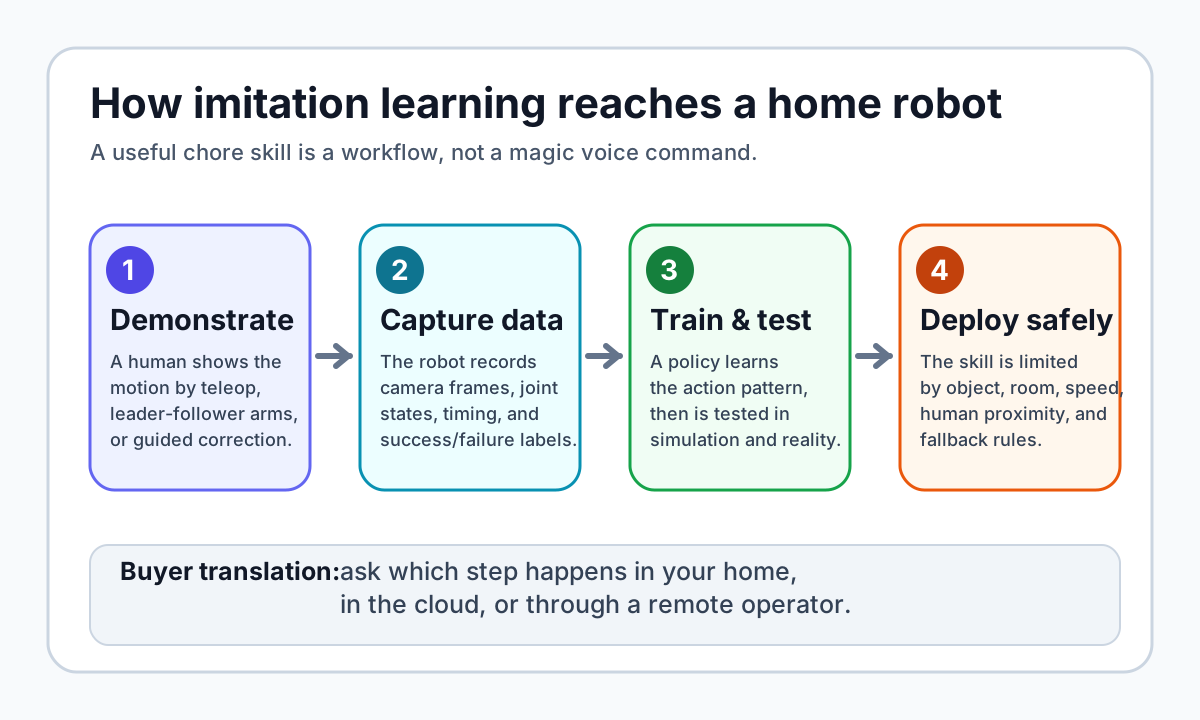
Scroll sideways to inspect the full chart.
Illustrative developer workflow; data fields and testing stages vary by method.
The Five Requirements for a Teachable Home Robot
A teachable chore robot needs more than an AI model. It needs the physical and software stack to make demonstrations repeatable.
1. A Body That Can Actually Do the Task
This sounds obvious, but it filters most robots immediately. A rolling companion robot can learn a better greeting routine, but it cannot fold a towel without an arm. A robot vacuum can improve room cleaning, but it cannot unload a dryer.
For household chores, look for manipulation hardware: arms, grippers, tactile sensing, wrist cameras, payload ratings, and a body that can safely move around people. In the ui44 home robot database, the robots closest to this problem are not standard vacuum cleaners. They are humanoids, mobile manipulators, laundry robots, and research platforms.
2. Sensing From the Robot's Point of View
In a robot-trajectory learning workflow, the dataset can include what the cameras saw alongside the robot’s joint states, actions, and task information. ROBOTIS’ OMX recording guide is one example of collecting these records through teleoperation. This is a specific learning setup, not a claim that every method requires the same sensor fields or that learning from video alone is impossible.
That is why robot learning often starts in labs before it reaches homes. Clean data is easier to collect when the lighting, objects, and operator workflow are controlled.
3. A Safe Way for Humans to Intervene
The more useful a robot becomes, the more dangerous blind autonomy becomes. If a robot can reach shelves, open drawers, or lift laundry baskets, it also needs speed limits, force limits, emergency stops, and fallback behavior.
1X's NEO is the most buyer-facing example. The robot is tracked in ui44 as a USD 20,000 pre-order humanoid with a 167 cm, 30 kg soft body, about four hours of battery life, stereo cameras, and household chore positioning. 1X's official NEO page says the robot works autonomously by default, but for chores it does not know, a buyer can schedule a 1X Expert to guide it. That is a practical admission: early home humanoids will need expert fallback for edge cases.
4. Enough Repetition to Survive Real Homes
A single perfect demo is not enough. A towel is never in exactly the same place. A mug handle faces a different direction. A shoe blocks the path. A pet walks through the scene.
1X's AI page describes Redwood as a vision-language-action model trained on both successes and failures, with joint control of locomotion and manipulation. That is the right direction because real chores require the body to move, brace, lean, and adapt while manipulating objects. The hard question is not whether the demo works once. It is how often it works when the house is messy.
5. A Clear Privacy and Data Policy
Teaching a robot usually means showing it your home. Buyers should ask where that data goes, who can view it, how long it is kept, and whether training can be disabled. Remote expert modes and cloud training may be useful, but they should be disclosed as remote assistance — not sold as pure autonomy.
What Happens After You Record a Demonstration?
A developer workflow makes the hidden work easier to see. The official LeRobot imitation-learning tutorial, checked on October 11, 2026, separates calibration, teleoperation, recording, training, and evaluation. It is an example for supported research hardware, not evidence that NEO or Isaac owners can install LeRobot or teach arbitrary chores through their companion apps.
Record One Attempt, Then Prepare the Next
Imagine a developer teaching a supported arm to move a block into a container. One recorded attempt is an episode: it has a starting arrangement, an action, and an end. LeRobot provides separate recording and environment-reset periods, and lets the operator discard an episode and record it again. Resetting means preparing the next example; it does not mean the robot has learned to tidy the scene itself.
That distinction changes how to judge a demonstration. If someone places the block under the gripper before each attempt, their preparation is part of the workflow even if it disappears from the edited video. A household analogue would be a person separating a towel from a tangled pile before the robot folds it. Success at the prepared subtask would not establish success at the whole chore. Ask what arrangement the operator must restore, and whether that preparation would still be needed during everyday use.
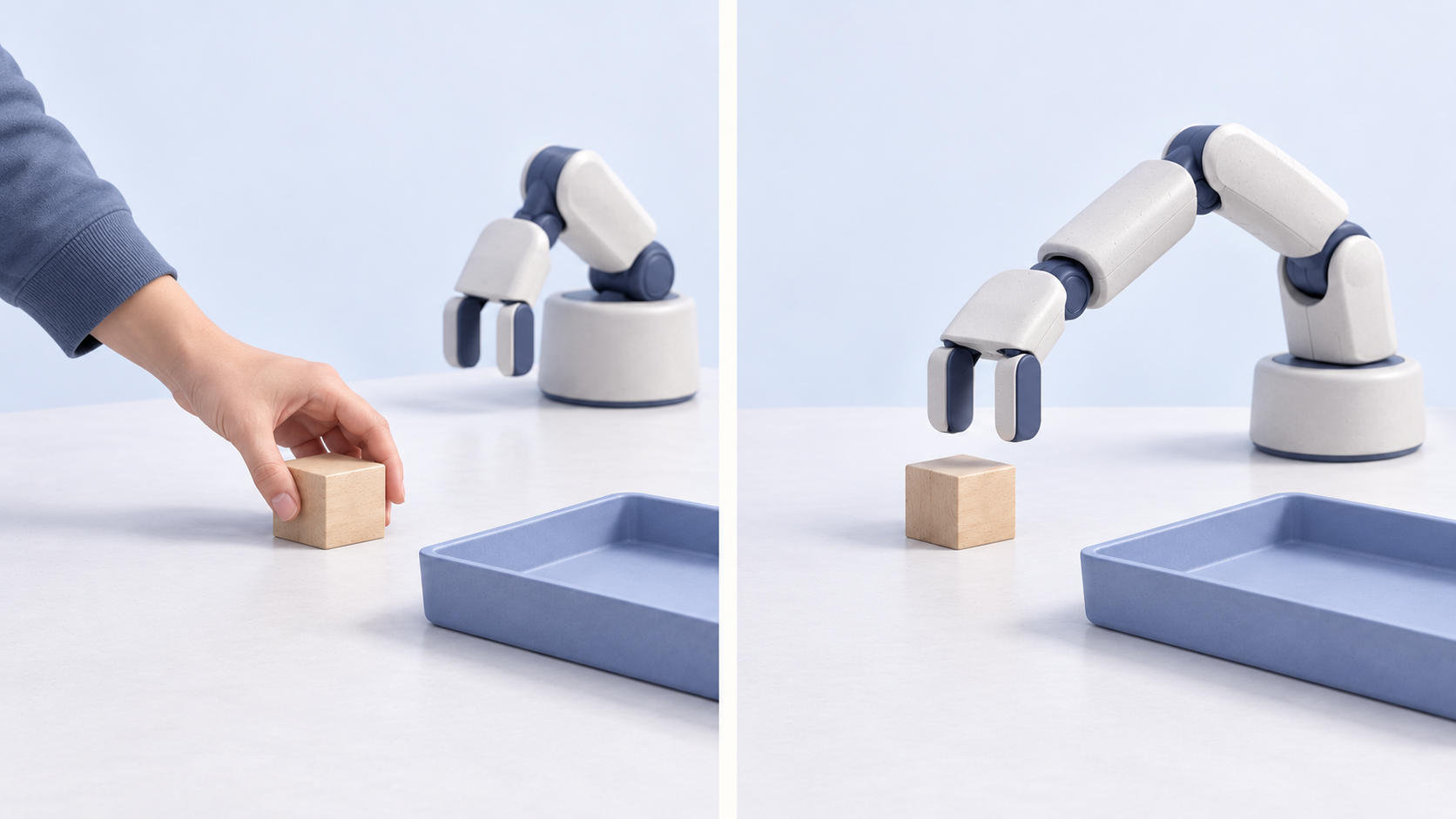
AI-generated conceptual illustration of a hypothetical recording setup. Left: a person resets the block while the arm is parked. Right: the next attempt begins with nobody in the workspace. This does not show autonomous reset or successful learning.
Inspect What Was Actually Recorded
LeRobot's dataset documentation describes camera video alongside states, actions, timestamps, and episode metadata. These are records of what the robot sensed and did, not merely a human-facing demonstration clip. Reviewing them can expose a mismatch between an attractive camera angle and the information available to the controller.
For the block example, a useful inspection question is whether the relevant camera can see the object before the grasp. If a hand hides it throughout the approach, repeating that scene does not automatically provide a clearer view. Similarly, counting saved episodes alone says little about whether they cover different starting positions or repeat the same narrow setup. The tutorial's example recording counts are not a universal minimum for learning a chore.
Data handling is another deliberate choice. The recording tutorial says data is saved locally and uploaded to the Hugging Face Hub by default; its dataset.push_to_hub=False option disables that upload. This setting belongs to that LeRobot recording workflow. It says nothing about a consumer robot's camera storage, remote operator access, or training consent.
Training Produces a Candidate, Not a Household Skill Guarantee
LeRobot's ACT guide describes training an action-prediction policy from a demonstration dataset. A developer chooses the dataset and training configuration and obtains model checkpoints. That software stage is different from the operator driving the arm during recording. Finishing it does not answer whether the block will land in the container when its starting position changes.
The separate policy-deployment guide describes running a trained policy and collecting evaluation episodes. For a reader assessing a robot claim, the useful evidence is what happened during those attempts: which starting conditions were tried, how often the task finished, and when a human intervened. A successful training run or selected replay should not stand in for those results. Physical evaluation belongs in a controlled, supervised setup appropriate to the hardware; this developer example is not an instruction to test an unvalidated policy around a family.
This also clarifies what a consumer offer must explain. Who records and checks the examples? Who trains the model, evaluates it, and decides that an update is ready for customers? A product may place those responsibilities with the manufacturer rather than the owner. Learning from service corrections can be valuable without providing an owner-accessible tool for teaching a new chore.
What Current Robots Tell Us
No consumer robot in 2026 gives you a universal "teach any chore" button. But a few robots show the shape of the future.
Robot
- What it proves
- Home-first humanoid with Expert Mode and learning claims
- ui44 data point
- $20,000 pre-order, 167 cm, 30 kg, ~4 hour battery
- Buyer reality
- The boldest home promise, but still early access and dependent on guided chores
Robot
- What it proves
- Real-home mobile manipulation platform
- ui44 data point
- $24,950, 24.5 kg, 33 x 34 x 141 cm, 2 kg payload, ROS 2/Python SDK
- Buyer reality
- Excellent for research and assistive robotics; not a plug-and-play family chore bot
Robot
- What it proves
- Narrow home task with remote correction loop
- ui44 data point
- Subscription or upfront plus monthly service; laundry folding
- Buyer reality
- More believable because it focuses on laundry instead of every chore
Robot
- What it proves
- Open imitation-learning pipeline
- ui44 data point
- 1.3 m, 34 kg, 23 DoF, 3 kg arm payload, development status
- Buyer reality
- Great signal for builders, not a consumer household helper yet
Robot
- What it proves
- Low-cost humanoid hardware baseline
- ui44 data point
- Starts at $13,500, 132 cm, 35 kg, 23 DoF, optional hands on EDU
- Buyer reality
- Standard lacks secondary development; EDU has it and requires a separate quote
| Robot | What it proves | ui44 data point | Buyer reality |
|---|---|---|---|
| 1X NEO | Home-first humanoid with Expert Mode and learning claims | $20,000 pre-order, 167 cm, 30 kg, ~4 hour battery | The boldest home promise, but still early access and dependent on guided chores |
| Hello Robot Stretch 3 | Real-home mobile manipulation platform | $24,950, 24.5 kg, 33 x 34 x 141 cm, 2 kg payload, ROS 2/Python SDK | Excellent for research and assistive robotics; not a plug-and-play family chore bot |
| Weave Isaac 0 | Narrow home task with remote correction loop | Subscription or upfront plus monthly service; laundry folding | More believable because it focuses on laundry instead of every chore |
| ROBOTIS AI Sapiens K0 | Open imitation-learning pipeline | 1.3 m, 34 kg, 23 DoF, 3 kg arm payload, development status | Great signal for builders, not a consumer household helper yet |
| Unitree G1 | Low-cost humanoid hardware baseline | Starts at $13,500, 132 cm, 35 kg, 23 DoF, optional hands on EDU | Standard lacks secondary development; EDU has it and requires a separate quote |
1X NEO: The Clearest Home-Facing Learning Claim
NEO is the robot to watch because 1X is explicitly connecting household chores, voice intent, expert guidance, and model learning. The official language is not just "remote control." It says a 1X Expert can guide a chore the robot does not know, helping NEO learn while getting the job done.
That is promising, but it also tells you what the first generation is likely to feel like. You may not be buying a fully autonomous servant. You may be buying a humanoid with a soft exterior, an expert-support service, and access to a growing library of skills.
For some buyers, that will be exciting. For others, the privacy and reliability trade-offs will be too large until the robot can do more locally and with less human supervision.
Stretch 3: The Honest Research Baseline
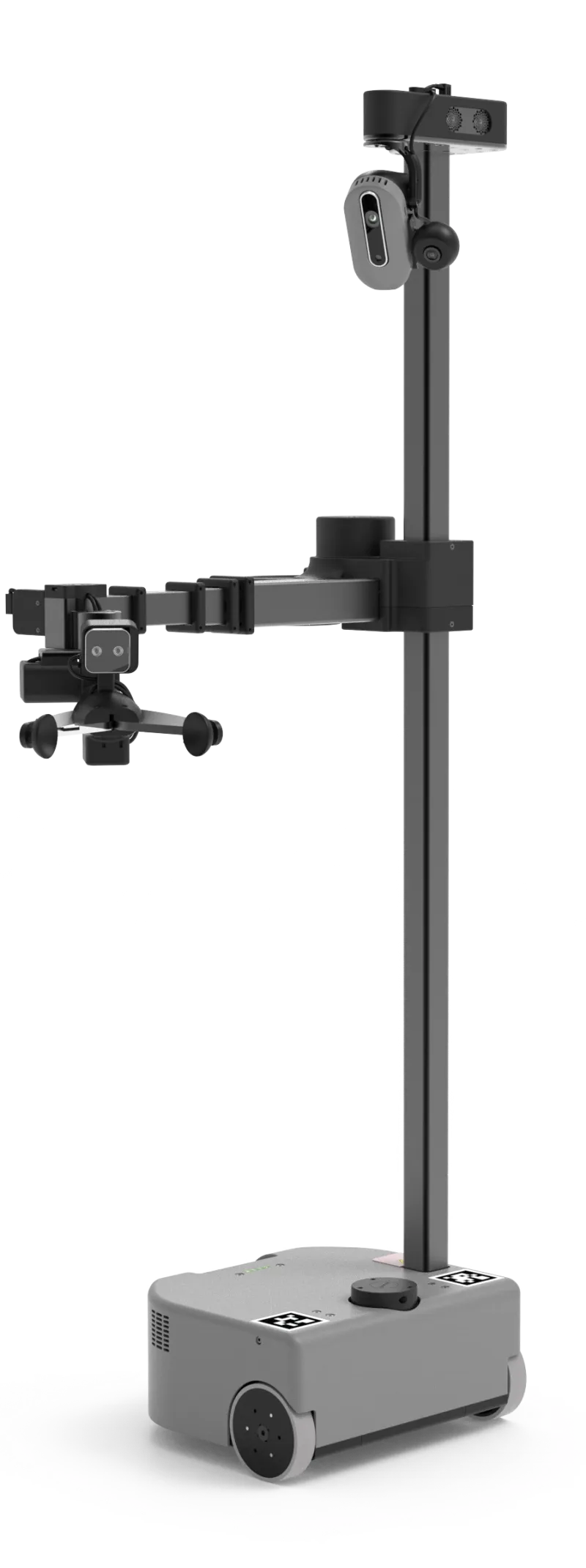
Stretch 3 is not marketed as a magic home servant, which is exactly why it is useful for understanding the field. The official Stretch 3 product page lists it as available now for USD 24,950, with a compact 33 x 34 cm footprint, 24.5 kg weight, 2-5 hour runtime, a 2 kg payload, ROS 2, Python SDK, and web/gamepad/dexterous teleoperation.
Those specs illustrate the equipment used in a learning workflow: a mobile base, reliable cameras, a manipulator, accessible software, and a way to collect data from real indoor spaces. Stretch is closer to a home manipulation toolkit than a consumer appliance, but it is one of the clearest bridges between research and real homes.
Weave Isaac 0: Why Narrow Skills May Arrive First
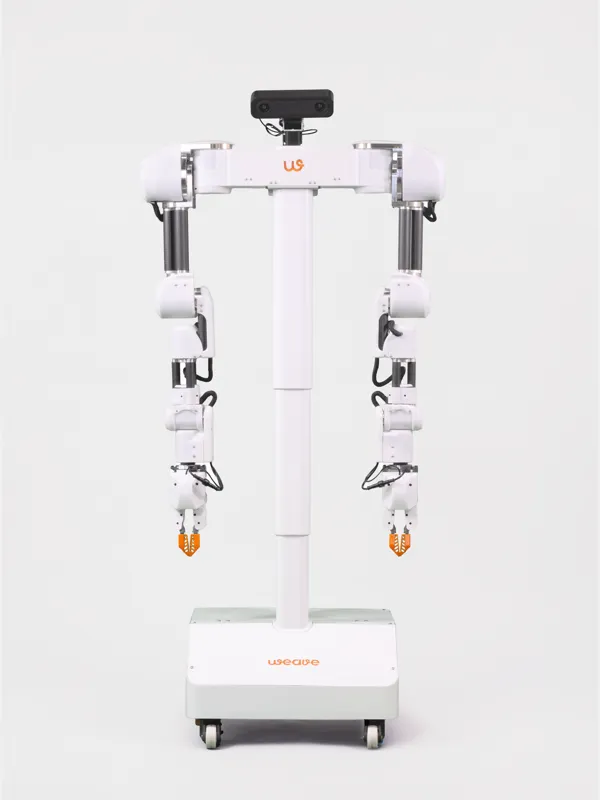
The Weave Isaac 0 is less general than NEO or Stretch, but that may be its advantage. ui44 tracks it as a home laundry-folding robot that combines autonomous folding with remote assistance. Its official product page says no special owner training is needed and improvements arrive through normal use and software updates. Weave estimates 30–90 minutes for an average load, depending on its size and garment mix. Those are manufacturer claims, not an independent measurement of unassisted completion.
As of October 11, 2026, Weave’s home-use order page lists USD 249/month or USD 3,999 upfront plus USD 49/month, with USD 250 refundable due today. The linked reservation agreement does not specify how that deposit applies to later payments; confirm its treatment before adding or subtracting it in a budget.
That is not "teach it anything." It is "give it one valuable household task and build a learning loop around that task." For buyers, this is probably the more realistic near-term pattern: robots that learn within a narrow boundary before they try to become general-purpose helpers.
ROBOTIS K0: Open Learning, Not Consumer Convenience
ROBOTIS AI Sapiens K0 is a development platform, but it makes the learning stack unusually visible. ROBOTIS’ introduction describes a 1.3 m, 34 kg humanoid with 23 degrees of freedom, a 3 kg max arm payload, Dynamixel-Q actuators, reinforcement learning in NVIDIA Isaac Sim, and imitation learning through leader-follower data collection.
The important buyer lesson is transparency. When a company can show how data is collected, what sensors are used, where training happens, and how policies run on hardware, its learning claims are easier to evaluate. Closed demos are harder to judge.
Unitree G1 and Fauna Sprout: Hardware Is Not Enough
Unitree G1 is compelling because it starts at $13,500 and has a 132 cm, 35 kg Standard body with 23 degrees of freedom, depth camera, 3D LiDAR, Wi-Fi 6, and Bluetooth 5.2. The official G1 specification table distinguishes the entry Standard, which lacks secondary development, from the separately quoted EDU, which supports it and offers hand options. The USD 13,500 starting price should not be read as the price of a complete teachable developer setup. Fauna Sprout takes a different approach. Its manufacturer page describes a 107 cm, 22.7 kg soft humanoid developer platform with 29 degrees of freedom, stereoscopic vision, time-of-flight sensors, an E-stop, and social behaviors.
Both are relevant to teachable homes, but neither should be confused with a ready general chore robot. The body is only the starting point. The harder part is safe manipulation, task data, user controls, and repeatable autonomy in the messy places people actually live.
Buyer Checklist: Questions to Ask Before You Believe the Demo
If you are comparing robots on /compare, ask these questions before you pay a deposit:
- What exactly can I teach? A new phrase, a new route, a new object, or a full physical chore?
- Who performs failed tasks? The robot, a remote expert, or you?
- Does learning happen locally, in the cloud, or both? This affects privacy and latency.
- Can I delete training data? If the answer is vague, assume the data policy is not mature.
- What are the safety limits? Look for payload, force, speed, soft exterior, tactile sensing, E-stop, and human-proximity behavior.
- Can the robot explain uncertainty? A useful home robot should know when to stop and ask for help.
- What happens after the company shuts down the service? If learning depends on cloud experts, the robot's long-term value depends on the company.
The Bottom Line
Supported developer platforms can learn limited tasks through a deliberate workflow of demonstrations, training, and evaluation. Whether a consumer can teach a particular robot a new chore depends on its supported features. Remote expert guidance, corrections, and software updates are useful services, but they do not by themselves provide that owner capability.
The most credible products in 2026 are honest about that boundary. NEO shows where a home humanoid could go, Stretch 3 shows the manipulation and teleop stack researchers already use in real homes, Isaac 0 shows why narrow chore robots may commercialize first, and ROBOTIS K0 shows the open-source learning pipeline underneath the hype.
For buyers, the key question is not "can it learn?" The better question is: what does the robot need from you, your home, your data, and a remote human before that learned chore becomes reliable?
Written by
ui44 Team
Published April 25, 2026
Share this article
Open a plain share link on X or Bluesky. No embeds, no widgets, no cookie baggage.