Stringman is a ceiling-mounted, cable-driven parallel robot from Neufangled Robotics. The current Arpeggio listing describes a four-wire suspended motion system: two powered anchors, each with a motor pair, plus two passive eyelets move a suspended gripper through a room-scale workspace. Neufangled's official Stringman product page lists a work area up to 5 m x 5 m x 3 m, 3 kg dynamic lifting capacity that depends on speed and altitude, roughly 0.4 m/s traverse speed, two anchor cameras, a wide-FOV gripper camera, Raspberry Pi Zero 2 W compute per component, external host-machine compute for control, suitable GPU/NPU hardware for AI control, 2.4 GHz Wi-Fi setup, 3D-printed PET-GF and PLA parts, and about 800 hours of accumulated real-home testing. Neufangled's homepage still describes a 2 kg ideal payload with 1 kg recommended, so buyers should treat payload as configuration-dependent rather than a single fixed number. The next batch is listed as a preorder expected around October 2026.
That does not make Stringman a finished appliance for everyone. It puts lines near your ceiling, needs anchors in the room, and works inside a defined volume. But for one job, moving light clutter from the floor into bins, the trade-off is interesting enough to compare against the mobile robots already in the ui44 database.
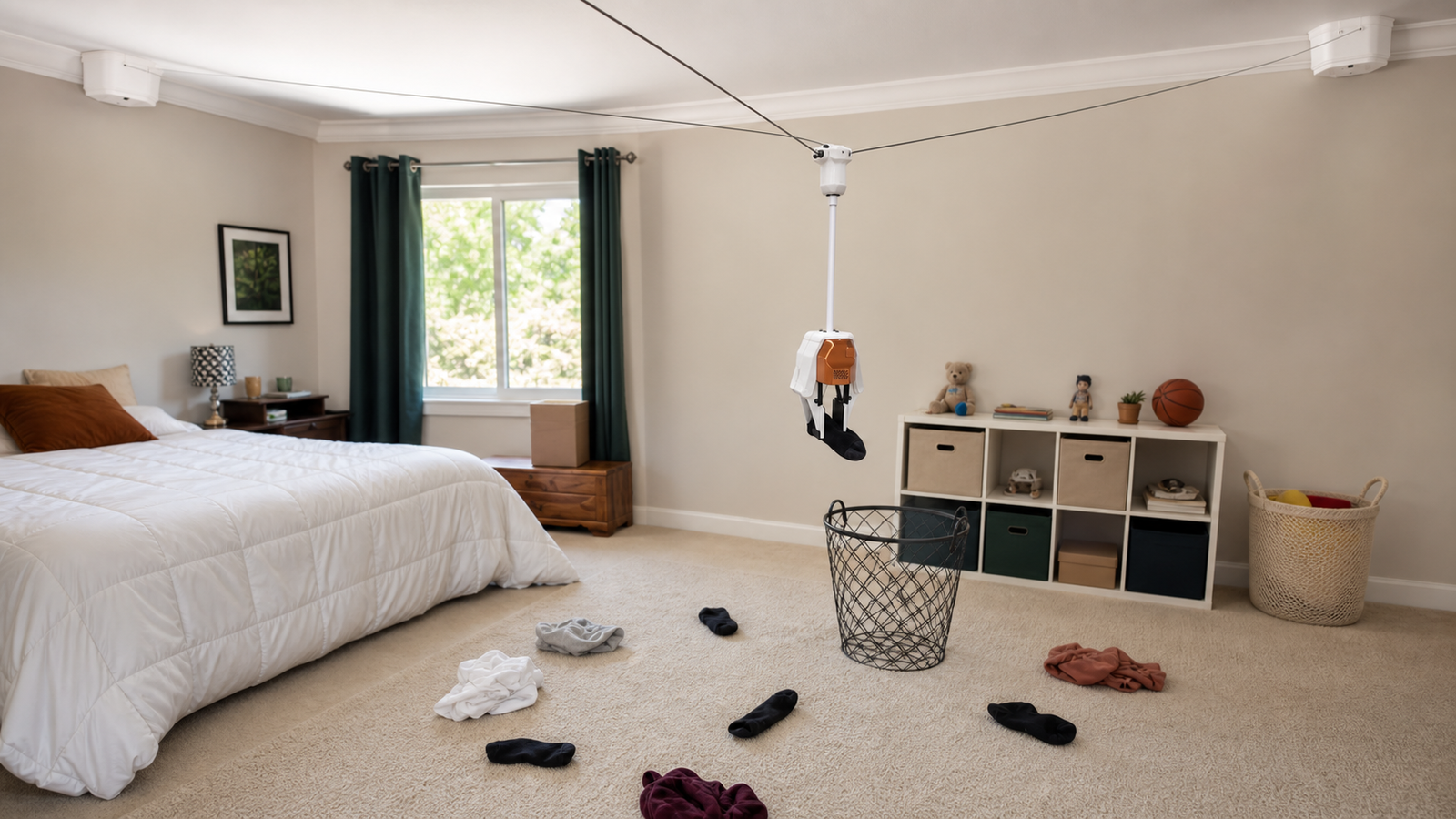
Why an Overhead Robot Is Worth Taking Seriously
The usual home-robot assumption is mobility first, manipulation second. A robot vacuum solves that by staying low and cleaning the floor. A humanoid solves it by trying to bring a human-shaped body into the room. A mobile manipulator such as Hello Robot Stretch 4 splits the difference: it rolls around indoors and brings a useful arm to cabinets, counters, and people.
Stringman flips the order. It gives up mobile autonomy and full-body reach, then uses the room itself as the robot's frame. That is why the shape matters. A cable-driven robot can cover a large volume with a small number of actuators, and it does not carry a battery, wheels, legs, or a full torso through the room.
The official Stringman page makes the cost argument directly: price in robotics is tightly tied to actuator count, and a cable robot can move a gripper around a room with far fewer powered joints than a mobile humanoid. Neufangled's current preorder page lists a $120 deposit plus an $845 balance, for a $965 total before any buyer-specific add-ons or later pricing changes. The Hackaday.io Stringman project page still shows an older about-$1,235 U.S./Canada shipping-inclusive project price, after an earlier version sold at $790 on Tindie. Even using the newer lower preorder total, Stringman is not cheap in absolute terms, but it is a different category from a $20,000 preorder humanoid or a $29,950 research mobile manipulator.
The Practical Job: Move Light Objects to Known Places
The strongest Stringman use case is not "clean my whole house." It is narrower: move common light clutter from the floor to known destinations. Think laundry into a hamper, toys into a box, trash into a bin, or small items from one marked zone to another.
That narrowness is a feature. Neufangled says Stringman uses clip-on fiducial tags to mark drop bins such as laundry, toy boxes, and trash cans. The robot does not need to understand every destination semantically if the destination is tagged. The hard part becomes detecting and grasping the loose item, then moving it to a known target.
This is also where the limits become clear. Stringman is not a dexterous hand. The official page describes a two-finger gripper with a wrist and says that is enough for the clutter it is designed to pick up. That is plausible for socks, shirts, soft toys, lightweight packaging, and some rigid objects. It is not a promise that the robot can sort Lego from food waste, untangle charging cables, identify fragile keepsakes, or decide whether a child's art project is trash.
Buyers should treat "clutter pickup" as a controlled workflow, not magic. The best setup is likely a playroom, laundry zone, maker room, or office corner where the allowed objects and destinations are deliberately constrained.
How It Compares With Robots Already in ui44
Stringman is not yet a normal ui44 catalog category. It sits between home automation hardware, open-source robotics, and a room-scale appliance. To make the trade-offs concrete, compare it with five robots already tracked in the database.
Robot
Stringman
- ui44 category
- Not yet cataloged
- Manipulation approach
- Ceiling-mounted four-wire cable gripper
- Public price/status
- $965 current preorder total; older project page lists about $1,235 shipped in U.S./Canada
- What it can teach this decision
- Cheap room-scale reach if you accept installation and visible lines
Robot
- ui44 category
- Cleaning
- Manipulation approach
- Foldable five-axis OmniGrip arm on a robot vacuum
- Public price/status
- $999.99 current Roborock US sale price on 2026-07-18; $2,599.99 compare-at/MSRP; available
- What it can teach this decision
- A mass-market cleaner can pick up a few light categories, but payload is only 300 g
Robot
- ui44 category
- Home Assistants
- Manipulation approach
- Mobile base plus telescoping arm
- Public price/status
- $29,950, available for research/enterprise and assistive pilots
- What it can teach this decision
- A serious home manipulator, but priced like a platform rather than an appliance
Robot
- ui44 category
- Home Assistants
- Manipulation approach
- Compact mobile manipulator with ROS 2/Python stack
- Public price/status
- $24,950 list price
- What it can teach this decision
- Proven research community and home-form factor, still specialist hardware
Robot
- ui44 category
- Humanoid
- Manipulation approach
- Full-body bipedal humanoid with arms
- Public price/status
- $20,000 Early Access or $499/month subscription, preorder
- What it can teach this decision
- General-purpose promise, higher cost, broader safety and reliability burden
Robot
- ui44 category
- Lawn & Garden
- Manipulation approach
- Outdoor mobile base with dual arms
- Public price/status
- EUR 8,990 reported preorder
- What it can teach this decision
- Train-by-demonstration manipulation, but aimed at outdoor/garden work
| Robot | ui44 category | Manipulation approach | Public price/status | What it can teach this decision |
|---|---|---|---|---|
| Stringman | Not yet cataloged | Ceiling-mounted four-wire cable gripper | $965 current preorder total; older project page lists about $1,235 shipped in U.S./Canada | Cheap room-scale reach if you accept installation and visible lines |
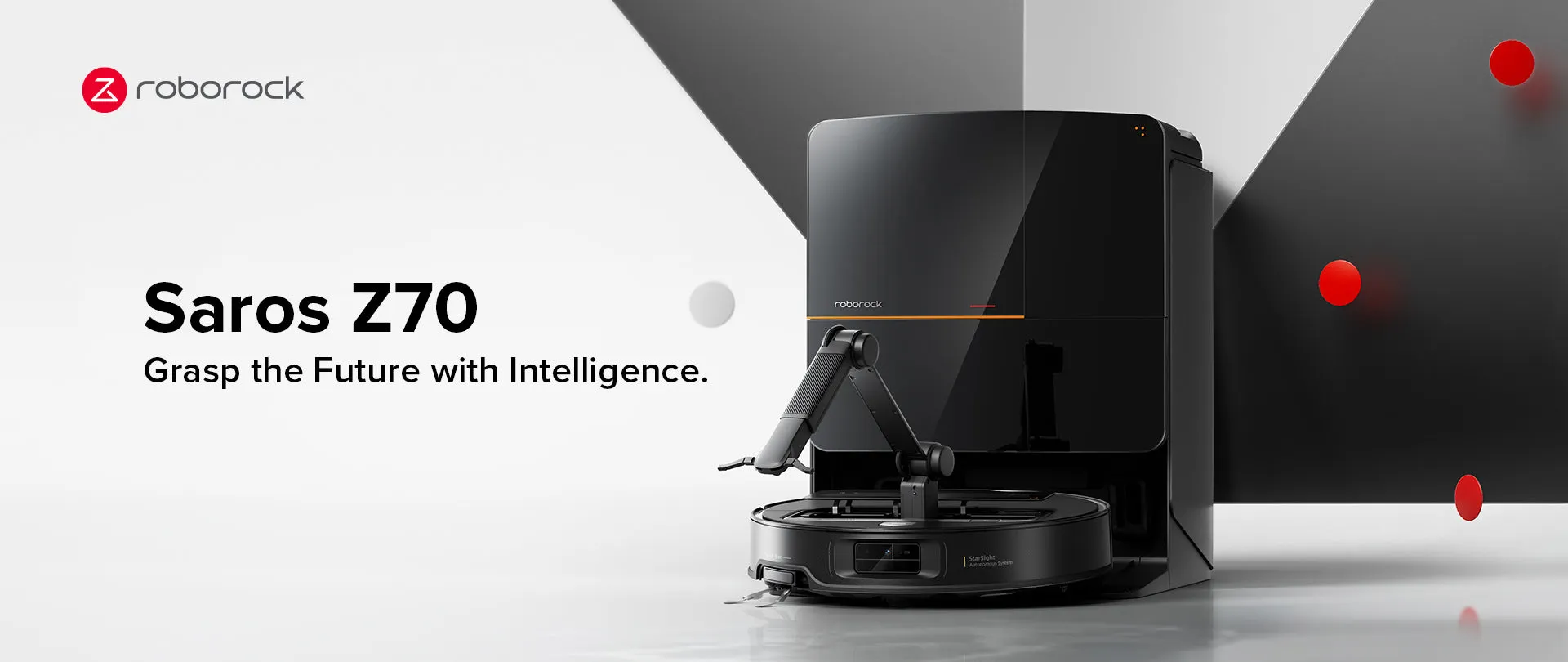
| Roborock Saros Z70 | Cleaning | Foldable five-axis OmniGrip arm on a robot vacuum | $999.99 current Roborock US sale price on 2026-07-18; $2,599.99 compare-at/MSRP; available | A mass-market cleaner can pick up a few light categories, but payload is only 300 g |
| Hello Robot Stretch 4 | Home Assistants | Mobile base plus telescoping arm | $29,950, available for research/enterprise and assistive pilots | A serious home manipulator, but priced like a platform rather than an appliance |
| Hello Robot Stretch 3 | Home Assistants | Compact mobile manipulator with ROS 2/Python stack | $24,950 list price | Proven research community and home-form factor, still specialist hardware |
| 1X NEO | Humanoid | Full-body bipedal humanoid with arms | $20,000 Early Access or $499/month subscription, preorder | General-purpose promise, higher cost, broader safety and reliability burden |
| EEVE Willow X | Lawn & Garden | Outdoor mobile base with dual arms | EUR 8,990 reported preorder | Train-by-demonstration manipulation, but aimed at outdoor/garden work |
The comparison is not about declaring a winner. It shows that "home robot" is becoming a design space, not one form factor. Saros Z70 adds a small arm to a vacuum. Stretch adds a capable arm to a mobile research platform. NEO tries to bring a whole humanoid body into the home. Stringman bolts the robot to the room and asks whether fixed infrastructure can beat mobile complexity for one annoying chore.
The Installation Trade-Off Is the Product
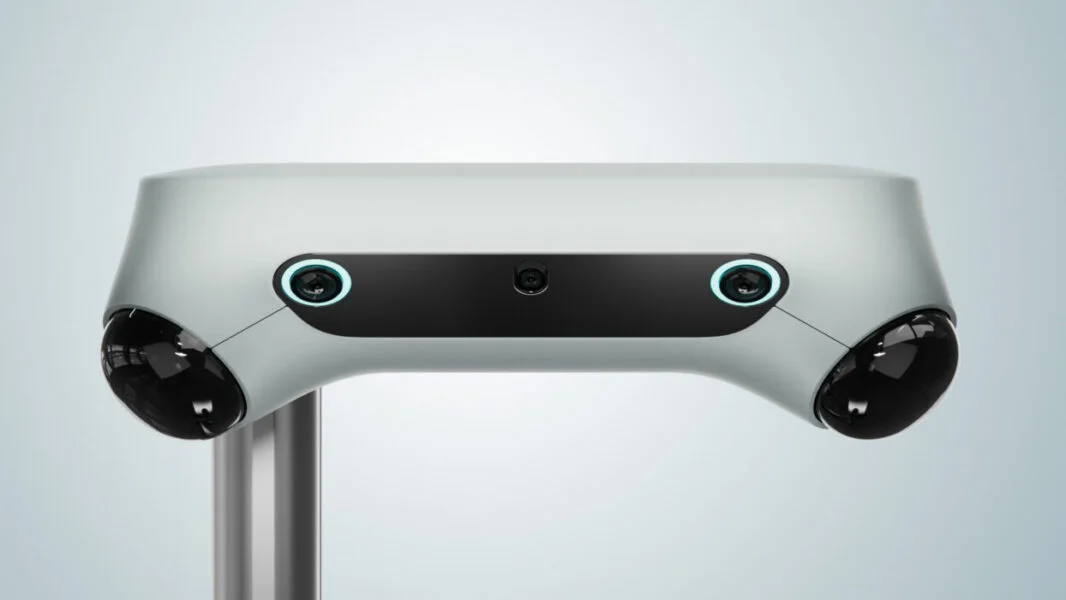
Stringman is only interesting if you are honest about the installation. The official FAQ says anchors are secured to studs with wood screws, similar to a curtain rod, and that setup needs a step ladder, cordless drill, and roughly an hour. A June 2026 Hackaday write-up also calls out the obvious buyer concern: while the crane is operating, the wires can dip into the occupied room. Neufangled says the lines park near the ceiling when not in use, but the visible infrastructure is still part of the product.
That makes Stringman closer to a built-in appliance than a gadget. It is not something most people will move room to room. The right buyer is someone with a specific room that repeatedly becomes messy and a tolerance for visible infrastructure. The wrong buyer is someone who wants a robot to roam the whole home with no installation.
Ceiling fans and low fixtures matter too. Neufangled says fans can be handled by mounting anchors at or below the fan level, and the work area can be shrunk to exclude low-hanging fixtures. That is a practical answer, but it also means some rooms simply will not be good candidates. A nursery with a fan, a living room with a chandelier, or a rental where drilling into studs is not allowed may be a non-starter.
The fixed-room model has one real advantage: the robot can always know the boundaries of its working volume. A mobile humanoid has to localize, walk, avoid furniture, avoid people, manage battery state, and manipulate objects at the same time. A ceiling robot can make a simpler bargain: "I work here, inside these anchors, with these bins."
Safety Looks Different When the Robot Hangs Overhead
Stringman avoids some humanoid risks. It is not a 30 kg biped walking near a toddler, and it is not a wheeled robot trying to squeeze between a pet bed and a chair. But overhead cables and a moving suspended gripper introduce their own safety questions.
The questions buyers should ask are specific:
- What happens if a child grabs the gripper?
- What happens if a cable snags on furniture, a toy, a plant, or a light fixture?
- Can the robot detect unexpected resistance and stop quickly?
- How does it behave if Wi-Fi drops during a movement?
- Is there a physical emergency stop within reach?
- Does it have a reliable "do not pick this up" workflow for fragile or risky items?
Those are not reasons to dismiss the concept. They are the right acceptance tests. A home clutter robot is only useful if people can share the room with it without turning every cleanup run into supervision duty.
Privacy May Be the Best Part of the Architecture
Stringman's privacy story is stronger than many camera-equipped home robots because Neufangled explicitly describes a fully on-premise mode where video processing and telemetry remain inside the local network. The page also offers remote management for buyers who prefer account-based access, but the local option matters.
That distinction should be part of every home-robot buying checklist. A clutter robot needs cameras pointed at private rooms. It may see children's toys, laundry, medications, paperwork, and ordinary domestic mess. If the robot's value is "it watches the room until it can clean it," local processing is not a nice bonus. It is a core product feature.
The ui44 database already tracks robots with cloud-connected cameras, companion features, voice interfaces, and remote teleoperation. For Stringman-style hardware, the right privacy questions are:
- Can the robot run without cloud video upload?
- Can remote access be disabled completely?
- Are logs, maps, training samples, and clips stored locally?
- Is the software open enough to audit?
- Can household members see when the robot is observing or recording?
Stringman's Apache 2.0 open-source and OSHWA-certified positioning helps here. It does not automatically make every deployment private, but it gives technical buyers more to inspect than a closed consumer camera robot.
Where Humanoids Still Have the Advantage
A ceiling-mounted robot is not a humanoid replacement. It cannot open the front door, carry a cup from the kitchen to the sofa, climb stairs, unload a dishwasher, fold laundry on a table, or use tools across multiple rooms. It also cannot bring its own body to the problem. If the object is outside the anchored volume, the robot is irrelevant.
That is why 1X NEO still belongs in the conversation. NEO is expensive and still preorder-stage, but its pitch is generality: a 167 cm, 30 kg home-focused humanoid with official current materials describing dual stereo fisheye cameras, beamforming microphones, IMUs, and tactile sensing in the hands, plus roughly four hours of battery life and household chore positioning. If it works as promised, it can address more of the home than one mounted room.
The challenge is that broad capability brings broad failure modes. A humanoid that tidies a room needs balance, navigation, manipulation, semantic understanding, safety certification, human interaction, charging behavior, and fallback support. Stringman removes many of those problems by accepting a fixed installation and a narrow job.
The buying question is therefore not "ceiling robot or humanoid?" It is "do you want one constrained task sooner, or a broader body later?"

Who Should Consider a Stringman-Style Robot?
Stringman makes the most sense for people who can answer yes to most of these:
- You have one room that repeatedly collects light clutter.
- The room has suitable ceiling geometry and no impossible fan or fixture conflict.
- You are comfortable drilling anchors into studs or building a removable test frame.
- You can define a few obvious drop zones, such as laundry, toys, and trash.
- The clutter is mostly soft or lightweight.
- You are comfortable with open-source, early hardware and some tinkering.
- You value local processing and auditability.
It makes less sense if you rent, dislike visible hardware, need whole-home coverage, need manipulation on counters and shelves, or expect a polished consumer appliance with support comparable to a robot vacuum brand.
For most buyers, the smart position is curiosity, not blind preorder. Watch for evidence on grasp reliability, snag handling, setup repeatability, noise, long-term line wear, and how often a person has to rescue the robot. Also watch whether the October 2026 batch ships close to the promised schedule and whether early owners publish real-room results.
The Bigger Signal for Home Robots
Stringman may or may not become a mainstream product. The bigger signal is that home robotics is starting to move beyond the vacuum-versus-humanoid framing. Some chores may be best solved by a body. Some by a smarter appliance. Some by room infrastructure. Some by a mobile base with one good arm. Some by a robot vacuum that moves only the items blocking its cleaning path.
That is healthy. Homes are not factories, but they do have repeatable zones: playrooms, laundry corners, kitchens, garages, patios, and bedrooms. A robot that is excellent in one zone can be more useful than a general-purpose robot that is impressive in demos but not reliable enough for daily use.
Stringman's ceiling-mounted design is not subtle. It asks you to change the room so the robot can be simpler. That will be a deal-breaker for many people. But it also points toward a practical future: the first home robots that actually help may be the ones that stop trying to be everything.
Related in the database
Use this article as a privacy verification workflow
Turn the article into a privacy verification pass grounded in the robots, manufacturers, and components it actually references.
Ceiling-Mounted Robots: Stringman Clutter Test already points you toward 5 linked robots, 4 manufacturers, and 4 countries inside the ui44 database. That matters because strong buyer guidance is easier to apply when you can move immediately from a claim or warning into concrete product pages, manufacturer directories, component explainers, and country-level context instead of treating the article as an isolated opinion piece. The fastest next step is to turn the article into a shortlist workflow: open the linked robot pages, verify which specs are actually published for those models, then compare the surrounding manufacturer and component context before you decide whether the underlying claim changes your buying plan.
For this topic, the useful discipline is to separate the editorial lesson from the catalog evidence. The article gives you the framing, but the robot pages tell you what each product actually ships with today: sensor stack, connectivity methods, listed price, release timing, category, and support-relevant compatibility notes. The manufacturer pages then show whether you are looking at a one-off launch, a broader lineup pattern, or a company that spans multiple categories. That layered workflow reduces the risk of buying on a single marketing phrase or a single support FAQ.
Use the robot pages to confirm which products actually expose cameras, microphones, Wi-Fi, or voice systems, then use the manufacturer pages to decide how much of the privacy question seems product-specific versus brand-wide. On this route cluster, Stretch 4, Stretch 3, and Saros Z70 form the fastest reality check. If you want a quick working shortlist, open Compare Stretch 4, Stretch 3, and Saros Z70 next, then keep this article open as the reasoning layer while you compare structured data side by side.
Practical Takeaway
Every robot, manufacturer, category, component, and country reference below resolves to a real ui44 page, keeping the follow-up path grounded in database records rather than generic advice.
Suggested next steps in ui44
- Open Stretch 4 and note the listed sensors, connectivity methods, and voice stack before you interpret any policy claim.
- Cross-check the wider brand context on Hello Robot so you can see whether the privacy question touches one model or a broader lineup.
- Use the linked component pages to confirm how common the relevant sensors and connectivity layers are across the database.
- Keep a short note of which policy layers you checked, which device features are actually present on the robot page, and which items still depend on region- or app-level confirmation.
- Finish with Compare Stretch 4, Stretch 3, and Saros Z70 so the policy reading sits next to structured product data.
Robot profiles worth opening next
Use the linked product pages as the evidence layer
The linked robot pages are where this article becomes operational. Instead of asking whether the headline is interesting, use the robot entries to inspect the actual mix of sensors, connectivity options, batteries, pricing, release timing, and stated capabilities attached to the products mentioned in the article. That is the easiest way to see whether the warning or opportunity described here affects one product family, a specific design pattern, or an entire buying lane.
Stretch 4
Hello Robot · Home Assistants · Available
Stretch 4 is tracked on ui44 as a available home assistants robot from Hello Robot. The database currently records a listed price of $29,950, a release date of 2026-05-12, 8 hours (light CPU load) battery life, Not officially disclosed charging time, and a published stack that includes Wide-FOV depth sensing, High-resolution RGB cameras, and Calibrated RGB + depth perception plus its listed connectivity stack.
For privacy-focused reading, this page matters because it shows the concrete device surface behind the policy discussion. Use it to verify whether Stretch 4 combines sensors and connectivity in a way that could change the in-home data footprint, and compare the listed capabilities such as Mobile Manipulation, Omnidirectional Indoor Mobility, and Autonomous Mapping and Navigation with any cloud, app, or voice layers.
Stretch 3
Hello Robot · Home Assistants · Active
Stretch 3 is tracked on ui44 as a active home assistants robot from Hello Robot. The database currently records a listed price of $24,950, a release date of 2024, 2–5 hours battery life, Not disclosed charging time, and a published stack that includes Intel D405 RGBD Camera (gripper), Intel D435if RGBD Camera (head), and Wide-Angle RGB Camera (head) plus Wi-Fi 6E and Bluetooth.
For privacy-focused reading, this page matters because it shows the concrete device surface behind the policy discussion. Use it to verify whether Stretch 3 combines sensors and connectivity in a way that could change the in-home data footprint, and compare the listed capabilities such as Mobile Manipulation, Autonomous Navigation, and Teleoperation (Web / Gamepad / Dexterous) with any cloud, app, or voice layers.
Saros Z70 is tracked on ui44 as a available cleaning robot from Roborock. The database currently records a listed price of $1,000, a release date of 2025-05, 6,400 mAh Li-ion; official FAQ says about 2h15+ vacuuming/mopping with the arm disabled, or about 2h10+ with the arm enabled while tidying 10 items (Mop Wash Frequency set to 15 minutes). battery life, 2.5-hour fast charging charging time, and a published stack that includes LiDAR (StarSight 2.0), 3D Structured Light, and RGB Camera plus Wi-Fi and Bluetooth.
For privacy-focused reading, this page matters because it shows the concrete device surface behind the policy discussion. Use it to verify whether Saros Z70 combines sensors and connectivity in a way that could change the in-home data footprint, and compare the listed capabilities such as OmniGrip 5-Axis Mechanical Arm, Object Pickup up to 300 g (socks, sandals, crumpled tissues, towels; more items planned via OTA), and Obstacle Relocation with any cloud, app, or voice layers, including Amazon Alexa and Google Assistant.
NEO
1X Technologies · Humanoid · Pre-order
NEO is tracked on ui44 as a pre-order humanoid robot from 1X Technologies. The database currently records a listed price of $20,000, a release date of 2025-10-28, ~4 hours battery life, Not disclosed charging time, and a published stack that includes RGB Cameras, Depth Sensors, and Tactile Skin plus Wi-Fi and Bluetooth.
For privacy-focused reading, this page matters because it shows the concrete device surface behind the policy discussion. Use it to verify whether NEO combines sensors and connectivity in a way that could change the in-home data footprint, and compare the listed capabilities such as Household Chores, Tidying Up, and Safe Human Interaction with any cloud, app, or voice layers.
Willow X is tracked on ui44 as a pre-order lawn & garden robot from EEVE. The database currently records a listed price of €8,990, a release date of 2026, 5-8 hours; 600 Wh battery battery life, Approximately 3 hours charging time, and a published stack that includes Four onboard cameras, Two depth cameras, and Two recording cameras plus Wi-Fi and Optional 4G.
For privacy-focused reading, this page matters because it shows the concrete device surface behind the policy discussion. Use it to verify whether Willow X combines sensors and connectivity in a way that could change the in-home data footprint, and compare the listed capabilities such as Train-by-demonstration Task Learning, Autonomous Task Execution, and Dual-arm Manipulation with any cloud, app, or voice layers.
Manufacturer context behind the article
Check whether this is one product story or a broader company pattern
Manufacturer pages add the privacy context that individual product pages cannot show on their own. They help you check whether cameras, microphones, cloud accounts, app controls, and policy assumptions appear across a broader lineup or stay tied to one specific product story.
Hello Robot
ui44 currently tracks 2 robots from Hello Robot across 1 category. The company is grouped under USA, and the current catalog footprint on ui44 includes Stretch 3, Stretch 4.
That wider brand context matters because privacy questions rarely stop at one FAQ page. A manufacturer route helps you see whether the article is centered on one premium model or on a company that has several relevant products and therefore more than one place where the same policy or app assumptions might matter. The category mix here currently points toward Home Assistants as the most useful next route if you want to see whether this article reflects a wider pattern inside the brand.
Roborock
ui44 currently tracks 6 robots from Roborock across 2 categorys. The company is grouped under China, and the current catalog footprint on ui44 includes Saros Z70, Saros Rover, Saros 20.
That wider brand context matters because privacy questions rarely stop at one FAQ page. A manufacturer route helps you see whether the article is centered on one premium model or on a company that has several relevant products and therefore more than one place where the same policy or app assumptions might matter. The category mix here currently points toward Cleaning, Lawn & Garden as the most useful next route if you want to see whether this article reflects a wider pattern inside the brand.
1X Technologies
ui44 currently tracks 2 robots from 1X Technologies across 1 category. The company is grouped under Norway, and the current catalog footprint on ui44 includes NEO, EVE.
That wider brand context matters because privacy questions rarely stop at one FAQ page. A manufacturer route helps you see whether the article is centered on one premium model or on a company that has several relevant products and therefore more than one place where the same policy or app assumptions might matter. The category mix here currently points toward Humanoid as the most useful next route if you want to see whether this article reflects a wider pattern inside the brand.
EEVE
ui44 currently tracks 1 robot from EEVE across 1 category. The company is grouped under Belgium, and the current catalog footprint on ui44 includes Willow X.
That wider brand context matters because privacy questions rarely stop at one FAQ page. A manufacturer route helps you see whether the article is centered on one premium model or on a company that has several relevant products and therefore more than one place where the same policy or app assumptions might matter. The category mix here currently points toward Lawn & Garden as the most useful next route if you want to see whether this article reflects a wider pattern inside the brand.
Broaden the scan without leaving the database
Categories, components, and countries add the wider context
Category framing
Category pages are useful when the article touches a buying pattern that shows up across brands. A category route helps you confirm whether the linked products sit in a narrow niche or whether the same question should be tested across a larger field of alternatives.
Home Assistants
The Home Assistants category page currently groups 16 tracked robots from 14 manufacturers. ui44 describes this lane as: Arm-based household helpers — laundry folders, kitchen robots, and mobile manipulators that take on hands-on physical tasks around the home.
That makes the category route a practical follow-up when you want to check whether the products linked in this article are typical for the lane or whether they sit at one edge of the market. Useful starting examples currently include Robody, Futuring 2 (F2), Stretch 3.
Cleaning
The Cleaning category page currently groups 62 tracked robots from 27 manufacturers. ui44 describes this lane as: Robot vacuums, mops, pool cleaners, and window cleaners — the workhorses of home automation that keep every surface spotless.
That makes the category route a practical follow-up when you want to check whether the products linked in this article are typical for the lane or whether they sit at one edge of the market. Useful starting examples currently include Scuba V3, EcoSurfer S2, Scuba V3 Ultra.
Country and ecosystem context
Country pages give extra context when support practices, launch sequencing, regulatory posture, or manufacturer mix matter. They are not a substitute for model-level verification, but they do help you see which ecosystems cluster together and which manufacturers sit in the same regional field when you broaden the search beyond the article headline.
USA
The USA route currently groups 89 tracked robots from 69 manufacturers in ui44. That gives you a useful regional lens when the article points toward support practices, launch sequencing, or brand clusters that may share similar ecosystem assumptions.
On the current route, manufacturers like Faraday Future, iRobot, Boston Dynamics make the page a good way to broaden the scan without losing the regional context that often shapes availability, documentation style, and adjacent alternatives.
China
The China route currently groups 188 tracked robots from 87 manufacturers in ui44. That gives you a useful regional lens when the article points toward support practices, launch sequencing, or brand clusters that may share similar ecosystem assumptions.
On the current route, manufacturers like Dreame, AGIBOT, Unitree Robotics make the page a good way to broaden the scan without losing the regional context that often shapes availability, documentation style, and adjacent alternatives.
Norway
The Norway route currently groups 2 tracked robots from 1 manufacturers in ui44. That gives you a useful regional lens when the article points toward support practices, launch sequencing, or brand clusters that may share similar ecosystem assumptions.
On the current route, manufacturers like 1X Technologies make the page a good way to broaden the scan without losing the regional context that often shapes availability, documentation style, and adjacent alternatives.
Questions to answer before you move from reading to buying
A follow-up FAQ built from the entities already linked in this article
Frequently Asked Questions
Which page should I open first after reading “Ceiling-Mounted Robots: Stringman Clutter Test”?
Start with Stretch 4. That gives you a concrete product anchor for the article’s main claim. From there, branch into the manufacturer and component pages so you can tell whether the article is describing one specific model, a repeated brand pattern, or a wider technology issue that affects multiple shortlist options.
How do the manufacturer pages change the buying decision?
Hello Robot help you zoom out from one article and one product. On ui44 they show lineup breadth, category spread, and the neighboring robots tied to the same company. That context is useful when you are deciding whether a risk belongs to a single model, whether it shows up across a brand’s portfolio, and whether you should keep looking at alternatives before committing.
When should I switch from reading to side-by-side comparison?
Move into Compare Stretch 4, Stretch 3, and Saros Z70 as soon as you understand the article’s main warning or promise. The article explains what to watch for, but the compare view is where you can check whether price, status, battery life, connectivity, sensors, and category fit still make the robot a good match for your own home and budget.
Where to go next in ui44
Keep the research chain inside the database
If you want to keep going, these follow-on pages give you the cleanest expansion path from article to research session. Open the comparison route first if you are deciding between products today. Open the manufacturer, category, and component routes if you still need to understand the broader pattern behind the claim.
Written by
ui44 Team
Published July 18, 2026
Share this article
Open a plain share link on X or Bluesky. No embeds, no widgets, no cookie baggage.