Article 20 min read 4,691 words

Astribot T1: What a $13K Humanoid Buys

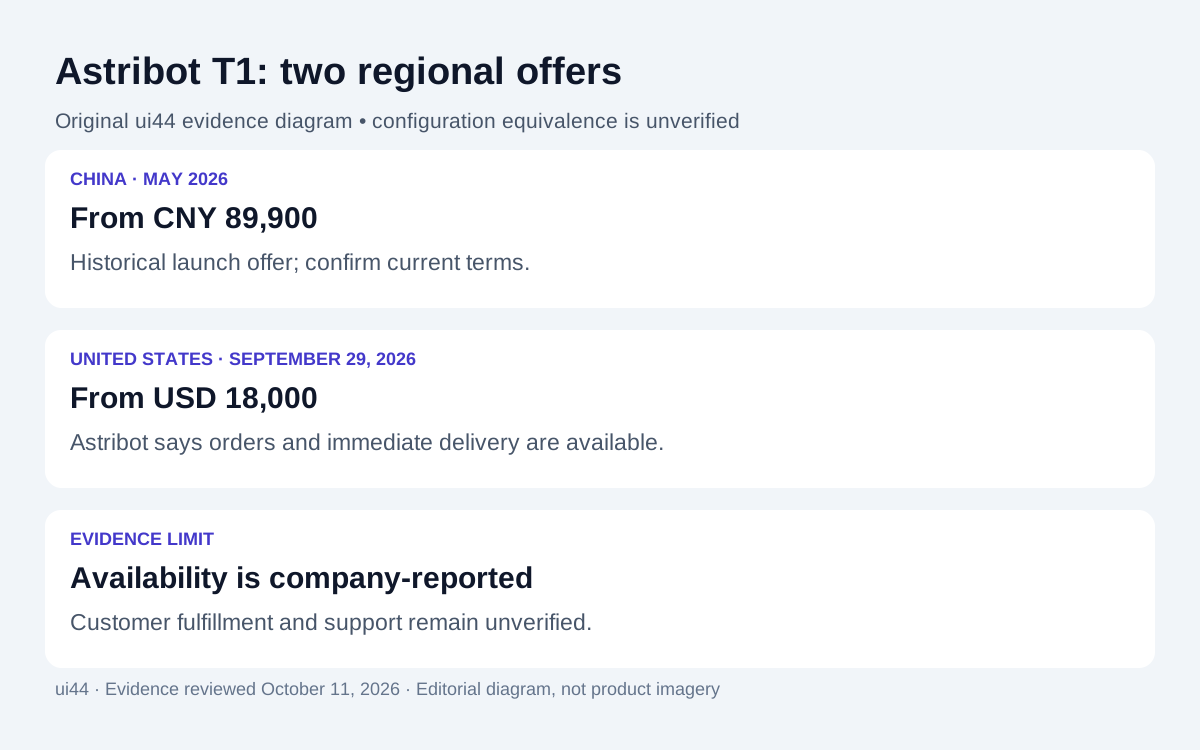
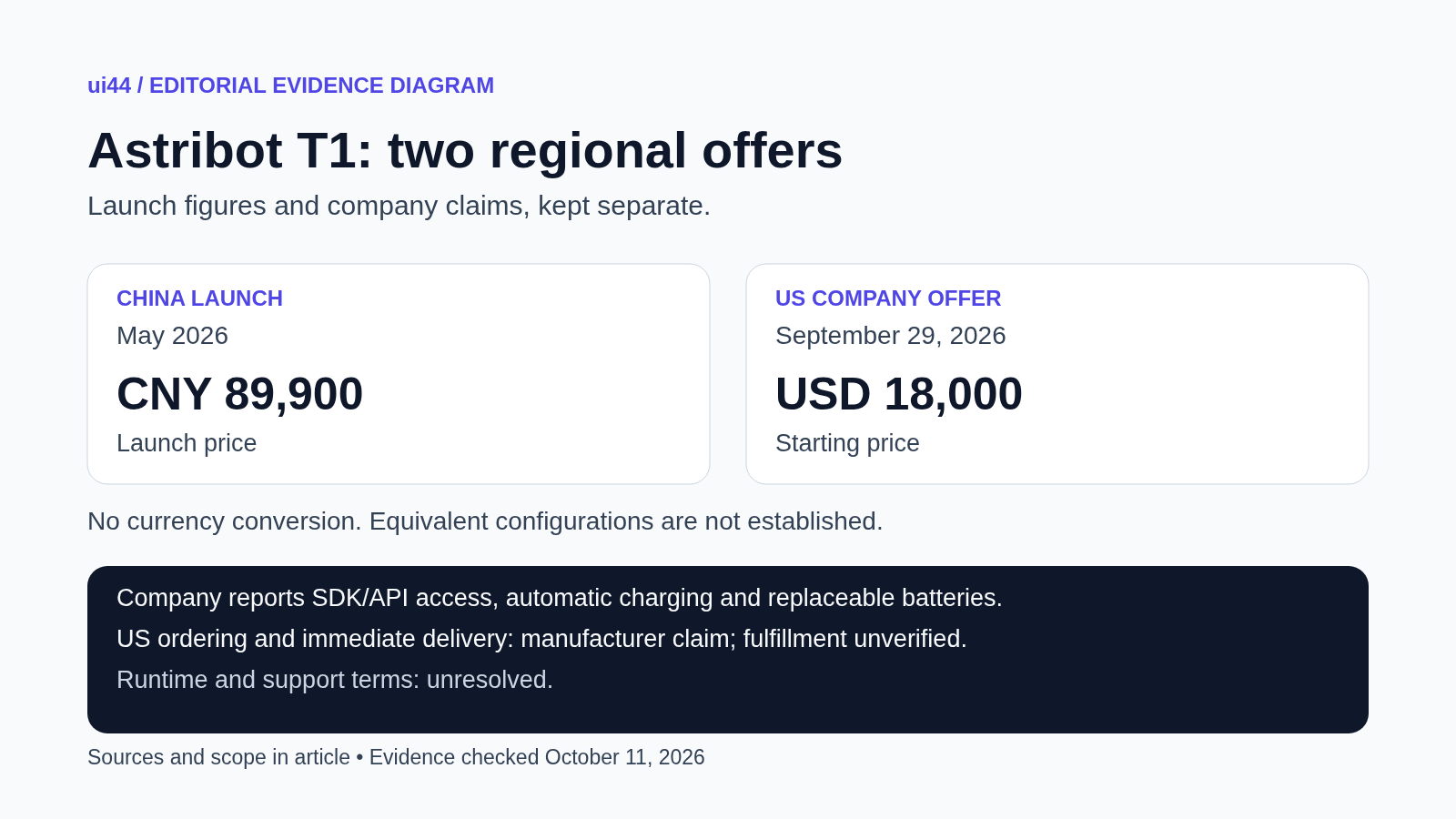
Astribot T1 is exactly the kind of robot that makes home-robot buyers sit up: a wheeled humanoid, dual-arm manipulation demos, and a starting price of ¥89,900, or roughly the low-$13,000 range before taxes, import costs, configuration choices, and regional terms. That is close to Unitree G1 territory, far below many full-size humanoid quotes, and much more concrete than another "contact sales" launch.

ui44 Team All articles

It is also not a finished home butler. The useful way to read T1 is as a lower entry price for a manipulation platform, not as proof that a household can buy a safe, supported, autonomous chore robot today.

Astribot T1 humanoid robot price signal and missing home readiness evidence
Scroll sideways to inspect the full chart.

The short version: Astribot T1 is one of the most interesting affordable humanoid signals of 2026 because it combines a real published price band with a useful payload and wheeled stability. But the gaps matter. Battery life, sensor stack, safety certifications, support model, regional delivery, and the split between autonomy, teleoperation, and scripted demos are still not clear enough for a normal buyer.

What did Astribot announce?

Astribot, also known as Stardust Intelligence, announced T1 in late May 2026 as a compact wheeled humanoid follow-on to Astribot S1. In ui44's database, T1 is tracked as a pre-order robot at ¥89,900 CNY, with a note that public configuration, deposit, delivery timing, and regional availability terms are not fully disclosed.

The published and corroborated headline specs are unusually specific for this price tier:

Astribot T1 spec

Price

What ui44 tracks
¥89,900 CNY starting price, about $13K before terms

Astribot T1 spec

Status

What ui44 tracks
Pre-order

Astribot T1 spec

Height / weight

What ui44 tracks
155 cm / 66 kg

Astribot T1 spec

Mobility

What ui44 tracks
Wheeled humanoid platform

Astribot T1 spec

Degrees of freedom

What ui44 tracks
23 DoF, excluding end effectors

Astribot T1 spec

Manipulation

What ui44 tracks
5 kg single-arm payload

Astribot T1 spec

End effectors

What ui44 tracks
Supports grippers or five-finger hands

Astribot T1 spec

Battery, sensors, charging

What ui44 tracks
Not officially disclosed in enough detail

Astribot T1 spec

Target scenarios

What ui44 tracks
Home, commercial, research, industrial, lab, EV work

That mix is why T1 is worth covering. A 5 kg single-arm payload is meaningful for household-scale objects: pots, small grocery bags, bottles, folded laundry, small appliances, and many tool or lab items sit below that line. The wheeled base also avoids the hardest bipedal reliability problem. In a home, wheels can be a practical advantage if the robot stays on one floor and does not need to climb stairs.

But published specs are not the same as home readiness. A robot can be tall, strong, and affordable on paper while still being unsuitable for kitchens, children, pets, carpet edges, clutter, privacy-sensitive rooms, and warranty support.

What does the $13K price actually buy?

It buys a lower-cost entry point into embodied-AI hardware. That is important. For years, humanoid pricing has split into two unsatisfying categories: research or enterprise platforms that are too expensive for almost everyone, and consumer concepts with vague pricing and vague delivery. T1's starting price is useful because it makes the comparison sharper.

The price appears to buy the physical platform: a 155 cm, 66 kg wheeled body; dual-arm manipulation; a cable-driven architecture; 23 degrees of freedom before end effectors; and compatibility with grippers or five-finger hands. It also buys access to Astribot's direction of travel: learning from human demonstrations and turning manipulation demos into deployable workflows.

It probably does not buy the thing many consumers imagine when they hear "home humanoid." It does not yet prove that T1 can unload a dishwasher without breaking glass, fold a basket of mixed clothing unsupervised, identify what belongs in which drawer, recover when a pet blocks the path, or explain exactly who is liable if it drops a pan.

That distinction matters because a low price can create a false sense of maturity. A cheaper robot is not automatically a consumer robot. It may simply be a cheaper developer platform.

How T1 compares with Unitree G1, 1X NEO, and other home-adjacent robots

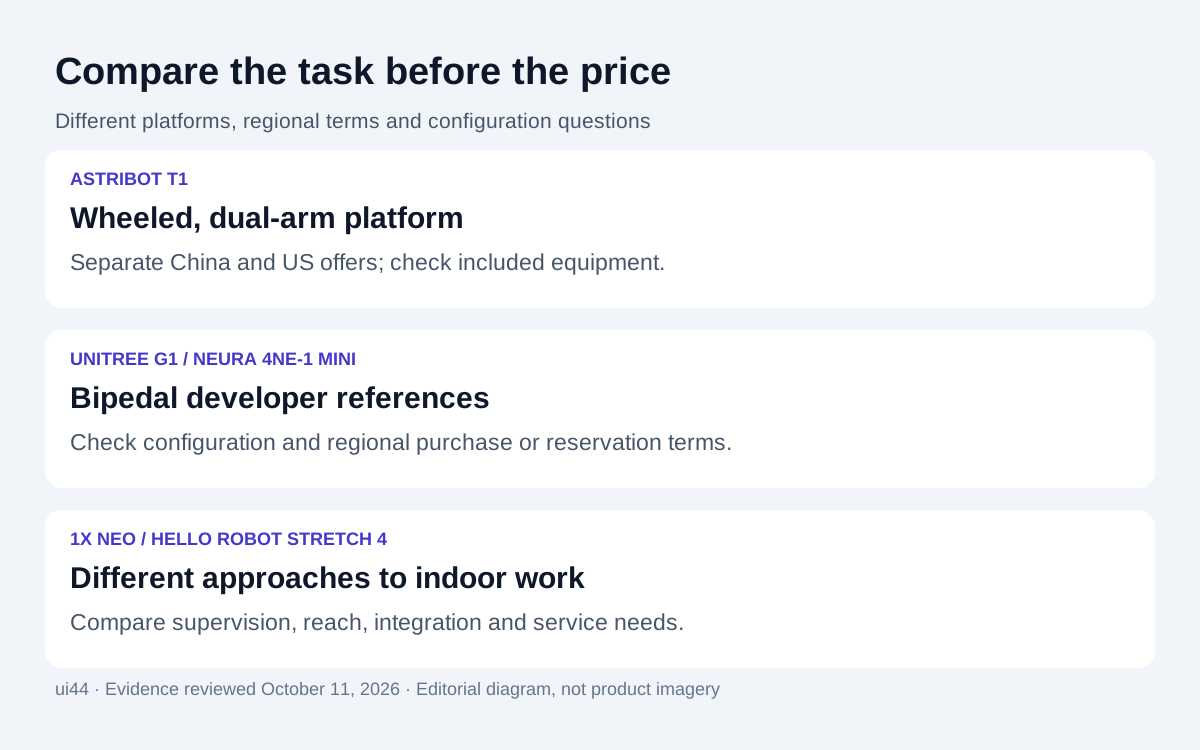
The closest price comparison is Unitree G1, which ui44 tracks as available from $13,500. G1 is smaller and lighter than T1 at 132 cm and 35 kg, and it is a biped rather than a wheeled robot. Its standard arm load is around 2 kg, with about 3 kg on the EDU configuration. That makes G1 a remarkable research humanoid for the money, but not a supported household helper.

T1 goes after a different trade-off. It is heavier, wheeled, and claims a higher single-arm payload. If your task is moving around a flat indoor workspace and manipulating objects, wheels plus 5 kg per arm may be more immediately useful than bipedal locomotion. If your task requires stairs, uneven outdoor terrain, or studying humanoid walking, G1 remains the clearer research reference.
Astribot T1 compared with Unitree G1 1X NEO NEURA 4NE-1 Mini and Stretch 4 home robots
Scroll sideways to inspect the full chart.

1X NEO is a different kind of comparison. ui44 tracks NEO as a $20,000 pre-order home-focused humanoid with a soft, lightweight body, 167 cm height, 30 kg weight, depth sensors, tactile skin, and roughly 4 hours of battery life. NEO is more explicitly designed around private homes, while T1 is framed across home, commercial, research, and industrial scenarios. If you are evaluating consumer readiness, NEO's home-first design is relevant. If you are evaluating price-to-manipulation hardware, T1 is the sharper new signal.

NEURA 4NE-1 Mini starts at €19,999 before taxes and shipping, with a €29,999 Pro tier that adds dexterous hands, teleoperation, SDK access, and digital-twin tools. It is also 132 cm tall and 36 kg, with a listed 3 kg payload and roughly 2.5 hours of battery life. That makes it another serious lower-cost humanoid reference, but still mostly a research, education, and developer proposition.

Then there is Hello Robot Stretch 4, which is not a humanoid, yet may be more honest for some home-assistance work. ui44 tracks Stretch 4 at $29,950, available now, with an 8-hour light-load runtime, a 160 cm working height, self-charging, ROS 2/Python access, and a telescoping arm rated for 2.5 kg extended or 4 kg retracted. It looks less futuristic than a humanoid, but it is built around bounded mobile manipulation in real indoor spaces.

The lesson is simple: price only answers one question. Home usefulness comes from the combination of manipulation, mobility, autonomy, safety, software, support, and repeatability.

The good signal: wheeled manipulation at a lower price

T1's most credible home-relevant signal is not that it has a face or a humanoid outline. It is that Astribot is emphasizing manipulation.

The launch materials and independent launch coverage describe cooking demos, laundry folding, laboratory operations, automotive parts sorting, and EV charging tasks. Those are not all home tasks, but they share the same underlying problem: the robot has to bring an arm to an object, choose a contact, apply the right force, move without snagging or dropping, and recover when the scene is not perfect.

The wheeled base helps here. A wheeled humanoid can be less romantic than a walking one, but wheels are often the practical choice indoors. They reduce the number of failure modes, make the platform more stable during arm motion, and can stretch battery and compute budget toward perception and manipulation instead of whole-body balance. For a kitchen, lab bench, laundry counter, or workshop, that may be a smart compromise.

T1's 5 kg single-arm payload also puts it above many small companion robots and some lower-cost humanoids. Payload is not dexterity, but it defines the work envelope. A robot that cannot lift the object cannot complete the task no matter how good its AI model is.

The weak signal: home autonomy is still mostly unproven

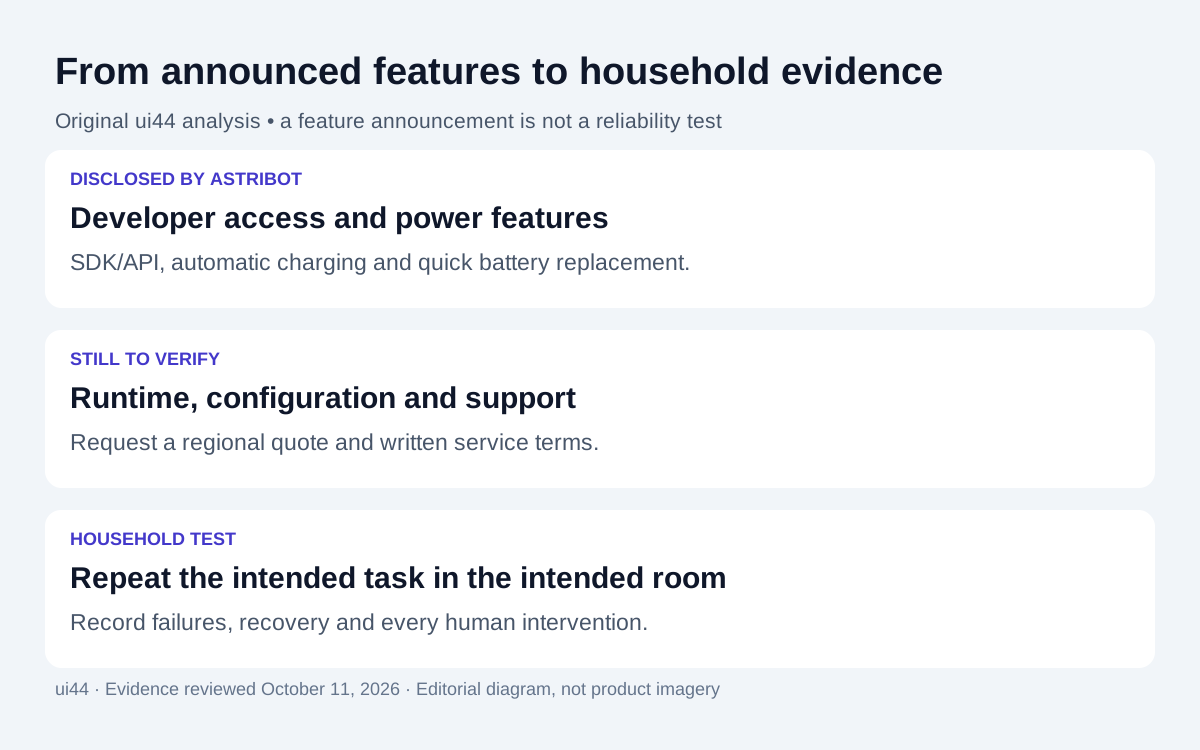
The largest missing piece is not another spectacular demo. It is boring proof. How long can T1 work unplugged? What sensors are in the shipping configuration? What compute is included at the ¥89,900 price? Which demos are autonomous, which are learned from human demonstration, and which require supervision or scripted setups? How often does it fail, and what happens after a failed grasp?
Astribot T1 home readiness ladder from launch specs to repeated real-home tasks
Scroll sideways to inspect the full chart.

These are not cynical questions. They are the difference between a platform and a product. A developer or lab may accept missing information because the goal is to experiment. A home buyer needs something else: clear delivery terms, repair options, safety limits, privacy controls, software updates, insurance clarity, and a way to return or service a 66 kg robot.

The word "home" also needs discipline. T1 may be home-adjacent because the tasks shown or claimed overlap with household chores. That does not mean it is ready for unsupervised use in an ordinary apartment. Homes contain people who did not sign up to be robot operators: children, guests, caregivers, roommates, pets, and neighbors. A home robot must understand when not to act.

Should you preorder Astribot T1 for a home?

For most households, no. At least not yet.

A serious robotics developer, AI lab, service-robot integrator, or company building manipulation workflows may reasonably watch T1 closely. The price could make experimentation easier, especially if Astribot publishes clearer SDK, compute, end-effector, and support details. For that audience, T1 could be a useful bridge between expensive research humanoids and narrow industrial arms.

For an ordinary home buyer, the bar should be higher. Before treating T1 as a home robot, ask for five things:
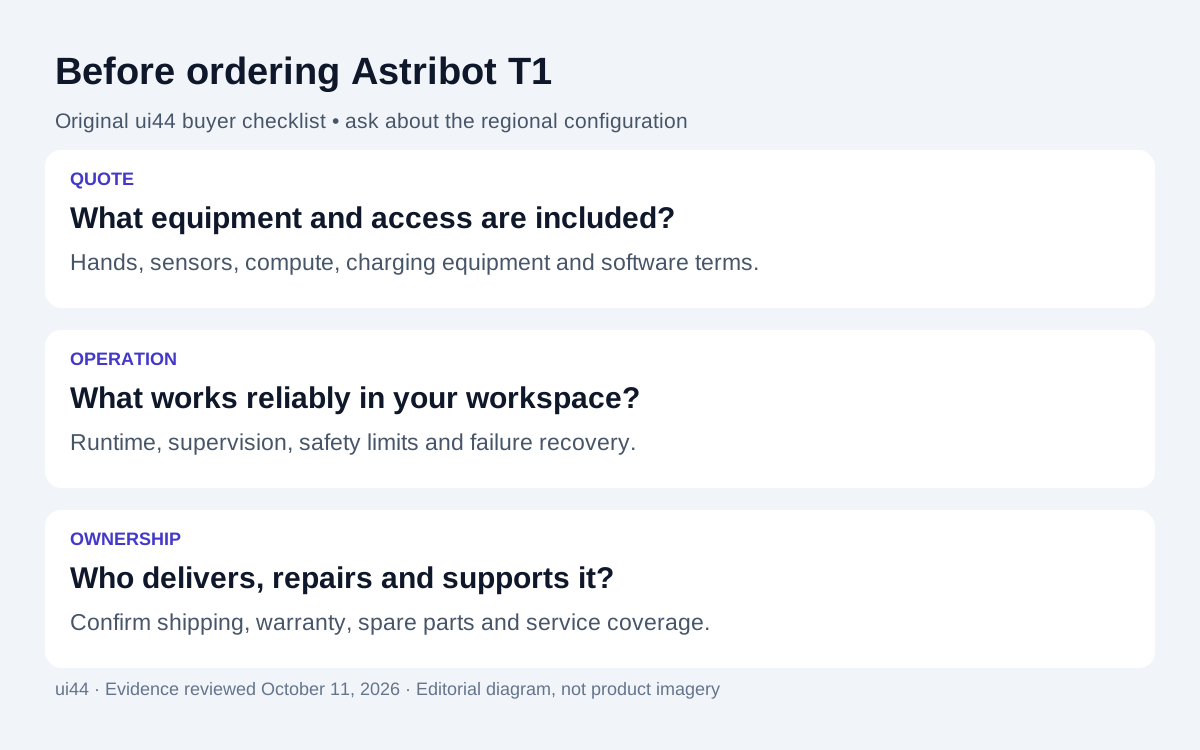
Astribot T1 home robot buyer checklist for preorder risk and autonomy questions
Scroll sideways to inspect the full chart.
  1. Exact configuration: what hardware, compute, hands, grippers, sensors, battery, charger, and software access are included at ¥89,900?
  2. Delivery and support: where does Astribot ship, when, with what warranty, repair process, spare parts, and updates?
  3. Autonomy disclosure: which tasks run without remote human control, and how does the robot ask for help?
  4. Safety and privacy: what force limits, emergency stops, logs, camera controls, and household data policies are in place?
  5. Repeatability: can the robot perform the same useful household task many times across messy rooms, not just once in a launch clip?

If those answers are vague, treat T1 as a promising platform rather than a consumer purchase.

What T1 means for the home-humanoid race

T1 matters because it pressures the market. A published starting price near Unitree G1 changes the conversation from "humanoids are someday expensive" to "which compromises make a lower-cost humanoid useful?" That is healthy. It forces buyers to compare payload, stability, runtime, dexterity, sensors, and software instead of only watching viral videos.

It also reinforces a pattern ui44 keeps seeing: the first real path toward home robots may not look like a perfect walking servant. It may look like a wheeled manipulator, a developer humanoid, a teleoperated assistive robot, or a platform that proves one narrow workflow before expanding. Zeroth M1 shows the small companion end of that spectrum. Stretch 4 shows the practical mobile-manipulator end. T1 sits closer to the humanoid-developer middle.

Compared with Figure 03, which has no consumer price and is focused on industrial evidence, T1 is more accessible but less proven. Compared with 1X NEO, it is less clearly home-first but potentially more interesting as a lower-cost manipulation platform. Compared with Unitree G1, it gives up bipedal walking in exchange for wheeled stability and a stronger claimed arm payload.

That is a real product strategy, not just a gimmick. But the buyer conclusion is still cautious.

ui44 take

Astribot T1 is a strong signal for affordable humanoid hardware and a weak signal for immediate household usefulness.

If Astribot follows the launch with detailed specs, transparent configuration pricing, delivery terms, developer documentation, safety information, and repeatable task metrics, T1 could become one of the most important affordable humanoid platforms in the database. If the evidence stays at the level of launch videos and broad scenario lists, it remains a fascinating pre-order robot rather than a home helper.

For now, the smartest reading is: T1 makes the affordable humanoid race more real, but it does not make the home-humanoid problem solved. Compare it in the ui44 robot database, check alternatives in /compare, and wait for the boring details before treating any $13K humanoid as a safe household purchase.

Database context

Use this article as a privacy verification workflow

Turn the article into a real verification pass

Astribot T1: What a $13K Humanoid Buys already points you toward 8 linked robots, 7 manufacturers, and 4 countries inside the ui44 database. That matters because strong buyer guidance is easier to apply when you can move immediately from a claim or warning into concrete product pages, manufacturer directories, component explainers, and country-level context instead of treating the article as an isolated opinion piece. The fastest next step is to turn the article into a shortlist workflow: open the linked robot pages, verify which specs are actually published for those models, then compare the surrounding manufacturer and component context before you decide whether the underlying claim changes your buying plan.

For this topic, the useful discipline is to separate the editorial lesson from the catalog evidence. The article gives you the framing, but the robot pages tell you what each product actually ships with today: sensor stack, connectivity methods, listed price, release timing, category, and support-relevant compatibility notes. The manufacturer pages then show whether you are looking at a one-off launch, a broader lineup pattern, or a company that spans multiple categories. That layered workflow reduces the risk of buying on a single marketing phrase or a single support FAQ.

Use the robot pages to confirm which products actually expose cameras, microphones, Wi-Fi, or voice systems, then use the manufacturer pages to decide how much of the privacy question seems product-specific versus brand-wide. On this route cluster, G1, Astribot T1, and Astribot S1 form the fastest reality check. If you want a quick working shortlist, open Compare G1, Astribot T1, and Astribot S1 next, then keep this article open as the reasoning layer while you compare structured data side by side.

Practical Takeaway

Every robot, manufacturer, category, component, and country reference below resolves to a real ui44 page, keeping the follow-up path grounded in database records rather than generic advice.

Suggested next steps in ui44

  1. Open G1 and note the listed sensors, connectivity methods, and voice stack before you interpret any policy claim.
  2. Cross-check the wider brand context on Unitree so you can see whether the privacy question touches one model or a broader lineup.
  3. Use the linked component pages to confirm how common the relevant sensors and connectivity layers are across the database.
  4. Keep a short note of which policy layers you checked, which device features are actually present on the robot page, and which items still depend on region- or app-level confirmation.
  5. Finish with Compare G1, Astribot T1, and Astribot S1 so the policy reading sits next to structured product data.

Database context

Robot profiles worth opening next

Use the linked product pages as the evidence layer

The linked robot pages are where this article becomes operational. Instead of asking whether the headline is interesting, use the robot entries to inspect the actual mix of sensors, connectivity options, batteries, pricing, release timing, and stated capabilities attached to the products mentioned in the article. That is the easiest way to see whether the warning or opportunity described here affects one product family, a specific design pattern, or an entire buying lane.

G1

Unitree · Humanoid · Available

$13,500

G1 is tracked on ui44 as a available humanoid robot from Unitree. The database currently records a listed price of $13,500, a release date of 2024, ~2 hours battery life, Not disclosed charging time, and a published stack that includes Depth Camera, 3D LiDAR, and 4 Microphone Array plus Wi-Fi 6 and Bluetooth 5.2.

For privacy-focused reading, this page matters because it shows the concrete device surface behind the policy discussion. Use it to verify whether G1 combines sensors and connectivity in a way that could change the in-home data footprint, and compare the listed capabilities such as Bipedal Walking, Object Manipulation, and Dexterous Hands (optional Dex3-1) with any cloud, app, or voice layers.

¥89,900

Astribot T1 is tracked on ui44 as a pre-order humanoid robot from Astribot (Stardust Intelligence). The database currently records a listed price of ¥89,900, a release date of 2026-05-28, Not officially disclosed battery life, Not officially disclosed charging time, and a published stack that includes Not officially disclosed plus Not officially disclosed.

For privacy-focused reading, this page matters because it shows the concrete device surface behind the policy discussion. Use it to verify whether Astribot T1 combines sensors and connectivity in a way that could change the in-home data footprint, and compare the listed capabilities such as Wheeled Humanoid Platform, Cable-Driven Motion Architecture, and 23 DOF Excluding End Effectors with any cloud, app, or voice layers.

Price TBA

Astribot S1 is tracked on ui44 as a active humanoid robot from Astribot (Stardust Intelligence). The database currently records a listed price of Price TBA, a release date of 2024-08-19, 4-6 hours (supports plug-in operation) battery life, Not disclosed charging time, and a published stack that includes Vision System, Force/Torque Sensors, and Proprioceptive Sensors plus Wi-Fi and API Access.

For privacy-focused reading, this page matters because it shows the concrete device surface behind the policy discussion. Use it to verify whether Astribot S1 combines sensors and connectivity in a way that could change the in-home data footprint, and compare the listed capabilities such as 7 DOF Per Arm, Effector Velocity ≥10 m/s, and Effector Acceleration ≈100 m/s² with any cloud, app, or voice layers.

NEO

1X Technologies · Humanoid · Pre-order

$20,000

NEO is tracked on ui44 as a pre-order humanoid robot from 1X Technologies. The database currently records a listed price of $20,000, a release date of 2025-10-28, ~4 hours battery life, Not disclosed charging time, and a published stack that includes RGB Cameras, Depth Sensors, and Tactile Skin plus Wi-Fi and Bluetooth.

For privacy-focused reading, this page matters because it shows the concrete device surface behind the policy discussion. Use it to verify whether NEO combines sensors and connectivity in a way that could change the in-home data footprint, and compare the listed capabilities such as Household Chores, Tidying Up, and Safe Human Interaction with any cloud, app, or voice layers.

4NE-1 Mini

NEURA Robotics · Humanoid · Pre-order

€19.999

4NE-1 Mini is tracked on ui44 as a pre-order humanoid robot from NEURA Robotics. The database currently records a listed price of €19.999, a release date of 2026-01-05, ~2.5 hours battery life, Not disclosed charging time, and a published stack that includes Multi-camera Array, Force/Torque Sensors, and 3D Vision plus Wi-Fi 6 and Gigabit Ethernet.

For privacy-focused reading, this page matters because it shows the concrete device surface behind the policy discussion. Use it to verify whether 4NE-1 Mini combines sensors and connectivity in a way that could change the in-home data footprint, and compare the listed capabilities such as 25 Degrees of Freedom, Autonomous Navigation, and Object Manipulation (Pro tier: 12-DOF dexterous hands) with any cloud, app, or voice layers, including Built-in Multi-language Voice Recognition.

Database context

Manufacturer context behind the article

Check whether this is one product story or a broader company pattern

Manufacturer pages add the privacy context that individual product pages cannot show on their own. They help you check whether cameras, microphones, cloud accounts, app controls, and policy assumptions appear across a broader lineup or stay tied to one specific product story.

Unitree

ui44 currently tracks 2 robots from Unitree across 1 category. The company is grouped under China, and the current catalog footprint on ui44 includes H1, G1.

That wider brand context matters because privacy questions rarely stop at one FAQ page. A manufacturer route helps you see whether the article is centered on one premium model or on a company that has several relevant products and therefore more than one place where the same policy or app assumptions might matter. The category mix here currently points toward Humanoid as the most useful next route if you want to see whether this article reflects a wider pattern inside the brand.

Astribot (Stardust Intelligence)

ui44 currently tracks 2 robots from Astribot (Stardust Intelligence) across 1 category. The company is grouped under China, and the current catalog footprint on ui44 includes Astribot S1, Astribot T1.

That wider brand context matters because privacy questions rarely stop at one FAQ page. A manufacturer route helps you see whether the article is centered on one premium model or on a company that has several relevant products and therefore more than one place where the same policy or app assumptions might matter. The category mix here currently points toward Humanoid as the most useful next route if you want to see whether this article reflects a wider pattern inside the brand.

1X Technologies

ui44 currently tracks 2 robots from 1X Technologies across 1 category. The company is grouped under Norway, and the current catalog footprint on ui44 includes NEO, EVE.

That wider brand context matters because privacy questions rarely stop at one FAQ page. A manufacturer route helps you see whether the article is centered on one premium model or on a company that has several relevant products and therefore more than one place where the same policy or app assumptions might matter. The category mix here currently points toward Humanoid as the most useful next route if you want to see whether this article reflects a wider pattern inside the brand.

NEURA Robotics

ui44 currently tracks 3 robots from NEURA Robotics across 2 categorys. The company is grouped under Germany, and the current catalog footprint on ui44 includes 4NE-1, 4NE-1 Mini, MiPA.

That wider brand context matters because privacy questions rarely stop at one FAQ page. A manufacturer route helps you see whether the article is centered on one premium model or on a company that has several relevant products and therefore more than one place where the same policy or app assumptions might matter. The category mix here currently points toward Humanoid, Home Assistants as the most useful next route if you want to see whether this article reflects a wider pattern inside the brand.

Database context

Broaden the scan without leaving the database

Categories, components, and countries add the wider context

Category framing

Category pages are useful when the article touches a buying pattern that shows up across brands. A category route helps you confirm whether the linked products sit in a narrow niche or whether the same question should be tested across a larger field of alternatives.

Humanoid

The Humanoid category page currently groups 99 tracked robots from 70 manufacturers. ui44 describes this lane as: Full-size bipedal humanoid robots designed to work alongside humans. From factory floors to household tasks, these machines represent the cutting edge of robotics.

That makes the category route a practical follow-up when you want to check whether the products linked in this article are typical for the lane or whether they sit at one edge of the market. Useful starting examples currently include NEO, EVE, Mornine M1.

Home Assistants

The Home Assistants category page currently groups 15 tracked robots from 14 manufacturers. ui44 describes this lane as: Arm-based household helpers — laundry folders, kitchen robots, and mobile manipulators that handle physical tasks at home.

That makes the category route a practical follow-up when you want to check whether the products linked in this article are typical for the lane or whether they sit at one edge of the market. Useful starting examples currently include Robody, Futuring 2 (F2), Stretch 3.

Country and ecosystem context

Country pages give extra context when support practices, launch sequencing, regulatory posture, or manufacturer mix matter. They are not a substitute for model-level verification, but they do help you see which ecosystems cluster together and which manufacturers sit in the same regional field when you broaden the search beyond the article headline.

China

The China route currently groups 157 tracked robots from 71 manufacturers in ui44. That gives you a useful regional lens when the article points toward support practices, launch sequencing, or brand clusters that may share similar ecosystem assumptions.

On the current route, manufacturers like AGIBOT, Dreame, Unitree Robotics make the page a good way to broaden the scan without losing the regional context that often shapes availability, documentation style, and adjacent alternatives.

Norway

The Norway route currently groups 2 tracked robots from 1 manufacturers in ui44. That gives you a useful regional lens when the article points toward support practices, launch sequencing, or brand clusters that may share similar ecosystem assumptions.

On the current route, manufacturers like 1X Technologies make the page a good way to broaden the scan without losing the regional context that often shapes availability, documentation style, and adjacent alternatives.

Germany

The Germany route currently groups 8 tracked robots from 5 manufacturers in ui44. That gives you a useful regional lens when the article points toward support practices, launch sequencing, or brand clusters that may share similar ecosystem assumptions.

On the current route, manufacturers like NEURA Robotics, Bosch, Agile Robots make the page a good way to broaden the scan without losing the regional context that often shapes availability, documentation style, and adjacent alternatives.

Database context

Questions to answer before you move from reading to buying

A follow-up FAQ built from the entities already linked in this article

Frequently Asked Questions

Which page should I open first after reading “Astribot T1: What a $13K Humanoid Buys”?

Start with G1. That gives you a concrete product anchor for the article’s main claim. From there, branch into the manufacturer and component pages so you can tell whether the article is describing one specific model, a repeated brand pattern, or a wider technology issue that affects multiple shortlist options.

How do the manufacturer pages change the buying decision?

Unitree help you zoom out from one article and one product. On ui44 they show lineup breadth, category spread, and the neighboring robots tied to the same company. That context is useful when you are deciding whether a risk belongs to a single model, whether it shows up across a brand’s portfolio, and whether you should keep looking at alternatives before committing.

When should I switch from reading to side-by-side comparison?

Move into Compare G1, Astribot T1, and Astribot S1 as soon as you understand the article’s main warning or promise. The article explains what to watch for, but the compare view is where you can check whether price, status, battery life, connectivity, sensors, and category fit still make the robot a good match for your own home and budget.

Database context

Where to go next in ui44

Keep the research chain inside the database

If you want to keep going, these follow-on pages give you the cleanest expansion path from article to research session. Open the comparison route first if you are deciding between products today. Open the manufacturer, category, and component routes if you still need to understand the broader pattern behind the claim.

UT

Written by

ui44 Team

Published May 31, 2026

Share this article

Open a plain share link on X or Bluesky. No embeds, no widgets, no cookie baggage.

Explore the database

Go beyond the headlines

Compare specs, features, and prices across 100+ robots from leading manufacturers worldwide.