Article 19 min read 4,426 words

MATRIX-3: Why Tactile Skin Matters at Home

MATRIX-3 is interesting because it does not frame home robotics as a bigger chatbot on legs. Matrix Robotics is pitching a humanoid with 3D woven biomimetic skin, fingertip tactile sensing down to 0.1 N, and 27-DOF hands that are supposed to judge material, shape, grip stability, and contact force.

ui44 Team All articles

That is the right direction. A robot that cannot feel contact is a poor fit for homes, where the hard problems are not just seeing objects. They are picking up a towel without dragging a glass, squeezing a sponge without crushing it, handing a cup to a person without shoving, and brushing past a chair without turning the chair into a battering ram.
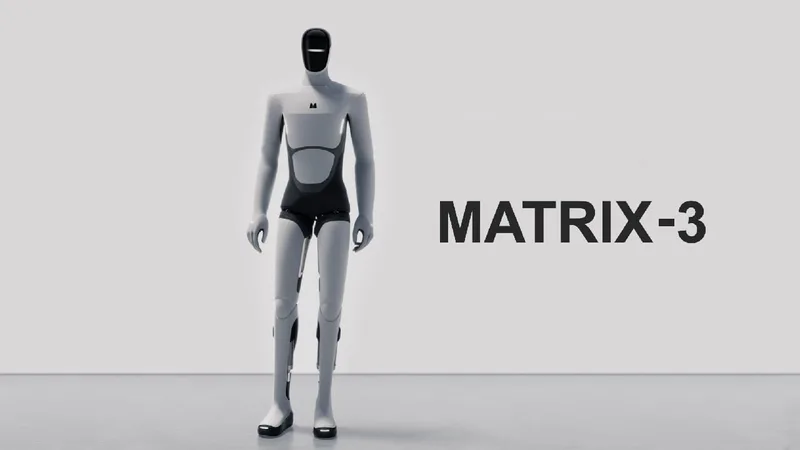
MATRIX-3 humanoid robot with tactile skin and 27-DOF hands for home robot manipulation

The catch is just as important: tactile skin is not home readiness by itself. In the ui44 database, MATRIX-3 is still a Development-status robot. Matrix Robotics says an Early Access Program is open for select industry partners, with pilot deployments expected to begin in mid-2026. ui44 does not list an official price, battery life, height, weight, or consumer sales channel because Matrix has not disclosed those details publicly.

So the useful buyer question is not "does MATRIX-3 have robot skin?" It is: what does touch sensing let a humanoid do safely in a real home, and what proof should you demand before treating it as a household helper?

What is MATRIX-3?

MATRIX-3 is Matrix Robotics' third-generation humanoid robot. The official launch page describes it as a physical-intelligence platform for commercial services, manufacturing, logistics, medical assistance, and eventually home environments. The company emphasizes three pieces of the system:

  • Biomimetic skin and tactile perception. The body uses a 3D woven flexible fabric with a distributed sensing network, while the fingertips use a high-sensitivity tactile sensor array.
  • Dexterous manipulation. The hand is described as a cable-driven 27-DOF design intended for tools, delicate instruments, and soft goods like fabric.
  • A cognitive core for zero-shot generalization. Matrix says its proprietary neural-network architecture can follow natural-language instructions and adapt to unfamiliar tasks without task-specific training.

Those claims put MATRIX-3 in a more serious category than a humanoid that only shows walking, waving, or staged pick-and-place. Touch, grip stability, and force control are exactly where home robots tend to fail.
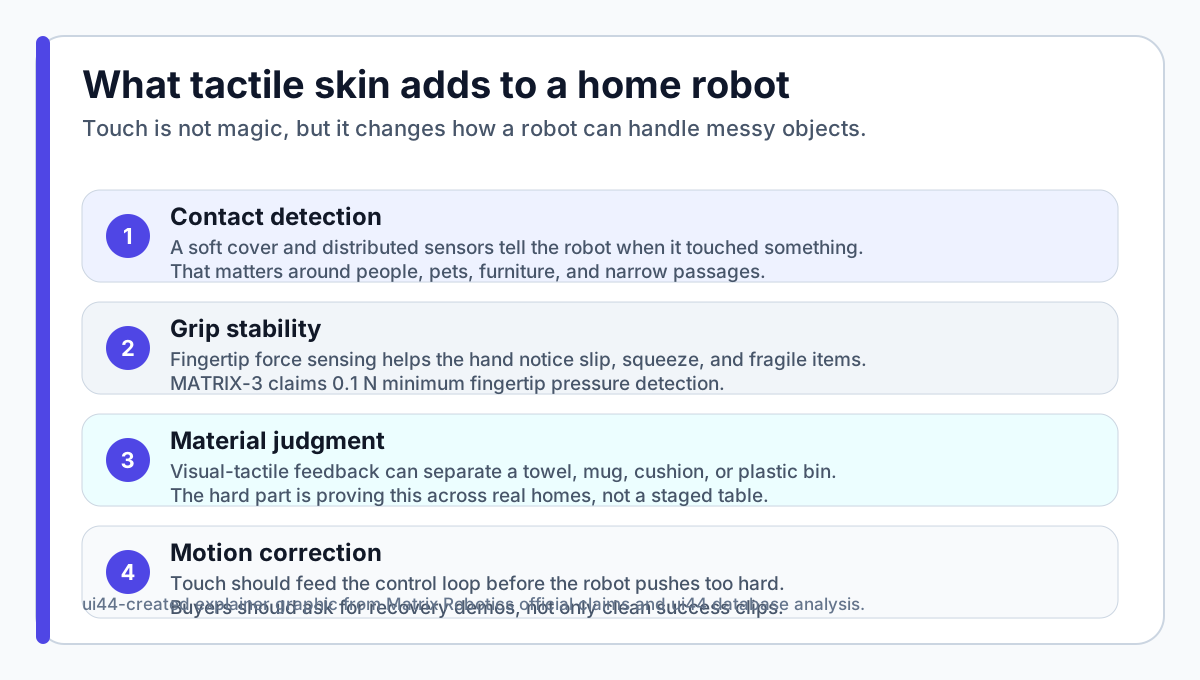
Tactile skin layers for MATRIX-3 home robot manipulation, from contact detection to grip stability
Scroll sideways to inspect the full chart.

But the official page is also heavy on ambition. It does not publish a normal consumer spec sheet. It does not give a price. It does not show a warranty or service network. It does not prove that the same robot can repeat household chores for weeks in different homes. That is why ui44 treats MATRIX-3 as a promising development robot, not a product recommendation.

Why does tactile skin matter for home robots?

Vision tells a robot where something appears to be. Touch tells it what actually happened after contact.

That distinction is huge in a home. A kitchen towel can fold, slide, catch on a handle, or hide an object underneath it. A cushion may look solid but deform under a hand. A plastic bin may be empty, half-full, or wedged against a sofa leg. A person receiving an object may move their hand slightly before the robot lets go.

A tactile humanoid can, in theory, use contact feedback to answer practical questions:

  • Did I touch the object or the table next to it?
  • Is the object slipping?
  • Am I squeezing too hard?
  • Did my arm brush a person, pet, chair, or cabinet?
  • Should I retry, loosen grip, stop, or ask for help?

That is why MATRIX-3's 0.1 N fingertip claim is worth watching. The number means the fingertips are supposed to detect very light pressure, not only obvious collisions. If the rest of the control stack uses that signal well, it could help with fragile items, fabric, and safer handovers.

The important phrase is if the rest of the control stack uses that signal well. A sensor is not a behavior. A robot can have excellent hardware and still fail if the policy does not interpret touch quickly enough, or if the hand has no safe recovery strategy after a slip.

How does MATRIX-3 compare with other tactile humanoids?

The closest comparison in ui44 is KAI from Kinetix AI. KAI is also a development-stage humanoid with a tactile-heavy pitch: ui44 lists it at 173 cm, 70 kg, a reported 115 total degrees of freedom, reported 18,000 tactile sensing points, and reported touch detection down to 0.1 N. Its reported battery is a 1.7 kWh semi-solid-state pack with about 4 hours per charge. Pricing remains undisclosed in ui44 because public reports conflict.

Figure 03 is the better-known high-end reference point. In ui44, Figure 03 is 173 cm, 61 kg, has about 5 hours of battery life, a 20 kg payload, stereo/depth vision, force sensors, tactile arrays, and the Helix VLA stack. That is strong manipulation hardware, but Figure 03 is not a normal consumer purchase and has no public price.

1X NEO is more explicitly home-facing. ui44 lists it as a $20,000 pre-order, 167 cm, 30 kg, about 4 hours of battery life, with RGB cameras, depth sensors, microphone array, and tactile skin. NEO's softer, lighter body is part of its safety story. The trade-off is that it is still a pre-order product, so buyers need delivery, warranty, autonomy, and support proof—not only a comforting form factor.

Unitree G1 shows the opposite trade-off. It starts around $13,500, is available as a compact research humanoid, and has optional dexterous hands in some configurations. But the ui44 record does not list full-body tactile skin. It is easier to buy than most premium humanoids, but it is not the same kind of contact-rich home-helper bet.
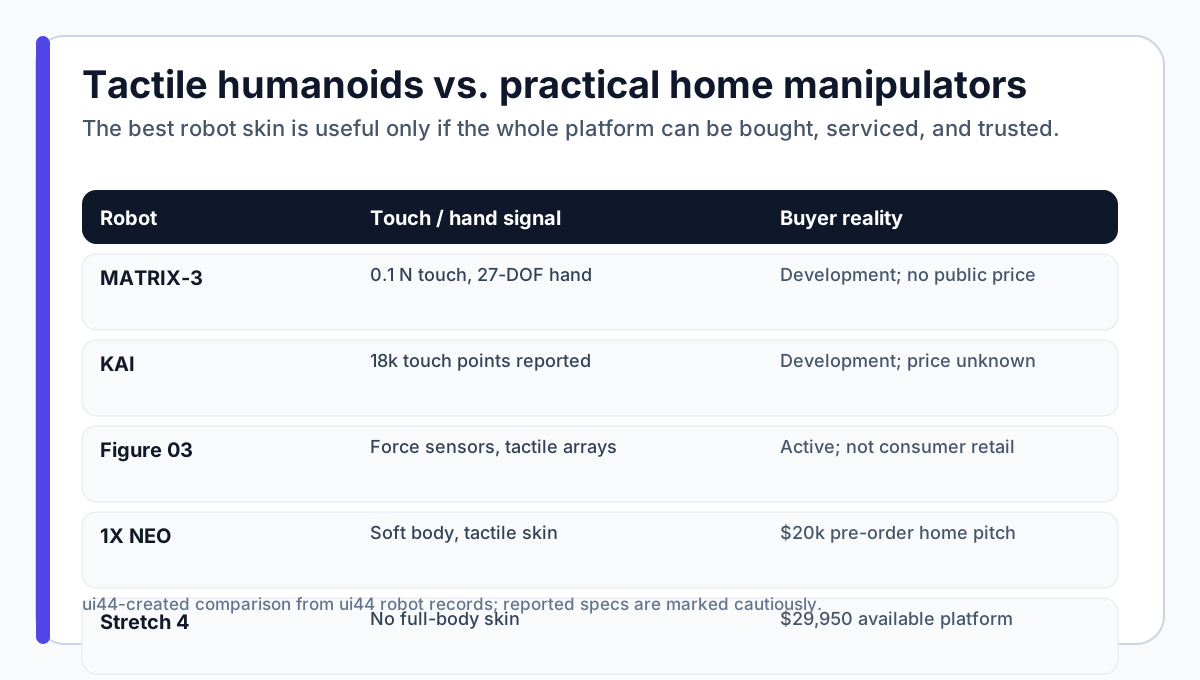
MATRIX-3 comparison with KAI, Figure 03, 1X NEO, and Stretch 4 for tactile home robot readiness
Scroll sideways to inspect the full chart.

Then there is Stretch 4, which is not a humanoid with skin at all. It is a wheeled mobile manipulator. ui44 lists it as available at $29,950, with a 160 cm working height, 8 hours of light-load battery life, a compact 45 cm diameter footprint, and an arm rated for 2.5 kg extended or 4 kg retracted payload. Stretch 4 is less human-shaped, but it is a useful reminder: the best home robot is not always the most anthropomorphic one. Sometimes the more practical answer is a lower-risk platform that can be bought, maintained, and piloted in real homes.

Which household tasks would tactile skin actually help?

Tactile sensing matters most where vision alone is brittle. The obvious examples are soft, flexible, or person-adjacent tasks.

Laundry and towels. Fabric changes shape constantly. A robot needs to know when cloth has slipped, bunched, snagged, or folded around the wrong part of the hand. MATRIX-3's official page specifically mentions soft goods like fabric, which is the right category to watch. It still needs repeatable proof, not one clean clip.

Handovers. Giving an object to a person is not only a grasping problem. The robot needs to sense when the person has taken weight, when the object is slipping, and when to let go. Tactile hands and force-limited arms matter more than a fluent voice response.

Tidying around clutter. Homes are contact-rich. A robot reaching for a bin or remote may brush cushions, cables, shoes, pets, chair legs, or humans. Distributed skin could help detect incidental contact before it turns into a push.

Tool use. Matrix says the 27-DOF hand is intended for standard tools and delicate instruments. That is relevant to spraying, wiping, opening containers, or holding a small appliance part. But tool use is also where warranty and safety questions get serious: what happens when the robot grips a knife, cleaning spray, hot pan, or plugged-in device?

Care tasks. Medical-assistance and home-care scenarios are tempting because tactile sensing sounds inherently gentle. That is exactly where claims should be most conservative. A robot helping a person out of a chair, handing medication, or touching skin is operating in a much higher-liability category than a robot sorting blocks.

What proof should buyers ask for?

A tactile-skin demo should not be judged by whether it looks futuristic. It should be judged by whether the robot can survive normal household variation.
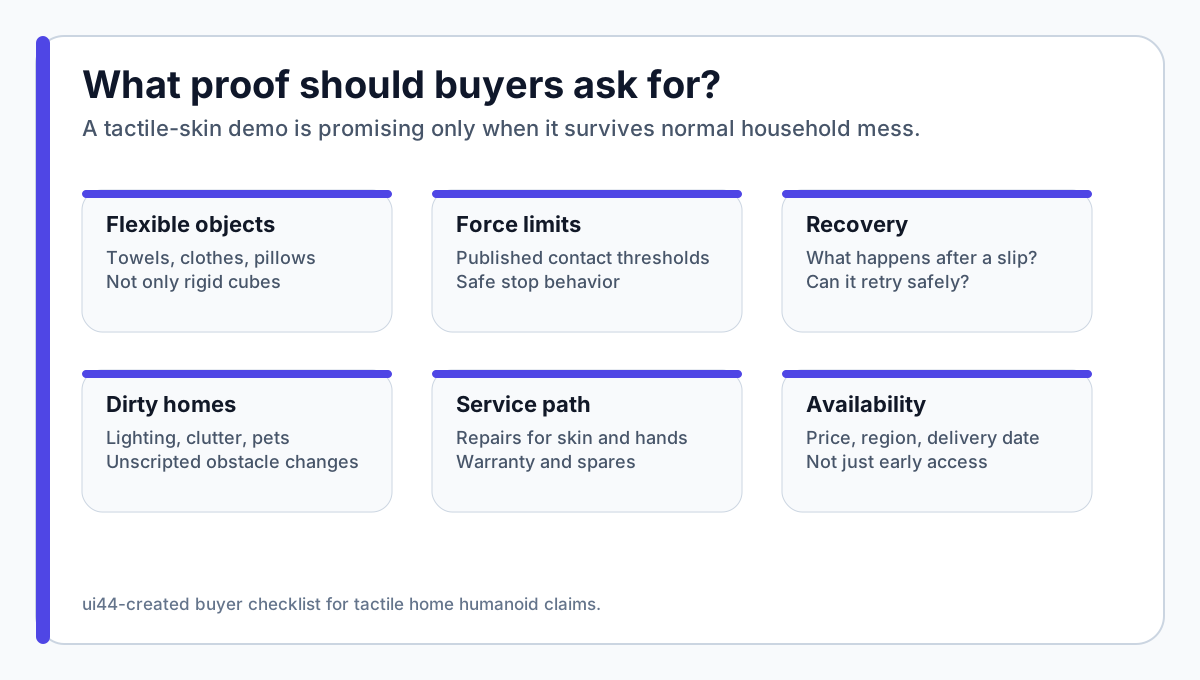
Buyer proof checklist for MATRIX-3 tactile humanoid robot home readiness
Scroll sideways to inspect the full chart.

Before treating MATRIX-3, KAI, NEO, or any tactile humanoid as home-ready, ask for these proofs:

  1. Repeated runs, not best-take clips. How many attempts? What was the success rate? What counted as failure?
  2. Recovery behavior. If the object slips, the hand jams, or a person moves, does the robot stop, retry, ask for help, or push through?
  3. Published contact limits. What forces trigger slowdown or stop behavior? Are those limits tested around children, pets, and older adults?
  4. Repairability. Skin, fingertips, and cable-driven hands are wear items. How are they serviced, and what do replacements cost?
  5. Environmental variety. Does the robot work under bad lighting, clutter, reflective surfaces, wrinkled fabric, and narrow furniture gaps?
  6. Availability truth. Is it a consumer product, an enterprise pilot, a developer kit, or an invitation-only early-access program?

That last point matters for MATRIX-3. Matrix Robotics can have a very impressive technical direction and still not be a robot you can buy for a home in 2026. The current evidence supports "watch closely," not "place an order."

Is MATRIX-3 closer to a home robot than older humanoids?

In one narrow sense, yes. MATRIX-3 is closer to the right problem. Home robots do not only need better conversation. They need physical judgment: how hard to hold, when to stop, when contact is unsafe, and how to recover when a task turns messy. A humanoid with tactile skin and dexterous hands is aimed at that missing layer.

In the buyer sense, not yet. ui44's database still has too many unknowns: MATRIX-3 has no official public price, no published household availability, no consumer support path, and no long-term independent home reliability evidence. Even the basic body specs that shoppers tend to compare—height, weight, battery life, charging time, and speed—are not all officially disclosed.

That makes MATRIX-3 a useful signal for the category rather than a near-term purchase. It tells us where high-end humanoid design is going: less "robot sees object, robot grabs object" and more "robot sees, touches, adjusts, and recovers." That is the correct direction for real homes.

Bottom line

MATRIX-3 is worth paying attention to because tactile skin is not a cosmetic feature. If implemented well, it could make humanoid robots safer and more useful around soft objects, fragile items, people, and clutter.

But tactile skin does not erase the normal buyer checklist. MATRIX-3 is still a development robot with early-access pilots, not a household appliance. The smart view is optimistic but strict: touch sensing is one of the right ingredients for home robots, while repeatable chores, safe recovery, serviceability, and clear availability are the evidence that still has to arrive.

For now, compare MATRIX-3 with other humanoids in ui44 and use /compare to separate sensor claims from shipping reality. Robot skin matters. Proof matters more.

Source notes

  • Matrix Robotics official MATRIX-3 page: tactile skin, 0.1 N fingertip sensing, 27-DOF hand, zero-shot generalization, early-access timing, and target markets.
  • ui44 robot database records for MATRIX-3, KAI, Figure 03, 1X NEO, Stretch 4, and Unitree G1, checked in this draft for status, pricing, sensors, battery, payload, and availability context.
  • Humanoid.Guide MATRIX-3 profile was used only as a third-party cross-check for the existence of external estimates. ui44 does not treat its unverified price, height, speed, or strength estimates as official MATRIX-3 specifications.

Database context

Use this article as a setup-friction workflow

Turn the article into a real verification pass

MATRIX-3: Why Tactile Skin Matters at Home already points you toward 6 linked robots, 6 manufacturers, and 3 countries inside the ui44 database. Treat those links as a first-day setup trail: open the robot pages, check what is actually published about charging, battery life, control method, app or OTA support, and recovery, then use the surrounding manufacturer and country context to judge whether the article describes a low-friction product path or a still-specialist deployment.

For setup topics, the useful discipline is to separate a polished demo from the work required after the box arrives. The article gives you the narrative, but the robot pages show the operational clues: dimensions, weight, battery runtime, charging time, controller support, listed availability, and the capabilities that might need supervision. Manufacturer pages then reveal whether the same setup assumptions repeat across a wider lineup.

Use the robot pages to verify what happens between delivery and the first useful task: size, weight, battery, charger or dock path, controller, app, OTA support, and recovery cues. On this route cluster, MATRIX-3, KAI (KaiBot), and Figure 03 form the fastest setup-friction reality check. If you want a quick working shortlist, open Compare MATRIX-3, KAI (KaiBot), and Figure 03 next, then keep this article open while you compare first-day setup evidence side by side.

Practical Takeaway

The links below stay tied to the robots, manufacturers, and countries actually referenced by this setup article, so the checklist remains grounded in published ui44 records rather than generic humanoid advice.

Suggested next steps in ui44

  1. Open MATRIX-3 and check the concrete first-day fields: box contents, charger or dock path, battery life, controller, app, OTA support, and recovery options.
  2. Use Matrix Robotics to see whether the company’s broader lineup looks appliance-like, developer-first, or still closer to a pilot deployment.
  3. Run Compare MATRIX-3, KAI (KaiBot), and Figure 03 with the article open and compare battery, size, weight, price path, status, and support cues side by side.
  4. Write down the first realistic task each robot can plausibly attempt on day one, then separate low-friction setup signals from impressive but still lab-style demos.

Database context

Robot profiles worth opening next

Use the linked product pages as the evidence layer

The linked robot pages are where this setup article becomes operational. Use the robot entries to inspect the actual mix of size, weight, battery runtime, charging path, control method, pricing, availability, and stated capabilities attached to the products mentioned in the article. That is the easiest way to see whether the first useful task looks appliance-like, developer-led, or still dependent on supervised experimentation.

MATRIX-3

Matrix Robotics · Humanoid · Development

Price TBA

MATRIX-3 is tracked on ui44 as a development humanoid robot from Matrix Robotics. The database currently records a listed price of Price TBA, a release date of 2026-01-10, Not officially disclosed battery life, Not officially disclosed charging time, and a published stack that includes High-sensitivity tactile sensor array (0.1 N minimum detection), 3D woven biomimetic skin with distributed sensing network, and Spatial perception foundation model (vision) plus its listed connectivity stack.

For setup-friction reading, this page matters because it shows the physical and support burden behind the demo. Use it to verify whether MATRIX-3 has a credible day-one path across charging, control, recovery, battery limits, and listed capabilities such as Natural humanoid gait with walking and navigation, 27-DOF cable-driven dexterous hands per hand, and 3D woven biomimetic skin for safe human interaction.

KAI (KaiBot)

Kinetix AI · Humanoid · Development

Price TBA

KAI (KaiBot) is tracked on ui44 as a development humanoid robot from Kinetix AI. The database currently records a listed price of Price TBA, a release date of 2026-04, 1.7 kWh semi-solid-state battery; about 4 hours per charge reported battery life, Not officially disclosed charging time, and a published stack that includes Full-body tactile skin with 18,000 sensing points, Touch detection down to 0.1 N reported, and Vision and spatial data captured for training through the KAI Halo wearable system plus Ethernet and Wi-Fi.

For setup-friction reading, this page matters because it shows the physical and support burden behind the demo. Use it to verify whether KAI (KaiBot) has a credible day-one path across charging, control, recovery, battery limits, and listed capabilities such as Bipedal Humanoid Locomotion, 115 Degrees of Freedom, and 72 Degrees of Freedom Across Both Hands.

Figure 03

Figure AI · Humanoid · Active

Price TBA

Figure 03 is tracked on ui44 as a active humanoid robot from Figure AI. The database currently records a listed price of Price TBA, a release date of 2025-10-09, ~5 hours battery life, Not disclosed charging time, and a published stack that includes Stereo Vision, Depth Cameras, and Force Sensors plus Wi-Fi and Bluetooth.

For setup-friction reading, this page matters because it shows the physical and support burden behind the demo. Use it to verify whether Figure 03 has a credible day-one path across charging, control, recovery, battery limits, and listed capabilities such as Complex Manipulation, Warehouse Work, and Manufacturing Tasks.

NEO

1X Technologies · Humanoid · Pre-order

$20,000

NEO is tracked on ui44 as a pre-order humanoid robot from 1X Technologies. The database currently records a listed price of $20,000, a release date of 2025-10-28, ~4 hours battery life, Not disclosed charging time, and a published stack that includes RGB Cameras, Depth Sensors, and Tactile Skin plus Wi-Fi and Bluetooth.

For setup-friction reading, this page matters because it shows the physical and support burden behind the demo. Use it to verify whether NEO has a credible day-one path across charging, control, recovery, battery limits, and listed capabilities such as Household Chores, Tidying Up, and Safe Human Interaction.

G1

Unitree · Humanoid · Available

$13,500

G1 is tracked on ui44 as a available humanoid robot from Unitree. The database currently records a listed price of $13,500, a release date of 2024-05-13, ~2 hours battery life, Not disclosed charging time, and a published stack that includes Depth Camera, 3D LiDAR, and 4 Microphone Array plus Wi-Fi 6 and Bluetooth 5.2.

For setup-friction reading, this page matters because it shows the physical and support burden behind the demo. Use it to verify whether G1 has a credible day-one path across charging, control, recovery, battery limits, and listed capabilities such as Bipedal Walking, Object Manipulation, and Dexterous Hands (optional Dex3-1).

Database context

Manufacturer context behind the article

Check whether this is one product story or a broader company pattern

Manufacturer pages add the setup context that individual product pages cannot show on their own. They help you check whether a brand repeats the same controller, battery, update, support, and availability patterns across multiple robots, or whether the article is really describing one early product path. That matters for humanoids because first-day friction usually comes from the surrounding ecosystem as much as from the robot itself.

Matrix Robotics

ui44 currently tracks 1 robot from Matrix Robotics across 1 category. The company is grouped under China, and the current catalog footprint on ui44 includes MATRIX-3.

That wider brand context matters because setup friction is rarely just a box problem. A manufacturer route helps you see whether the company has repeated controller, battery, support, and update patterns across its lineup, or whether the article is really about one early product story. The category mix here currently points toward Humanoid as the most useful next route if you want to see whether this article reflects a wider pattern inside the brand.

Kinetix AI

ui44 currently tracks 1 robot from Kinetix AI across 1 category. The company is grouped under China, and the current catalog footprint on ui44 includes KAI (KaiBot).

That wider brand context matters because setup friction is rarely just a box problem. A manufacturer route helps you see whether the company has repeated controller, battery, support, and update patterns across its lineup, or whether the article is really about one early product story. The category mix here currently points toward Humanoid as the most useful next route if you want to see whether this article reflects a wider pattern inside the brand.

Figure AI

ui44 currently tracks 2 robots from Figure AI across 1 category. The company is grouped under USA, and the current catalog footprint on ui44 includes Figure 03, Figure 02.

That wider brand context matters because setup friction is rarely just a box problem. A manufacturer route helps you see whether the company has repeated controller, battery, support, and update patterns across its lineup, or whether the article is really about one early product story. The category mix here currently points toward Humanoid as the most useful next route if you want to see whether this article reflects a wider pattern inside the brand.

1X Technologies

ui44 currently tracks 2 robots from 1X Technologies across 1 category. The company is grouped under Norway, and the current catalog footprint on ui44 includes NEO, EVE.

That wider brand context matters because setup friction is rarely just a box problem. A manufacturer route helps you see whether the company has repeated controller, battery, support, and update patterns across its lineup, or whether the article is really about one early product story. The category mix here currently points toward Humanoid as the most useful next route if you want to see whether this article reflects a wider pattern inside the brand.

Database context

Broaden the scan without leaving the database

Categories, components, and countries add the wider context

Category framing

Category pages are useful when the article touches a buying pattern that shows up across brands. A category route helps you confirm whether the linked products sit in a narrow niche or whether the same question should be tested across a larger field of alternatives.

Humanoid

The Humanoid category page currently groups 113 tracked robots from 82 manufacturers. ui44 describes this lane as: Full-size bipedal humanoid robots designed to work alongside humans. From factory floors to household tasks, these machines represent the cutting edge of robotics.

That makes the category route a practical follow-up when you want to check whether the products linked in this article are typical for the lane or whether they sit at one edge of the market. Useful starting examples currently include NEO, EVE, Mornine M1.

Home Assistants

The Home Assistants category page currently groups 15 tracked robots from 14 manufacturers. ui44 describes this lane as: Arm-based household helpers — laundry folders, kitchen robots, and mobile manipulators that handle physical tasks at home.

That makes the category route a practical follow-up when you want to check whether the products linked in this article are typical for the lane or whether they sit at one edge of the market. Useful starting examples currently include Robody, Futuring 2 (F2), Stretch 3.

Country and ecosystem context

Country pages give extra context when support practices, launch sequencing, regulatory posture, or manufacturer mix matter. They are not a substitute for model-level verification, but they do help you see which ecosystems cluster together and which manufacturers sit in the same regional field when you broaden the search beyond the article headline.

China

The China route currently groups 175 tracked robots from 82 manufacturers in ui44. That gives you a useful regional lens when the article points toward support practices, launch sequencing, or brand clusters that may share similar ecosystem assumptions.

On the current route, manufacturers like Dreame, AGIBOT, Unitree Robotics make the page a good way to broaden the scan without losing the regional context that often shapes availability, documentation style, and adjacent alternatives.

USA

The USA route currently groups 79 tracked robots from 63 manufacturers in ui44. That gives you a useful regional lens when the article points toward support practices, launch sequencing, or brand clusters that may share similar ecosystem assumptions.

On the current route, manufacturers like iRobot, Boston Dynamics, Faraday Future make the page a good way to broaden the scan without losing the regional context that often shapes availability, documentation style, and adjacent alternatives.

Norway

The Norway route currently groups 2 tracked robots from 1 manufacturers in ui44. That gives you a useful regional lens when the article points toward support practices, launch sequencing, or brand clusters that may share similar ecosystem assumptions.

On the current route, manufacturers like 1X Technologies make the page a good way to broaden the scan without losing the regional context that often shapes availability, documentation style, and adjacent alternatives.

Database context

Questions to answer before you move from reading to buying

A follow-up FAQ built from the entities already linked in this article

Frequently Asked Questions

Which page should I open first after reading “MATRIX-3: Why Tactile Skin Matters at Home”?

Start with MATRIX-3. That gives you a concrete product anchor for the article’s main claim. From there, branch into the manufacturer and component pages so you can tell whether the article is describing one specific model, a repeated brand pattern, or a wider technology issue that affects multiple shortlist options.

How do the manufacturer pages change the buying decision?

Matrix Robotics help you zoom out from one article and one product. On ui44 they show lineup breadth, category spread, and the neighboring robots tied to the same company. That context is useful when you are deciding whether a risk belongs to a single model, whether it shows up across a brand’s portfolio, and whether you should keep looking at alternatives before committing.

When should I switch from reading to side-by-side comparison?

Move into Compare MATRIX-3, KAI (KaiBot), and Figure 03 as soon as you understand the article’s main warning or promise. The article explains what to watch for, but the compare view is where you can check whether price, status, battery life, connectivity, sensors, and category fit still make the robot a good match for your own home and budget.

Database context

Where to go next in ui44

Keep the research chain inside the database

If you want to keep going, these follow-on pages give you the cleanest expansion path from article to research session. Open the comparison route first if you are deciding between products today. Open the manufacturer, category, and component routes if you still need to understand the broader pattern behind the claim.

UT

Written by

ui44 Team

Published May 26, 2026

Share this article

Open a plain share link on X or Bluesky. No embeds, no widgets, no cookie baggage.

Explore the database

Go beyond the headlines

Compare specs, features, and prices across 100+ robots from leading manufacturers worldwide.