That is a real shift. It changes the buyer question from "can I even import an AGIBOT robot?" to "which AGIBOT platform is actually appropriate for my use case?" But it does not mean the average household should order a humanoid and expect laundry, dishes, elder care, or general chores. RobotShop reduces the procurement gap. It does not erase the autonomy, safety, warranty, data, and workflow questions that still define physical AI.

The practical way to read the new lineup is this: AGIBOT X2 is the most interesting compact humanoid for researchers and serious enthusiasts, AGIBOT D1 Pro is the most accessible robot dog, AGIBOT A2 Ultra and AGIBOT G2 are enterprise platforms, and C5 is a commercial cleaning machine rather than a home robot.
Can you buy AGIBOT robots in North America now?
The short answer is yes, with caveats. RobotShop's Business Wire announcement says AGIBOT products are available through RobotShop immediately, with customers able to purchase select models online or request customized quotes for project-based deployments. The same announcement frames RobotShop's role as more than a checkout page: solution scoping, integration planning, onboarding, deployment support, training, and operational support are part of the pitch.
That matters because AGIBOT is not selling ordinary consumer electronics. These are embodied-AI systems: bipedal humanoids, quadrupeds, wheeled manipulators, commercial cleaners, and accessories that may need safety planning, spare parts, custom software, operator training, site surveys, and insurance review. If you are buying for a lab, university, exhibition, retail pilot, inspection route, or structured service environment, a North American value-added distributor can be a big deal.
For home buyers, it is a filter, not a green light. A regionally supported sales path means you can ask clearer questions about delivery, service, import duties, and warranty handling. It does not mean the robot has been proven safe around children, pets, stairs, glassware, rugs, clutter, or untrained visitors.
The key distinction is availability versus readiness. "Available in North America" means the path to purchase is less exotic. "Ready for your home" would mean the robot can deliver a useful task safely, repeatedly, and with ordinary consumer support. AGIBOT is much closer to the first than the second.
Which AGIBOT robot fits which buyer?
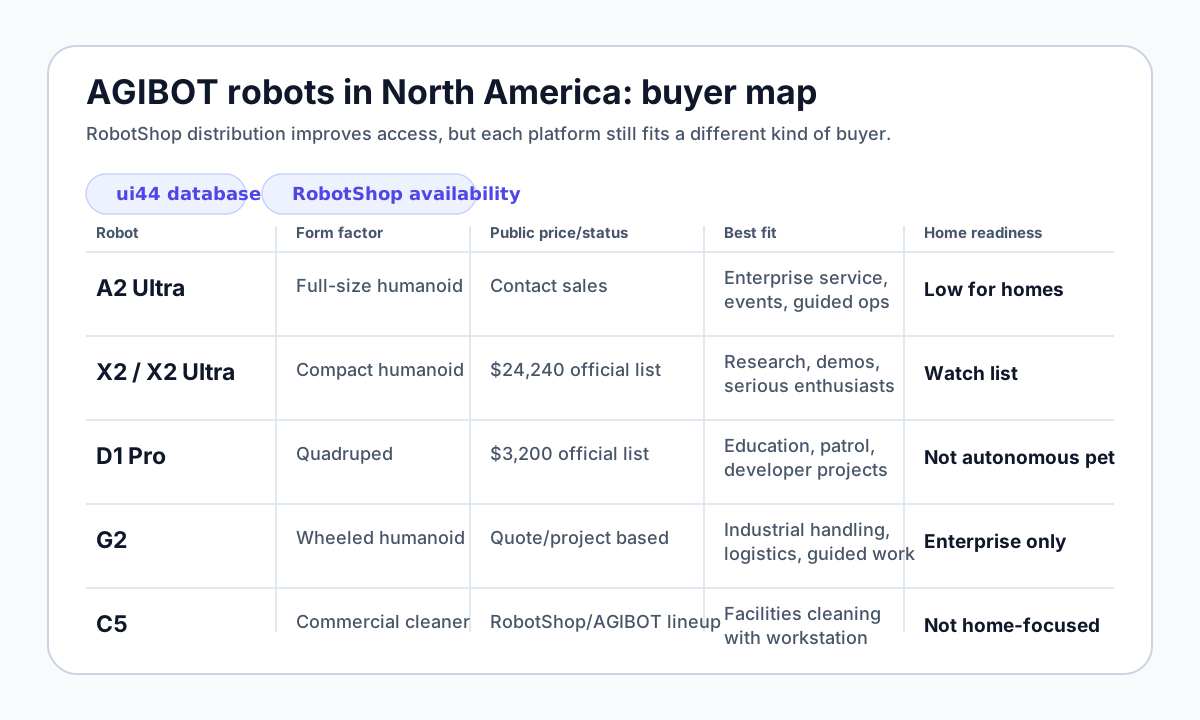
Here is the ui44 buyer map, using the database fields that matter most: form factor, public price, status, size, battery, payload, and current use case.
Robot
- ui44 category/status
- Compact humanoid, Available
- Public price signal
- $24,240 official AGIBOT store list
- Useful specs from ui44
- 131 cm, 35 kg / 39 kg Ultra, up to 1.8 m/s, ~2 hours walking, 500 Wh swappable battery, 3 kg max payload in specific postures and ≤1 kg across full range
- Best North American buyer
- Robotics lab, demo venue, developer, serious enthusiast who understands optional packages
Robot
- ui44 category/status
- Quadruped, Available
- Public price signal
- $3,200 official AGIBOT store list
- Useful specs from ui44
- 15.5 kg, 3.5 m/s, 1–2h battery, ≈5 kg effective payload, 16 cm stair climbing, 40° slope, 122° wide-angle camera
- Best North American buyer
- Education, research, patrol demo, robot-dog development project
Robot
- ui44 category/status
- Full-size humanoid, Available
- Public price signal
- Enterprise pricing / contact sales
- Useful specs from ui44
- 169 cm, 69 kg, 1.5h+ walking or 3h standing, 3D LiDAR, RGB-D, 4G/5G, NVIDIA Jetson Orin 64G, FCC/CE certifications in ui44 record
- Best North American buyer
- Enterprise customer interaction, exhibitions, guided service deployments
Robot
- ui44 category/status
- Wheeled humanoid, Active
- Public price signal
- Commercial pricing not publicly disclosed
- Useful specs from ui44
- 24/7 operation via dual hot-swappable batteries, autonomous charging, force-controlled arms, multimodal voice interaction, Jetson Thor domain controller
- Best North American buyer
- Manufacturing, logistics, guided tours, structured enterprise manipulation
Robot
AGIBOT C5
- ui44 category/status
- Commercial cleaning robot, not yet in ui44 robot DB
- Public price signal
- RobotShop/AGIBOT lineup item
- Useful specs from ui44
- AGIBOT describes sweeping, scrubbing, dust mopping, obstacle avoidance, self-charging, wastewater disposal, tank rinsing, and fresh-water refilling
- Best North American buyer
- Facilities cleaning: supermarkets, airports, hospitals, hotels, offices, shopping malls
| Robot | ui44 category/status | Public price signal | Useful specs from ui44 | Best North American buyer |
|---|---|---|---|---|
| AGIBOT X2 | Compact humanoid, Available | $24,240 official AGIBOT store list | 131 cm, 35 kg / 39 kg Ultra, up to 1.8 m/s, ~2 hours walking, 500 Wh swappable battery, 3 kg max payload in specific postures and ≤1 kg across full range | Robotics lab, demo venue, developer, serious enthusiast who understands optional packages |
| AGIBOT D1 Pro | Quadruped, Available | $3,200 official AGIBOT store list | 15.5 kg, 3.5 m/s, 1–2h battery, ≈5 kg effective payload, 16 cm stair climbing, 40° slope, 122° wide-angle camera | Education, research, patrol demo, robot-dog development project |
| AGIBOT A2 Ultra | Full-size humanoid, Available | Enterprise pricing / contact sales | 169 cm, 69 kg, 1.5h+ walking or 3h standing, 3D LiDAR, RGB-D, 4G/5G, NVIDIA Jetson Orin 64G, FCC/CE certifications in ui44 record | Enterprise customer interaction, exhibitions, guided service deployments |
| AGIBOT G2 | Wheeled humanoid, Active | Commercial pricing not publicly disclosed | 24/7 operation via dual hot-swappable batteries, autonomous charging, force-controlled arms, multimodal voice interaction, Jetson Thor domain controller | Manufacturing, logistics, guided tours, structured enterprise manipulation |
| AGIBOT C5 | Commercial cleaning robot, not yet in ui44 robot DB | RobotShop/AGIBOT lineup item | AGIBOT describes sweeping, scrubbing, dust mopping, obstacle avoidance, self-charging, wastewater disposal, tank rinsing, and fresh-water refilling | Facilities cleaning: supermarkets, airports, hospitals, hotels, offices, shopping malls |
The standout for a home-robot reader is X2, but not because it is a chores robot. It is interesting because it is compact enough to imagine indoors and specific enough to evaluate: ui44 tracks the X2 at 131 cm tall with a $24,240 official store list price, ~2 hours walking time at 0.5 m/s, swappable battery support, mobile app support, OTA updates, and a very important payload limitation: 3 kg only in specific postures, ≤1 kg across the full range.
That payload detail is the difference between a credible robotics platform and a fantasy butler. X2 can be a useful research or demo humanoid. It should not be marketed to ordinary households as a reliable grocery-carrying, laundry-folding, or kitchen-cleaning worker.

D1 Pro is the easier impulse buy on paper. At $3,200, it sits closer to a high-end robot-dog hobby platform than to a six-figure enterprise humanoid. But AGIBOT's own store language is worth reading closely: the Pro version is built around remote operation and app control, while secondary development and autonomous-follow work belong to the Edu/developer path. In other words, D1 Pro can be a fun and capable quadruped platform; it is not a self-driving guard dog for a suburban yard.
A2 Ultra and G2 are the opposite. They are more serious as deployment machines, but less plausible as private-home purchases. A2 Ultra is a full-size humanoid with enterprise pricing, certifications in ui44's record, and a history of commercial deployment. G2 is a wheeled humanoid for factories, logistics, assembly, and guided-service workflows. If you need one, you probably already have a site, budget, safety plan, and integration partner.
Is RobotShop support the same as home readiness?
No. It is better described as procurement and deployment support. That is useful, especially for buyers who previously had to navigate overseas storefronts, customs, unclear delivery timelines, and manufacturer support channels on their own. RobotShop says it can help buyers move from discovery to deployment with scoping, onboarding, integration planning, training, and operational support. That lowers friction.
It does not answer every buyer question.
The official AGIBOT store pages still show why. The X2 listing says customers may need to cover duties, taxes, and import-clearance fees, and that optional capabilities matter: advanced autonomous movement, navigation behavior, auto-charging, and richer interaction depend on selected packages. The D1 Pro listing is even more direct about technical support: hardware warranty is one part of the story, while many technical issues are expected to be resolved by the user through documentation, development guides, and self-testing.
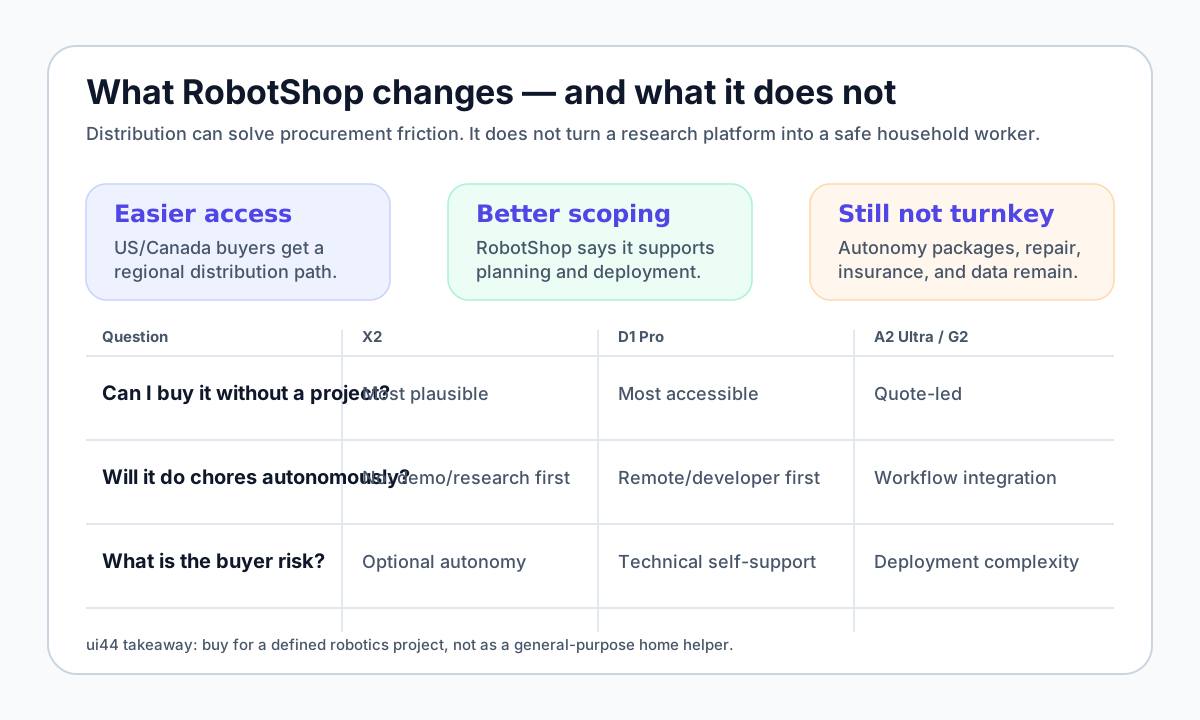
That is not a criticism. It is normal for early robotics. A robot that can walk, balance, map, gesture, speak, or carry small objects is still not the same as a consumer appliance. The operator needs to understand operating design domain, software packages, update policy, remote-control fallback, battery handling, repair logistics, and what happens when the robot makes a bad prediction in a shared space.
For a business buyer, RobotShop's value is that these conversations can happen before the invoice. For a household buyer, the value is that the gaps become more visible. If a seller cannot explain exactly what the robot will do on day one, what still requires teleoperation, and who pays when a part breaks, you are not buying a home helper. You are buying an experiment.
What should you ask before buying an AGIBOT robot?
Use the RobotShop availability news as a reason to ask better questions, not as a reason to rush. The checklist changes depending on the platform.
If you are considering AGIBOT X2
Ask whether you are buying X2 or X2 Ultra. The difference matters. AGIBOT's X2 spec sheet separates the base model from Ultra: Ultra adds 3D LiDAR, RGB-D, additional cameras, 4G/5G, an Orin NX high-performance board, secondary development support, and an optional auto-charging dock. If your use case requires mapping, autonomous navigation, end-effectors, or custom development, the base model may not be enough.
Also ask what payload means in your task. A robot that can hold 3 kg in specific postures may still be limited to ≤1 kg across the full arm range. That can be fine for gestures, light props, demonstrations, and some manipulation experiments. It is not enough to assume normal home carrying tasks.
If you are considering AGIBOT D1 Pro
Ask whether you need the Pro or Edu path. The D1 Pro's official store page lists strong mobility numbers — 3.5 m/s, 40° slope handling, 16 cm continuous stair climb height, 1–2 hours endurance, and ≈5 kg effective payload. But it also says the Pro version does not support secondary development, while the Edu version adds expansion interfaces.
That makes D1 Pro a better fit for demonstrations, mobility research, education, and controlled patrol experiments than for unsupervised home security. If you want a quadruped that can follow people, respond to custom autonomy, or operate in a specific property layout, confirm which version and software stack supports that before ordering.
If you are considering A2 Ultra or G2
Treat the purchase like an enterprise robotics deployment. Ask for a written use case, environment assumptions, safety boundaries, operator training plan, service agreement, spare-parts path, insurance review, and data-handling policy. A2 Ultra and G2 are more capable platforms, but their value comes from deployment design. The robot is only one part of the system.
G2 in particular is a reminder that "humanoid" does not always mean "bipedal home robot." ui44 tracks it as a wheeled humanoid built for industrial handling, logistics sorting, guided tours, autonomous charging, force-controlled arms, and 24/7 operation with hot-swappable batteries. That sounds less romantic than a walking android, but it is more realistic for productive robotics.
Who should actually buy now?
A North American buyer should consider AGIBOT now if the use case is structured, budgeted, and measurable. Good examples include a robotics lab that needs a compact humanoid, a university course that wants a quadruped platform, an exhibition venue that needs guided interaction, a facilities team evaluating a commercial cleaner, or an enterprise team piloting manipulation in a known work cell.
Most households should wait. That is especially true if the goal is chores. The X2's price and payload limits, D1 Pro's remote/developer emphasis, A2 Ultra's enterprise posture, G2's industrial focus, and C5's commercial-cleaning target all point in the same direction: AGIBOT is becoming easier to access, but the best current buyers are still technical or operational buyers.
The encouraging part is that distribution is one of the boring milestones that actually matters. Robots do not become real in homes just because a demo goes viral. They become real when buyers can compare models, get service, receive parts, ask warranty questions, plan deployments, and say no when a platform does not fit. RobotShop's AGIBOT partnership helps with that middle layer.
The honest takeaway: AGIBOT robots in North America are now more buyable, not magically more domestic. If you are buying for a robotics project, the lineup is worth a serious look. If you are buying for your living room, keep watching X2, compare it against other compact humanoids in ui44's robot database, and wait for clear proof of safe, repeatable home tasks.
Sources & References
Source
https://www.businesswire.com/news/home/20260414539694/en/RobotShop-Becomes-AGIBOTs-Value-Added-Distribution-Partner-in-North-America
- Why it matters
- RobotShop/AGIBOT North America distribution announcement, availability, and support framing
- Checked
- 2026-04-28
Source
https://www.agibot.com/products/X2
- Why it matters
- Official X2 / X2 Ultra specifications
- Checked
- 2026-04-28
Source
https://store.agibot.com/products/x2
- Why it matters
- Official X2 store price, package notes, import-duty and technical-support caveats
- Checked
- 2026-04-28
Source
https://store.agibot.com/products/d1-pro
- Why it matters
- Official D1 Pro price, mobility specs, support notes, Pro/Edu differences
- Checked
- 2026-04-28
Source
https://www.agibot.com/products/A2_Ultra
- Why it matters
- Official A2 Ultra product page and image source
- Checked
- 2026-04-28
Source
https://www.agibot.com/products/G2
- Why it matters
- Official G2 product page and product-family source
- Checked
- 2026-04-28
Source
https://www.agibot.com/products/C5
- Why it matters
- Official C5 commercial-cleaning robot description
- Checked
- 2026-04-28
Source
https://www.prnewswire.com/news-releases/agibot-unveils-new-generation-of-embodied-ai-robots-and-models-accelerating-real-world-deployment-of-physical-ai-302746174.html
- Why it matters
- AGIBOT broader embodied-AI platform and commercial-deployment context
- Checked
- 2026-04-28
Source
/robots/agibot-x2, /robots/agibot-a2-ultra, /robots/agibot-d1-pro, /robots/agibot-g2
- Why it matters
- ui44 database entries for specs, pricing, status, and buyer comparisons
- Checked
- 2026-04-28
| Source | Why it matters | Checked |
|---|---|---|
| https://www.businesswire.com/news/home/20260414539694/en/RobotShop-Becomes-AGIBOTs-Value-Added-Distribution-Partner-in-North-America | RobotShop/AGIBOT North America distribution announcement, availability, and support framing | 2026-04-28 |
| https://www.agibot.com/products/X2 | Official X2 / X2 Ultra specifications | 2026-04-28 |
| https://store.agibot.com/products/x2 | Official X2 store price, package notes, import-duty and technical-support caveats | 2026-04-28 |
| https://store.agibot.com/products/d1-pro | Official D1 Pro price, mobility specs, support notes, Pro/Edu differences | 2026-04-28 |
| https://www.agibot.com/products/A2_Ultra | Official A2 Ultra product page and image source | 2026-04-28 |
| https://www.agibot.com/products/G2 | Official G2 product page and product-family source | 2026-04-28 |
| https://www.agibot.com/products/C5 | Official C5 commercial-cleaning robot description | 2026-04-28 |
| https://www.prnewswire.com/news-releases/agibot-unveils-new-generation-of-embodied-ai-robots-and-models-accelerating-real-world-deployment-of-physical-ai-302746174.html | AGIBOT broader embodied-AI platform and commercial-deployment context | 2026-04-28 |
| /robots/agibot-x2, /robots/agibot-a2-ultra, /robots/agibot-d1-pro, /robots/agibot-g2 | ui44 database entries for specs, pricing, status, and buyer comparisons | 2026-04-28 |
Related in the database
Use this article as a market-reality workflow
Turn the article into a market-reality pass grounded in the robots, manufacturers, and countries it actually references.
AGIBOT North America: Which Robots Can You Buy? already points you toward 4 linked robots, 1 manufacturer, and 1 country inside the ui44 database. That matters because strong buyer guidance is easier to apply when you can move immediately from a claim or warning into concrete product pages, manufacturer directories, component explainers, and country-level context instead of treating the article as an isolated opinion piece. The fastest next step is to turn the article into a shortlist workflow: open the linked robot pages, verify which specs are actually published for those models, then compare the surrounding manufacturer and component context before you decide whether the underlying claim changes your buying plan.
For this topic, the useful discipline is to separate the editorial lesson from the catalog evidence. The article gives you the framing, but the robot pages tell you what each product actually ships with today: sensor stack, connectivity methods, listed price, release timing, category, and support-relevant compatibility notes. The manufacturer pages then show whether you are looking at a one-off launch, a broader lineup pattern, or a company that spans multiple categories. That layered workflow reduces the risk of buying on a single marketing phrase or a single support FAQ.
Launch claims age fast. The safest move is to pair the article with robot status, price, and manufacturer breadth checks inside ui44 so you can see whether X2, D1 Pro, and A2 Ultra are actually ready for a shortlist or still mostly launch-stage signals. If you want a quick working shortlist, open Compare X2, D1 Pro, and A2 Ultra next, then keep this article open as the reasoning layer while you compare structured data side by side.
Practical Takeaway
Every robot, manufacturer, category, component, and country reference below resolves to a real ui44 page, keeping the follow-up path grounded in database records rather than generic advice.
Suggested next steps in ui44
- Check each linked robot page for listed price, status, and release timing before you treat a launch announcement as a shipping reality.
- Open AGIBOT to see whether the company’s ui44 footprint already shows a mature product lane or only a small launch cluster.
- Use country pages when the article spans several ecosystems, because launch timing and lineup depth often differ by region even when the headline sounds global.
- Finish with Compare X2, D1 Pro, and A2 Ultra so availability claims sit next to real product data.
- Treat every article as a live market snapshot. Re-check status and pricing before you move from interest to purchase intent.
Robot profiles worth opening next
Use the linked product pages as the evidence layer
The linked robot pages are where this article becomes operational. Instead of asking whether the headline is interesting, use the robot entries to inspect the actual mix of sensors, connectivity options, batteries, pricing, release timing, and stated capabilities attached to the products mentioned in the article. That is the easiest way to see whether the warning or opportunity described here affects one product family, a specific design pattern, or an entire buying lane.
X2 is tracked on ui44 as a available humanoid robot from AGIBOT. The database currently records a listed price of $24,240, a release date of 2025, ~2 hours at 0.5 m/s walking battery life, ~1.5 hours charging time, and a published stack that includes 3D LiDAR (Ultra), RGB-D Camera (Ultra), and RGB Cameras plus Wi-Fi and Bluetooth.
For market and launch stories, this entry grounds the article in real product data. Use the combination of status, release timing, price, and published capabilities like Bipedal Walking, 25-30 DOF Articulation, and Object Manipulation (with OmniHand accessory) to decide whether X2 belongs on a live shortlist or should stay in the watchlist bucket a little longer.
D1 Pro is tracked on ui44 as a available quadruped robot from AGIBOT. The database currently records a listed price of $3,200, a release date of 2025-08-01, 1–2 hours per charge battery life, Approx. 1 hour (10% to 90% charge) charging time, and a published stack that includes Wide-Angle Camera (122° DFOV) and IMU plus Wi-Fi and Bluetooth 5.2.
For market and launch stories, this entry grounds the article in real product data. Use the combination of status, release timing, price, and published capabilities like All-Terrain Locomotion (RL-based gait), Stair Climbing (up to 16 cm steps), and Slope Traversal (up to 40°) to decide whether D1 Pro belongs on a live shortlist or should stay in the watchlist bucket a little longer.
A2 Ultra is tracked on ui44 as a available humanoid robot from AGIBOT. The database currently records a listed price of $999,999, a release date of 2024, Standing: 3h, Walking: 1.5h+ battery life, 2 hours charging time, and a published stack that includes 3D LiDAR, RGB-D Camera, and RGB Camera plus Wi-Fi and 4G/5G.
For market and launch stories, this entry grounds the article in real product data. Use the combination of status, release timing, price, and published capabilities like Bipedal Walking, Autonomous Navigation, and Intelligent Obstacle Avoidance to decide whether A2 Ultra belongs on a live shortlist or should stay in the watchlist bucket a little longer.
G2 is tracked on ui44 as a active humanoid robot from AGIBOT. The database currently records a listed price of Price TBA, a release date of 2025-10, 24/7 operation via dual hot-swappable batteries battery life, Autonomous charging supported charging time, and a published stack that includes Multimodal spatial perception system, 360° surround-view sensing, and Collision detection sensors plus its listed connectivity stack.
For market and launch stories, this entry grounds the article in real product data. Use the combination of status, release timing, price, and published capabilities like Omnidirectional wheeled mobility, Force-controlled dual-arm manipulation, and Submillimeter-precision task execution to decide whether G2 belongs on a live shortlist or should stay in the watchlist bucket a little longer.
Manufacturer context behind the article
Check whether this is one product story or a broader company pattern
Manufacturer pages add the market context that individual product pages cannot show on their own. They help you check whether a launch headline is backed by a deeper tracked lineup, a visible order path, and adjacent products that make the company look committed rather than opportunistic.
AGIBOT
ui44 currently tracks 10 robots from AGIBOT across 3 categorys. The company is grouped under China, and the current catalog footprint on ui44 includes A2 Ultra, X2, Expedition A3.
That wider brand context matters because launch headlines can obscure how deep or shallow a company’s actual product footprint is. The manufacturer route helps you tell the difference between a growing ecosystem and a single high-visibility announcement. The category mix here currently points toward Humanoid, Quadruped, Commercial as the most useful next route if you want to see whether this article reflects a wider pattern inside the brand.
Broaden the scan without leaving the database
Categories, components, and countries add the wider context
Category framing
Category pages are useful when the article touches a buying pattern that shows up across brands. A category route helps you confirm whether the linked products sit in a narrow niche or whether the same question should be tested across a larger field of alternatives.
Humanoid
The Humanoid category page currently groups 129 tracked robots from 91 manufacturers. ui44 describes this lane as: Full-size bipedal humanoid robots built to work alongside people — from factory floors to household tasks. Compare the cutting edge of humanoid robotics.
That makes the category route a practical follow-up when you want to check whether the products linked in this article are typical for the lane or whether they sit at one edge of the market. Useful starting examples currently include NEO, EVE, Mornine M1.
Quadruped
The Quadruped category page currently groups 25 tracked robots from 16 manufacturers. ui44 describes this lane as: Four-legged robot dogs and quadrupeds built for rough terrain, inspection, and exploration — going where wheels can't.
That makes the category route a practical follow-up when you want to check whether the products linked in this article are typical for the lane or whether they sit at one edge of the market. Useful starting examples currently include Argos X1, D1 Pro, D2 Max.
Country and ecosystem context
Country pages give extra context when support practices, launch sequencing, regulatory posture, or manufacturer mix matter. They are not a substitute for model-level verification, but they do help you see which ecosystems cluster together and which manufacturers sit in the same regional field when you broaden the search beyond the article headline.
China
The China route currently groups 189 tracked robots from 86 manufacturers in ui44. That gives you a useful regional lens when the article points toward support practices, launch sequencing, or brand clusters that may share similar ecosystem assumptions.
On the current route, manufacturers like Unitree Robotics, AGIBOT, Dreame make the page a good way to broaden the scan without losing the regional context that often shapes availability, documentation style, and adjacent alternatives.
Questions to answer before you move from reading to buying
A follow-up FAQ built from the entities already linked in this article
Frequently Asked Questions
Which page should I open first after reading “AGIBOT North America: Which Robots Can You Buy?”?
Start with X2. That gives you a concrete product anchor for the article’s main claim. From there, branch into the manufacturer and component pages so you can tell whether the article is describing one specific model, a repeated brand pattern, or a wider technology issue that affects multiple shortlist options.
How do the manufacturer pages change the buying decision?
AGIBOT help you zoom out from one article and one product. On ui44 they show lineup breadth, category spread, and the neighboring robots tied to the same company. That context is useful when you are deciding whether a risk belongs to a single model, whether it shows up across a brand’s portfolio, and whether you should keep looking at alternatives before committing.
When should I switch from reading to side-by-side comparison?
Move into Compare X2, D1 Pro, and A2 Ultra as soon as you understand the article’s main warning or promise. The article explains what to watch for, but the compare view is where you can check whether price, status, battery life, connectivity, sensors, and category fit still make the robot a good match for your own home and budget.
Where to go next in ui44
Keep the research chain inside the database
If you want to keep going, these follow-on pages give you the cleanest expansion path from article to research session. Open the comparison route first if you are deciding between products today. Open the manufacturer, category, and component routes if you still need to understand the broader pattern behind the claim.
Written by
ui44 Team
Published April 29, 2026
Share this article
Open a plain share link on X or Bluesky. No embeds, no widgets, no cookie baggage.