The useful question is not "is Bumi the cheapest humanoid ever?" That absolute claim is too hard to verify cleanly. The useful question is: what does a $1,400 humanoid actually buy you, and when should you compare it with a more expensive robot like the Unitree R1, Unitree G1, FF Master, or 1X NEO?
What Is the Noetix Bumi?
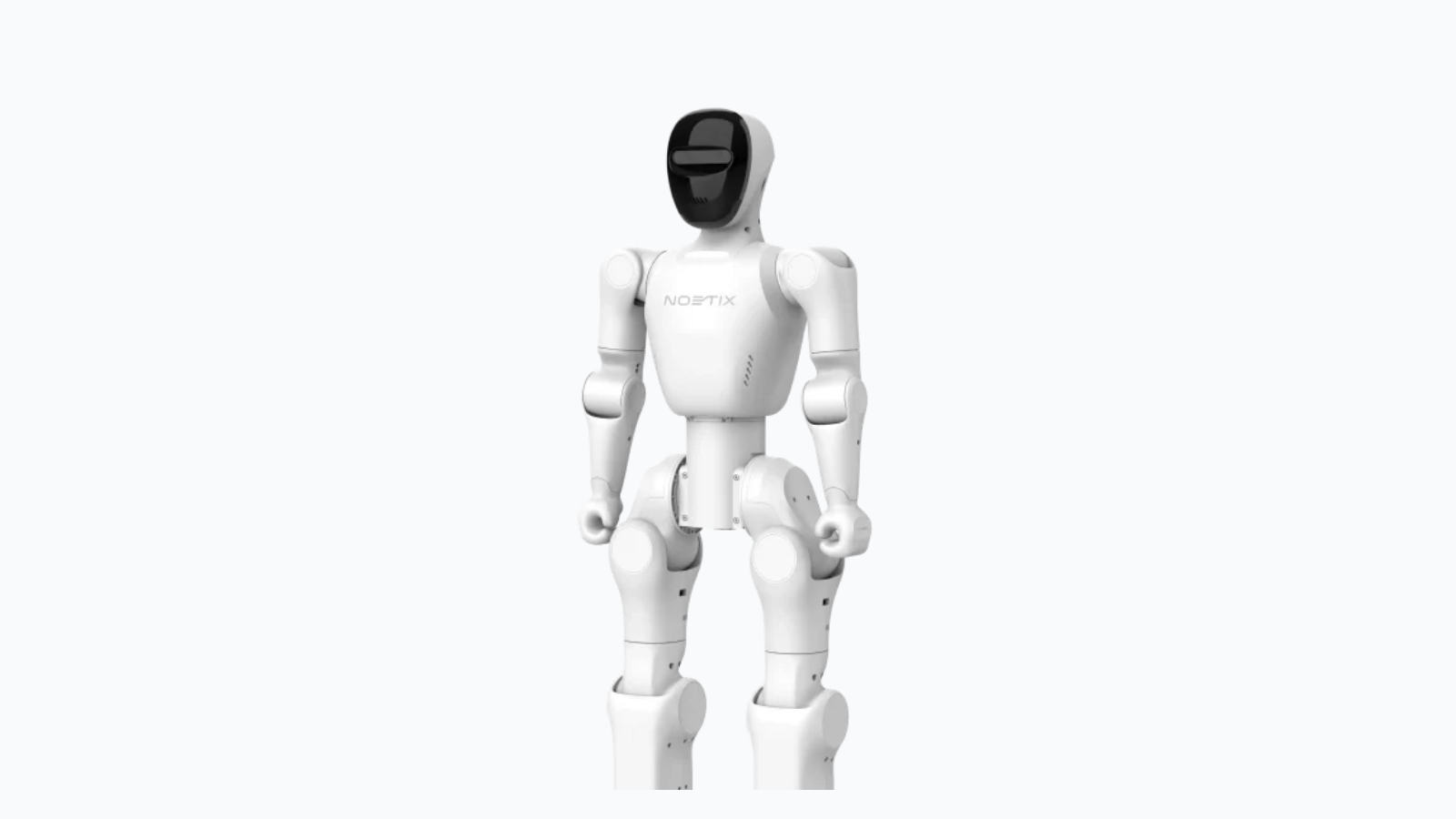
Bumi is a compact bipedal humanoid from Noetix Robotics. Noetix's own English Bumi page calls it a "10k-CNY class" high-performance humanoid and positions it around four use cases: family companionship, maker education, technology hobbies, and programming learning. That matches the current ui44 database framing: Bumi is an education and interaction robot, not a chores robot.
Here are the buyer-relevant specs from the ui44 robot database:
| Spec | Noetix Bumi |
|---|---|
| Database category | Humanoid |
| Price | $1,370 USD listed from ¥9,998 China pricing |
| Status | Pre-order |
| Height | 94 cm / 3.1 ft |
| Weight | 12 kg / 26.5 lb |
| Battery life | 1–2 hours from a 48 V, 3.5+ Ah battery |
| Charging time | Not officially disclosed in our database |
| Max speed | Not officially disclosed in our database |
| Current ui44 sensor listing | IMU and joint encoders |
| Core capabilities | Bipedal walking, running, dancing, voice interaction, graphical programming |
Two terms in that table are worth translating. An IMU is a balance and motion sensor that helps a robot understand acceleration and orientation. Joint encoders measure how far each motorized joint has moved, which is essential for stable walking. Those are robotics basics, but they are not the same thing as a full home-navigation stack with mature room mapping, obstacle semantics, and reliable object manipulation.
There is also a sensor-disclosure wrinkle buyers should understand. The current ui44 data file lists IMU and joint encoders for Bumi, while Noetix's official parameter graphic also shows a depth camera, ring-type microphone, and speaker. So the honest reading is: Bumi clearly has interaction hardware, but its final retail sensor stack is not as cleanly documented in English as more mature robots. Do not buy it assuming 1X NEO-style household perception.
The Price Ladder Changed
Bumi matters because it sits far below the other publicly priced humanoids in our database. If you only look at the headline price, it looks like the entire market just collapsed. If you look at price plus purpose, the story is more specific: Bumi is a low-cost learning platform, while the next tiers are research or home-assistance bets.
| Robot | Public database price | Status | Height / weight | Battery | Best current fit |
|---|---|---|---|---|---|
| Noetix Bumi | $1,370 | Pre-order | 94 cm / 12 kg | 1–2 hrs | Learning, demos, family interaction |
| Unitree R1 | From $4,900 for R1 Air | Pre-order | 123 cm / ~25–29 kg | ~1 hr mixed activity | Agile low-cost humanoid platform |
| Unitree G1 | $13,500 | Available | 132 cm / 35 kg | ~2 hrs | Research and development |
| FF Master | $19,990 | Available | 131 cm / 39 kg | Up to 2 hrs | Compact home/education companion platform |
| NEURA 4NE-1 Mini | €19,999 | Pre-order | 132 cm / 36 kg | ~2.5 hrs | Cognitive humanoid research and education |
| 1X NEO | $20,000 | Pre-order | 167 cm / 30 kg | ~4 hrs | Home humanoid assistance ambition |
That table deliberately excludes the Zeroth W1 from this humanoid price comparison because ui44 categorizes it as a Home Assistant, not a humanoid. W1 is a tracked mobile assistant, which may be a more useful home robot for some buyers, but it is not a bipedal humanoid price peer.
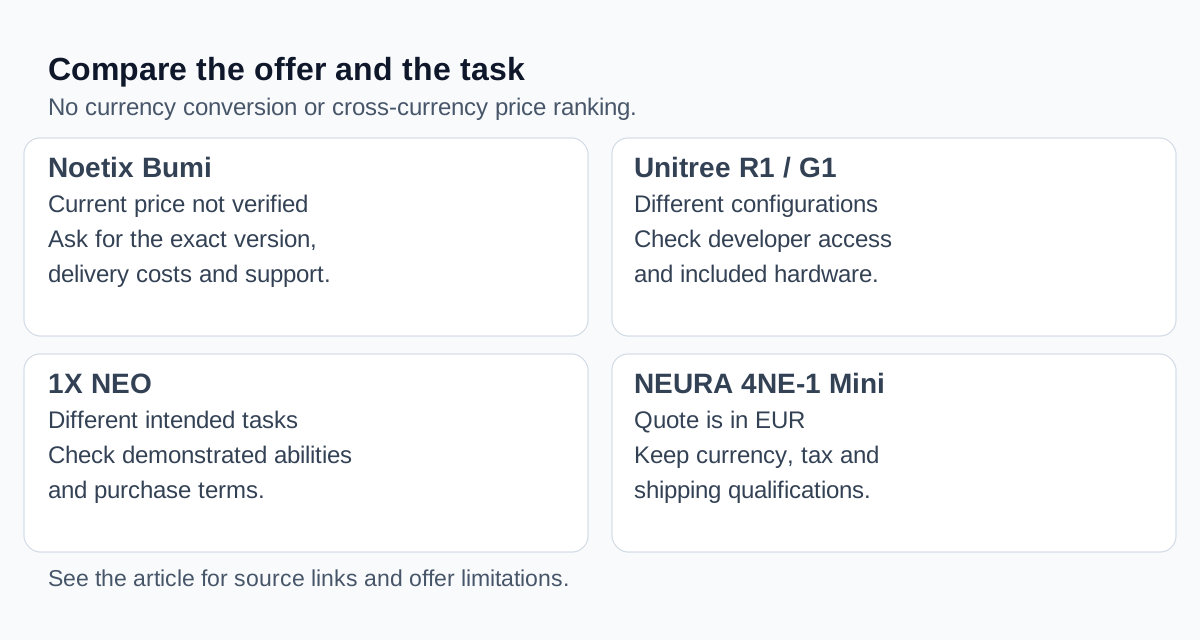
The table also treats 1X NEO carefully: it is exactly $20,000 in our database, not "under $20,000." It belongs here because many buyers will naturally ask whether Bumi is a cheaper path to the same dream. It is not. Bumi and NEO are selling very different promises.
What Bumi Can Actually Do
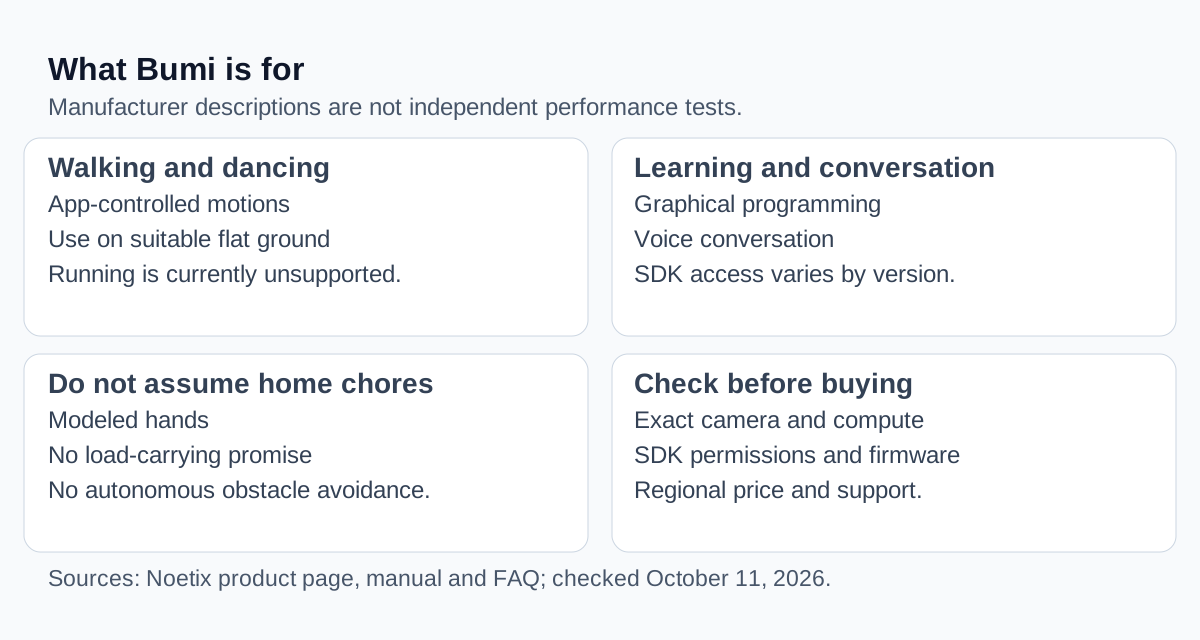
The strongest evidence for Bumi is around movement, education, and interaction. The current ui44 database lists bipedal walking, running, dancing, voice interaction, graphical programming, and educational companion use. Noetix's Bumi page reinforces that positioning with maker education and programming learning as first-party use cases. Aparobot's coverage also reports support for an open programming interface and 21 degrees of freedom, although ui44 does not yet store a Bumi DoF field in the robot data file.
What that means in plain English:
- Bumi is meant to walk around, perform motions, and act as a physical robotics learning object.
- It is priced more like an advanced STEM platform than a professional humanoid.
- It may be interesting for families, classrooms, makerspaces, and hobbyists who want real bipedal hardware to experiment with.
- It is not positioned as a robot that can clean your house, cook dinner, or carry groceries.
Walking, Running, and Dancing
Bumi's biggest advantage is that it is a real bipedal robot at a dramatically lower price. The ui44 database lists walking, running, and dancing, and Noetix's marketing leans heavily into motion. That matters because most cheap "robot" products are either wheeled toys, screens on wheels, or small companion devices. Bumi is physically attempting the more difficult humanoid form factor.
Voice and Companionship
The Bumi pitch includes voice interaction and family companionship. Treat that as a companion and education claim, not as proof that Bumi can understand a messy home the way a more expensive embodied-AI system hopes to. A classroom demo or a living-room conversation is a narrower problem than autonomous chores.
Programming Learning
This is the cleanest buyer use case. If a child, student, or hobbyist wants to learn robotics on hardware that actually balances and moves, Bumi is more compelling than a generic kit. The price is still high for a toy, but low for a bipedal humanoid learning platform.
Short Sessions, Not All-Day Work
A 1–2 hour battery-life listing is fine for lessons, demos, and experiments. It is weak for a robot that is supposed to be a meaningful daily home helper. That is one of the clearest lines between Bumi and pricier platforms like 1X NEO or NEURA 4NE-1 Mini.
What Bumi Probably Cannot Do
The most important buyer warning is simple: Bumi's price breakthrough comes with capability boundaries.
It does not have articulated dexterous hands in the current ui44 record. Without hands, it cannot reliably pick up objects, fold laundry, load a dishwasher, carry plates, or do the physical manipulation work people imagine when they hear "home humanoid." It also has no confirmed Western retail timeline, no long-term owner reliability record, and no mature English documentation comparable to established global product pages.
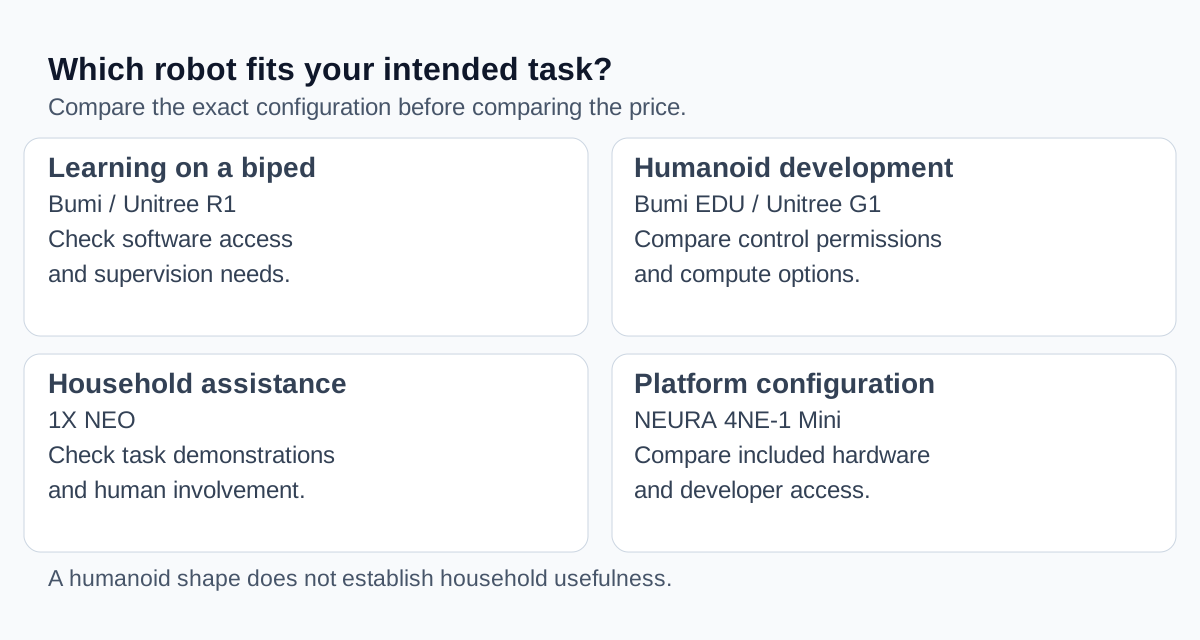
The better mental model is not "discount 1X NEO." It is "walking robotics learning platform that happens to have a humanoid body." That framing sounds less dramatic, but it is far more useful if you are deciding whether to spend money.
Bumi vs. Unitree R1, G1, FF Master, and 1X NEO
Bumi vs. Unitree R1
The Unitree R1 is the most natural price comparison because R1 Air starts at $4,900 in our database. But it is still a very different robot. R1 is taller at 123 cm, much heavier at roughly 25–29 kg depending on version, and oriented around agile bipedal motion. Unitree also distinguishes between R1 Air, standard R1, and EDU variants; optional dexterous hands belong to EDU, not the $4,900 Air configuration.
If you want the cheapest bipedal robot for education and family demos, Bumi is the more interesting headline. If you want a more serious humanoid development platform with Unitree's ecosystem behind it, R1 is the more relevant comparison.
Bumi vs. Unitree G1
The Unitree G1 is nearly ten times the price, but it is also the first robot in this list that feels like a serious research humanoid rather than a low-cost learning device. The ui44 database lists a 132 cm body, 35 kg weight, roughly 2 hours of runtime, depth camera, 3D LiDAR, a microphone array, and optional Dex3-1 hands. That sensor and manipulation package is the kind of thing Bumi does not offer at its price.
Bumi vs. FF Master and NEURA 4NE-1 Mini
FF Master and NEURA 4NE-1 Mini are the around-$20k compact humanoid tier. FF Master is listed as available at $19,990 with five-fingered dexterous hands and up to 2 hours of battery life. NEURA 4NE-1 Mini is listed at €19,999 in standard form, with a Pro tier adding more advanced hands, teleoperation, and digital-twin features.
These are not Bumi alternatives for a casual family purchase. They are what you look at when you need a more capable humanoid platform and can justify a five- figure budget.
Bumi vs. 1X NEO
The 1X NEO is the comparison many readers will care about, because NEO is explicitly pitched as a home humanoid. ui44 lists NEO at $20,000, 167 cm tall, 30 kg, and roughly 4 hours of battery life. That is a completely different class of product: larger, softer, more expensive, and designed around household assistance.
Bumi may get people comfortable with a humanoid in the home. NEO is trying to be the robot that does something useful once it is there. Those are not the same job.
Should You Buy Bumi?
Bumi makes the most sense if all three of these are true:
- You are in, or can safely buy from, the China-first availability path.
- You want a robotics learning platform, not a robot servant.
- You are comfortable with early-product uncertainty around documentation, support, spare parts, software updates, and real owner experience.
It makes much less sense if you want practical household labor. In that case, a narrower robot may be more useful sooner. A vacuum with a small pickup arm like Roborock Saros Z70 is not a humanoid, but it is actually designed around a concrete physical task. That is the trade-off buyers need to keep in mind: humanoid form is exciting, but task usefulness still wins.
The Real Takeaway
Noetix Bumi is not proof that useful humanoid home workers have arrived at $1,400. It is proof that humanoid-shaped hardware is moving into a price band where families, classrooms, and hobbyists can start paying attention.
That distinction matters. A cheaper humanoid is still limited if it cannot manipulate objects, run for long periods, or ship globally with reliable support. But a bipedal robot at this price changes who gets to learn, experiment, and build with humanoid hardware. That is why Bumi is worth tracking.
For now, the verdict is cautious but genuinely interesting: Bumi is the cheapest priced humanoid in ui44's database and a serious signal for robotics education. It is not the home robot that folds your laundry.
Browse all models in the humanoid robot category, or compare Bumi with Unitree R1 and Unitree G1 side by side.
Database context
Use this article as a privacy verification workflow
Turn the article into a real verification pass
Noetix Bumi: $1,400 Humanoid Reality Check already points you toward 8 linked robots, 8 manufacturers, 0 components, 3 countrys inside the ui44 database. That matters because strong buyer guidance is easier to apply when you can move immediately from a claim or warning into concrete product pages, manufacturer directories, component explainers, and country-level context instead of treating the article as an isolated opinion piece. The fastest next step is to turn the article into a shortlist workflow: open the linked robot pages, verify which specs are actually published for those models, then compare the surrounding manufacturer and component context before you decide whether the underlying claim changes your buying plan.
For this topic, the useful discipline is to separate the editorial lesson from the catalog evidence. The article gives you the framing, but the robot pages tell you what each product actually ships with today: sensor stack, connectivity methods, listed price, release timing, category, and support-relevant compatibility notes. The manufacturer pages then show whether you are looking at a one-off launch, a broader lineup pattern, or a company that spans multiple categories. That layered workflow reduces the risk of buying on a single marketing phrase or a single support FAQ.
Use the robot pages to confirm which products actually expose cameras, microphones, Wi-Fi, or voice systems, then use the manufacturer pages to decide how much of the privacy question seems product-specific versus brand-wide. On this route cluster, R1, G1, and FF Master form the fastest reality check. If you want a quick working shortlist, open Compare R1, G1, and FF Master next, then keep this article open as the reasoning layer while you compare structured data side by side.
Practical Takeaway
This long-form add-on is generated from typed ui44 entities, so every robot, manufacturer, category, component, and country reference below resolves back to a real internal page instead of filler text.
Suggested next steps in ui44
- Open R1 and note the listed sensors, connectivity methods, and voice stack before you interpret any policy claim.
- Cross-check the wider brand context on Unitree Robotics so you can see whether the privacy question touches one model or a broader lineup.
- Use the linked component pages to confirm how common the relevant sensors and connectivity layers are across the database.
- Keep a short note of which policy layers you checked, which device features are actually present on the robot page, and which items still depend on region- or app-level confirmation.
- Finish with Compare R1, G1, and FF Master so the policy reading sits next to structured product data.
Database context
Robot profiles worth opening next
Use the linked product pages as the evidence layer
The linked robot pages are where this article becomes operational. Instead of asking whether the headline is interesting, use the robot entries to inspect the actual mix of sensors, connectivity options, batteries, pricing, release timing, and stated capabilities attached to the products mentioned in the article. That is the easiest way to see whether the warning or opportunity described here affects one product family, a specific design pattern, or an entire buying lane.
R1
Unitree Robotics · Humanoid · Pre-order
R1 is tracked on ui44 as a pre-order humanoid robot from Unitree Robotics. The database currently records a listed price of $4,900, a release date of 2025, ~1 hour (mixed activity) battery life, Not officially disclosed charging time, and a published stack that includes Binocular Cameras, 4-Mic Array, and Dual 6-Axis IMU plus Wi-Fi and Bluetooth 5.2.
For privacy-focused reading, this page matters because it shows the concrete device surface behind the policy discussion. Use it to verify whether R1 combines sensors and connectivity in a way that could change the in-home data footprint, and compare the listed capabilities such as Bipedal Walking & Running, Cartwheels & Handstands, and Push Recovery with any cloud, app, or voice layers, including UnifoLM (voice + image commands).
G1 is tracked on ui44 as a available humanoid robot from Unitree. The database currently records a listed price of $13,500, a release date of 2024, ~2 hours battery life, Not disclosed charging time, and a published stack that includes Depth Camera, 3D LiDAR, and 4 Microphone Array plus Wi-Fi 6 and Bluetooth 5.2.
For privacy-focused reading, this page matters because it shows the concrete device surface behind the policy discussion. Use it to verify whether G1 combines sensors and connectivity in a way that could change the in-home data footprint, and compare the listed capabilities such as Bipedal Walking, Object Manipulation, and Dexterous Hands (optional Dex3-1) with any cloud, app, or voice layers.
FF Master
Faraday Future · Humanoid · Available
FF Master is tracked on ui44 as a available humanoid robot from Faraday Future. The database currently records a listed price of $19,990, a release date of 2026-02-05, Up to 2 hours battery life, Not disclosed charging time, and a published stack that includes 3D LiDAR, Stereo RGB Cameras, and Interactive RGB Camera plus Wi-Fi and 4G.
For privacy-focused reading, this page matters because it shows the concrete device surface behind the policy discussion. Use it to verify whether FF Master combines sensors and connectivity in a way that could change the in-home data footprint, and compare the listed capabilities such as Bipedal Walking, Autonomous Navigation, and Obstacle Avoidance with any cloud, app, or voice layers.
NEO
1X Technologies · Humanoid · Pre-order
NEO is tracked on ui44 as a pre-order humanoid robot from 1X Technologies. The database currently records a listed price of $20,000, a release date of 2025-10-28, ~4 hours battery life, Not disclosed charging time, and a published stack that includes RGB Cameras, Depth Sensors, and Tactile Skin plus Wi-Fi and Bluetooth.
For privacy-focused reading, this page matters because it shows the concrete device surface behind the policy discussion. Use it to verify whether NEO combines sensors and connectivity in a way that could change the in-home data footprint, and compare the listed capabilities such as Household Chores, Tidying Up, and Safe Human Interaction with any cloud, app, or voice layers.
Bumi
Noetix Robotics · Humanoid · Pre-order
Bumi is tracked on ui44 as a pre-order humanoid robot from Noetix Robotics. The database currently records a listed price of $1,370, a release date of 2025, 1–2 hours (48 V, 3.5+ Ah battery) battery life, Not officially disclosed charging time, and a published stack that includes IMU and Joint encoders plus Wi-Fi.
For privacy-focused reading, this page matters because it shows the concrete device surface behind the policy discussion. Use it to verify whether Bumi combines sensors and connectivity in a way that could change the in-home data footprint, and compare the listed capabilities such as Bipedal Walking, Running, and Dancing with any cloud, app, or voice layers, including Voice interaction (proprietary).
Database context
Manufacturer context behind the article
Check whether this is one product story or a broader company pattern
Manufacturer pages add the market context that individual product pages cannot show on their own. They help you check whether the article is centered on a brand with a deep lineup, whether that brand spans several categories, and how much of its ui44 footprint depends on one flagship model versus a broader product strategy. That matters for topics like privacy, warranty terms, setup friction, and launch promises because the surrounding lineup often reveals whether a pattern is isolated or systemic.
Unitree Robotics
ui44 currently tracks 6 robots from Unitree Robotics across 2 categorys. The company is grouped under China, and the current catalog footprint on ui44 includes B2, B1, Go2.
That wider brand context matters because privacy questions rarely stop at one FAQ page. A manufacturer route helps you see whether the article is centered on one premium model or on a company that has several relevant products and therefore more than one place where the same policy or app assumptions might matter. The category mix here currently points toward Quadruped, Humanoid as the most useful next route if you want to see whether this article reflects a wider pattern inside the brand.
Unitree
ui44 currently tracks 2 robots from Unitree across 1 category. The company is grouped under China, and the current catalog footprint on ui44 includes H1, G1.
That wider brand context matters because privacy questions rarely stop at one FAQ page. A manufacturer route helps you see whether the article is centered on one premium model or on a company that has several relevant products and therefore more than one place where the same policy or app assumptions might matter. The category mix here currently points toward Humanoid as the most useful next route if you want to see whether this article reflects a wider pattern inside the brand.
Faraday Future
ui44 currently tracks 3 robots from Faraday Future across 2 categorys. The company is grouped under Unknown, and the current catalog footprint on ui44 includes FF Futurist, FF Master, FX Aegis.
That wider brand context matters because privacy questions rarely stop at one FAQ page. A manufacturer route helps you see whether the article is centered on one premium model or on a company that has several relevant products and therefore more than one place where the same policy or app assumptions might matter. The category mix here currently points toward Humanoid, Quadruped as the most useful next route if you want to see whether this article reflects a wider pattern inside the brand.
1X Technologies
ui44 currently tracks 2 robots from 1X Technologies across 1 category. The company is grouped under Norway, and the current catalog footprint on ui44 includes NEO, EVE.
That wider brand context matters because privacy questions rarely stop at one FAQ page. A manufacturer route helps you see whether the article is centered on one premium model or on a company that has several relevant products and therefore more than one place where the same policy or app assumptions might matter. The category mix here currently points toward Humanoid as the most useful next route if you want to see whether this article reflects a wider pattern inside the brand.
Database context
Broaden the scan without leaving the database
Categories, components, and countries add the wider context
Category framing
Category pages are useful when the article touches a buying pattern that shows up across brands. A category route helps you confirm whether the linked products sit in a narrow niche or whether the same question should be tested across a larger field of alternatives.
Humanoid
The Humanoid category page currently groups 61 tracked robots from 44 manufacturers. ui44 describes this lane as: Full-size bipedal humanoid robots designed to work alongside humans. From factory floors to household tasks, these machines represent the cutting edge of robotics.
That makes the category route a practical follow-up when you want to check whether the products linked in this article are typical for the lane or whether they sit at one edge of the market. Useful starting examples currently include NEO, EVE, Mornine M1.
Home Assistants
The Home Assistants category page currently groups 12 tracked robots from 12 manufacturers. ui44 describes this lane as: Arm-based household helpers — laundry folders, kitchen robots, and mobile manipulators that handle physical tasks at home.
That makes the category route a practical follow-up when you want to check whether the products linked in this article are typical for the lane or whether they sit at one edge of the market. Useful starting examples currently include Robody, Futuring 2 (F2), Stretch 3.
Country and ecosystem context
Country pages give extra context when support practices, launch sequencing, regulatory posture, or manufacturer mix matter. They are not a substitute for model-level verification, but they do help you see which ecosystems cluster together and which manufacturers sit in the same regional field when you broaden the search beyond the article headline.
🇨🇳 China
The China route currently groups 46 tracked robots from 14 manufacturers in ui44. That gives you a useful regional lens when the article points toward support practices, launch sequencing, or brand clusters that may share similar ecosystem assumptions.
On the current route, manufacturers like AGIBOT, Roborock, Unitree Robotics make the page a good way to broaden the scan without losing the regional context that often shapes availability, documentation style, and adjacent alternatives.
🇳🇴 Norway
The Norway route currently groups 2 tracked robots from 1 manufacturers in ui44. That gives you a useful regional lens when the article points toward support practices, launch sequencing, or brand clusters that may share similar ecosystem assumptions.
On the current route, manufacturers like 1X Technologies make the page a good way to broaden the scan without losing the regional context that often shapes availability, documentation style, and adjacent alternatives.
🇩🇪 Germany
The Germany route currently groups 2 tracked robots from 1 manufacturers in ui44. That gives you a useful regional lens when the article points toward support practices, launch sequencing, or brand clusters that may share similar ecosystem assumptions.
On the current route, manufacturers like NEURA Robotics make the page a good way to broaden the scan without losing the regional context that often shapes availability, documentation style, and adjacent alternatives.
Database context
Questions to answer before you move from reading to buying
A follow-up FAQ built from the entities already linked in this article
Frequently Asked Questions
Which page should I open first after reading “Noetix Bumi: $1,400 Humanoid Reality Check”?
Start with R1. That gives you a concrete product anchor for the article’s main claim. From there, branch into the manufacturer and component pages so you can tell whether the article is describing one specific model, a repeated brand pattern, or a wider technology issue that affects multiple shortlist options.
How do the manufacturer pages change the buying decision?
Unitree Robotics help you zoom out from one article and one product. On ui44 they show lineup breadth, category spread, and the neighboring robots tied to the same company. That context is useful when you are deciding whether a risk belongs to a single model, whether it shows up across a brand’s portfolio, and whether you should keep looking at alternatives before committing.
When should I switch from reading to side-by-side comparison?
Move into Compare R1, G1, and FF Master as soon as you understand the article’s main warning or promise. The article explains what to watch for, but the compare view is where you can check whether price, status, battery life, connectivity, sensors, and category fit still make the robot a good match for your own home and budget.
Database context
Where to go next in ui44
Keep the research chain inside the database
If you want to keep going, these follow-on pages give you the cleanest expansion path from article to research session. Open the comparison route first if you are deciding between products today. Open the manufacturer, category, and component routes if you still need to understand the broader pattern behind the claim.
Written by
ui44 Team
Published April 25, 2026
Share this article
Open a plain share link on X or Bluesky. No embeds, no widgets, no cookie baggage.