Article 19 min read 4,309 words

DexBench: Robot Hand Skills Home Humanoids Need

Robot companies love to show a humanoid picking up a cup, folding a shirt, or moving a plastic bin. Those clips are useful, but they can also hide the hard part. A robot hand is not ready for the home just because it has five fingers, and a simple gripper is not useless just because it looks less human.

ui44 Team All articles

That is why DexBench is interesting for home-robot buyers. Built around industrial dexterity tasks, it gives us a better vocabulary for asking what a robot hand can actually do: grasp different shapes, place contacts precisely, time motion, regulate force, and recover when the task changes halfway through.
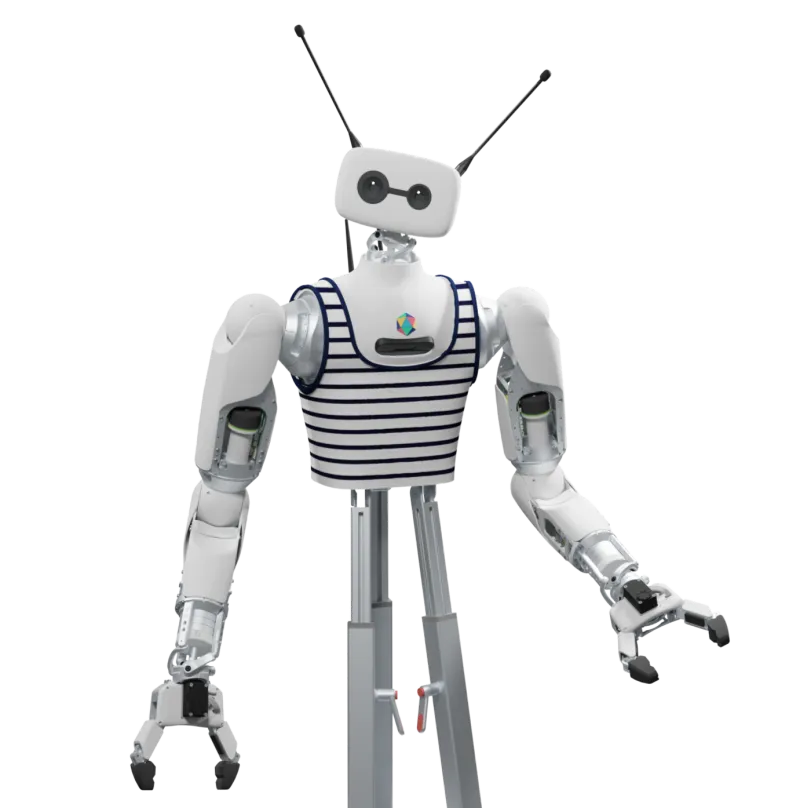
Reachy 2 robot arm showing why DexBench robot hand dexterity benchmarks matter for home humanoids

The short version: DexBench is not a shopping scorecard yet. It is a benchmark language. But if you are comparing home humanoids, assistive robots, or mobile manipulators, it points to the questions that matter more than "how many fingers does it have?"

What is DexBench?

DexBench describes itself as an industry-grade benchmark for robotic dexterity. Its own framing is blunt: manipulation research has focused heavily on grasping, but industry needs much more than grasping. The site currently lists 18 benchmark tasks and 56 evaluation cases, organized around object-state complexity and five dexterity regimes.

The companion RLDX-1 technical report from RLWRLD matters because it explains why the benchmark exists. RLWRLD says frontier vision-language-action models often fail on tasks such as pouring, in-hand rotation, and reactive grasping because the missing information is not just visual. The model needs high-DoF hand-object geometry, temporal dynamics, contact forces, torque, tactile feedback, and memory.

That maps closely to the home. A useful home robot may need to pull a towel from a pile, rotate a bottle to read the label, hand over a plate without squeezing too hard, pick a dropped charger cable, or stop pouring when the mug is full. Those are not one generic "pick up object" skill.
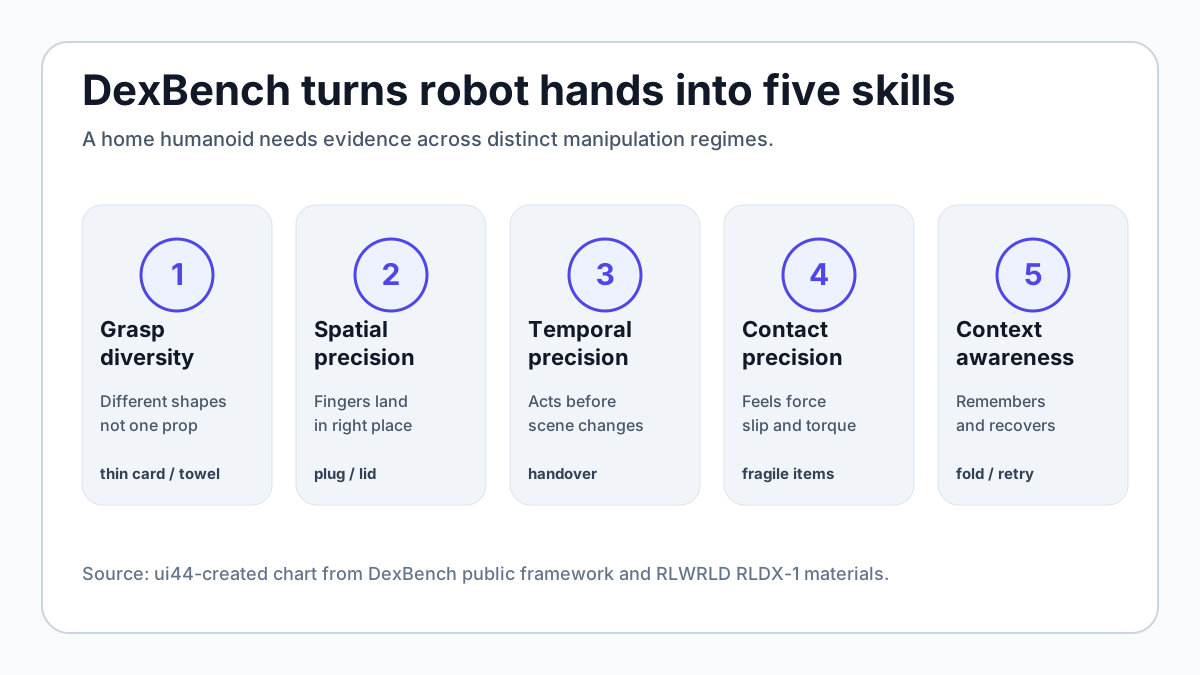
DexBench five robot hand dexterity regimes for home humanoids
Scroll sideways to inspect the full chart.

DexBench's useful buyer insight is that dexterity is not a property of the hand alone. A two-finger gripper with the right sensing and control can be more competent for a narrow task than a five-finger hand driven by a weak policy. A humanoid hand should earn trust by passing hard task regimes, not by looking human in a launch video.

The five skills buyers should ask vendors to prove

DexBench organizes dexterity into five regimes. Translated into home-robot language, they become a practical checklist.

DexBench regime

Grasp diversity

Home-robot question
Can the robot form useful contacts on many object shapes?
Example household task
Pick a thin card, towel edge, bottle, remote, or charger plug

DexBench regime

Spatial precision

Home-robot question
Can it place the fingers or tool accurately before contact?
Example household task
Insert a plug, align a lid, place a mug under a spout

DexBench regime

Temporal precision

Home-robot question
Can it act at the right moment when things move?
Example household task
Catch a slipping towel or hand over an object safely

DexBench regime

Contact precision

Home-robot question
Can it regulate force and detect slip/contact changes?
Example household task
Pour, tighten, push a switch, hold fragile items

DexBench regime

Context awareness

Home-robot question
Can it remember progress and recover?
Example household task
Fold a garment, pack a bag, or retry a failed grasp

This framing is better than a spec-sheet race. A robot with a 20 kg payload can still be bad at threading a small cap. A robot with elegant fingers can still fail if it has no tactile feedback. A mobile base can carry the arm to the counter, but the hand still needs to solve contact.

The RLDX-1 project page makes the same point from the model side. It describes separate components for motion awareness, physical sensing, and memory, rather than assuming that a bigger VLA will magically infer contact forces from video. Its public GitHub page says the open checkpoints include pre-trained and mid-trained models in the 7B to 8B parameter range, and the arXiv abstract reports RLDX-1 outperforming recent VLA baselines on simulation and real-world dexterous-manipulation tasks.

For buyers, the exact benchmark leaderboard is less important than the principle: the vendor should explain which failure modes the robot can handle. If the answer is only "AI," treat that as a warning sign.

How current home-robot hardware maps to DexBench

ui44's database already shows why the benchmark is useful. The most credible home-adjacent robots have very different manipulation stacks.
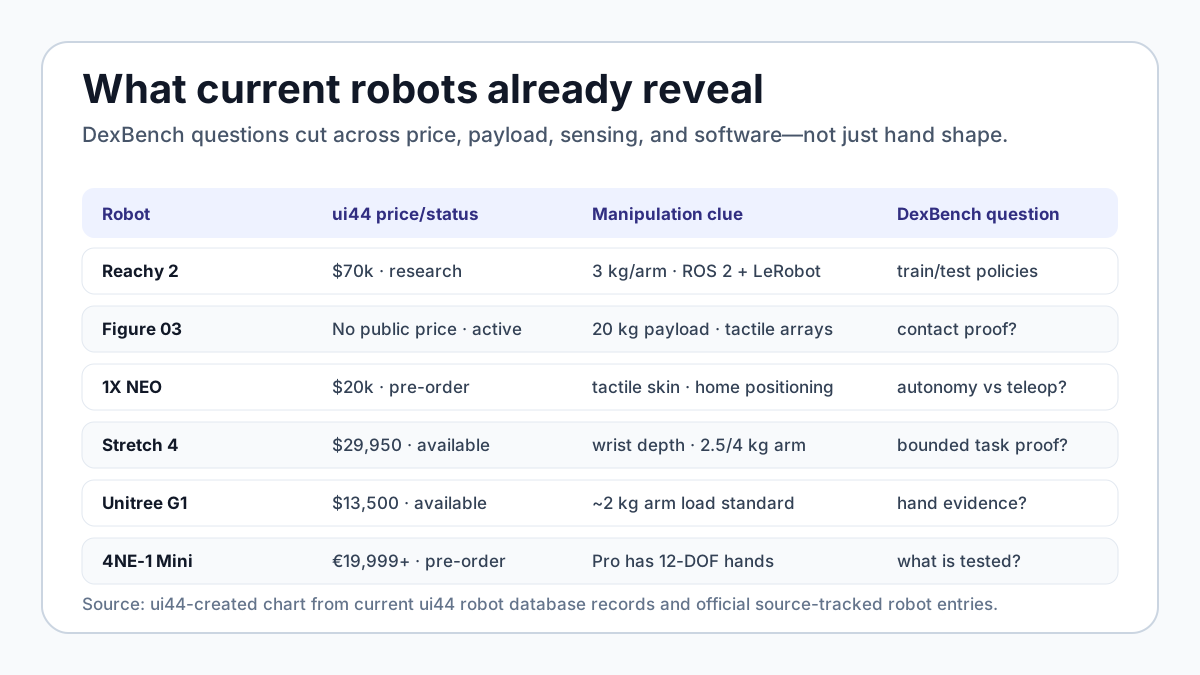
ui44 database comparison of robot hand dexterity specs for DexBench home humanoid questions
Scroll sideways to inspect the full chart.

Reachy 2 is not a consumer home robot, but it is a useful reference point because it is built for research manipulation. ui44 tracks it at $70,000, with 3 kg per arm, ROS 2, a Python SDK, and compatibility with Hugging Face LeRobot. That makes it relevant to developers who want to train and test manipulation policies, not to ordinary buyers looking for a finished chore robot.

Figure 03 is the opposite kind of signal: a full humanoid with no public price yet, about 5 hours of battery life, a 20 kg listed payload, Helix VLA, force sensors, and tactile arrays in the ui44 record. Those sensors are exactly the kind of hardware contact-precision tasks need, but the buyer question is proof: which household tasks have been repeated, measured, and published beyond short videos?

1X NEO is tracked as a $20,000 pre-order humanoid with a 30 kg body, around 4 hours of battery life, depth sensors, tactile skin, and 1X embodied intelligence. NEO is one of the more directly home-positioned humanoids in the database, so DexBench-style questions are especially relevant: can it recover from a failed grasp, or does a remote operator take over when the object moves?

Hello Robot Stretch 4 is a reminder that home manipulation does not require a biped. It costs $29,950, uses a mobile base, has a wrist-mounted depth camera, and ui44 tracks its arm payload at 2.5 kg extended or 4 kg retracted. Its gripper is not anthropomorphic, but for assistive pick-and-place, clear sensing and a bounded workspace can be more important than looking human.

Unitree G1 starts at $13,500 and brings humanoid walking into a lower price band, but ui44 tracks arm payload around 2 kg on the standard model and about 3 kg on G1 EDU. NEURA 4NE-1 Mini starts at €19,999 before taxes/shipping, with a €29,999 Pro tier that adds 12-DOF dexterous hands, SDK, digital twin, and teleoperation. LimX Oli lists a 3 kg single-arm load and contact-sales pricing. These are very different buyer propositions, but DexBench asks the same thing of all of them: which dexterity regimes are proven, and under what conditions?

What DexBench does not prove for a home buyer

DexBench is valuable, but it is not a consumer certification label. Most of its current examples are industrial: insertion, fastening, bimanual regrasping, cutting, cable handling, and other tasks that stress manipulation. Those tasks are relevant because homes also contain deformable, slippery, occluded, and awkward objects. But a benchmark pass in a lab does not prove that a robot can work safely in your kitchen.

Three gaps matter.

First, homes are messier than benchmark scenes. The same spoon may be in a sink, under a napkin, next to a glass, or partly wet. A benchmark can isolate a skill, but a home robot has to decide when not to attempt it.

Second, safety is broader than manipulation success. A hand that can grip firmly also needs force limits around pets, children, glassware, skin, and electronics. Contact precision should include the ability to stop, release, and ask for help.

Third, autonomy and teleoperation often blur together. A robot may have excellent hardware, but if the impressive household demo depends on a remote human supervisor, buyers need to know that. Teleoperation can be a sensible transition strategy, especially for assistive care, but it is not the same as a fully autonomous chore robot.
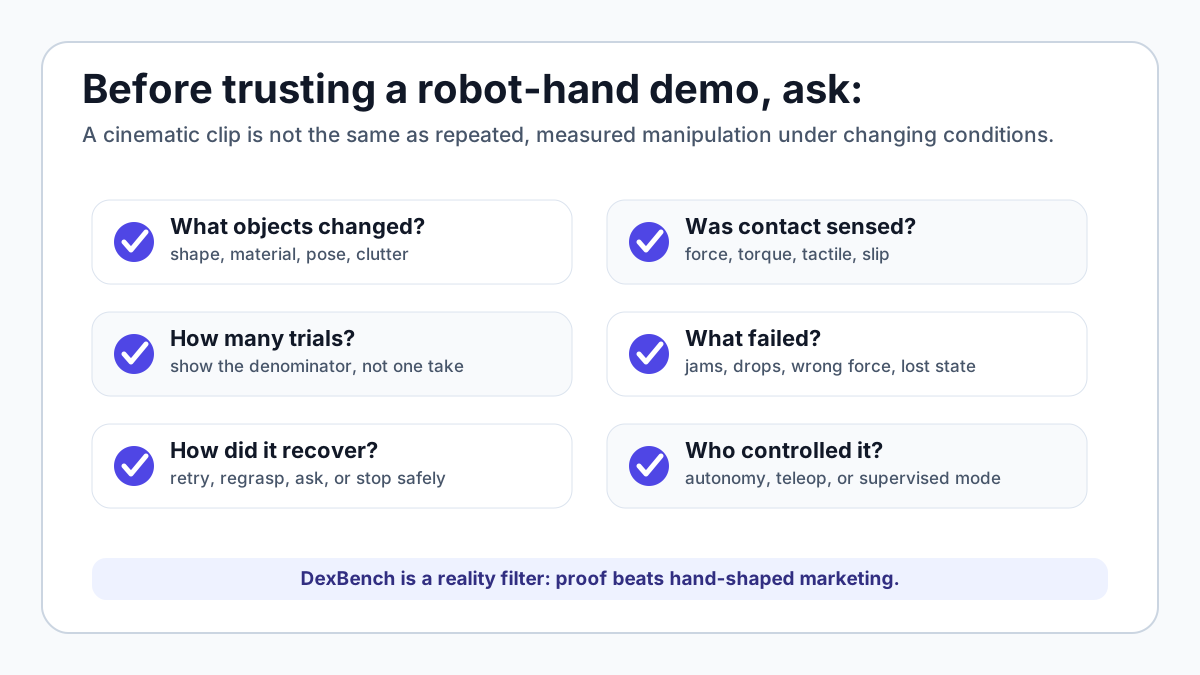
DexBench buyer checklist for evaluating home humanoid robot hands
Scroll sideways to inspect the full chart.

That is why the right question is not "did the robot pass DexBench?" The better question is: which benchmark-like claims are backed by repeated trials, clear success criteria, and disclosed limits?

Questions to ask before believing a robot-hand demo

When a vendor shows a home humanoid manipulating objects, ask for specifics. Good answers do not have to be academic papers, but they should be concrete.

  1. What objects were tested? Thin, soft, reflective, transparent, wet, and deformable objects are much harder than large rigid props.
  2. What changed between trials? A true grasp-diversity claim should vary size, orientation, lighting, clutter, and starting pose.
  3. Was contact sensed or guessed? Force/torque and tactile signals matter for pouring, tightening, handovers, and fragile objects.
  4. How often did it fail? A single take is not a success rate. Ask for the denominator.
  5. What happens after failure? Context awareness means the robot can retry, regrasp, ask for help, or abandon safely.
  6. Was a person controlling it? Teleoperation, autonomy, and supervised autonomy should be labeled separately.

Those questions also help distinguish robot categories. A mobile manipulator like Stretch can be honest and useful with a narrow task envelope. A consumer humanoid needs a broader claim because it is asking for more trust, more money, and more space in the home.

Should home-robot buyers care about DexBench now?

Yes, but as a reality filter, not as a buying requirement.

DexBench gives buyers and developers a vocabulary for the next phase of home robots. The first phase was mobility: can the robot navigate without crashing? The current phase is perception and language: can it understand a scene and a spoken instruction? The harder phase is contact: can it change the world safely with its hands?

That is where the home-robot market will separate. Social robots and camera robots can be useful without dexterous manipulation. But any robot claiming to clean up, cook, fold laundry, care for a person, or load a dishwasher needs to prove hand skills across grasp diversity, spatial precision, timing, force, and recovery.

For now, DexBench is best used as a checklist. When a company says its humanoid has human-like hands, ask which DexBench-style regimes it has actually demonstrated. When a company says its robot has a powerful AI brain, ask whether that brain sees motion, remembers task progress, and senses contact. And when a demo looks too smooth, ask what the robot did after the first failed grasp.

The robots that answer those questions clearly will be more credible than the ones with the most cinematic hands.

Database context

Use this article as a market-reality workflow

Turn the article into a real verification pass

DexBench: Robot Hand Skills Home Humanoids Need already points you toward 7 linked robots, 7 manufacturers, and 5 countries inside the ui44 database. That matters because strong buyer guidance is easier to apply when you can move immediately from a claim or warning into concrete product pages, manufacturer directories, component explainers, and country-level context instead of treating the article as an isolated opinion piece. The fastest next step is to turn the article into a shortlist workflow: open the linked robot pages, verify which specs are actually published for those models, then compare the surrounding manufacturer and component context before you decide whether the underlying claim changes your buying plan.

For this topic, the useful discipline is to separate the editorial lesson from the catalog evidence. The article gives you the framing, but the robot pages tell you what each product actually ships with today: sensor stack, connectivity methods, listed price, release timing, category, and support-relevant compatibility notes. The manufacturer pages then show whether you are looking at a one-off launch, a broader lineup pattern, or a company that spans multiple categories. That layered workflow reduces the risk of buying on a single marketing phrase or a single support FAQ.

Launch claims age fast. The safest move is to pair the article with robot status, price, and manufacturer breadth checks inside ui44 so you can see whether Reachy 2, Figure 03, and NEO are actually ready for a shortlist or still mostly launch-stage signals. If you want a quick working shortlist, open Compare Reachy 2, Figure 03, and NEO next, then keep this article open as the reasoning layer while you compare structured data side by side.

Practical Takeaway

Every robot, manufacturer, category, component, and country reference below resolves to a real ui44 page, keeping the follow-up path grounded in database records rather than generic advice.

Suggested next steps in ui44

  1. Check each linked robot page for listed price, status, and release timing before you treat a launch announcement as a shipping reality.
  2. Open Pollen Robotics to see whether the company’s ui44 footprint already shows a mature product lane or only a small launch cluster.
  3. Use country pages when the article spans several ecosystems, because launch timing and lineup depth often differ by region even when the headline sounds global.
  4. Finish with Compare Reachy 2, Figure 03, and NEO so availability claims sit next to real product data.
  5. Treat every article as a live market snapshot. Re-check status and pricing before you move from interest to purchase intent.

Database context

Robot profiles worth opening next

Use the linked product pages as the evidence layer

The linked robot pages are where this article becomes operational. Instead of asking whether the headline is interesting, use the robot entries to inspect the actual mix of sensors, connectivity options, batteries, pricing, release timing, and stated capabilities attached to the products mentioned in the article. That is the easiest way to see whether the warning or opportunity described here affects one product family, a specific design pattern, or an entire buying lane.

Reachy 2

Pollen Robotics · Research · Active

$70,000

Reachy 2 is tracked on ui44 as a active research robot from Pollen Robotics. The database currently records a listed price of $70,000, a release date of 2024, 8 hours (mobile base, per official hardware docs) battery life, Not disclosed charging time, and a published stack that includes Stereo RGB Cameras (fish-eye), Time-of-Flight Depth Sensor (OAK-FFC ToF 33D), and RGB-D Camera (Orbbec Gemini 336) plus Wi-Fi and Ethernet.

For market and launch stories, this entry grounds the article in real product data. Use the combination of status, release timing, price, and published capabilities like Object manipulation (pick and place), VR teleoperation, and Autonomous navigation to decide whether Reachy 2 belongs on a live shortlist or should stay in the watchlist bucket a little longer.

Figure 03

Figure AI · Humanoid · Active

Price TBA

Figure 03 is tracked on ui44 as a active humanoid robot from Figure AI. The database currently records a listed price of Price TBA, a release date of 2025-10-09, ~5 hours battery life, Not disclosed charging time, and a published stack that includes Stereo Vision, Depth Cameras, and Force Sensors plus Wi-Fi and Bluetooth.

For market and launch stories, this entry grounds the article in real product data. Use the combination of status, release timing, price, and published capabilities like Complex Manipulation, Warehouse Work, and Manufacturing Tasks to decide whether Figure 03 belongs on a live shortlist or should stay in the watchlist bucket a little longer.

NEO

1X Technologies · Humanoid · Pre-order

$20,000

NEO is tracked on ui44 as a pre-order humanoid robot from 1X Technologies. The database currently records a listed price of $20,000, a release date of 2025-10-28, ~4 hours battery life, Not disclosed charging time, and a published stack that includes RGB Cameras, Depth Sensors, and Tactile Skin plus Wi-Fi and Bluetooth.

For market and launch stories, this entry grounds the article in real product data. Use the combination of status, release timing, price, and published capabilities like Household Chores, Tidying Up, and Safe Human Interaction to decide whether NEO belongs on a live shortlist or should stay in the watchlist bucket a little longer.

Stretch 4

Hello Robot · Home Assistants · Available

$29,950

Stretch 4 is tracked on ui44 as a available home assistants robot from Hello Robot. The database currently records a listed price of $29,950, a release date of 2026-05-12, 8 hours (light CPU load) battery life, Not officially disclosed charging time, and a published stack that includes Wide-FOV depth sensing, High-resolution RGB cameras, and Calibrated RGB + depth perception plus its listed connectivity stack.

For market and launch stories, this entry grounds the article in real product data. Use the combination of status, release timing, price, and published capabilities like Mobile Manipulation, Omnidirectional Indoor Mobility, and Autonomous Mapping and Navigation to decide whether Stretch 4 belongs on a live shortlist or should stay in the watchlist bucket a little longer.

G1

Unitree · Humanoid · Available

$13,500

G1 is tracked on ui44 as a available humanoid robot from Unitree. The database currently records a listed price of $13,500, a release date of 2024, ~2 hours battery life, Not disclosed charging time, and a published stack that includes Depth Camera, 3D LiDAR, and 4 Microphone Array plus Wi-Fi 6 and Bluetooth 5.2.

For market and launch stories, this entry grounds the article in real product data. Use the combination of status, release timing, price, and published capabilities like Bipedal Walking, Object Manipulation, and Dexterous Hands (optional Dex3-1) to decide whether G1 belongs on a live shortlist or should stay in the watchlist bucket a little longer.

Database context

Manufacturer context behind the article

Check whether this is one product story or a broader company pattern

Manufacturer pages add the market context that individual product pages cannot show on their own. They help you check whether a launch headline is backed by a deeper tracked lineup, a visible order path, and adjacent products that make the company look committed rather than opportunistic.

Pollen Robotics

ui44 currently tracks 2 robots from Pollen Robotics across 2 categorys. The company is grouped under France, and the current catalog footprint on ui44 includes Reachy 2, Reachy Mini.

That wider brand context matters because launch headlines can obscure how deep or shallow a company’s actual product footprint is. The manufacturer route helps you tell the difference between a growing ecosystem and a single high-visibility announcement. The category mix here currently points toward Research, Companions as the most useful next route if you want to see whether this article reflects a wider pattern inside the brand.

Figure AI

ui44 currently tracks 2 robots from Figure AI across 1 category. The company is grouped under USA, and the current catalog footprint on ui44 includes Figure 03, Figure 02.

That wider brand context matters because launch headlines can obscure how deep or shallow a company’s actual product footprint is. The manufacturer route helps you tell the difference between a growing ecosystem and a single high-visibility announcement. The category mix here currently points toward Humanoid as the most useful next route if you want to see whether this article reflects a wider pattern inside the brand.

1X Technologies

ui44 currently tracks 2 robots from 1X Technologies across 1 category. The company is grouped under Norway, and the current catalog footprint on ui44 includes NEO, EVE.

That wider brand context matters because launch headlines can obscure how deep or shallow a company’s actual product footprint is. The manufacturer route helps you tell the difference between a growing ecosystem and a single high-visibility announcement. The category mix here currently points toward Humanoid as the most useful next route if you want to see whether this article reflects a wider pattern inside the brand.

Hello Robot

ui44 currently tracks 2 robots from Hello Robot across 1 category. The company is grouped under USA, and the current catalog footprint on ui44 includes Stretch 3, Stretch 4.

That wider brand context matters because launch headlines can obscure how deep or shallow a company’s actual product footprint is. The manufacturer route helps you tell the difference between a growing ecosystem and a single high-visibility announcement. The category mix here currently points toward Home Assistants as the most useful next route if you want to see whether this article reflects a wider pattern inside the brand.

Database context

Broaden the scan without leaving the database

Categories, components, and countries add the wider context

Category framing

Category pages are useful when the article touches a buying pattern that shows up across brands. A category route helps you confirm whether the linked products sit in a narrow niche or whether the same question should be tested across a larger field of alternatives.

Research

The Research category page currently groups 36 tracked robots from 28 manufacturers. ui44 describes this lane as: Academic and research robotics platforms pushing the boundaries of what machines can learn and do.

That makes the category route a practical follow-up when you want to check whether the products linked in this article are typical for the lane or whether they sit at one edge of the market. Useful starting examples currently include HRP-4C, HRP-5P, NAO6.

Humanoid

The Humanoid category page currently groups 99 tracked robots from 70 manufacturers. ui44 describes this lane as: Full-size bipedal humanoid robots designed to work alongside humans. From factory floors to household tasks, these machines represent the cutting edge of robotics.

That makes the category route a practical follow-up when you want to check whether the products linked in this article are typical for the lane or whether they sit at one edge of the market. Useful starting examples currently include NEO, EVE, Mornine M1.

Country and ecosystem context

Country pages give extra context when support practices, launch sequencing, regulatory posture, or manufacturer mix matter. They are not a substitute for model-level verification, but they do help you see which ecosystems cluster together and which manufacturers sit in the same regional field when you broaden the search beyond the article headline.

France

The France route currently groups 5 tracked robots from 4 manufacturers in ui44. That gives you a useful regional lens when the article points toward support practices, launch sequencing, or brand clusters that may share similar ecosystem assumptions.

On the current route, manufacturers like Pollen Robotics, Aldebaran / Maxtronics, Aldebaran Robotics make the page a good way to broaden the scan without losing the regional context that often shapes availability, documentation style, and adjacent alternatives.

USA

The USA route currently groups 70 tracked robots from 55 manufacturers in ui44. That gives you a useful regional lens when the article points toward support practices, launch sequencing, or brand clusters that may share similar ecosystem assumptions.

On the current route, manufacturers like iRobot, Boston Dynamics, Faraday Future make the page a good way to broaden the scan without losing the regional context that often shapes availability, documentation style, and adjacent alternatives.

Norway

The Norway route currently groups 2 tracked robots from 1 manufacturers in ui44. That gives you a useful regional lens when the article points toward support practices, launch sequencing, or brand clusters that may share similar ecosystem assumptions.

On the current route, manufacturers like 1X Technologies make the page a good way to broaden the scan without losing the regional context that often shapes availability, documentation style, and adjacent alternatives.

Database context

Questions to answer before you move from reading to buying

A follow-up FAQ built from the entities already linked in this article

Frequently Asked Questions

Which page should I open first after reading “DexBench: Robot Hand Skills Home Humanoids Need”?

Start with Reachy 2. That gives you a concrete product anchor for the article’s main claim. From there, branch into the manufacturer and component pages so you can tell whether the article is describing one specific model, a repeated brand pattern, or a wider technology issue that affects multiple shortlist options.

How do the manufacturer pages change the buying decision?

Pollen Robotics help you zoom out from one article and one product. On ui44 they show lineup breadth, category spread, and the neighboring robots tied to the same company. That context is useful when you are deciding whether a risk belongs to a single model, whether it shows up across a brand’s portfolio, and whether you should keep looking at alternatives before committing.

When should I switch from reading to side-by-side comparison?

Move into Compare Reachy 2, Figure 03, and NEO as soon as you understand the article’s main warning or promise. The article explains what to watch for, but the compare view is where you can check whether price, status, battery life, connectivity, sensors, and category fit still make the robot a good match for your own home and budget.

Database context

Where to go next in ui44

Keep the research chain inside the database

If you want to keep going, these follow-on pages give you the cleanest expansion path from article to research session. Open the comparison route first if you are deciding between products today. Open the manufacturer, category, and component routes if you still need to understand the broader pattern behind the claim.

UT

Written by

ui44 Team

Published May 31, 2026

Share this article

Open a plain share link on X or Bluesky. No embeds, no widgets, no cookie baggage.

Explore the database

Go beyond the headlines

Compare specs, features, and prices across 100+ robots from leading manufacturers worldwide.