That is finally starting to change, but not in the way a lot of CES headlines make it sound.
In 2026, ui44's database shows two very different categories emerging. One is the true stair-climbing concept, represented by Roborock Saros Rover, a development-stage machine designed to actually go step by step up a staircase while cleaning. The other is the much more practical category you can buy right now: premium robots like Dreame X60 Max Ultra Complete, Dreame X50 Ultra, and Roborock Saros 20, which use lift systems or retractable legs to cross tall thresholds and room dividers, not full stair flights.
That distinction matters, because threshold crossing solves a real household problem today. Full staircase autonomy is still mostly a preview of where the category is headed.
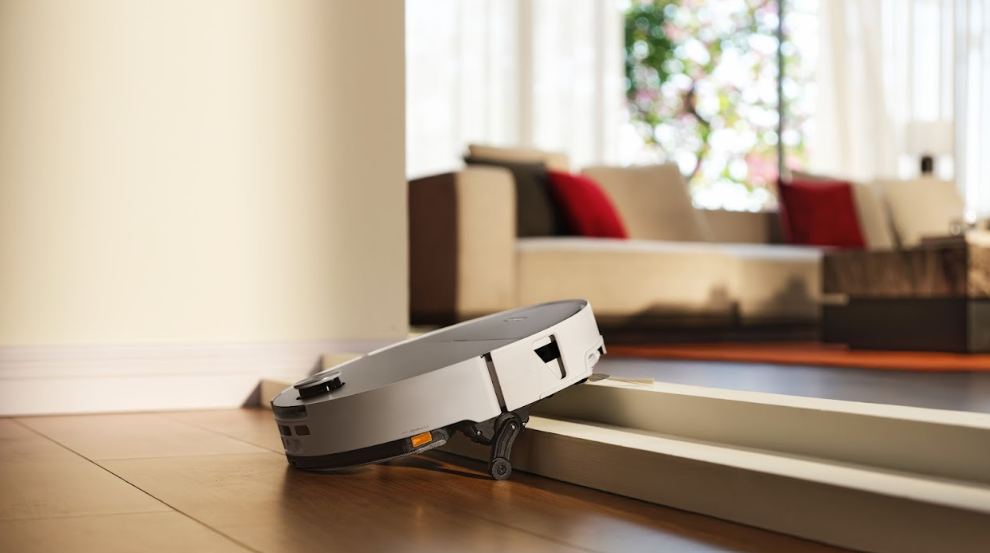
The short answer: not really, but for the first time the answer is no longer a hard no
If your question is, "Can I buy one robot vacuum today that will autonomously travel between floors and clean my staircase without help?" the honest answer is still no.
If your question is, "Can I now buy robot vacuums that handle much bigger door thresholds, split-level transitions, and awkward room dividers than older models?" the answer is yes.
That is the state of the market in April 2026.
This is also why generic advice on "multi-floor robot vacuums" is often misleading. Many products advertise multi-level mapping, but that only means the app can store separate maps for different floors. It does not mean the robot can move itself from one level to another. In practice, most multi-floor owners still do one of three things:
- Carry one robot between floors.
- Buy a second robot for the other floor.
- Accept that stairs themselves stay a manual cleaning job.
The reason this has been so hard is simple. A robot vacuum does not just need to climb up safely. It also has to climb down safely, avoid falling, keep its body stable, avoid tangling on stair noses or carpet edges, and then still dock, empty debris, refill water, and manage mops reliably. The mobility problem is only half the challenge.
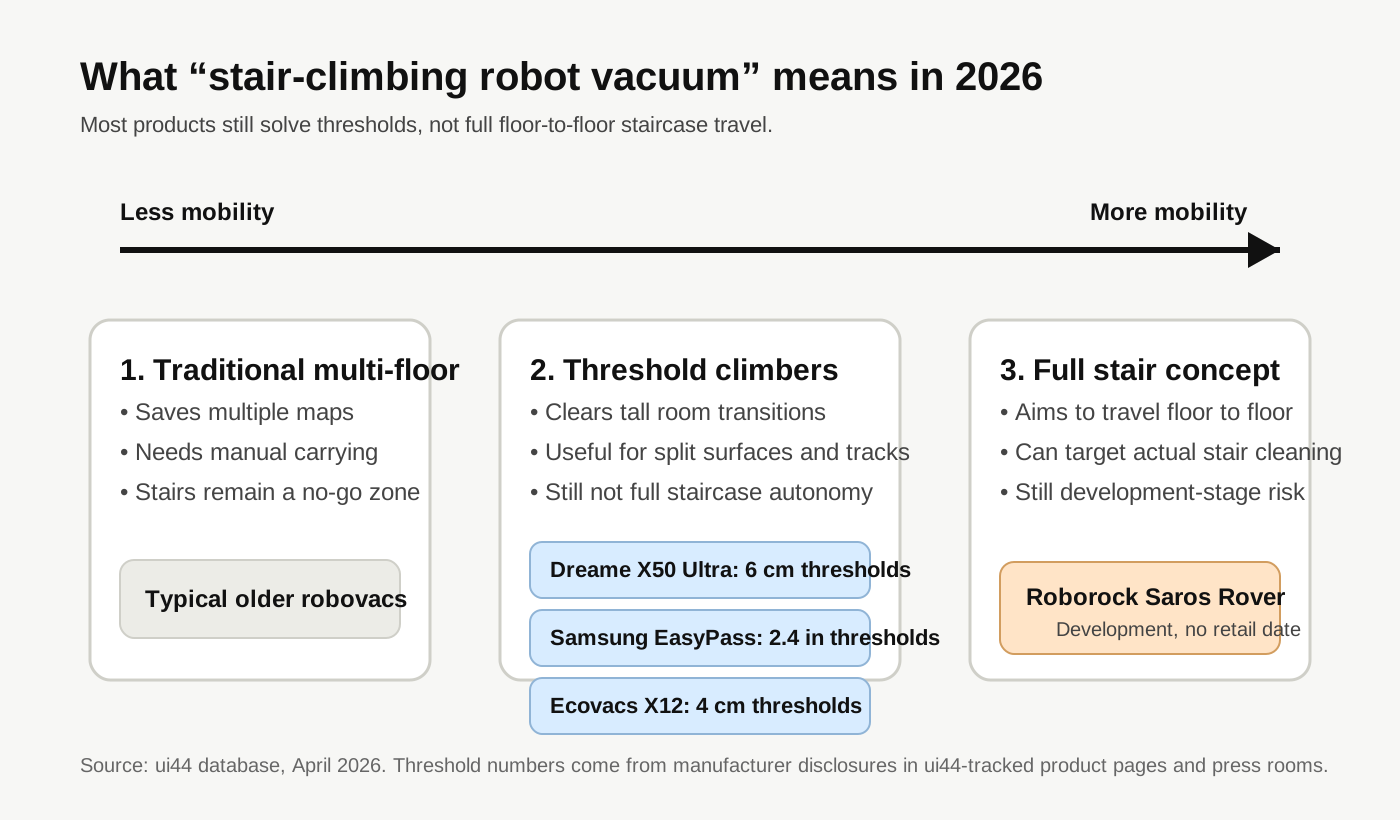
What counts as "stair climbing" in 2026?
For buyers, it helps to separate these machines into three buckets.
1. Traditional multi-floor robots
These save multiple maps and can clean different floors, but only after you move them manually. That is still the normal state of the category.
2. Threshold climbers
These robots use wheel-lift systems, climbing arms, or retractable legs to get over tall thresholds, raised transitions, sliding-door tracks, and uneven room dividers. This is where the meaningful 2026 progress is happening.
In ui44's database, that includes:
- Dreame X50 Ultra, with ProLeap retractable legs for thresholds up to 6 cm
- Dreame X60 Max Ultra Complete, with up to 8.8 cm double-layer threshold crossing
- Roborock Saros 20, also rated for about 8.8 cm double-layer threshold crossing
- Samsung Bespoke AI Jet Bot Steam Ultra, with EasyPass wheels for thresholds up to 2.4 inches
- Ecovacs Deebot X12 OmniCyclone, with TruePass adaptive 4WD for thresholds up to 4 cm
These are impressive, but they are not stair cleaners in the normal sense of the word.
3. True stair-climbing robots
This is the category people actually imagine: a robot that can approach a staircase, lift itself onto the first step, keep going, then transition onto the next floor. In ui44's current database, the clearest example is Roborock Saros Rover.
That matters because it means the category has finally moved from science-fiction wish list to at least one named, public product in development. It just has not yet moved into everyday retail reality.
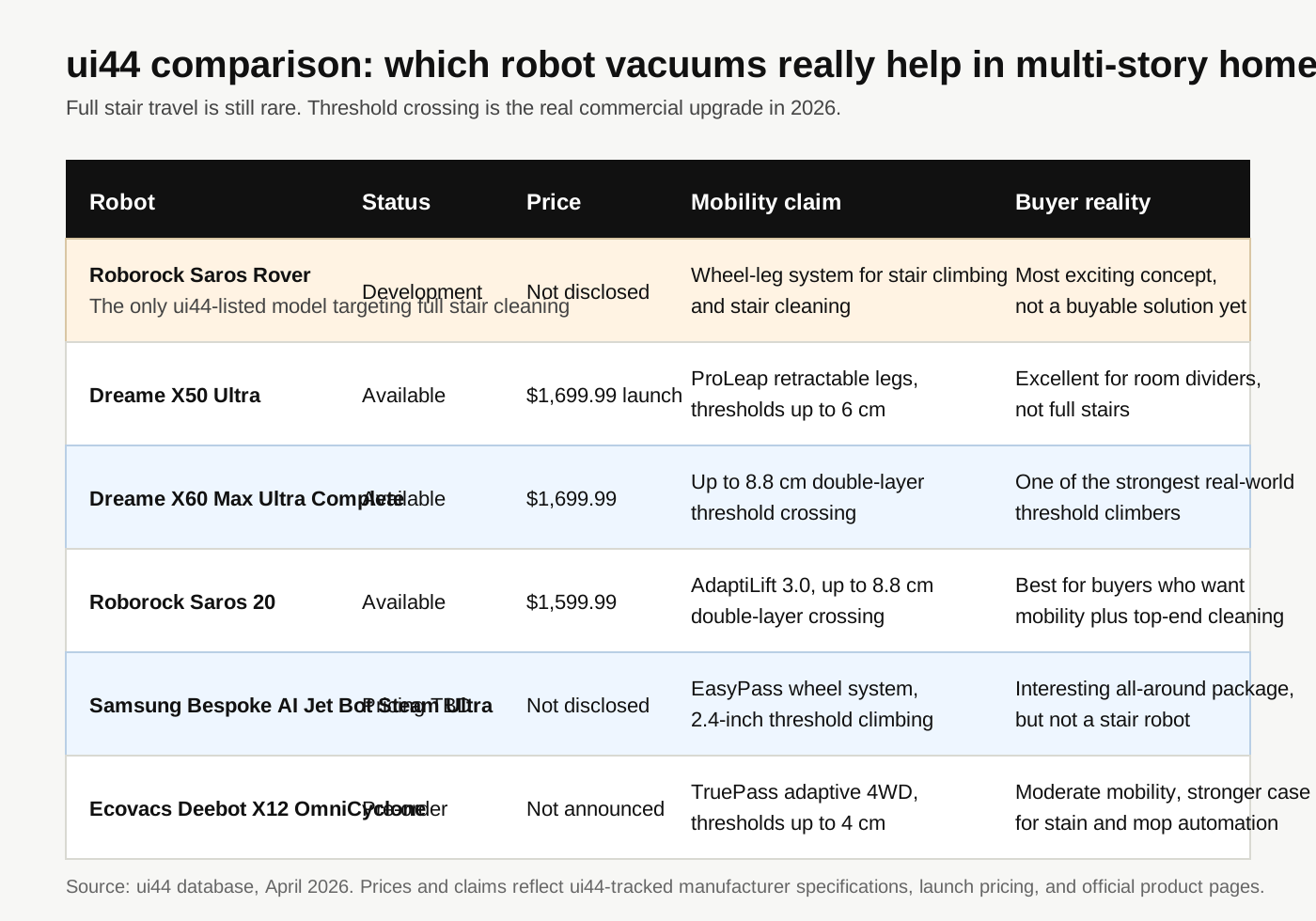
The ui44 comparison: what each model really solves
Here is the buyer-friendly way to look at the current field.
Robot
Roborock Saros Rover
- Status in ui44 DB
- Development
- Price in ui44 DB
- Not disclosed
- Mobility claim
- Stair climbing and stair cleaning
- What it realistically solves
- Full staircase concept, if it reaches market
Robot
Dreame X50 Ultra
- Status in ui44 DB
- Available
- Price in ui44 DB
- $1,699.99 launch MSRP
- Mobility claim
- ProLeap legs, 6 cm thresholds
- What it realistically solves
- Raised room dividers, thick thresholds, split surfaces
Robot
Dreame X60 Max Ultra Complete
- Status in ui44 DB
- Available
- Price in ui44 DB
- $1,699.99
- Mobility claim
- Up to 8.8 cm double-layer crossing
- What it realistically solves
- Bigger transitions than X50, still not full stairs
Robot
Roborock Saros 20
- Status in ui44 DB
- Available
- Price in ui44 DB
- $1,599.99
- Mobility claim
- Up to 8.8 cm double-layer crossing
- What it realistically solves
- Tall thresholds plus flagship cleaning performance
Robot
Samsung Bespoke AI Jet Bot Steam Ultra
- Status in ui44 DB
- Development / pricing TBD
- Price in ui44 DB
- Not disclosed
- Mobility claim
- EasyPass wheel, 2.4-inch threshold climbing
- What it realistically solves
- Higher door sills and transitions, not floor-to-floor travel
Robot
Ecovacs Deebot X12 OmniCyclone
- Status in ui44 DB
- Pre-order
- Price in ui44 DB
- Not announced
- Mobility claim
- 4 cm adaptive 4WD threshold crossing
- What it realistically solves
- Premium edge and stain cleaning with moderate climbing ability
| Robot | Status in ui44 DB | Price in ui44 DB | Mobility claim | What it realistically solves |
|---|---|---|---|---|
| Roborock Saros Rover | Development | Not disclosed | Stair climbing and stair cleaning | Full staircase concept, if it reaches market |
| Dreame X50 Ultra | Available | $1,699.99 launch MSRP | ProLeap legs, 6 cm thresholds | Raised room dividers, thick thresholds, split surfaces |
| Dreame X60 Max Ultra Complete | Available | $1,699.99 | Up to 8.8 cm double-layer crossing | Bigger transitions than X50, still not full stairs |
| Roborock Saros 20 | Available | $1,599.99 | Up to 8.8 cm double-layer crossing | Tall thresholds plus flagship cleaning performance |
| Samsung Bespoke AI Jet Bot Steam Ultra | Development / pricing TBD | Not disclosed | EasyPass wheel, 2.4-inch threshold climbing | Higher door sills and transitions, not floor-to-floor travel |
| Ecovacs Deebot X12 OmniCyclone | Pre-order | Not announced | 4 cm adaptive 4WD threshold crossing | Premium edge and stain cleaning with moderate climbing ability |
The pattern is clear. Almost every shipping or near-shipping machine is solving threshold mobility, not staircase autonomy.
That is still useful. For some homes, threshold crossing is the real blocker. If your robot keeps getting trapped by room transitions, a model that can clear 4 to 8.8 cm obstacles may change your daily experience more than another 5,000 Pa of suction ever would.
Roborock Saros Rover is the real staircase story, but it is still a concept-stage buying risk
According to Roborock's official CES 2026 announcement, the Saros Rover uses a two-wheel-leg architecture with independently controlled wheel-legs that can raise and lower to keep the robot level on changing terrain. Roborock explicitly says it is designed for multi-story homes and that it can clean stairs as it moves across them.
That is the breakthrough claim.
It is also why the Saros Rover deserves attention even without a price. It is not just another better threshold jumper. It is a direct attempt to remove one of the last giant no-go zones in domestic floor robotics.
But buyers should stay disciplined here.
ui44's database lists the Saros Rover as development with no disclosed retail price, no launch date, and no final consumer spec sheet. That makes it important industry evidence, not a product recommendation.
Independent CES coverage broadly supports that cautious framing. Vacuum Wars described demo footage showing the Rover stabilizing itself, changing direction quickly, and climbing stairs, but also treated it as an early look at a product with many unanswered questions. Popular Mechanics made the same core point more bluntly: the concept is exciting, but nobody should assume they can buy one soon.
That caution is healthy. A robot that climbs stairs has more moving parts, more wear points, more safety demands, and more ways to fail than a robot that only crosses flat thresholds. The engineering challenge is not just getting the robot up the stairs once for a demo. It is getting it to do that hundreds of times in real homes with different stair widths, materials, carpet edges, toys, pets, and lighting conditions.
So yes, the Saros Rover is the most interesting robot vacuum mobility announcement of 2026 so far. No, it is not yet proof that the carrying-your-vacuum-upstairs era is over.
The products you can actually buy are smarter threshold climbers
The better buyer question for 2026 is not, "Which robot climbs stairs?" It is, "Which robot gets stuck less often in a real house with messy transitions?"
That is where the current generation is more credible.

Dreame X50 Ultra: the first major step toward robotic legs in a shipping product
The Dreame X50 Ultra was one of the first serious signals that mobility was becoming a design battleground. ui44 lists it at an original launch MSRP of $1,699.99, with the standout feature being its ProLeap retractable legs that let it climb thresholds up to 6 cm.
That does not sound revolutionary until you compare it with older robot vacuums that got defeated by ordinary bathroom lips or chunky sliding-door tracks.
The X50 Ultra matters because it showed manufacturers that buyers would pay for mobility hardware, not just more suction or more AI buzzwords. Its 20,000 Pa suction, retractable VersaLift LiDAR, and hot-water dock made it a flagship anyway, but the real story was that little set of robotic legs.
Dreame X60 Max Ultra Complete: threshold mobility gets more serious
The Dreame X60 Max Ultra Complete pushes the same idea further. ui44 tracks it at $1,699.99 with 35,000 Pa suction and up to 8.8 cm double-layer threshold crossing, plus a 79.5 mm ultra-slim body when the sensor is retracted.
That 8.8 cm figure is big enough to matter in homes with unusually aggressive transitions or stacked threshold geometry. It still does not mean stair flight autonomy, but it does mean the robot can operate across more of the floor plan without help.
The X60 is a good example of what this whole category is really turning into: not humanoid-style walking, but smarter, mechanically adaptive wheel systems that stretch the definition of what a round floor robot can traverse.
Roborock Saros 20: flagship cleaning plus aggressive obstacle crossing
The Roborock Saros 20 is another strong case study because it connects the experimental and commercial sides of the market. ui44 lists it at $1,599.99 MSRP, with 36,000 Pa suction, 300+ object recognition, and AdaptiLift Chassis 3.0 that can cross double-layer thresholds up to about 8.8 cm.
Roborock's own positioning is revealing here. The company describes the Saros 20 as the first consumer product to ship the AI architecture introduced with the Saros Rover. In other words, the stair robot concept is already influencing the premium products people can actually buy.
That makes the Saros 20 one of the clearest answers for buyers who do not need staircase travel, but do need a robot that can stop getting trapped by complicated thresholds.
Samsung Bespoke AI Jet Bot Steam Ultra: smaller mobility number, interesting packaging
Samsung's Bespoke AI Jet Bot Steam Ultra takes a slightly different angle. ui44 does not yet list a price, but it does track the EasyPass Wheel system, which Samsung says can climb thresholds up to 2.4 inches, roughly 6.1 cm.
That is not as aggressive as the top Dreame and Roborock claims on double-layer crossings, but it is still materially better than what many older premium bots handled. Samsung combines that with 100°C steam cleaning, AI object recognition, AI liquid recognition, SmartThings integration, and Knox security.
For some buyers, that package may matter more than chasing the absolute biggest crossing number.
Ecovacs Deebot X12 OmniCyclone: less dramatic mobility, stronger whole-system autonomy
The Ecovacs Deebot X12 OmniCyclone is another reminder that mobility is only one part of the value equation. ui44 lists it as pre-order with price still unannounced, but the robot combines 22,000 Pa suction, FocusJet stain pre-dissolving, a self-washing roller mop, AGENT YIKO 2.0 weekly planning, and TruePass adaptive 4WD threshold crossing up to 4 cm.
That 4 cm mobility claim is lower than the most aggressive rivals here, so it is not the best choice if tall transitions are your main pain point. But if your home has moderate thresholds and you care more about stain handling, bagless emptying, or automated planning, it may still be the more balanced machine.
What should multi-story buyers actually do in 2026?
The buying advice is much simpler than the marketing.
If you need actual stair cleaning, wait
If the stairs themselves are your core problem, there is still no retail-safe, fully proven answer in ui44's database. Watch Roborock Saros Rover, but do not plan your purchase around a development-stage product.
If your real issue is thresholds, buy accordingly
If your robot gets stranded between rooms, look hard at the threshold numbers and mobility systems rather than just suction. On ui44 today, the most aggressive threshold-crossing claims in this group come from Dreame X60 Max Ultra Complete and Roborock Saros 20, both at up to about 8.8 cm in double-layer scenarios.
If you want the least friction right now, one robot per floor still wins
It is not glamorous, but for many larger homes the most reliable setup is still one docked robot per floor. That avoids carrying, avoids re-docking weirdness, avoids map confusion, and usually gives faster routine cleaning. If budget allows, compare candidates on ui44 Compare rather than forcing one robot to do a job the category still handles poorly.
Be careful with "multi-floor" wording
This is the big one. Multi-floor mapping, multi-level mapping, and multi-story support are not the same thing as autonomous floor transfer. If a brand is vague, assume manual carrying is still part of the workflow unless the company explicitly shows staircase traversal.

When will robot vacuums really stop needing to be carried upstairs?
My honest read is that 2026 is the year stair-climbing moved from fantasy to public prototype, not the year it became normal consumer reality.
The likely path from here looks familiar. First, high-end concept demos prove the category is technically possible. Then premium shipping models absorb a few of those ideas in safer, narrower ways. Only after that do you get a more dependable mainstream product.
That is exactly what is happening now. Saros Rover represents the bold concept. Saros 20, X50 Ultra, X60 Max Ultra Complete, Samsung's EasyPass design, and Ecovacs' adaptive 4WD represent the commercialized halfway step.
So if you are looking for a realistic planning horizon, think in stages:
- 2026: true stair climbing is a public demo and development story
- 2026 buyer reality: threshold-climbing is the real usable upgrade
- 2027 and beyond: maybe the first premium stair robots become credible, if reliability and docking logistics hold up
The docking logistics part is easy to overlook. A vacuum that climbs stairs is impressive. A vacuum-and-mop that can also handle water tanks, dirty water, self-emptying, and full-floor autonomy across multiple levels is much harder. That is why this will probably arrive as a premium niche first, not an overnight standard feature.
Frequently Asked Questions
Is multi-floor mapping the same thing as stair climbing?
No. Multi-floor mapping only means the robot can save more than one floor plan
in the app. It does not mean the robot can physically move between those floors.
That distinction still trips up buyers because marketing pages often put the two
ideas close together. If you are comparing models, treat map storage as a
software feature and threshold or stair movement as a hardware feature. They are
not interchangeable.
If you want a deeper look at that software side, ui44 already has a dedicated
guide on
robot vacuum multi-floor map limits.
It helps answer a different question: how many floor plans the robot remembers,
how those maps get restored, and when remapping becomes annoying.
Can any robot vacuum clean the steps themselves today?
Not as a normal retail recommendation. In ui44's current database, the closest
public example is Roborock Saros Rover, but it is still tracked as a
development-stage product with no consumer launch details, no published retail
price, and no long-term reliability record in real homes.
That matters because stair cleaning is harsher than floor cleaning. Every step
creates repeated edge changes, traction changes, and balance changes. A demo can
prove that a robot got up a staircase. It does not prove that the same robot can
do it every day in homes with socks, pet hair, narrow landings, dark carpeting,
or irregular stair noses.
Should you buy one premium robot or one robot per floor?
For most households in 2026, one robot per floor is still the lower-friction
solution if your budget can support it. It sounds less futuristic, but it avoids
manual carrying, reduces re-docking friction, and usually gives more consistent
cleaning coverage. It also lets you choose different robots for different jobs,
for example one stronger mop combo downstairs and a simpler vacuum-only robot
upstairs.
If you only want one machine, focus less on the phrase "multi-floor" and more on
the obstacle geometry in your actual home. Measure doorway lips, sliding-door
tracks, bathroom thresholds, and any raised transitions before you shop. ui44's
robot vacuum threshold claims guide
and
robot vacuum dock placement guide
are both more useful for that decision than generic "best for two-story homes"
roundups.
Which spec matters more for split-level homes: suction or climbing ability?
If your current robot already cleans well enough once it reaches the right room,
mobility is usually the more important upgrade. Extra suction does not help much
if the robot never crosses the divider that blocks half the floor plan. For
buyers in homes with rugs, door tracks, or uneven transitions, threshold height,
wheel design, retractable chassis systems, and dock location often matter more
than another big jump in Pa numbers.
That is also why 2026 feels like a real turning point. The biggest practical
gains are no longer just about stronger cleaning motors. They are about robots
reaching more of the home without rescue.
Bottom line
Robot vacuums are finally learning to deal with vertical obstacles, but 2026 buyers should stay precise about what that means.
If you want a robot that handles tall thresholds and awkward transitions much better than older models, this is a genuinely good year to shop. The data in ui44's database shows real progress, especially from Roborock and Dreame.
If you want a robot that independently climbs your staircase, cleans each step, and moves floor to floor like a small domestic rover, that future has started to appear, but it has not arrived in stores yet.
That is still exciting. It is just not the same thing as done.
Written by
ui44 Team
Published April 17, 2026
Share this article
Open a plain share link on X or Bluesky. No embeds, no widgets, no cookie baggage.