The buyer mistake is to watch a robot throw punches and conclude that a home helper is almost ready. A fight can prove that a humanoid body survives contact, that a pilot interface is responsive, that balance controllers are improving, and that audiences care. It does not prove that the same robot can notice a spilled drink, choose the right towel, avoid the dog bowl, and finish the job without a person guiding it.
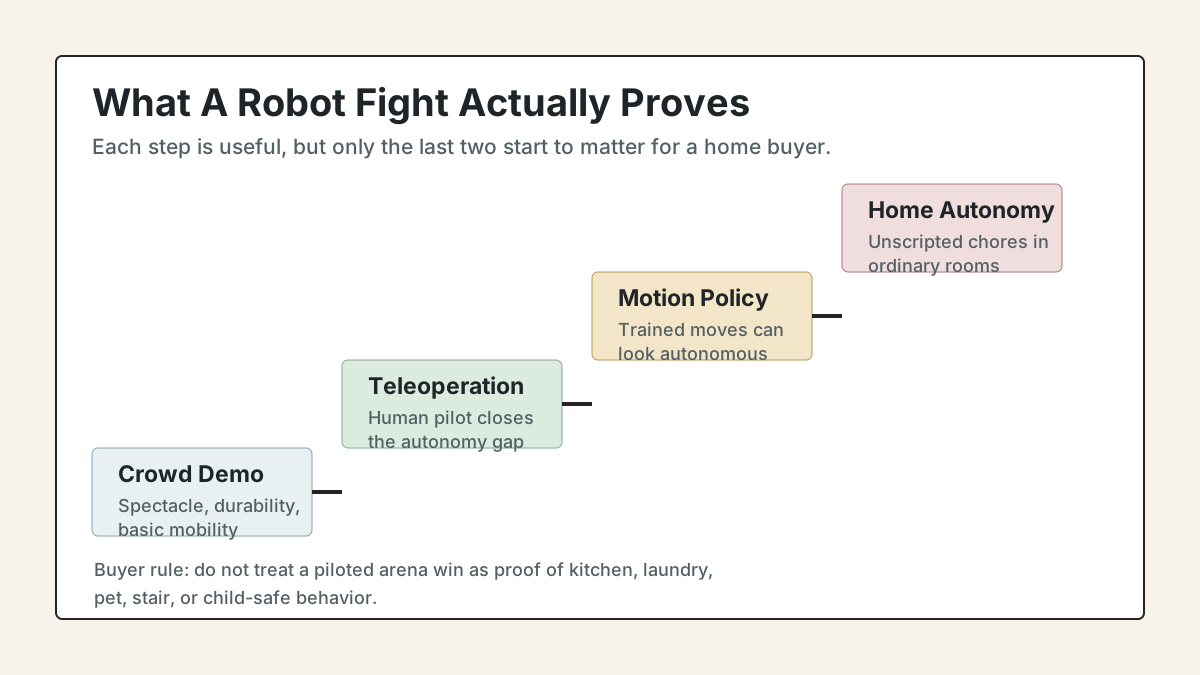
That distinction matters because the public demo calendar is filling up. Rest of World reported on VR-controlled humanoid boxing events in San Francisco using modified Unitree G1 robots, while Ultimate Bots presents itself as a humanoid sports league where teams train, engineer, and pilot real robots. The arena is a legitimate robotics proving ground. It is just not the same thing as a kitchen.
What Does Robot Boxing Actually Test?
A humanoid fight tests several real engineering problems. The robot needs to walk under disturbance, absorb impacts, avoid overheating, keep communications stable, and recover from awkward poses. Those are not fake challenges. A robot that cannot survive a gentle push in a padded arena should not be trusted near a coffee table.
But the environment is also simplified. The floor is known. The task is narrow. The opponent is another robot. The target is obvious. The crowd does not care if the robot drops a sock, misidentifies a glass, blocks a doorway, or needs three minutes to decide whether the chair is movable. Home autonomy is harder because the goals are less theatrical and the error budget is smaller.
A useful way to read these events is to split the evidence into layers:
Evidence from a fight
Balance under bumps
- What it can support
- Locomotion robustness is improving
- What it cannot support
- Safe navigation in cluttered homes
Evidence from a fight
Punch timing
- What it can support
- Low-latency control and repeatable motions
- What it cannot support
- General-purpose manipulation
Evidence from a fight
Falls and recovery
- What it can support
- Mechanical resilience and recovery policy quality
- What it cannot support
- Safe operation around people and pets
Evidence from a fight
Team strategy
- What it can support
- Human interface and training workflow
- What it cannot support
- Independent household decision-making
Evidence from a fight
Audience response
- What it can support
- Market attention and entertainment value
- What it cannot support
- Product readiness for chores
| Evidence from a fight | What it can support | What it cannot support |
|---|---|---|
| Balance under bumps | Locomotion robustness is improving | Safe navigation in cluttered homes |
| Punch timing | Low-latency control and repeatable motions | General-purpose manipulation |
| Falls and recovery | Mechanical resilience and recovery policy quality | Safe operation around people and pets |
| Team strategy | Human interface and training workflow | Independent household decision-making |
| Audience response | Market attention and entertainment value | Product readiness for chores |
That last column is where the hype usually gets loose. A knockout clip is a short demonstration of a body and a control stack. A home robot purchase is a bet on reliability over thousands of boring, unscripted moments.
Teleoperation Is Not A Dirty Word
Teleoperation often gets treated as an admission of failure. That is too harsh. For early humanoids, remote control and human fallback are practical tools. They let teams collect data, keep events safe, and show what the hardware can do before full autonomy is ready.
The problem starts when teleoperation is hidden or blurred. If a person is driving the body, the demo is evidence about the robot's mechanics, latency, and interface. If a trained motion policy is running a prelearned punch, the demo is evidence about motion generation. If the robot is choosing actions from its own perception in a changing environment, that is a much stronger autonomy claim. Those three demos can look similar on video, but they mean different things.
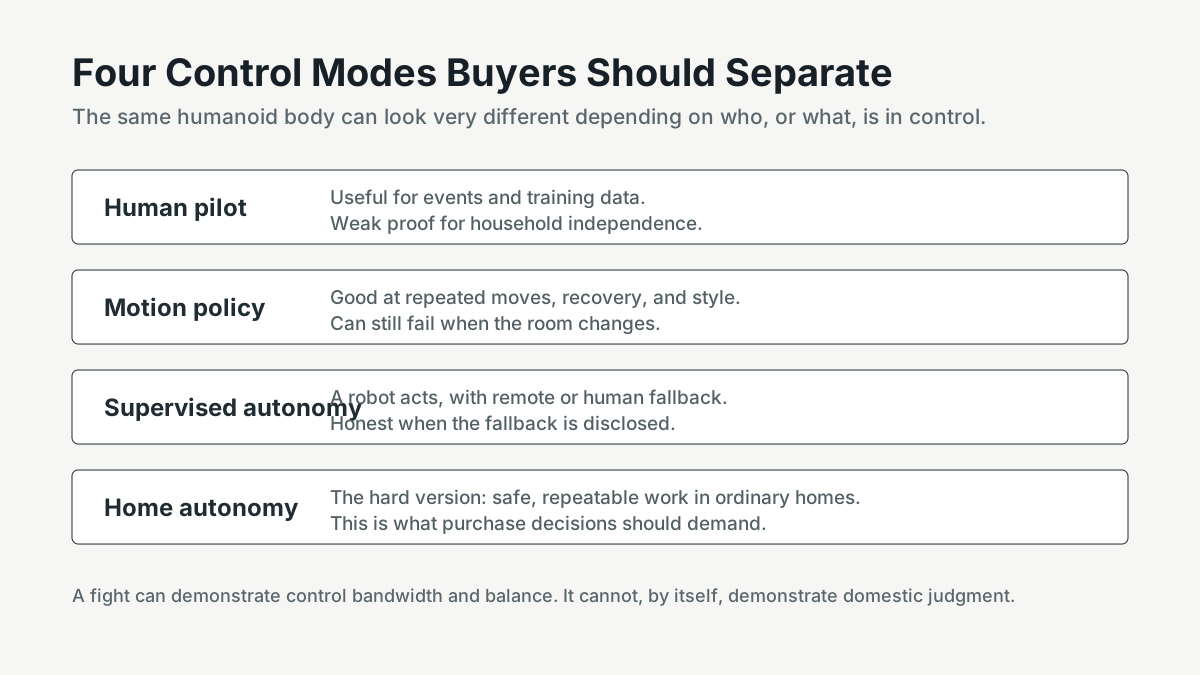
Ultimate Bots is refreshingly explicit about this split. Its public site says teams include pilots who drive the body and "ghosts" who build the mind. That is an interesting format because it puts the human-machine boundary in the open. For home robot buyers, that openness is exactly what to demand from every demo: who is controlling the robot, what part is learned, and when a human steps in.
This is also why supervised autonomy should not be dismissed. A home-facing robot that clearly says "I can do some tasks autonomously and ask for human help on the hard parts" is more trustworthy than a research robot pretending every edited clip is fully independent. The line matters more than the label.
The Unitree G1 Is Real Hardware, Not A Home Butler
The Unitree G1 is central to this conversation because it is one of the most accessible full humanoid platforms in the ui44 database. It is listed as available, starts at $13,500, stands 132 cm, weighs 35 kg with battery, and is rated for roughly 2 hours of battery life. It has depth sensing, 3D LiDAR, microphones, Wi-Fi 6, Bluetooth 5.2, bipedal movement, optional dexterous hands, and secondary development support.
That is impressive. It also tells you what category the product is really in: research and development hardware. G1 is much more plausible as a platform for labs, developers, universities, events, and robot sport teams than as a turnkey apartment helper. A buyer should view every G1 fight through that lens. The robot body is increasingly available. The household service layer is the hard part.
Unitree's newer R1 makes the price story even more interesting. ui44 lists R1 as a pre-order from $4,900 for the Air pre-sale configuration, with a standard R1 at $5,900. It is smaller than G1 at 123 cm and about 29 kg, with roughly 1 hour of mixed-activity battery life. That price point can make humanoids look closer to consumer electronics, but price alone does not solve autonomy, safety certification, support, or home task coverage.
If robot sports push manufacturers to build cheaper, tougher humanoid bodies, that is valuable. The benefit may show up first in developer platforms, school labs, entertainment venues, and teleoperated services. The home payoff comes later, after the boring reliability work catches up.
Compare The Arena Robots With Home-Facing Robots
The cleanest buyer test is to compare a combat-capable body with robots that are actually positioned for useful work.
Robot
- ui44 status
- Available
- Price signal
- $13,500 starting price
- Why it matters here
- Real, buyable humanoid research hardware often used in demos
Robot
- ui44 status
- Pre-order
- Price signal
- From $4,900 Air pre-sale
- Why it matters here
- Shows how quickly low-cost humanoid bodies are moving
Robot
- ui44 status
- Pre-order
- Price signal
- $20,000
- Why it matters here
- More explicitly home-facing, with household chores in the product pitch
Robot
- ui44 status
- Active
- Price signal
- Inquiry-only official sales
- Why it matters here
- Developer and competition platform with ROS 2 support and self-recovery
Robot
- ui44 status
- Discontinued
- Price signal
- Not publicly priced
- Why it matters here
- Industrial proof point, not a consumer home robot
| Robot | ui44 status | Price signal | Why it matters here |
|---|---|---|---|
| Unitree G1 | Available | $13,500 starting price | Real, buyable humanoid research hardware often used in demos |
| Unitree R1 | Pre-order | From $4,900 Air pre-sale | Shows how quickly low-cost humanoid bodies are moving |
| 1X NEO | Pre-order | $20,000 | More explicitly home-facing, with household chores in the product pitch |
| Booster T1 | Active | Inquiry-only official sales | Developer and competition platform with ROS 2 support and self-recovery |
| Figure 02 | Discontinued | Not publicly priced | Industrial proof point, not a consumer home robot |
1X NEO is the more relevant comparison for a household buyer because its positioning is about chores, tidying, gentle manipulation, and safe human interaction. ui44 lists it as a $20,000 pre-order, 167 cm tall, 30 kg, with around 4 hours of battery life. That does not make NEO a solved product. It does make the evidence question clearer: can the robot do home tasks repeatedly, safely, and transparently, especially when it needs human help?
Booster T1 is useful for a different reason. It is an active humanoid platform with ROS 2 compatibility, an SDK, bipedal walking and running, and self-recovery from prone to standing. That profile belongs close to the robot sports and research world. The same capabilities that make a robot interesting for a competition team can be excellent for developer learning without implying a consumer appliance.
Figure 02 is a cautionary proof point. It had serious industrial claims, including visual reasoning, speech-to-speech interaction, pick-and-place capability, and automotive assembly support. ui44 now marks it as discontinued. Even strong industrial progress does not automatically produce a stable consumer product line, much less a robot ready to work in a private home.
A Good Demo Answers These Questions
The best demo is not the flashiest one. It is the one that leaves fewer important questions unanswered.
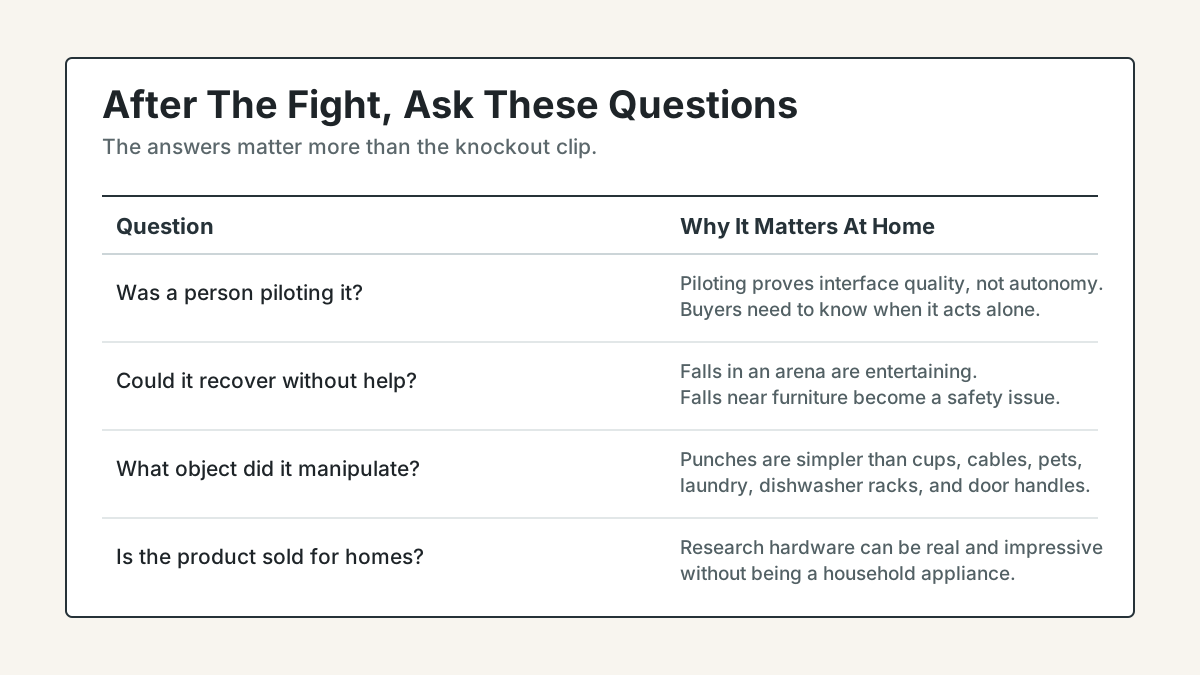
For any humanoid robot video, especially a sports or combat demo, ask:
- Was the robot piloted, scripted, supervised, or autonomous? A piloted robot can still be impressive. The important thing is that the control mode is disclosed.
- What happened when the robot failed? A fall followed by human rescue is useful information. So is autonomous recovery. So is a timeout.
- Was the environment structured? Flat floors, marked arenas, known lighting, and trained opponents are easier than homes.
- Did the robot manipulate ordinary objects? A punch is not the same as handling a glass, a cable, a folded shirt, or a dishwasher rack.
- Is the product sold, supported, and insured for home use? Research availability is not consumer readiness.
- What does the company say about human fallback? Clear fallback is a sign of maturity. Hidden fallback is a warning sign.
Those questions turn robot sports from hype into signal. You can enjoy the match and still grade the evidence honestly.
What Combat Leagues Could Improve
Robot combat leagues may still help home robotics in three practical ways.
First, they stress hardware in public. Humanoids need knees, ankles, hands, batteries, cooling, and protective shells that survive real abuse. An arena is not a living room, but it is a faster way to expose weak parts than a polished lab clip.
Second, they improve interfaces. If pilots can control a humanoid under time pressure, the same interface lessons may influence remote assistance, training data collection, and safety fallback. Home robots may need human escalation for years. Better teleoperation makes that fallback less clumsy.
Third, they make the market care about bodies, not just chatbots. A humanoid is not a language model in a plastic shell. It is motors, batteries, sensors, thermal limits, balance control, contact forces, and support logistics. Robot sports put those physical constraints on display.
The danger is that entertainment incentives reward the wrong evidence. A league wants drama. A buyer needs repeatability. A sponsor wants a clip. A household needs quiet, safe behavior at 7 a.m. when someone left a backpack in the hallway.
The Buyer Takeaway
Humanoid robot combat is not a scam, and it is not proof of home autonomy. It is a useful public stress test for bodies, pilots, controls, and audience appetite. Read it that way.
If you are evaluating a humanoid for actual use, start with the boring facts: price, availability, battery life, support model, control mode, manipulation evidence, and what happens when the robot gets stuck. On that score, the current ui44 database paints a mixed picture. Unitree G1 is real and available at $13,500, but still reads like research hardware. Unitree R1 pushes humanoid pricing downward, but is still pre-order. 1X NEO is more home-facing, but also a $20,000 pre-order. Booster T1 is a strong developer and competition platform. Figure 02 shows how quickly even serious humanoid programs can change.
Enjoy the robot fight. Then ask who was driving, what was learned, and whether the same robot can do something useful after the lights go down.
Related in the database
Use this article as a buyer workflow
Turn the article into a real verification pass grounded in the robots, manufacturers, categories, components, and countries it actually references.
Humanoid Robot Combat: What Demos Actually Prove already points you toward 5 linked robots, 5 manufacturers, and 3 countries inside the ui44 database. That matters because strong buyer guidance is easier to apply when you can move immediately from a claim or warning into concrete product pages, manufacturer directories, component explainers, and country-level context instead of treating the article as an isolated opinion piece. The fastest next step is to turn the article into a shortlist workflow: open the linked robot pages, verify which specs are actually published for those models, then compare the surrounding manufacturer and component context before you decide whether the underlying claim changes your buying plan.
For this topic, the useful discipline is to separate the editorial lesson from the catalog evidence. The article gives you the framing, but the robot pages tell you what each product actually ships with today: sensor stack, connectivity methods, listed price, release timing, category, and support-relevant compatibility notes. The manufacturer pages then show whether you are looking at a one-off launch, a broader lineup pattern, or a company that spans multiple categories. That layered workflow reduces the risk of buying on a single marketing phrase or a single support FAQ.
The fastest win is to keep the article’s editorial framing tied to real product pages. That way you can test whether G1, R1, and NEO still make sense once price, category, release timing, and surrounding manufacturer context are visible in one place. If you want a quick working shortlist, open Compare G1, R1, and NEO next, then keep this article open as the reasoning layer while you compare structured data side by side.
Practical Takeaway
Every robot, manufacturer, category, component, and country reference below resolves to a real ui44 page, keeping the follow-up path grounded in database records rather than generic advice.
Suggested next steps in ui44
- Open G1 first so the article’s main point is anchored to a real robot page.
- Use Unitree to see the broader company context around the products linked in the article.
- Open the linked component pages when you want to separate a shared technology pattern from a single-brand story.
- Build a working shortlist with Compare G1, R1, and NEO.
- Keep a short note of what is already verified in the article and what still needs live confirmation from current vendor documentation.
Robot profiles worth opening next
Use the linked product pages as the evidence layer
The linked robot pages are where this article becomes operational. Instead of asking whether the headline is interesting, use the robot entries to inspect the actual mix of sensors, connectivity options, batteries, pricing, release timing, and stated capabilities attached to the products mentioned in the article. That is the easiest way to see whether the warning or opportunity described here affects one product family, a specific design pattern, or an entire buying lane.
G1 is tracked on ui44 as a available humanoid robot from Unitree. The database currently records a listed price of $13,500, a release date of 2024-05-13, ~2 hours battery life, Not disclosed charging time, and a published stack that includes Depth Camera, 3D LiDAR, and 4 Microphone Array plus Wi-Fi 6 and Bluetooth 5.2.
For general buyer research, this route gives you the concrete profile that the article alone cannot. Compare the published capabilities of Bipedal Walking, Object Manipulation, and Dexterous Hands (optional Dex3-1) with the linked alternatives so the final decision is based on actual product fit, not just the framing of the article.
R1
Unitree Robotics · Humanoid · Pre-order
R1 is tracked on ui44 as a pre-order humanoid robot from Unitree Robotics. The database currently records a listed price of $4,900, a release date of 2025, ~1 hour (mixed activity) battery life, Not officially disclosed charging time, and a published stack that includes Monocular camera (R1 Air); binocular camera (R1/R1 EDU), 4-Mic Array, and Dual 6-Axis IMU plus Wi-Fi 6 and Bluetooth 5.2.
For general buyer research, this route gives you the concrete profile that the article alone cannot. Compare the published capabilities of Bipedal Walking & Running, Cartwheels & Handstands, and Push Recovery with the linked alternatives so the final decision is based on actual product fit, not just the framing of the article.
NEO
1X Technologies · Humanoid · Pre-order
NEO is tracked on ui44 as a pre-order humanoid robot from 1X Technologies. The database currently records a listed price of $20,000, a release date of 2025-10-28, ~4 hours battery life, Not disclosed charging time, and a published stack that includes RGB Cameras, Depth Sensors, and Tactile Skin plus Wi-Fi and Bluetooth.
For general buyer research, this route gives you the concrete profile that the article alone cannot. Compare the published capabilities of Household Chores, Tidying Up, and Safe Human Interaction with the linked alternatives so the final decision is based on actual product fit, not just the framing of the article.
Booster T1
Booster Robotics · Humanoid · Active
Booster T1 is tracked on ui44 as a active humanoid robot from Booster Robotics. The database currently records a listed price of $29,800, a release date of 2024, 2 hours walking, 4 hours standing battery life, Not disclosed charging time, and a published stack that includes Intel RealSense D455 RGBD Depth Camera, 9-axis IMU, and Circular 6-Mic Array plus Wi-Fi 6 and Bluetooth 5.2.
For general buyer research, this route gives you the concrete profile that the article alone cannot. Compare the published capabilities of 23-41 Degrees of Freedom (version-dependent), Bipedal Walking & Running, and Self-Recovery (prone to standing) with the linked alternatives so the final decision is based on actual product fit, not just the framing of the article.
Figure 02 is tracked on ui44 as a discontinued humanoid robot from Figure AI. The database currently records a listed price of Price TBA, a release date of 2024-08-06, Not disclosed (50% greater capacity than Figure 01) battery life, Not disclosed charging time, and a published stack that includes 6 RGB Cameras, Onboard Vision Language Model, and Microphones plus Wi-Fi and Bluetooth.
For general buyer research, this route gives you the concrete profile that the article alone cannot. Compare the published capabilities of Autonomous Task Execution, Speech-to-Speech Conversation, and Pick and Place with the linked alternatives so the final decision is based on actual product fit, not just the framing of the article.
Manufacturer context behind the article
Check whether this is one product story or a broader company pattern
Manufacturer pages add the market context that individual product pages cannot show on their own. They help you check whether the article is centered on a brand with a deep lineup, whether that brand spans several categories, and how much of its ui44 footprint depends on one flagship model versus a broader product strategy.
Unitree
ui44 currently tracks 2 robots from Unitree across 1 category. The company is grouped under China, and the current catalog footprint on ui44 includes H1, G1.
That wider brand context matters because the best buying decision usually depends on lineup depth and adjacent options, not just the one model featured most prominently in the article. The category mix here currently points toward Humanoid as the most useful next route if you want to see whether this article reflects a wider pattern inside the brand.
Unitree Robotics
ui44 currently tracks 9 robots from Unitree Robotics across 3 categorys. The company is grouped under China, and the current catalog footprint on ui44 includes B2, B1, Go2.
That wider brand context matters because the best buying decision usually depends on lineup depth and adjacent options, not just the one model featured most prominently in the article. The category mix here currently points toward Quadruped, Humanoid, Research as the most useful next route if you want to see whether this article reflects a wider pattern inside the brand.
1X Technologies
ui44 currently tracks 2 robots from 1X Technologies across 1 category. The company is grouped under Norway, and the current catalog footprint on ui44 includes NEO, EVE.
That wider brand context matters because the best buying decision usually depends on lineup depth and adjacent options, not just the one model featured most prominently in the article. The category mix here currently points toward Humanoid as the most useful next route if you want to see whether this article reflects a wider pattern inside the brand.
Booster Robotics
ui44 currently tracks 3 robots from Booster Robotics across 1 category. The company is grouped under China, and the current catalog footprint on ui44 includes Booster K1, Booster T2, Booster T1.
That wider brand context matters because the best buying decision usually depends on lineup depth and adjacent options, not just the one model featured most prominently in the article. The category mix here currently points toward Humanoid as the most useful next route if you want to see whether this article reflects a wider pattern inside the brand.
Broaden the scan without leaving the database
Categories, components, and countries add the wider context
Category framing
Category pages are useful when the article touches a buying pattern that shows up across brands. A category route helps you confirm whether the linked products sit in a narrow niche or whether the same question should be tested across a larger field of alternatives.
Humanoid
The Humanoid category page currently groups 129 tracked robots from 92 manufacturers. ui44 describes this lane as: Full-size bipedal humanoid robots built to work alongside people — from factory floors to household tasks. Compare the cutting edge of humanoid robotics.
That makes the category route a practical follow-up when you want to check whether the products linked in this article are typical for the lane or whether they sit at one edge of the market. Useful starting examples currently include NEO, EVE, Mornine M1.
Country and ecosystem context
Country pages give extra context when support practices, launch sequencing, regulatory posture, or manufacturer mix matter. They are not a substitute for model-level verification, but they do help you see which ecosystems cluster together and which manufacturers sit in the same regional field when you broaden the search beyond the article headline.
China
The China route currently groups 189 tracked robots from 87 manufacturers in ui44. That gives you a useful regional lens when the article points toward support practices, launch sequencing, or brand clusters that may share similar ecosystem assumptions.
On the current route, manufacturers like AGIBOT, Dreame, Unitree Robotics make the page a good way to broaden the scan without losing the regional context that often shapes availability, documentation style, and adjacent alternatives.
Norway
The Norway route currently groups 2 tracked robots from 1 manufacturers in ui44. That gives you a useful regional lens when the article points toward support practices, launch sequencing, or brand clusters that may share similar ecosystem assumptions.
On the current route, manufacturers like 1X Technologies make the page a good way to broaden the scan without losing the regional context that often shapes availability, documentation style, and adjacent alternatives.
USA
The USA route currently groups 89 tracked robots from 69 manufacturers in ui44. That gives you a useful regional lens when the article points toward support practices, launch sequencing, or brand clusters that may share similar ecosystem assumptions.
On the current route, manufacturers like Faraday Future, iRobot, Boston Dynamics make the page a good way to broaden the scan without losing the regional context that often shapes availability, documentation style, and adjacent alternatives.
Questions to answer before you move from reading to buying
A follow-up FAQ built from the entities already linked in this article
Frequently Asked Questions
Which page should I open first after reading “Humanoid Robot Combat: What Demos Actually Prove”?
Start with G1. That gives you a concrete product anchor for the article’s main claim. From there, branch into the manufacturer and component pages so you can tell whether the article is describing one specific model, a repeated brand pattern, or a wider technology issue that affects multiple shortlist options.
How do the manufacturer pages change the buying decision?
Unitree help you zoom out from one article and one product. On ui44 they show lineup breadth, category spread, and the neighboring robots tied to the same company. That context is useful when you are deciding whether a risk belongs to a single model, whether it shows up across a brand’s portfolio, and whether you should keep looking at alternatives before committing.
When should I switch from reading to side-by-side comparison?
Move into Compare G1, R1, and NEO as soon as you understand the article’s main warning or promise. The article explains what to watch for, but the compare view is where you can check whether price, status, battery life, connectivity, sensors, and category fit still make the robot a good match for your own home and budget.
Where to go next in ui44
Keep the research chain inside the database
If you want to keep going, these follow-on pages give you the cleanest expansion path from article to research session. Open the comparison route first if you are deciding between products today. Open the manufacturer, category, and component routes if you still need to understand the broader pattern behind the claim.
Written by
ui44 Team
Published July 4, 2026
Share this article
Open a plain share link on X or Bluesky. No embeds, no widgets, no cookie baggage.