If you're wondering what this has to do with your living room, the answer is: more than you think.
What Is the Humanoid Robot Half-Marathon?
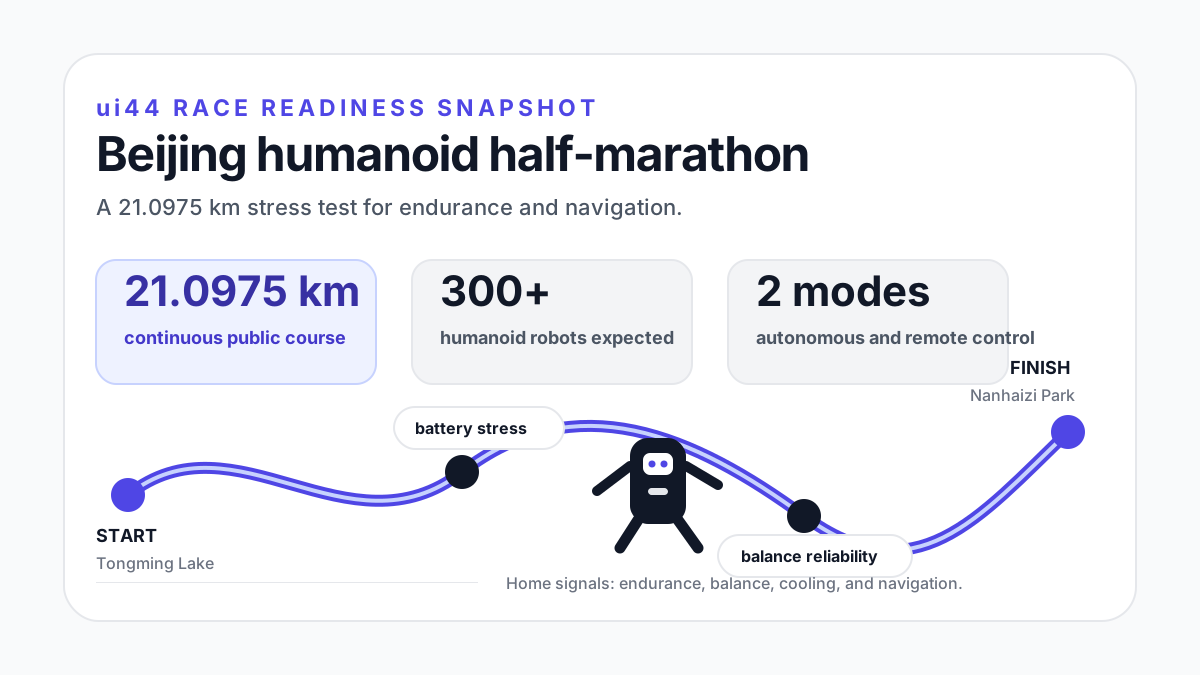
The 2026 Beijing E-Town Humanoid Robot Half-Marathon is the second edition of what organizers bill as the world's first competitive endurance event for bipedal humanoid robots. It starts at Kechuang 17th Street near Tongming Lake in Beijing's Yizhuang district and finishes in Nanhaizi Park — the same course as the simultaneous Beijing E-Town Half-Marathon for human runners.
The scale has exploded since the inaugural 2025 event. Participating teams are up nearly fivefold. Twenty universities have registered — ten times the number from the first event. And for the first time, robots will compete in two distinct categories:
- Autonomous navigation — the robot runs itself using onboard sensors and AI
- Remote control — a human operator guides the robot in real time
Thirty-eight percent of teams are entering in the autonomous category, a significant benchmark for the industry. To discourage remote control as a crutch, the organizers apply a 1.2× time penalty coefficient to non-autonomous finishers.
All robots wear BeiDou Navigation Satellite System shoulder badges for centimeter-level positioning. Only certified power batteries are allowed. A team of humanoid robotics experts will conduct pre-race compliance inspections.
Why Should Home Robot Buyers Care About a Footrace?
A half-marathon is 21 km of pavement, wind, temperature changes, vibrations, and battery drain. If a humanoid robot can reliably cover that distance, it demonstrates three things that matter for home use:
- Battery endurance — A robot that runs for 2+ hours continuously can handle a full day of household tasks with charging breaks.
- Balance and reliability — Bipedal walking on flat ground for hours tests joint durability, motor overheating, and fall recovery in ways lab demos don't.
- Autonomous navigation — If 38% of teams can navigate 21 km without human input, the underlying perception and path-planning technology is maturing fast.
That said, running on a closed, flat course in good weather is not the same as navigating a cluttered home with stairs, pets, and children. A marathon proves physical endurance. It doesn't prove the robot can fold laundry or load a dishwasher.
The Contenders: Which Brands Are Racing?
The 26 participating brands represent China's humanoid robotics ecosystem at its most competitive. Based on our Home Robot Database, here are the brands most likely to field teams — and what we know about their robots:
Unitree
The undisputed production leader. Unitree shipped approximately 5,500 humanoid robots in 2025, more than any other manufacturer. Their H1 (180 cm, 47 kg) holds a walking speed record of 7.4 mph (3.3 m/s), and their G1 is available starting at $13,500. Unitree's IPO prospectus shows humanoid robots overtook quadrupeds as their primary revenue source in 2025, with 60% gross margins. They're targeting 10,000–20,000 humanoid units in 2026.
Unitree's H1 is the odds-on favorite to win the speed category — its 3.3 m/s top speed is among the fastest for any bipedal humanoid.
AGIBOT
AGIBOT rolled out its 10,000th humanoid robot on March 28, 2026 — an Expedition A3 — just three months after hitting 5,000 units. The A3 (175 cm, 55 kg) demonstrated martial-arts aerial kicks at its unveiling, while the A2 Ultra holds a Guinness World Record for walking 106.3 km continuously.
AGIBOT's endurance credentials are real. A2 Ultra's verified 106 km walk is five times the half-marathon distance. The question is speed — at 4.3 km/h max, it would need roughly 5 hours to complete the course.
UBTECH
UBTECH reported a 2,203% increase in humanoid revenue for 2025. Their Walker S (170 cm, 60 kg) has been deployed in NIO automobile factories, and the new Walker S2 features autonomous battery swapping — a potential advantage in an endurance race. Mass production and first deliveries of the S2 began in November 2025.
EngineAI
EngineAI's T800 (173 cm, 75–85 kg) launched in December 2025 and was showcased globally at CES 2026. With hardware supporting speeds of ≥3 m/s and 4–5 hours of battery life, it's a strong marathon platform. EngineAI also makes the compact PM01 (140 cm, 42 kg), which could compete in a smaller class.
RobotEra
RobotEra's STAR1 holds the world bipedal speed record at 3.6 m/s (about 8 mph), set during a Gobi Desert run in 2024. At 171 cm and 63 kg with 55 degrees of freedom and a 4-hour battery, it has the specs to be competitive. If STAR1 enters, it could challenge Unitree's H1 for the speed title.
Fourier
Fourier's GR-2 (175 cm, 63 kg) features 53 joints and 12-DoF dexterous hands with tactile sensors. Originally from a medical robotics background, Fourier's humanoid is built for durability rather than speed — 5 km/h max. But at 63 kg with strong joint torque (380+ N·m), it's a solid endurance candidate.
Leju Robotics
Leju's Kuavo 5 (168 cm, 55 kg) is notable for its 8-hour battery life — tied for the longest of any full-size humanoid in our database, matching the AGIBOT Expedition A3 and Kepler Forerunner K2. It has served as a 5G-A equipped torchbearer and been deployed in NIO automotive assembly. Leju has raised over $200 million in pre-IPO funding.
Other Likely Participants
Several other Chinese humanoid makers we track could field teams:
- Kepler — Forerunner K2 (175 cm, 75 kg, 52 DOF, 8-hour battery, $30,000). Strong endurance specs.
- Booster Robotics — T1 (118 cm, 30 kg, $34,999). Won the 2025 RoboCup Soccer AdultSize championship. A proven competitor.
- LimX Dynamics — Oli (165 cm, 55 kg) with the COSA agentic OS. Raised $200M Series B.
- DOBOT — Atom with ±0.05 mm manipulation precision and straight-knee walking. Listed at $79,000.
- Astribot — S1 (170 cm, 80 kg) with effector speeds exceeding 10 m/s. Available since late 2025 in China.
What Does a Robot Marathon Actually Prove?
Here's what the half-marathon tests — and what it doesn't:
What It Tests
Capability
Battery endurance (2+ hours)
- Why It Matters for Home
- A home robot needs to work through a full cleaning or task session
Capability
Joint durability
- Why It Matters for Home
- Repeated cycles reveal motor and actuator quality
Capability
Balance consistency
- Why It Matters for Home
- Flat-ground stability is the baseline for any mobility task
Capability
Fall recovery
- Why It Matters for Home
- A robot that can get back up after falling is safer around people
Capability
Thermal management
- Why It Matters for Home
- Motors that overheat after 30 minutes won't survive daily chores
| Capability | Why It Matters for Home |
|---|---|
| Battery endurance (2+ hours) | A home robot needs to work through a full cleaning or task session |
| Joint durability | Repeated cycles reveal motor and actuator quality |
| Balance consistency | Flat-ground stability is the baseline for any mobility task |
| Fall recovery | A robot that can get back up after falling is safer around people |
| Thermal management | Motors that overheat after 30 minutes won't survive daily chores |
What It Doesn't Test
- Object manipulation — Running doesn't involve picking up, carrying, or placing objects
- Home navigation — The course is a flat, predictable road, not a cluttered living room
- Human interaction — No children, pets, guests, or unexpected obstacles
- Multi-floor capability — No stairs, ramps, or uneven surfaces
- Task intelligence — No understanding of "clean the kitchen" or "put away groceries"
Think of it this way: a marathon proves your robot has the body to work in a home. It doesn't prove it has the brain.
How Does Autonomous vs Remote Control Change Things?
The 38% autonomous figure is the most interesting data point from this event. In the 2025 inaugural race, the default mode was closer to "human-led." This year, more than a third of teams are confident enough to let their robots navigate 21 km without human input.
This matters because autonomy is the dividing line between a research platform and a consumer product. A robot that requires a human operator is a tool. A robot that operates itself is a product. For a deeper look at this distinction, see our analysis of teleoperation vs. autonomy in home humanoid robots.
The 1.2× time penalty for remote-controlled entries is a smart incentive. It forces teams to invest in perception and decision-making rather than relying on skilled operators. For consumers, this is the right signal: the industry is being pushed toward autonomy, not just spectacle.
The Robot "Baturu" Challenge: Obstacle Course Meets Disaster Response
On April 18, the day before the marathon, a companion event called the "Robot Baturu Challenge" will test 17 obstacle scenarios simulating emergency rescue conditions. Named after a Qing Dynasty military honor, the challenge pushes robots through unstable terrain, obstacles, and complex real-world scenarios that test:
- Autonomous decision-making under pressure
- Precise motor control on uneven surfaces
- Sustained operation in challenging conditions
This is arguably more relevant to home robotics than the marathon itself. A home robot faces unpredictable obstacles daily — a child's toy on the stairs, a spilled glass, a pet that won't move. The Baturu Challenge's focus on real-world complexity is a better proxy for household readiness than a flat 21 km run.
Why Does a Chinese Robot Race Matter Outside China?
The 26 brands competing in Beijing aren't just Chinese companies — they represent the manufacturing ecosystem that will eventually build the affordable home humanoid robots that reach Western living rooms. Consider the parallels with consumer electronics:
In 2010, Chinese manufacturers were known for cheap knockoffs. By 2020, companies like Xiaomi, DJI, and Anker were global quality leaders in their categories. The same trajectory is playing out in humanoid robotics, but compressed into a shorter timeline. AGIBOT went from founding to 10,000 units in roughly two years. Unitree's IPO prospectus reveals 60% gross margins on humanoid robots — signals of a maturing, profitable industry, not a subsidized science project.
The marathon is a public proving ground. When AGIBOT's A2 Ultra walked 106.3 km for a Guinness record, that wasn't a lab demo behind closed doors — it was a verified, independently measured achievement. Public benchmarks build consumer trust in a way that promotional videos cannot.
For Western consumers, the practical implication is straightforward: the robots that win or finish strong in Beijing's marathon are the ones whose descendants will show up in your local electronics store within 3–5 years. The marathon is an early preview of the competitive landscape.
The Price Question: How Much Will These Robots Cost at Home?
Production numbers are scaling fast, but price remains the biggest barrier to home adoption. Here's where things stand based on our database:
Robot
- Current Price
- $13,500
- Target Market
- Research/hobbyist
- Notes
- Most affordable full-size humanoid available today
Robot
- Current Price
- $20,000 ($499/mo)
- Target Market
- Consumer pre-order
- Notes
- First dedicated consumer humanoid preorder
Robot
- Current Price
- $30,000
- Target Market
- Research
- Notes
- 8-hour battery, strong endurance specs
Robot
- Current Price
- $34,999
- Target Market
- Research/competition
- Notes
- RoboCup 2025 champion
Robot
- Current Price
- $79,000
- Target Market
- Industrial
- Notes
- ±0.05 mm precision manipulation
| Robot | Current Price | Target Market | Notes |
|---|---|---|---|
| Unitree G1 | $13,500 | Research/hobbyist | Most affordable full-size humanoid available today |
| 1X NEO | $20,000 ($499/mo) | Consumer pre-order | First dedicated consumer humanoid preorder |
| Kepler K2 | $30,000 | Research | 8-hour battery, strong endurance specs |
| Booster T1 | $34,999 | Research/competition | RoboCup 2025 champion |
| DOBOT Atom | $79,000 | Industrial | ±0.05 mm precision manipulation |
UBTECH, one of the marathon's most likely contenders, has publicly targeted $20,000 per unit by 2030 with 20–30% annual cost reductions. If achieved, that trajectory would bring a capable humanoid below $5,000 sometime between 2031 and 2033 — roughly the same timeframe that 1X Technologies and Sunday are targeting for mass-market home products.
The marathon itself is indirectly relevant to pricing: endurance events expose component weaknesses (motors, batteries, joints) at scale. When 300 robots run 21 km simultaneously, manufacturers gather more real-world failure data in a single afternoon than months of lab testing could provide. Faster iteration cycles mean faster cost reduction.
When Will Marathon-Level Humanoids Reach Western Homes?
Here's the honest timeline, grounded in production data from our database:
2026–2027: Industrial scale-up, not homes. China produced roughly 13,000 humanoid robots in 2025, with 94% growth projected for 2026. But nearly all units go to factories, warehouses, and research institutions — not living rooms. Unitree and AGIBOT together account for nearly 80% of shipments, and both are focused on commercial and industrial customers.
2028–2029: First consumer pilots. Companies like 1X Technologies are already taking consumer preorders ($20,000 or $499/month), with US deliveries targeted for 2026. But these are early-adopter products, not mainstream appliances. The price needs to drop by 5–10× for mass adoption.
2030+: Real possibility. If production costs follow the trajectory of robot vacuums (which went from $1,500 to $300 in under a decade), a capable home humanoid under $5,000 is plausible by the early 2030s. But humanoid robots are far more complex than robot vacuums — the actuators, batteries, and compute requirements are orders of magnitude harder.
What to Watch on April 19
If you want to gauge how close we are to home humanoids, here are the things to look for in the race results:
- How many robots finish? A 300-robot starting grid is impressive, but the finish rate matters more. If most robots break down in the first 5 km, the technology isn't ready.
- What's the fastest autonomous time? Compare this to the fastest remote-controlled time. If autonomous robots are within 20% of teleop speeds, that's significant.
- Which brands finish strong? The marathon is a public, standardized test. Brands whose robots finish reliably will have a credibility advantage over those whose robots don't.
- Do any robots fall and recover? Fall recovery on a flat course is a minimum viable capability for any home robot. If robots can't get back up on pavement, they definitely can't handle your living room.
- Battery swap vs single charge? The rules allow certified power batteries but don't explicitly prohibit swapping. How teams manage energy will reveal real-world battery limitations.
The Bottom Line
The Beijing Humanoid Robot Half-Marathon is a publicity event, yes. But it's also a genuine, observable benchmark at an unprecedented scale. No other industry event puts 300 humanoid robots through the same physical test simultaneously, in public, with standardized rules and timing.
For home robot buyers, the message is cautiously optimistic. The hardware is getting good fast — production is scaling, prices are coming down, and endurance is improving. But the software gap remains enormous. Running 21 km in a straight line is an engineering achievement. Understanding "put the groceries away, but not the ice cream — that goes in the freezer" is something else entirely.
We'll be tracking the results on April 19. Check back for our post-race analysis of what the finishing times and failure modes reveal about the state of humanoid robotics.
Frequently Asked Questions
Can I watch the Beijing Humanoid Robot Half-Marathon?
The event is scheduled for April 19, 2026, starting at Kechuang 17th Street near
Tongming Lake in Beijing's Yizhuang district. Chinese state media and robotics
outlets typically provide live coverage. Check the
official event site for streaming
information as the date approaches. International robotics outlets like
Humanoids Daily and
Humanoid Press are also likely to provide
real-time updates.
What happens if a robot falls during the race?
The event rules allow teams to attempt fall recovery. A robot that can get back
up on its own and continue is scored normally. If a robot cannot recover, the
team may intervene, but this typically results in a time penalty or
disqualification depending on the severity of the intervention. Fall recovery on
a flat, predictable surface is considered a minimum capability — it's one of the
most telling metrics for home-readiness.
How fast can these humanoid robots actually run?
The fastest bipedal humanoid robots in our database can reach 3.3–3.6 m/s
(7.4–8.0 mph) — a brisk jogging pace. Unitree's H1 holds a
walking speed record at 3.3 m/s, while
RobotEra's STAR1 achieved 3.6 m/s during a Gobi Desert
run. For context, a human half-marathon winner runs at roughly 5.5 m/s (12.3
mph). The robots won't be competitive with elite human runners, but the gap is
narrowing every year.
Why aren't Western companies like Tesla or Figure competing?
The Beijing Half-Marathon is primarily a Chinese domestic event organized by
Beijing E-Town and Chinese robotics institutions. Western humanoid companies
like Tesla (Optimus), Figure, and
Apptronik (Apollo) are focused on industrial
deployments and their own demonstration events. Tesla is repurposing its Fremont
facility for Optimus Gen 3 production, while Figure recently appeared at the
White House with its Figure 03. The competitive landscape is effectively split
between Chinese manufacturers competing on production volume and cost, and
Western manufacturers competing on software sophistication and industrial
partnerships.
Is a half-marathon distance relevant for a home robot?
Not directly, but the underlying capabilities translate. A robot that can walk
21 km continuously demonstrates 2–5 hours of battery endurance, reliable joint
operation over thousands of gait cycles, and thermal management that prevents
overheating during sustained activity. A home robot might only need to operate
1–2 hours between charges, but the safety margin matters — you don't want your
robot's motors failing while it's carrying a hot pan from the kitchen.
What should I do if I'm considering buying a humanoid robot?
Right now, the honest advice is to wait unless you're a researcher or early
adopter with $13,500–$20,000 to invest. The Unitree G1 and
1X NEO are the most accessible options, but both are limited
in what they can autonomously do in a home. Watch the marathon results — the
companies whose robots perform well here are the ones most likely to ship
reliable consumer products first. In the meantime, explore our
full humanoid robot database to track which models are
closest to home deployment.
---
_Want to compare the specs of every humanoid robot in this article? Visit our
humanoid robot category page or use our
comparison tool to see them side by side._
Written by
ui44 Team
Published April 10, 2026
Share this article
Open a plain share link on X or Bluesky. No embeds, no widgets, no cookie baggage.