That does not mean robot maids have arrived. It means the evidence has moved from "watch this polished kitchen video" to "watch what happens when 100 robots meet real apartments, pets, children, older adults, dishes, laundry, Wi-Fi, support calls, and maintenance." That is a much better test.
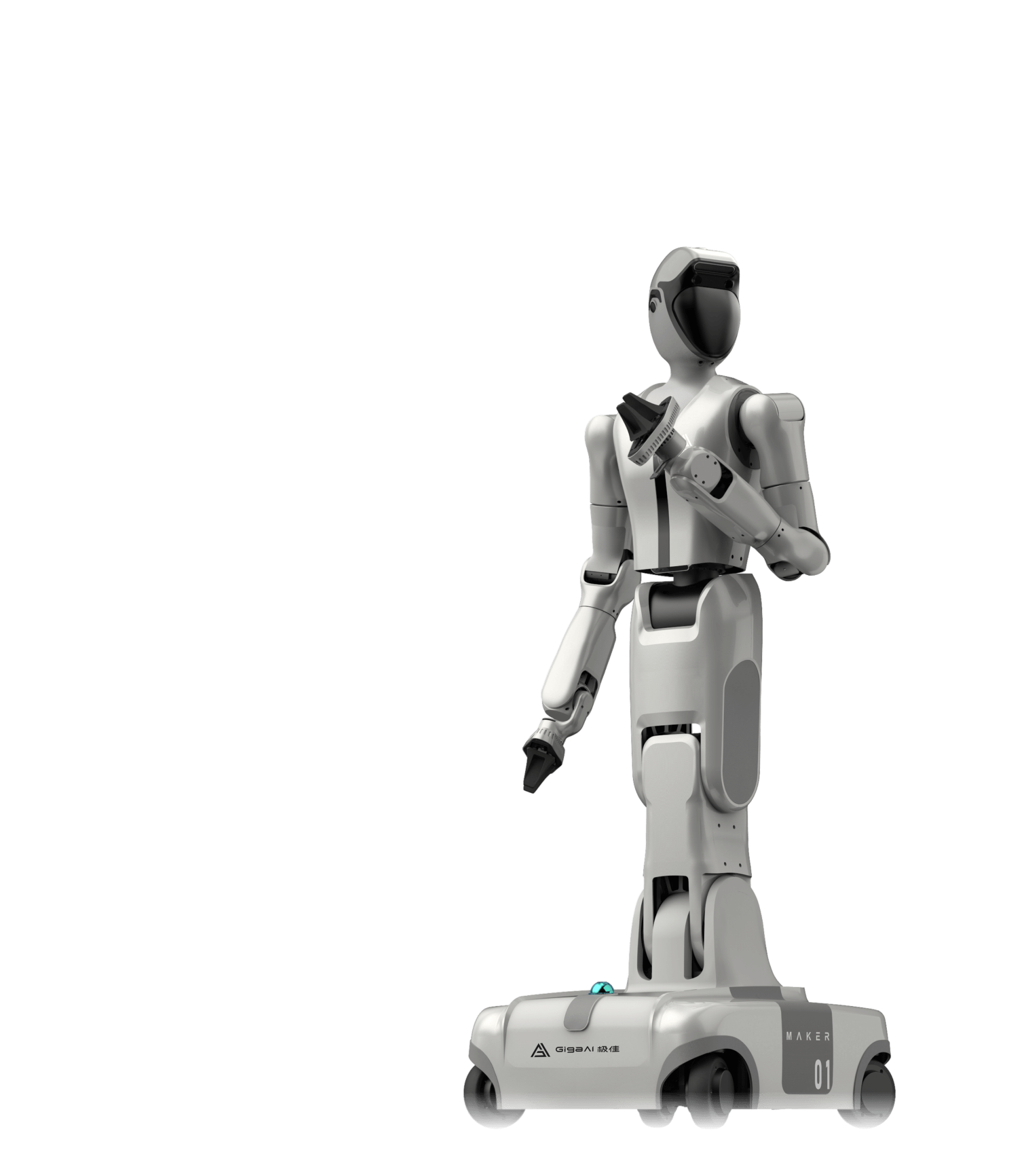
The short version: SeeLight S1 is a real signal for home robotics, but the buyer conclusion is still "watch the pilot," not "preorder a butler." Its most important claim is not that it can fry an egg once. It is that GigaAI and its Hubei partners are trying to collect household operating data from a meaningful fleet and turn that into cheaper, safer, more capable home robots.
What does the Wuhan trial actually prove?
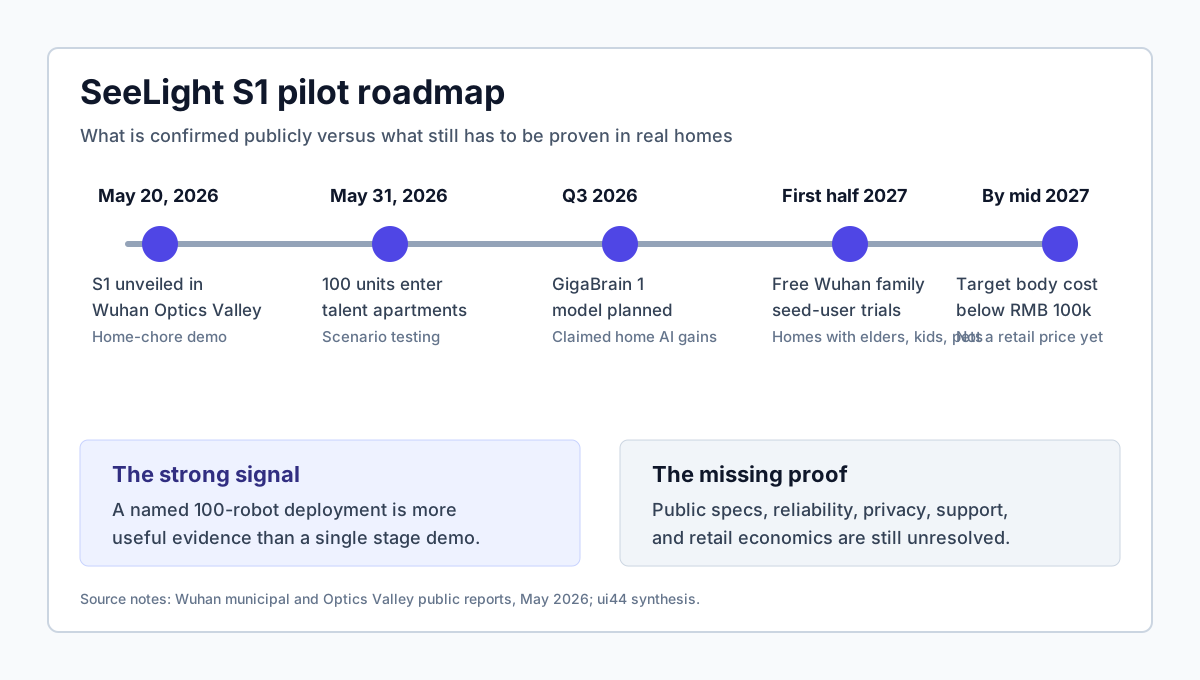
The public facts are unusually concrete for a home humanoid launch. According to the Wuhan municipal report, SeeLight S1 was launched by Hubei Jijia Vision Robot Technology with the Hubei Humanoid Robot Industry Alliance and the Hubei Humanoid Robot Innovation Center. The company announced a 100-unit cooperation order with Hubei Science and Technology Investment Group, with the first robots going into Optics Valley talent apartments for scenario testing.
That setup matters for three reasons.
First, apartments are less forgiving than labs. A robot can rehearse one countertop sequence in a clean demo kitchen. A real home asks whether it can handle different table heights, clutter, lighting, chair placement, laundry textures, cabinet handles, pets crossing the path, and people interrupting.
Second, 100 units are enough to expose boring problems. If a single prototype fails, it can be dismissed as a bad day. If a fleet keeps needing resets, replacement grippers, cleaned sensors, or remote human help, the company learns what the support burden really looks like.
Third, the pilot is explicitly about acceptance. Wuhan reporting says the seed user program will prioritize typical homes with older adults, children, or pets, and that the early Wuhan trial will be free. That is a smart way to get feedback, but it also means this is not a normal consumer product with a final price, warranty, service agreement, and delivery queue.
What SeeLight S1 claims to do
The stated task list is exactly the kind of list home robot buyers care about: cooking, washing clothes, folding laundry, clearing a table, organizing surfaces, and talking with older adults. Optics Valley reporting says the robot demo included heating food in a microwave, taking out dishes, cleaning them, and putting them back.
The more important technical claim is that S1 is not supposed to follow a fixed industrial script. The same public reports say it uses a self-developed embodied intelligence model to understand the task goal and plan an action path. GigaAI also plans to release GigaBrain 1 in Q3 2026, with claimed improvements in household-scene understanding, task generalization, and action precision.
Those claims should be treated as hypotheses until the pilot produces operating data. "Understands a task goal" can mean very different things:
Claim buyers will hear
Folds clothes
- What would make it convincing
- Repeats across shirt sizes, towels, and messy piles without perfect setup
Claim buyers will hear
Cooks
- What would make it convincing
- Handles heat, liquids, knives, cleanup, and human interruption safely
Claim buyers will hear
Clears the table
- What would make it convincing
- Detects fragile objects, spills, pets, and where each item belongs
Claim buyers will hear
Learns a home
- What would make it convincing
- Improves after layout changes without exposing private household data
Claim buyers will hear
Stops on contact
- What would make it convincing
- Publishes force limits, recovery behavior, and safety certification path
| Claim buyers will hear | What would make it convincing |
|---|---|
| Folds clothes | Repeats across shirt sizes, towels, and messy piles without perfect setup |
| Cooks | Handles heat, liquids, knives, cleanup, and human interruption safely |
| Clears the table | Detects fragile objects, spills, pets, and where each item belongs |
| Learns a home | Improves after layout changes without exposing private household data |
| Stops on contact | Publishes force limits, recovery behavior, and safety certification path |
This is why the S1 trial is more useful than a product video. A video proves that one sequence happened. A trial can reveal how much human staging, reset work, teleoperation, map preparation, and maintenance sits behind the sequence.
The ui44 database view
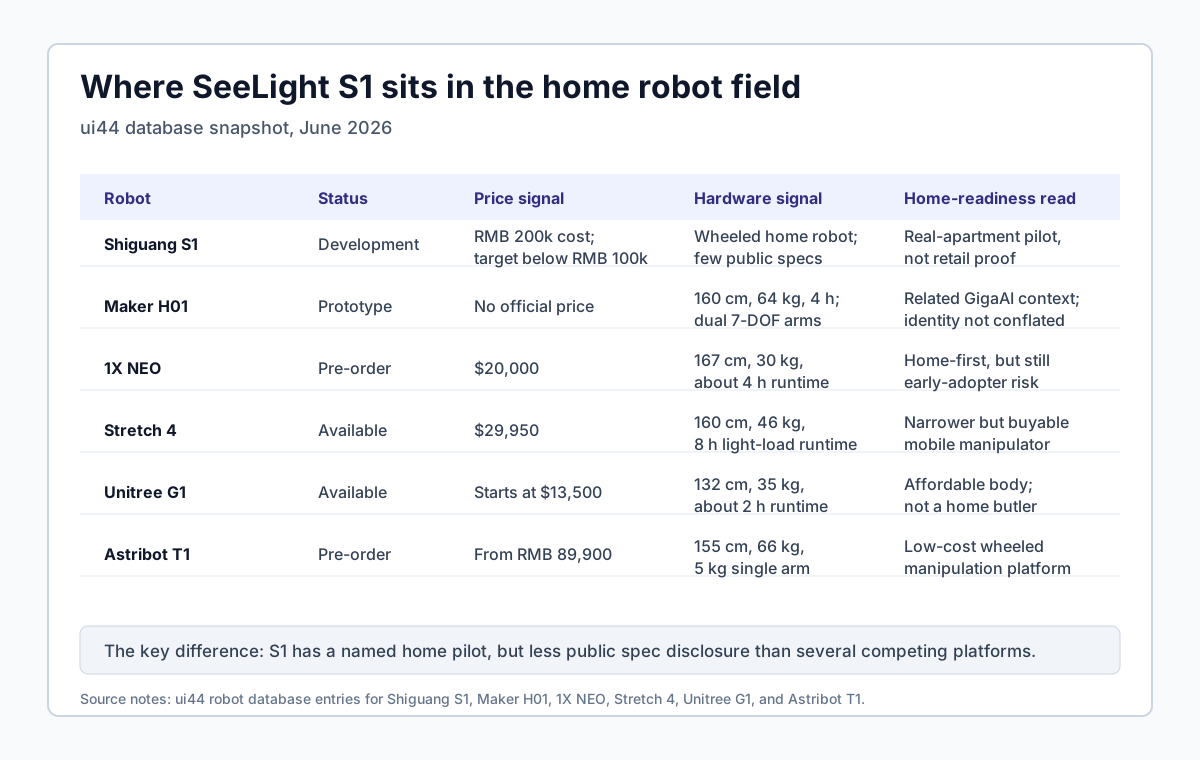
The ui44 database currently separates Shiguang S1 from GigaAI Maker H01. That distinction matters. Maker H01 has more public specification detail and a local image asset, while S1 has the home pilot story. Public sources do not yet prove whether S1 is a renamed Maker H01, a derivative, or a sibling platform, so buyers should not casually merge the spec sheets.
Here is the useful comparison.
Robot
- ui44 status
- Development
- Price signal
- No retail price; reported current unit cost around RMB 200,000 and target body cost below RMB 100,000
- Why it is relevant
- The rare home-humanoid claim tied to a 100-unit apartment pilot
Robot
- ui44 status
- Prototype
- Price signal
- No official public price
- Why it is relevant
- Related GigaAI wheeled humanoid context with 160 cm height, 64 kg weight, up to 4 hours runtime, and dual 7-DOF arms in third-party profiles
Robot
- ui44 status
- Pre-order
- Price signal
- $20,000 early adopter price
- Why it is relevant
- A home-first biped with soft design, roughly 4 hours runtime, and large unresolved autonomy/support questions
Robot
- ui44 status
- Available
- Price signal
- $29,950
- Why it is relevant
- A buyable mobile manipulator with 8-hour light-load runtime, 160 cm working height, and a narrower assistive/research role
Robot
- ui44 status
- Available
- Price signal
- Starts at $13,500
- Why it is relevant
- A comparatively affordable humanoid body, but still closer to developer platform than household helper
Robot
- ui44 status
- Pre-order
- Price signal
- From RMB 89,900
- Why it is relevant
- A low-cost wheeled humanoid platform with a 5 kg single-arm payload claim and many undisclosed autonomy details
Robot
- ui44 status
- Development
- Price signal
- No retail price
- Why it is relevant
- Another home-first wheeled robot bet, with a planned family beta rather than open retail availability
| Robot | ui44 status | Price signal | Why it is relevant |
|---|---|---|---|
| Shiguang S1 | Development | No retail price; reported current unit cost around RMB 200,000 and target body cost below RMB 100,000 | The rare home-humanoid claim tied to a 100-unit apartment pilot |
| Maker H01 | Prototype | No official public price | Related GigaAI wheeled humanoid context with 160 cm height, 64 kg weight, up to 4 hours runtime, and dual 7-DOF arms in third-party profiles |
| 1X NEO | Pre-order | $20,000 early adopter price | A home-first biped with soft design, roughly 4 hours runtime, and large unresolved autonomy/support questions |
| Hello Robot Stretch 4 | Available | $29,950 | A buyable mobile manipulator with 8-hour light-load runtime, 160 cm working height, and a narrower assistive/research role |
| Unitree G1 | Available | Starts at $13,500 | A comparatively affordable humanoid body, but still closer to developer platform than household helper |
| Astribot T1 | Pre-order | From RMB 89,900 | A low-cost wheeled humanoid platform with a 5 kg single-arm payload claim and many undisclosed autonomy details |
| Sunday Memo | Development | No retail price | Another home-first wheeled robot bet, with a planned family beta rather than open retail availability |
The pattern is clear: early home robots are splitting into two groups. Some are buyable bodies that still need better household autonomy. Others have strong home scenarios but are still pilots, betas, or preorders. SeeLight S1 belongs in the second group until Wuhan users publish more evidence.
What the 100-robot trial can prove
The best outcome for S1 is not a viral video. It is an honest field report with boring numbers:
Question
How many hours did each robot operate per week?
- Why it matters at home
- Runtime, charging, and daily usefulness matter more than one demo sequence
Question
What task success rate did families see?
- Why it matters at home
- A household robot has to finish chores without creating new chores
Question
How often did remote support intervene?
- Why it matters at home
- Hidden human help changes the true cost and privacy profile
Question
What failed first?
- Why it matters at home
- Grippers, wheels, sensors, battery packs, and software resets all affect ownership
Question
What data left the home?
- Why it matters at home
- Real-home learning can include video, voice, maps, and object interactions
Question
How did children and pets change behavior?
- Why it matters at home
- Contact stop is useful, but a home robot also needs prediction and avoidance
| Question | Why it matters at home |
|---|---|
| How many hours did each robot operate per week? | Runtime, charging, and daily usefulness matter more than one demo sequence |
| What task success rate did families see? | A household robot has to finish chores without creating new chores |
| How often did remote support intervene? | Hidden human help changes the true cost and privacy profile |
| What failed first? | Grippers, wheels, sensors, battery packs, and software resets all affect ownership |
| What data left the home? | Real-home learning can include video, voice, maps, and object interactions |
| How did children and pets change behavior? | Contact stop is useful, but a home robot also needs prediction and avoidance |
This kind of trial can also test the "home data flywheel" thesis. GigaAI CEO Zhu Zheng is quoted in local reporting as saying Optics Valley offers a complete humanoid supply chain, public acceptance, and local household-service resources, and that the company wants to build a large-scale home-scene dataset. If S1 improves because the apartments generate diverse chore data, that would be a real milestone.
But it creates the central buyer trade-off. The more a robot learns from your home, the more you need clear rules about recording, retention, labeling, teleoperation, model training, deletion, and who can inspect the footage.
Watch the cost target carefully
The reported price story is promising but easy to overread. Wuhan reporting says the current unit cost is about RMB 200,000, and the company hopes to bring body cost below RMB 100,000 in the first half of 2027 after planned factory scaling.
That is not the same as saying a finished consumer robot will sell for RMB 100,000. "Body cost" may exclude support, installation, warranty, spare parts, cloud compute, teleoperation fallback, insurance, software subscription, and profit margin. A robot that needs human fallback for hard tasks may also have a service cost that is larger than the hardware cost.
Still, the target is worth watching. It sits in the same early-consumer zone as other frontier robots: Unitree G1 starts around $13,500, 1X NEO is listed at $20,000 for early adopters, and Stretch 4 is $29,950 for research and assistive deployment buyers. If SeeLight S1 can really approach the low end of that range while doing useful domestic manipulation, it would matter. The word "if" is doing real work here.
The safety claim is only a starting point
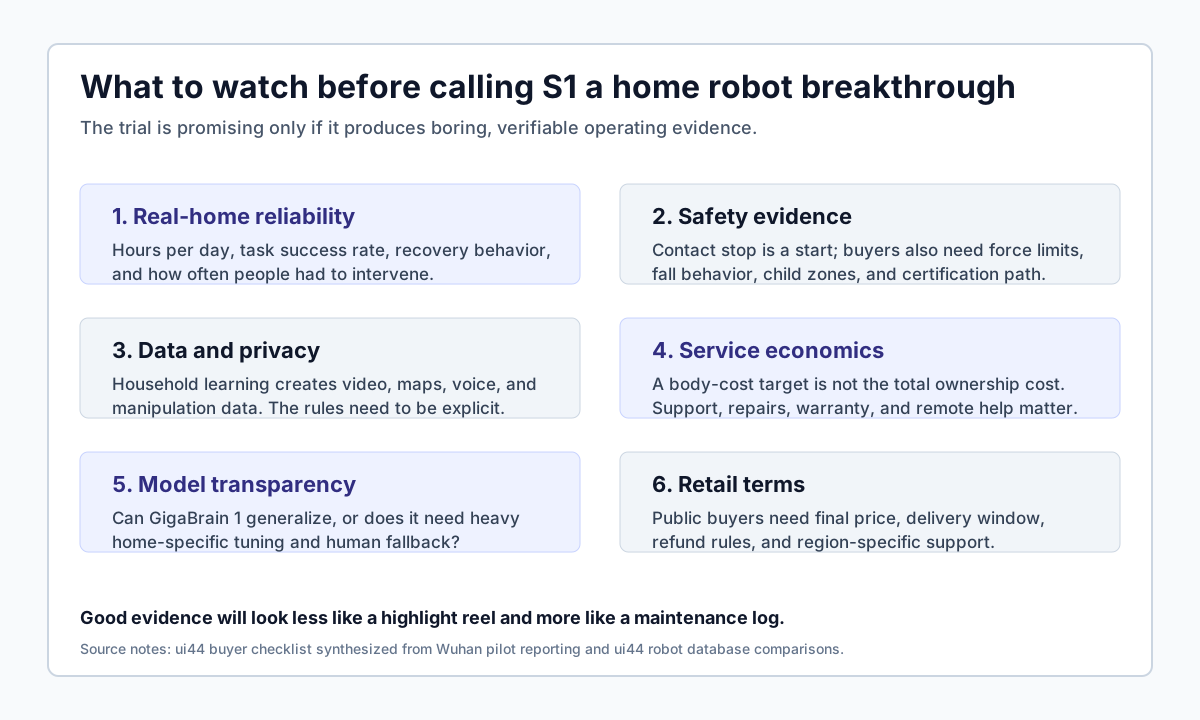
SeeLight S1 reportedly includes a compliant control mechanism that stops the robot when it contacts people or pets. That is the right direction, but it is not the whole safety case.
A household robot with arms needs to avoid risky contact before it happens. It needs force limits at the wrist and arm, safe recovery when an object slips, reasonable behavior around knives and heat, low-speed modes around children, clear no-go zones, and predictable shutdown behavior. If it is tall and heavy, fall risk matters. If it rolls, wheel pinch points and thresholds matter. If it learns from the home, privacy and remote-assist controls are part of safety too.
This is where narrower robots still have an advantage. Stretch 4 is expensive and not a mass-market butler, but its role is clearer: mobile manipulation, assistive pilots, developer access, mapping, navigation, and VLM grasping demos. Unitree G1 is cheaper, but ui44 does not treat it as a finished home helper. 1X NEO is explicitly home-facing, yet still asks buyers to accept early-adopter risk. S1 has to prove it can combine household ambition with boring operational discipline.
What should buyers ask next?
If you are tracking SeeLight S1 because you want a future home robot, the right questions are practical:
- Are there unedited apartment videos showing full task setup, errors, and recovery, not only finished clips?
- How many tasks can S1 do without pre-arranged objects and perfect lighting?
- Does the robot run autonomy locally, in the cloud, or with remote human help?
- What household data is collected during the pilot, and can users delete it?
- What are the official specs: height, weight, payload, runtime, charging time, sensors, noise, and connectivity?
- What safety standard or independent testing path will the company use before paid consumer deployment?
- Is the 2027 cost target a bill-of-materials target, a body price, or a real customer price with service included?
- Who repairs the robot when a gripper, wheel, sensor, or battery fails?
Those questions are not cynicism. They are how a good pilot becomes a credible product.
Bottom line
SeeLight S1 is worth taking seriously because it is attached to a specific 100-robot Wuhan apartment trial, seed-user plan, and cost-reduction target. That is stronger evidence than most "robot maid" announcements. It also fits the broader pattern ui44 tracks: home robots are moving from single-purpose appliances toward mobile manipulation, but the hardest parts are reliability, safety, service, privacy, and real chore completion in messy rooms.
For now, the best buyer stance is patient curiosity. Track the S1 pilot, compare it against Maker H01, 1X NEO, Stretch 4, Unitree G1, and Astribot T1, and use the ui44 compare tool to separate demos from products. If Wuhan's 100 robots produce transparent field data, SeeLight S1 could become one of the more important home robot stories of 2026. If they only produce highlight reels, it stays in the familiar category: impressive prototype, unresolved household proof.
Database context
Use this article as a setup-friction workflow
Turn the article into a real verification pass
GigaAI SeeLight S1: What Wuhan Trial Proves already points you toward 7 linked robots, 7 manufacturers, and 3 countries inside the ui44 database. Treat those links as a first-day setup trail: open the robot pages, check what is actually published about charging, battery life, control method, app or OTA support, and recovery, then use the surrounding manufacturer and country context to judge whether the article describes a low-friction product path or a still-specialist deployment.
For setup topics, the useful discipline is to separate a polished demo from the work required after the box arrives. The article gives you the narrative, but the robot pages show the operational clues: dimensions, weight, battery runtime, charging time, controller support, listed availability, and the capabilities that might need supervision. Manufacturer pages then reveal whether the same setup assumptions repeat across a wider lineup.
Use the robot pages to verify what happens between delivery and the first useful task: size, weight, battery, charger or dock path, controller, app, OTA support, and recovery cues. On this route cluster, Shiguang S1, Maker H01, and NEO form the fastest setup-friction reality check. If you want a quick working shortlist, open Compare Shiguang S1, Maker H01, and NEO next, then keep this article open while you compare first-day setup evidence side by side.
Practical Takeaway
The links below stay tied to the robots, manufacturers, and countries actually referenced by this setup article, so the checklist remains grounded in published ui44 records rather than generic humanoid advice.
Suggested next steps in ui44
- Open Shiguang S1 and check the concrete first-day fields: box contents, charger or dock path, battery life, controller, app, OTA support, and recovery options.
- Use Hubei Jijia Vision Robot Technology to see whether the company’s broader lineup looks appliance-like, developer-first, or still closer to a pilot deployment.
- Run Compare Shiguang S1, Maker H01, and NEO with the article open and compare battery, size, weight, price path, status, and support cues side by side.
- Write down the first realistic task each robot can plausibly attempt on day one, then separate low-friction setup signals from impressive but still lab-style demos.
Database context
Robot profiles worth opening next
Use the linked product pages as the evidence layer
The linked robot pages are where this setup article becomes operational. Use the robot entries to inspect the actual mix of size, weight, battery runtime, charging path, control method, pricing, availability, and stated capabilities attached to the products mentioned in the article. That is the easiest way to see whether the first useful task looks appliance-like, developer-led, or still dependent on supervised experimentation.
Shiguang S1
Hubei Jijia Vision Robot Technology · Humanoid · Development
Shiguang S1 is tracked on ui44 as a development humanoid robot from Hubei Jijia Vision Robot Technology. The database currently records a listed price of Price TBA, a release date of 2026-05-20, Not officially disclosed battery life, Not officially disclosed charging time, and a published stack that includes Compliant control/contact-stop safety mechanism plus its listed connectivity stack.
For setup-friction reading, this page matters because it shows the physical and support burden behind the demo. Use it to verify whether Shiguang S1 has a credible day-one path across charging, control, recovery, battery limits, and listed capabilities such as Household Chores, Cooking and Meal Handling, and Laundry Folding.
Maker H01 is tracked on ui44 as a prototype humanoid robot from GigaAI. The database currently records a listed price of Price TBA, a release date of 2026, Up to 4 hours per charge (Humanoid.Guide profile; not officially listed by GigaAI) battery life, Not officially disclosed charging time, and a published stack that includes Multiple onboard cameras (Humanoid.Guide profile), 360-degree LiDAR (Humanoid.Guide profile), and Official Maker H01 page does not disclose the full sensor stack plus Bluetooth (Humanoid.Guide profile) and Ethernet (Humanoid.Guide profile).
For setup-friction reading, this page matters because it shows the physical and support burden behind the demo. Use it to verify whether Maker H01 has a credible day-one path across charging, control, recovery, battery limits, and listed capabilities such as Dual-Arm Manipulation, Flexible-Object Manipulation, and Long-Horizon Task Planning.
NEO
1X Technologies · Humanoid · Pre-order
NEO is tracked on ui44 as a pre-order humanoid robot from 1X Technologies. The database currently records a listed price of $20,000, a release date of 2025-10-28, ~4 hours battery life, Not disclosed charging time, and a published stack that includes RGB Cameras, Depth Sensors, and Tactile Skin plus Wi-Fi and Bluetooth.
For setup-friction reading, this page matters because it shows the physical and support burden behind the demo. Use it to verify whether NEO has a credible day-one path across charging, control, recovery, battery limits, and listed capabilities such as Household Chores, Tidying Up, and Safe Human Interaction.
Stretch 4
Hello Robot · Home Assistants · Available
Stretch 4 is tracked on ui44 as a available home assistants robot from Hello Robot. The database currently records a listed price of $29,950, a release date of 2026-05-12, 8 hours (light CPU load) battery life, Not officially disclosed charging time, and a published stack that includes Wide-FOV depth sensing, High-resolution RGB cameras, and Calibrated RGB + depth perception plus its listed connectivity stack.
For setup-friction reading, this page matters because it shows the physical and support burden behind the demo. Use it to verify whether Stretch 4 has a credible day-one path across charging, control, recovery, battery limits, and listed capabilities such as Mobile Manipulation, Omnidirectional Indoor Mobility, and Autonomous Mapping and Navigation.
G1 is tracked on ui44 as a available humanoid robot from Unitree. The database currently records a listed price of $13,500, a release date of 2024, ~2 hours battery life, Not disclosed charging time, and a published stack that includes Depth Camera, 3D LiDAR, and 4 Microphone Array plus Wi-Fi 6 and Bluetooth 5.2.
For setup-friction reading, this page matters because it shows the physical and support burden behind the demo. Use it to verify whether G1 has a credible day-one path across charging, control, recovery, battery limits, and listed capabilities such as Bipedal Walking, Object Manipulation, and Dexterous Hands (optional Dex3-1).
Database context
Manufacturer context behind the article
Check whether this is one product story or a broader company pattern
Manufacturer pages add the setup context that individual product pages cannot show on their own. They help you check whether a brand repeats the same controller, battery, update, support, and availability patterns across multiple robots, or whether the article is really describing one early product path. That matters for humanoids because first-day friction usually comes from the surrounding ecosystem as much as from the robot itself.
Hubei Jijia Vision Robot Technology
ui44 currently tracks 1 robot from Hubei Jijia Vision Robot Technology across 1 category. The company is grouped under China, and the current catalog footprint on ui44 includes Shiguang S1.
That wider brand context matters because setup friction is rarely just a box problem. A manufacturer route helps you see whether the company has repeated controller, battery, support, and update patterns across its lineup, or whether the article is really about one early product story. The category mix here currently points toward Humanoid as the most useful next route if you want to see whether this article reflects a wider pattern inside the brand.
GigaAI
ui44 currently tracks 1 robot from GigaAI across 1 category. The company is grouped under China, and the current catalog footprint on ui44 includes Maker H01.
That wider brand context matters because setup friction is rarely just a box problem. A manufacturer route helps you see whether the company has repeated controller, battery, support, and update patterns across its lineup, or whether the article is really about one early product story. The category mix here currently points toward Humanoid as the most useful next route if you want to see whether this article reflects a wider pattern inside the brand.
1X Technologies
ui44 currently tracks 2 robots from 1X Technologies across 1 category. The company is grouped under Norway, and the current catalog footprint on ui44 includes NEO, EVE.
That wider brand context matters because setup friction is rarely just a box problem. A manufacturer route helps you see whether the company has repeated controller, battery, support, and update patterns across its lineup, or whether the article is really about one early product story. The category mix here currently points toward Humanoid as the most useful next route if you want to see whether this article reflects a wider pattern inside the brand.
Hello Robot
ui44 currently tracks 2 robots from Hello Robot across 1 category. The company is grouped under USA, and the current catalog footprint on ui44 includes Stretch 3, Stretch 4.
That wider brand context matters because setup friction is rarely just a box problem. A manufacturer route helps you see whether the company has repeated controller, battery, support, and update patterns across its lineup, or whether the article is really about one early product story. The category mix here currently points toward Home Assistants as the most useful next route if you want to see whether this article reflects a wider pattern inside the brand.
Database context
Broaden the scan without leaving the database
Categories, components, and countries add the wider context
Category framing
Category pages are useful when the article touches a buying pattern that shows up across brands. A category route helps you confirm whether the linked products sit in a narrow niche or whether the same question should be tested across a larger field of alternatives.
Humanoid
The Humanoid category page currently groups 100 tracked robots from 71 manufacturers. ui44 describes this lane as: Full-size bipedal humanoid robots designed to work alongside humans. From factory floors to household tasks, these machines represent the cutting edge of robotics.
That makes the category route a practical follow-up when you want to check whether the products linked in this article are typical for the lane or whether they sit at one edge of the market. Useful starting examples currently include NEO, EVE, Mornine M1.
Home Assistants
The Home Assistants category page currently groups 15 tracked robots from 14 manufacturers. ui44 describes this lane as: Arm-based household helpers — laundry folders, kitchen robots, and mobile manipulators that handle physical tasks at home.
That makes the category route a practical follow-up when you want to check whether the products linked in this article are typical for the lane or whether they sit at one edge of the market. Useful starting examples currently include Robody, Futuring 2 (F2), Stretch 3.
Country and ecosystem context
Country pages give extra context when support practices, launch sequencing, regulatory posture, or manufacturer mix matter. They are not a substitute for model-level verification, but they do help you see which ecosystems cluster together and which manufacturers sit in the same regional field when you broaden the search beyond the article headline.
China
The China route currently groups 162 tracked robots from 73 manufacturers in ui44. That gives you a useful regional lens when the article points toward support practices, launch sequencing, or brand clusters that may share similar ecosystem assumptions.
On the current route, manufacturers like AGIBOT, Dreame, Unitree Robotics make the page a good way to broaden the scan without losing the regional context that often shapes availability, documentation style, and adjacent alternatives.
Norway
The Norway route currently groups 2 tracked robots from 1 manufacturers in ui44. That gives you a useful regional lens when the article points toward support practices, launch sequencing, or brand clusters that may share similar ecosystem assumptions.
On the current route, manufacturers like 1X Technologies make the page a good way to broaden the scan without losing the regional context that often shapes availability, documentation style, and adjacent alternatives.
USA
The USA route currently groups 73 tracked robots from 57 manufacturers in ui44. That gives you a useful regional lens when the article points toward support practices, launch sequencing, or brand clusters that may share similar ecosystem assumptions.
On the current route, manufacturers like iRobot, Boston Dynamics, Faraday Future make the page a good way to broaden the scan without losing the regional context that often shapes availability, documentation style, and adjacent alternatives.
Database context
Questions to answer before you move from reading to buying
A follow-up FAQ built from the entities already linked in this article
Frequently Asked Questions
Which page should I open first after reading “GigaAI SeeLight S1: What Wuhan Trial Proves”?
Start with Shiguang S1. That gives you a concrete product anchor for the article’s main claim. From there, branch into the manufacturer and component pages so you can tell whether the article is describing one specific model, a repeated brand pattern, or a wider technology issue that affects multiple shortlist options.
How do the manufacturer pages change the buying decision?
Hubei Jijia Vision Robot Technology help you zoom out from one article and one product. On ui44 they show lineup breadth, category spread, and the neighboring robots tied to the same company. That context is useful when you are deciding whether a risk belongs to a single model, whether it shows up across a brand’s portfolio, and whether you should keep looking at alternatives before committing.
When should I switch from reading to side-by-side comparison?
Move into Compare Shiguang S1, Maker H01, and NEO as soon as you understand the article’s main warning or promise. The article explains what to watch for, but the compare view is where you can check whether price, status, battery life, connectivity, sensors, and category fit still make the robot a good match for your own home and budget.
Database context
Where to go next in ui44
Keep the research chain inside the database
If you want to keep going, these follow-on pages give you the cleanest expansion path from article to research session. Open the comparison route first if you are deciding between products today. Open the manufacturer, category, and component routes if you still need to understand the broader pattern behind the claim.
Written by
ui44 Team
Published June 1, 2026
Share this article
Open a plain share link on X or Bluesky. No embeds, no widgets, no cookie baggage.