That is partly true. It is also where the comparison becomes dangerous. A car mainly chooses how to move a protected vehicle through public space. A home robot has to move its own body through private space, touch objects, understand vague human requests, and recover when the sock, mug, pet, chair leg, or person is not where the training data expected.
The useful question is not "can car AI become robot AI?" It is which parts transfer, which parts need a new body of data, and which claims should make buyers skeptical.
ui44's short answer: autonomous-driving AI is becoming real infrastructure for physical AI. It will help home robots with perception, prediction, safety loops, simulation, and fleet operations. It will not magically solve laundry, dish loading, elder care, or safe manipulation inside a cluttered apartment.
Why car AI suddenly matters to home robots
The new signal is not just Tesla using car ideas for Optimus. Several companies are now explicitly treating vehicle autonomy as a physical-AI training ground.
DeepRoute.ai, covered by Pandaily after the 2026 Beijing Auto Show, framed its autonomous-driving stack as Physical AI infrastructure, not merely ADAS software. The company described a foundation-model architecture with three roles: a Driver model for action, an Analyst model for language and explanations, and a Critic model for learning from bad behavior. The important number is scale: more than 300,000 vehicles, 1.3 billion kilometers of real-world driving data, and 44.8 million hours of active usage in the past year.
That is the kind of data flywheel home robotics does not have yet.
XPENG is even more direct. In its official Physical AI materials, XPENG says VLA 2.0 can be applied across AI cars, humanoid robots, and flying cars. The company describes VLA 2.0 as a physical-world model that generates action directly from visual signals, trains on nearly 100 million driving clips, and uses vehicle deployment as part of a broader self-driving, robotaxi, humanoid, and flying-car stack. Its later X-Cache report says world-model inference can be accelerated by roughly 2.6x to 2.7x without major quality loss, and explicitly says the pattern can extend to embodied intelligence and robot simulation.
Those are not home-robot product guarantees. They are evidence that the best car-AI teams are building systems that look increasingly relevant to robots: video understanding, action generation, simulation, edge deployment, safety critics, and fast iteration.
What actually transfers from autonomous driving?
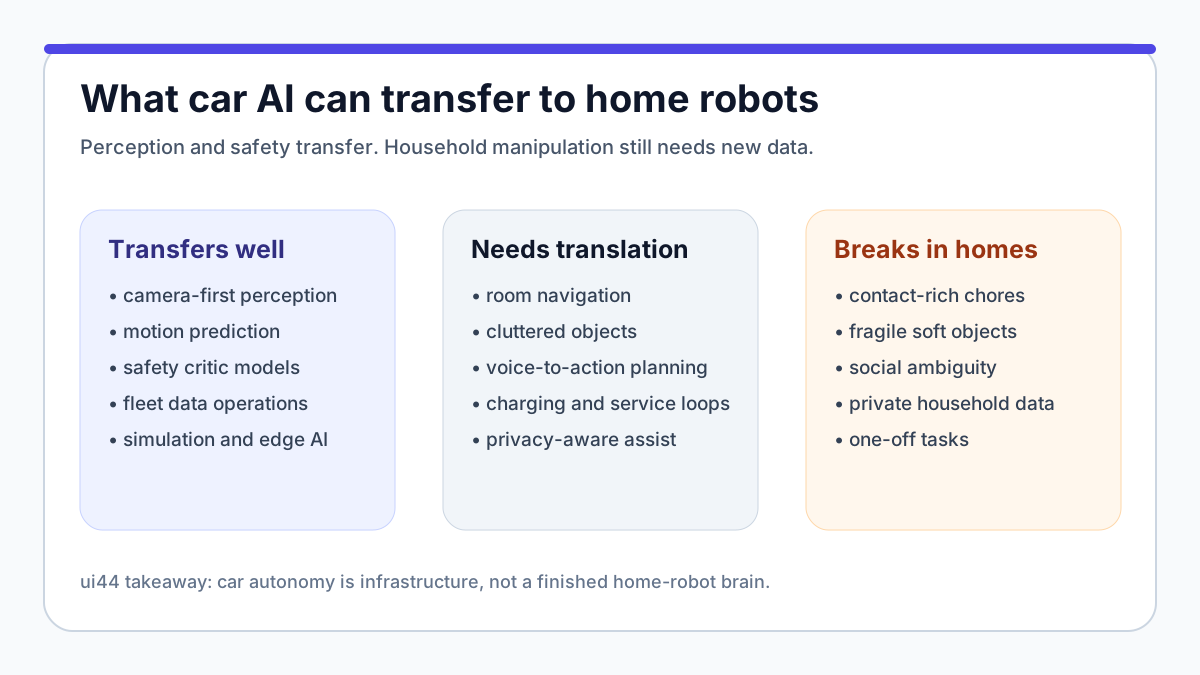
The strongest transfer is not "driving skills." Your humanoid does not need to merge onto a freeway. The transfer is the engineering discipline around real-time physical decisions.
1. Perception under motion
Cars have pushed cameras, sensor fusion, low-latency inference, and scene prediction harder than almost any consumer-facing robotics market. A home robot also needs to understand a moving world: people walking past, pets crossing its path, doors opening, furniture changing, and objects partly hidden by clutter.
That helps companies like XPENG Iron. ui44's database lists Iron as a development-stage humanoid with a 720-degree AI vision system, stereo cameras, LiDAR, force/torque sensors, IMU, 5G connectivity, a 30B-parameter AI model, and XPENG's Turing AI chip stack. Those specs do not make it home-ready, but they show why an automaker can bring a serious perception foundation to humanoids.
2. Safety critics and negative examples
A car autonomy stack learns not only from good driving but also from near misses, disengagements, hard braking, and unsafe choices. DeepRoute's Critic model framing is interesting because home robots need the same category of learning. A robot should learn what bad looks like: pushing a glass too close to an edge, continuing an arm motion after a person says "stop," pinching fabric, entering a bathroom at the wrong moment, or navigating too close to a sleeping dog.
This is where the car analogy is useful. Home robot safety will not be solved by a nicer chatbot voice. It needs a model trained to avoid physical failure modes.
3. Fleet operations
Autonomous-driving companies know how to collect edge cases, replay incidents, label failures, test new models, roll out software gradually, and monitor real-world behavior. Home robot companies need the same machinery.
The problem is consent. A car fleet can collect road clips in public or semi-public environments. A home robot sees bedrooms, medications, children, visitors, routines, and objects that reveal a household's life. The data loop is necessary, but it must be slower, more permissioned, and more local than vehicle data.
Where the car analogy breaks
The hardest household tasks are not miniature driving tasks. They are manipulation tasks.
A car can avoid a plastic bag. A home robot may need to pick it up without tearing it, decide whether it is trash, and know whether the human was saving it. A car can predict a pedestrian crossing. A care robot may need to support a person standing up, which means reading balance, intent, pain, and physical contact at the same time.
That difference matters for buyers. If a robot maker says "we use self-driving AI," ask what the AI actually controls. Is it only navigation? Is it scene understanding? Does it plan arm motion? Does it stop a hand locally? Does it learn from failed grasps? Does it understand private home context, or only public-road geometry?
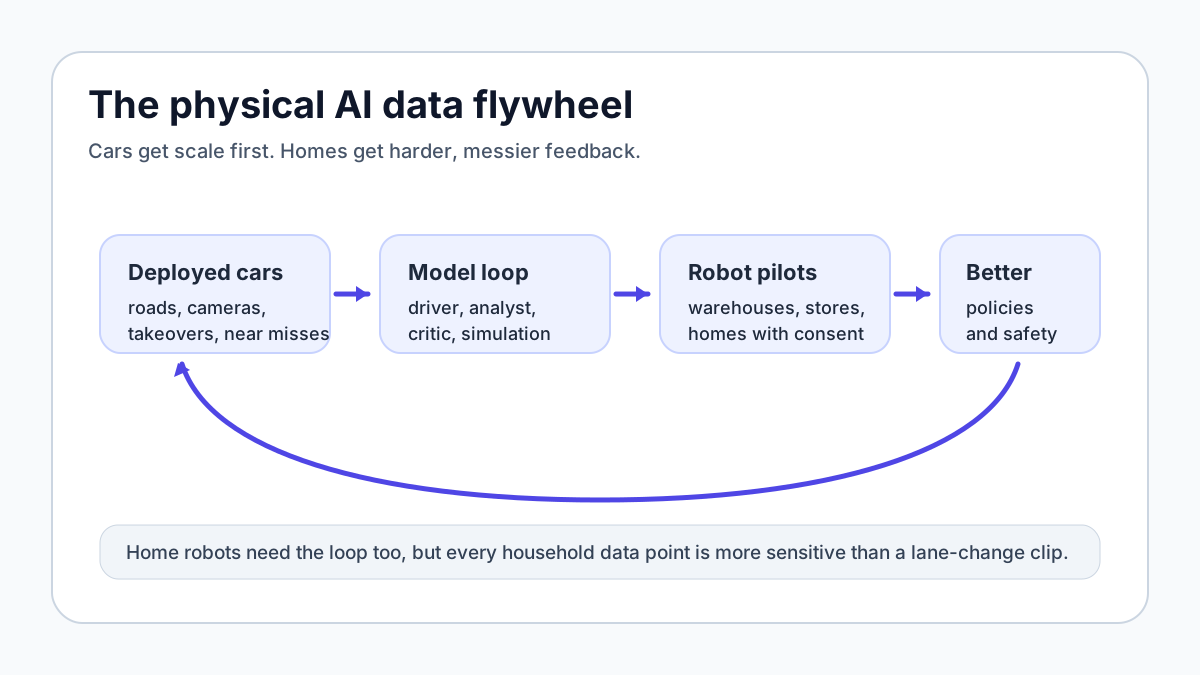
The second break is data density. DeepRoute can talk about hundreds of thousands of vehicles and billions of kilometers. A home robot company might have hundreds or thousands of robots, many in controlled labs, offices, stores, or early-access homes. The range of household tasks is also brutal. Folding one towel, loading one dishwasher, and helping one person stand are three different worlds.
The third break is social ambiguity. Roads have rules. Homes have preferences. "Put this away" depends on whose object it is, where the household keeps it, whether it is clean, whether it is fragile, and whether the person is in a hurry. That is why a home robot brain needs memory controls and user-specific context, not just a general physical-world model.
The robots to compare right now
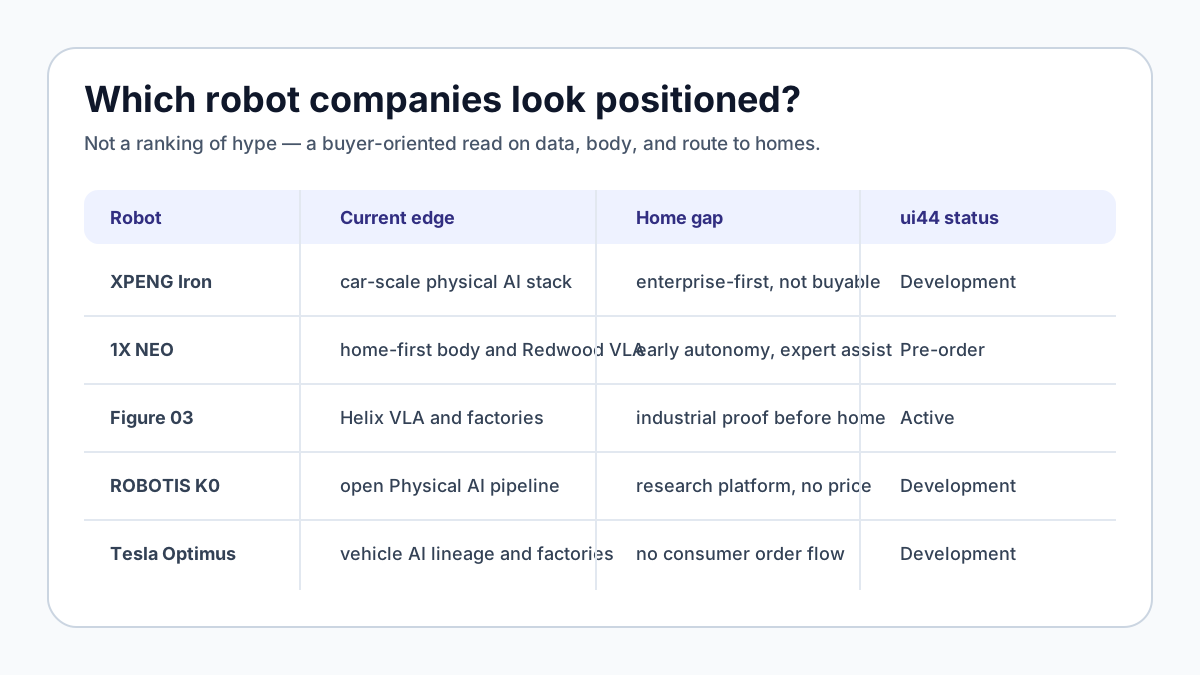
A buyer does not need to follow every foundation-model claim. A better approach is to compare the companies by route to useful household behavior.
XPENG Iron: strongest car-to-robot thesis, weakest home availability
XPENG Iron is the cleanest example of the car-AI thesis. It comes from an EV maker with self-driving investment, robotaxi plans, chips, vehicle data, and a public Physical AI strategy. ui44 lists Iron at 173 cm, 70 kg, around 4 hours of active use, 6 km/h walking speed, and an estimated enterprise price around $150,000. It is not a consumer product.
The promise is cross-domain learning: cars, robotaxis, humanoids, and flying vehicles sharing pieces of the same physical-AI stack. The risk is that home buyers see the humanoid and assume household readiness. XPENG's own near-term positioning still points first toward commercial, store, factory, and service environments.
1X NEO: weakest car lineage, strongest home focus
1X NEO is almost the opposite. 1X is not an automaker, but NEO is one of the clearest home-first humanoid products in the ui44 database: $20,000 early-access ownership, 167 cm, 30 kg, about 4 hours of battery life, RGB cameras, depth sensors, tactile skin, and a microphone array. 1X's official order page also lists a $499/month subscription option and a $200 refundable deposit for early access.
The AI story is Redwood. 1X says Redwood trains on both successes and failures, controls locomotion jointly with manipulation, uses off-board language for voice and context, and is meant to learn household chores from real interactions. That is exactly the part car AI cannot fully provide: body-specific, home-specific learning.
The trade-off is maturity. NEO's early buyers should expect limited autonomy, scheduled Expert Mode for tasks it cannot handle, and a service model that matters as much as the model name. If car AI is the broad infrastructure story, NEO is the home-deployment reality check.
Figure and Tesla: industrial routes before homes
Figure 03 and Optimus Gen 2 are useful comparison points because both are backed by organizations with serious engineering resources, but neither is a normal household purchase today.
Figure's Helix VLA is important because it splits high-level vision-language understanding from fast low-level control: the published Helix description says one component runs around 7-9 Hz while the reactive visuomotor policy runs at 200 Hz for upper-body action. ui44 lists Figure 03 with a 173 cm body, 61 kg weight, roughly 5 hours of battery life, and 20 kg payload, but no public purchase price.
Tesla's Optimus Gen 2 has the clearest brand connection to vehicle AI. ui44 lists it as development-stage, 173 cm, 57 kg, up to 5 mph, with cameras, force/torque sensors, IMU, and touch sensors. The catch is simple: there is no consumer order flow, and the often-cited roughly $30,000 price remains a target, not a posted product.
For both, factories are the sensible proving ground. A robot can learn repetitive, instrumented, supervised tasks there before anyone should trust it with household caregiving or fragile chores.
ROBOTIS K0: the open research path
ROBOTIS AI Sapiens K0 matters for a different reason. It is not a home product, and ui44 lists no public price. But it is a useful signal for how physical AI may spread beyond closed automaker stacks.
The K0 is a 1.3 m, 34 kg, 23-DOF humanoid research platform with a 3 kg max arm payload, a 46.8 V / 9000 mAh battery, Dynamixel-Q actuators, a 6 TOPS NPU, and open-source hardware/software ambitions. ROBOTIS describes reinforcement learning in NVIDIA Isaac Sim and imitation learning through leader-follower demonstrations.
That kind of open pipeline will not ship your laundry robot next month. It can, however, give labs and smaller companies a reproducible body for testing policies that are not locked inside one automaker's fleet.
Which company looks most credible?
It depends on the question.
If the question is who has the best car-AI transfer story, XPENG looks strongest. It has the clearest public cross-domain thesis: cars, robotaxis, humanoids, flying vehicles, VLA models, world models, chips, and data loops.
If the question is who is closest to a home buyer, 1X is more relevant. NEO is explicitly home-focused, priced, and orderable in a way XPENG Iron, Figure 03, and Optimus are not.
If the question is who may improve the whole field, ROBOTIS deserves attention because open Physical AI tools can make robotics less dependent on closed demos and more reproducible.
The mistake is treating those as the same race. They are different paths:
- car-first physical AI: scale, data, simulation, edge inference;
- home-first humanoid: safety, service, privacy, task learning;
- industrial-first humanoid: repetitive work before household chaos;
- open research platform: slower commercialization, better shared learning.
A good home robot may eventually borrow from all four.
What buyers should ask when a robot claims "car AI"
Marketing will turn this into a slogan. Buyers should turn it back into requirements.
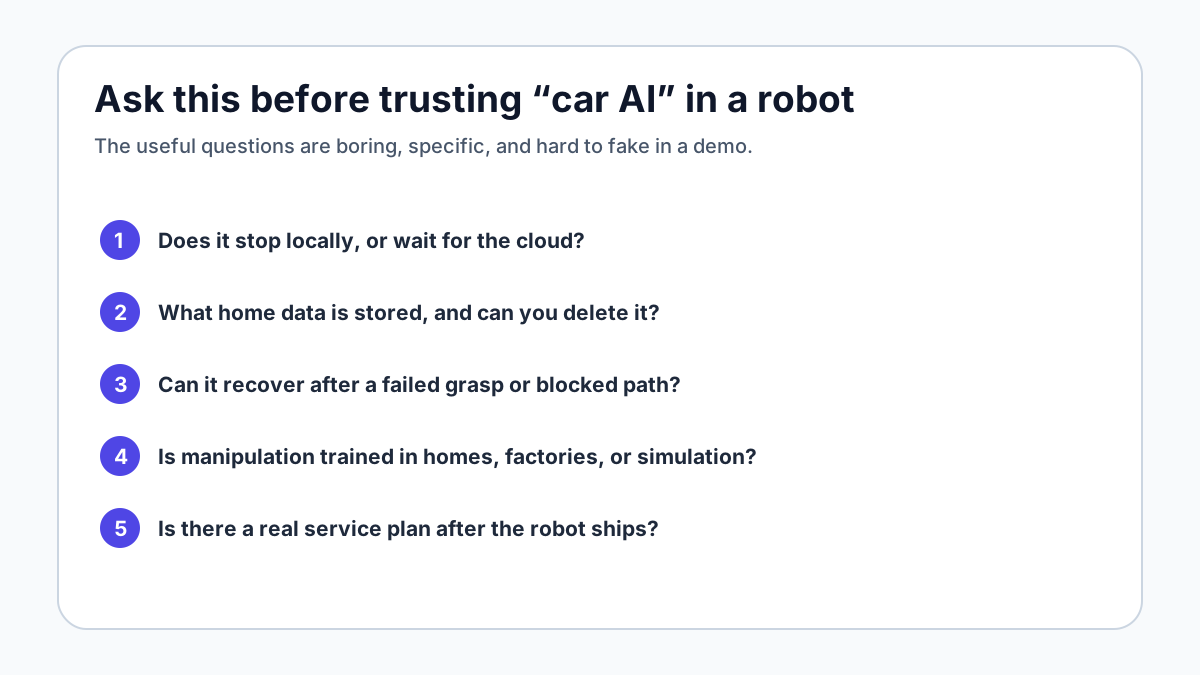
Ask these five questions:
- What runs locally? Stop commands, collision response, and balance recovery should not wait on a cloud model.
- What data leaves the home? A robot training loop is powerful, but household video is not road video.
- What does the model control? Navigation, language, arms, hands, or all of them?
- How does it learn from failure? A home robot that cannot learn from failed grasps will stay demo-bound.
- What happens after shipping? Autonomy requires updates, service, remote help, parts, and clear user control.
This is also where ui44's existing guides connect. If you want the model-level background, start with what a VLA model means for home robots. If you care about privacy and latency, read the on-device AI guide. If you are comparing real autonomy claims, the home robot autonomy levels guide is the practical checklist.
Bottom line
Self-driving car AI will probably influence home robots. It may even become one of the core layers of the home robot brain. But the transfer is uneven.
Car AI gives robots better perception infrastructure, safety-learning habits, simulation tools, edge deployment discipline, and fleet operations. It does not hand them dexterous manipulation, household judgment, privacy trust, or a service network.
For now, treat automaker-backed humanoids like XPENG Iron and Tesla Optimus as signals about where physical AI is going, not products to plan your home around. Treat 1X NEO as the more relevant home-buyer experiment, but judge it by what it can actually do in early access. Treat open platforms like ROBOTIS K0 as infrastructure for the labs and developers who may turn today's demos into tomorrow's less fragile robots.
The winning home robot brain will not be a self-driving car model copied into a humanoid. It will be a physical AI stack that learned from roads, then relearned the home.
Related in the database
Use this article as a privacy verification workflow
Turn the article into a privacy verification pass grounded in the robots, manufacturers, and components it actually references.
Will Self-Driving Car AI Power Home Robots? already points you toward 5 linked robots, 5 manufacturers, and 4 countries inside the ui44 database. That matters because strong buyer guidance is easier to apply when you can move immediately from a claim or warning into concrete product pages, manufacturer directories, component explainers, and country-level context instead of treating the article as an isolated opinion piece. The fastest next step is to turn the article into a shortlist workflow: open the linked robot pages, verify which specs are actually published for those models, then compare the surrounding manufacturer and component context before you decide whether the underlying claim changes your buying plan.
For this topic, the useful discipline is to separate the editorial lesson from the catalog evidence. The article gives you the framing, but the robot pages tell you what each product actually ships with today: sensor stack, connectivity methods, listed price, release timing, category, and support-relevant compatibility notes. The manufacturer pages then show whether you are looking at a one-off launch, a broader lineup pattern, or a company that spans multiple categories. That layered workflow reduces the risk of buying on a single marketing phrase or a single support FAQ.
Use the robot pages to confirm which products actually expose cameras, microphones, Wi-Fi, or voice systems, then use the manufacturer pages to decide how much of the privacy question seems product-specific versus brand-wide. On this route cluster, Iron, NEO, and Figure 03 form the fastest reality check. If you want a quick working shortlist, open Compare Iron, NEO, and Figure 03 next, then keep this article open as the reasoning layer while you compare structured data side by side.
Practical Takeaway
Every robot, manufacturer, category, component, and country reference below resolves to a real ui44 page, keeping the follow-up path grounded in database records rather than generic advice.
Suggested next steps in ui44
- Open Iron and note the listed sensors, connectivity methods, and voice stack before you interpret any policy claim.
- Cross-check the wider brand context on XPENG Robotics so you can see whether the privacy question touches one model or a broader lineup.
- Use the linked component pages to confirm how common the relevant sensors and connectivity layers are across the database.
- Keep a short note of which policy layers you checked, which device features are actually present on the robot page, and which items still depend on region- or app-level confirmation.
- Finish with Compare Iron, NEO, and Figure 03 so the policy reading sits next to structured product data.
Robot profiles worth opening next
Use the linked product pages as the evidence layer
The linked robot pages are where this article becomes operational. Instead of asking whether the headline is interesting, use the robot entries to inspect the actual mix of sensors, connectivity options, batteries, pricing, release timing, and stated capabilities attached to the products mentioned in the article. That is the easiest way to see whether the warning or opportunity described here affects one product family, a specific design pattern, or an entire buying lane.
Iron
XPENG Robotics · Humanoid · Development
Iron is tracked on ui44 as a development humanoid robot from XPENG Robotics. The database currently records a listed price of Price TBA, a release date of 2026, Not officially disclosed battery life, Not officially disclosed charging time, and a published stack that includes 720° AI Vision System (360° horizontal + 360° vertical), Stereo Cameras, and LiDAR plus Wi-Fi and 5G.
For privacy-focused reading, this page matters because it shows the concrete device surface behind the policy discussion. Use it to verify whether Iron combines sensors and connectivity in a way that could change the in-home data footprint, and compare the listed capabilities such as Bipedal Walking & Dynamic Balance, Fine Motor Manipulation (22 DoF per hand), and Natural Language Conversation with any cloud, app, or voice layers, including Built-in AI Speech (adapted from XPENG cockpit systems).
NEO
1X Technologies · Humanoid · Pre-order
NEO is tracked on ui44 as a pre-order humanoid robot from 1X Technologies. The database currently records a listed price of $20,000, a release date of 2025-10-28, ~4 hours battery life, Not disclosed charging time, and a published stack that includes RGB Cameras, Depth Sensors, and Tactile Skin plus Wi-Fi and Bluetooth.
For privacy-focused reading, this page matters because it shows the concrete device surface behind the policy discussion. Use it to verify whether NEO combines sensors and connectivity in a way that could change the in-home data footprint, and compare the listed capabilities such as Household Chores, Tidying Up, and Safe Human Interaction with any cloud, app, or voice layers.
Figure 03 is tracked on ui44 as a active humanoid robot from Figure AI. The database currently records a listed price of Price TBA, a release date of 2025-10-09, ~5 hours battery life, Not disclosed charging time, and a published stack that includes Stereo Vision, Depth Cameras, and Force Sensors plus Wi-Fi and Bluetooth.
For privacy-focused reading, this page matters because it shows the concrete device surface behind the policy discussion. Use it to verify whether Figure 03 combines sensors and connectivity in a way that could change the in-home data footprint, and compare the listed capabilities such as Complex Manipulation, Warehouse Work, and Manufacturing Tasks with any cloud, app, or voice layers.
Optimus Gen 2
Tesla · Humanoid · Development
Optimus Gen 2 is tracked on ui44 as a development humanoid robot from Tesla. The database currently records a listed price of Price TBA, a release date of 2023-12-13, Not officially disclosed battery life, Not officially disclosed charging time, and a published stack that includes Cameras, Force/Torque Sensors, and IMU plus Wi-Fi and Bluetooth.
For privacy-focused reading, this page matters because it shows the concrete device surface behind the policy discussion. Use it to verify whether Optimus Gen 2 combines sensors and connectivity in a way that could change the in-home data footprint, and compare the listed capabilities such as Bipedal Walking, Object Manipulation, and Factory Tasks with any cloud, app, or voice layers.
AI Sapiens K0
ROBOTIS · Research · Development
AI Sapiens K0 is tracked on ui44 as a development research robot from ROBOTIS. The database currently records a listed price of Price TBA, a release date of 2026, Not officially disclosed (46.8 V, 9000 mAh battery) battery life, Not disclosed charging time, and a published stack that includes IMU (inferred from locomotion capability) plus Wi-Fi 5 and Bluetooth 5.0.
For privacy-focused reading, this page matters because it shows the concrete device surface behind the policy discussion. Use it to verify whether AI Sapiens K0 combines sensors and connectivity in a way that could change the in-home data footprint, and compare the listed capabilities such as Bipedal locomotion research, Reinforcement learning training in NVIDIA Isaac Sim, and Imitation learning via leader-follower data collection with any cloud, app, or voice layers.
Manufacturer context behind the article
Check whether this is one product story or a broader company pattern
Manufacturer pages add the privacy context that individual product pages cannot show on their own. They help you check whether cameras, microphones, cloud accounts, app controls, and policy assumptions appear across a broader lineup or stay tied to one specific product story.
XPENG Robotics
ui44 currently tracks 1 robot from XPENG Robotics across 1 category. The company is grouped under China, and the current catalog footprint on ui44 includes Iron.
That wider brand context matters because privacy questions rarely stop at one FAQ page. A manufacturer route helps you see whether the article is centered on one premium model or on a company that has several relevant products and therefore more than one place where the same policy or app assumptions might matter. The category mix here currently points toward Humanoid as the most useful next route if you want to see whether this article reflects a wider pattern inside the brand.
1X Technologies
ui44 currently tracks 2 robots from 1X Technologies across 1 category. The company is grouped under Norway, and the current catalog footprint on ui44 includes NEO, EVE.
That wider brand context matters because privacy questions rarely stop at one FAQ page. A manufacturer route helps you see whether the article is centered on one premium model or on a company that has several relevant products and therefore more than one place where the same policy or app assumptions might matter. The category mix here currently points toward Humanoid as the most useful next route if you want to see whether this article reflects a wider pattern inside the brand.
Figure AI
ui44 currently tracks 2 robots from Figure AI across 1 category. The company is grouped under USA, and the current catalog footprint on ui44 includes Figure 03, Figure 02.
That wider brand context matters because privacy questions rarely stop at one FAQ page. A manufacturer route helps you see whether the article is centered on one premium model or on a company that has several relevant products and therefore more than one place where the same policy or app assumptions might matter. The category mix here currently points toward Humanoid as the most useful next route if you want to see whether this article reflects a wider pattern inside the brand.
Tesla
ui44 currently tracks 2 robots from Tesla across 1 category. The company is grouped under USA, and the current catalog footprint on ui44 includes Optimus Gen 2, Optimus Gen 1.
That wider brand context matters because privacy questions rarely stop at one FAQ page. A manufacturer route helps you see whether the article is centered on one premium model or on a company that has several relevant products and therefore more than one place where the same policy or app assumptions might matter. The category mix here currently points toward Humanoid as the most useful next route if you want to see whether this article reflects a wider pattern inside the brand.
Broaden the scan without leaving the database
Categories, components, and countries add the wider context
Category framing
Category pages are useful when the article touches a buying pattern that shows up across brands. A category route helps you confirm whether the linked products sit in a narrow niche or whether the same question should be tested across a larger field of alternatives.
Humanoid
The Humanoid category page currently groups 129 tracked robots from 92 manufacturers. ui44 describes this lane as: Full-size bipedal humanoid robots built to work alongside people — from factory floors to household tasks. Compare the cutting edge of humanoid robotics.
That makes the category route a practical follow-up when you want to check whether the products linked in this article are typical for the lane or whether they sit at one edge of the market. Useful starting examples currently include NEO, EVE, Mornine M1.
Research
The Research category page currently groups 49 tracked robots from 39 manufacturers. ui44 describes this lane as: Academic and research robotics platforms pushing the boundaries of what machines can learn and do in the lab and beyond.
That makes the category route a practical follow-up when you want to check whether the products linked in this article are typical for the lane or whether they sit at one edge of the market. Useful starting examples currently include HRP-4C, HRP-5P, NAO6.
Country and ecosystem context
Country pages give extra context when support practices, launch sequencing, regulatory posture, or manufacturer mix matter. They are not a substitute for model-level verification, but they do help you see which ecosystems cluster together and which manufacturers sit in the same regional field when you broaden the search beyond the article headline.
China
The China route currently groups 189 tracked robots from 87 manufacturers in ui44. That gives you a useful regional lens when the article points toward support practices, launch sequencing, or brand clusters that may share similar ecosystem assumptions.
On the current route, manufacturers like AGIBOT, Dreame, Unitree Robotics make the page a good way to broaden the scan without losing the regional context that often shapes availability, documentation style, and adjacent alternatives.
Norway
The Norway route currently groups 2 tracked robots from 1 manufacturers in ui44. That gives you a useful regional lens when the article points toward support practices, launch sequencing, or brand clusters that may share similar ecosystem assumptions.
On the current route, manufacturers like 1X Technologies make the page a good way to broaden the scan without losing the regional context that often shapes availability, documentation style, and adjacent alternatives.
USA
The USA route currently groups 89 tracked robots from 69 manufacturers in ui44. That gives you a useful regional lens when the article points toward support practices, launch sequencing, or brand clusters that may share similar ecosystem assumptions.
On the current route, manufacturers like Faraday Future, iRobot, Boston Dynamics make the page a good way to broaden the scan without losing the regional context that often shapes availability, documentation style, and adjacent alternatives.
Questions to answer before you move from reading to buying
A follow-up FAQ built from the entities already linked in this article
Frequently Asked Questions
Which page should I open first after reading “Will Self-Driving Car AI Power Home Robots?”?
Start with Iron. That gives you a concrete product anchor for the article’s main claim. From there, branch into the manufacturer and component pages so you can tell whether the article is describing one specific model, a repeated brand pattern, or a wider technology issue that affects multiple shortlist options.
How do the manufacturer pages change the buying decision?
XPENG Robotics help you zoom out from one article and one product. On ui44 they show lineup breadth, category spread, and the neighboring robots tied to the same company. That context is useful when you are deciding whether a risk belongs to a single model, whether it shows up across a brand’s portfolio, and whether you should keep looking at alternatives before committing.
When should I switch from reading to side-by-side comparison?
Move into Compare Iron, NEO, and Figure 03 as soon as you understand the article’s main warning or promise. The article explains what to watch for, but the compare view is where you can check whether price, status, battery life, connectivity, sensors, and category fit still make the robot a good match for your own home and budget.
Where to go next in ui44
Keep the research chain inside the database
If you want to keep going, these follow-on pages give you the cleanest expansion path from article to research session. Open the comparison route first if you are deciding between products today. Open the manufacturer, category, and component routes if you still need to understand the broader pattern behind the claim.
Written by
ui44 Team
Published May 9, 2026
Share this article
Open a plain share link on X or Bluesky. No embeds, no widgets, no cookie baggage.