That does not automatically make it the premium robot vacuum to buy. In the ui44 database, the Dyson Spot+Scrub Ai sits in a very crowded band: around the same money as the Ecovacs Deebot X8 Pro Omni, Dreame X50 Ultra, and Roborock Qrevo Curv 2 Flow, with the Roborock Saros Z70 just above it if you care about robot arms.
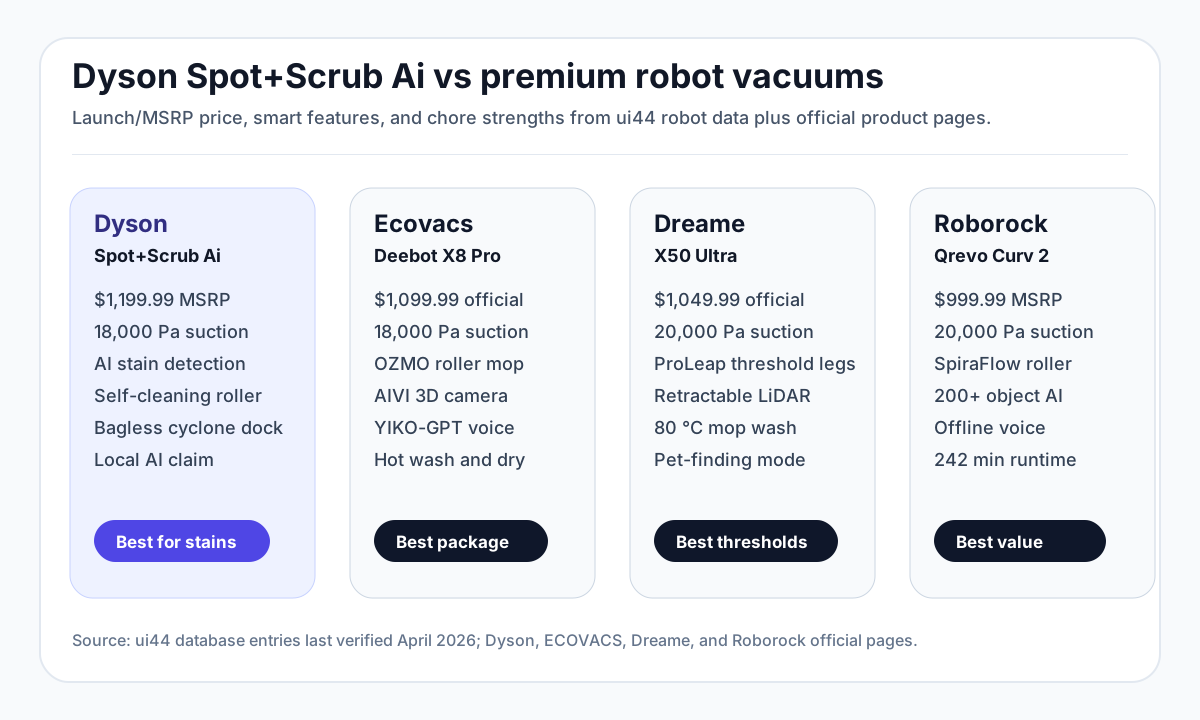
Short answer: Dyson is the most interesting pick if you specifically want stain-aware wet cleaning, a bagless cyclone dock, and Dyson's current local-AI privacy claim. It is not the automatic best all-rounder. Ecovacs and Roborock look stronger on feature density for the money, Dreame is better for difficult thresholds and low furniture, and the Saros Z70 is more novel if you want a consumer cleaning robot with a small manipulator.
Is Dyson Spot+Scrub Ai actually different?
Yes, but in a narrower way than the brand name suggests.
The important Dyson move is not raw suction. ui44 lists Spot+Scrub Ai at 18,000 Pa, which is strong, but not class-leading in 2026. The Dreame X50 Ultra and Roborock Qrevo Curv 2 Flow are both listed at 20,000 Pa, while newer Roborock and Dreame flagships go much higher. Dyson's useful difference is that the suction system is paired with a wet roller, green-spectrum illumination, a front HD camera, and AI logic that decides whether a stain needs more passes.
Dyson's official product page says the robot can reveal hidden stains, inspect surfaces with an AI-powered camera, identify household objects, substances, and stains, and run repeated cleaning passes before moving on. The same page also claims the AI operates inside the robot's secure processing environment rather than depending on cloud image processing. That is a meaningful privacy and latency claim, and it belongs in the same conversation as the ui44 guide to privacy-first robot vacuums.
The dock is also genuinely Dyson-coded. Instead of a disposable dust bag, the Spot+Scrub Ai uses a cyclone auto-empty dock with separate clean-water and dirty-water handling. ui44's database records a 3-litre onboard dust capacity claim for the dock system, while Dyson's live page describes up to 100 days of dry dirt storage, 140°F roller washing, and 113°F hot-air drying. That is a different maintenance philosophy from bag-based premium docks.
The trade-off is physical size and layout tolerance. Spot+Scrub Ai is listed in ui44 at 110 mm tall, compared with 98 mm for the Ecovacs X8 Pro Omni and about 89 mm for the Dreame X50 Ultra with its sensor retracted. In WIRED's testing, Dyson's height and body shape became a real issue around low furniture: the robot missed Cheerios under overhangs, wedged itself under cabinetry, and struggled with a low bed frame. PCMag's test was more positive about navigation and obstacle avoidance, but the mixed review pattern is the buyer signal: Dyson has finally become competitive, not magically immune to robot-vacuum physics.
How does Dyson compare with Roborock, Ecovacs, and Dreame?
Here is the data-driven version, using ui44 database fields plus current official product-page context.
Robot
- ui44 price context
- $1,199.99 launch/MSRP in ui44; Dyson page showed an $849.99 sale during research
- Smart features
- HD camera, LiDAR, green illumination, AI stain detection, local-AI claim
- Cleaning hardware
- 18,000 Pa, self-cleaning roller mop, bagless cyclone dock
- Best fit
- Stain-focused hard-floor buyers who like Dyson maintenance
Robot
- ui44 price context
- $1,099.99 official US listing in ui44
- Smart features
- AIVI 3D 3.0, VLM object recognition, YIKO-GPT voice
- Cleaning hardware
- 18,000 Pa, OZMO Roller, 75°C wash, 63°C dry
- Best fit
- Best all-round premium mop/vac package
Robot
- ui44 price context
- $1,049.99 X50 Ultra / $1,149.99 Complete in ui44
- Smart features
- AI obstacle avoidance, retractable VersaLift LiDAR, pet-finding mode
- Cleaning hardware
- 20,000 Pa, ProLeap threshold legs, 80°C mop washing
- Best fit
- Homes with thresholds, rugs, and low furniture
Robot
- ui44 price context
- $999.99 MSRP; $899.99 store price in ui44
- Smart features
- Reactive AI obstacle avoidance, SmartPlan 3.0, offline Hello Rocky voice
- Cleaning hardware
- 20,000 Pa, SpiraFlow roller, hot wash and warm dry
- Best fit
- Value pick if roller mopping matters
Robot
- ui44 price context
- $1,299.99 current official price in ui44
- Smart features
- StarSight 2.0, AI object recognition, 5-axis OmniGrip arm
- Cleaning hardware
- 22,000 Pa, vacuum/mop dock, object pickup
- Best fit
- Most novel premium cleaner, but arm use is narrow
| Robot | ui44 price context | Smart features | Cleaning hardware | Best fit |
|---|---|---|---|---|
| Dyson Spot+Scrub Ai | $1,199.99 launch/MSRP in ui44; Dyson page showed an $849.99 sale during research | HD camera, LiDAR, green illumination, AI stain detection, local-AI claim | 18,000 Pa, self-cleaning roller mop, bagless cyclone dock | Stain-focused hard-floor buyers who like Dyson maintenance |
| Ecovacs Deebot X8 Pro Omni | $1,099.99 official US listing in ui44 | AIVI 3D 3.0, VLM object recognition, YIKO-GPT voice | 18,000 Pa, OZMO Roller, 75°C wash, 63°C dry | Best all-round premium mop/vac package |
| Dreame X50 Ultra | $1,049.99 X50 Ultra / $1,149.99 Complete in ui44 | AI obstacle avoidance, retractable VersaLift LiDAR, pet-finding mode | 20,000 Pa, ProLeap threshold legs, 80°C mop washing | Homes with thresholds, rugs, and low furniture |
| Roborock Qrevo Curv 2 Flow | $999.99 MSRP; $899.99 store price in ui44 | Reactive AI obstacle avoidance, SmartPlan 3.0, offline Hello Rocky voice | 20,000 Pa, SpiraFlow roller, hot wash and warm dry | Value pick if roller mopping matters |
| Roborock Saros Z70 | $1,299.99 current official price in ui44 | StarSight 2.0, AI object recognition, 5-axis OmniGrip arm | 22,000 Pa, vacuum/mop dock, object pickup | Most novel premium cleaner, but arm use is narrow |
The table makes the buying decision less emotional. Dyson is no longer behind on basic premium features, but it is not ahead everywhere. It has a stain-first story; Ecovacs has the more complete roller-mop station story; Dreame has the mechanical mobility story; Roborock has both a strong value model and a more experimental arm model.
Where does Dyson win?
Dyson wins on four buyer-visible ideas.
First, stain detection is concrete. A lot of robot vacuums say "AI" when they really mean obstacle labels, room suggestions, or smarter scheduling. Dyson's pitch is easier to understand: the robot shines green light, sees a spill or stain, decides how aggressively to clean, checks again, and repeats. That is a clearer household outcome than a vague claim that the app is smarter.
Second, the wet roller approach is modern. Roller mops are becoming the premium direction because they can rinse dirty material away continuously instead of dragging a saturated pad across the floor. Dyson's 12-point hydration system is directly comparable to ECOVACS' OZMO Roller and Roborock's SpiraFlow system. If your main problem is sticky kitchen residue, paw prints, or tracked-in grime on sealed hard floors, the roller architecture matters more than another 2,000 Pa of suction.
Third, the dock avoids bags. Bagless auto-empty docks are not always cleaner for the person emptying them, but they do avoid buying proprietary dust bags for years. If you already like Dyson's stick-vac emptying workflow, Spot+Scrub Ai's cyclone dock will feel more familiar than the sealed-bag stations from Roborock, Dreame, and many Ecovacs models.
Fourth, Dyson's current privacy language is stronger than expected. The live Dyson page says the advanced AI system operates entirely within the robot's secure processing environment and avoids cloud dependencies or stored images. Buyers should still read the MyDyson app settings and privacy policy before trusting a camera robot, but the claim is specific enough to be worth rewarding.
The catch: Dyson's best advantages are narrow. They matter most if you have hard floors, visible stains, and a preference for Dyson maintenance. They matter less if you need maximum carpet pickup, the lowest body height, the best threshold crossing, or the most advanced object manipulation.
Where do the rivals beat Dyson?
The rivals beat Dyson by solving different physical problems.
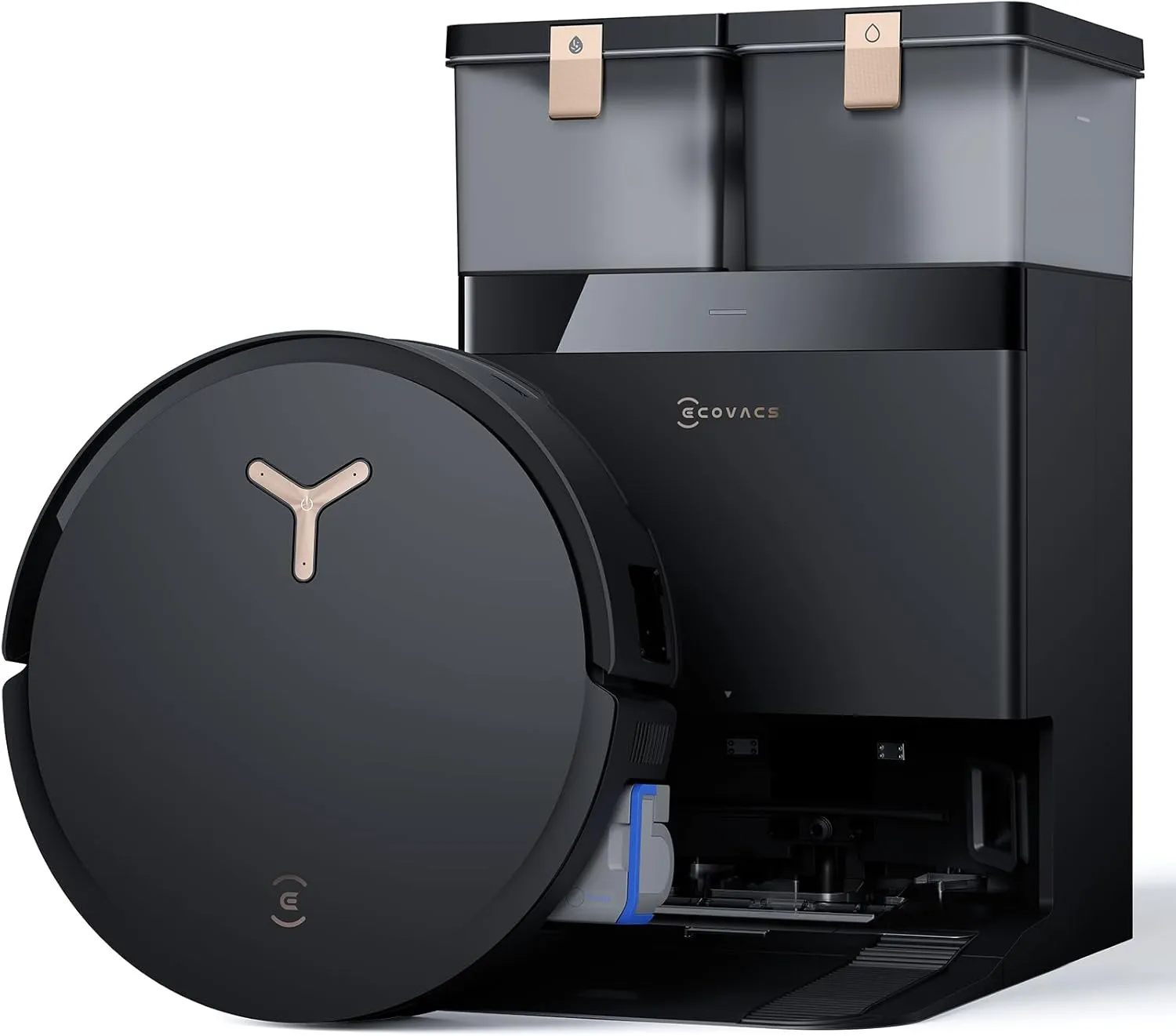
Ecovacs' X8 Pro Omni is the cleanest direct comparison because it also uses a roller mop and similar 18,000 Pa suction. Its official page emphasizes the OZMO Roller rinsing itself with 16 clean-water nozzles at 200 RPM, TruEdge 2.0 extension, ZeroTangle 2.0, AIVI 3D 3.0 object-aware edge cleaning, and YIKO-GPT voice control. PCMag's Spot+Scrub Ai review says the X8 Pro Omni earned better overall cleaning scores in its testing and remained the editor's choice, which is exactly the warning Dyson loyalists should hear: Dyson is competitive, but it has not erased the category specialists.
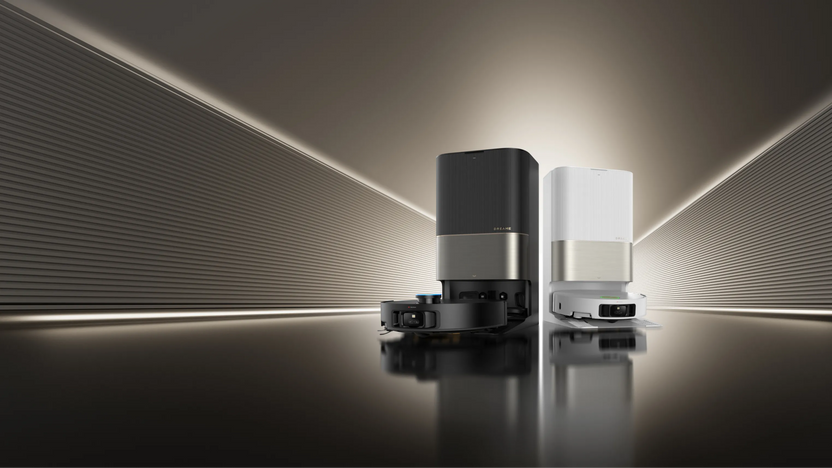
Dreame's X50 Ultra is the layout specialist. Its ui44 entry lists 20,000 Pa suction, a VersaLift retractable LiDAR sensor, and ProLeap retractable legs that climb thresholds up to 6 cm. That matters in homes with tall transitions, metal strips, chunky rugs, or low sofas. Dyson's AI stain logic does not help if the robot cannot reach the room cleanly or gets awkwardly trapped under furniture.
Roborock's Qrevo Curv 2 Flow is the value pressure. ui44 lists it at $999.99 MSRP and $899.99 on Roborock's US store as of April 2026, with 20,000 Pa suction, SpiraFlow roller mopping, 15 N downward pressure, Reactive AI obstacle avoidance for 200+ object types, and onboard offline "Hello Rocky" voice control. If you do not care about Dyson's bagless dock or stain-aware camera workflow, that is a lot of robot for less money.
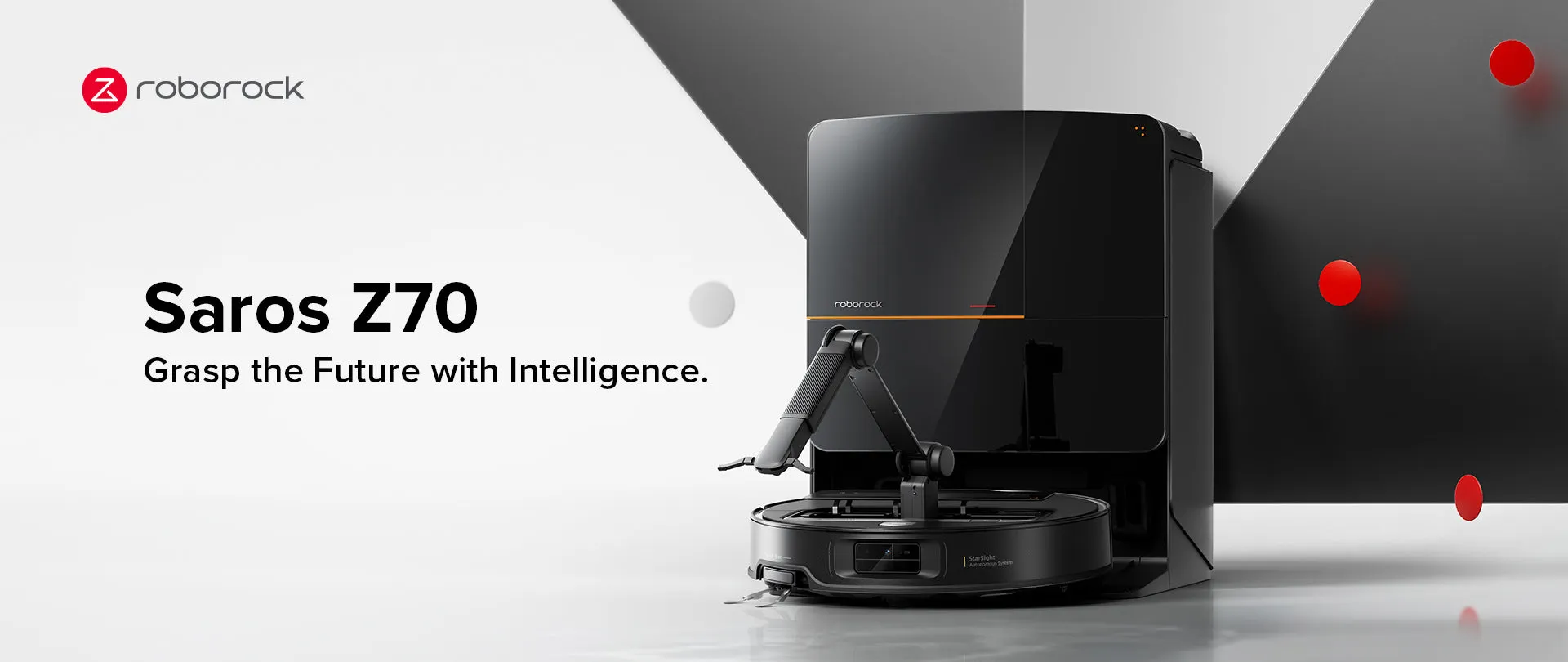
Then there is the Saros Z70 wildcard. It is not the closest price match, but it is important for ui44 readers because it includes a foldable 5-axis OmniGrip arm. The arm does not turn the vacuum into a household helper, but it can move small items like socks and shoes out of the cleaning path. That is a different kind of autonomy from Dyson's: Roborock is trying to clear the floor before cleaning; Dyson is trying to identify and scrub what is on the floor.
Which premium robot vacuum should you buy?
Use this buyer-fit filter before comparing coupon prices.
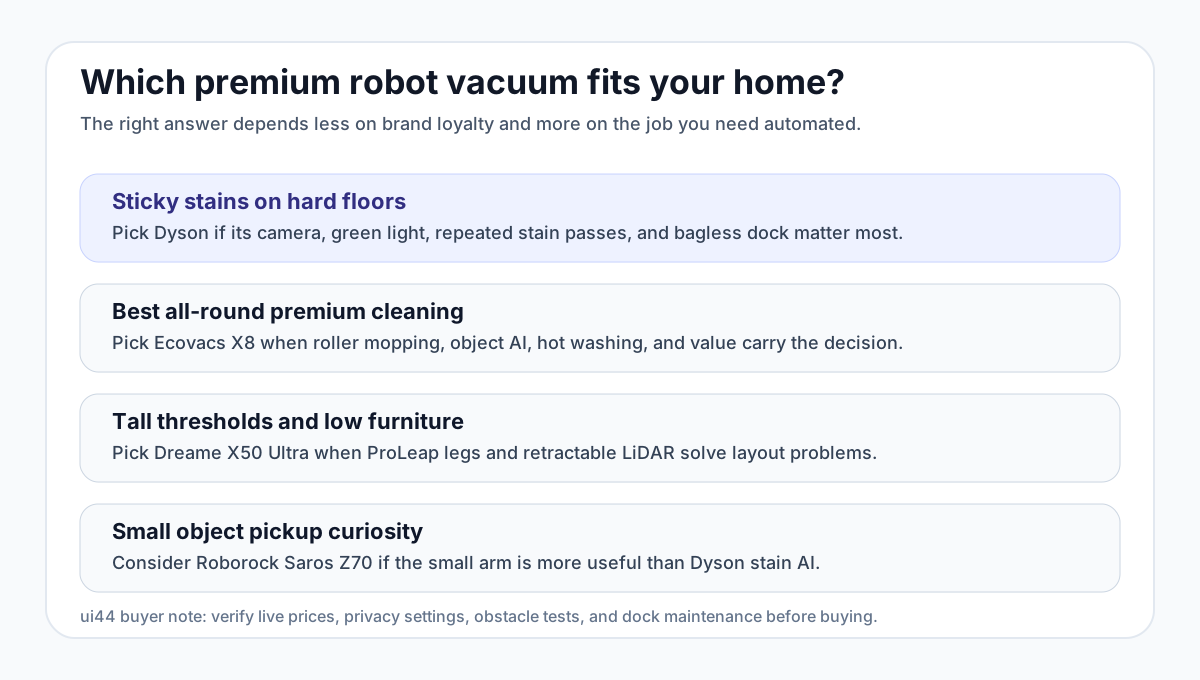
Buy Dyson Spot+Scrub Ai if your home is mostly hard floors, the annoying messes are visible stains or spills, you like Dyson's bagless maintenance style, and you value the local-AI claim enough to verify it in the app. It is the easiest robot here to explain to a non-robotics buyer: it sees stains, scrubs them, checks again, and empties into a Dyson-style dock.
Buy Ecovacs Deebot X8 Pro Omni if you want the safest premium all-rounder in this price band. It has a mature roller-mop story, strong edge-cleaning hardware, object-aware navigation, hot washing, hot-air drying, and a long hands-free dock cycle. It is also the rival most directly called out by PCMag as outperforming Dyson overall in testing.
Buy Dreame X50 Ultra if the floor plan is the challenge. The ProLeap legs, retractable LiDAR, and 20,000 Pa suction are more relevant than stain AI in homes with thresholds, carpets, low sofas, and rooms that ordinary robots fail to enter. Dreame is also a better fit if you want a model that is physically trying to adapt to the house rather than only recognizing messes.
Buy Roborock Qrevo Curv 2 Flow if you want roller mopping and smart features for less money than Dyson's launch price. Its 20,000 Pa suction, SpiraFlow roller, Reactive AI, long runtime, and offline voice assistant make Dyson's $1,199.99 MSRP feel less comfortable unless Dyson's stain workflow is the thing you care about.
Consider Roborock Saros Z70 if you are buying for novelty and can accept first-generation limits. The arm is not a universal home manipulator, but it is one of the clearest examples of a cleaning robot crossing into light physical interaction. If you are curious about where home robots go after mapping and mopping, Saros Z70 is more interesting than Dyson.
What should you verify before buying?
Before buying any of these robots, verify five things that spec sheets hide.
1. Live price, not launch price. ui44 records Dyson's Spot+Scrub Ai at its $1,199.99 launch/MSRP, but Dyson's official page showed an $849.99 sale during this research pass. Robot-vacuum pricing moves quickly. Compare live prices against the database price, not instead of it.
2. Furniture clearance. Measure the lowest furniture you actually want the robot to enter. Dyson's 110 mm height is not unusually huge, but it is tall enough to matter under beds, cabinets, and sofa rails. Dreame's retractable LiDAR and Roborock's low Saros platform can be more useful than another AI feature.
3. Multi-floor workflow. WIRED's review notes that Dyson's multi-floor use is not as seamless as a single-floor docked workflow because the robot cannot empty, wash, and dry itself away from the base. That is true of many docked robots, but it matters more with wet rollers because dirty water and mop drying are part of the maintenance loop.
4. Privacy settings. Dyson's local-processing language is promising, but a camera robot still has app accounts, maps, firmware updates, support logs, and voice integrations. Check what works locally, what uploads, and what you lose if you turn cloud features off. Use /compare to line up camera-equipped models next to simpler LiDAR-only robots if privacy is the deciding factor.
5. Dock consumables. Bagless does not mean maintenance-free. Dyson avoids dust bags, but you still have filters, tanks, roller cleaning, detergent, and periodic dock hygiene. Ecovacs, Roborock, and Dreame often use dust bags but can keep emptying cleaner and simpler. Choose the mess you are willing to handle.
Bottom line
The Dyson Spot+Scrub Ai is finally a credible Dyson robot vacuum. That alone is newsworthy. It fixes the old 360 Vis Nav problem by adding mopping, self-emptying, self-cleaning, LiDAR, obstacle-aware navigation, and a stain-specific AI feature that ordinary shoppers can understand.
But the premium robot-vacuum market did not wait for Dyson. Ecovacs already has a mature roller-mop flagship. Dreame is solving thresholds and furniture with mechanical hardware. Roborock is pushing value with the Qrevo line and novelty with the Saros Z70 arm.
So the honest recommendation is this: buy Dyson for stain AI, local-processing language, and bagless Dyson maintenance. Buy one of the rivals if your priority is overall cleaning value, difficult floor geometry, lower clearance, or the most interesting robot hardware. Dyson is back in the conversation, but the smart buy still depends on the floor plan in front of the robot.
Related in the database
Use this article as a privacy verification workflow
Turn the article into a privacy verification pass grounded in the robots, manufacturers, and components it actually references.
Dyson Spot+Scrub Ai vs Premium Robot Vacuums already points you toward 5 linked robots, 4 manufacturers, and 2 countries inside the ui44 database. That matters because strong buyer guidance is easier to apply when you can move immediately from a claim or warning into concrete product pages, manufacturer directories, component explainers, and country-level context instead of treating the article as an isolated opinion piece. The fastest next step is to turn the article into a shortlist workflow: open the linked robot pages, verify which specs are actually published for those models, then compare the surrounding manufacturer and component context before you decide whether the underlying claim changes your buying plan.
For this topic, the useful discipline is to separate the editorial lesson from the catalog evidence. The article gives you the framing, but the robot pages tell you what each product actually ships with today: sensor stack, connectivity methods, listed price, release timing, category, and support-relevant compatibility notes. The manufacturer pages then show whether you are looking at a one-off launch, a broader lineup pattern, or a company that spans multiple categories. That layered workflow reduces the risk of buying on a single marketing phrase or a single support FAQ.
Use the robot pages to confirm which products actually expose cameras, microphones, Wi-Fi, or voice systems, then use the manufacturer pages to decide how much of the privacy question seems product-specific versus brand-wide. On this route cluster, Spot+Scrub Ai, Deebot X8 Pro Omni, and X50 Ultra form the fastest reality check. If you want a quick working shortlist, open Compare Spot+Scrub Ai, Deebot X8 Pro Omni, and X50 Ultra next, then keep this article open as the reasoning layer while you compare structured data side by side.
Practical Takeaway
Every robot, manufacturer, category, component, and country reference below resolves to a real ui44 page, keeping the follow-up path grounded in database records rather than generic advice.
Suggested next steps in ui44
- Open Spot+Scrub Ai and note the listed sensors, connectivity methods, and voice stack before you interpret any policy claim.
- Cross-check the wider brand context on Dyson so you can see whether the privacy question touches one model or a broader lineup.
- Use the linked component pages to confirm how common the relevant sensors and connectivity layers are across the database.
- Keep a short note of which policy layers you checked, which device features are actually present on the robot page, and which items still depend on region- or app-level confirmation.
- Finish with Compare Spot+Scrub Ai, Deebot X8 Pro Omni, and X50 Ultra so the policy reading sits next to structured product data.
Robot profiles worth opening next
Use the linked product pages as the evidence layer
The linked robot pages are where this article becomes operational. Instead of asking whether the headline is interesting, use the robot entries to inspect the actual mix of sensors, connectivity options, batteries, pricing, release timing, and stated capabilities attached to the products mentioned in the article. That is the easiest way to see whether the warning or opportunity described here affects one product family, a specific design pattern, or an entire buying lane.
Spot+Scrub Ai
Dyson · Cleaning · Available
Spot+Scrub Ai is tracked on ui44 as a available cleaning robot from Dyson. The database currently records a listed price of $1,200, a release date of 2026-03-12, Up to 200 minutes battery life, 3 hours charging time, and a published stack that includes LiDAR pulsed lasers, Ultrasonic floor-type sensors, and AI-powered front-facing HD camera plus Wi-Fi and Bluetooth.
For privacy-focused reading, this page matters because it shows the concrete device surface behind the policy discussion. Use it to verify whether Spot+Scrub Ai combines sensors and connectivity in a way that could change the in-home data footprint, and compare the listed capabilities such as 18,000 Pa Suction, Self-Cleaning Wet Roller Mop, and 12-Point Hydration System with any cloud, app, or voice layers, including Amazon Alexa and Google Assistant.
Deebot X8 Pro Omni
Ecovacs · Cleaning · Available
Deebot X8 Pro Omni is tracked on ui44 as a available cleaning robot from Ecovacs. The database currently records a listed price of $1,100, a release date of 2025-01, Up to 291 minutes (low power mode) battery life, 4h37min charging time, and a published stack that includes dToF LiDAR (Embedded), AIVI 3D 3.0 Camera, and Dual Structured Light plus Wi-Fi and Bluetooth.
For privacy-focused reading, this page matters because it shows the concrete device surface behind the policy discussion. Use it to verify whether Deebot X8 Pro Omni combines sensors and connectivity in a way that could change the in-home data footprint, and compare the listed capabilities such as 18,000 Pa Suction Power, OZMO Roller Instant Self-Washing Mopping, and ZeroTangle 2.0 Anti-Hair-Wrap with any cloud, app, or voice layers, including YIKO-GPT (built-in LLM assistant) and Amazon Alexa.
X50 Ultra is tracked on ui44 as a available cleaning robot from Dreame. The database currently records a listed price of $1,050, a release date of 2025-02, 6,400 mAh battery; up to 220 minutes in Quiet Mode / 205 m² (2,207.85 ft²) per charge battery life, Not officially disclosed charging time, and a published stack that includes LiDAR (VersaLift motorized retractable), 3D Structured Light, and RGB Camera plus Wi-Fi (2.4GHz only).
For privacy-focused reading, this page matters because it shows the concrete device surface behind the policy discussion. Use it to verify whether X50 Ultra combines sensors and connectivity in a way that could change the in-home data footprint, and compare the listed capabilities such as ProLeap Retractable Legs (climb 6cm thresholds), VersaLift Motorized LiDAR (clean under 8.9cm furniture), and 20,000 Pa HyperForce Suction with any cloud, app, or voice layers, including Amazon Alexa and Google Assistant.
Qrevo Curv 2 Flow
Roborock · Cleaning · Available
Qrevo Curv 2 Flow is tracked on ui44 as a available cleaning robot from Roborock. The database currently records a listed price of $900, a release date of 2026-01, Up to 242 minutes battery life, About 3 hours from 15% to full (5,200 mAh battery) charging time, and a published stack that includes PreciSense Spinning LiDAR, 3D Structured Light, and RGB Camera plus Wi-Fi and Bluetooth.
For privacy-focused reading, this page matters because it shows the concrete device surface behind the policy discussion. Use it to verify whether Qrevo Curv 2 Flow combines sensors and connectivity in a way that could change the in-home data footprint, and compare the listed capabilities such as SpiraFlow Self-Cleaning Roller Mop (270 mm, 220 RPM), 15 N Downward Mopping Pressure, and 8-Nozzle Clean Water Delivery with any cloud, app, or voice layers, including Hello Rocky (onboard, offline) and Amazon Alexa.
Saros Z70 is tracked on ui44 as a available cleaning robot from Roborock. The database currently records a listed price of $1,000, a release date of 2025-05, 6,400 mAh Li-ion; official FAQ says about 2h15+ vacuuming/mopping with the arm disabled, or about 2h10+ with the arm enabled while tidying 10 items (Mop Wash Frequency set to 15 minutes). battery life, 2.5-hour fast charging charging time, and a published stack that includes LiDAR (StarSight 2.0), 3D Structured Light, and RGB Camera plus Wi-Fi and Bluetooth.
For privacy-focused reading, this page matters because it shows the concrete device surface behind the policy discussion. Use it to verify whether Saros Z70 combines sensors and connectivity in a way that could change the in-home data footprint, and compare the listed capabilities such as OmniGrip 5-Axis Mechanical Arm, Object Pickup up to 300 g (socks, sandals, crumpled tissues, towels; more items planned via OTA), and Obstacle Relocation with any cloud, app, or voice layers, including Amazon Alexa and Google Assistant.
Manufacturer context behind the article
Check whether this is one product story or a broader company pattern
Manufacturer pages add the privacy context that individual product pages cannot show on their own. They help you check whether cameras, microphones, cloud accounts, app controls, and policy assumptions appear across a broader lineup or stay tied to one specific product story.
Dyson
ui44 currently tracks 1 robot from Dyson across 1 category. The company is grouped under Singapore, and the current catalog footprint on ui44 includes Spot+Scrub Ai.
That wider brand context matters because privacy questions rarely stop at one FAQ page. A manufacturer route helps you see whether the article is centered on one premium model or on a company that has several relevant products and therefore more than one place where the same policy or app assumptions might matter. The category mix here currently points toward Cleaning as the most useful next route if you want to see whether this article reflects a wider pattern inside the brand.
Ecovacs
ui44 currently tracks 7 robots from Ecovacs across 3 categorys. The company is grouped under China, and the current catalog footprint on ui44 includes Deebot X8 Pro Omni, Deebot X12 OmniCyclone, Deebot T90 Pro Omni.
That wider brand context matters because privacy questions rarely stop at one FAQ page. A manufacturer route helps you see whether the article is centered on one premium model or on a company that has several relevant products and therefore more than one place where the same policy or app assumptions might matter. The category mix here currently points toward Cleaning, Lawn & Garden, Companions as the most useful next route if you want to see whether this article reflects a wider pattern inside the brand.
Dreame
ui44 currently tracks 10 robots from Dreame across 2 categorys. The company is grouped under China, and the current catalog footprint on ui44 includes X50 Ultra, A3 AWD Pro, X60 Max Ultra Complete.
That wider brand context matters because privacy questions rarely stop at one FAQ page. A manufacturer route helps you see whether the article is centered on one premium model or on a company that has several relevant products and therefore more than one place where the same policy or app assumptions might matter. The category mix here currently points toward Cleaning, Lawn & Garden as the most useful next route if you want to see whether this article reflects a wider pattern inside the brand.
Roborock
ui44 currently tracks 6 robots from Roborock across 2 categorys. The company is grouped under China, and the current catalog footprint on ui44 includes Saros Z70, Saros Rover, Saros 20.
That wider brand context matters because privacy questions rarely stop at one FAQ page. A manufacturer route helps you see whether the article is centered on one premium model or on a company that has several relevant products and therefore more than one place where the same policy or app assumptions might matter. The category mix here currently points toward Cleaning, Lawn & Garden as the most useful next route if you want to see whether this article reflects a wider pattern inside the brand.
Broaden the scan without leaving the database
Categories, components, and countries add the wider context
Category framing
Category pages are useful when the article touches a buying pattern that shows up across brands. A category route helps you confirm whether the linked products sit in a narrow niche or whether the same question should be tested across a larger field of alternatives.
Cleaning
The Cleaning category page currently groups 62 tracked robots from 27 manufacturers. ui44 describes this lane as: Robot vacuums, mops, pool cleaners, and window cleaners — the workhorses of home automation that keep every surface spotless.
That makes the category route a practical follow-up when you want to check whether the products linked in this article are typical for the lane or whether they sit at one edge of the market. Useful starting examples currently include Scuba V3, EcoSurfer S2, Scuba V3 Ultra.
Country and ecosystem context
Country pages give extra context when support practices, launch sequencing, regulatory posture, or manufacturer mix matter. They are not a substitute for model-level verification, but they do help you see which ecosystems cluster together and which manufacturers sit in the same regional field when you broaden the search beyond the article headline.
Singapore
The Singapore route currently groups 11 tracked robots from 6 manufacturers in ui44. That gives you a useful regional lens when the article points toward support practices, launch sequencing, or brand clusters that may share similar ecosystem assumptions.
On the current route, manufacturers like eufy, Dyson, InsBotics make the page a good way to broaden the scan without losing the regional context that often shapes availability, documentation style, and adjacent alternatives.
China
The China route currently groups 189 tracked robots from 87 manufacturers in ui44. That gives you a useful regional lens when the article points toward support practices, launch sequencing, or brand clusters that may share similar ecosystem assumptions.
On the current route, manufacturers like AGIBOT, Dreame, Unitree Robotics make the page a good way to broaden the scan without losing the regional context that often shapes availability, documentation style, and adjacent alternatives.
Questions to answer before you move from reading to buying
A follow-up FAQ built from the entities already linked in this article
Frequently Asked Questions
Which page should I open first after reading “Dyson Spot+Scrub Ai vs Premium Robot Vacuums”?
Start with Spot+Scrub Ai. That gives you a concrete product anchor for the article’s main claim. From there, branch into the manufacturer and component pages so you can tell whether the article is describing one specific model, a repeated brand pattern, or a wider technology issue that affects multiple shortlist options.
How do the manufacturer pages change the buying decision?
Dyson help you zoom out from one article and one product. On ui44 they show lineup breadth, category spread, and the neighboring robots tied to the same company. That context is useful when you are deciding whether a risk belongs to a single model, whether it shows up across a brand’s portfolio, and whether you should keep looking at alternatives before committing.
When should I switch from reading to side-by-side comparison?
Move into Compare Spot+Scrub Ai, Deebot X8 Pro Omni, and X50 Ultra as soon as you understand the article’s main warning or promise. The article explains what to watch for, but the compare view is where you can check whether price, status, battery life, connectivity, sensors, and category fit still make the robot a good match for your own home and budget.
Where to go next in ui44
Keep the research chain inside the database
If you want to keep going, these follow-on pages give you the cleanest expansion path from article to research session. Open the comparison route first if you are deciding between products today. Open the manufacturer, category, and component routes if you still need to understand the broader pattern behind the claim.
Written by
ui44 Team
Published May 18, 2026
Share this article
Open a plain share link on X or Bluesky. No embeds, no widgets, no cookie baggage.