The bigger signal is that Bear is trying to connect three things most humanoid demos still keep separate: deployed autonomous mobile robot fleets, object manipulation, and a support operation that already has to keep robots running in messy public spaces. If KR1 ever becomes relevant to homes, that operational layer may matter more than the shape of the robot.
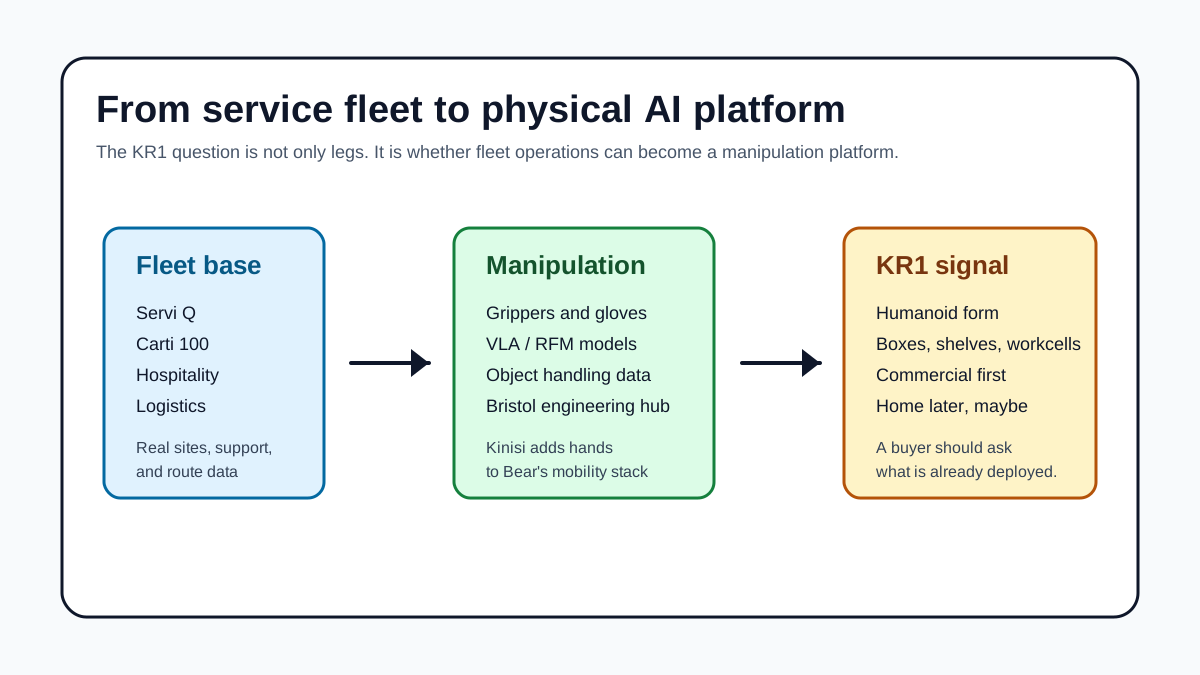
Robot Newspaper reported on June 22, 2026 that Bear Robotics signed a deal to acquire UK-based Kinisi Robotics, the company behind the KR1 humanoid platform. The report says Bear has supplied about 16,000 autonomous robots across more than 5,000 sites in roughly 20 countries, and frames the acquisition as adding manipulation AI to Bear's existing autonomous mobility and multi-robot orchestration stack.
Kinisi's own site describes KR1 as a robot for warehouse and storeroom work: lifting, picking, loading, transporting, and adapting to different tasks. It also emphasizes local onboard processing, not cloud-only decision making. Bear's official site, meanwhile, is full of practical fleet language: narrow-path navigation, real-time multi-robot path planning, peer-to-peer communication, stable delivery, and commercial deployment metrics.
That combination is why this story belongs on ui44. The near-term buyer is not a household. The useful question for households is whether companies with real commercial fleets are building the missing infrastructure that general-purpose home robots will eventually need.
The KR1 News Is Really About The Stack
Most humanoid robot coverage starts with the body: height, hands, walking speed, and whether the robot looks at home in a kitchen. Bear's move points in the opposite direction. It starts with a working service-robot business and asks what happens when manipulation is added.
That distinction matters. A mobile base that can navigate restaurants, hotels, senior-living facilities, warehouses, and factories already has to solve boring but essential problems: mapping, traffic, charging, scheduling, remote support, software updates, and fleet monitoring. Those are not glamorous, but they are the difference between a demo robot and a deployed robot.
ui44's database already shows Bear in this category through Servi Q, a compact commercial service robot. Servi Q is listed as active, with a 106 cm body, 45 kg weight, at least 12 hours of usage-dependent battery life, and a 30 kg total payload split across trays. It is not a humanoid, but it is the kind of commercial AMR that can quietly teach a company how robots behave around humans all day.
KR1 brings the missing arm-and-hand side of the equation. Robot Newspaper says Kinisi contributes a KR1 humanoid platform for picking, placing, sorting, and transporting objects, plus VLA and robot foundation model work, and its own gripper and glove technology for lower-cost manipulation data collection. If those pieces are tightly integrated with Bear's mobility stack, the result could be more interesting than a humanoid prototype built in isolation.
For home robots, the lesson is simple: the future helper is unlikely to arrive from legs alone. It will need route planning, hand skills, fleet support, service parts, repair workflows, privacy controls, and a business model that can survive after the launch video fades.
Why A Service-Robot Fleet Is A Real Advantage
Bear's homepage says its robots had saved more than 1.2 billion steps and made more than 77 million deliveries as of Q1 2026. Those are company-published metrics, not independent audit numbers, but they still reveal the type of machine Bear has been building: robots that repeat a narrow service workflow thousands of times instead of impressing on a stage once.
That matters because robot learning is not only about model size. It is also about the distribution of real tasks. Restaurants and hotels produce narrow aisles, blocked paths, reflective floors, human traffic, elevators, trays, spills, and schedule pressure. Warehouses add totes, shelving, pallet flow, receiving, returns, and barcode-driven workflows. A robot that survives those environments is closer to practical automation than one that only walks on a lab floor.
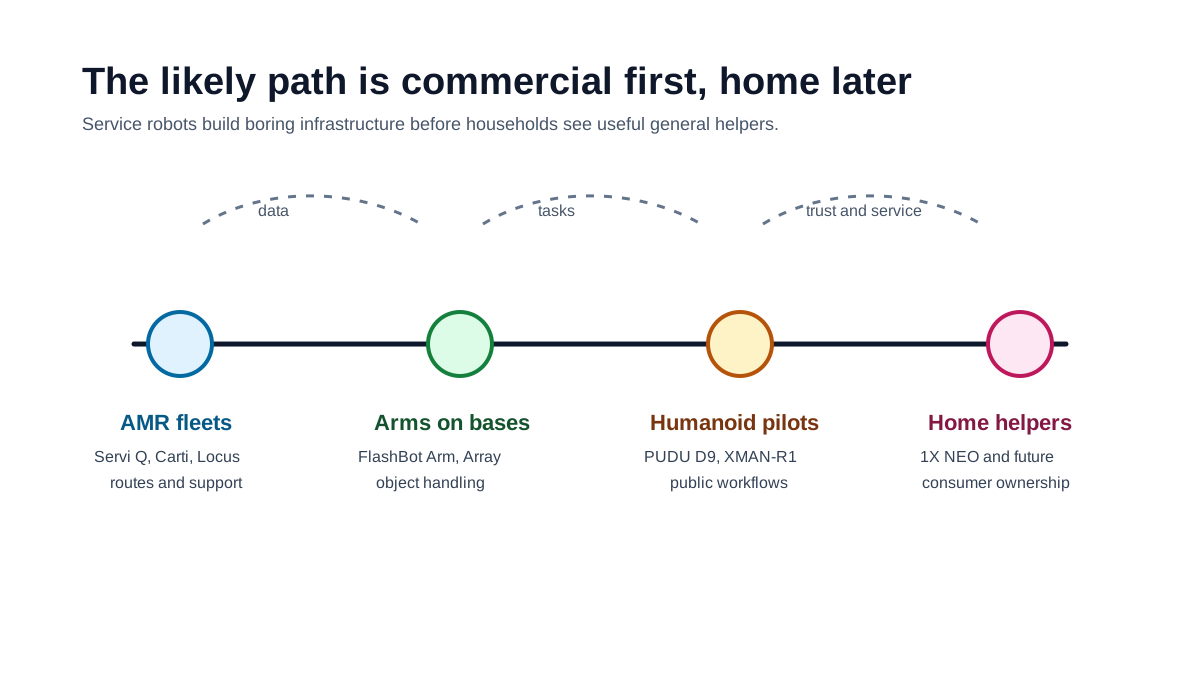
The strongest commercial-to-home pattern in the ui44 database is not "humanoid first." It is "useful workflow first." PUDU FlashBot Arm is an active commercial robot with two 7-DOF arms, DH11 dexterous hands, RGBD cameras, LiDAR, panoramic cameras, pressure-sensitive skin, up to 8 hours of no-load battery life, and a 15 kg capacity. Locus Array is a warehouse mobile manipulator built around AI-powered vision, robotic picking, and LocusONE orchestration. Neither is a consumer home product, but both show the same direction: mobile robots are being asked to handle objects, not just move themselves.
Bear plus Kinisi fits that pattern. If KR1 is successful, the first proof will probably be in structured commercial workflows: moving objects between shelves and carts, handling supplies, sorting items, and coordinating with non-humanoid AMRs. That does not make it boring. It makes it credible.
What Does KR1 Still Have To Prove?
The acquisition does not make KR1 a home robot. It makes KR1 a more interesting commercial robot candidate.
Kinisi says KR1 is built for real-world deployments and wide-ranging tasks, including heavy boxes and precise assembly. The site also says KR1 has onboard intelligence and can process locally. Those are useful claims, but home buyers should separate "promising" from "ready."
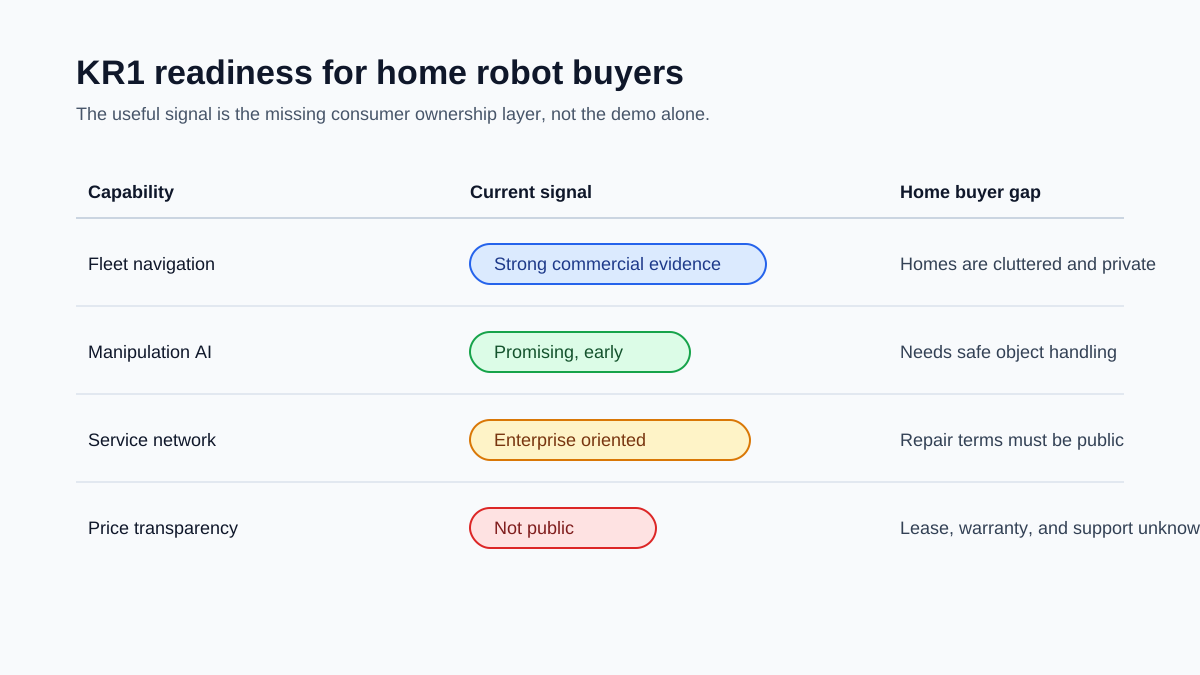
The gaps are familiar:
Question
What can KR1 do autonomously for 30 days in one messy site?
- Why it matters for homes
- A household does not want a supervised lab robot. It wants repeatable chores.
Question
What happens when the robot misgrips, drops, or blocks an object?
- Why it matters for homes
- Home work is contact-rich and full of fragile things.
Question
How are repairs handled?
- Why it matters for homes
- A humanoid with hands will break different parts than a vacuum or speaker.
Question
What data leaves the home?
- Why it matters for homes
- Local processing helps, but privacy terms and logs matter.
Question
What is the price or lease?
- Why it matters for homes
- Commercial pricing can hide costs that consumers cannot absorb.
| Question | Why it matters for homes |
|---|---|
| What can KR1 do autonomously for 30 days in one messy site? | A household does not want a supervised lab robot. It wants repeatable chores. |
| What happens when the robot misgrips, drops, or blocks an object? | Home work is contact-rich and full of fragile things. |
| How are repairs handled? | A humanoid with hands will break different parts than a vacuum or speaker. |
| What data leaves the home? | Local processing helps, but privacy terms and logs matter. |
| What is the price or lease? | Commercial pricing can hide costs that consumers cannot absorb. |
That last point is important. ui44 lists 1X NEO at a $20,000 pre-order price and Unitree G1 at $13,500 for a research-oriented available humanoid. Those robots are very different from KR1, but they give buyers a reference point: even when a humanoid price is public, the true ownership cost depends on software access, support, repair, and what the robot can safely do without a remote operator.
Bear has not publicly turned KR1 into a consumer offer. That restraint is healthy. A commercial deployment path can expose hard reliability problems before those problems move into kitchens, bedrooms, and elder-care apartments.
The Useful Comparison: Pudu, Locus, Mirokai, And 1X
KR1 should be judged against the wider market, not against science-fiction expectations.
PUDU D9 is a full-size humanoid in pre-order status in ui44's database. It is listed at 170 cm, with a current weight note of 65 kg on the product-page spec and 58 kg in a latest-iteration update, a maximum payload of 20 kg, single-arm payload of 10 kg, up to 2 m/s speed, and multimodal perception claims around visual, tactile, force, and auditory sensors. Pudu has a commercial service-robot background, which is why D9 is relevant here: it is another example of a company trying to move from service fleets toward humanoid form.
Mirokai, from Enchanted Tools, takes a different route. ui44 lists it as an active commercial social humanoid, 123 cm tall, about 26 kg, with roughly 4 hours of battery life and configuration-dependent load handling. It is less about warehouse manipulation and more about human-facing care, hospitality, and social interaction. That makes it a useful reminder that "humanoid" is not one category. A social robot, a warehouse picker, and a household helper have different success criteria.
Locus Array is another important comparison because it is not humanoid at all. It combines a mobile base, robotic arm, AI vision, grasp planning, and fleet orchestration for warehouse picking. For many commercial tasks, that may be more practical than legs. If KR1's advantage is real, it has to beat simpler mobile-manipulator approaches where the task does not require a human body shape.
1X is the consumer-facing contrast. NEO is explicitly positioned around the home, with a soft lightweight body, 167 cm height, 30 kg weight, about 4 hours of battery life, RGB and depth sensing, tactile skin, microphones, and 1X's embodied intelligence stack in ui44's record. That is the closer emotional picture of a home helper. Bear and Kinisi are closer to the operational picture of how such robots might become reliable.
Why This Could Matter For Home Robot Buyers
Home robot buyers should watch Bear and Kinisi for four signals.
First, watch whether KR1 is shown doing end-to-end workflows rather than isolated manipulation tricks. A robot that picks one object on a table is interesting. A robot that repeatedly moves many object types through a real facility with changing humans, carts, doors, and schedules is a stronger signal.
Second, watch whether KR1 cooperates with Bear's non-humanoid robots. The acquisition is most valuable if humanoids, tray robots, and warehouse AMRs can share maps, tasks, and operational data. A home version of that idea could eventually mean a household robot that coordinates with simpler appliances instead of trying to do everything alone.
Third, watch service terms. Bear already sells into businesses where uptime matters. If that discipline reaches manipulation robots, it could produce clearer maintenance, part replacement, warranty, and remote-support practices. Those are exactly the boring details home humanoids need.
Fourth, watch privacy and local autonomy. Kinisi's site emphasizes onboard processing. For homes, that is a good starting point, but buyers will need specifics: video retention, remote access, teleoperation, model updates, failure logs, and whether sensitive household data trains shared systems.
The Home-Robot Takeaway
The Bear-Kinisi story is not that a service robot company suddenly has a home humanoid. It does not. KR1 appears aimed first at commercial and industrial workflows, and key consumer details are missing.
The real story is that a company with deployed autonomous robots wants manipulation, humanoid form, and physical AI inside the same operating platform. That is exactly the kind of convergence home robot buyers should care about. The home helper market will not be won only by the robot that walks best. It will be won by the robot that can do useful work, fail safely, get repaired, protect private data, and keep improving without turning the household into a lab.
For now, Bear Robotics and Kinisi belong on the watchlist because they connect the right ingredients: service fleet experience, commercial support, mobile robots, KR1 manipulation ambitions, and a path through real workplaces before the home. That is a more grounded signal than another humanoid demo clip.
Sources & References
- Robot Newspaper: Bear Robotics acquisition report, June 22, 2026: https://www.irobotnews.com/news/articleView.html?idxno=47032
- Kinisi official KR1 site: https://kinisi.com/
- Bear Robotics official site: https://www.bearrobotics.ai/
Related in the database
Use this article as a privacy verification workflow
Turn the article into a privacy verification pass grounded in the robots, manufacturers, and components it actually references.
Bear Robotics, Kinisi, and the KR1 Signal already points you toward 8 linked robots, 7 manufacturers, and 4 countries inside the ui44 database. That matters because strong buyer guidance is easier to apply when you can move immediately from a claim or warning into concrete product pages, manufacturer directories, component explainers, and country-level context instead of treating the article as an isolated opinion piece. The fastest next step is to turn the article into a shortlist workflow: open the linked robot pages, verify which specs are actually published for those models, then compare the surrounding manufacturer and component context before you decide whether the underlying claim changes your buying plan.
For this topic, the useful discipline is to separate the editorial lesson from the catalog evidence. The article gives you the framing, but the robot pages tell you what each product actually ships with today: sensor stack, connectivity methods, listed price, release timing, category, and support-relevant compatibility notes. The manufacturer pages then show whether you are looking at a one-off launch, a broader lineup pattern, or a company that spans multiple categories. That layered workflow reduces the risk of buying on a single marketing phrase or a single support FAQ.
Use the robot pages to confirm which products actually expose cameras, microphones, Wi-Fi, or voice systems, then use the manufacturer pages to decide how much of the privacy question seems product-specific versus brand-wide. On this route cluster, Servi Q, PUDU D9, and PUDU FlashBot Arm form the fastest reality check. If you want a quick working shortlist, open Compare Servi Q, PUDU D9, and PUDU FlashBot Arm next, then keep this article open as the reasoning layer while you compare structured data side by side.
Practical Takeaway
Every robot, manufacturer, category, component, and country reference below resolves to a real ui44 page, keeping the follow-up path grounded in database records rather than generic advice.
Suggested next steps in ui44
- Open Servi Q and note the listed sensors, connectivity methods, and voice stack before you interpret any policy claim.
- Cross-check the wider brand context on Bear Robotics so you can see whether the privacy question touches one model or a broader lineup.
- Use the linked component pages to confirm how common the relevant sensors and connectivity layers are across the database.
- Keep a short note of which policy layers you checked, which device features are actually present on the robot page, and which items still depend on region- or app-level confirmation.
- Finish with Compare Servi Q, PUDU D9, and PUDU FlashBot Arm so the policy reading sits next to structured product data.
Robot profiles worth opening next
Use the linked product pages as the evidence layer
The linked robot pages are where this article becomes operational. Instead of asking whether the headline is interesting, use the robot entries to inspect the actual mix of sensors, connectivity options, batteries, pricing, release timing, and stated capabilities attached to the products mentioned in the article. That is the easiest way to see whether the warning or opportunity described here affects one product family, a specific design pattern, or an entire buying lane.
Servi Q
Bear Robotics · Commercial · Active
Servi Q is tracked on ui44 as a active commercial robot from Bear Robotics. The database currently records a listed price of Price TBA, a release date of 2026-05-16, ≥12 hours (usage-dependent) battery life, <4 hours charging time, and a published stack that includes Backward bump detection (sensor type not publicly disclosed) plus Peer-to-peer Bear Robotics fleet communication.
For privacy-focused reading, this page matters because it shows the concrete device surface behind the policy discussion. Use it to verify whether Servi Q combines sensors and connectivity in a way that could change the in-home data footprint, and compare the listed capabilities such as Autonomous Food and Item Delivery, 18-Inch Narrow-Aisle Navigation, and Stable Spill-Resistant Delivery with any cloud, app, or voice layers.
PUDU D9
Pudu Robotics · Humanoid · Pre-order
PUDU D9 is tracked on ui44 as a pre-order humanoid robot from Pudu Robotics. The database currently records a listed price of Price TBA, a release date of 2024-12, Not publicly disclosed battery life, Not publicly disclosed charging time, and a published stack that includes Visual sensors, Tactile sensors, and Force sensors plus Not publicly disclosed.
For privacy-focused reading, this page matters because it shows the concrete device surface behind the policy discussion. Use it to verify whether PUDU D9 combines sensors and connectivity in a way that could change the in-home data footprint, and compare the listed capabilities such as Bipedal walking, Stair and slope navigation, and Real-time 3D semantic mapping with any cloud, app, or voice layers.
PUDU FlashBot Arm
Pudu Robotics · Commercial · Active
PUDU FlashBot Arm is tracked on ui44 as a active commercial robot from Pudu Robotics. The database currently records a listed price of Price TBA, a release date of 2025-03, Up to 8 hours (no-load) battery life, 4 hours charging time, and a published stack that includes RGBD cameras, LiDAR, and Panoramic cameras plus Not publicly disclosed.
For privacy-focused reading, this page matters because it shows the concrete device surface behind the policy discussion. Use it to verify whether PUDU FlashBot Arm combines sensors and connectivity in a way that could change the in-home data footprint, and compare the listed capabilities such as Autonomous delivery, Two 7-DOF robotic arms, and PUDU DH11 dexterous hands with any cloud, app, or voice layers.
Locus Array
Locus Robotics · Commercial · Active
Locus Array is tracked on ui44 as a active commercial robot from Locus Robotics. The database currently records a listed price of Price TBA, a release date of 2026-04, Not publicly disclosed battery life, Not publicly disclosed charging time, and a published stack that includes AI-powered vision/perception, Computer vision, and NeuraGrasp onboard sensory inputs plus LocusONE platform.
For privacy-focused reading, this page matters because it shows the concrete device surface behind the policy discussion. Use it to verify whether Locus Array combines sensors and connectivity in a way that could change the in-home data footprint, and compare the listed capabilities such as Robots-to-Goods warehouse automation, Autonomous in-aisle picking, and Putaway, induction, drop-off, slotting, and replenishment workflows with any cloud, app, or voice layers.
Mirokaï
Enchanted Tools · Commercial · Active
Mirokaï is tracked on ui44 as a active commercial robot from Enchanted Tools. The database currently records a listed price of Price TBA, a release date of 2025, ~4 hours battery life, Not disclosed charging time, and a published stack that includes 2 RGBD Cameras, 2 Infrared Cameras, and 9 Time-of-Flight Cameras plus Wi-Fi and Bluetooth.
For privacy-focused reading, this page matters because it shows the concrete device surface behind the policy discussion. Use it to verify whether Mirokaï combines sensors and connectivity in a way that could change the in-home data footprint, and compare the listed capabilities such as 26 Degrees of Freedom, Omnidirectional Rolling Globe Locomotion, and Expressive Animated Face (projector-based) with any cloud, app, or voice layers, including Multi-language speech recognition & synthesis with emotional prosody.
Manufacturer context behind the article
Check whether this is one product story or a broader company pattern
Manufacturer pages add the privacy context that individual product pages cannot show on their own. They help you check whether cameras, microphones, cloud accounts, app controls, and policy assumptions appear across a broader lineup or stay tied to one specific product story.
Bear Robotics
ui44 currently tracks 1 robot from Bear Robotics across 1 category. The company is grouped under USA, and the current catalog footprint on ui44 includes Servi Q.
That wider brand context matters because privacy questions rarely stop at one FAQ page. A manufacturer route helps you see whether the article is centered on one premium model or on a company that has several relevant products and therefore more than one place where the same policy or app assumptions might matter. The category mix here currently points toward Commercial as the most useful next route if you want to see whether this article reflects a wider pattern inside the brand.
Pudu Robotics
ui44 currently tracks 6 robots from Pudu Robotics across 3 categorys. The company is grouped under China, and the current catalog footprint on ui44 includes BellaBot, PUDU D9, PUDU D7.
That wider brand context matters because privacy questions rarely stop at one FAQ page. A manufacturer route helps you see whether the article is centered on one premium model or on a company that has several relevant products and therefore more than one place where the same policy or app assumptions might matter. The category mix here currently points toward Commercial, Humanoid, Quadruped as the most useful next route if you want to see whether this article reflects a wider pattern inside the brand.
Locus Robotics
ui44 currently tracks 1 robot from Locus Robotics across 1 category. The company is grouped under USA, and the current catalog footprint on ui44 includes Locus Array.
That wider brand context matters because privacy questions rarely stop at one FAQ page. A manufacturer route helps you see whether the article is centered on one premium model or on a company that has several relevant products and therefore more than one place where the same policy or app assumptions might matter. The category mix here currently points toward Commercial as the most useful next route if you want to see whether this article reflects a wider pattern inside the brand.
Enchanted Tools
ui44 currently tracks 1 robot from Enchanted Tools across 1 category. The company is grouped under France, and the current catalog footprint on ui44 includes Mirokaï.
That wider brand context matters because privacy questions rarely stop at one FAQ page. A manufacturer route helps you see whether the article is centered on one premium model or on a company that has several relevant products and therefore more than one place where the same policy or app assumptions might matter. The category mix here currently points toward Commercial as the most useful next route if you want to see whether this article reflects a wider pattern inside the brand.
Broaden the scan without leaving the database
Categories, components, and countries add the wider context
Category framing
Category pages are useful when the article touches a buying pattern that shows up across brands. A category route helps you confirm whether the linked products sit in a narrow niche or whether the same question should be tested across a larger field of alternatives.
Commercial
The Commercial category page currently groups 44 tracked robots from 38 manufacturers. ui44 describes this lane as: Delivery robots, warehouse automation, and hospitality service bots — robots built for business and commercial operations.
That makes the category route a practical follow-up when you want to check whether the products linked in this article are typical for the lane or whether they sit at one edge of the market. Useful starting examples currently include G2 Air, aeo, Pepper.
Humanoid
The Humanoid category page currently groups 129 tracked robots from 92 manufacturers. ui44 describes this lane as: Full-size bipedal humanoid robots built to work alongside people — from factory floors to household tasks. Compare the cutting edge of humanoid robotics.
That makes the category route a practical follow-up when you want to check whether the products linked in this article are typical for the lane or whether they sit at one edge of the market. Useful starting examples currently include NEO, EVE, Mornine M1.
Country and ecosystem context
Country pages give extra context when support practices, launch sequencing, regulatory posture, or manufacturer mix matter. They are not a substitute for model-level verification, but they do help you see which ecosystems cluster together and which manufacturers sit in the same regional field when you broaden the search beyond the article headline.
USA
The USA route currently groups 89 tracked robots from 69 manufacturers in ui44. That gives you a useful regional lens when the article points toward support practices, launch sequencing, or brand clusters that may share similar ecosystem assumptions.
On the current route, manufacturers like Faraday Future, iRobot, Boston Dynamics make the page a good way to broaden the scan without losing the regional context that often shapes availability, documentation style, and adjacent alternatives.
China
The China route currently groups 189 tracked robots from 87 manufacturers in ui44. That gives you a useful regional lens when the article points toward support practices, launch sequencing, or brand clusters that may share similar ecosystem assumptions.
On the current route, manufacturers like AGIBOT, Dreame, Unitree Robotics make the page a good way to broaden the scan without losing the regional context that often shapes availability, documentation style, and adjacent alternatives.
France
The France route currently groups 8 tracked robots from 7 manufacturers in ui44. That gives you a useful regional lens when the article points toward support practices, launch sequencing, or brand clusters that may share similar ecosystem assumptions.
On the current route, manufacturers like Pollen Robotics, Aldebaran / Maxtronics, Aldebaran Robotics make the page a good way to broaden the scan without losing the regional context that often shapes availability, documentation style, and adjacent alternatives.
Questions to answer before you move from reading to buying
A follow-up FAQ built from the entities already linked in this article
Frequently Asked Questions
Which page should I open first after reading “Bear Robotics, Kinisi, and the KR1 Signal”?
Start with Servi Q. That gives you a concrete product anchor for the article’s main claim. From there, branch into the manufacturer and component pages so you can tell whether the article is describing one specific model, a repeated brand pattern, or a wider technology issue that affects multiple shortlist options.
How do the manufacturer pages change the buying decision?
Bear Robotics help you zoom out from one article and one product. On ui44 they show lineup breadth, category spread, and the neighboring robots tied to the same company. That context is useful when you are deciding whether a risk belongs to a single model, whether it shows up across a brand’s portfolio, and whether you should keep looking at alternatives before committing.
When should I switch from reading to side-by-side comparison?
Move into Compare Servi Q, PUDU D9, and PUDU FlashBot Arm as soon as you understand the article’s main warning or promise. The article explains what to watch for, but the compare view is where you can check whether price, status, battery life, connectivity, sensors, and category fit still make the robot a good match for your own home and budget.
Where to go next in ui44
Keep the research chain inside the database
If you want to keep going, these follow-on pages give you the cleanest expansion path from article to research session. Open the comparison route first if you are deciding between products today. Open the manufacturer, category, and component routes if you still need to understand the broader pattern behind the claim.
Written by
ui44 Team
Published July 3, 2026
Share this article
Open a plain share link on X or Bluesky. No embeds, no widgets, no cookie baggage.