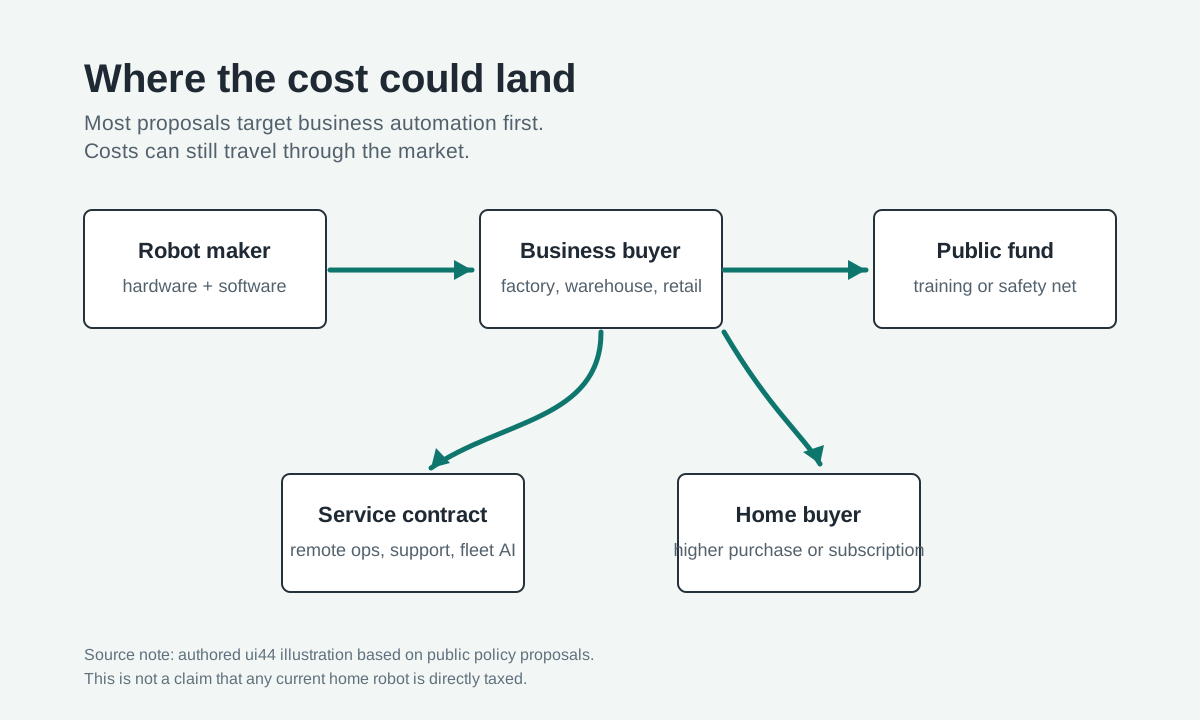
For home buyers, the short answer is simple: a robot tax probably would not show up first as a line item on a consumer invoice. Most proposals aim at companies using robots or AI to replace labor, not at households buying a helper robot. But the long answer matters. If policy raises the cost of building, deploying, servicing, or financing humanoids, those costs can still reach the home market through higher prices, slower launches, stricter subscriptions, or fewer low-cost models.
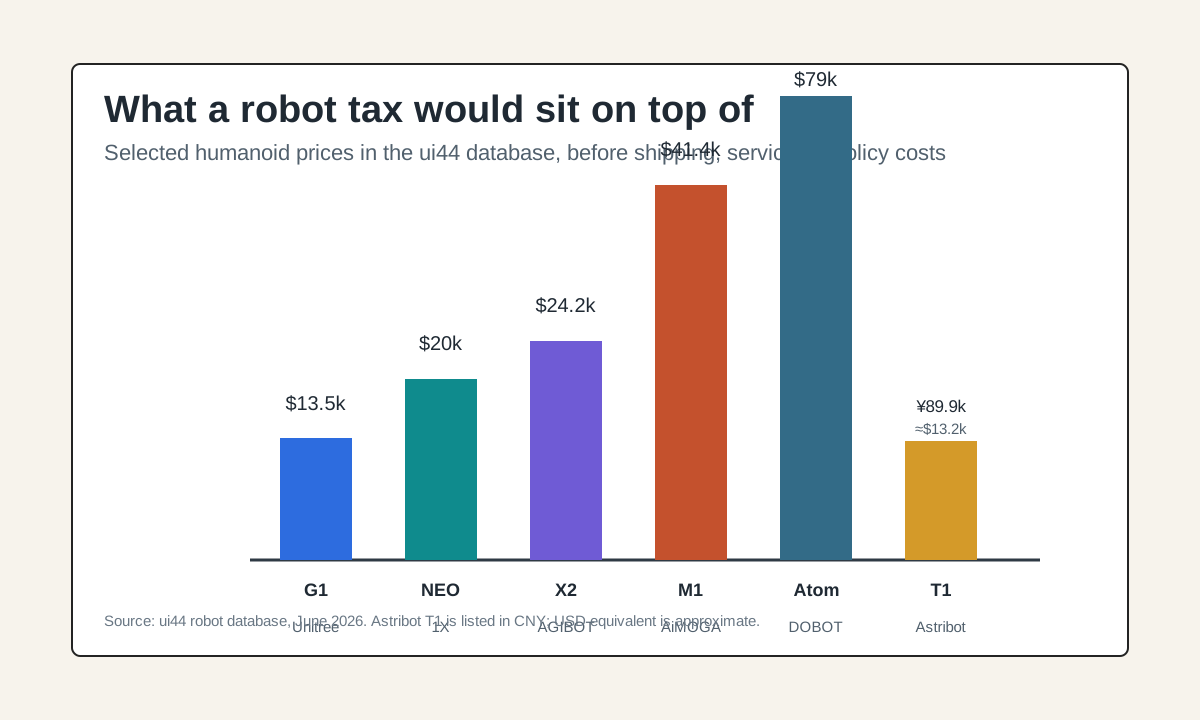
That matters because home humanoids are already expensive before policy costs enter the picture. In the ui44 database, 1X NEO is listed at $20,000, Unitree G1 at $13,500, AGIBOT X2 at $24,240, AiMOGA Mornine M1 at $41,400, DOBOT Atom at $79,000, and Astribot T1 at ¥89,900 CNY, about $13,165 before exchange-rate changes, import costs, or regional pricing. At those prices, even a small cost increase is not cosmetic.
What People Mean By A Robot Tax
"Robot tax" is not one single policy. It can mean several different things:
Policy idea
Reduced automation tax credits
- What gets taxed
- Robot investment becomes less subsidized
- Who pays first
- Companies buying robots
- Why it matters for home robots
- Can slow production scale and keep robot hardware expensive
Policy idea
Payroll replacement levy
- What gets taxed
- Estimated labor replaced by automation
- Who pays first
- Employers
- Why it matters for home robots
- Mostly affects commercial deployments, not private homes
Policy idea
Excess automation-profit tax
- What gets taxed
- Extra profit linked to automation
- Who pays first
- Companies
- Why it matters for home robots
- May raise fleet pricing or service fees
Policy idea
AI usage or compute tax
- What gets taxed
- Training, API, GPU, or model usage
- Who pays first
- AI providers or robot operators
- Why it matters for home robots
- Could affect cloud autonomy subscriptions
Policy idea
Consumer robot sales tax surcharge
- What gets taxed
- The robot purchase itself
- Who pays first
- Buyers
- Why it matters for home robots
- Direct price impact, but politically harder to justify for household robots
| Policy idea | What gets taxed | Who pays first | Why it matters for home robots |
|---|---|---|---|
| Reduced automation tax credits | Robot investment becomes less subsidized | Companies buying robots | Can slow production scale and keep robot hardware expensive |
| Payroll replacement levy | Estimated labor replaced by automation | Employers | Mostly affects commercial deployments, not private homes |
| Excess automation-profit tax | Extra profit linked to automation | Companies | May raise fleet pricing or service fees |
| AI usage or compute tax | Training, API, GPU, or model usage | AI providers or robot operators | Could affect cloud autonomy subscriptions |
| Consumer robot sales tax surcharge | The robot purchase itself | Buyers | Direct price impact, but politically harder to justify for household robots |
The current policy conversation is mostly about the first four. Chosun described Korean robot- and AI-tax proposals as attempts to offset shrinking public revenue if AI and robots reduce employment. The report framed a robot tax as a levy on economic value generated by robots or AI-integrated robots, while noting the core objections: it can be hard to define what counts as a taxable robot, and higher automation costs can slow productivity gains.
Korea JoongAng Daily reported in May 2026 that Korea was again weighing robot-tax ideas as AI-driven job-loss concerns grew, specifically against the backdrop of humanoid robots entering real deployment conversations. Its summary pointed to Korea's high robot density and discussed multiple possible tax designs, including payroll-like replacement ideas and taxes on automation-driven gains. The details matter because a tax on corporate use is very different from a tax on a household device.
Why Korea Is The Right Early Warning Signal
Korea is not just another country talking about AI. It is one of the most automated industrial economies in the world. The International Federation of Robotics reported that South Korea had 1,012 industrial robots per 10,000 employees in 2022, ahead of Singapore and Germany. More recent summaries continue to put Korea at or near the top of global robot-density rankings.
That means Korea is where many policy trade-offs appear early. A country with high robot adoption gets the productivity benefits, but also sees the labor anxiety, tax-base questions, union negotiations, and regulatory pressure sooner than markets where robots remain rare.
The humanoid angle adds heat. ITIF described Hyundai Motor's humanoid debate as a policy flashpoint after Boston Dynamics showed a next-generation Atlas platform and Hyundai signaled factory deployment. According to ITIF, the Korean discussion is not only about job loss; it is also about weak productivity growth, labor-market adjustment, and how an aging manufacturing economy stays competitive.
That is important for home robots because consumer humanoids will not scale in isolation. They will borrow parts, batteries, perception stacks, hands, actuators, safety methods, and service models from industrial deployments. If commercial humanoids become more expensive or slower to deploy, home models may inherit the delay.

The Direct Price Risk Is Smaller Than The Indirect Risk
The cleanest way to think about this is to separate direct and indirect costs.
A direct consumer robot tax would be easy to understand: buy a $20,000 home humanoid, pay an added percentage at checkout. That would be politically visible, easy for buyers to hate, and tricky to justify when the robot is being used for household chores, eldercare support, companionship, or accessibility rather than replacing a taxable employee.
The indirect path is more plausible. A government might tax businesses that replace workers with robots, reduce automation credits, charge certain AI usage, or impose reporting and safety obligations. Robot makers and fleet operators would then adjust prices. The home buyer might never see a "robot tax" label, but the cost could arrive through:
- higher base hardware prices
- mandatory service plans
- higher remote-operation fees
- more expensive insurance and certification
- slower entry-level models because commercial margins are better
- fewer secondhand units if commercial fleets hold robots longer
For a home buyer, that can feel the same as a tax even if the law never targets consumers.
What The Numbers Look Like On Today's Home Humanoids
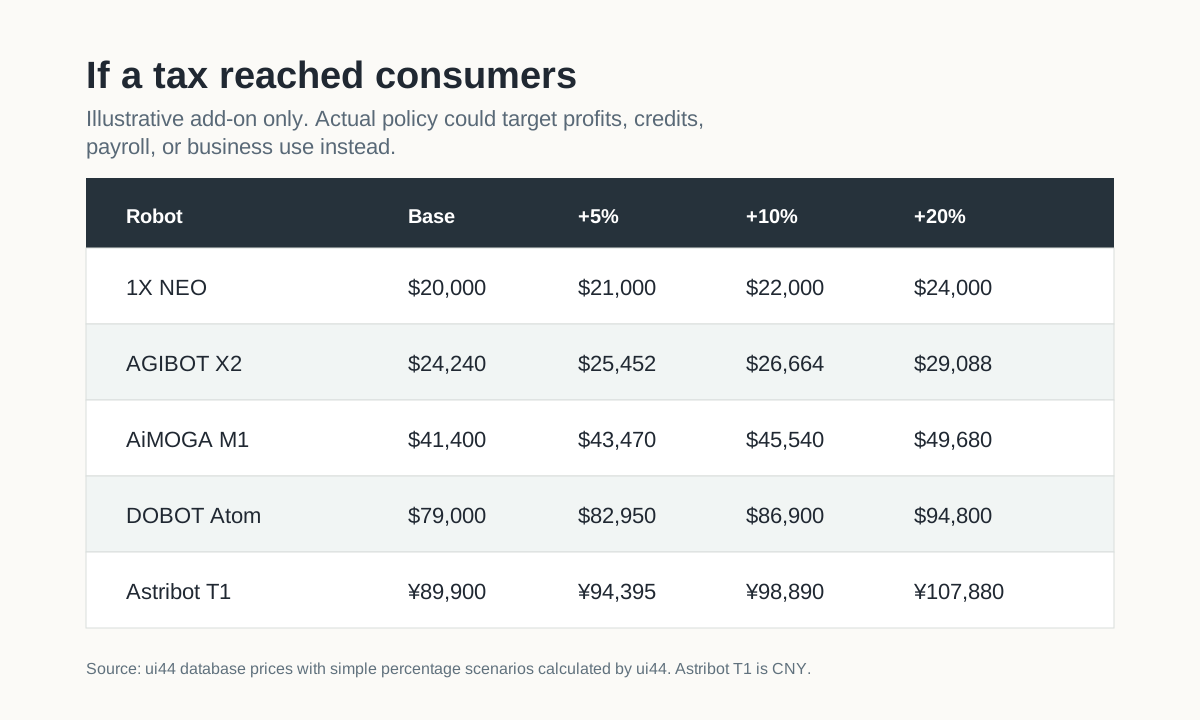
Simple scenario math shows why this debate matters. A 5% cost pass-through on a $13,500 Unitree G1 is $675. On a $20,000 1X NEO, it is $1,000. On a $79,000 DOBOT Atom, it is $3,950. On Astribot T1's ¥89,900 CNY launch price, the same 5% add-on would be ¥4,495 CNY.
At 10%, the add-on becomes big enough to change buyer behavior. The 1X NEO would effectively move from $20,000 to $22,000. The AGIBOT X2 would move from $24,240 to $26,664. The AiMOGA Mornine M1 would move from $41,400 to $45,540. Astribot T1 would move from ¥89,900 to ¥98,890 CNY, before any currency conversion or import math.
At 20%, the tax-equivalent cost would be punishing for early home adoption. A $20,000 home humanoid becomes $24,000. A $79,000 robot becomes $94,800. Astribot T1's ¥89,900 CNY launch price becomes ¥107,880 CNY. That does not mean any government is likely to put a 20% tax on consumer humanoids. It does show how sensitive the category is while prices remain high.
Robot
- ui44 listed price
- $20,000
- +5% scenario
- $21,000
- +10% scenario
- $22,000
- +20% scenario
- $24,000
Robot
- ui44 listed price
- $24,240
- +5% scenario
- $25,452
- +10% scenario
- $26,664
- +20% scenario
- $29,088
Robot
- ui44 listed price
- $41,400
- +5% scenario
- $43,470
- +10% scenario
- $45,540
- +20% scenario
- $49,680
Robot
- ui44 listed price
- $79,000
- +5% scenario
- $82,950
- +10% scenario
- $86,900
- +20% scenario
- $94,800
Robot
- ui44 listed price
- ¥89,900 CNY
- +5% scenario
- ¥94,395 CNY
- +10% scenario
- ¥98,890 CNY
- +20% scenario
- ¥107,880 CNY
| Robot | ui44 listed price | +5% scenario | +10% scenario | +20% scenario |
|---|---|---|---|---|
| 1X NEO | $20,000 | $21,000 | $22,000 | $24,000 |
| AGIBOT X2 | $24,240 | $25,452 | $26,664 | $29,088 |
| AiMOGA Mornine M1 | $41,400 | $43,470 | $45,540 | $49,680 |
| DOBOT Atom | $79,000 | $82,950 | $86,900 | $94,800 |
| Astribot T1 | ¥89,900 CNY | ¥94,395 CNY | ¥98,890 CNY | ¥107,880 CNY |
The Subscription Layer May Matter More Than Hardware
Many serious home humanoids are unlikely to be one-and-done purchases. They may need remote support, cloud AI, fleet learning, warranty coverage, teleoperation fallback, replacement hands, batteries, charging docks, and software updates. A buyer might focus on the hardware price, but the business model may live in the service layer.
That is where AI taxes or automation reporting costs could matter. A household robot that relies on cloud inference, remote supervision, or premium autonomy could face higher operating costs even if the physical machine is not taxed. The result might be a cheaper-looking purchase price with a more expensive monthly plan.
This is already easy to imagine from the robots in the database. 1X NEO emphasizes household chores, safe human interaction, adaptive learning, and gentle manipulation. Astribot T1 lists human-demonstration learning, fine manipulation, cooking and food-prep demos, laundry folding, lab operations, and EV charging tasks. DOBOT Atom lists manipulation precision and cross-scenario service or industrial work. These are not simple appliances. They are AI-enabled systems that will likely depend on ongoing software and support.
That means buyers should compare total cost of ownership, not just the launch price. A robot tax may be less likely to add $2,000 at checkout than to add $30, $80, or $200 per month to a service plan. Over five years, that can matter more than a one-time surcharge.
The Counterargument: Taxes Can Slow The Price Decline Buyers Need
Robot-tax supporters usually argue from fairness. If automation replaces wages, payroll taxes, or social-insurance contributions, public revenue may fall. A tax could fund retraining, worker support, or a broader safety net. That argument becomes stronger if humanoids really do move from demos to large-scale labor substitution.
The problem is timing. Home humanoids are not cheap mass-market appliances yet. They are expensive, early, support-heavy products. A tax that slows production scale could delay the price declines that make useful robots accessible to households.
There is already evidence that tax design can affect robot adoption. ITIF summarized research on South Korea's 2018 reduction in automation tax credits, describing it as a "quasi-robot tax." According to ITIF, affected Korean industries reduced robot installations by 28% compared with Japanese counterparts, while the average employment effect was statistically insignificant. That does not settle the policy debate, but it is a warning: taxing automation can reduce robot investment without automatically protecting jobs.
For home humanoids, that would be a bad trade if it means fewer units, slower learning, weaker supply chains, and higher service costs. The home market needs the opposite: volume, reliability, repairability, and competition.
Which Buyers Should Care First?
Not every buyer faces the same risk.
Early adopters buying a humanoid mainly for experimentation, content, education, or development should care about import rules, warranty structure, and software access more than a hypothetical consumer robot tax. Their bigger risk is buying a robot that becomes unsupported or region-locked.
Households buying for chores should care about service fees. If policy costs hit cloud autonomy or remote support, a robot marketed as a home helper could become expensive to operate even if the hardware price looks manageable.
Care, accessibility, and elder-support buyers should watch policy especially closely. Governments may treat assistive home robots differently from labor-replacement robots, but only if regulations are written carefully. A blunt robot tax could accidentally make helpful devices less accessible.
Small businesses buying humanoids for customer service, cleaning support, inventory, food prep, or light logistics face the clearest exposure. They are closer to the target of automation taxes than households are. If small-business deployments become more expensive, makers may focus on large enterprise fleets that can absorb compliance costs, leaving fewer consumer-grade options.
What To Watch Before Buying
The useful signal is not whether politicians say "robot tax." The useful signal is which cost center they target.
Watch for these details:
- Does the proposal tax robot purchases, robot profits, automation investment credits, payroll replacement, AI usage, or data?
- Does it exempt personal, assistive, educational, or medical use?
- Does it apply only to employers above a certain size?
- Does it target industrial robots, humanoids, AI agents, or all automation?
- Does it tax domestic deployment only, or also imports and subscriptions?
- Does it include a certification path that raises compliance costs?
For home buyers, exemptions matter. A household robot used for laundry, mobility assistance, companionship, or accessibility is not the same policy problem as a fleet of humanoids replacing workers in a factory. Good regulation should see that difference.
The Practical Takeaway
A robot tax is unlikely to be the main reason a home humanoid is expensive in 2026. The bigger reasons are hardware complexity, low production volume, manipulation reliability, safety engineering, batteries, support, and AI software. But policy can still bend the price curve.
If a robot tax is aimed narrowly at large employers replacing labor, most home buyers may feel only indirect effects. If it touches AI usage, fleet software, service contracts, or broad automation equipment, the home market may feel it sooner. If it becomes a direct consumer surcharge, buyers will notice immediately.
The healthiest outcome would separate three things: commercial automation that clearly replaces payroll, assistive home robots that expand independence, and experimental consumer humanoids still trying to become reliable products. Treating all of them as the same taxable object would be easy to administer and hard on the market.
For now, buyers should assume the first wave of useful home humanoids will remain expensive with or without a robot tax. The smartest move is to track the total package: purchase price, subscription, warranty, autonomy limits, repair access, and likely policy exposure. The robot's sticker price is only the beginning.
Written by
ui44 Team
Published June 9, 2026
Share this article
Open a plain share link on X or Bluesky. No embeds, no widgets, no cookie baggage.