Article 21 min read 4,779 words

Is Apple Making a Home Robot? Rumors Explained

An Apple home robot is plausible. A full Apple humanoid folding laundry in your kitchen soon is not. The serious question is not whether Apple has robotics research, but which product shape could survive the jump from lab demo to something normal people would keep on a counter, desk, or living-room floor.

ui44 Team All articles

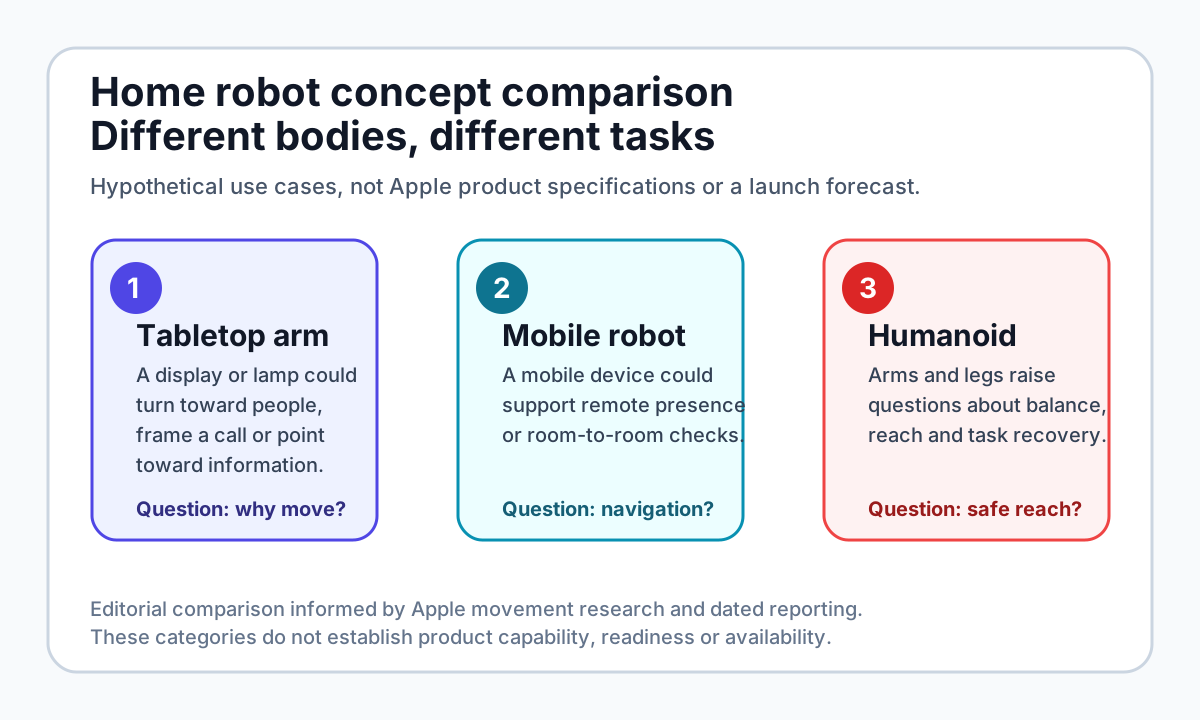
The current rumor cloud points in three directions: a tabletop smart-display arm or lamp-like assistant, a mobile companion that can follow you around, and much more speculative humanoid work. Apple has confirmed research into expressive movement for a non-anthropomorphic lamp-like robot; reporting has also described robotic home displays, mobile concepts, and early humanoid exploration. None of that is a confirmed product.

Apple home robot rumors form factor map comparing tabletop arm, mobile companion, and humanoid robot

The most likely first Apple robot is therefore not a Rosie-style housekeeper. It is probably a more physical smart-home hub: a display or lamp that turns toward you, frames video calls, gestures toward information, and makes Siri feel less like a disembodied voice. That sounds modest, but it is exactly why it might be credible.

Is Apple Actually Making a Home Robot?

Apple is clearly exploring robotics. Its ELEGNT research paper describes a lamp-like robot built to study expressive and functional movement. The important phrase is non-anthropomorphic: the research robot does not need a face, legs, or hands to communicate attention, intention, and emotion. It can look out a window before answering a weather question, turn toward a person, or move in a way that makes the object feel attentive.

That matters because home robots fail when they promise too much. A useful first Apple robot would need to answer a tighter product question: what can movement add to the smart home that a HomePod, iPad, or Apple TV cannot already do?

The answer might be presence. A moving display can aim a camera during a FaceTime call. A lamp-like assistant can glance toward the doorbell feed. A robotic arm can keep a screen pointed at someone cooking, exercising, or helping a child with homework. These are not chores, but they are real home use cases.

The harder claim is manipulation. Once a robot reaches for laundry, dishes, or a pet bowl, it needs safe force control, reliable perception, recovery when things go wrong, and a way to explain failures. ui44's database shows why that is a much steeper climb.

The Three Apple Robot Shapes, Ranked by Plausibility

Apple robot concept Closest ui44 comparison What it would need to prove First-product odds
Tabletop display arm or expressive lamp ElliQ 3, Syncere Lume Speech, camera framing, attention, privacy, a reason to move Highest
Mobile smart-home companion Samsung Ballie, KEYi Loona Navigation, docking, pet safety, household mapping, useful daily routines Medium
Furniture robot with a hidden arm Syncere Lume, Weave Isaac 0 One bounded task that beats a normal appliance Medium-low
Mobile manipulator Hello Robot Stretch 3 Safe reach, grasping, recovery, teleop fallback, high price tolerance Low
Full home humanoid 1X NEO, Fauna Sprout Whole-body safety, runtime, dexterity, cost, service network Very low near term

This is the practical filter: the first version must be useful even if it never picks up an object. If Apple starts with an expressive HomePod-with-a-screen, that is not a cop-out. It is the same product discipline that made the Watch a notification and health device before it became a broader wearable platform.

Why a Tabletop Apple Robot Makes More Sense Than a Humanoid

The tabletop version has the fewest ways to hurt the user, damage furniture, or embarrass itself. It can stay plugged in. It does not need to climb thresholds, avoid dog toys, localize itself across floors, or carry a glass across the room. It can still create a meaningfully different experience from a stationary smart display.

ElliQ 3 is a useful comparison. It is a tabletop companion for older adults, not a mobile chore robot. ui44 lists it as a mains-powered device around 25 cm tall and roughly 1.3 kg, with far-field microphones, a front camera, a touchscreen, proactive conversation, medication reminders, wellness programs, and video calling. Its pricing model is also revealing: $249.99 enrollment plus $59.99 per month. The hardware is not the whole product; the service layer matters.

A tabletop Apple robot would probably follow that logic. The device would need to be a service endpoint for the home: calls, reminders, music, smart-home status, camera views, family check-ins, and perhaps lightweight tutoring or fitness coaching. Movement would be the interface layer, not the main job.
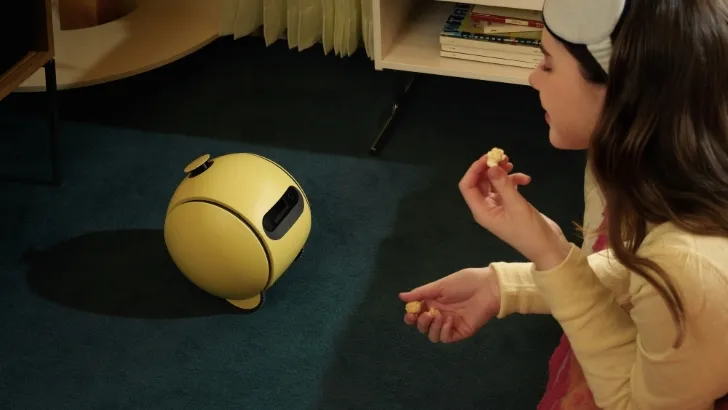
Samsung Ballie smart home companion robot as a comparison point for Apple home robot rumors

Samsung Ballie shows both the promise and the danger. It is a spherical rolling companion robot with SmartThings control, a projector, pet and family monitoring, call handling, and Gemini-backed multimodal AI in the ui44 record. It also has no confirmed price or release date as of early 2026 after years of demos and revisions. A mobile home robot is easy to show on a stage and much harder to ship as a reliable household product.

That is why Apple's rumored tabletop arm is more believable than a rolling robot. It can borrow from iPad, HomePod, FaceTime, Siri, Apple Intelligence, HomeKit, and accessibility features without needing to solve every navigation problem on day one.

Could Apple Build a Robot Lamp Instead?

A lamp sounds silly until you look at the product category. Lamps already live in rooms, aim light at people, and can move without seeming threatening. Apple's ELEGNT research uses the lamp shape precisely because movement can communicate attention without a human face.

The closest current ui44 database entry is Syncere Lume, a pre-order home robot disguised as a sculptural floor lamp. Lume is listed at $1,499, with a $149 refundable deposit and claimed first-batch shipping in summer 2026. It is 45 inches folded and hides an articulating arm inside the body. Syncere says it can fold laundry, make beds, reset pillows, handle simple pick-and-place tidying, and provide adaptive lighting.

That is a bolder promise than Apple needs to make first. Apple could use the same lesson but avoid the hardest chore claims: make a lamp or display that moves beautifully, frames people accurately, and becomes the most natural smart-home interface in the room. The product could be valuable before it touches laundry.

Apple home robot readiness scorecard comparing tabletop robot, mobile companion, manipulator, and humanoid readiness

The watch item for buyers is not whether the prototype looks cute. It is whether Apple explains what physical motion does better than a stationary screen. If the only answer is personality, the product risks becoming an expensive novelty. If motion improves calls, accessibility, attention, security, and smart-home control, it becomes easier to justify.

What If Apple Goes Mobile?

A mobile Apple robot could be more exciting: a roaming FaceTime screen, home patrol camera, pet companion, family messenger, or rolling smart-home controller. It would also inherit every practical problem that delayed other home robots.

KEYi Loona is the affordable end of this idea. ui44 lists Loona at about $499, 17.3 cm tall, 1.1 kg, with a 720p camera, 3D time-of-flight sensor, four-microphone array, LCD face, autonomous navigation, auto-docking, and ChatGPT-4o integration. It is a real consumer companion robot, but it is small, playful, and intentionally limited.

LOVOT is the premium emotional-companion version. It uses more than 50 sensors, warm-body behavior, room mapping, person recognition, touch response, and a charging nest. It is also expensive: ui44 lists the current LOVOT 3.0 at ¥577,500 in Japan, plus a required monthly care plan.

An Apple mobile companion would have to sit somewhere between those examples and Ballie. It would need Apple-level privacy guarantees, excellent docking, reliable obstacle avoidance, quiet motors, a clear answer to camera anxiety, and a daily job beyond rolling around to be charming. That is doable, but it is much harder than a tabletop device.

Why the Humanoid Rumor Is the Least Useful Buying Signal

Humanoid rumors generate clicks because they imply a future where the robot can use the same stairs, handles, tools, and furniture as humans. That is a real long-term argument. It is not a near-term consumer product plan.

The robots closest to that future are still expensive, limited, or early-access. 1X NEO is one of the most home-focused humanoids in the ui44 database: 167 cm tall, 30 kg, about four hours of battery life, soft-body design, pre-order status, and a $20,000 early-adopter price. Fauna Sprout is smaller at 107 cm and 22.7 kg, with 29 degrees of freedom, a soft exterior, swappable 3-3.5 hour battery, contact-sales pricing, and an SDK-oriented Creator Edition.

1X NEO home humanoid robot showing the scale gap between Apple robot rumors and full humanoid chores

Those are not Apple-like mass-market price points. They are early robotics platforms. A humanoid also needs far more than Apple-style industrial design. It needs manipulation, safety certification, service, replacement parts, insurance clarity, and a model for what happens when the robot fails mid-task.

This is why an Apple humanoid may exist as research without being the first product. Apple can learn from humanoid work in sensing, movement, intention, teleoperation, and embodied AI while shipping a much narrower home robot first.

The Real Competition Is Not Just Other Robots

Apple's first robot would compete with boring products that already work: iPads, HomePods, phones, security cameras, smart displays, robot vacuums, and human habits. That is a brutal benchmark. A robot has to be better enough to justify cost, space, setup, privacy risk, and maintenance.

The strongest existing home robots usually win by narrowing the job. Weave Isaac 0 folds laundry only. It is stationary, mains powered, and listed at $7,999 upfront or $450 per month. It does one painful chore rather than pretending to be a general housekeeper. Hello Robot Stretch 3 goes the opposite direction: a $24,950 open-source mobile manipulator for research, assistive care, and embodied AI, with a 24.5 kg body, 141 cm height, 2-5 hour runtime, compact 33 x 34 cm footprint, and 2 kg payload.

Hello Robot Stretch 3 mobile manipulator showing why useful home robot arms are harder than smart displays

Those two examples frame Apple's choice. A consumer Apple robot should either do a narrow physical job extremely well or avoid physical chores and make the smart-home interface feel alive. Trying to do both at launch would be the risky middle.

What Should Buyers Watch For?

If Apple announces anything robot-like, ignore the sizzle reel and look for five signals.

First, does Apple describe a specific daily job? "A smarter Siri with a moving screen" is vague. "Keeps you framed during calls, checks the door, points the screen where you are, and controls Home devices without touching it" is a product.

Second, is it stationary, tabletop, mobile, or manipulative? The risk jumps at each level. A tabletop display can fail gracefully. A mobile camera robot can get stuck. A manipulator can break things.

Third, what is processed on-device? A camera-and-microphone robot in the home needs more than a generic privacy promise. Buyers should expect clear camera indicators, local processing where possible, household member controls, recording limits, guest modes, and plain-language data retention settings.

Fourth, what does it cost after year one? Companion robots often shift cost into subscriptions, service plans, or cloud features. ElliQ, LOVOT, and Isaac 0 all show that recurring cost is part of the category.

Fifth, can it work without perfect Apple ecosystem lock-in? Apple will naturally make the best experience inside its own ecosystem, but a home robot that cannot coexist with common smart-home devices, multiple users, and mixed-device households will feel narrower than the marketing suggests.

Bottom Line: Expect a Kinetic Smart-Home Hub Before a Chore Robot

The most credible Apple home robot is a kinetic smart-home hub: part display, part speaker, part camera, part expressive object. It may look like a tabletop arm, a lamp, or a small mobile companion. The least credible near-term version is a full humanoid that safely handles open-ended chores around a normal home.

That is not a disappointment. The home robot category needs products that do one or two jobs well before it needs another humanoid hype cycle. If Apple can make a robot that people trust in the kitchen, living room, or bedside without promising to fold every towel, that would already be a meaningful step.

For now, treat Apple robot rumors as a form-factor map, not a buying plan. If you want a real product today, compare current companion and home-assistant robots in the ui44 robot database, use /compare to check specs side by side, and be skeptical of any robot that skips from "expressive motion" to "does your chores" without showing the hard middle.

Database context

Use this article as a privacy verification workflow

Turn the article into a real verification pass

Is Apple Making a Home Robot? Rumors Explained already points you toward 9 linked robots, 9 manufacturers, and 6 countries inside the ui44 database. That matters because strong buyer guidance is easier to apply when you can move immediately from a claim or warning into concrete product pages, manufacturer directories, component explainers, and country-level context instead of treating the article as an isolated opinion piece. The fastest next step is to turn the article into a shortlist workflow: open the linked robot pages, verify which specs are actually published for those models, then compare the surrounding manufacturer and component context before you decide whether the underlying claim changes your buying plan.

For this topic, the useful discipline is to separate the editorial lesson from the catalog evidence. The article gives you the framing, but the robot pages tell you what each product actually ships with today: sensor stack, connectivity methods, listed price, release timing, category, and support-relevant compatibility notes. The manufacturer pages then show whether you are looking at a one-off launch, a broader lineup pattern, or a company that spans multiple categories. That layered workflow reduces the risk of buying on a single marketing phrase or a single support FAQ.

Use the robot pages to confirm which products actually expose cameras, microphones, Wi-Fi, or voice systems, then use the manufacturer pages to decide how much of the privacy question seems product-specific versus brand-wide. On this route cluster, ElliQ 3, Lume, and Ballie form the fastest reality check. If you want a quick working shortlist, open Compare ElliQ 3, Lume, and Ballie next, then keep this article open as the reasoning layer while you compare structured data side by side.

Practical Takeaway

Every robot, manufacturer, category, component, and country reference below resolves to a real ui44 page, keeping the follow-up path grounded in database records rather than generic advice.

Suggested next steps in ui44

  1. Open ElliQ 3 and note the listed sensors, connectivity methods, and voice stack before you interpret any policy claim.
  2. Cross-check the wider brand context on Intuition Robotics so you can see whether the privacy question touches one model or a broader lineup.
  3. Use the linked component pages to confirm how common the relevant sensors and connectivity layers are across the database.
  4. Keep a short note of which policy layers you checked, which device features are actually present on the robot page, and which items still depend on region- or app-level confirmation.
  5. Finish with Compare ElliQ 3, Lume, and Ballie so the policy reading sits next to structured product data.

Database context

Robot profiles worth opening next

Use the linked product pages as the evidence layer

The linked robot pages are where this article becomes operational. Instead of asking whether the headline is interesting, use the robot entries to inspect the actual mix of sensors, connectivity options, batteries, pricing, release timing, and stated capabilities attached to the products mentioned in the article. That is the easiest way to see whether the warning or opportunity described here affects one product family, a specific design pattern, or an entire buying lane.

ElliQ 3

Intuition Robotics · Companions · Available

Price TBA

ElliQ 3 is tracked on ui44 as a available companions robot from Intuition Robotics. The database currently records a listed price of Price TBA, a release date of 2024-01, Mains powered battery life, N/A (plugged in) charging time, and a published stack that includes Far-field Microphones, Front Camera, and Integrated Touchscreen plus Wi-Fi and Bluetooth.

For privacy-focused reading, this page matters because it shows the concrete device surface behind the policy discussion. Use it to verify whether ElliQ 3 combines sensors and connectivity in a way that could change the in-home data footprint, and compare the listed capabilities such as Proactive Conversation, Medication Reminders, and Health & Pain Tracking with any cloud, app, or voice layers, including ElliQ Voice AI.

Lume

Syncere · Home Assistants · Pre-order

$1,499

Lume is tracked on ui44 as a pre-order home assistants robot from Syncere. The database currently records a listed price of $1,499, a release date of 2026-04-15, Not officially disclosed battery life, Not officially disclosed charging time, and a published stack that includes Vision system (officially referenced as part of ClearTouch) plus its listed connectivity stack.

For privacy-focused reading, this page matters because it shows the concrete device surface behind the policy discussion. Use it to verify whether Lume combines sensors and connectivity in a way that could change the in-home data footprint, and compare the listed capabilities such as Laundry folding, Bed making, and Pillow resetting with any cloud, app, or voice layers.

Ballie

Samsung · Companions · Development

Price TBA

Ballie is tracked on ui44 as a development companions robot from Samsung. The database currently records a listed price of Price TBA, a release date of TBD, Not officially disclosed battery life, Not officially disclosed charging time, and a published stack that includes Camera, Spatial Sensors, and Environmental Sensors plus Wi-Fi and SmartThings.

For privacy-focused reading, this page matters because it shows the concrete device surface behind the policy discussion. Use it to verify whether Ballie combines sensors and connectivity in a way that could change the in-home data footprint, and compare the listed capabilities such as Autonomous Home Navigation, Built-in Projector (Wall & Floor), and Smart Home Control via SmartThings with any cloud, app, or voice layers, including Bixby.

Loona

KEYi Tech · Companions · Available

$499

Loona is tracked on ui44 as a available companions robot from KEYi Tech. The database currently records a listed price of $499, a release date of 2023, 1.5 hours continuous play; up to 30 hours depending on usage battery life, Not officially disclosed charging time, and a published stack that includes 3D Time-of-Flight (ToF) Sensor, 720p RGB Camera, and Touch Sensor plus Wi-Fi (Dual-band 2.4G/5.8G, 802.11a/b/g/n) and USB Type-C (charging).

For privacy-focused reading, this page matters because it shows the concrete device surface behind the policy discussion. Use it to verify whether Loona combines sensors and connectivity in a way that could change the in-home data footprint, and compare the listed capabilities such as Face Recognition, Voice Commands, and Emotion Expression (LCD face) with any cloud, app, or voice layers.

Isaac 0

Weave Robotics · Home Assistants · Available

$7,999

Isaac 0 is tracked on ui44 as a available home assistants robot from Weave Robotics. The database currently records a listed price of $7,999, a release date of 2026-02, Mains powered (600W, 120V) battery life, N/A (plugged in) charging time, and a published stack that includes Vision System and Proprioceptive Sensors plus Wi-Fi 2.4GHz/5GHz and Ethernet.

For privacy-focused reading, this page matters because it shows the concrete device surface behind the policy discussion. Use it to verify whether Isaac 0 combines sensors and connectivity in a way that could change the in-home data footprint, and compare the listed capabilities such as Laundry Folding, T-shirts, Long Sleeves, Sweaters, and Pants and Towels with any cloud, app, or voice layers.

Database context

Manufacturer context behind the article

Check whether this is one product story or a broader company pattern

Manufacturer pages add the market context that individual product pages cannot show on their own. They help you check whether the article is centered on a brand with a deep lineup, whether that brand spans several categories, and how much of its ui44 footprint depends on one flagship model versus a broader product strategy. That matters for topics like privacy, warranty terms, setup friction, and launch promises because the surrounding lineup often reveals whether a pattern is isolated or systemic.

Intuition Robotics

ui44 currently tracks 1 robot from Intuition Robotics across 1 category. The company is grouped under Israel, and the current catalog footprint on ui44 includes ElliQ 3.

That wider brand context matters because privacy questions rarely stop at one FAQ page. A manufacturer route helps you see whether the article is centered on one premium model or on a company that has several relevant products and therefore more than one place where the same policy or app assumptions might matter. The category mix here currently points toward Companions as the most useful next route if you want to see whether this article reflects a wider pattern inside the brand.

Syncere

ui44 currently tracks 1 robot from Syncere across 1 category. The company is grouped under Unknown, and the current catalog footprint on ui44 includes Lume.

That wider brand context matters because privacy questions rarely stop at one FAQ page. A manufacturer route helps you see whether the article is centered on one premium model or on a company that has several relevant products and therefore more than one place where the same policy or app assumptions might matter. The category mix here currently points toward Home Assistants as the most useful next route if you want to see whether this article reflects a wider pattern inside the brand.

Samsung

ui44 currently tracks 2 robots from Samsung across 2 categorys. The company is grouped under South Korea, and the current catalog footprint on ui44 includes Ballie, Bespoke AI Jet Bot Steam Ultra.

That wider brand context matters because privacy questions rarely stop at one FAQ page. A manufacturer route helps you see whether the article is centered on one premium model or on a company that has several relevant products and therefore more than one place where the same policy or app assumptions might matter. The category mix here currently points toward Companions, Cleaning as the most useful next route if you want to see whether this article reflects a wider pattern inside the brand.

KEYi Tech

ui44 currently tracks 1 robot from KEYi Tech across 1 category. The company is grouped under Unknown, and the current catalog footprint on ui44 includes Loona.

That wider brand context matters because privacy questions rarely stop at one FAQ page. A manufacturer route helps you see whether the article is centered on one premium model or on a company that has several relevant products and therefore more than one place where the same policy or app assumptions might matter. The category mix here currently points toward Companions as the most useful next route if you want to see whether this article reflects a wider pattern inside the brand.

Database context

Broaden the scan without leaving the database

Categories, components, and countries add the wider context

Category framing

Category pages are useful when the article touches a buying pattern that shows up across brands. A category route helps you confirm whether the linked products sit in a narrow niche or whether the same question should be tested across a larger field of alternatives.

Companions

The Companions category page currently groups 33 tracked robots from 31 manufacturers. ui44 describes this lane as: Social robots, robot pets, and elderly care companions designed for emotional connection and daily support.

That makes the category route a practical follow-up when you want to check whether the products linked in this article are typical for the lane or whether they sit at one edge of the market. Useful starting examples currently include PARO, Abi, Moflin.

Home Assistants

The Home Assistants category page currently groups 12 tracked robots from 12 manufacturers. ui44 describes this lane as: Arm-based household helpers — laundry folders, kitchen robots, and mobile manipulators that handle physical tasks at home.

That makes the category route a practical follow-up when you want to check whether the products linked in this article are typical for the lane or whether they sit at one edge of the market. Useful starting examples currently include Robody, Futuring 2 (F2), Stretch 3.

Country and ecosystem context

Country pages give extra context when support practices, launch sequencing, regulatory posture, or manufacturer mix matter. They are not a substitute for model-level verification, but they do help you see which ecosystems cluster together and which manufacturers sit in the same regional field when you broaden the search beyond the article headline.

Israel

The Israel route currently groups 2 tracked robots from 2 manufacturers in ui44. That gives you a useful regional lens when the article points toward support practices, launch sequencing, or brand clusters that may share similar ecosystem assumptions.

On the current route, manufacturers like Intuition Robotics, Mentee Robotics make the page a good way to broaden the scan without losing the regional context that often shapes availability, documentation style, and adjacent alternatives.

South Korea

The South Korea route currently groups 2 tracked robots from 1 manufacturers in ui44. That gives you a useful regional lens when the article points toward support practices, launch sequencing, or brand clusters that may share similar ecosystem assumptions.

On the current route, manufacturers like Samsung make the page a good way to broaden the scan without losing the regional context that often shapes availability, documentation style, and adjacent alternatives.

Denmark

The Denmark route currently groups 1 tracked robots from 1 manufacturers in ui44. That gives you a useful regional lens when the article points toward support practices, launch sequencing, or brand clusters that may share similar ecosystem assumptions.

On the current route, manufacturers like Weave Robotics make the page a good way to broaden the scan without losing the regional context that often shapes availability, documentation style, and adjacent alternatives.

Database context

Questions to answer before you move from reading to buying

A follow-up FAQ built from the entities already linked in this article

Frequently Asked Questions

Which page should I open first after reading “Is Apple Making a Home Robot? Rumors Explained”?

Start with ElliQ 3. That gives you a concrete product anchor for the article’s main claim. From there, branch into the manufacturer and component pages so you can tell whether the article is describing one specific model, a repeated brand pattern, or a wider technology issue that affects multiple shortlist options.

How do the manufacturer pages change the buying decision?

Intuition Robotics help you zoom out from one article and one product. On ui44 they show lineup breadth, category spread, and the neighboring robots tied to the same company. That context is useful when you are deciding whether a risk belongs to a single model, whether it shows up across a brand’s portfolio, and whether you should keep looking at alternatives before committing.

When should I switch from reading to side-by-side comparison?

Move into Compare ElliQ 3, Lume, and Ballie as soon as you understand the article’s main warning or promise. The article explains what to watch for, but the compare view is where you can check whether price, status, battery life, connectivity, sensors, and category fit still make the robot a good match for your own home and budget.

Database context

Where to go next in ui44

Keep the research chain inside the database

If you want to keep going, these follow-on pages give you the cleanest expansion path from article to research session. Open the comparison route first if you are deciding between products today. Open the manufacturer, category, and component routes if you still need to understand the broader pattern behind the claim.

UT

Written by

ui44 Team

Published April 28, 2026

Share this article

Open a plain share link on X or Bluesky. No embeds, no widgets, no cookie baggage.

Explore the database

Go beyond the headlines

Compare specs, features, and prices across 100+ robots from leading manufacturers worldwide.