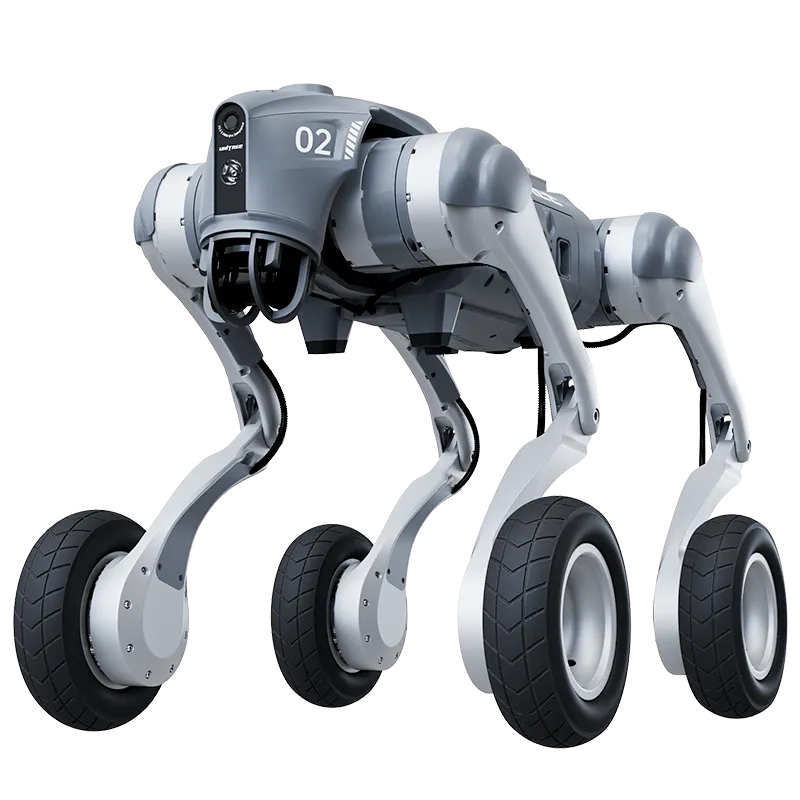
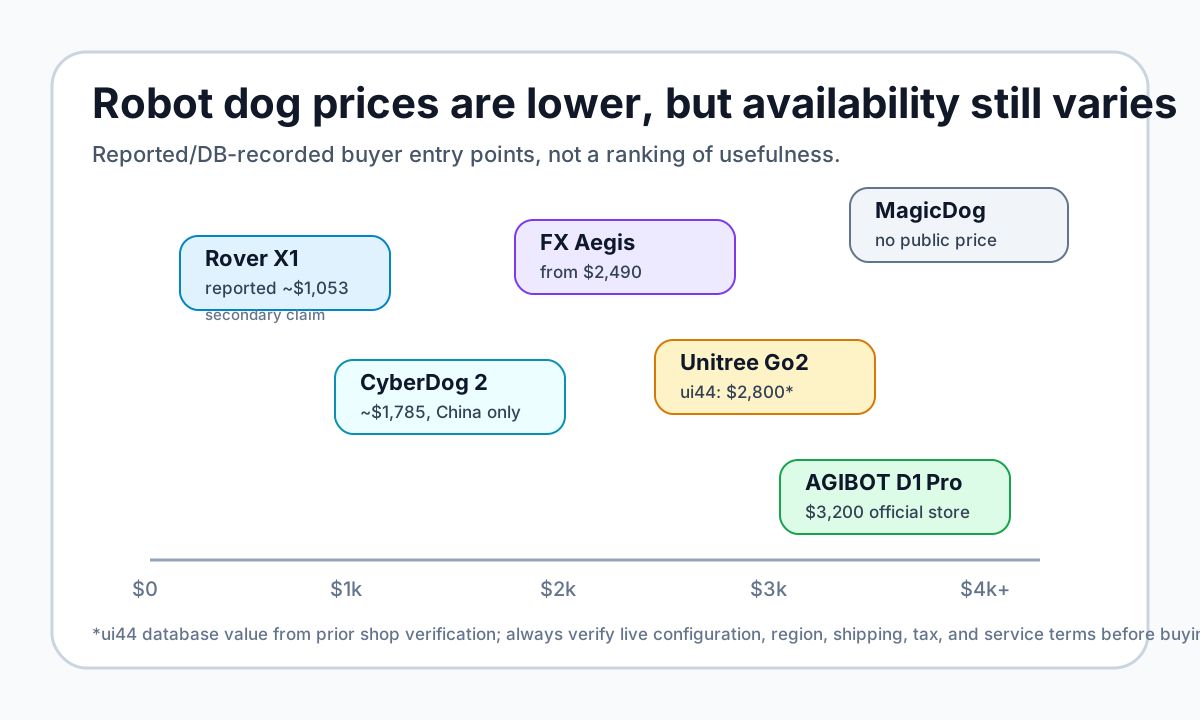
A few years ago, a four-legged robot in the home mostly meant one of two things: an enterprise inspection robot that cost like a car, or a toy robot dog that was fun for a weekend and then sat in a closet. That gap is narrowing. DOBOT's INFFNI sub-brand is showing Rover X1 as a consumer-focused wheel-leg quadruped. Faraday Future lists the FX Aegis from $2,490. Unitree Go2 and AGIBOT D1 Pro sit in the same early-adopter band. New companion-focused models such as MagicDog are trying to make robot dogs feel less like developer hardware and more like household products.
So the useful question is not "can a robot dog walk?" Many can. The useful question is whether a quadruped robot can do something in your home that a camera, speaker, robot vacuum, or wheeled companion robot cannot.
The Current Robot Dog Market, Without the Hype
ui44's database currently tracks 227 robots, including 15 platforms that are quadrupeds or robot-dog-shaped systems in the broad sense. The important split is between consumer-ish quadrupeds and industrial quadrupeds.
Consumer-ish models are getting cheaper, lighter, and more interactive. They are plausible for developers, educators, security hobbyists, smart-home experimenters, and people who simply want a serious robot dog. Industrial models like Boston Dynamics Spot and ANYbotics ANYmal prove the form factor can create real value, but they are not normal home purchases.
| Robot | ui44 status | Buyer price signal | What stands out | Home-readiness caveat |
|---|---|---|---|---|
| DOBOT/INFFNI Rover X1 | Not yet in ui44 DB | Secondary coverage reports about $1,053; official CES page did not publish retail terms | Wheel-leg mobility, 1.8 m/s demo speed, 16 cm step and 35° incline demos, adaptive following | Treat the price as unverified until official retail pages and support terms are live |
| Xiaomi CyberDog 2 | Available | ui44: about $1,785, China only | 8.9 kg body, 19 sensors, ROS2/Ubuntu developer angle | Region-limited and more developer/toy than service robot |
| FX Aegis | Available | ui44: from $2,490 | FCC-certified U.S. sales, 40° slope claim, autonomous patrol/follow-me, Wi-Fi/5G | Security/patrol pitch is clearer than true household chores |
| Unitree Go2 | Available | ui44: $2,800 from prior shop verification; Unitree pages can vary by region/configuration | 4D LiDAR, 3D mapping, side-follow, 1-2h battery or 2-4h EDU battery | Great mobility demo; usefulness depends on your exact app and support plan |
| AGIBOT D1 Pro | Available | Official store: $3,200 | 15.5 kg, 3.5 m/s, 5 kg effective payload, 16 cm step, 40° slope, 1-2h battery | Pro version is mostly remote/app control; autonomous following is an Edu/developer project |
| MagicDog | Active | No public price yet | Emotion system, voice/vision/touch interaction, 4K head camera, 13 DoF, 1.5-3h battery | Could be a companion product, but pricing and real availability are still the big unknowns |
What a Quadruped Can Actually Do at Home
A robot dog has one obvious advantage over a wheeled robot: it can handle uneven ground, thresholds, small steps, grass, gravel, and messy real-world surfaces better than most indoor rolling platforms. That matters if your intended use is not just "move around the living room."
The strongest current home uses are practical but narrow.
1. Patrol and Remote Presence
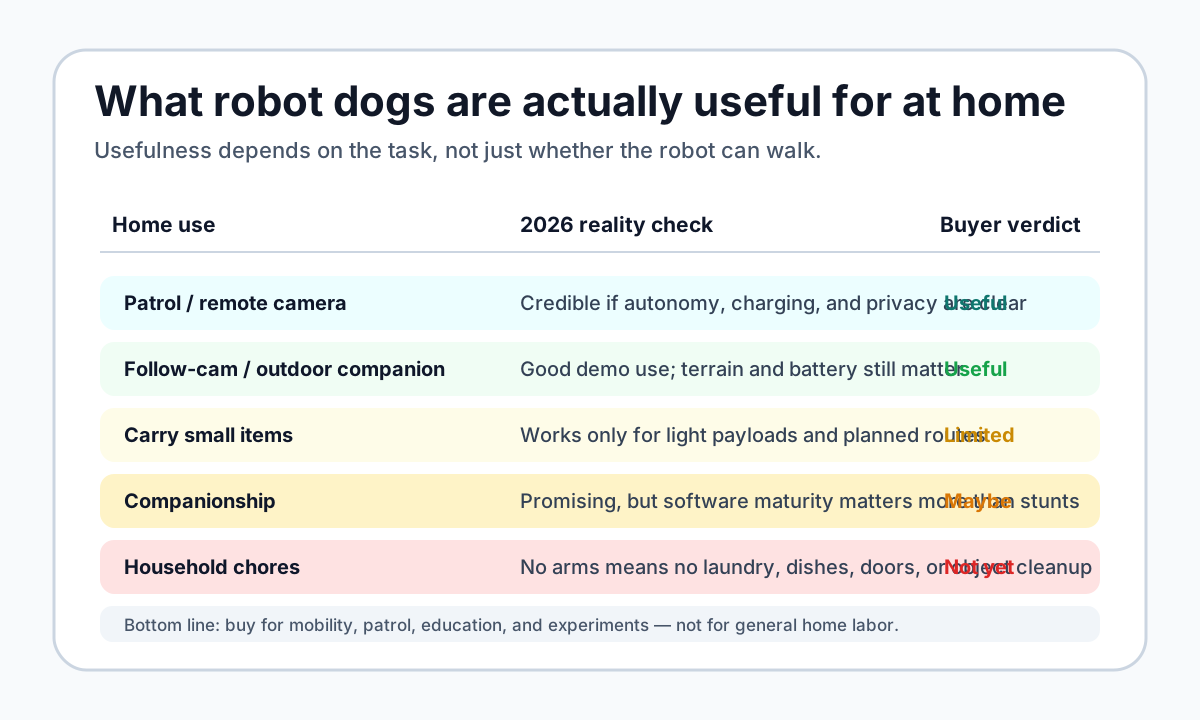
This is the clearest use case. A quadruped can move through a home, yard, workshop, small business, or short-term rental while carrying cameras and other sensors. FX Aegis is explicitly positioned around patrol, status feedback, security-system integration, and follow-me behavior. MagicDog also lists patrol mode and human recognition, though it is framed more as a companion robot.
The buyer question is privacy. A mobile camera with legs is still a mobile camera. Before buying, check whether video is local or cloud-routed, whether remote access can be disabled, who can see recorded footage, and whether guest or family consent is practical in your home.
2. Follow-Cam and Outdoor Companion
The "robot follows you" demo is not just a stunt. For filming, hiking on easy terrain, warehouse tours, property checks, or carrying a small sensor kit, it is a real capability. Unitree Go2 lists intelligent side-follow. DOBOT's official CES write-up says Rover X1 navigated around people in a crowded environment and showed adaptive following rather than pure remote control.
This is where wheel-leg hybrids become interesting. A robot that rolls on smooth surfaces and uses legs for obstacles can be more efficient than a pure walking platform. That is the most believable reason to care about Rover X1 even before retail terms are fully clear.
3. Education, Development, and Family Tech Projects
If you want a programmable robot that physically moves through the world, quadrupeds are far more interesting than a screen-based smart speaker. Go2, CyberDog 2, D1 Pro Edu, MagicDog EDU, and Unitree As2 EDU all have some version of developer or secondary-development story.
That does not mean every buyer should become a robotics engineer. It does mean these robots are best when someone in the household actually wants to tinker: program routes, test following modes, attach sensors, build routines, or use the robot in education.
4. Light Carrying, But Not Chores
This is the point most marketing blurs. A quadruped can carry something, but that is not the same as doing household work.
The AGIBOT D1 Pro record in ui44 lists an effective payload around 5 kg, with up to 8 kg for light items. MagicDog lists about 5 kg typical and about 10 kg maximum. Unitree Go2 lists payload bands around 7-12 kg depending on configuration. That is enough for a small basket, sensor payload, camera rig, or picnic bag. It is not enough to unload a dishwasher, fold laundry, pick up toys, open doors, or manipulate random objects.
For chores, arms matter. A robot dog without a useful arm is mostly a mobile platform. Boston Dynamics Spot can add an arm, but that moves you into enterprise territory, not normal home buying.
The Industrial Baseline Shows What "Useful" Really Means
The reason to study industrial quadrupeds is not that you should buy one for your hallway. It is that they show what real usefulness looks like when the platform, software, service, and workflow are mature.
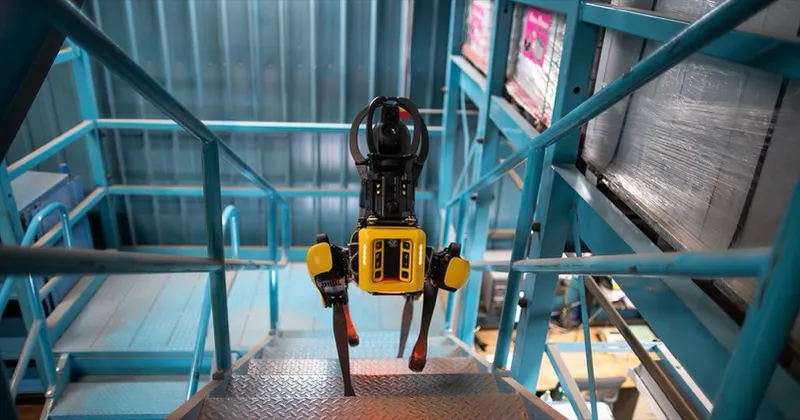
Boston Dynamics Spot is a good baseline. ui44 records Spot as a 33.8 kg commercial quadruped with about 90 minutes of battery life, a 14 kg payload capacity, autonomous charging, dynamic obstacle avoidance, fleet management through Orbit, and optional arm support. Boston Dynamics says more than 1,500 Spots are in customer hands and emphasizes inspection, data capture, construction, energy, manufacturing, research, and hazardous response.
ANYmal D makes the same point from another angle. It is an IP67 industrial inspection robot with 360° LiDAR, depth cameras, thermal and ultrasonic sensing, automatic docking, and wet/bumpy-terrain navigation. That is not a living-room feature list. It is a paid work process: inspect equipment, collect data, return to the dock, repeat safely.
For home buyers, the lesson is simple: a quadruped becomes useful when it has a repeatable job. "Walks like a dog" is not a job. "Patrol this property every night and alert me only when something changes" is closer to one. "Follow me while filming and avoid people on a path" is closer. "Carry this specific payload across this known route" is closer.
What Specs Matter More Than the Viral Backflip
Backflips are fun. They are also almost irrelevant to home usefulness. If you are comparing robot dogs in the ui44 compare tool, prioritize these specs first.
Autonomy and Perception
Look for the sensors and behaviors that match your intended use. Go2's 4D LiDAR and mapping are more relevant to autonomous movement than a stunt video. FX Aegis's patrol and follow-me positioning matters if you want security. MagicDog's voice, vision, touch, and emotional-interaction stack matters if you care about companionship.
Also notice what is not disclosed. AGIBOT D2 Max is an interesting April 2026 development because AGIBOT describes it as an all-terrain Level 3 autonomous quadruped. But price, height, weight, battery life, speed, and detailed compute are not publicly disclosed yet. That makes it important, not buyable.
Payload and Mounting
Payload determines whether the robot can carry anything useful. A 5 kg payload can support a camera/sensor kit or small bag. A 14 kg payload, like Spot's, opens more serious work. But payload also changes runtime, stability, and safety. Do not compare payload numbers without asking how the robot behaves when loaded.
Battery, Charging, and Support
A robot that lasts 90 minutes and then needs manual charging is a very different product from a robot that docks itself and runs scheduled patrols. Go2's battery range depends heavily on configuration. D1 Pro lists 1-2 hours. MagicDog lists 1.5-3 hours. Unitree As2 is more industrial: ui44 records more than 4 hours unloaded on Pro/EDU configurations and more than 2.5 hours with a 15 kg load.
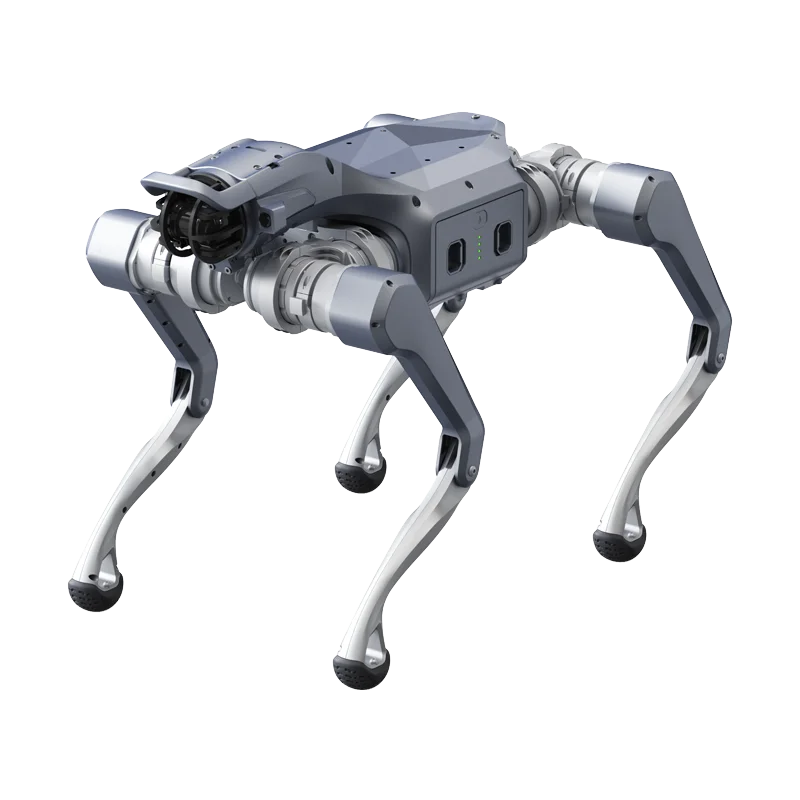
Support matters just as much as battery. These are not disposable gadgets. Check who repairs motors, batteries, cameras, and controllers in your region. If a robot is imported, ask what happens when a joint fails six months later.
Should You Buy One in 2026?
Buy a quadruped robot in 2026 only if you have a narrow, concrete use case and you are comfortable being an early adopter.
Buy now if:
- you want a serious programmable robot for education or development;
- you have a patrol, follow-cam, or sensor-carrying use case;
- you accept that setup, software, spare parts, and safety rules are part of the product;
- you are comparing specific robots, not buying the category in abstract.
Wait if:
- you expect laundry, dishes, tidying, or general physical chores;
- you want a robot that is quiet, invisible, and maintenance-free;
- you need mature warranty support in every country;
- you are only reacting to a viral demo or a low advertised price.
For most households, the best first robot is still a boring single-purpose machine that solves a real chore. For enthusiasts, educators, and property owners with a real patrol/following use case, robot dogs are finally crossing from "expensive demo" into "possibly useful tool."
The $1,000 robot dog headline is exciting, but the honest answer is narrower: quadrupeds are becoming useful at home for mobility-first tasks. They are not yet general-purpose home helpers. If you buy one, buy it for what legs are good at: moving through imperfect spaces, carrying a small payload, watching a route, and giving developers a physical platform to build on.
Database context
Use this article as a privacy verification workflow
Turn the article into a real verification pass
Quadruped Robots for Home: Are $1,000 Dogs Useful? already points you toward 9 linked robots, 7 manufacturers, and 3 countries inside the ui44 database. That matters because strong buyer guidance is easier to apply when you can move immediately from a claim or warning into concrete product pages, manufacturer directories, component explainers, and country-level context instead of treating the article as an isolated opinion piece. The fastest next step is to turn the article into a shortlist workflow: open the linked robot pages, verify which specs are actually published for those models, then compare the surrounding manufacturer and component context before you decide whether the underlying claim changes your buying plan.
For this topic, the useful discipline is to separate the editorial lesson from the catalog evidence. The article gives you the framing, but the robot pages tell you what each product actually ships with today: sensor stack, connectivity methods, listed price, release timing, category, and support-relevant compatibility notes. The manufacturer pages then show whether you are looking at a one-off launch, a broader lineup pattern, or a company that spans multiple categories. That layered workflow reduces the risk of buying on a single marketing phrase or a single support FAQ.
Use the robot pages to confirm which products actually expose cameras, microphones, Wi-Fi, or voice systems, then use the manufacturer pages to decide how much of the privacy question seems product-specific versus brand-wide. On this route cluster, FX Aegis, Go2, and D1 Pro form the fastest reality check. If you want a quick working shortlist, open Compare FX Aegis, Go2, and D1 Pro next, then keep this article open as the reasoning layer while you compare structured data side by side.
Practical Takeaway
Every robot, manufacturer, category, component, and country reference below resolves to a real ui44 page, keeping the follow-up path grounded in database records rather than generic advice.
Suggested next steps in ui44
- Open FX Aegis and note the listed sensors, connectivity methods, and voice stack before you interpret any policy claim.
- Cross-check the wider brand context on Faraday Future so you can see whether the privacy question touches one model or a broader lineup.
- Use the linked component pages to confirm how common the relevant sensors and connectivity layers are across the database.
- Keep a short note of which policy layers you checked, which device features are actually present on the robot page, and which items still depend on region- or app-level confirmation.
- Finish with Compare FX Aegis, Go2, and D1 Pro so the policy reading sits next to structured product data.
Database context
Robot profiles worth opening next
Use the linked product pages as the evidence layer
The linked robot pages are where this article becomes operational. Instead of asking whether the headline is interesting, use the robot entries to inspect the actual mix of sensors, connectivity options, batteries, pricing, release timing, and stated capabilities attached to the products mentioned in the article. That is the easiest way to see whether the warning or opportunity described here affects one product family, a specific design pattern, or an entire buying lane.
FX Aegis
Faraday Future · Quadruped · Available
FX Aegis is tracked on ui44 as a available quadruped robot from Faraday Future. The database currently records a listed price of $2,490, a release date of 2026-02-05, Not officially disclosed battery life, Not officially disclosed charging time, and a published stack that includes HD Cameras, LiDAR (optional module), and Depth Cameras (optional module) plus Wi-Fi and 5G.
For privacy-focused reading, this page matters because it shows the concrete device surface behind the policy discussion. Use it to verify whether FX Aegis combines sensors and connectivity in a way that could change the in-home data footprint, and compare the listed capabilities such as Quadruped Locomotion, Wheeled Mobility (optional variant), and Autonomous Navigation with any cloud, app, or voice layers.
Go2
Unitree Robotics · Quadruped · Available
Go2 is tracked on ui44 as a available quadruped robot from Unitree Robotics. The database currently records a listed price of $2,800, a release date of 2023, 1–2h (standard) / 2–4h (EDU long endurance) battery life, Not officially disclosed charging time, and a published stack that includes 4D LiDAR L2 (360°×96° hemispherical), HD Wide-angle Camera, and Depth Camera (EDU) plus Wi-Fi 6 and Bluetooth 5.2.
For privacy-focused reading, this page matters because it shows the concrete device surface behind the policy discussion. Use it to verify whether Go2 combines sensors and connectivity in a way that could change the in-home data footprint, and compare the listed capabilities such as Quadruped Walking & Running, Advanced AI Gaits (roll-over, obstacle climbing), and 3D LiDAR Mapping with any cloud, app, or voice layers, including Offline voice interaction (Pro/X/EDU).
D1 Pro is tracked on ui44 as a available quadruped robot from AGIBOT. The database currently records a listed price of $3,200, a release date of 2024, 1–2 hours per charge battery life, ≤2 hours charging time, and a published stack that includes Wide-Angle Camera (122° DFOV) and IMU plus Wi-Fi and Bluetooth 5.2.
For privacy-focused reading, this page matters because it shows the concrete device surface behind the policy discussion. Use it to verify whether D1 Pro combines sensors and connectivity in a way that could change the in-home data footprint, and compare the listed capabilities such as All-Terrain Locomotion (RL-based gait), Stair Climbing (up to 16 cm steps), and Slope Traversal (up to 40°) with any cloud, app, or voice layers.
MagicDog is tracked on ui44 as a active companions robot from MagicLab. The database currently records a listed price of Price TBA, a release date of 2026-01, 1.5-3 hours battery life, Not officially disclosed charging time, and a published stack that includes 2D LiDAR, Dual Camera, and Depth Camera plus Real-time transmission support; wireless standards not officially disclosed.
For privacy-focused reading, this page matters because it shows the concrete device surface behind the policy discussion. Use it to verify whether MagicDog combines sensors and connectivity in a way that could change the in-home data footprint, and compare the listed capabilities such as Autonomous Emotional Expression, Voice, Vision, and Touch Interaction, and Target Detection and Following with any cloud, app, or voice layers.
CyberDog 2
Xiaomi · Quadruped · Available
CyberDog 2 is tracked on ui44 as a available quadruped robot from Xiaomi. The database currently records a listed price of $1,785, a release date of 2023, ~90 minutes battery life, Not disclosed charging time, and a published stack that includes Intel RealSense Depth Camera, AI Camera, and RGB Camera plus Wi-Fi 802.11ac and Bluetooth 5.0.
For privacy-focused reading, this page matters because it shows the concrete device surface behind the policy discussion. Use it to verify whether CyberDog 2 combines sensors and connectivity in a way that could change the in-home data footprint, and compare the listed capabilities such as Quadruped Locomotion, Autonomous Navigation, and Object Tracking with any cloud, app, or voice layers, including AI Voice Recognition.
Database context
Manufacturer context behind the article
Check whether this is one product story or a broader company pattern
Manufacturer pages add the market context that individual product pages cannot show on their own. They help you check whether the article is centered on a brand with a deep lineup, whether that brand spans several categories, and how much of its ui44 footprint depends on one flagship model versus a broader product strategy. That matters for topics like privacy, warranty terms, setup friction, and launch promises because the surrounding lineup often reveals whether a pattern is isolated or systemic.
Faraday Future
ui44 currently tracks 3 robots from Faraday Future across 2 categorys. The company is grouped under Unknown, and the current catalog footprint on ui44 includes FF Futurist, FF Master, FX Aegis.
That wider brand context matters because privacy questions rarely stop at one FAQ page. A manufacturer route helps you see whether the article is centered on one premium model or on a company that has several relevant products and therefore more than one place where the same policy or app assumptions might matter. The category mix here currently points toward Humanoid, Quadruped as the most useful next route if you want to see whether this article reflects a wider pattern inside the brand.
Unitree Robotics
ui44 currently tracks 6 robots from Unitree Robotics across 2 categorys. The company is grouped under China, and the current catalog footprint on ui44 includes B2, B1, Go2.
That wider brand context matters because privacy questions rarely stop at one FAQ page. A manufacturer route helps you see whether the article is centered on one premium model or on a company that has several relevant products and therefore more than one place where the same policy or app assumptions might matter. The category mix here currently points toward Quadruped, Humanoid as the most useful next route if you want to see whether this article reflects a wider pattern inside the brand.
AGIBOT
ui44 currently tracks 6 robots from AGIBOT across 2 categorys. The company is grouped under China, and the current catalog footprint on ui44 includes A2 Ultra, X2, Expedition A3.
That wider brand context matters because privacy questions rarely stop at one FAQ page. A manufacturer route helps you see whether the article is centered on one premium model or on a company that has several relevant products and therefore more than one place where the same policy or app assumptions might matter. The category mix here currently points toward Humanoid, Quadruped as the most useful next route if you want to see whether this article reflects a wider pattern inside the brand.
MagicLab
ui44 currently tracks 1 robot from MagicLab across 1 category. The company is grouped under Unknown, and the current catalog footprint on ui44 includes MagicDog.
That wider brand context matters because privacy questions rarely stop at one FAQ page. A manufacturer route helps you see whether the article is centered on one premium model or on a company that has several relevant products and therefore more than one place where the same policy or app assumptions might matter. The category mix here currently points toward Companions as the most useful next route if you want to see whether this article reflects a wider pattern inside the brand.
Database context
Broaden the scan without leaving the database
Categories, components, and countries add the wider context
Category framing
Category pages are useful when the article touches a buying pattern that shows up across brands. A category route helps you confirm whether the linked products sit in a narrow niche or whether the same question should be tested across a larger field of alternatives.
Quadruped
The Quadruped category page currently groups 9 tracked robots from 5 manufacturers. ui44 describes this lane as: Four-legged robot dogs and quadrupeds built for rough terrain, inspection, and exploration where wheels can't go.
That makes the category route a practical follow-up when you want to check whether the products linked in this article are typical for the lane or whether they sit at one edge of the market. Useful starting examples currently include D1 Pro, D2 Max, X30.
Companions
The Companions category page currently groups 32 tracked robots from 30 manufacturers. ui44 describes this lane as: Social robots, robot pets, and elderly care companions designed for emotional connection and daily support.
That makes the category route a practical follow-up when you want to check whether the products linked in this article are typical for the lane or whether they sit at one edge of the market. Useful starting examples currently include PARO, Abi, Moflin.
Country and ecosystem context
Country pages give extra context when support practices, launch sequencing, regulatory posture, or manufacturer mix matter. They are not a substitute for model-level verification, but they do help you see which ecosystems cluster together and which manufacturers sit in the same regional field when you broaden the search beyond the article headline.
China
The China route currently groups 46 tracked robots from 14 manufacturers in ui44. That gives you a useful regional lens when the article points toward support practices, launch sequencing, or brand clusters that may share similar ecosystem assumptions.
On the current route, manufacturers like AGIBOT, Roborock, Unitree Robotics make the page a good way to broaden the scan without losing the regional context that often shapes availability, documentation style, and adjacent alternatives.
USA
The USA route currently groups 16 tracked robots from 12 manufacturers in ui44. That gives you a useful regional lens when the article points toward support practices, launch sequencing, or brand clusters that may share similar ecosystem assumptions.
On the current route, manufacturers like Boston Dynamics, Figure AI, Tesla make the page a good way to broaden the scan without losing the regional context that often shapes availability, documentation style, and adjacent alternatives.
Switzerland
The Switzerland route currently groups 2 tracked robots from 1 manufacturers in ui44. That gives you a useful regional lens when the article points toward support practices, launch sequencing, or brand clusters that may share similar ecosystem assumptions.
On the current route, manufacturers like ANYbotics make the page a good way to broaden the scan without losing the regional context that often shapes availability, documentation style, and adjacent alternatives.
Database context
Questions to answer before you move from reading to buying
A follow-up FAQ built from the entities already linked in this article
Frequently Asked Questions
Which page should I open first after reading “Quadruped Robots for Home: Are $1,000 Dogs Useful?”?
Start with FX Aegis. That gives you a concrete product anchor for the article’s main claim. From there, branch into the manufacturer and component pages so you can tell whether the article is describing one specific model, a repeated brand pattern, or a wider technology issue that affects multiple shortlist options.
How do the manufacturer pages change the buying decision?
Faraday Future help you zoom out from one article and one product. On ui44 they show lineup breadth, category spread, and the neighboring robots tied to the same company. That context is useful when you are deciding whether a risk belongs to a single model, whether it shows up across a brand’s portfolio, and whether you should keep looking at alternatives before committing.
When should I switch from reading to side-by-side comparison?
Move into Compare FX Aegis, Go2, and D1 Pro as soon as you understand the article’s main warning or promise. The article explains what to watch for, but the compare view is where you can check whether price, status, battery life, connectivity, sensors, and category fit still make the robot a good match for your own home and budget.
Database context
Where to go next in ui44
Keep the research chain inside the database
If you want to keep going, these follow-on pages give you the cleanest expansion path from article to research session. Open the comparison route first if you are deciding between products today. Open the manufacturer, category, and component routes if you still need to understand the broader pattern behind the claim.
Written by
ui44 Team
Published April 25, 2026
Share this article
Open a plain share link on X or Bluesky. No embeds, no widgets, no cookie baggage.