The headline number is eye-catching. The Hugging Face launch post describes a current bipedal platform that costs around $2,500 in parts, depending on sourcing, shipping, and taxes. The GitHub workspace is more conservative, describing a hardware cost target below $5,000. The gap is not a contradiction so much as a warning label. A bill of materials is not a retail price, and a research platform is not a supported appliance.
For home robot buyers, LeRobot Humanoid matters because it asks a useful question: what happens when the learning stack, mechanical files, and build process become accessible enough for many more builders to test? The answer is not "cheap humanoids for everyone." The better answer is "faster evidence about what humanoids can actually do outside a lab."
What LeRobot Humanoid Actually Is
LeRobot Humanoid is a project workspace that groups the robot's design, hardware, model assets, runtime, and simulation-based identification work. The official GitHub README says the project is meant to collect the path from design to deployment in one place, with independent repositories for mechanical/control co-design, hardware build assets, model files, runtime, and identification.
That is a very different product shape from a consumer robot. A consumer home robot normally hides its complexity behind a mobile app, warranty, charger, update channel, replacement parts program, and support team. LeRobot Humanoid exposes the complexity on purpose. It is for people who want to build, modify, train, and measure a robot rather than simply operate it.
The useful home-robot signal is the stack, not the shell. A humanoid that can be reproduced by more labs, universities, startups, and advanced hobbyists can generate more public evidence about biped balance, manipulation, teleoperation, simulation transfer, repairability, and training data. Those are exactly the hard parts that must improve before useful home humanoids become boring enough to trust.
The Price Is The Start, Not The Total Cost
The $2,500 figure is best read as a parts-cost milestone. The official blog frames the current platform at about $2,500 in parts, while the GitHub workspace says the hardware target is under $5,000 depending on sourcing, shipping, and taxes. Either way, the number sits below most humanoids in the ui44 database.
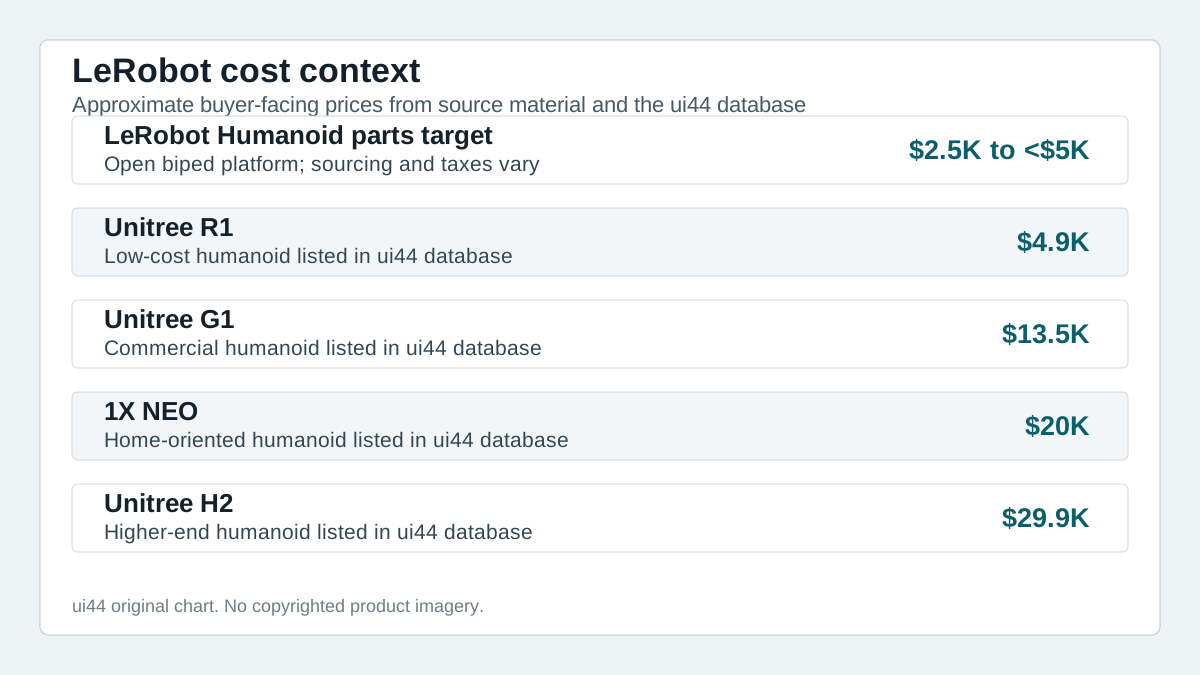
Here is the buyer-facing context from ui44's database:
Robot
LeRobot Humanoid
- Type
- Open biped platform
- Listed price in ui44
- About $2,500 in parts; project target below $5,000
- What the price means
- Build cost, not retail support
Robot
- Type
- Humanoid
- Listed price in ui44
- $4,900
- What the price means
- Low-cost commercial humanoid category
Robot
- Type
- Humanoid
- Listed price in ui44
- $13,500
- What the price means
- More complete commercial humanoid platform
Robot
- Type
- Home-oriented humanoid
- Listed price in ui44
- $20,000
- What the price means
- Aimed closer to real home use
Robot
- Type
- Humanoid
- Listed price in ui44
- $29,900
- What the price means
- Higher-end humanoid hardware tier
| Robot | Type | Listed price in ui44 | What the price means |
|---|---|---|---|
| LeRobot Humanoid | Open biped platform | About $2,500 in parts; project target below $5,000 | Build cost, not retail support |
| Unitree R1 | Humanoid | $4,900 | Low-cost commercial humanoid category |
| Unitree G1 | Humanoid | $13,500 | More complete commercial humanoid platform |
| 1X NEO | Home-oriented humanoid | $20,000 | Aimed closer to real home use |
| Unitree H2 | Humanoid | $29,900 | Higher-end humanoid hardware tier |
The comparison is not perfectly fair, and that is the point. A $2,500 parts list does not include your time, failed prints, replacement actuators, tools, spare wiring, batteries, shipping surprises, or the cost of fixing mistakes. It also does not include the consumer-facing parts of a product: safety validation, packaging, service, documentation written for non-builders, and a company that takes responsibility when something goes wrong.
Still, the price band is important. If a biped learning platform can be reproduced for less than many premium laptops, more teams can collect failure data. Cheap robots fail more often in more places, and those failures are valuable when they are documented well.
Why Does Open Source Matter For Home Robots?
Open-source humanoids do not automatically create home robots. They create a wider test surface.
The home is a brutal environment for robotics because it is unstructured without being random. Chairs move, rugs curl, pets cross paths, cables appear, lighting changes, people interrupt tasks, and most objects were designed for human hands. A robot that works in one demo may fail in another apartment five minutes later.
An open platform can help because builders can inspect and improve the weak links. If the mechanical design is public, people can change a joint or print a stronger part. If the model assets are public, simulation work can be compared more honestly. If the runtime is accessible, researchers can test policies, teleoperation approaches, recovery behaviors, and safer control loops without waiting for a vendor to expose a private interface.
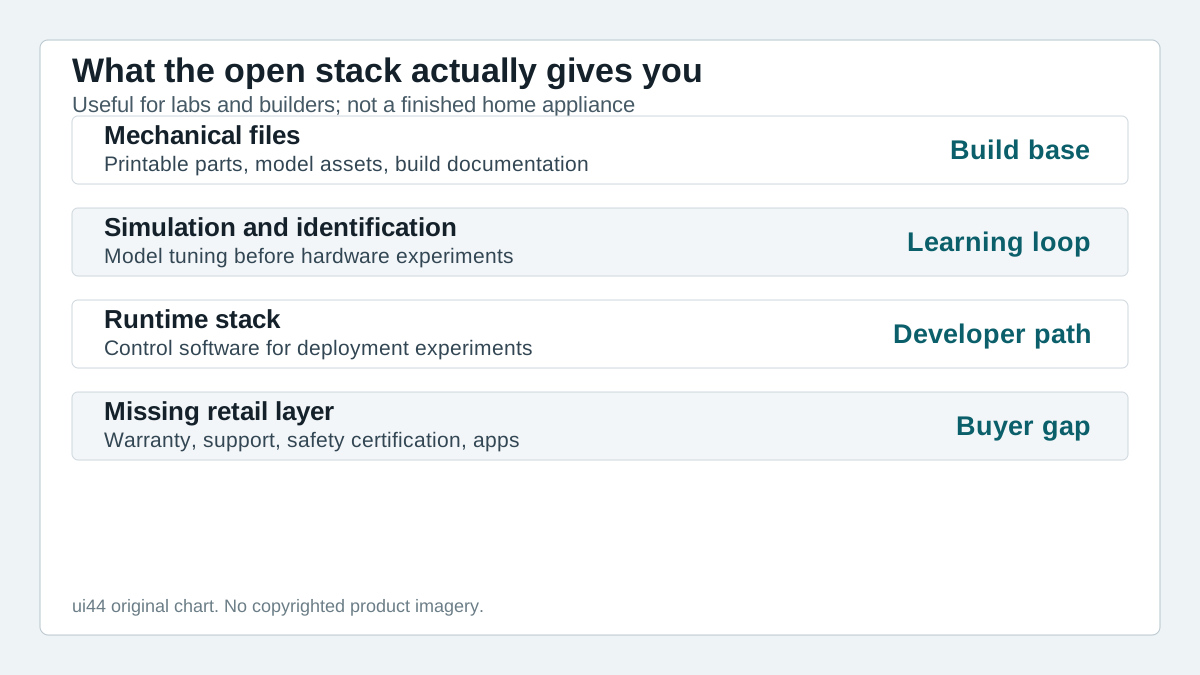
That does not mean the average buyer should build one. It means the ecosystem may get better measurements. For a site like ui44, that distinction matters. The best future home robot may not come directly from LeRobot Humanoid, but it may borrow ideas, datasets, parts, tests, or developers that grew around projects like it.
What It Does Not Prove Yet
The temptation with any low-cost humanoid is to jump from "it walks" to "it can help at home." Those are not the same claim.
A useful home robot needs a long chain of capabilities. It must move without falling into people or furniture. It must perceive common household objects. It must manipulate items that vary in shape, weight, friction, and fragility. It must know when not to act. It must recover when a task fails. It must be quiet enough, safe enough, maintainable enough, and boring enough to live with.
LeRobot Humanoid is better understood as a platform for exploring that chain. It can make research cheaper. It can make experiments easier to reproduce. It can let more people test policies on a physical biped. But it does not remove the home-readiness checklist.
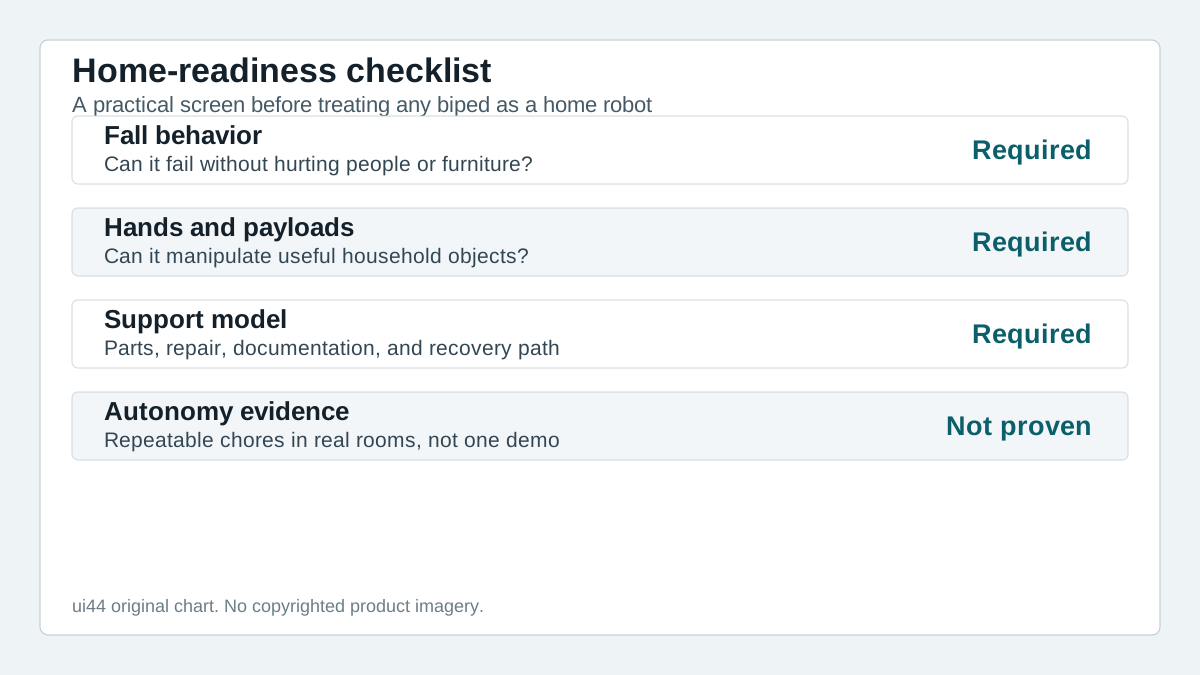
Before treating any open biped as a home robot, ask four practical questions:
- Can it fall safely, or at least fail in a way that does not damage people, pets, furniture, floors, and itself?
- Can it manipulate useful household objects, not just wave arms or move through a prepared scene?
- Can a normal owner get parts, repairs, software recovery, and support when something breaks?
- Has it repeated useful tasks in real rooms, with clutter and interruptions, not just in a single edited demo?
If the answer is no, the robot may still be valuable. It is just valuable as a development platform, not as a home assistant.
The Best Comparison Is Not A Robot Vacuum
Robot vacuums became home products because the task was bounded. A vacuum can fail gracefully: it gets stuck, misses a corner, or returns to the dock. A humanoid has a much larger action space. It can fall, grab the wrong thing, block a hallway, pinch fingers, or damage objects above floor level. The risk profile is different.
That is why LeRobot Humanoid should be compared with other humanoid and developer platforms, not with finished appliances. Booster T1 is another humanoid listed in ui44, but its presence in the database does not mean it is ready for ordinary apartments. Unitree's humanoid lineup shows how quickly prices are moving: Unitree R1 appears at $4,900, Unitree G1 at $13,500, and Unitree H2 at $29,900. The spread is huge because the category is still forming.
LeRobot Humanoid lands at the research-builder end of that spread. It may be cheaper than commercial humanoids, but it also shifts more work onto the builder. That is a good trade for a lab and a bad trade for most households.
What Buyers Should Watch Next
The next useful signal is not another walking clip. Watch for repeatable tasks.
For home relevance, the project or its community would need to show behaviors such as safe recovery after loss of balance, robust standing from common positions, reliable object pickup with household clutter, simple navigation around furniture, and repeatable teleoperated data collection that can train better policies. The word "repeatable" is doing a lot of work here. One successful video is a demo. Fifty attempts with failure categories is evidence.
Also watch how the documentation evolves. A low-cost open humanoid becomes more valuable when the build process is clear enough for many people to reproduce, the bill of materials is stable, the calibration process is documented, and broken parts can be replaced without heroic effort. For a future home robot ecosystem, repairability may matter almost as much as autonomy.
Finally, watch whether the open stack connects to broader robot-learning tooling. Hugging Face's LeRobot work is already associated with datasets, policies, and reproducible learning workflows. If the humanoid platform becomes another body that can collect useful training data, it could help the field even before it helps households.
Bottom Line
LeRobot Humanoid is exciting because it lowers the cost of asking serious questions about biped robots. It is not exciting because it is secretly a cheap home helper.
For buyers, the practical takeaway is simple: do not treat a $2,500 open-source biped as a consumer humanoid. Treat it as evidence that the developer platform layer is getting cheaper, more open, and more reproducible. That layer matters because the home humanoids people eventually buy will need better training data, better failure recovery, better test coverage, and better repair paths than today's demos show.
If you want a robot for your home today, compare finished products by task, support, price, and safety evidence on ui44's robot database or build a shortlist in Compare. If you want to understand where home humanoids may be heading, LeRobot Humanoid is worth watching precisely because it is not finished.
Sources: Hugging Face LeRobot Humanoid article, LeRobot Humanoid GitHub workspace, and Robot News coverage.
Database context
Use this article as a warranty and coverage workflow
Turn the article into a real verification pass
LeRobot Humanoid: Can a $2,500 Biped Help Homes? already points you toward 5 linked robots, 4 manufacturers, and 2 countries inside the ui44 database. That matters because strong buyer guidance is easier to apply when you can move immediately from a claim or warning into concrete product pages, manufacturer directories, component explainers, and country-level context instead of treating the article as an isolated opinion piece. The fastest next step is to turn the article into a shortlist workflow: open the linked robot pages, verify which specs are actually published for those models, then compare the surrounding manufacturer and component context before you decide whether the underlying claim changes your buying plan.
For this topic, the useful discipline is to separate the editorial lesson from the catalog evidence. The article gives you the framing, but the robot pages tell you what each product actually ships with today: sensor stack, connectivity methods, listed price, release timing, category, and support-relevant compatibility notes. The manufacturer pages then show whether you are looking at a one-off launch, a broader lineup pattern, or a company that spans multiple categories. That layered workflow reduces the risk of buying on a single marketing phrase or a single support FAQ.
The most practical move is to keep warranty language and product context together. Compare the linked robots first, then check whether the manufacturer pages suggest a mature service lane or a more limited lineup. On this article, R1, G1, and NEO are the right place to start. If you want a quick working shortlist, open Compare R1, G1, and NEO next, then keep this article open as the reasoning layer while you compare structured data side by side.
Practical Takeaway
Every robot, manufacturer, category, component, and country reference below resolves to a real ui44 page, keeping the follow-up path grounded in database records rather than generic advice.
Suggested next steps in ui44
- Compare the listed price, release timing, and category fit of the linked robots before you treat warranty length as a direct value proxy.
- Open Unitree Robotics to see whether the brand has several relevant models in the same lane or whether the article is centered on one flagship product.
- Record what the article proves, what still depends on seller or region rules, and which consumables or battery-related details you still need to verify externally.
- Use Compare R1, G1, and NEO before checkout so the warranty conversation stays anchored to a real shortlist.
- Do not treat the article as the final source of truth on coverage terms. Treat it as the framing layer that tells you which documentation you still need to inspect before purchase.
Database context
Robot profiles worth opening next
Use the linked product pages as the evidence layer
The linked robot pages are where this article becomes operational. Instead of asking whether the headline is interesting, use the robot entries to inspect the actual mix of sensors, connectivity options, batteries, pricing, release timing, and stated capabilities attached to the products mentioned in the article. That is the easiest way to see whether the warning or opportunity described here affects one product family, a specific design pattern, or an entire buying lane.
R1
Unitree Robotics · Humanoid · Pre-order
R1 is tracked on ui44 as a pre-order humanoid robot from Unitree Robotics. The database currently records a listed price of $4,900, a release date of 2025, ~1 hour (mixed activity) battery life, Not officially disclosed charging time, and a published stack that includes Binocular Cameras, 4-Mic Array, and Dual 6-Axis IMU plus Wi-Fi and Bluetooth 5.2.
For warranty and coverage questions, the robot page gives you the operating context that fine print often leaves out. Review the published capability mix, including Bipedal Walking & Running, Cartwheels & Handstands, and Push Recovery, and the listed battery and charging profile before deciding whether a coverage term meaningfully reduces your ownership risk or merely sounds reassuring in isolation.
G1 is tracked on ui44 as a available humanoid robot from Unitree. The database currently records a listed price of $13,500, a release date of 2024-05-13, ~2 hours battery life, Not disclosed charging time, and a published stack that includes Depth Camera, 3D LiDAR, and 4 Microphone Array plus Wi-Fi 6 and Bluetooth 5.2.
For warranty and coverage questions, the robot page gives you the operating context that fine print often leaves out. Review the published capability mix, including Bipedal Walking, Object Manipulation, and Dexterous Hands (optional Dex3-1), and the listed battery and charging profile before deciding whether a coverage term meaningfully reduces your ownership risk or merely sounds reassuring in isolation.
NEO
1X Technologies · Humanoid · Pre-order
NEO is tracked on ui44 as a pre-order humanoid robot from 1X Technologies. The database currently records a listed price of $20,000, a release date of 2025-10-28, ~4 hours battery life, Not disclosed charging time, and a published stack that includes RGB Cameras, Depth Sensors, and Tactile Skin plus Wi-Fi and Bluetooth.
For warranty and coverage questions, the robot page gives you the operating context that fine print often leaves out. Review the published capability mix, including Household Chores, Tidying Up, and Safe Human Interaction, and the listed battery and charging profile before deciding whether a coverage term meaningfully reduces your ownership risk or merely sounds reassuring in isolation.
Unitree H2
Unitree Robotics · Humanoid · Available
Unitree H2 is tracked on ui44 as a available humanoid robot from Unitree Robotics. The database currently records a listed price of $29,900, a release date of 2025, About 3 hours battery life, Not officially disclosed charging time, and a published stack that includes Binocular Camera (Wide FOV), Array Microphone, and IMU plus Wi-Fi 6 and Bluetooth 5.2.
For warranty and coverage questions, the robot page gives you the operating context that fine print often leaves out. Review the published capability mix, including 31 Degrees of Freedom, 360 N·m Peak Leg Joint Torque, and 120 N·m Peak Arm Joint Torque, and the listed battery and charging profile before deciding whether a coverage term meaningfully reduces your ownership risk or merely sounds reassuring in isolation.
Booster T1
Booster Robotics · Humanoid · Active
Booster T1 is tracked on ui44 as a active humanoid robot from Booster Robotics. The database currently records a listed price of Price TBA, a release date of 2024, 2 hours walking, 4 hours standing battery life, Not disclosed charging time, and a published stack that includes Intel RealSense D455 RGBD Depth Camera, 9-axis IMU, and Circular 6-Mic Array plus Wi-Fi 6 and Bluetooth 5.2.
For warranty and coverage questions, the robot page gives you the operating context that fine print often leaves out. Review the published capability mix, including 23-41 Degrees of Freedom (version-dependent), Bipedal Walking & Running, and Self-Recovery (prone to standing), and the listed battery and charging profile before deciding whether a coverage term meaningfully reduces your ownership risk or merely sounds reassuring in isolation.
Database context
Manufacturer context behind the article
Check whether this is one product story or a broader company pattern
Manufacturer pages add the support context that individual product pages cannot show on their own. They help you check whether the article is pointing at one coverage promise or at a company with a broader service footprint and multiple products to maintain.
Unitree Robotics
ui44 currently tracks 9 robots from Unitree Robotics across 3 categorys. The company is grouped under China, and the current catalog footprint on ui44 includes B2, B1, Go2.
That wider brand context matters because support confidence is easier to judge when you can see the company’s overall footprint, not just one warranty phrase attached to one product. A broader tracked lineup can change how you interpret the article’s coverage discussion. The category mix here currently points toward Quadruped, Humanoid, Research as the most useful next route if you want to see whether this article reflects a wider pattern inside the brand.
Unitree
ui44 currently tracks 2 robots from Unitree across 1 category. The company is grouped under China, and the current catalog footprint on ui44 includes H1, G1.
That wider brand context matters because support confidence is easier to judge when you can see the company’s overall footprint, not just one warranty phrase attached to one product. A broader tracked lineup can change how you interpret the article’s coverage discussion. The category mix here currently points toward Humanoid as the most useful next route if you want to see whether this article reflects a wider pattern inside the brand.
1X Technologies
ui44 currently tracks 2 robots from 1X Technologies across 1 category. The company is grouped under Norway, and the current catalog footprint on ui44 includes NEO, EVE.
That wider brand context matters because support confidence is easier to judge when you can see the company’s overall footprint, not just one warranty phrase attached to one product. A broader tracked lineup can change how you interpret the article’s coverage discussion. The category mix here currently points toward Humanoid as the most useful next route if you want to see whether this article reflects a wider pattern inside the brand.
Booster Robotics
ui44 currently tracks 1 robot from Booster Robotics across 1 category. The company is grouped under China, and the current catalog footprint on ui44 includes Booster T1.
That wider brand context matters because support confidence is easier to judge when you can see the company’s overall footprint, not just one warranty phrase attached to one product. A broader tracked lineup can change how you interpret the article’s coverage discussion. The category mix here currently points toward Humanoid as the most useful next route if you want to see whether this article reflects a wider pattern inside the brand.
Database context
Broaden the scan without leaving the database
Categories, components, and countries add the wider context
Category framing
Category pages are useful when the article touches a buying pattern that shows up across brands. A category route helps you confirm whether the linked products sit in a narrow niche or whether the same question should be tested across a larger field of alternatives.
Humanoid
The Humanoid category page currently groups 108 tracked robots from 78 manufacturers. ui44 describes this lane as: Full-size bipedal humanoid robots designed to work alongside humans. From factory floors to household tasks, these machines represent the cutting edge of robotics.
That makes the category route a practical follow-up when you want to check whether the products linked in this article are typical for the lane or whether they sit at one edge of the market. Useful starting examples currently include NEO, EVE, Mornine M1.
Country and ecosystem context
Country pages give extra context when support practices, launch sequencing, regulatory posture, or manufacturer mix matter. They are not a substitute for model-level verification, but they do help you see which ecosystems cluster together and which manufacturers sit in the same regional field when you broaden the search beyond the article headline.
China
The China route currently groups 170 tracked robots from 78 manufacturers in ui44. That gives you a useful regional lens when the article points toward support practices, launch sequencing, or brand clusters that may share similar ecosystem assumptions.
On the current route, manufacturers like Dreame, AGIBOT, Unitree Robotics make the page a good way to broaden the scan without losing the regional context that often shapes availability, documentation style, and adjacent alternatives.
Norway
The Norway route currently groups 2 tracked robots from 1 manufacturers in ui44. That gives you a useful regional lens when the article points toward support practices, launch sequencing, or brand clusters that may share similar ecosystem assumptions.
On the current route, manufacturers like 1X Technologies make the page a good way to broaden the scan without losing the regional context that often shapes availability, documentation style, and adjacent alternatives.
Database context
Questions to answer before you move from reading to buying
A follow-up FAQ built from the entities already linked in this article
Frequently Asked Questions
Which page should I open first after reading “LeRobot Humanoid: Can a $2,500 Biped Help Homes?”?
Start with R1. That gives you a concrete product anchor for the article’s main claim. From there, branch into the manufacturer and component pages so you can tell whether the article is describing one specific model, a repeated brand pattern, or a wider technology issue that affects multiple shortlist options.
How do the manufacturer pages change the buying decision?
Unitree Robotics help you zoom out from one article and one product. On ui44 they show lineup breadth, category spread, and the neighboring robots tied to the same company. That context is useful when you are deciding whether a risk belongs to a single model, whether it shows up across a brand’s portfolio, and whether you should keep looking at alternatives before committing.
When should I switch from reading to side-by-side comparison?
Move into Compare R1, G1, and NEO as soon as you understand the article’s main warning or promise. The article explains what to watch for, but the compare view is where you can check whether price, status, battery life, connectivity, sensors, and category fit still make the robot a good match for your own home and budget.
Database context
Where to go next in ui44
Keep the research chain inside the database
If you want to keep going, these follow-on pages give you the cleanest expansion path from article to research session. Open the comparison route first if you are deciding between products today. Open the manufacturer, category, and component routes if you still need to understand the broader pattern behind the claim.
Written by
ui44 Team
Published June 7, 2026
Share this article
Open a plain share link on X or Bluesky. No embeds, no widgets, no cookie baggage.