The practical version is more complicated and more interesting. A few examples can help a robot adapt, but they do not replace hands, sensors, control latency, safety boundaries, simulation, recovery behavior, or a service model for when the robot learns the wrong thing. For home buyers, the useful question is not "can AI learn from examples?" It is "what kind of example, on what hardware, for what task, with what failure rate?"
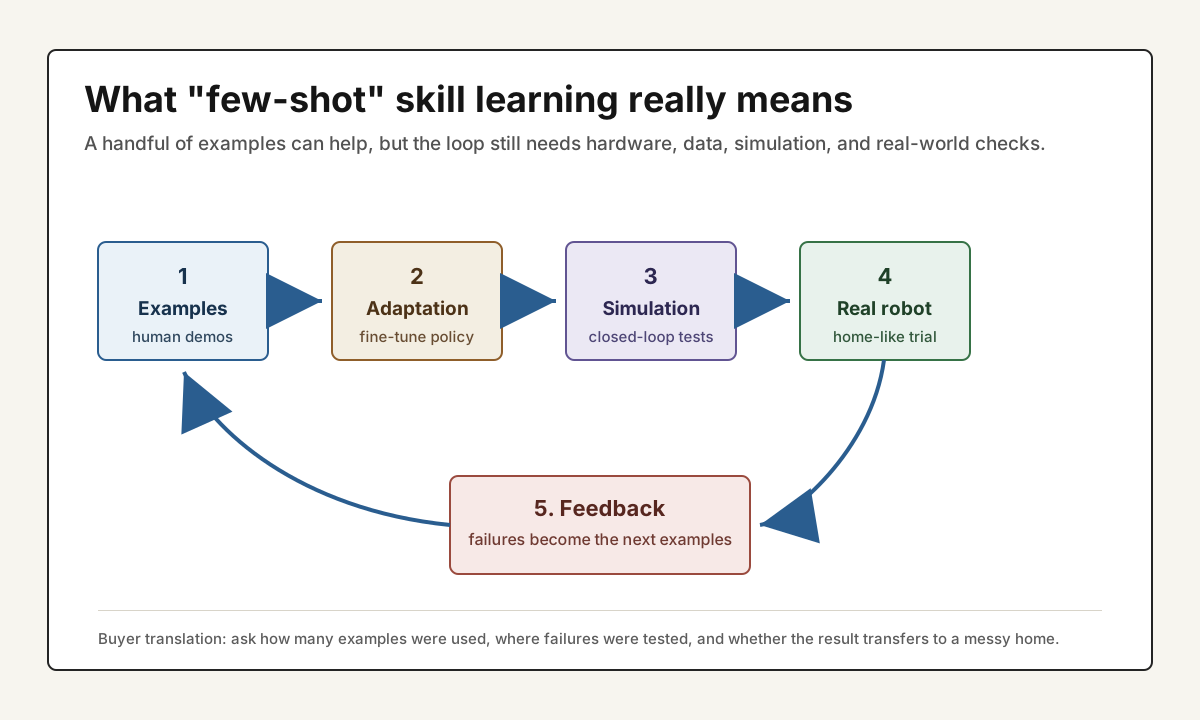
This matters because the latest embodied-AI announcements are moving away from simple remote-control demos. Genesis AI's GENE-26.5 post says many difficult demo skills need less than one hour of task-specific robot data, or under 200 episodes for skills shorter than 20 seconds. Zhongke Diwuji's BridgeV2W work, covered in the Pandaily funding report and described in the related research, points in a similar direction: using world models to predict how robot actions change a scene instead of collecting every possible real-world trial by hand.
Those are important signals. They are not yet a guarantee that a consumer robot can watch you fold one towel and generalize to every shirt, bedsheet, lighting condition, laundry basket, and impatient human in the house.
What "few-shot" means in a home robot
In consumer software, few-shot learning often means a model can infer a pattern from a few examples in a prompt. In robotics, the phrase carries more physical baggage. The robot has to convert an example into motion, contact, force, timing, and recovery.
A home chore has at least five layers:
Layer
Perception
- What the robot has to learn
- What object is where
- Why it is hard at home
- clutter, lighting, pets, transparent objects
Layer
Motion
- What the robot has to learn
- Where the arm, base, and hands should move
- Why it is hard at home
- narrow rooms and changing furniture
Layer
Contact
- What the robot has to learn
- How much force to use
- Why it is hard at home
- soft objects, liquids, cables, fragile items
Layer
Sequence
- What the robot has to learn
- What step comes next
- Why it is hard at home
- chores have hidden state and interruptions
Layer
Recovery
- What the robot has to learn
- What to do when it fails
- Why it is hard at home
- most homes are not instrumented test cells
| Layer | What the robot has to learn | Why it is hard at home |
|---|---|---|
| Perception | What object is where | clutter, lighting, pets, transparent objects |
| Motion | Where the arm, base, and hands should move | narrow rooms and changing furniture |
| Contact | How much force to use | soft objects, liquids, cables, fragile items |
| Sequence | What step comes next | chores have hidden state and interruptions |
| Recovery | What to do when it fails | most homes are not instrumented test cells |
That is why a good few-shot claim should always say what kind of task was learned. "Pick up this cup from this counter" is not the same claim as "clear the dinner table." "Transfer liquid in a lab pipette" is not the same claim as "make breakfast for a child." The more varied the task and environment, the more proof the claim needs.
Genesis' own framing is useful here because it does not treat manipulation as a model-only problem. Its GENE-26.5 article argues that manipulation depends on the full stack: hardware, human-centric data, control, model design, and evaluation. That is exactly the right lens for home buyers.
The demo is only half the story
The most impressive recent demonstrations are not just "robot arm moves object" clips. Genesis lists cooking, lab pipetting, Rubik's Cube solving, smoothie preparation, wire harnessing, multi-object grasping, and piano playing as tasks used to stress different parts of manipulation. The cooking example is framed as a four-minute long-horizon task with more than 20 subtasks.
That is more relevant to homes than a clean pick-and-place benchmark because home chores are long-horizon and contact-rich. A robot making a simple meal may need to hold a tomato, stabilize a cutting board, use a knife, move ingredients, avoid a hot surface, and stop safely when a person reaches into the workspace.
But the buyer translation is still cautious: a demo task proves that a stack can do that task under the tested conditions. It does not prove that the robot is a general household worker.
Genesis also says GENE-26.5 depends on a data engine that combines glove data, egocentric video, third-person video, and robot data, and that the company has collected more than 200,000 hours across these modalities. That scale matters. It also shows why "few-shot" is a slightly misleading phrase if read too literally. The final adaptation may be small, but the system behind it can still depend on very large pretraining and evaluation infrastructure.
The hardware decides what can be learned
One reason robot learning is harder than phone AI is that the model is attached to a body. If the hand cannot pinch a soft object, the model cannot learn a reliable pinching chore by wishful thinking. If the arm has too much latency or tracking error, delicate actions turn into misses. If the robot does not sense contact, it may not know when it is crushing, sliding, or failing.
Genesis makes this point directly with its Genesis Hand 1.0 roadmap: a 20 active degree-of-freedom, back-drivable hand designed to match human-hand size and soft contact more closely. Its control-stack section is just as important. Genesis says its middleware can reduce tracking error from about 20 mm to about 2 mm in one benchmark, and reduce delay from roughly 80 ms to 9 ms, with tuned settings as low as 3 ms.
Those numbers are not a buying guide by themselves, but they explain why home robots with superficially similar AI labels may behave very differently.
ui44's database shows the spread. Figure 03 is tracked as a 173 cm, 61 kg humanoid using Figure's Helix VLA system, with stereo vision, depth cameras, force sensors, tactile arrays, roughly five hours of battery life, and a 20 kg payload. 1X NEO is more explicitly home-focused: 167 cm, 30 kg, a soft lightweight body, about four hours of battery life, and a listed $20,000 price. Clone Alpha is even more direct about owner-taught skills, because Clone describes a Telekinesis training platform for demonstrating new household tasks, but ui44 also tracks it as a limited 279-unit Alpha Edition with many public specs still undisclosed.
The lesson: when a company says a robot can learn from examples, check whether the body can actually express the learned behavior.
Database signals to watch
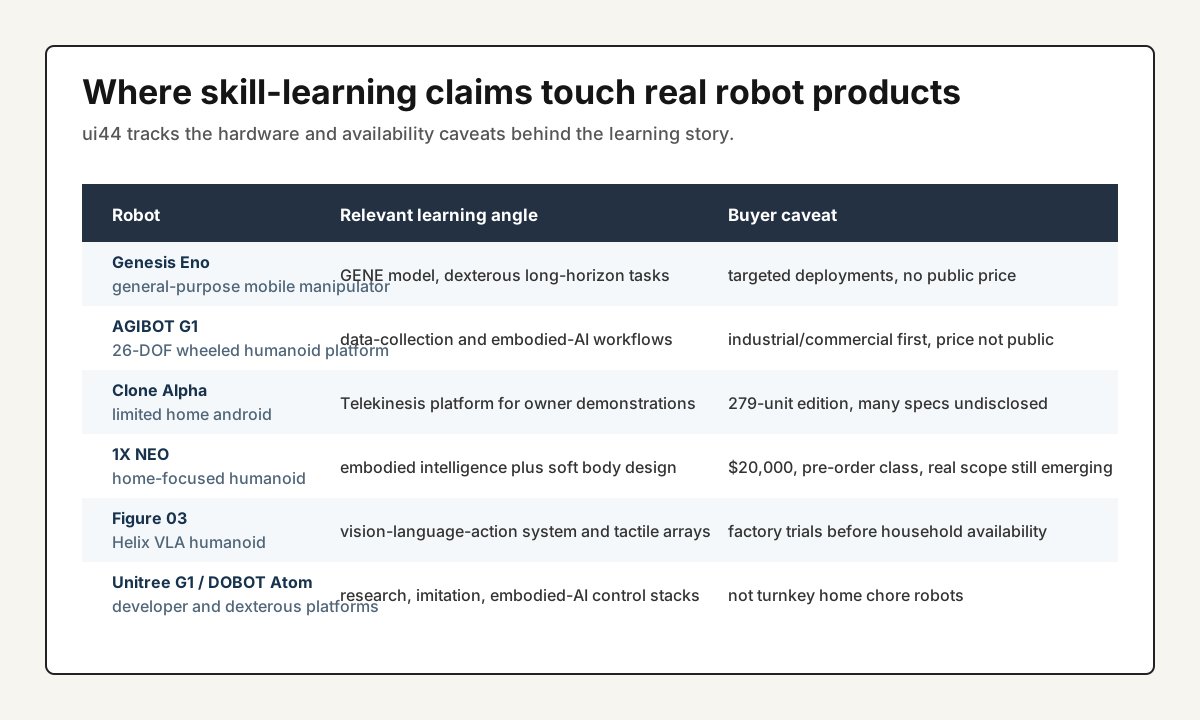
The most useful home-robot learning claims will connect three things: a model story, a hardware story, and an availability story.
Genesis Eno is a good example of the first two. It is not a humanoid in the classic two-legged sense, but ui44 tracks it as a general-purpose mobile manipulator built around GENE, context understanding, memory, reasoning, dynamic planning, and dexterous long-horizon execution. That is relevant to homes because the home does not actually care whether the robot has a human silhouette. It cares whether the robot can move, reach, perceive, and recover.
AGIBOT G1 shows a different angle. ui44 tracks it as a 26-DOF wheeled humanoid-style platform for industrial, commercial, and domestic scenarios, with a working height over 2 m, 3 kg continuous one-arm handling, six-axis force sensors on both arms, eight upper-body high-resolution cameras, front and rear RGB-D cameras, LiDAR, and explicit data-collection workflows. A robot like this may matter less as a household product today than as the sort of embodiment that generates, validates, and transfers skills.
DOBOT Atom is another useful comparison point because ui44 lists a $79,000 Atom price with the caveat that the official product page no longer shows the figure, so it is currently unverifiable. The same database record tracks dexterous-manipulation positioning, binocular RGB vision, Intel RealSense D455 depth sensing, 360-degree LiDAR, and a ROM-1 embodied-AI stack using imitation and reinforcement learning. It sounds closer to a developer or enterprise platform than a normal appliance, but those platforms are where many home-relevant skills will be proven first.
Unitree G1, at $13,500 in ui44's database, is the cheaper research-style counterweight. It is compact at 132 cm and 35 kg, with optional dexterous three-finger hands and EDU compute options, but a developer humanoid is not the same thing as a supervised household product. A buyer should separate "can be used by labs to train skills" from "will clean my kitchen safely."
Simulation helps, but it is not magic
Simulation is becoming central because real robot trials are slow, expensive, and physically risky. Genesis' simulation post argues for trustworthy, high-throughput evaluation: path-traced rendering, batched physics, multi-physics coverage for rigid bodies, cloth, fluids, granular materials, and deformables, plus cross-embodiment support including humanoids and dexterous hands.
For buyers, the important phrase is closed-loop evaluation. An open-loop model can look good by predicting what should happen next. A closed-loop robot has to live with the consequences of its own previous action. If it nudges a bowl, the scene changes. If it grabs a towel badly, the next frame is harder. If it spills water, the task has changed.
BridgeV2W points to the same trend from another direction. Its research framing is about adapting video-generation models into embodied world models by aligning actions with predicted video through embodiment masks. The buyer version is simple: the model should not only recognize a chore. It should predict what its own body will do to the world.
That could reduce the number of real-world examples needed for a new chore. It does not remove the need for real-world validation.
A buyer checklist for few-shot claims
What would make few-shot learning believable at home?
The credible version will probably arrive in narrow slices before it arrives as a general home assistant.
One early version could be a robot learning a new placement preference: "mugs go on this shelf, not that shelf." Another could be household-specific routing: "take laundry from this basket to this machine." A third could be object handling for a small set of safe items: bottles, towels, packaged food, mail, or children's toys. These are still useful tasks, and they are easier to validate than fully open-ended cooking or elder care.
Robots such as Robody also show why autonomy may not be the only path. ui44 tracks Robody as a home-care robotic avatar combining AI for routine chores and monitoring with human-in-the-loop VR teleoperation for tasks that need judgment or dexterity. That hybrid model is less flashy than a purely autonomous humanoid, but it may be more honest for early home deployment.
For owner-trained robots, Clone Alpha's Telekinesis angle is one to watch. For model-native robots, Figure's Helix, 1X's embodied intelligence, Genesis' GENE, AGIBOT's data workflows, and DOBOT's ROM-1 all point toward the same market direction: the robot is no longer just hardware waiting for hand-coded scripts. It is becoming a learning system attached to a body.
The hard part is that homes punish vague claims. A robot that learns a chore from a few examples still has to know when the chore is unsafe, when an object is not the one it expected, when a child or pet entered the workspace, and when the right answer is to stop.
Bottom line
Few-shot learning is one of the most important ideas in home robotics, but it is not a magic phrase. It is a way to reduce task-specific data and setup time when the rest of the system is strong enough.
For buyers, the best signal is not the number of examples alone. It is the whole chain: the robot's hand and sensors, the model's pretraining, the simulation and closed-loop evaluation, the real-world failure data, the support model, and the actual product path.
The robots closest to this story today are not all household appliances. Some are developer platforms, some are industrial humanoids, some are service robots, and some are early home-focused products. That is fine. The home robot market usually learns from the lab and the warehouse before it reaches the kitchen.
The useful question for 2026 is no longer whether robots can learn from examples at all. They can. The useful question is whether the robot you can actually buy can learn the specific chore you care about, in your specific home, without turning every exception into your problem.
Related in the database
Use this article as a buyer workflow
Turn the article into a real verification pass grounded in the robots, manufacturers, categories, components, and countries it actually references.
Few-Shot Robot Learning for Home Chores? already points you toward 8 linked robots, 8 manufacturers, and 5 countries inside the ui44 database. That matters because strong buyer guidance is easier to apply when you can move immediately from a claim or warning into concrete product pages, manufacturer directories, component explainers, and country-level context instead of treating the article as an isolated opinion piece. The fastest next step is to turn the article into a shortlist workflow: open the linked robot pages, verify which specs are actually published for those models, then compare the surrounding manufacturer and component context before you decide whether the underlying claim changes your buying plan.
For this topic, the useful discipline is to separate the editorial lesson from the catalog evidence. The article gives you the framing, but the robot pages tell you what each product actually ships with today: sensor stack, connectivity methods, listed price, release timing, category, and support-relevant compatibility notes. The manufacturer pages then show whether you are looking at a one-off launch, a broader lineup pattern, or a company that spans multiple categories. That layered workflow reduces the risk of buying on a single marketing phrase or a single support FAQ.
The fastest win is to keep the article’s editorial framing tied to real product pages. That way you can test whether Figure 03, NEO, and Clone Alpha still make sense once price, category, release timing, and surrounding manufacturer context are visible in one place. If you want a quick working shortlist, open Compare Figure 03, NEO, and Clone Alpha next, then keep this article open as the reasoning layer while you compare structured data side by side.
Practical Takeaway
Every robot, manufacturer, category, component, and country reference below resolves to a real ui44 page, keeping the follow-up path grounded in database records rather than generic advice.
Suggested next steps in ui44
- Open Figure 03 first so the article’s main point is anchored to a real robot page.
- Use Figure AI to see the broader company context around the products linked in the article.
- Open the linked component pages when you want to separate a shared technology pattern from a single-brand story.
- Build a working shortlist with Compare Figure 03, NEO, and Clone Alpha.
- Keep a short note of what is already verified in the article and what still needs live confirmation from current vendor documentation.
Robot profiles worth opening next
Use the linked product pages as the evidence layer
The linked robot pages are where this article becomes operational. Instead of asking whether the headline is interesting, use the robot entries to inspect the actual mix of sensors, connectivity options, batteries, pricing, release timing, and stated capabilities attached to the products mentioned in the article. That is the easiest way to see whether the warning or opportunity described here affects one product family, a specific design pattern, or an entire buying lane.
Figure 03 is tracked on ui44 as a active humanoid robot from Figure AI. The database currently records a listed price of Price TBA, a release date of 2025-10-09, ~5 hours battery life, Not disclosed charging time, and a published stack that includes Stereo Vision, Depth Cameras, and Force Sensors plus Wi-Fi and Bluetooth.
For general buyer research, this route gives you the concrete profile that the article alone cannot. Compare the published capabilities of Complex Manipulation, Warehouse Work, and Manufacturing Tasks with the linked alternatives so the final decision is based on actual product fit, not just the framing of the article.
NEO
1X Technologies · Humanoid · Pre-order
NEO is tracked on ui44 as a pre-order humanoid robot from 1X Technologies. The database currently records a listed price of $20,000, a release date of 2025-10-28, ~4 hours battery life, Not disclosed charging time, and a published stack that includes RGB Cameras, Depth Sensors, and Tactile Skin plus Wi-Fi and Bluetooth.
For general buyer research, this route gives you the concrete profile that the article alone cannot. Compare the published capabilities of Household Chores, Tidying Up, and Safe Human Interaction with the linked alternatives so the final decision is based on actual product fit, not just the framing of the article.
Clone Alpha
Clone Robotics · Humanoid · Pre-order
Clone Alpha is tracked on ui44 as a pre-order humanoid robot from Clone Robotics. The database currently records a listed price of Price TBA, a release date of 2025, Not officially disclosed battery life, Not officially disclosed charging time, and a published stack that includes Nervous system (specific sensors not officially disclosed) plus its listed connectivity stack.
For general buyer research, this route gives you the concrete profile that the article alone cannot. Compare the published capabilities of Bipedal Humanoid Locomotion, Myofiber Artificial Muscle Actuation, and Natural-Language Interaction with the linked alternatives so the final decision is based on actual product fit, not just the framing of the article.
Eno
Genesis AI · Commercial · Development
Eno is tracked on ui44 as a development commercial robot from Genesis AI. The database currently records a listed price of Price TBA, a release date of 2026-06-16, Not officially disclosed battery life, Not officially disclosed charging time, and a published stack that includes Vision/perception stack for GENE; exact camera and sensor hardware not officially disclosed plus Not officially disclosed.
For general buyer research, this route gives you the concrete profile that the article alone cannot. Compare the published capabilities of General-purpose mobile manipulation, Wheeled indoor mobility, and Dual-arm dexterous manipulation with the linked alternatives so the final decision is based on actual product fit, not just the framing of the article.
G1 is tracked on ui44 as a available humanoid robot from AGIBOT. The database currently records a listed price of Price TBA, a release date of TBD, 4h+ runtime battery life, Not officially disclosed charging time, and a published stack that includes Six-axis force sensors on both arms, Eight high-resolution upper-body cameras, and Front and rear RGB-D cameras plus Wired data connection and Cloud data transmission.
For general buyer research, this route gives you the concrete profile that the article alone cannot. Compare the published capabilities of 26-DOF Wheeled Manipulation, One-Arm 3 kg Continuous Handling, and Working Height over 2 m with the linked alternatives so the final decision is based on actual product fit, not just the framing of the article.
Manufacturer context behind the article
Check whether this is one product story or a broader company pattern
Manufacturer pages add the market context that individual product pages cannot show on their own. They help you check whether the article is centered on a brand with a deep lineup, whether that brand spans several categories, and how much of its ui44 footprint depends on one flagship model versus a broader product strategy.
Figure AI
ui44 currently tracks 2 robots from Figure AI across 1 category. The company is grouped under USA, and the current catalog footprint on ui44 includes Figure 03, Figure 02.
That wider brand context matters because the best buying decision usually depends on lineup depth and adjacent options, not just the one model featured most prominently in the article. The category mix here currently points toward Humanoid as the most useful next route if you want to see whether this article reflects a wider pattern inside the brand.
1X Technologies
ui44 currently tracks 2 robots from 1X Technologies across 1 category. The company is grouped under Norway, and the current catalog footprint on ui44 includes NEO, EVE.
That wider brand context matters because the best buying decision usually depends on lineup depth and adjacent options, not just the one model featured most prominently in the article. The category mix here currently points toward Humanoid as the most useful next route if you want to see whether this article reflects a wider pattern inside the brand.
Clone Robotics
ui44 currently tracks 1 robot from Clone Robotics across 1 category. The company is grouped under USA, and the current catalog footprint on ui44 includes Clone Alpha.
That wider brand context matters because the best buying decision usually depends on lineup depth and adjacent options, not just the one model featured most prominently in the article. The category mix here currently points toward Humanoid as the most useful next route if you want to see whether this article reflects a wider pattern inside the brand.
Genesis AI
ui44 currently tracks 1 robot from Genesis AI across 1 category. The company is grouped under France, and the current catalog footprint on ui44 includes Eno.
That wider brand context matters because the best buying decision usually depends on lineup depth and adjacent options, not just the one model featured most prominently in the article. The category mix here currently points toward Commercial as the most useful next route if you want to see whether this article reflects a wider pattern inside the brand.
Broaden the scan without leaving the database
Categories, components, and countries add the wider context
Category framing
Category pages are useful when the article touches a buying pattern that shows up across brands. A category route helps you confirm whether the linked products sit in a narrow niche or whether the same question should be tested across a larger field of alternatives.
Humanoid
The Humanoid category page currently groups 129 tracked robots from 92 manufacturers. ui44 describes this lane as: Full-size bipedal humanoid robots built to work alongside people — from factory floors to household tasks. Compare the cutting edge of humanoid robotics.
That makes the category route a practical follow-up when you want to check whether the products linked in this article are typical for the lane or whether they sit at one edge of the market. Useful starting examples currently include NEO, EVE, Mornine M1.
Commercial
The Commercial category page currently groups 44 tracked robots from 38 manufacturers. ui44 describes this lane as: Delivery robots, warehouse automation, and hospitality service bots — robots built for business and commercial operations.
That makes the category route a practical follow-up when you want to check whether the products linked in this article are typical for the lane or whether they sit at one edge of the market. Useful starting examples currently include G2 Air, aeo, Pepper.
Country and ecosystem context
Country pages give extra context when support practices, launch sequencing, regulatory posture, or manufacturer mix matter. They are not a substitute for model-level verification, but they do help you see which ecosystems cluster together and which manufacturers sit in the same regional field when you broaden the search beyond the article headline.
USA
The USA route currently groups 89 tracked robots from 69 manufacturers in ui44. That gives you a useful regional lens when the article points toward support practices, launch sequencing, or brand clusters that may share similar ecosystem assumptions.
On the current route, manufacturers like Faraday Future, iRobot, Boston Dynamics make the page a good way to broaden the scan without losing the regional context that often shapes availability, documentation style, and adjacent alternatives.
Norway
The Norway route currently groups 2 tracked robots from 1 manufacturers in ui44. That gives you a useful regional lens when the article points toward support practices, launch sequencing, or brand clusters that may share similar ecosystem assumptions.
On the current route, manufacturers like 1X Technologies make the page a good way to broaden the scan without losing the regional context that often shapes availability, documentation style, and adjacent alternatives.
France
The France route currently groups 8 tracked robots from 7 manufacturers in ui44. That gives you a useful regional lens when the article points toward support practices, launch sequencing, or brand clusters that may share similar ecosystem assumptions.
On the current route, manufacturers like Pollen Robotics, Aldebaran / Maxtronics, Aldebaran Robotics make the page a good way to broaden the scan without losing the regional context that often shapes availability, documentation style, and adjacent alternatives.
Questions to answer before you move from reading to buying
A follow-up FAQ built from the entities already linked in this article
Frequently Asked Questions
Which page should I open first after reading “Few-Shot Robot Learning for Home Chores?”?
Start with Figure 03. That gives you a concrete product anchor for the article’s main claim. From there, branch into the manufacturer and component pages so you can tell whether the article is describing one specific model, a repeated brand pattern, or a wider technology issue that affects multiple shortlist options.
How do the manufacturer pages change the buying decision?
Figure AI help you zoom out from one article and one product. On ui44 they show lineup breadth, category spread, and the neighboring robots tied to the same company. That context is useful when you are deciding whether a risk belongs to a single model, whether it shows up across a brand’s portfolio, and whether you should keep looking at alternatives before committing.
When should I switch from reading to side-by-side comparison?
Move into Compare Figure 03, NEO, and Clone Alpha as soon as you understand the article’s main warning or promise. The article explains what to watch for, but the compare view is where you can check whether price, status, battery life, connectivity, sensors, and category fit still make the robot a good match for your own home and budget.
Where to go next in ui44
Keep the research chain inside the database
If you want to keep going, these follow-on pages give you the cleanest expansion path from article to research session. Open the comparison route first if you are deciding between products today. Open the manufacturer, category, and component routes if you still need to understand the broader pattern behind the claim.
Written by
ui44 Team
Published June 23, 2026
Share this article
Open a plain share link on X or Bluesky. No embeds, no widgets, no cookie baggage.