That does not mean a Navel-style robot is ready to sit unassisted in every living room. It means something more specific, and more interesting for home robot buyers: a social robot has to survive real routines, real staff constraints, real privacy reviews, and real human moods before it deserves trust.
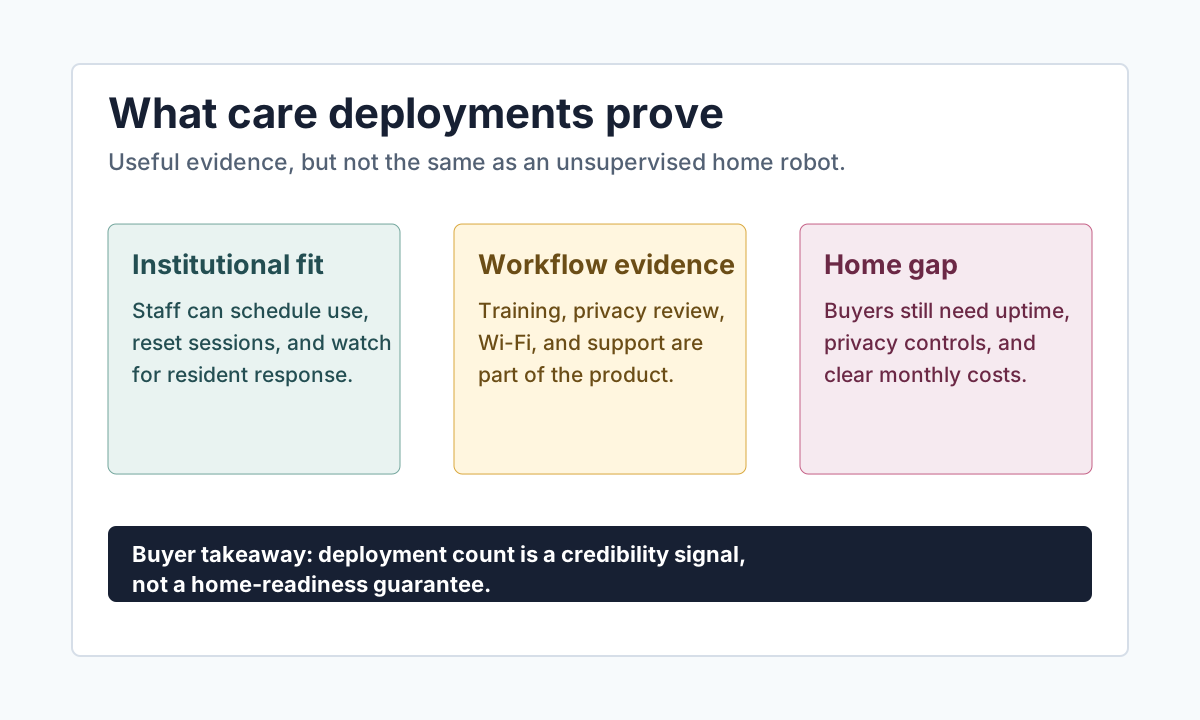
For buyers, the lesson is not "wait for a care robot to replace people." It is the opposite. The useful near-term robots are narrow, supervised, and honest about the work they do. Navel is not lifting residents, dispensing medicine, or cleaning rooms. Its value proposition is social activation: conversation, mood support, memory-aware interaction, and structured engagement in places where staff time is scarce.
That makes Navel a good test case for the next wave of home companions. If a robot is going to be trusted around an older adult, a child, or anyone who might treat it as a social presence, the question is no longer just whether the robot can talk. The question is whether the company has designed the product, support model, privacy posture, and failure modes around vulnerable humans.
What Navel Is Actually Selling
Navel describes its robot as an "empathy robot" for care facilities. The official product page says the robot can address people by name, remember previous conversations, chat about everyday topics, tell jokes or poems, and respond with animated eye contact. It is configured through a browser, used over Wi-Fi, and sold for care or research rather than as a consumer gadget.
The specifications are more concrete than most companion-robot pitches. Navel lists Linux as the operating system; face detection, person identification, emotion recognition, head pose, and eye gaze as computer-vision capabilities; sound-source localization and beam forming for audio; speech-to-text via cloud service; Acapela text-to-speech across 30 languages; and an LLM-based dialog manager. Hardware includes an NVIDIA Jetson AGX Xavier, an Intel RealSense depth module, two lidar sensors, three sonar sensors, seven microphones, three round displays, a 288 Wh battery, LAN, Wi-Fi, and a roughly 72 cm, 8 kg body.
Those details matter because a care robot lives or dies on reliability. A vague "AI companion" can impress in a short video. A deployed social robot has to hear people in noisy rooms, maintain appropriate distance, recognize when interaction is failing, and give staff a way to configure, supervise, and update it.
Navel's own privacy claims are also unusually specific for this category. The company says dialog generation uses GDPR-compliant servers in Europe, conversation data is stored only on the robot rather than in the cloud, image data is analyzed on the robot and deleted after 100 milliseconds, and personal data is not used for training. Those are vendor claims, not an independent audit, but they are exactly the kind of claims a serious buyer should demand in writing.
Why Care Facilities Are a Better Test Than Living Rooms
Care facilities are imperfect, but they are a stronger proving ground than a staged home demo. A facility can train staff, define when the robot should be used, document resident reactions, and decide whether the robot is improving daily routines or merely adding another device to manage.
That structure is why the "100 robots" signal is meaningful. It suggests that Navel is moving beyond one-off pilots into repeat deployments. It also gives buyers a better lens for evaluating every home companion robot: not "can it charm someone for five minutes?" but "can it remain useful after the novelty fades?"
The answer will be mixed. Social robots are especially vulnerable to early delight followed by slow disappointment. They can feel magical when they remember a detail, make eye contact, or ask a good question. They can also become frustrating when the Wi-Fi drops, several people speak at once, the robot repeats itself, or the user realizes that "companionship" is partly a subscription-backed cloud service.
That is why Navel's care-facility path is relevant even if the product is not a consumer home robot. The care setting exposes the hidden work: setup, data-protection review, staff training, support calls, updates, and expectations management.
The ui44 Comparison: Navel Is Closer to ElliQ Than to a Humanoid Butler
Home robot buyers often put every friendly robot into the same mental bucket. That is a mistake. A care social robot, an older-adult companion, a therapeutic robot, and a mobile humanoid platform all have different risk profiles.
In the ui44 database, the closest consumer comparison is ElliQ 3. ElliQ is designed for older adults, focuses on proactive conversation, reminders, wellness programs, video calling, and activities, and uses a membership model rather than a traditional hardware sale. Our database currently tracks official ElliQ pricing as a $249 one-time lease initiation fee plus subscription options shown at $59/month, $49/month annually, or $39/month on a 24-month plan. The robot is leased during the membership.
LOVOT sits on a different branch. It is an emotional companion from GROOVE X, designed around affection rather than care workflow. ui44 tracks the current LOVOT 3.0 price at JPY 577,500, with a monthly care plan from JPY 9,900/month, and notes that the product is Japan-only in practice.
PARO is the older care precedent: a therapeutic companion used in dementia care and other clinical or social-care settings. It does not try to be a general AI conversational partner. That narrowness is part of why PARO is still relevant.
Pepper is the cautionary example. It was one of the most recognized social robots in the world, with about 27,000 units manufactured before production paused in 2021 because demand was weak. Pepper proved that public enthusiasm and emotional design do not automatically create a durable product category.
Mirokai, from Enchanted Tools, points toward the next layer: a mobile social humanoid platform with arms, autonomous navigation, face tracking, multi-LLM conversation, and a hospital/service-sector angle. It is more physically capable than Navel or ElliQ, but also more complex and less consumer-ready.
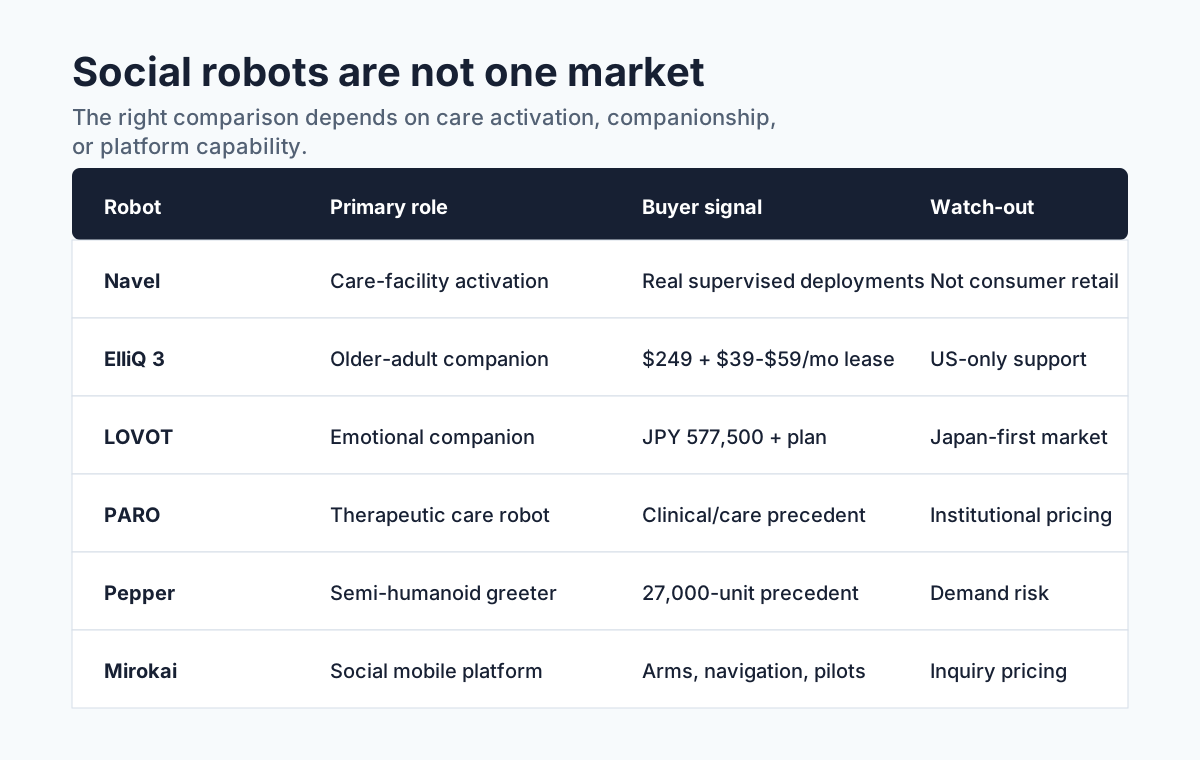
The useful takeaway is that "social robot" is not one market. Navel is evidence for supervised social activation in care. ElliQ is evidence for subscription-based older-adult companionship. LOVOT is evidence that emotional robots can be sold as premium lifestyle products. PARO is evidence that therapy-adjacent robots can work when expectations are narrow. Pepper is evidence that scale does not guarantee product-market fit. Mirokai is evidence that the category is moving toward social robots with manipulation and mobility, but not yet toward cheap household autonomy.
What Should Home Robot Buyers Learn From Navel?
The first lesson is that the robot's job needs to be small enough to judge. "Keep someone company" is emotionally appealing, but it is too broad. Better questions are: does the robot start conversations reliably? Does it help a person participate in group activity? Does it reduce repeated staff prompting? Does it make scheduled check-ins easier? Does it create measurable engagement without creating dependency?
The second lesson is that support is part of the product. Navel says implementation includes preparation for data protection and IT issues, shipment, about two hours of training, regular video calls during the first months, shared customer consultation hours, regular updates, and remote support. That is not a side detail. For a social robot, the support model may matter as much as the sensors.
The third lesson is that buyers should separate emotional capability from physical capability. Navel can talk, orient, recognize social cues, and move through designed interactions. It does not solve the tasks people often imagine when they hear "care robot": lifting, bathing, feeding, medication handling, fall response, laundry, or cleaning. Those are different robotics problems.
The fourth lesson is that privacy must be evaluated before the first demo. Social robots use cameras, microphones, cloud speech services, memory, and personalization. A household with an older adult should ask the same questions a care facility asks: what is processed locally, what is sent to cloud services, how long logs are retained, who can access support data, whether recordings are used for training, and how deletion works.
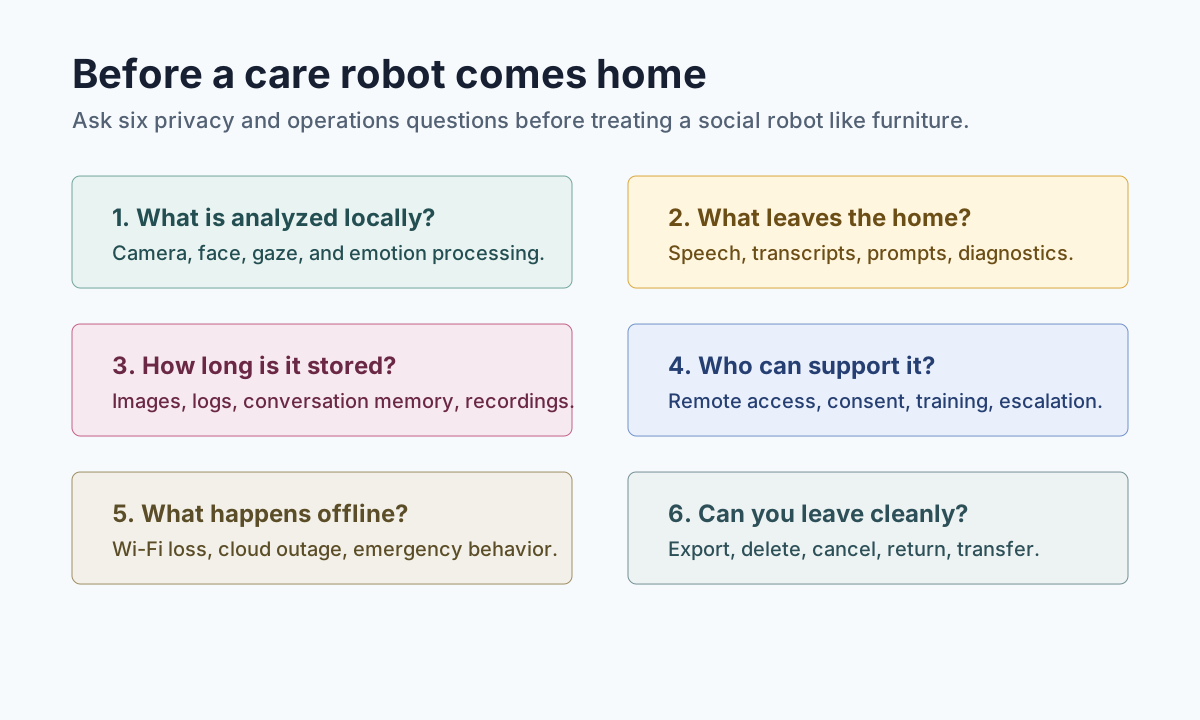
The fifth lesson is that monthly cost is not optional math. ElliQ's official lease-membership pricing makes that visible. LOVOT's hardware price plus care plan makes it visible. Navel's care product is sold through quote or lease-style institutional channels, which means buyers should expect the economics to look more like a supported service than a one-time electronics purchase.
A Practical Buyer Checklist
The Bottom Line
Navel Robotics is worth watching because it pushes social robots into a domain where vague companionship claims are not enough. A care facility forces the hard questions early: privacy, training, support, measurable benefit, and the difference between engagement and replacement.
For home buyers, the right conclusion is cautious optimism. Social robots are becoming more credible, especially for conversation, activation, reminders, and emotional presence. But the best evidence still comes from narrow, supervised use cases rather than all-purpose home autonomy.
If a future home care robot can combine Navel's deployment discipline, ElliQ's consumer support model, PARO's narrow therapeutic clarity, and Mirokai's emerging mobility, the category gets much more interesting. Until then, treat every companion robot as a service relationship, not just a device. The robot may be the visible product, but the real thing you are buying is the company's ability to keep that social presence useful, private, and supportable over time.
Related in the database
Use this article as a privacy verification workflow
Turn the article into a privacy verification pass grounded in the robots, manufacturers, and components it actually references.
Navel Robotics: 100 Care Robots, Home Lessons already points you toward 5 linked robots, 5 manufacturers, and 3 countries inside the ui44 database. That matters because strong buyer guidance is easier to apply when you can move immediately from a claim or warning into concrete product pages, manufacturer directories, component explainers, and country-level context instead of treating the article as an isolated opinion piece. The fastest next step is to turn the article into a shortlist workflow: open the linked robot pages, verify which specs are actually published for those models, then compare the surrounding manufacturer and component context before you decide whether the underlying claim changes your buying plan.
For this topic, the useful discipline is to separate the editorial lesson from the catalog evidence. The article gives you the framing, but the robot pages tell you what each product actually ships with today: sensor stack, connectivity methods, listed price, release timing, category, and support-relevant compatibility notes. The manufacturer pages then show whether you are looking at a one-off launch, a broader lineup pattern, or a company that spans multiple categories. That layered workflow reduces the risk of buying on a single marketing phrase or a single support FAQ.
Use the robot pages to confirm which products actually expose cameras, microphones, Wi-Fi, or voice systems, then use the manufacturer pages to decide how much of the privacy question seems product-specific versus brand-wide. On this route cluster, ElliQ 3, LOVOT, and PARO form the fastest reality check. If you want a quick working shortlist, open Compare ElliQ 3, LOVOT, and PARO next, then keep this article open as the reasoning layer while you compare structured data side by side.
Practical Takeaway
Every robot, manufacturer, category, component, and country reference below resolves to a real ui44 page, keeping the follow-up path grounded in database records rather than generic advice.
Suggested next steps in ui44
- Open ElliQ 3 and note the listed sensors, connectivity methods, and voice stack before you interpret any policy claim.
- Cross-check the wider brand context on Intuition Robotics so you can see whether the privacy question touches one model or a broader lineup.
- Use the linked component pages to confirm how common the relevant sensors and connectivity layers are across the database.
- Keep a short note of which policy layers you checked, which device features are actually present on the robot page, and which items still depend on region- or app-level confirmation.
- Finish with Compare ElliQ 3, LOVOT, and PARO so the policy reading sits next to structured product data.
Robot profiles worth opening next
Use the linked product pages as the evidence layer
The linked robot pages are where this article becomes operational. Instead of asking whether the headline is interesting, use the robot entries to inspect the actual mix of sensors, connectivity options, batteries, pricing, release timing, and stated capabilities attached to the products mentioned in the article. That is the easiest way to see whether the warning or opportunity described here affects one product family, a specific design pattern, or an entire buying lane.
ElliQ 3
Intuition Robotics · Companions · Available
ElliQ 3 is tracked on ui44 as a available companions robot from Intuition Robotics. The database currently records a listed price of Price TBA, a release date of 2024-01, Mains powered battery life, N/A (plugged in) charging time, and a published stack that includes 4-mic array, 12 MP camera for images, and 1080p HD video at 30 fps with 120° horizontal FoV plus Wi-Fi 802.11b/g/n/ac (2.4 GHz and 5 GHz) and Bluetooth 5+.
For privacy-focused reading, this page matters because it shows the concrete device surface behind the policy discussion. Use it to verify whether ElliQ 3 combines sensors and connectivity in a way that could change the in-home data footprint, and compare the listed capabilities such as Proactive Conversation, Medication Reminders, and Health & Pain Tracking with any cloud, app, or voice layers, including ElliQ Voice AI.
LOVOT is tracked on ui44 as a available companions robot from GROOVE X. The database currently records a listed price of ¥577,500, a release date of 2019, 30-45 minutes active, then returns to nest battery life, 15-30 minutes (on charging nest) charging time, and a published stack that includes Horn Top Camera (half-sphere), Horn Front Camera, and Depth Camera plus Wi-Fi and Bluetooth.
For privacy-focused reading, this page matters because it shows the concrete device surface behind the policy discussion. Use it to verify whether LOVOT combines sensors and connectivity in a way that could change the in-home data footprint, and compare the listed capabilities such as Emotional Companionship, Person Recognition, and Touch Response (full body sensors) with any cloud, app, or voice layers.
PARO is tracked on ui44 as a active companions robot from AIST. The database currently records a listed price of Price TBA, a release date of 2003, Not officially disclosed battery life, Not officially disclosed charging time, and a published stack that includes Tactile sensors, Light sensor, and Audition (audio) sensor plus Not publicly detailed.
For privacy-focused reading, this page matters because it shows the concrete device surface behind the policy discussion. Use it to verify whether PARO combines sensors and connectivity in a way that could change the in-home data footprint, and compare the listed capabilities such as Therapeutic companionship, Responds to touch, voice direction, and handling, and Learns preferred user interactions with any cloud, app, or voice layers.
Pepper
Aldebaran Robotics · Commercial · Available
Pepper is tracked on ui44 as a available commercial robot from Aldebaran Robotics. The database currently records a listed price of Price TBA, a release date of 2014-06, ~12 hours (shop use) battery life, ~8 hours 20 minutes charging time, and a published stack that includes RGB Camera ×2 (forehead + mouth), 3D Depth Sensor, and Microphone ×4 plus Wi-Fi 802.11 a/b/g/n (2.4/5 GHz) and Ethernet.
For privacy-focused reading, this page matters because it shows the concrete device surface behind the policy discussion. Use it to verify whether Pepper combines sensors and connectivity in a way that could change the in-home data footprint, and compare the listed capabilities such as Emotion Recognition, Facial Expression Analysis, and Natural Conversation with any cloud, app, or voice layers, including Multilingual Speech Recognition & Synthesis.
Mirokaï
Enchanted Tools · Commercial · Active
Mirokaï is tracked on ui44 as a active commercial robot from Enchanted Tools. The database currently records a listed price of Price TBA, a release date of 2025, ~4 hours battery life, Not disclosed charging time, and a published stack that includes 2 RGBD Cameras, 2 Infrared Cameras, and 9 Time-of-Flight Cameras plus Wi-Fi and Bluetooth.
For privacy-focused reading, this page matters because it shows the concrete device surface behind the policy discussion. Use it to verify whether Mirokaï combines sensors and connectivity in a way that could change the in-home data footprint, and compare the listed capabilities such as 26 Degrees of Freedom, Omnidirectional Rolling Globe Locomotion, and Expressive Animated Face (projector-based) with any cloud, app, or voice layers, including Multi-language speech recognition & synthesis with emotional prosody.
Manufacturer context behind the article
Check whether this is one product story or a broader company pattern
Manufacturer pages add the privacy context that individual product pages cannot show on their own. They help you check whether cameras, microphones, cloud accounts, app controls, and policy assumptions appear across a broader lineup or stay tied to one specific product story.
Intuition Robotics
ui44 currently tracks 1 robot from Intuition Robotics across 1 category. The company is grouped under Israel, and the current catalog footprint on ui44 includes ElliQ 3.
That wider brand context matters because privacy questions rarely stop at one FAQ page. A manufacturer route helps you see whether the article is centered on one premium model or on a company that has several relevant products and therefore more than one place where the same policy or app assumptions might matter. The category mix here currently points toward Companions as the most useful next route if you want to see whether this article reflects a wider pattern inside the brand.
GROOVE X
ui44 currently tracks 1 robot from GROOVE X across 1 category. The company is grouped under Japan, and the current catalog footprint on ui44 includes LOVOT.
That wider brand context matters because privacy questions rarely stop at one FAQ page. A manufacturer route helps you see whether the article is centered on one premium model or on a company that has several relevant products and therefore more than one place where the same policy or app assumptions might matter. The category mix here currently points toward Companions as the most useful next route if you want to see whether this article reflects a wider pattern inside the brand.
AIST
ui44 currently tracks 3 robots from AIST across 2 categorys. The company is grouped under Japan, and the current catalog footprint on ui44 includes HRP-4C, HRP-5P, PARO.
That wider brand context matters because privacy questions rarely stop at one FAQ page. A manufacturer route helps you see whether the article is centered on one premium model or on a company that has several relevant products and therefore more than one place where the same policy or app assumptions might matter. The category mix here currently points toward Research, Companions as the most useful next route if you want to see whether this article reflects a wider pattern inside the brand.
Aldebaran Robotics
ui44 currently tracks 1 robot from Aldebaran Robotics across 1 category. The company is grouped under France, and the current catalog footprint on ui44 includes Pepper.
That wider brand context matters because privacy questions rarely stop at one FAQ page. A manufacturer route helps you see whether the article is centered on one premium model or on a company that has several relevant products and therefore more than one place where the same policy or app assumptions might matter. The category mix here currently points toward Commercial as the most useful next route if you want to see whether this article reflects a wider pattern inside the brand.
Broaden the scan without leaving the database
Categories, components, and countries add the wider context
Category framing
Category pages are useful when the article touches a buying pattern that shows up across brands. A category route helps you confirm whether the linked products sit in a narrow niche or whether the same question should be tested across a larger field of alternatives.
Companions
The Companions category page currently groups 53 tracked robots from 48 manufacturers. ui44 describes this lane as: Social robots, robot pets, and elderly-care companions designed for emotional connection and everyday support at home.
That makes the category route a practical follow-up when you want to check whether the products linked in this article are typical for the lane or whether they sit at one edge of the market. Useful starting examples currently include PARO, Abi, Next-Generation Companion Robot.
Commercial
The Commercial category page currently groups 44 tracked robots from 38 manufacturers. ui44 describes this lane as: Delivery robots, warehouse automation, and hospitality service bots — robots built for business and commercial operations.
That makes the category route a practical follow-up when you want to check whether the products linked in this article are typical for the lane or whether they sit at one edge of the market. Useful starting examples currently include G2 Air, aeo, Pepper.
Country and ecosystem context
Country pages give extra context when support practices, launch sequencing, regulatory posture, or manufacturer mix matter. They are not a substitute for model-level verification, but they do help you see which ecosystems cluster together and which manufacturers sit in the same regional field when you broaden the search beyond the article headline.
Israel
The Israel route currently groups 5 tracked robots from 5 manufacturers in ui44. That gives you a useful regional lens when the article points toward support practices, launch sequencing, or brand clusters that may share similar ecosystem assumptions.
On the current route, manufacturers like Flytrex, Intuition Robotics, Maytronics make the page a good way to broaden the scan without losing the regional context that often shapes availability, documentation style, and adjacent alternatives.
Japan
The Japan route currently groups 26 tracked robots from 17 manufacturers in ui44. That gives you a useful regional lens when the article points toward support practices, launch sequencing, or brand clusters that may share similar ecosystem assumptions.
On the current route, manufacturers like AIST, SoftBank Robotics, Toyota make the page a good way to broaden the scan without losing the regional context that often shapes availability, documentation style, and adjacent alternatives.
France
The France route currently groups 8 tracked robots from 7 manufacturers in ui44. That gives you a useful regional lens when the article points toward support practices, launch sequencing, or brand clusters that may share similar ecosystem assumptions.
On the current route, manufacturers like Pollen Robotics, Aldebaran / Maxtronics, Aldebaran Robotics make the page a good way to broaden the scan without losing the regional context that often shapes availability, documentation style, and adjacent alternatives.
Questions to answer before you move from reading to buying
A follow-up FAQ built from the entities already linked in this article
Frequently Asked Questions
Which page should I open first after reading “Navel Robotics: 100 Care Robots, Home Lessons”?
Start with ElliQ 3. That gives you a concrete product anchor for the article’s main claim. From there, branch into the manufacturer and component pages so you can tell whether the article is describing one specific model, a repeated brand pattern, or a wider technology issue that affects multiple shortlist options.
How do the manufacturer pages change the buying decision?
Intuition Robotics help you zoom out from one article and one product. On ui44 they show lineup breadth, category spread, and the neighboring robots tied to the same company. That context is useful when you are deciding whether a risk belongs to a single model, whether it shows up across a brand’s portfolio, and whether you should keep looking at alternatives before committing.
When should I switch from reading to side-by-side comparison?
Move into Compare ElliQ 3, LOVOT, and PARO as soon as you understand the article’s main warning or promise. The article explains what to watch for, but the compare view is where you can check whether price, status, battery life, connectivity, sensors, and category fit still make the robot a good match for your own home and budget.
Where to go next in ui44
Keep the research chain inside the database
If you want to keep going, these follow-on pages give you the cleanest expansion path from article to research session. Open the comparison route first if you are deciding between products today. Open the manufacturer, category, and component routes if you still need to understand the broader pattern behind the claim.
Written by
ui44 Team
Published July 6, 2026
Share this article
Open a plain share link on X or Bluesky. No embeds, no widgets, no cookie baggage.