That is the more useful way to read the newest humanoid announcements. Figure's April 2026 production update is interesting not only because it says BotQ has delivered more than 350 Figure 03 units, but because it gives buyers a glimpse of the factory evidence behind those robots: more than 50 in-process inspection points, more than 80 functional verification tests per robot, burn-in exercises, over 80% end-of-line first-pass yield, a 99.3% battery-line first-pass yield, and fleet diagnostics for field failures.
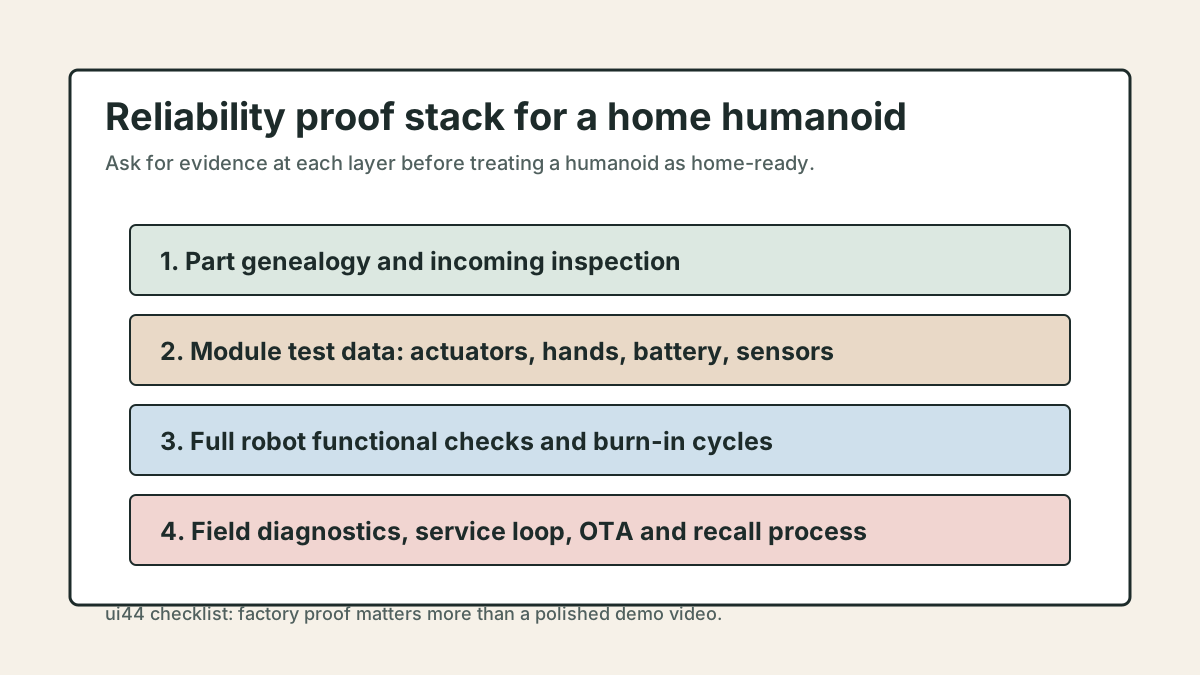
Most home buyers will not get that much detail from every vendor. That is exactly why reliability questions matter. A humanoid that walks through a showroom is one thing. A humanoid that can move near kids, pets, stairs, doors, tables, cables, dishes, and sleeping people is another class of product.
What Reliability Tests Should A Home Humanoid Pass Before You Buy?
Before buying or reserving a home humanoid, ask for proof in five areas:
Reliability area
Manufacturing traceability
- What to ask for
- Can each actuator, battery, sensor, and hand module be traced to test data?
- Why it matters at home
- A field failure should lead to a known part batch, not guesswork.
Reliability area
Full-robot burn-in
- What to ask for
- How many cycles of walking, squatting, reaching, carrying, docking, and recovery are run before shipment?
- Why it matters at home
- Whole-body failures often appear only when systems interact.
Reliability area
Battery and charging safety
- What to ask for
- Which certifications, abuse tests, thermal checks, and dock tests are completed?
- Why it matters at home
- A mobile robot with a large battery lives inside the house.
Reliability area
Diagnostics and fallback behavior
- What to ask for
- What happens when a joint, perception stack, network, or battery subsystem degrades?
- Why it matters at home
- The robot should fail calmly, not improvise around people.
Reliability area
Service and recall process
- What to ask for
- Who repairs it, how fast, and how are fleet-wide issues handled?
- Why it matters at home
- An expensive humanoid is not a disposable appliance.
| Reliability area | What to ask for | Why it matters at home |
|---|---|---|
| Manufacturing traceability | Can each actuator, battery, sensor, and hand module be traced to test data? | A field failure should lead to a known part batch, not guesswork. |
| Full-robot burn-in | How many cycles of walking, squatting, reaching, carrying, docking, and recovery are run before shipment? | Whole-body failures often appear only when systems interact. |
| Battery and charging safety | Which certifications, abuse tests, thermal checks, and dock tests are completed? | A mobile robot with a large battery lives inside the house. |
| Diagnostics and fallback behavior | What happens when a joint, perception stack, network, or battery subsystem degrades? | The robot should fail calmly, not improvise around people. |
| Service and recall process | Who repairs it, how fast, and how are fleet-wide issues handled? | An expensive humanoid is not a disposable appliance. |

Demos Test Capability. Burn-In Tests Durability.
The first trap is confusing "can do" with "can keep doing." A robot might complete a chore once because the scene is carefully arranged, the operator is nearby, the battery is fresh, and the task has been practiced. Reliability asks a harsher question: what happens after hundreds or thousands of repetitions, after parts warm up, after joints wear, after a fingertip sensor sees dust and oil, after a charging contact is slightly misaligned, or after the robot has already been updated twice?
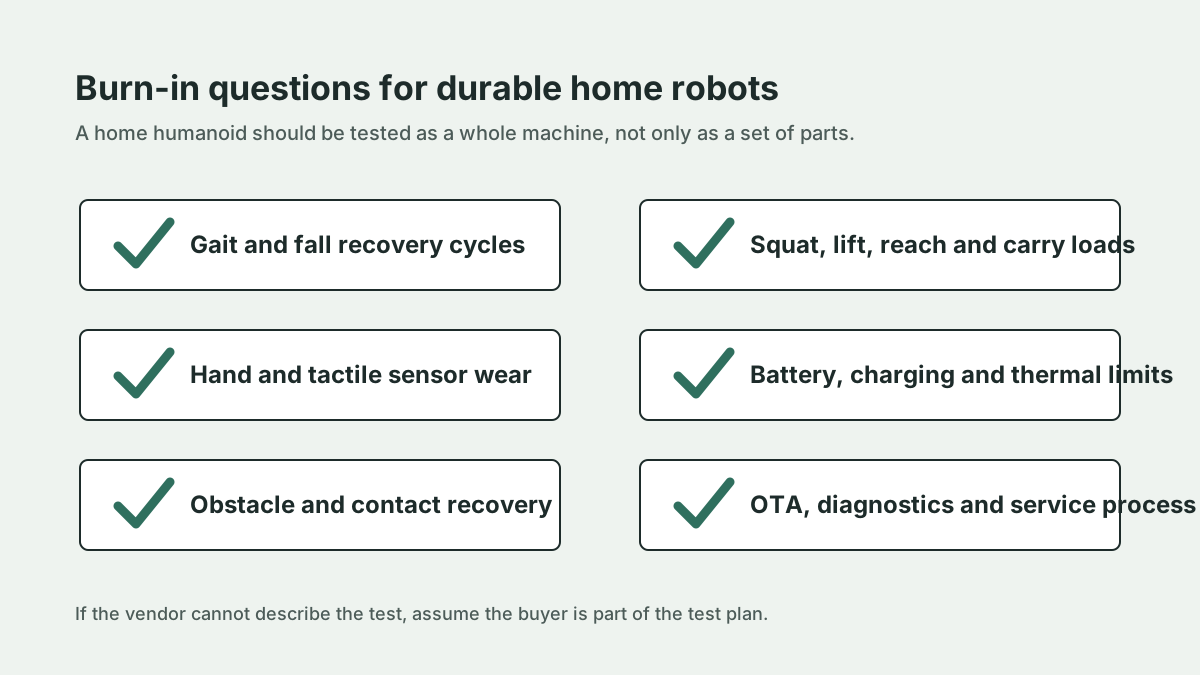
Figure's production note is useful because it names full-body burn-in exercises such as squatting, shoulder presses, and jogging at cycle counts in the thousands. That does not prove Figure 03 is ready for every home, and ui44 still lists it as not available for consumer purchase. But it does define the right buyer standard: whole-machine stress, repeated enough times to find early-cycle failures before the customer does.
For a home humanoid, burn-in should cover more than walking. Ask whether the vendor tests:
- repeated sit-to-stand or squat motions, because knee, hip, and ankle loads are not gentle;
- shoulder, elbow, wrist, and hand cycles under load, because manipulation is where home value lives;
- docking and charging alignment, because a robot that cannot recharge itself becomes a chore;
- thermal behavior during long sessions, not just a short demo;
- perception and contact recovery when a person, chair, door, rug, or cable interrupts the plan;
- software rollback and safe-stop behavior after updates.
The key point is simple: if the vendor cannot describe the test, assume the buyer is part of the test plan.
Use Figure 03 As The New Disclosure Benchmark
Figure is not the only humanoid company trying to move from prototype to production, but its BotQ posts set a higher disclosure bar than most consumer-facing robotics copy. The March 2025 BotQ announcement described a first-generation line capable of up to 12,000 humanoids per year, in-house manufacturing for critical systems, custom manufacturing execution software, and a reliability team running highly accelerated lifecycle tests. The April 2026 update added numbers: 350-plus Figure 03 units delivered, a cadence increase from one robot per day to one per hour, 9,000-plus actuators produced, and more than 80 functional checks before sign-off.
Do not read those numbers as a purchase recommendation by themselves. Read them as a template for questions:
- What is the current end-of-line first-pass yield?
- How many robots have completed the full production process, not just prototype builds?
- Which subsystems fail most often during burn-in?
- Are failures tied back to part genealogy and suppliers?
- Are robots updated over the air, and can the company run a recall campaign?
- Is there a field-service management system, or is support still ad hoc?
Those questions are especially important because the home market is not the same as a factory pilot. A factory can limit where robots operate, train staff, tape off areas, and keep technicians nearby. A home is more varied, less supervised, and less forgiving.
Compare Robots By Reliability Evidence, Not Just Price
The ui44 database already shows how wide the humanoid market is becoming. Unitree G1 is listed at $13,500, making it a visible compact lower-cost humanoid research and developer platform. 1X NEO is listed at $20,000 for early adopters and is explicitly home-focused. NEURA 4NE-1 Mini is positioned around EUR 19,999 for the Standard tier and EUR 29,999 for Pro, with education and light service use cases. Figure 03, MenteeBot, and Tesla Optimus Gen 2 do not have normal consumer pricing in the database today.
Those prices are useful, but they are not reliability scores. A $13,500 humanoid can still be a serious engineering platform if the buyer understands its limits. A $20,000 early-adopter product can still carry support risk if the service process is immature. A no-price roadmap robot can look advanced while still being years away from ordinary household support.
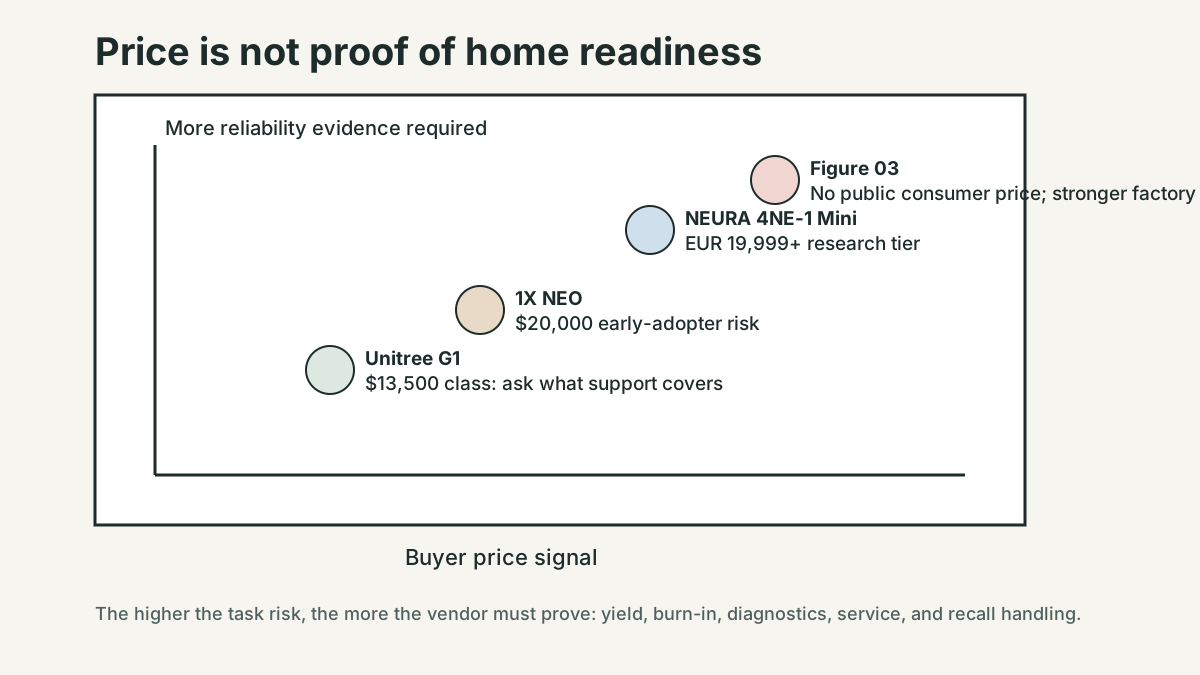
The better comparison is: what proof comes with the price?
Robot
Figure 03
- ui44 status signal
- Production and factory disclosures, no ordinary consumer sale
- Reliability question to ask
- Will factory yield, burn-in, and service metrics continue into residential deployments?
Robot
1X NEO
- ui44 status signal
- Home-focused, $20,000 early-adopter listing
- Reliability question to ask
- What tasks are autonomous, what requires supervision, and what happens when a remote expert is unavailable?
Robot
Unitree G1
- ui44 status signal
- Compact lower-cost developer platform at $13,500
- Reliability question to ask
- What parts, repair path, and safety coverage exist for non-lab home use?
Robot
NEURA 4NE-1 Mini
- ui44 status signal
- Compact cognitive humanoid with research and education tiers
- Reliability question to ask
- Which reliability claims apply to home use rather than demos, education, or light service settings?
Robot
MenteeBot
- ui44 status signal
- Household and warehouse ambition, commercial targets further out
- Reliability question to ask
- How much of the home task stack has been tested outside controlled proof-of-concepts?
Robot
Optimus Gen 2
- ui44 status signal
- High-profile development program, no normal home buyer channel
- Reliability question to ask
- What validated service, safety, and support model will exist before consumer availability?
| Robot | ui44 status signal | Reliability question to ask |
|---|---|---|
| Figure 03 | Production and factory disclosures, no ordinary consumer sale | Will factory yield, burn-in, and service metrics continue into residential deployments? |
| 1X NEO | Home-focused, $20,000 early-adopter listing | What tasks are autonomous, what requires supervision, and what happens when a remote expert is unavailable? |
| Unitree G1 | Compact lower-cost developer platform at $13,500 | What parts, repair path, and safety coverage exist for non-lab home use? |
| NEURA 4NE-1 Mini | Compact cognitive humanoid with research and education tiers | Which reliability claims apply to home use rather than demos, education, or light service settings? |
| MenteeBot | Household and warehouse ambition, commercial targets further out | How much of the home task stack has been tested outside controlled proof-of-concepts? |
| Optimus Gen 2 | High-profile development program, no normal home buyer channel | What validated service, safety, and support model will exist before consumer availability? |
This is where ui44's buyer framing differs from a generic "best humanoids" list. The question is not "which robot looks most human?" It is "which robot has the evidence trail that makes household operation plausible?"

Battery Safety Is A Reliability Issue, Not A Footnote
Humanoid batteries deserve their own line on the checklist. A robot that weighs tens of kilograms, walks, manipulates objects, docks itself, and may charge unattended needs conservative battery engineering. Figure says Figure 03's battery has protection at the battery management system, cell, interconnect, and pack levels, and that the battery has achieved UN38.3 certification. That is the kind of claim buyers should look for, then verify in the paperwork.
Ask these questions before treating a humanoid as home-ready:
- Is the battery removable, serviceable, or locked inside the chassis?
- Is the charger wired, wireless, or dock-based, and how does the robot confirm alignment?
- What happens if charging is interrupted by a person, pet, rug, or moved dock?
- Does the robot reduce power or stop safely when a pack, joint, or compute module overheats?
- Are battery packs tracked by serial number and test history?
- What is the replacement cost and expected service interval?
For cheaper developer platforms, the answer may be "this is not a consumer appliance." That can be honest and acceptable. The dangerous answer is vague consumer confidence without battery, charging, and service detail.
Hands And Contact Are Where Home Reliability Gets Hard
Walking gets attention because falls are dramatic. Hands may be the bigger reliability problem. Home value depends on reaching into cabinets, opening doors, picking up soft and hard objects, avoiding fingers, and recognizing when a grip is slipping. Figure says Figure 03 includes palm cameras and internally developed tactile sensors that can detect very small forces. That is a promising direction, but again the buyer question is not only "does it have tactile sensing?"
Ask:
- How many grasp cycles are tested before shipment?
- What materials were used in hand and fingertip wear tests?
- Can fingertips, covers, or textiles be replaced without a factory return?
- Does the robot know when a grasp is unsafe, or does it keep squeezing?
- How does it behave when a camera is occluded by the object it is holding?
This matters for mundane reasons. A robot that drops a towel is annoying. A robot that drops a glass, pulls a cable, bumps a person, or misreads a child's hand is a safety and support problem.
The Service Loop May Matter More Than The Demo
A reliable home humanoid is not one that never fails. It is one whose failures are anticipated, diagnosed, repaired, and fed back into the design. Figure's April 2026 note mentions alerting and diagnostics, fallback ladders, field-service management, fleet-wide upgrades, recall-campaign processes, fleet management, and OTA updates. Those are not glamorous features, but they are the infrastructure that makes a robot fleet manageable.
For a buyer, the service loop should be part of the purchase decision:
- Who is allowed to service the robot?
- Can a technician replace common modules in the home?
- Are parts stocked in the buyer's country?
- Are logs available to the owner, or only to the manufacturer?
- How are privacy-sensitive logs separated from diagnostic telemetry?
- Can an update be paused, rolled back, or scheduled?
- What is the support promise if the company changes strategy?
This is where early buyers should be skeptical of both startups and large companies. Startups may move fast but lack regional service networks. Large companies may have support muscle but may not yet have a consumer humanoid process. The best evidence is specific: repair times, replacement modules, recall process, software update history, and warranty terms.
A Practical Reliability Scorecard
If you are evaluating a home humanoid today, use a simple scoring approach. Give one point for each clear, written answer:
- The vendor publishes basic production status: prototype, pilot fleet, commercial pilot, or consumer shipment.
- The vendor explains end-of-line functional testing.
- The vendor describes burn-in cycles for walking, lifting, manipulation, docking, and recovery.
- The vendor gives battery safety and certification details.
- The vendor has a diagnostic and alerting system for deployed robots.
- The vendor explains safe fallback behavior when a subsystem degrades.
- The vendor has a clear field-service and replacement-part process.
- The vendor can run OTA updates with rollback or recovery planning.
- The vendor explains what data is collected during failures and how privacy is handled.
- The vendor makes warranty, repair, and recall terms readable before payment.
A score below four does not necessarily mean the robot is bad. It may mean it is a developer kit, lab platform, or early-access product rather than a home appliance. A score above seven should be treated as exceptional evidence for a still-emerging consumer appliance, and buyers should verify each supporting claim before giving that score much weight.
What To Do Before Paying A Deposit
Before paying for a humanoid reservation, ask the seller to answer the checklist in writing. If the product is an early-adopter program, ask what happens if promised autonomy, support, or delivery timing changes. If the product is not yet sold to consumers, treat every price rumor as incomplete until service, warranty, and safety documents exist.
Also compare against the robots in ui44 rather than relying on launch clips. Start with the humanoid category, open the robot pages, and separate four signals:
- price or reservation cost;
- current availability;
- stated home use versus lab, factory, education, or research use;
- reliability evidence, including burn-in, safety, support, and field operations.
Humanoids are moving from demos toward small fleets, and that is real progress. But home readiness is not a vibe. It is a chain of evidence from supplier inspection to final test, from burn-in to diagnostics, from OTA updates to service visits. The buyer who asks for that evidence will make a better decision than the buyer who simply asks which humanoid looks most advanced.
Written by
ui44 Team
Published June 9, 2026
Share this article
Open a plain share link on X or Bluesky. No embeds, no widgets, no cookie baggage.