Article 18 min read 4,185 words

Why Home Robot Chefs Need Ingredient Onboarding

The next wave of robot-chef demos will make cooking look like a software problem. Ask for dinner, watch a robot arm move, and let the AI figure out the rest. That is the appealing version. The harder version is much more specific: every ingredient behaves differently, every utensil changes the motion plan, and every home kitchen adds clutter, heat, liquids, odd containers, uneven portions, and people walking through the workspace.

ui44 Team All articles

That is why ingredient onboarding matters. A robot chef does not only need to know what "add carrots" means. It has to learn how carrots are shaped, how they sit in a bin, which tool can pick them up, how much force is safe, how to avoid dragging sauce across the counter, how to release the portion cleanly, and what to do when the food sticks.
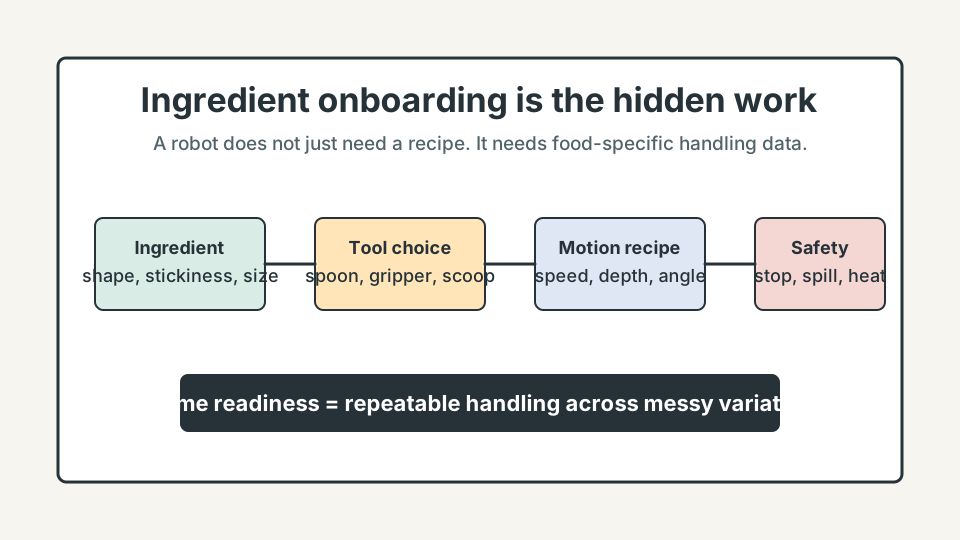
Ingredient onboarding map for home robot chefs showing ingredient data, tool choice, motion parameters, and safety checks
Scroll sideways to inspect the full chart.

Chef Robotics has been unusually clear about this problem. In its post on using LLM agents to rapidly onboard new ingredients, the company describes ingredient onboarding as a way to turn production context, food properties, and historical robot behavior into a usable manipulation setup. In a second post on its bi-manual Food Foundation Model system, Chef frames the work around professional prep-table assembly, not consumer home cooking.

That distinction is important for buyers. A robot that can manipulate food in a controlled commercial setting is interesting. A robot that can cook safely and flexibly in a normal kitchen is a different product category.

How does a robot chef learn a new ingredient?

Most people think of cooking as a recipe sequence: chop, heat, stir, serve. Robots see it as a long chain of physical uncertainty. Food is deformable, wet, sticky, slippery, irregular, and often hard to identify visually once it is mixed with other food. A scoop of rice, a basil leaf, a tomato slice, a piece of tofu, and a spoonful of sauce are not interchangeable objects.

Ingredient onboarding is the process of creating enough structured knowledge for the robot to handle one new ingredient reliably. In a factory or prepared-food line, that can include the ingredient name, container type, target portion size, serving utensil, tool geometry, bin position, camera view, motion path, speed, contact depth, release motion, and acceptable error range. The robot may also need examples of failed attempts: food left behind, food dragged across a tray, sauce clinging to the utensil, or a portion that lands outside the container.

The LLM part is useful because it can help gather and organize the setup. It can infer that diced cucumber and cherry tomatoes might need different scoop or placement behavior. It can turn human notes into parameter candidates. It can search previous runs for similar ingredients. But the value is not that the LLM "knows cooking." The value is that it helps produce a physical handling recipe that the robot can test, measure, and improve.
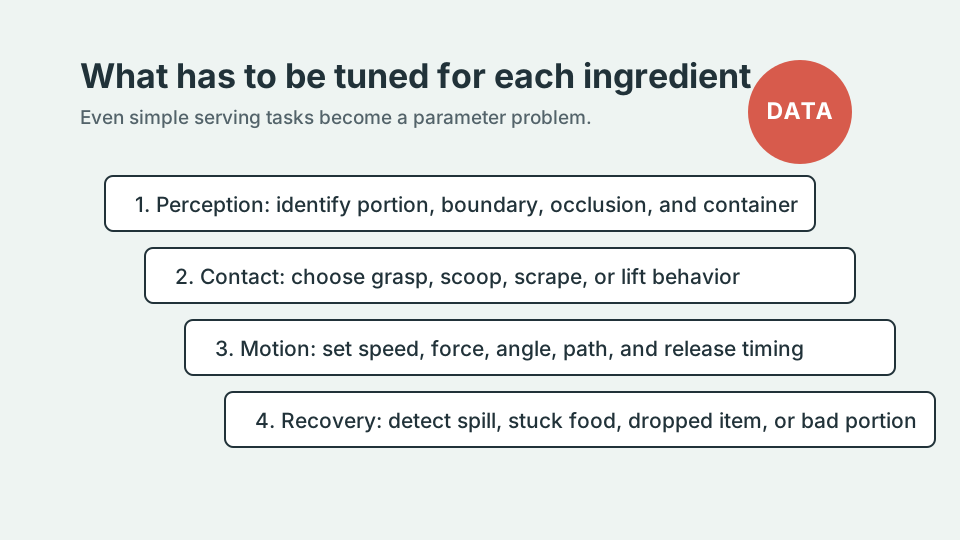
Robot chef parameter stack showing perception, contact, motion, and recovery tuning for each food ingredient
Scroll sideways to inspect the full chart.

That is the missing middle between a recipe app and a cooking robot. Home buyers should care less about whether a robot can describe a recipe and more about whether it can repeat physical ingredient handling after the kitchen changes.

Why commercial prep tables are easier than homes

Chef Robotics' examples are useful because they are serious, but they also show why the home version is hard. A professional food-assembly environment can control the containers, lighting, work surface, target task, ingredient list, hygiene rules, and human supervision. Even then, onboarding is a real engineering process. That should reset expectations for consumer kitchens.

A home kitchen has far more variation. The same ingredient may arrive fresh, frozen, sliced, crushed, half-used, or stuck to packaging. Utensils live in different drawers. Bowls are not always in the same place. The counter may be wet. The user may interrupt. A child may put a hand near the workspace. A pet may walk under the robot. A recipe may call for judgment that is obvious to a person but vague to a machine: "a little more," "until glossy," "do not overmix," or "serve while hot."

This is also why videos of a robot stirring a pot or placing one ingredient should be treated as demos, not proof of home readiness. Cooking is not one manipulation skill. It is a bundle of perception, force control, hygiene, heat awareness, recovery behavior, and ingredient-specific calibration.

What ui44's robot database says about the gap

ui44 tracks several robots that are relevant to kitchen autonomy, even though none should be treated as a finished home chef today. The pattern is consistent: the hardware is getting closer, but the public evidence for general home food handling is still thin.

Robot

Astribot T1

What matters for robot-chef claims
Pre-order humanoid platform listed from ¥89,900 (about $13,165), with a 5 kg single-arm payload and cooking or food-prep demos mentioned in launch coverage.
Buyer takeaway
Promising manipulation hardware, but public battery, sensor, autonomy, and home availability details remain limited.

Robot

Dreame Z1 Laundry Robot

What matters for robot-chef claims
Development-stage home robot with a multi-joint arm, multimodal sensing, and autonomous clothing-handling claims.
Buyer takeaway
Useful evidence that appliance brands are adding arms, but laundry manipulation is not food handling.

Robot

Dreame Cyber10 Ultra

What matters for robot-chef claims
Development robot vacuum with a bionic arm for moving small objects up to about 500 g and using dock-stored tools.
Buyer takeaway
Shows arm-aware home navigation, but the arm is for tidying and cleaning support, not cooking.

Robot

AGIBOT G2 Air

What matters for robot-chef claims
Compact single-arm mobile manipulator with a 3 kg payload, 750-800 mm arm reach, and a sub-800 mm width for structured workspaces.
Buyer takeaway
A relevant commercial manipulation form factor, but not sold as a consumer kitchen robot.

Robot

AGIBOT G1

What matters for robot-chef claims
Wheeled humanoid-style robot with a 3 kg continuous one-arm handling spec, LiDAR, RGB-D cameras, force sensors, and data-collection workflows.
Buyer takeaway
Stronger manipulation ingredients than most home robots, but still more embodied-AI platform than kitchen appliance.

Robot

NEO

What matters for robot-chef claims
$20,000 pre-order humanoid with about 4 hours of battery life, cameras, depth sensors, tactile skin, and microphone array.
Buyer takeaway
A consumer-facing humanoid direction, but buyers should ask exactly which food tasks are supported without teleoperation.

Robot

Figure 03

What matters for robot-chef claims
Active humanoid with Helix VLA, depth cameras, force sensors, tactile arrays, about 5 hours of runtime, and a 20 kg payload listing.
Buyer takeaway
High-end manipulation signal, but not a home robot chef product with published ingredient onboarding.

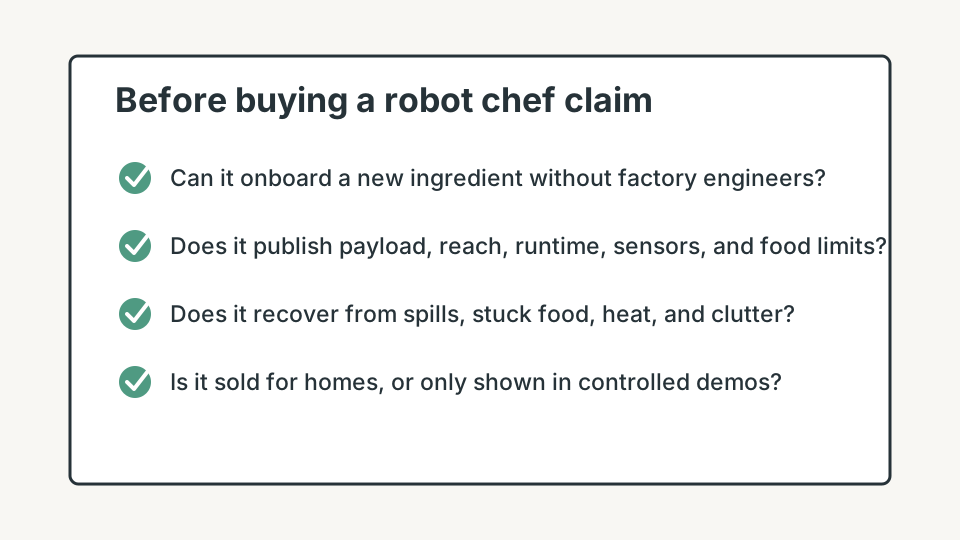
The useful conclusion is not that robot chefs are impossible. It is that a kitchen robot needs a deeper readiness claim than "has arms" or "uses AI." A robot may have strong motors and still fail at sauce. It may understand a recipe and still drop a slippery ingredient. It may run a beautiful demo and still need an engineer to set up the next food item.
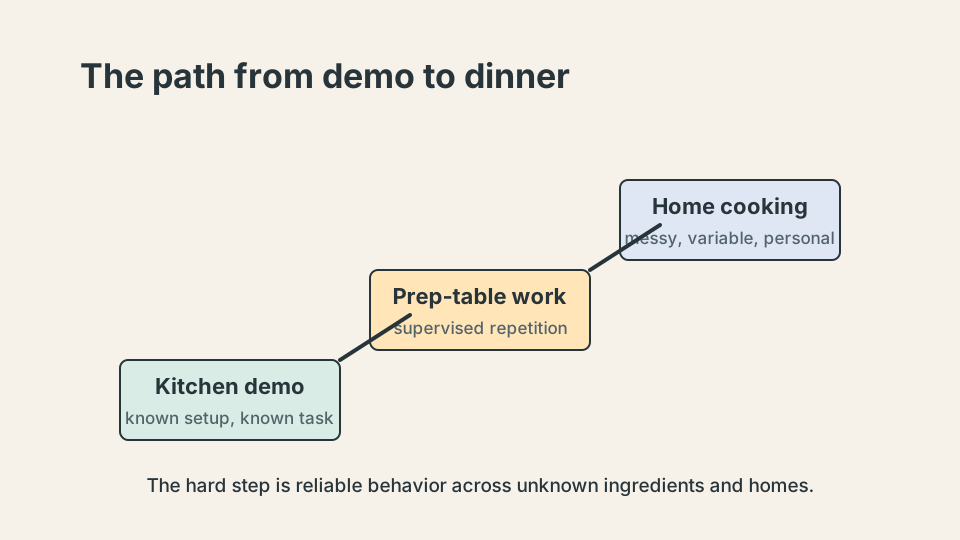
Home robot chef readiness ladder from kitchen demo to prep-table work to messy home cooking
Scroll sideways to inspect the full chart.

A better checklist for robot-chef claims

What would make a home robot chef credible

A credible home robot chef would probably start narrow. The first useful version might not cook any recipe. It might prepare a few repeatable meals from known containers, use a limited utensil set, avoid open flames, stay inside a defined counter zone, and ask for help when the situation changes. That sounds less exciting than a general-purpose kitchen humanoid, but it is closer to a real product.

The strongest near-term claim would combine three things: a published ingredient-onboarding process, a controlled list of supported foods, and transparent safety limits. For example, a company could say: this robot can assemble these 20 cold meals, from these ingredient containers, with these utensils, under these counter and lighting conditions, and it will stop if it detects heat, spills, hands, pets, or unknown objects. That would be less cinematic than a humanoid chef video, but much more useful to a buyer.

There is also a business reason this may arrive through commercial kitchens first. Restaurants, commissaries, hospitals, and prepared-food lines can standardize ingredients, bins, and workflows. They can supervise the robot and measure output. They can justify expensive hardware if labor savings or consistency improves. Homes are more chaotic and more price-sensitive.

For ui44 readers, the practical lesson is simple: do not evaluate a robot chef by how human its demo looks. Evaluate it by how openly it handles ingredient variation. The real breakthrough will not be a robot that can talk about dinner. It will be a robot that can safely learn what today's dinner is made of.

Database context

Use this article as a buyer workflow

Turn the article into a real verification pass

Why Home Robot Chefs Need Ingredient Onboarding already points you toward 7 linked robots, 5 manufacturers, and 3 countries inside the ui44 database. That matters because strong buyer guidance is easier to apply when you can move immediately from a claim or warning into concrete product pages, manufacturer directories, component explainers, and country-level context instead of treating the article as an isolated opinion piece. The fastest next step is to turn the article into a shortlist workflow: open the linked robot pages, verify which specs are actually published for those models, then compare the surrounding manufacturer and component context before you decide whether the underlying claim changes your buying plan.

For this topic, the useful discipline is to separate the editorial lesson from the catalog evidence. The article gives you the framing, but the robot pages tell you what each product actually ships with today: sensor stack, connectivity methods, listed price, release timing, category, and support-relevant compatibility notes. The manufacturer pages then show whether you are looking at a one-off launch, a broader lineup pattern, or a company that spans multiple categories. That layered workflow reduces the risk of buying on a single marketing phrase or a single support FAQ.

The fastest win is to keep the article’s editorial framing tied to real product pages. That way you can test whether Astribot T1, Z1 Laundry Robot, and Cyber10 Ultra still make sense once price, category, release timing, and surrounding manufacturer context are visible in one place. If you want a quick working shortlist, open Compare Astribot T1, Z1 Laundry Robot, and Cyber10 Ultra next, then keep this article open as the reasoning layer while you compare structured data side by side.

Practical Takeaway

Every robot, manufacturer, category, component, and country reference below resolves to a real ui44 page, keeping the follow-up path grounded in database records rather than generic advice.

Suggested next steps in ui44

  1. Open Astribot T1 first so the article’s main point is anchored to a real robot page.
  2. Use Astribot (Stardust Intelligence) to see the broader company context around the products linked in the article.
  3. Open the linked component pages when you want to separate a shared technology pattern from a single-brand story.
  4. Build a working shortlist with Compare Astribot T1, Z1 Laundry Robot, and Cyber10 Ultra.
  5. Keep a short note of what is already verified in the article and what still needs live confirmation from current vendor documentation.

Database context

Robot profiles worth opening next

Use the linked product pages as the evidence layer

The linked robot pages are where this article becomes operational. Instead of asking whether the headline is interesting, use the robot entries to inspect the actual mix of sensors, connectivity options, batteries, pricing, release timing, and stated capabilities attached to the products mentioned in the article. That is the easiest way to see whether the warning or opportunity described here affects one product family, a specific design pattern, or an entire buying lane.

¥89,900

Astribot T1 is tracked on ui44 as a pre-order humanoid robot from Astribot (Stardust Intelligence). The database currently records a listed price of ¥89,900, a release date of 2026-05-28, Not officially disclosed battery life, Not officially disclosed charging time, and a published stack that includes Not officially disclosed plus Not officially disclosed.

For general buyer research, this route gives you the concrete profile that the article alone cannot. Compare the published capabilities of Wheeled Humanoid Platform, Cable-Driven Motion Architecture, and 23 DOF Excluding End Effectors with the linked alternatives so the final decision is based on actual product fit, not just the framing of the article.

Z1 Laundry Robot

Dreame · Cleaning · Development

Price TBA

Z1 Laundry Robot is tracked on ui44 as a development cleaning robot from Dreame. The database currently records a listed price of Price TBA, a release date of 2026-04-28, Not officially disclosed battery life, Not officially disclosed charging time, and a published stack that includes Multimodal sensing system plus Not officially disclosed.

For general buyer research, this route gives you the concrete profile that the article alone cannot. Compare the published capabilities of Autonomous clothing pickup, Autonomous washing workflow, and Autonomous drying workflow with the linked alternatives so the final decision is based on actual product fit, not just the framing of the article.

Cyber10 Ultra

Dreame · Cleaning · Development

Price TBA

Cyber10 Ultra is tracked on ui44 as a development cleaning robot from Dreame. The database currently records a listed price of Price TBA, a release date of 2026-01, Not officially disclosed battery life, Not officially disclosed charging time, and a published stack that includes TriSight obstacle identification, Binocular 3D mapping cameras, and RGB and infrared cameras on the robotic arm plus Not officially disclosed.

For general buyer research, this route gives you the concrete profile that the article alone cannot. Compare the published capabilities of Robot vacuum cleaning, CyberDex Bionic Ecosystem, and CyberDex Hyper-Flex robotic arm with the linked alternatives so the final decision is based on actual product fit, not just the framing of the article.

G2 Air

AGIBOT · Commercial · Development

Price TBA

G2 Air is tracked on ui44 as a development commercial robot from AGIBOT. The database currently records a listed price of Price TBA, a release date of 2026-04, Not officially disclosed battery life, Not officially disclosed charging time, and a published stack that includes Not officially disclosed plus Not officially disclosed.

For general buyer research, this route gives you the concrete profile that the article alone cannot. Compare the published capabilities of Single-Arm Mobile Manipulation, 7-DOF Arm, and Human-in-the-Loop Operation with the linked alternatives so the final decision is based on actual product fit, not just the framing of the article.

G1

AGIBOT · Humanoid · Available

Price TBA

G1 is tracked on ui44 as a available humanoid robot from AGIBOT. The database currently records a listed price of Price TBA, a release date of TBD, Not officially disclosed battery life, Not officially disclosed charging time, and a published stack that includes Six-axis force sensors on both arms, Eight high-resolution upper-body cameras, and Front and rear RGB-D cameras plus Wired data connection and Cloud data transmission.

For general buyer research, this route gives you the concrete profile that the article alone cannot. Compare the published capabilities of 26-DOF Wheeled Manipulation, One-Arm 3 kg Continuous Handling, and Working Height over 2 m with the linked alternatives so the final decision is based on actual product fit, not just the framing of the article.

Database context

Manufacturer context behind the article

Check whether this is one product story or a broader company pattern

Manufacturer pages add the market context that individual product pages cannot show on their own. They help you check whether the article is centered on a brand with a deep lineup, whether that brand spans several categories, and how much of its ui44 footprint depends on one flagship model versus a broader product strategy.

Astribot (Stardust Intelligence)

ui44 currently tracks 2 robots from Astribot (Stardust Intelligence) across 1 category. The company is grouped under China, and the current catalog footprint on ui44 includes Astribot S1, Astribot T1.

That wider brand context matters because the best buying decision usually depends on lineup depth and adjacent options, not just the one model featured most prominently in the article. The category mix here currently points toward Humanoid as the most useful next route if you want to see whether this article reflects a wider pattern inside the brand.

Dreame

ui44 currently tracks 10 robots from Dreame across 2 categorys. The company is grouped under China, and the current catalog footprint on ui44 includes X50 Ultra, A3 AWD Pro, X60 Max Ultra Complete.

That wider brand context matters because the best buying decision usually depends on lineup depth and adjacent options, not just the one model featured most prominently in the article. The category mix here currently points toward Cleaning, Lawn & Garden as the most useful next route if you want to see whether this article reflects a wider pattern inside the brand.

AGIBOT

ui44 currently tracks 9 robots from AGIBOT across 3 categorys. The company is grouped under China, and the current catalog footprint on ui44 includes A2 Ultra, X2, Expedition A3.

That wider brand context matters because the best buying decision usually depends on lineup depth and adjacent options, not just the one model featured most prominently in the article. The category mix here currently points toward Humanoid, Quadruped, Commercial as the most useful next route if you want to see whether this article reflects a wider pattern inside the brand.

1X Technologies

ui44 currently tracks 2 robots from 1X Technologies across 1 category. The company is grouped under Norway, and the current catalog footprint on ui44 includes NEO, EVE.

That wider brand context matters because the best buying decision usually depends on lineup depth and adjacent options, not just the one model featured most prominently in the article. The category mix here currently points toward Humanoid as the most useful next route if you want to see whether this article reflects a wider pattern inside the brand.

Database context

Broaden the scan without leaving the database

Categories, components, and countries add the wider context

Category framing

Category pages are useful when the article touches a buying pattern that shows up across brands. A category route helps you confirm whether the linked products sit in a narrow niche or whether the same question should be tested across a larger field of alternatives.

Humanoid

The Humanoid category page currently groups 110 tracked robots from 80 manufacturers. ui44 describes this lane as: Full-size bipedal humanoid robots designed to work alongside humans. From factory floors to household tasks, these machines represent the cutting edge of robotics.

That makes the category route a practical follow-up when you want to check whether the products linked in this article are typical for the lane or whether they sit at one edge of the market. Useful starting examples currently include NEO, EVE, Mornine M1.

Cleaning

The Cleaning category page currently groups 59 tracked robots from 25 manufacturers. ui44 describes this lane as: Robot vacuums, mops, pool cleaners, and window cleaners. The workhorses of home automation that keep your spaces spotless.

That makes the category route a practical follow-up when you want to check whether the products linked in this article are typical for the lane or whether they sit at one edge of the market. Useful starting examples currently include Scuba V3, EcoSurfer S2, AquaSense X.

Country and ecosystem context

Country pages give extra context when support practices, launch sequencing, regulatory posture, or manufacturer mix matter. They are not a substitute for model-level verification, but they do help you see which ecosystems cluster together and which manufacturers sit in the same regional field when you broaden the search beyond the article headline.

China

The China route currently groups 171 tracked robots from 79 manufacturers in ui44. That gives you a useful regional lens when the article points toward support practices, launch sequencing, or brand clusters that may share similar ecosystem assumptions.

On the current route, manufacturers like Dreame, AGIBOT, Unitree Robotics make the page a good way to broaden the scan without losing the regional context that often shapes availability, documentation style, and adjacent alternatives.

Norway

The Norway route currently groups 2 tracked robots from 1 manufacturers in ui44. That gives you a useful regional lens when the article points toward support practices, launch sequencing, or brand clusters that may share similar ecosystem assumptions.

On the current route, manufacturers like 1X Technologies make the page a good way to broaden the scan without losing the regional context that often shapes availability, documentation style, and adjacent alternatives.

USA

The USA route currently groups 78 tracked robots from 62 manufacturers in ui44. That gives you a useful regional lens when the article points toward support practices, launch sequencing, or brand clusters that may share similar ecosystem assumptions.

On the current route, manufacturers like iRobot, Boston Dynamics, Faraday Future make the page a good way to broaden the scan without losing the regional context that often shapes availability, documentation style, and adjacent alternatives.

Database context

Questions to answer before you move from reading to buying

A follow-up FAQ built from the entities already linked in this article

Frequently Asked Questions

Which page should I open first after reading “Why Home Robot Chefs Need Ingredient Onboarding”?

Start with Astribot T1. That gives you a concrete product anchor for the article’s main claim. From there, branch into the manufacturer and component pages so you can tell whether the article is describing one specific model, a repeated brand pattern, or a wider technology issue that affects multiple shortlist options.

How do the manufacturer pages change the buying decision?

Astribot (Stardust Intelligence) help you zoom out from one article and one product. On ui44 they show lineup breadth, category spread, and the neighboring robots tied to the same company. That context is useful when you are deciding whether a risk belongs to a single model, whether it shows up across a brand’s portfolio, and whether you should keep looking at alternatives before committing.

When should I switch from reading to side-by-side comparison?

Move into Compare Astribot T1, Z1 Laundry Robot, and Cyber10 Ultra as soon as you understand the article’s main warning or promise. The article explains what to watch for, but the compare view is where you can check whether price, status, battery life, connectivity, sensors, and category fit still make the robot a good match for your own home and budget.

Database context

Where to go next in ui44

Keep the research chain inside the database

If you want to keep going, these follow-on pages give you the cleanest expansion path from article to research session. Open the comparison route first if you are deciding between products today. Open the manufacturer, category, and component routes if you still need to understand the broader pattern behind the claim.

UT

Written by

ui44 Team

Published June 7, 2026

Share this article

Open a plain share link on X or Bluesky. No embeds, no widgets, no cookie baggage.

Explore the database

Go beyond the headlines

Compare specs, features, and prices across 100+ robots from leading manufacturers worldwide.