Weave’s February launch announcement described first shipments to Bay Area homes. The current order page gives a California delivery estimate. It is a stationary laundry-folding robot that runs from a normal wall outlet, folds a load in about 30 to 90 minutes. Its payment options combine a subscription route with an upfront-plus-monthly route. Both need to be assessed as ongoing service commitments, rather than a hardware sticker price alone.
As of October 11, 2026, Weave’s home-use order page lists USD 249/month or USD 3,999 upfront plus USD 49/month, with USD 250 refundable due today. The linked reservation agreement does not specify how that deposit applies to later payments; confirm its treatment before adding or subtracting it in a budget.
Isaac 0 offers a concrete way to assess a laundry-focused home robot: a named region, a bounded chore and published payment terms. Those are manufacturer claims and purchase signals, not independent proof of reliable folding in every home. Remote specialist assistance remains part of the service. The Isaac 0 catalog page puts that offer alongside other home-robot options.
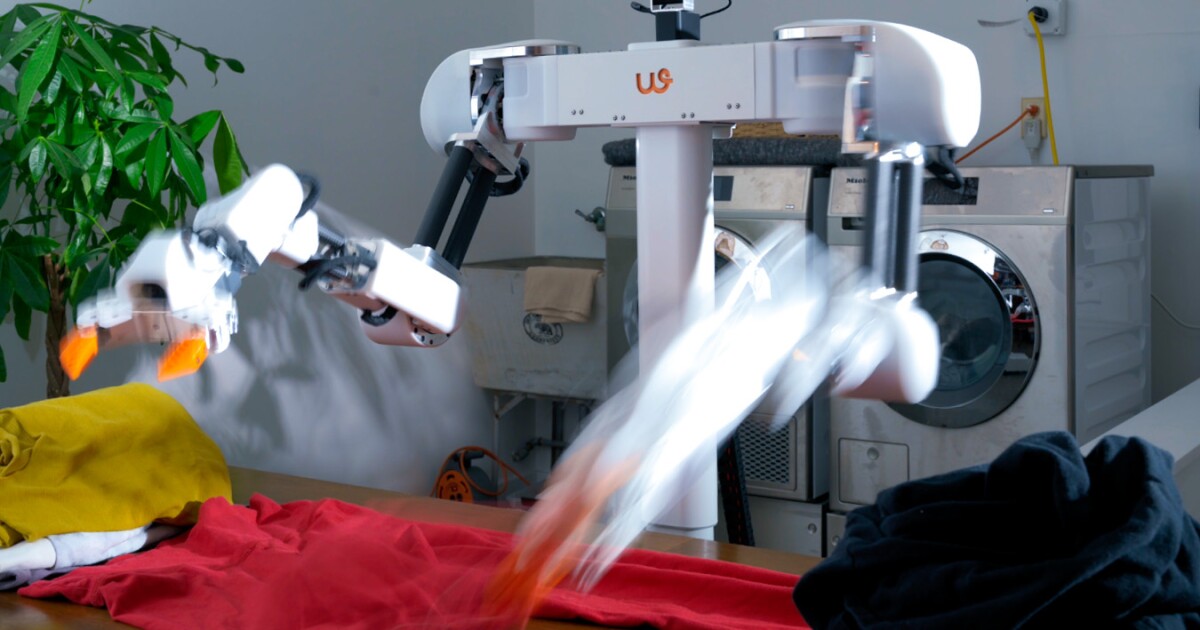
What Weave’s shipping and ordering information establishes
A lot of robotics announcements still leave buyers with the same basic problem: there is no clear price, no real ordering path, no install story, and no honest explanation of what the robot can and cannot do.
Weave provides several specific buyer signals to examine:
- a live order page with a posted upfront price and subscription option
- a current delivery estimate for California residents
- a concrete install story, namely a desk and a standard wall outlet
- a bounded task instead of a vague "helps around the house" claim
- a February launch claim of remote specialist corrections lasting 5 to 10 seconds
That assistance claim describes the February launch announcement, not a universal service guarantee. The current product page says assistance varies with garment type and experience. It does not establish a guaranteed intervention duration or full autonomy.
Here is the practical reason that matters: buyers can evaluate a narrow, partially assisted product much more easily than a broad promise. You can ask a simple question. Does this machine reliably turn a messy load of shirts, pants, sweaters, and towels into folded stacks often enough to save me time?
That is a much better product question than "is this the future of robotics?"
Signal
Availability
- What Weave says
- First home shipments started in February 2026 for Bay Area residents
- Why it matters
- This is stronger than a CES demo or waitlist with no geography
Signal
Price
- What Weave says
- Subscription or upfront plus monthly service; see dated terms above
- Why it matters
- Buyers can finally compare it with other real spending decisions
Signal
Setup
- What Weave says
- Installs in an afternoon on a regular wall outlet
- Why it matters
- It sounds more like an appliance than a lab robot
Signal
Task
- What Weave says
- Laundry folding in roughly 30 to 90 minutes per load
- Why it matters
- Narrow scope makes the promise testable
Signal
Human assist
- What Weave says
- February launch claim: 5 to 10 second remote corrections
- Why it matters
- Weave is admitting the real reliability model instead of hiding it
| Signal | What Weave says | Why it matters |
|---|---|---|
| Availability | First home shipments started in February 2026 for Bay Area residents | This is stronger than a CES demo or waitlist with no geography |
| Price | Subscription or upfront plus monthly service; see dated terms above | Buyers can finally compare it with other real spending decisions |
| Setup | Installs in an afternoon on a regular wall outlet | It sounds more like an appliance than a lab robot |
| Task | Laundry folding in roughly 30 to 90 minutes per load | Narrow scope makes the promise testable |
| Human assist | February launch claim: 5 to 10 second remote corrections | Weave is admitting the real reliability model instead of hiding it |
What you actually get for the money
Isaac 0 is a stationary laundry robot with mains power and Wi-Fi or Ethernet connectivity. Its current product page describes software and model updates over the air. This design concentrates on one part of the laundry workflow rather than whole-home mobility.
That creates a very different value proposition from a $20,000 home humanoid. Instead of paying for walking, general manipulation, and social interaction, you are paying for a single chore appliance with robotic hands.
Spec or detail
ui44 status
- Weave Isaac 0
- Available
Spec or detail
Price
- Weave Isaac 0
- Upfront payment plus ongoing monthly service
Spec or detail
Alternate pricing
- Weave Isaac 0
- Monthly subscription; see dated terms above
Spec or detail
Delivery signal
- Weave Isaac 0
- California estimate of 4 to 6 weeks; confirm your address
Spec or detail
Power
- Weave Isaac 0
- Mains powered, 600W, 120V
Spec or detail
Mobility
- Weave Isaac 0
- Stationary
Spec or detail
Task scope
- Weave Isaac 0
- Folds t-shirts, long sleeves, sweaters, pants, and towels
Spec or detail
Claimed cycle time
- Weave Isaac 0
- 30 to 90 minutes per load
Spec or detail
Connectivity
- Weave Isaac 0
- Wi-Fi 2.4GHz/5GHz, Ethernet
Spec or detail
Assist model
- Weave Isaac 0
- Short remote specialist corrections when needed
| Spec or detail | Weave Isaac 0 |
|---|---|
| ui44 status | Available |
| Price | Upfront payment plus ongoing monthly service |
| Alternate pricing | Monthly subscription; see dated terms above |
| Delivery signal | California estimate of 4 to 6 weeks; confirm your address |
| Power | Mains powered, 600W, 120V |
| Mobility | Stationary |
| Task scope | Folds t-shirts, long sleeves, sweaters, pants, and towels |
| Claimed cycle time | 30 to 90 minutes per load |
| Connectivity | Wi-Fi 2.4GHz/5GHz, Ethernet |
| Assist model | Short remote specialist corrections when needed |
That list also reveals Isaac 0's ceiling.
It does not move laundry from a bedroom hamper to a washer. It does not carry a basket to a closet. It does not sort socks across a whole house. It solves one slice of the laundry workflow, and it solves it by simplifying the robot's job as much as possible.
I think that is the right trade. Laundry folding is annoying, repetitive, and surprisingly time-consuming, but it is also consistent enough to productize. A robot that does one boring household chore reliably is more valuable than a robot that demos ten chores and ships none of them.
There is also a quiet but important installation point here. Because Isaac 0 is stationary and mains powered, Weave avoids two of the biggest headaches in home robotics at once: battery anxiety and whole-home navigation. That is less sexy than a walking humanoid, but it is exactly the kind of design compromise that can make a first-generation product real.
How Isaac 0 compares with the bigger home-robot promises
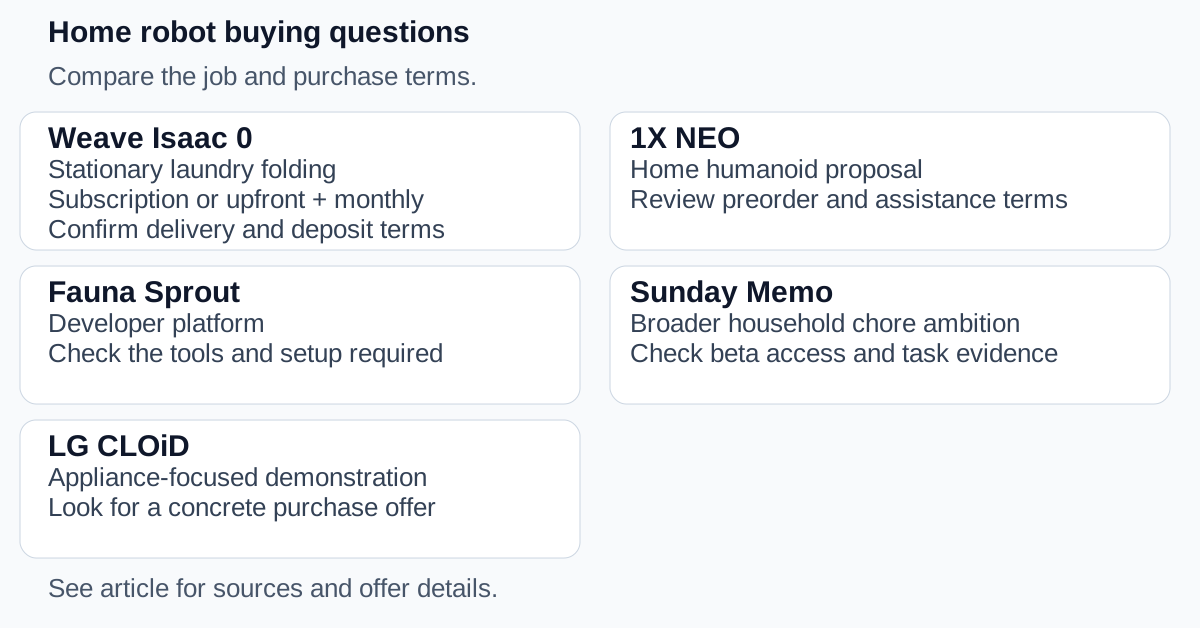
The clearest way to understand Isaac 0 is not to compare it with a washer or a folding board. It is to compare it with the other home robots currently asking for your attention.
Sunday Memo is broader, but still less concrete for buyers
Sunday Memo is one of the most compelling home robot concepts in ui44's database because it is focused on real chores: clearing tables, loading dishwashers, folding laundry, and making coffee. Its official site says its beta launches in late 2026.
That is a strong story. But it is still a story about a beta, not a live buyer product. Sunday has not announced retail pricing, and its home rollout is still framed as limited beta deployment rather than something you can price against a car payment or appliance package.
The useful distinction is the offer: Isaac 0 has posted ordering terms for a bounded task, while Sunday describes a broader beta program.
1X NEO is the clearer humanoid preorder, but it solves a different problem
1X NEO remains one of the clearest home humanoid products in ui44's database, with a USD 20,000 early-adopter offer on its order page. The official NEO page also says the robot works autonomously by default but lets users schedule a 1X Expert to guide chores it does not yet know.
That makes NEO philosophically closer to Isaac 0 than it may first appear. Both products are openly using human assistance as part of the early reliability stack. The difference is body plan and scope.
NEO is a 167 cm, 30 kg bipedal humanoid designed for general household chores. Isaac 0 is a stationary appliance-robot for one repetitive task. If you want a bet on the long-term future of home humanoids, NEO is more exciting. If you want the simpler product with fewer ways to fail, Isaac 0 is easier to believe.
For a deeper read on that trade-off, ui44 already has a 1X NEO preorder guide and a broader guide to humanoid robots that might actually ship in 2026.

LG CLOiD is a credible appliance giant, but still a demo-stage robot
LG CLOiD may be the most important comparison robot in this whole article. LG’s official CES 2026 materials say it can start laundry cycles and fold or stack garments after drying. It has a wheeled base, two seven-degree-of-freedom arms, and five independently actuated fingers on each hand. That is a serious home-appliance company making a serious home-robot argument.
But LG has not announced pricing or a retail launch path. For now, CLOiD is credible because of LG's ecosystem, service network, and appliance expertise, not because buyers can order it.
That is why Isaac 0 matters. It shows what happens when a smaller startup ships first by doing less.
Fauna Sprout is active now, but not really a laundry appliance
Fauna Sprout is another useful reality check. Its product page describes a Creator Edition developer platform, a soft exterior, 29 degrees of freedom, and a 3 to 3.5 hour swappable battery. That is a real robot you can engage with today.
Sprout is a developer platform for interaction design, SDK access and experimentation. That positioning does not establish a tightly defined home chore workflow or independently verified safety.
So if the question is "which home robot is more advanced overall," Isaac 0 is not the obvious winner. If the question is "which robot gives a household the clearest path to paying for a specific chore to go away," Isaac 0 suddenly looks much stronger.
Why a stationary laundry robot might reach homes before a walking one
This is the deeper lesson in the Isaac 0 launch.
The fastest path into homes may not be a humanoid robot that can theoretically do everything. It may be a series of much narrower robots that each remove one frustrating block of housework.
Laundry folding is a perfect example because it has four qualities product teams love:
- it is repetitive
- it has visible success and failure states
- it happens indoors in a controlled environment
- consumers instantly understand the value
That does not make it easy. Cloth is still messy, deformable, and inconsistent. But it makes the problem more product-shaped than general home autonomy.
A stationary format helps too. Weave does not have to solve stairs, doorway transitions, navigation around pets, battery docking, or carrying a basket down hallways. It can spend more of its engineering budget on perception, manipulation, recovery, and fold quality.
That is also why I would not dismiss the remote correction model as a weakness. For an early household robot, it may be the most rational bridge between lab performance and actual usefulness. We already see similar honesty in 1X's expert assist framing. The companies worth watching are the ones admitting where the human backup still sits.
Should you buy Isaac 0 or wait?
If Weave confirms service at your address and you hate folding laundry, Isaac 0 is one of the first 2026 home robots that looks honest enough to evaluate like a real product. That alone is refreshing.
It probably makes sense for you if:
- folding laundry is a real weekly time drain in your home
- you are comfortable being an early adopter
- you prefer evaluating a bounded folding task to an all-purpose promise
- you can tolerate ongoing software changes and occasional remote rescue
You should probably wait if:
- you want a whole-home robot rather than a fixed station
- Weave cannot confirm delivery and support at your address
- you want a polished mass-market appliance instead of a first-generation system
- you are uncomfortable with any remote human intervention in the loop
The nice thing is that ui44 readers do not have to guess blindly. You can check Isaac 0, Sunday Memo, 1X NEO, and LG CLOiD side by side in ui44's compare tools and ask a simple buyer question: which company is giving me the most verifiable path from robot demo to daily use?
The bottom line
Weave Isaac 0 does not prove that the home humanoid age has arrived. It proves something more useful.
A home robot does not need to walk, chat, cook, and fold laundry on day one to matter. It may just need to take one annoying task off your list, admit where human backup still exists, and show up at your door when the company says it will.
That is why Isaac 0 matters.
It is not the most ambitious home robot in ui44's database. But right now, it may be the clearest example of a company narrowing the problem enough to ship. And in a market full of oversized promises, that is a bigger milestone than it sounds.
Frequently Asked Questions
Is Weave Isaac 0 fully autonomous?
No. Weave’s February launch announcement described 5 to 10 second remote
specialist corrections. Its current product page says assistance varies with
garment type and experience. These statements do not establish full autonomy or
a guaranteed intervention duration.
Is Isaac 0 available outside the Bay Area?
The order page checked October 11, 2026 gives California residents an estimated
4 to 6 week delivery timeline. Confirm service at your address directly; an
estimate is not a delivery guarantee. The linked reservation agreement requires
a separate order agreement before delivery and does not make a reservation a
commitment to supply the robot.
How should I compare Isaac 0’s payment options?
Choose a time horizon and a task before comparing offers. The upfront option
still carries a monthly charge, so the initial payment is not the total cost of
using the robot. Keep the refundable reservation payment separate until Weave
confirms how it is applied. Ask what happens to service, updates and hardware
access if you cancel either plan, and request the actual order agreement before
treating a budget as final.
A useful trial should also count your active work: preparing garments, moving
laundry to the station, clearing folded stacks and handling exceptions. A lower
payment does not establish better value if your main bottleneck is carrying
baskets or loading a washer. Isaac 0 addresses folding; compare that specific
job with the tasks you expect a broader home robot to perform.
Written by
ui44 Team
Published April 21, 2026
Share this article
Open a plain share link on X or Bluesky. No embeds, no widgets, no cookie baggage.