That distinction matters. The consumer version of this story is not "Amazon bought a robot maid." It is closer to this: after years of warehouse automation, Astro experiments, Alexa devices, Ring integration, and last-mile delivery work, Amazon appears to be rebuilding its home-robot option from the inside out. If a future Amazon home robot arrives, it will probably inherit more from Sprout's safe developer platform and Rivr's deployment pipeline than from the fantasy of a full-size robot butler.
For buyers, the right question is not whether Amazon will sell a humanoid next year. The better question is whether these acquisitions solve the problems that made earlier home robots feel limited: safe movement around people, useful manipulation, recovery when autonomy fails, privacy, subscriptions, and a reason to exist beyond being a camera on wheels.
What Amazon Actually Bought
Amazon confirmed two robotics deals in March 2026. TechCrunch reported that Amazon acquired Fauna Robotics, a New York startup developing kid-size humanoid robots for homes and other human spaces. It also acquired Rivr, a Zurich startup building autonomous legged-and-wheeled delivery robots designed for doorstep delivery.
The two companies look unrelated at first. Fauna is about humanoid embodiment, safety, social interaction, teleoperation, and developer workflows. Rivr is about last-100-yards logistics: stairs, sidewalks, doorsteps, and repeated deployments that generate data. Together, though, they point to a familiar Amazon pattern: control more of the physical delivery and home-interface stack, then use scale to make the hardware better.
The Robot Report framed the Fauna deal as a platform move, not a near-term consumer product move. That reading is the most credible one. Amazon already knows how to build devices, cloud services, retail channels, smart-home subscriptions, and enormous logistics systems. What it still needs for a serious home robot is embodied learning infrastructure: robots that can fail safely, collect useful corrections, and improve without pretending autonomy is solved.
Fauna Sprout Is the Key Home-Robot Clue
The most relevant product in the deal is Fauna Sprout, not because it is ready to clean your house, but because it shows the kind of hardware Amazon wanted to absorb.
In the ui44 database, Sprout is listed as a 107 cm, 22.7 kg humanoid with 29 degrees of freedom, a soft exterior, compliant motor control, an E-stop, a ZED 2i stereo camera, four time-of-flight sensors, a directional microphone array, dual speakers, and an NVIDIA Jetson AGX Orin 64GB onboard compute stack. Fauna's official product page also lists a 3-3.5 hour swappable battery, 6-DoF arms, 1-DoF grippers, and a developer-ready software stack.
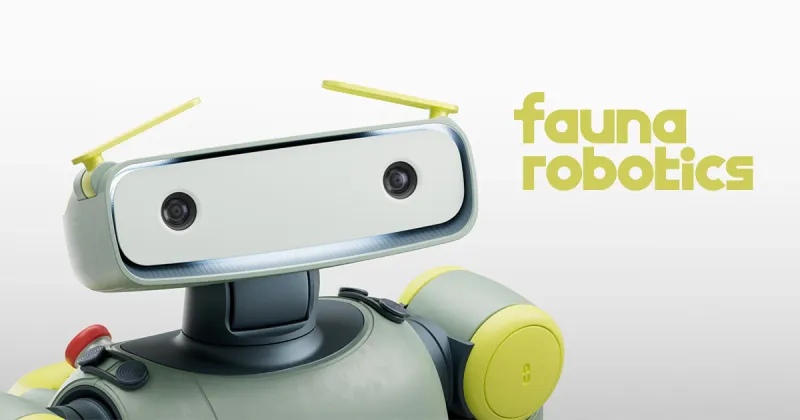
Those specs are modest compared with a warehouse humanoid that can carry heavy loads. That is the point. A 22.7 kg soft robot with conservative manipulation is a more believable home-learning platform than an 80 kg industrial humanoid walking through a living room. Sprout's value is not raw strength; it is a bounded body that can interact with people, recover from failures, and give engineers a safer place to learn what household autonomy actually requires.
The Robot Report's technical analysis highlighted several important design choices: separate learned policies for different motions, hard safety limits, operator recovery workflows, and teleoperation loops that can turn failures into training data. That is not as flashy as a demo of a robot folding laundry. It is more useful. Home robots fail in transitions, edge cases, and recovery moments. A robot that can capture those failures cleanly is a better long-term bet than a robot that only works in polished clips.
Rivr Gives Amazon a Deployment Loop, Not a Living-Room Robot
Rivr is the less obviously "home robot" acquisition, but it may be just as important. Its official site describes the company as building General Physical AI through Doorstep Delivery with autonomous legged robots. Each delivery is meant to generate data that improves the AI, combining simulation, reinforcement learning, and real-world self-supervised learning.
That language can sound vague, but the operational idea is concrete. Doorsteps are messy. They involve stairs, curbs, gates, uneven surfaces, weather, pets, people, and awkward handoff moments. A robot that repeatedly approaches real homes will see more practical edge cases than a lab demo does.
For Amazon, Rivr is probably not about selling you a consumer robot. It is about making delivery more autonomous and learning from a huge number of physical interactions near homes. That is valuable even if the robot never crosses the threshold. If Amazon eventually wants a home robot, doorstep robotics gives it a real-world training frontier adjacent to the home without immediately asking customers to trust a machine inside the living room.
This is why the Fauna and Rivr deals fit together. Fauna gives Amazon a small humanoid sandbox. Rivr gives it a deployment path where robots meet the physical world at scale. The common denominator is not the robot shape; it is data from real environments.
How This Compares With Amazon Astro
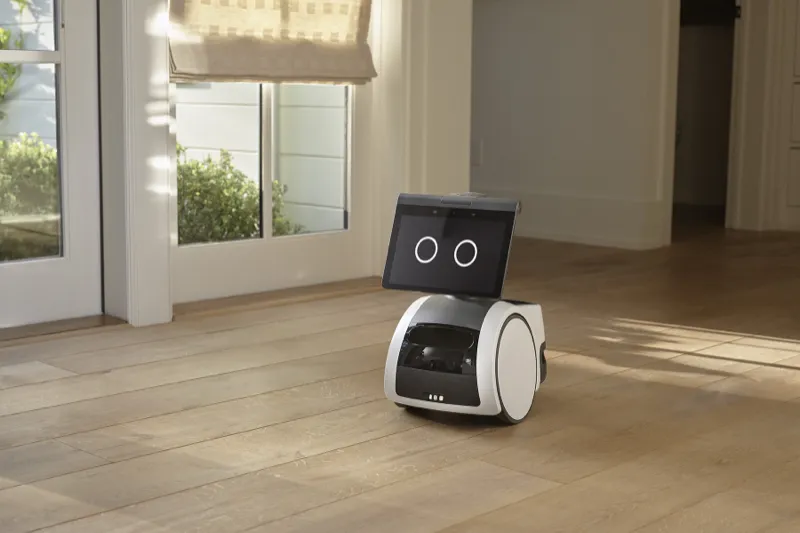
Amazon already has a home robot in the ui44 database: Amazon Astro. Astro is a 44 cm, 9.35 kg wheeled robot with Alexa, Ring integration, Visual ID, home patrol, remote monitoring, a 10.1-inch screen, a 1080p periscope camera, ultrasonic sensors, time-of-flight sensing, and Amazon's AZ1 Neural Edge chip. Its listed launch price is $1,599.99 by invitation only.
Astro is useful context because it shows both Amazon's advantage and its problem. The advantage is ecosystem integration. Astro can use Alexa, Ring, smart-home routines, video calling, maps, alerts, and subscriptions. A startup without Amazon's device ecosystem would struggle to match that.
The problem is that Astro is still mostly a mobile screen and monitoring device. It can patrol, follow, call, alert, and observe. It cannot manipulate the world. It cannot load a dishwasher, pick up clutter, fold laundry, or open a door. That made it a reasonable first home-robot experiment, but not the general-purpose helper people imagine when they hear "Amazon bought a humanoid company."
The Fauna acquisition fills one of Astro's biggest gaps: a body with arms, legs, expressive social hardware, and a developer stack for embodied behavior. Rivr fills another: outdoor/doorstep movement around stairs and real-world delivery conditions. Neither deal instantly turns Astro into a robot butler. Together, they show where Amazon knows Astro was too narrow.
The Smart-Home Platform Angle
Amazon is not the only company trying to make the home robot a platform. The more useful comparison is not another humanoid acquisition; it is Samsung Ballie.
In ui44, Ballie is tracked as a development-stage AI companion with no announced price, a rolling body, camera, spatial and environmental sensors, SmartThings control, Bixby voice interaction, and Google Gemini plus Samsung language models. It is meant to navigate the home, project content, monitor pets or family, control appliances, and behave like a mobile smart-home companion.

Ballie and Astro show the near-term smart-home robot path: a mobile interface, not a chore machine. These products can be useful without arms because they plug into security, entertainment, reminders, calls, and appliance control. They also avoid the hardest manipulation problems.
Fauna moves Amazon closer to the next step: a home robot with a body that can interact physically. But the distance from smart-home companion to useful household manipulator is huge. A future Amazon robot would need to combine Astro's ecosystem, Sprout's safe embodiment, and Rivr's deployment learning without becoming too expensive, too invasive, or too dependent on remote human help.
What the ui44 Database Says About the Competitive Bar
The current home-humanoid market already sets a high bar for Amazon. 1X NEO is listed in ui44 as a home-focused humanoid in pre-order status with a $20,000 early-adopter price, 167 cm height, 30 kg weight, about 4 hours of battery life, RGB cameras, depth sensors, tactile skin, and a soft lightweight body. It is explicitly marketed around household chores and safe human coexistence.

That comparison is sobering. If Amazon enters home humanoids, consumers will not judge it against a lab robot. They will ask why it is better than NEO-style pre-order humanoids, why it is safer than industrial platforms, and why it is more useful than a rolling smart display.
Amazon also has to contend with the industrial side of robotics. Boston Dynamics Stretch, for example, is not a home robot, but it shows what a commercially focused robot can do when the task is constrained: warehouse case handling at up to 800 boxes per hour, with a 7-DoF arm, vision, LiDAR, time-of-flight sensors, and deployments through enterprise sales. Spot, another Boston Dynamics robot in ui44, has more than 1,500 units deployed worldwide, autonomous navigation, stairs, self-charging, and an optional arm, but it remains an enterprise robot rather than a normal consumer purchase.
The lesson is simple: robots become useful first when the task and environment are constrained. Warehouses, patrol routes, doorstep delivery, and monitored developer programs are easier than arbitrary home chores. Amazon's acquisitions make more sense if you see them as steps toward constrained deployment, not as a shortcut to full household autonomy.
What Should Buyers Watch After Amazon’s Robot Acquisitions?
If you are wondering whether to wait for an Amazon home robot, the practical answer is: do not pause a purchase because of these acquisitions alone. There is no announced Amazon humanoid product, no price, no launch date, and no evidence that Sprout will become a consumer appliance soon.
What you should watch instead:
| Signal to watch | Why it matters for a future Amazon home robot |
|---|---|
| A new Astro roadmap | Shows whether Amazon still wants a consumer home-robot product line |
| Alexa plus embodied AI demos | Indicates whether the assistant is moving from voice commands to physical action |
| Ring or home-monitoring bundles | Suggests Amazon may start with security/care, not chores |
| Developer or R&D partner programs | Would mirror Fauna's current platform-first path |
| Doorstep robot pilots | Shows whether Rivr becomes an Amazon logistics deployment, not just an acquihire |
| Clear privacy controls | Essential if cameras, microphones, maps, and robot movement enter the home |
The first Amazon robot after these deals may not be a humanoid. It could be a better Astro, a delivery robot, a Ring-adjacent patrol product, or developer hardware that never reaches retail. That is not disappointing; it is more realistic than expecting a full home helper immediately.
The Privacy and Subscription Question
Amazon's strongest home-robot advantage is also the reason buyers should be careful. A robot tied to Alexa, Ring, maps, cameras, microphones, subscriptions, and retail accounts could be genuinely useful. It could also concentrate an unusual amount of household context in one ecosystem.
Astro's official page emphasizes privacy controls such as mic/camera/motion disabling, out-of-bounds zones, and on-device Visual ID processing. Those are the kinds of controls any future Amazon robot would need, but with a humanoid or manipulator the stakes rise. A robot that can move through rooms and act on the world needs transparent logs, clear data retention settings, local disable controls, and understandable remote-assistance rules.
Subscription design matters too. Astro's advanced monitoring features connect to Ring Home Premium. A future Amazon robot could be sold as hardware plus services: monitoring, care check-ins, delivery coordination, AI assistance, or remote expert help. That could make the robot more capable. It could also make the real cost much higher than the sticker price.
Bottom Line: Amazon Bought Options, Not a Finished Home Robot
The most honest interpretation is that Amazon bought options. Fauna gives it a small humanoid platform built around safety, teleoperation, developer access, and failure-driven learning. Rivr gives it a path to robots operating around real homes through doorstep delivery. Astro gives it a consumer-home baseline. Alexa, Ring, and Amazon's logistics network give it distribution and services.
That combination is meaningful. It is also not a product announcement.
For the next few years, the useful home robot will probably arrive in pieces: mobile monitoring, smart-home control, delivery support, social presence, teleoperated help, constrained manipulation, and gradual autonomy. Amazon's new robotics deals make it more plausible that the company wants to own several of those pieces. They do not prove that a general-purpose Amazon home robot is ready.
If Amazon does eventually ship a serious home robot, the deciding factor will not be whether it looks humanoid. It will be whether it can do something in the home that Astro could not, at a price and privacy level ordinary buyers can accept.
Database context
Use this article as a privacy verification workflow
Turn the article into a real verification pass
Amazon’s Robot Acquisitions: Home Robot Signal? already points you toward 6 linked robots, 5 manufacturers, and 3 countries inside the ui44 database. That matters because strong buyer guidance is easier to apply when you can move immediately from a claim or warning into concrete product pages, manufacturer directories, component explainers, and country-level context instead of treating the article as an isolated opinion piece. The fastest next step is to turn the article into a shortlist workflow: open the linked robot pages, verify which specs are actually published for those models, then compare the surrounding manufacturer and component context before you decide whether the underlying claim changes your buying plan.
For this topic, the useful discipline is to separate the editorial lesson from the catalog evidence. The article gives you the framing, but the robot pages tell you what each product actually ships with today: sensor stack, connectivity methods, listed price, release timing, category, and support-relevant compatibility notes. The manufacturer pages then show whether you are looking at a one-off launch, a broader lineup pattern, or a company that spans multiple categories. That layered workflow reduces the risk of buying on a single marketing phrase or a single support FAQ.
Use the robot pages to confirm which products actually expose cameras, microphones, Wi-Fi, or voice systems, then use the manufacturer pages to decide how much of the privacy question seems product-specific versus brand-wide. On this route cluster, Sprout, Astro, and Ballie form the fastest reality check. If you want a quick working shortlist, open Compare Sprout, Astro, and Ballie next, then keep this article open as the reasoning layer while you compare structured data side by side.
Practical Takeaway
Every robot, manufacturer, category, component, and country reference below resolves to a real ui44 page, keeping the follow-up path grounded in database records rather than generic advice.
Suggested next steps in ui44
- Open Sprout and note the listed sensors, connectivity methods, and voice stack before you interpret any policy claim.
- Cross-check the wider brand context on Fauna Robotics so you can see whether the privacy question touches one model or a broader lineup.
- Use the linked component pages to confirm how common the relevant sensors and connectivity layers are across the database.
- Keep a short note of which policy layers you checked, which device features are actually present on the robot page, and which items still depend on region- or app-level confirmation.
- Finish with Compare Sprout, Astro, and Ballie so the policy reading sits next to structured product data.
Database context
Robot profiles worth opening next
Use the linked product pages as the evidence layer
The linked robot pages are where this article becomes operational. Instead of asking whether the headline is interesting, use the robot entries to inspect the actual mix of sensors, connectivity options, batteries, pricing, release timing, and stated capabilities attached to the products mentioned in the article. That is the easiest way to see whether the warning or opportunity described here affects one product family, a specific design pattern, or an entire buying lane.
Sprout
Fauna Robotics · Humanoid · Active
Sprout is tracked on ui44 as a active humanoid robot from Fauna Robotics. The database currently records a listed price of Price TBA, a release date of 2025, 3–3.5 hours (swappable battery) battery life, Not disclosed charging time, and a published stack that includes ZED 2i Stereoscopic Vision, 4× Time-of-Flight Sensors, and Torso IMU plus Wi-Fi and Ethernet.
For privacy-focused reading, this page matters because it shows the concrete device surface behind the policy discussion. Use it to verify whether Sprout combines sensors and connectivity in a way that could change the in-home data footprint, and compare the listed capabilities such as Bipedal Walking, 29 Degrees of Freedom, and 6 DOF Arms with 1 DOF Grippers with any cloud, app, or voice layers, including Dual Speakers (high fidelity).
Astro is tracked on ui44 as a active security & patrol robot from Amazon. The database currently records a listed price of $1,599, a release date of 2021, Not officially disclosed battery life, Not officially disclosed charging time, and a published stack that includes 5MP Bezel Camera, 1080p Periscope Camera (132° FOV), and Infrared Vision plus Wi-Fi 802.11ac and Bluetooth.
For privacy-focused reading, this page matters because it shows the concrete device surface behind the policy discussion. Use it to verify whether Astro combines sensors and connectivity in a way that could change the in-home data footprint, and compare the listed capabilities such as Autonomous Home Patrol, Visual ID (face recognition), and Remote Home Monitoring with any cloud, app, or voice layers, including Amazon Alexa.
Ballie is tracked on ui44 as a development companions robot from Samsung. The database currently records a listed price of Price TBA, a release date of TBD, Not officially disclosed battery life, Not officially disclosed charging time, and a published stack that includes Camera, Spatial Sensors, and Environmental Sensors plus Wi-Fi and SmartThings.
For privacy-focused reading, this page matters because it shows the concrete device surface behind the policy discussion. Use it to verify whether Ballie combines sensors and connectivity in a way that could change the in-home data footprint, and compare the listed capabilities such as Autonomous Home Navigation, Built-in Projector (Wall & Floor), and Smart Home Control via SmartThings with any cloud, app, or voice layers, including Bixby.
NEO
1X Technologies · Humanoid · Pre-order
NEO is tracked on ui44 as a pre-order humanoid robot from 1X Technologies. The database currently records a listed price of $20,000, a release date of 2025-10-28, ~4 hours battery life, Not disclosed charging time, and a published stack that includes RGB Cameras, Depth Sensors, and Tactile Skin plus Wi-Fi and Bluetooth.
For privacy-focused reading, this page matters because it shows the concrete device surface behind the policy discussion. Use it to verify whether NEO combines sensors and connectivity in a way that could change the in-home data footprint, and compare the listed capabilities such as Household Chores, Tidying Up, and Safe Human Interaction with any cloud, app, or voice layers.
Stretch
Boston Dynamics · Commercial · Active
Stretch is tracked on ui44 as a active commercial robot from Boston Dynamics. The database currently records a listed price of Price TBA, a release date of 2022, Up to 16 hours (two full shifts) battery life, Under 2 hours with Fast Charger charging time, and a published stack that includes Computer Vision Cameras, Time-of-Flight Sensors, and LiDAR plus Wi-Fi and Ethernet.
For privacy-focused reading, this page matters because it shows the concrete device surface behind the policy discussion. Use it to verify whether Stretch combines sensors and connectivity in a way that could change the in-home data footprint, and compare the listed capabilities such as Autonomous Truck/Container Unloading, Up to 800 Cases Per Hour, and Vacuum Gripper (up to 23kg / 50 lbs) with any cloud, app, or voice layers.
Database context
Manufacturer context behind the article
Check whether this is one product story or a broader company pattern
Manufacturer pages add the market context that individual product pages cannot show on their own. They help you check whether the article is centered on a brand with a deep lineup, whether that brand spans several categories, and how much of its ui44 footprint depends on one flagship model versus a broader product strategy. That matters for topics like privacy, warranty terms, setup friction, and launch promises because the surrounding lineup often reveals whether a pattern is isolated or systemic.
Fauna Robotics
ui44 currently tracks 1 robot from Fauna Robotics across 1 category. The company is grouped under USA, and the current catalog footprint on ui44 includes Sprout.
That wider brand context matters because privacy questions rarely stop at one FAQ page. A manufacturer route helps you see whether the article is centered on one premium model or on a company that has several relevant products and therefore more than one place where the same policy or app assumptions might matter. The category mix here currently points toward Humanoid as the most useful next route if you want to see whether this article reflects a wider pattern inside the brand.
Amazon
ui44 currently tracks 1 robot from Amazon across 1 category. The company is grouped under USA, and the current catalog footprint on ui44 includes Astro.
That wider brand context matters because privacy questions rarely stop at one FAQ page. A manufacturer route helps you see whether the article is centered on one premium model or on a company that has several relevant products and therefore more than one place where the same policy or app assumptions might matter. The category mix here currently points toward Security & Patrol as the most useful next route if you want to see whether this article reflects a wider pattern inside the brand.
Samsung
ui44 currently tracks 2 robots from Samsung across 2 categorys. The company is grouped under South Korea, and the current catalog footprint on ui44 includes Ballie, Bespoke AI Jet Bot Steam Ultra.
That wider brand context matters because privacy questions rarely stop at one FAQ page. A manufacturer route helps you see whether the article is centered on one premium model or on a company that has several relevant products and therefore more than one place where the same policy or app assumptions might matter. The category mix here currently points toward Companions, Cleaning as the most useful next route if you want to see whether this article reflects a wider pattern inside the brand.
1X Technologies
ui44 currently tracks 2 robots from 1X Technologies across 1 category. The company is grouped under Norway, and the current catalog footprint on ui44 includes NEO, EVE.
That wider brand context matters because privacy questions rarely stop at one FAQ page. A manufacturer route helps you see whether the article is centered on one premium model or on a company that has several relevant products and therefore more than one place where the same policy or app assumptions might matter. The category mix here currently points toward Humanoid as the most useful next route if you want to see whether this article reflects a wider pattern inside the brand.
Database context
Broaden the scan without leaving the database
Categories, components, and countries add the wider context
Category framing
Category pages are useful when the article touches a buying pattern that shows up across brands. A category route helps you confirm whether the linked products sit in a narrow niche or whether the same question should be tested across a larger field of alternatives.
Humanoid
The Humanoid category page currently groups 61 tracked robots from 44 manufacturers. ui44 describes this lane as: Full-size bipedal humanoid robots designed to work alongside humans. From factory floors to household tasks, these machines represent the cutting edge of robotics.
That makes the category route a practical follow-up when you want to check whether the products linked in this article are typical for the lane or whether they sit at one edge of the market. Useful starting examples currently include NEO, EVE, Mornine M1.
Security & Patrol
The Security & Patrol category page currently groups 3 tracked robots from 3 manufacturers. ui44 describes this lane as: Surveillance and patrol robots that monitor homes, businesses, and perimeters autonomously.
That makes the category route a practical follow-up when you want to check whether the products linked in this article are typical for the lane or whether they sit at one edge of the market. Useful starting examples currently include Astro, Vision 60, Watchbot 2.
Country and ecosystem context
Country pages give extra context when support practices, launch sequencing, regulatory posture, or manufacturer mix matter. They are not a substitute for model-level verification, but they do help you see which ecosystems cluster together and which manufacturers sit in the same regional field when you broaden the search beyond the article headline.
USA
The USA route currently groups 16 tracked robots from 12 manufacturers in ui44. That gives you a useful regional lens when the article points toward support practices, launch sequencing, or brand clusters that may share similar ecosystem assumptions.
On the current route, manufacturers like Boston Dynamics, Figure AI, Tesla make the page a good way to broaden the scan without losing the regional context that often shapes availability, documentation style, and adjacent alternatives.
South Korea
The South Korea route currently groups 2 tracked robots from 1 manufacturers in ui44. That gives you a useful regional lens when the article points toward support practices, launch sequencing, or brand clusters that may share similar ecosystem assumptions.
On the current route, manufacturers like Samsung make the page a good way to broaden the scan without losing the regional context that often shapes availability, documentation style, and adjacent alternatives.
Norway
The Norway route currently groups 2 tracked robots from 1 manufacturers in ui44. That gives you a useful regional lens when the article points toward support practices, launch sequencing, or brand clusters that may share similar ecosystem assumptions.
On the current route, manufacturers like 1X Technologies make the page a good way to broaden the scan without losing the regional context that often shapes availability, documentation style, and adjacent alternatives.
Database context
Questions to answer before you move from reading to buying
A follow-up FAQ built from the entities already linked in this article
Frequently Asked Questions
Which page should I open first after reading “Amazon’s Robot Acquisitions: Home Robot Signal?”?
Start with Sprout. That gives you a concrete product anchor for the article’s main claim. From there, branch into the manufacturer and component pages so you can tell whether the article is describing one specific model, a repeated brand pattern, or a wider technology issue that affects multiple shortlist options.
How do the manufacturer pages change the buying decision?
Fauna Robotics help you zoom out from one article and one product. On ui44 they show lineup breadth, category spread, and the neighboring robots tied to the same company. That context is useful when you are deciding whether a risk belongs to a single model, whether it shows up across a brand’s portfolio, and whether you should keep looking at alternatives before committing.
When should I switch from reading to side-by-side comparison?
Move into Compare Sprout, Astro, and Ballie as soon as you understand the article’s main warning or promise. The article explains what to watch for, but the compare view is where you can check whether price, status, battery life, connectivity, sensors, and category fit still make the robot a good match for your own home and budget.
Database context
Where to go next in ui44
Keep the research chain inside the database
If you want to keep going, these follow-on pages give you the cleanest expansion path from article to research session. Open the comparison route first if you are deciding between products today. Open the manufacturer, category, and component routes if you still need to understand the broader pattern behind the claim.
Written by
ui44 Team
Published April 26, 2026
Share this article
Open a plain share link on X or Bluesky. No embeds, no widgets, no cookie baggage.