That is why the most interesting home robot safety question in 2026 is not whether the robot has a large language model. It is whether the robot has a live enough model of your room, its own body, and the object it is about to touch.
The Robotics and AI Institute's ICRA 2026 roundup included a paper called Real-is-Sim: Bridging the Sim-to-Real Gap with a Dynamic Digital Twin. The core idea is sharp: keep a simulation synchronized with the real world at 60 Hz, let the control policy act on the simulated robot, and have the physical robot follow the simulated joint states while measurements keep correcting the twin. In other words, the policy is always operating inside the model, while the real robot shadows the model.
That is not a consumer product feature yet. But for buyers watching humanoids, mobile manipulators, and arm-equipped cleaning robots move toward homes, it is a useful lens. The future home robot may need a real-time digital twin before it earns permission to pick up your things.
What a real-time digital twin changes
A normal robot map answers questions like "where are the walls?" and "where is the dock?" A useful manipulation twin has to answer more demanding questions:
- Where is the robot's arm, gripper, base, and center of mass right now?
- Where are the object, table edge, cable, pet bowl, and nearby human?
- If the robot nudges this towel, does it slide, fold, snag, or pull something else with it?
- If the planned motion is wrong, can the robot stop or re-plan before contact becomes damage?
The RAI work matters because it shifts simulation from a training-only tool into the control loop. Instead of training in simulation, hoping transfer works, and then deploying directly on hardware, the dynamic twin becomes the mediator. The robot can evaluate and execute through a continuously corrected virtual copy.
For a lab task, that is a research architecture. For homes, it points at a product requirement: a robot that touches belongings needs more than object recognition. It needs short-horizon physical prediction.
Why homes are harder than demos
Factory robots often get fixtures, known parts, defined lighting, controlled lanes, and safety cages. Homes offer the opposite: soft objects, half-open drawers, glossy tables, children, pets, cables, stairs, clothes, and objects that are never exactly where they were yesterday.
That is why "can pick up a cup" is not the same as "safe to clean a kitchen." The home version includes edge cases:
- The cup is partly full.
- The counter is wet.
- The robot is on a rug and its base shifts while reaching.
- A person walks behind it.
- The target object is touching another object.
- The object is soft, transparent, reflective, deformable, or too fragile to squeeze.
Real-time twins are attractive because they can turn those moments into continuous checks instead of one-time decisions. The robot does not just say "I see a towel." It keeps asking whether its simulated contact still matches the sensed towel, whether the gripper load is plausible, and whether the next few centimeters of motion still look safe.
The ui44 comparison: which robots need this most?
Not every home robot needs a dynamic twin. A voice companion on a desk can be safe with normal motion limits. A mapping-only vacuum can rely on navigation, obstacle avoidance, and conservative bump behavior. The need rises quickly once a robot has an arm, hands, or enough mass to make contact risky.
Robot
- Why it matters
- A real mobile manipulator built for homes, research, and assistive pilots.
- ui44 data point
- $29,950, 160 cm working height, 2.5 kg extended arm payload, 4 kg retracted payload, 8 hour light-load runtime.
Robot
- Why it matters
- A home-focused humanoid whose main promise is safe coexistence around people.
- ui44 data point
- $20,000 early-adopter price, 167 cm, 30 kg, about 4 hours of battery life.
Robot
- Why it matters
- A full-size humanoid platform moving from industrial validation toward broader embodied AI claims.
- ui44 data point
- 173 cm, 61 kg, 20 kg payload, about 5 hours of battery life; not a consumer product.
Robot
- Why it matters
- A relatively affordable research humanoid that brings dexterous manipulation closer to hobbyist and lab budgets.
- ui44 data point
- $13,500, 132 cm, 35 kg, optional dexterous hands, roughly 2 hour runtime.
Robot
- Why it matters
- A compact humanoid with a buyer-facing price and a Pro tier that includes digital twin access.
- ui44 data point
- EUR19,999 Standard, EUR29,999 Pro, 132 cm, 36 kg, 3 kg payload.
Robot
- Why it matters
- A consumer cleaning robot with a foldable arm, showing manipulation entering mainstream appliances.
- ui44 data point
- $1,699.99, five-axis OmniGrip arm, official item handling up to 300 g.
| Robot | Why it matters | ui44 data point |
|---|---|---|
| Hello Robot Stretch 4 | A real mobile manipulator built for homes, research, and assistive pilots. | $29,950, 160 cm working height, 2.5 kg extended arm payload, 4 kg retracted payload, 8 hour light-load runtime. |
| 1X NEO | A home-focused humanoid whose main promise is safe coexistence around people. | $20,000 early-adopter price, 167 cm, 30 kg, about 4 hours of battery life. |
| Figure 03 | A full-size humanoid platform moving from industrial validation toward broader embodied AI claims. | 173 cm, 61 kg, 20 kg payload, about 5 hours of battery life; not a consumer product. |
| Unitree G1 | A relatively affordable research humanoid that brings dexterous manipulation closer to hobbyist and lab budgets. | $13,500, 132 cm, 35 kg, optional dexterous hands, roughly 2 hour runtime. |
| NEURA 4NE-1 Mini | A compact humanoid with a buyer-facing price and a Pro tier that includes digital twin access. | EUR19,999 Standard, EUR29,999 Pro, 132 cm, 36 kg, 3 kg payload. |
| Roborock Saros Z70 | A consumer cleaning robot with a foldable arm, showing manipulation entering mainstream appliances. | $1,699.99, five-axis OmniGrip arm, official item handling up to 300 g. |

The spread is important. Stretch 4 is expensive but honest about being a developer and assistive platform. NEO is explicitly home-focused but still early. Figure 03 is industrially oriented and not a consumer product. Unitree G1 is affordable by humanoid standards, but that does not make it a household appliance. Saros Z70 is already consumer-priced and gives buyers a first taste of what even a small arm changes: the robot is no longer only cleaning around objects; it is deciding which objects to move.
The safety layer buyers should look for
If digital twins become product features, they should not appear as vague marketing copy. Buyers should look for concrete behaviors and limits.
First, the robot should know its own reachable workspace. An arm-equipped robot should be able to explain which surfaces it can reach, how much it can lift at different extensions, and when it will refuse a task because posture or balance is poor. Stretch 4's payload split is a good example of useful honesty: 2.5 kg with the arm extended, 4 kg retracted.
Second, the robot should maintain a live collision model. This means more than "obstacle avoidance" while driving. The arm path, elbow, wrist, held object, base, and any moving person in the scene all matter. A full-size humanoid such as Figure 03 or NEO needs this even more than a wheeled arm, because the whole body can become part of the manipulation.
Third, the robot should preserve uncertainty. The safest robot is often the one that says "I am not sure enough to do that." Transparent objects, cables, loose fabrics, pet toys, and cluttered piles should trigger slow mode, a request for human confirmation, or a refusal.
Fourth, remote help should be treated as a privacy and safety boundary, not a magic fix. A human teleoperator can recover from failures, but home buyers deserve clear controls over when cameras stream, what is stored, and whether the robot can move while someone remote is assisting.

Digital twins will not solve everything
The honest version is that a real-time twin is not a force field. It can be wrong. Sensors miss things. Soft objects deform in hard-to-model ways. Low-friction surfaces surprise planners. Pets and children do not follow trajectories.
There is also a cost problem. Keeping a high-quality twin synchronized can require compute, sensors, calibration, and software maintenance. That is easier to justify on a $29,950 Stretch 4 or an enterprise humanoid than on a $1,699 cleaning robot. The consumer version may be much simpler: a local short-horizon physics model for the arm and nearby objects, not a full photorealistic copy of the apartment.
Still, even a limited twin can be valuable if it changes the robot's default from "execute the command" to "simulate, check, execute slowly, compare, and stop when reality diverges."
That is the buyer-relevant difference. The feature is not the digital twin itself. The feature is safer refusal, slower contact, better recovery, and fewer surprising motions around people and belongings.
The near-term path: research robots first, appliances second
The first home-adjacent systems to benefit are likely research and assistive robots. Hello Robot's Stretch line already lives in that space: real homes, real labs, ROS 2, Python, teleoperation, mapping, navigation, and manipulation demos. That is the right environment for testing how digital twins behave outside controlled industrial cells.
NEURA's 4NE-1 Mini is another signal because the Pro tier explicitly includes digital twin access in ui44's tracked data. That does not mean a consumer can safely delegate chores to it. It means robot makers see simulated counterparts as part of the developer workflow, not just as a research afterthought.
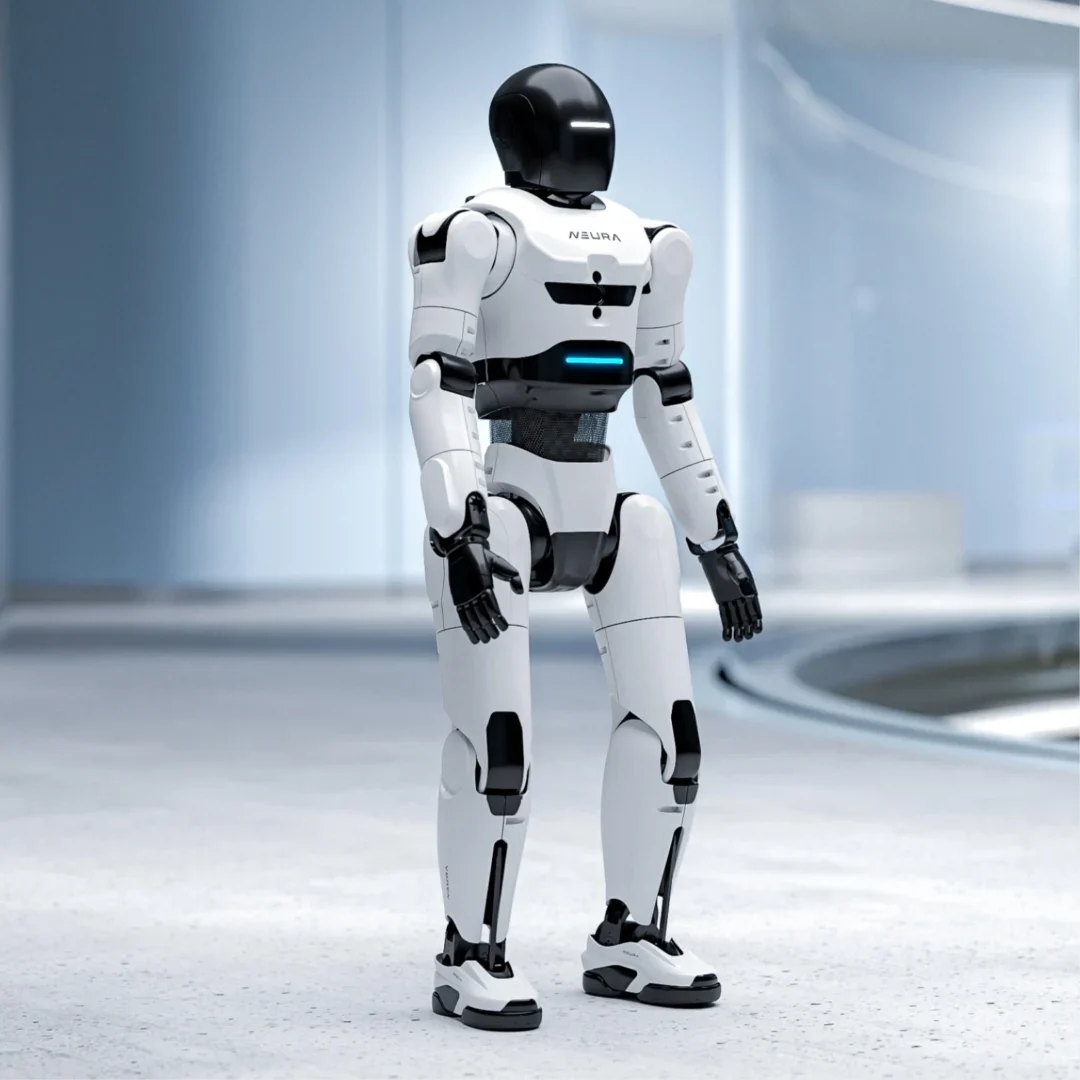
Consumer appliances will probably adopt narrower versions. Roborock's Saros Z70 does not need a full human-scale household twin to lift a sock. But once a vacuum has an arm, the same class of questions appears at smaller scale: what object is this, how heavy is it, where can it be placed, and what happens if the grasp fails?
That is why arm-equipped cleaners are more important than they look. They are the bridge between passive navigation and physical manipulation in a price band normal buyers can understand.
What this means before you buy
For now, buyers should treat manipulation claims with a simple rule: the more a robot can touch, the more evidence you should demand.
Ask for the payload at reach, not just the maximum payload. Ask what object categories are supported. Ask whether the robot recognizes uncertainty. Ask whether it has local processing for safety-critical motion. Ask how it handles people entering its workspace. Ask what happens after a failed grasp. Ask whether remote assistance is opt-in, logged, and visibly indicated.
For home humanoids, the bar should be higher. A 30 kg to 70 kg robot moving near people should not rely on a demo script and a cloud model. It needs conservative force limits, reliable perception, physical compliance, emergency stop behavior, and a control architecture that can notice when the real world has diverged from the plan.
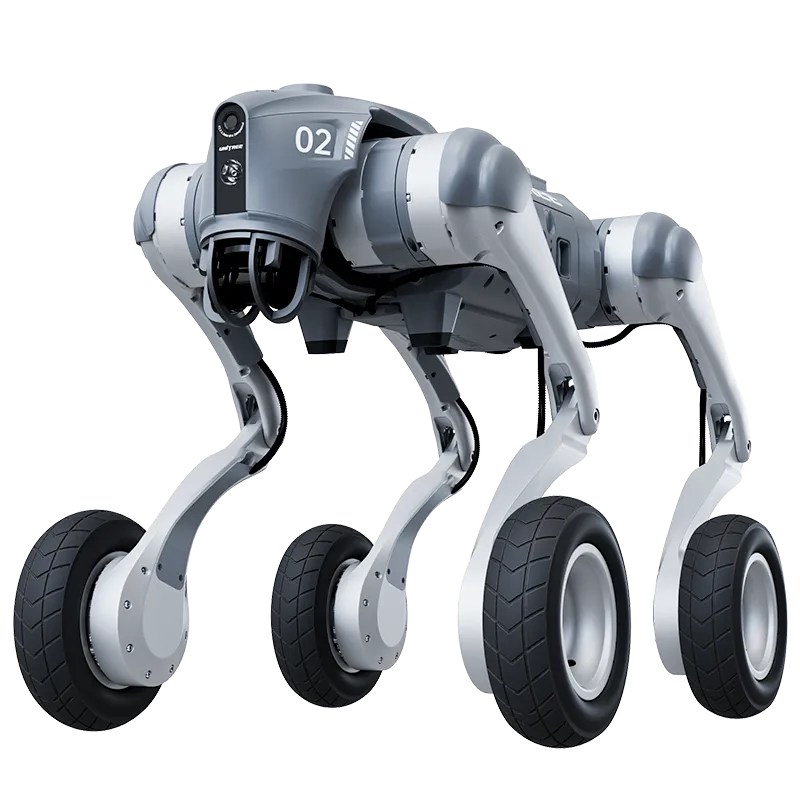
Digital twins are one way to build that architecture. They are not the only way, and they are not enough by themselves. But they are a useful sign that the company understands the hard problem: manipulation is physics, not just language.
Bottom line
Real-time digital twins will probably arrive in home robotics quietly. They may be hidden behind phrases like simulation-based control, world model, safety model, or embodied AI runtime. The label matters less than the behavior.
The robot should plan in a model, act cautiously in the room, compare the two constantly, and stop when the match breaks. That is the kind of intelligence home robots need before they handle fragile, messy, personal spaces.
For buyers, the practical takeaway is clear: do not buy a manipulating robot only because it can reach. Buy it when the maker can show how it knows when not to reach.
Related in the database
Use this article as a privacy verification workflow
Turn the article into a privacy verification pass grounded in the robots, manufacturers, and components it actually references.
Do Home Robots Need Real-Time Digital Twins? already points you toward 6 linked robots, 6 manufacturers, and 4 countries inside the ui44 database. That matters because strong buyer guidance is easier to apply when you can move immediately from a claim or warning into concrete product pages, manufacturer directories, component explainers, and country-level context instead of treating the article as an isolated opinion piece. The fastest next step is to turn the article into a shortlist workflow: open the linked robot pages, verify which specs are actually published for those models, then compare the surrounding manufacturer and component context before you decide whether the underlying claim changes your buying plan.
For this topic, the useful discipline is to separate the editorial lesson from the catalog evidence. The article gives you the framing, but the robot pages tell you what each product actually ships with today: sensor stack, connectivity methods, listed price, release timing, category, and support-relevant compatibility notes. The manufacturer pages then show whether you are looking at a one-off launch, a broader lineup pattern, or a company that spans multiple categories. That layered workflow reduces the risk of buying on a single marketing phrase or a single support FAQ.
Use the robot pages to confirm which products actually expose cameras, microphones, Wi-Fi, or voice systems, then use the manufacturer pages to decide how much of the privacy question seems product-specific versus brand-wide. On this route cluster, Stretch 4, NEO, and Figure 03 form the fastest reality check. If you want a quick working shortlist, open Compare Stretch 4, NEO, and Figure 03 next, then keep this article open as the reasoning layer while you compare structured data side by side.
Practical Takeaway
Every robot, manufacturer, category, component, and country reference below resolves to a real ui44 page, keeping the follow-up path grounded in database records rather than generic advice.
Suggested next steps in ui44
- Open Stretch 4 and note the listed sensors, connectivity methods, and voice stack before you interpret any policy claim.
- Cross-check the wider brand context on Hello Robot so you can see whether the privacy question touches one model or a broader lineup.
- Use the linked component pages to confirm how common the relevant sensors and connectivity layers are across the database.
- Keep a short note of which policy layers you checked, which device features are actually present on the robot page, and which items still depend on region- or app-level confirmation.
- Finish with Compare Stretch 4, NEO, and Figure 03 so the policy reading sits next to structured product data.
Robot profiles worth opening next
Use the linked product pages as the evidence layer
The linked robot pages are where this article becomes operational. Instead of asking whether the headline is interesting, use the robot entries to inspect the actual mix of sensors, connectivity options, batteries, pricing, release timing, and stated capabilities attached to the products mentioned in the article. That is the easiest way to see whether the warning or opportunity described here affects one product family, a specific design pattern, or an entire buying lane.
Stretch 4
Hello Robot · Home Assistants · Available
Stretch 4 is tracked on ui44 as a available home assistants robot from Hello Robot. The database currently records a listed price of $29,950, a release date of 2026-05-12, 8 hours (light CPU load) battery life, Not officially disclosed charging time, and a published stack that includes Wide-FOV depth sensing, High-resolution RGB cameras, and Calibrated RGB + depth perception plus its listed connectivity stack.
For privacy-focused reading, this page matters because it shows the concrete device surface behind the policy discussion. Use it to verify whether Stretch 4 combines sensors and connectivity in a way that could change the in-home data footprint, and compare the listed capabilities such as Mobile Manipulation, Omnidirectional Indoor Mobility, and Autonomous Mapping and Navigation with any cloud, app, or voice layers.
NEO
1X Technologies · Humanoid · Pre-order
NEO is tracked on ui44 as a pre-order humanoid robot from 1X Technologies. The database currently records a listed price of $20,000, a release date of 2025-10-28, ~4 hours battery life, Not disclosed charging time, and a published stack that includes RGB Cameras, Depth Sensors, and Tactile Skin plus Wi-Fi and Bluetooth.
For privacy-focused reading, this page matters because it shows the concrete device surface behind the policy discussion. Use it to verify whether NEO combines sensors and connectivity in a way that could change the in-home data footprint, and compare the listed capabilities such as Household Chores, Tidying Up, and Safe Human Interaction with any cloud, app, or voice layers.
Figure 03 is tracked on ui44 as a active humanoid robot from Figure AI. The database currently records a listed price of Price TBA, a release date of 2025-10-09, ~5 hours battery life, Not disclosed charging time, and a published stack that includes Stereo Vision, Depth Cameras, and Force Sensors plus Wi-Fi and Bluetooth.
For privacy-focused reading, this page matters because it shows the concrete device surface behind the policy discussion. Use it to verify whether Figure 03 combines sensors and connectivity in a way that could change the in-home data footprint, and compare the listed capabilities such as Complex Manipulation, Warehouse Work, and Manufacturing Tasks with any cloud, app, or voice layers.
G1 is tracked on ui44 as a available humanoid robot from Unitree. The database currently records a listed price of $13,500, a release date of 2024-05-13, ~2 hours battery life, Not disclosed charging time, and a published stack that includes Depth Camera, 3D LiDAR, and 4 Microphone Array plus Wi-Fi 6 and Bluetooth 5.2.
For privacy-focused reading, this page matters because it shows the concrete device surface behind the policy discussion. Use it to verify whether G1 combines sensors and connectivity in a way that could change the in-home data footprint, and compare the listed capabilities such as Bipedal Walking, Object Manipulation, and Dexterous Hands (optional Dex3-1) with any cloud, app, or voice layers.
4NE-1 Mini
NEURA Robotics · Humanoid · Pre-order
4NE-1 Mini is tracked on ui44 as a pre-order humanoid robot from NEURA Robotics. The database currently records a listed price of €19,999, a release date of 2026-01-05, ~2.5 hours battery life, Not disclosed charging time, and a published stack that includes Multi-camera Array, Force/Torque Sensors, and 3D Vision plus Wi-Fi 6 and Gigabit Ethernet.
For privacy-focused reading, this page matters because it shows the concrete device surface behind the policy discussion. Use it to verify whether 4NE-1 Mini combines sensors and connectivity in a way that could change the in-home data footprint, and compare the listed capabilities such as 25 Degrees of Freedom, Autonomous Navigation, and Object Manipulation (Pro tier: 12-DOF dexterous hands) with any cloud, app, or voice layers, including Built-in Multi-language Voice Recognition.
Manufacturer context behind the article
Check whether this is one product story or a broader company pattern
Manufacturer pages add the privacy context that individual product pages cannot show on their own. They help you check whether cameras, microphones, cloud accounts, app controls, and policy assumptions appear across a broader lineup or stay tied to one specific product story.
Hello Robot
ui44 currently tracks 2 robots from Hello Robot across 1 category. The company is grouped under USA, and the current catalog footprint on ui44 includes Stretch 3, Stretch 4.
That wider brand context matters because privacy questions rarely stop at one FAQ page. A manufacturer route helps you see whether the article is centered on one premium model or on a company that has several relevant products and therefore more than one place where the same policy or app assumptions might matter. The category mix here currently points toward Home Assistants as the most useful next route if you want to see whether this article reflects a wider pattern inside the brand.
1X Technologies
ui44 currently tracks 2 robots from 1X Technologies across 1 category. The company is grouped under Norway, and the current catalog footprint on ui44 includes NEO, EVE.
That wider brand context matters because privacy questions rarely stop at one FAQ page. A manufacturer route helps you see whether the article is centered on one premium model or on a company that has several relevant products and therefore more than one place where the same policy or app assumptions might matter. The category mix here currently points toward Humanoid as the most useful next route if you want to see whether this article reflects a wider pattern inside the brand.
Figure AI
ui44 currently tracks 2 robots from Figure AI across 1 category. The company is grouped under USA, and the current catalog footprint on ui44 includes Figure 03, Figure 02.
That wider brand context matters because privacy questions rarely stop at one FAQ page. A manufacturer route helps you see whether the article is centered on one premium model or on a company that has several relevant products and therefore more than one place where the same policy or app assumptions might matter. The category mix here currently points toward Humanoid as the most useful next route if you want to see whether this article reflects a wider pattern inside the brand.
Unitree
ui44 currently tracks 2 robots from Unitree across 1 category. The company is grouped under China, and the current catalog footprint on ui44 includes H1, G1.
That wider brand context matters because privacy questions rarely stop at one FAQ page. A manufacturer route helps you see whether the article is centered on one premium model or on a company that has several relevant products and therefore more than one place where the same policy or app assumptions might matter. The category mix here currently points toward Humanoid as the most useful next route if you want to see whether this article reflects a wider pattern inside the brand.
Broaden the scan without leaving the database
Categories, components, and countries add the wider context
Category framing
Category pages are useful when the article touches a buying pattern that shows up across brands. A category route helps you confirm whether the linked products sit in a narrow niche or whether the same question should be tested across a larger field of alternatives.
Home Assistants
The Home Assistants category page currently groups 16 tracked robots from 14 manufacturers. ui44 describes this lane as: Arm-based household helpers — laundry folders, kitchen robots, and mobile manipulators that take on hands-on physical tasks around the home.
That makes the category route a practical follow-up when you want to check whether the products linked in this article are typical for the lane or whether they sit at one edge of the market. Useful starting examples currently include Robody, Futuring 2 (F2), Stretch 3.
Humanoid
The Humanoid category page currently groups 129 tracked robots from 92 manufacturers. ui44 describes this lane as: Full-size bipedal humanoid robots built to work alongside people — from factory floors to household tasks. Compare the cutting edge of humanoid robotics.
That makes the category route a practical follow-up when you want to check whether the products linked in this article are typical for the lane or whether they sit at one edge of the market. Useful starting examples currently include NEO, EVE, Mornine M1.
Country and ecosystem context
Country pages give extra context when support practices, launch sequencing, regulatory posture, or manufacturer mix matter. They are not a substitute for model-level verification, but they do help you see which ecosystems cluster together and which manufacturers sit in the same regional field when you broaden the search beyond the article headline.
USA
The USA route currently groups 89 tracked robots from 69 manufacturers in ui44. That gives you a useful regional lens when the article points toward support practices, launch sequencing, or brand clusters that may share similar ecosystem assumptions.
On the current route, manufacturers like Faraday Future, iRobot, Boston Dynamics make the page a good way to broaden the scan without losing the regional context that often shapes availability, documentation style, and adjacent alternatives.
Norway
The Norway route currently groups 2 tracked robots from 1 manufacturers in ui44. That gives you a useful regional lens when the article points toward support practices, launch sequencing, or brand clusters that may share similar ecosystem assumptions.
On the current route, manufacturers like 1X Technologies make the page a good way to broaden the scan without losing the regional context that often shapes availability, documentation style, and adjacent alternatives.
China
The China route currently groups 189 tracked robots from 87 manufacturers in ui44. That gives you a useful regional lens when the article points toward support practices, launch sequencing, or brand clusters that may share similar ecosystem assumptions.
On the current route, manufacturers like AGIBOT, Dreame, Unitree Robotics make the page a good way to broaden the scan without losing the regional context that often shapes availability, documentation style, and adjacent alternatives.
Questions to answer before you move from reading to buying
A follow-up FAQ built from the entities already linked in this article
Frequently Asked Questions
Which page should I open first after reading “Do Home Robots Need Real-Time Digital Twins?”?
Start with Stretch 4. That gives you a concrete product anchor for the article’s main claim. From there, branch into the manufacturer and component pages so you can tell whether the article is describing one specific model, a repeated brand pattern, or a wider technology issue that affects multiple shortlist options.
How do the manufacturer pages change the buying decision?
Hello Robot help you zoom out from one article and one product. On ui44 they show lineup breadth, category spread, and the neighboring robots tied to the same company. That context is useful when you are deciding whether a risk belongs to a single model, whether it shows up across a brand’s portfolio, and whether you should keep looking at alternatives before committing.
When should I switch from reading to side-by-side comparison?
Move into Compare Stretch 4, NEO, and Figure 03 as soon as you understand the article’s main warning or promise. The article explains what to watch for, but the compare view is where you can check whether price, status, battery life, connectivity, sensors, and category fit still make the robot a good match for your own home and budget.
Where to go next in ui44
Keep the research chain inside the database
If you want to keep going, these follow-on pages give you the cleanest expansion path from article to research session. Open the comparison route first if you are deciding between products today. Open the manufacturer, category, and component routes if you still need to understand the broader pattern behind the claim.
Written by
ui44 Team
Published July 5, 2026
Share this article
Open a plain share link on X or Bluesky. No embeds, no widgets, no cookie baggage.