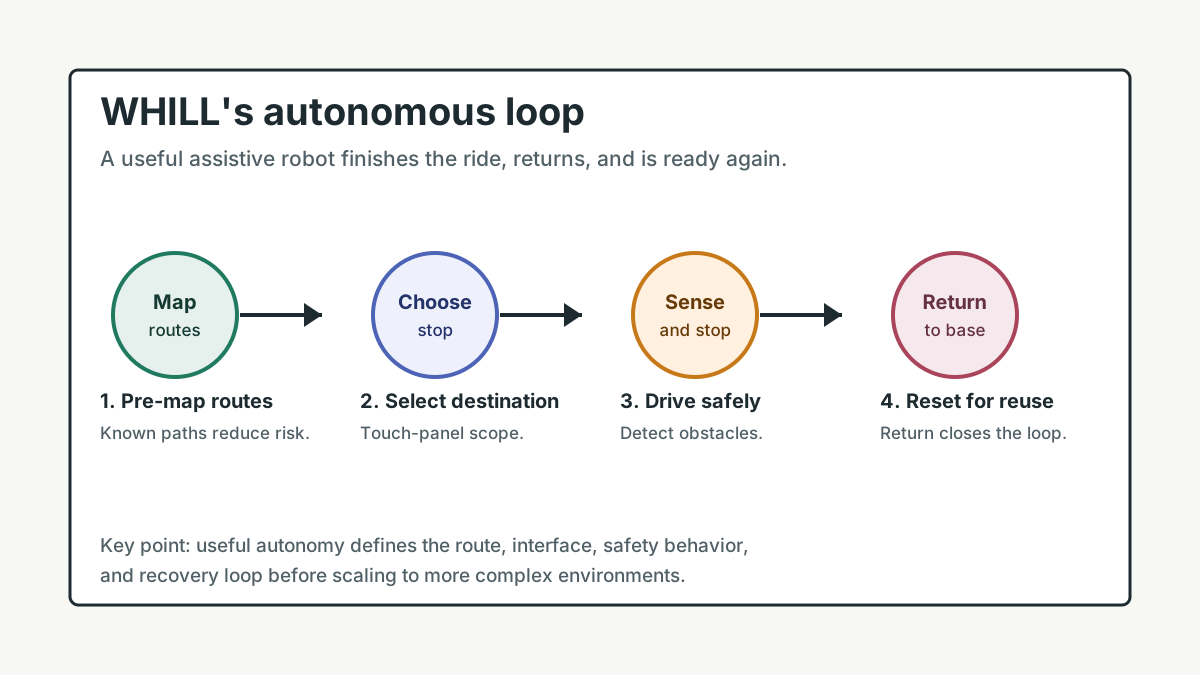
Most home-care robot promises still ask buyers to believe in open-ended autonomy: a robot that can understand messy rooms, help an older adult, handle emergencies, and move safely around people, pets, furniture, and changing floor plans. WHILL's model is narrower and more operational. It uses pre-collected map data, onboard sensing, selected destinations, collision avoidance, remote fleet visibility, and automatic return to a station after the passenger gets off. In other words, the service solves a real movement problem by constraining the environment before trying to scale the autonomy.
That lesson is useful for anyone comparing assistive home robots in the ui44 database. The robots that look closest to home care are not all solving the same problem. Amazon Astro is a $1,599 mobile home security and remote-care robot. Devanthro Robody is positioned as a 1.65 m, 60 kg home-care robotic avatar with AI plus VR teleoperation and a listed six-hour battery life. Andromeda Abi is a social companion for aged care, about 110 cm tall, with generative conversation and care-team workflows. PARO is a therapeutic companion robot for clinical and elder-care settings. Fourier GR-3 is a 165 cm, 71 kg humanoid care-bot platform with a soft shell, tactile sensing, and hot-swappable batteries. Diligent Moxi and ASUS Kairo sit more clearly in facility service robotics.
WHILL shows why the split matters. The first home assistive robots that feel reliable may behave less like general-purpose humanoids and more like services: bounded routes, known tasks, visible fleet state, remote recovery, and clear rules for when autonomy stops.
What WHILL Has Actually Shipped
WHILL announced on June 4, 2026 that its autonomous mobility service had started a trial at Heathrow Airport Terminal 3 with ABM, a major passenger assistance provider. The company framed the deployment around accessibility, staff workload, and more efficient passenger movement. The same release says WHILL's autonomous service is operating or being used at 26 locations globally and has exceeded 1 million cumulative service uses.
The important part is not the headline number alone. It is the operating pattern behind it. WHILL says the vehicle uses pre-collected map information and onboard sensors to compare the planned route with surrounding conditions. The rider selects a destination on a touch panel. The chair drives to that destination. After the rider gets off, it returns without a passenger to the original location or a station so it can be used again.
On WHILL's autonomous-drive product page, the company also describes facility-facing tools: real-time visibility into vehicle location and operating state, remote movement of vehicles to needed places, route setting, collision avoidance, and automatic return. The page says the autonomous model won a CES 2023 Best of Innovation Award in accessibility and notes a 24-unit deployment at Haneda Airport from June 2021.
Those are all very unglamorous details, which is why they are valuable. Assistive autonomy fails when the robot is treated as a one-off gadget. WHILL's pitch treats autonomy as a managed service.
The Home Robot Lesson: Autonomy Is Not One Feature
When a buyer reads "autonomous," it sounds like a single capability. For assistive robots, it is really a stack of separate promises:
Autonomy layer
Map
- What WHILL constrains
- Pre-collected facility routes
- Why homes are harder
- Furniture and clutter change constantly
Autonomy layer
Task
- What WHILL constrains
- Move a person to a selected destination
- Why homes are harder
- Home care mixes reminders, fetching, monitoring, and emergency response
Autonomy layer
Interface
- What WHILL constrains
- Touch-panel destination choice
- Why homes are harder
- Users may need voice, caregiver app, or passive detection
Autonomy layer
Safety
- What WHILL constrains
- Stop before obstacles, managed walking-speed routes
- Why homes are harder
- Pets, rugs, thresholds, children, and narrow passages vary by room
Autonomy layer
Recovery
- What WHILL constrains
- Automatic return and fleet management
- Why homes are harder
- A stranded home robot may block a hallway or require a caregiver
| Autonomy layer | What WHILL constrains | Why homes are harder |
|---|---|---|
| Map | Pre-collected facility routes | Furniture and clutter change constantly |
| Task | Move a person to a selected destination | Home care mixes reminders, fetching, monitoring, and emergency response |
| Interface | Touch-panel destination choice | Users may need voice, caregiver app, or passive detection |
| Safety | Stop before obstacles, managed walking-speed routes | Pets, rugs, thresholds, children, and narrow passages vary by room |
| Recovery | Automatic return and fleet management | A stranded home robot may block a hallway or require a caregiver |
The difference is not that airports are simple. Airports are busy, public, regulated, and high-pressure. The difference is that the task can be standardized. A terminal has known destinations. Staff can monitor the system. Routes can be mapped, tested, and changed deliberately. That is a much better first market for assistive mobility autonomy than an open-ended promise to "help around the home."
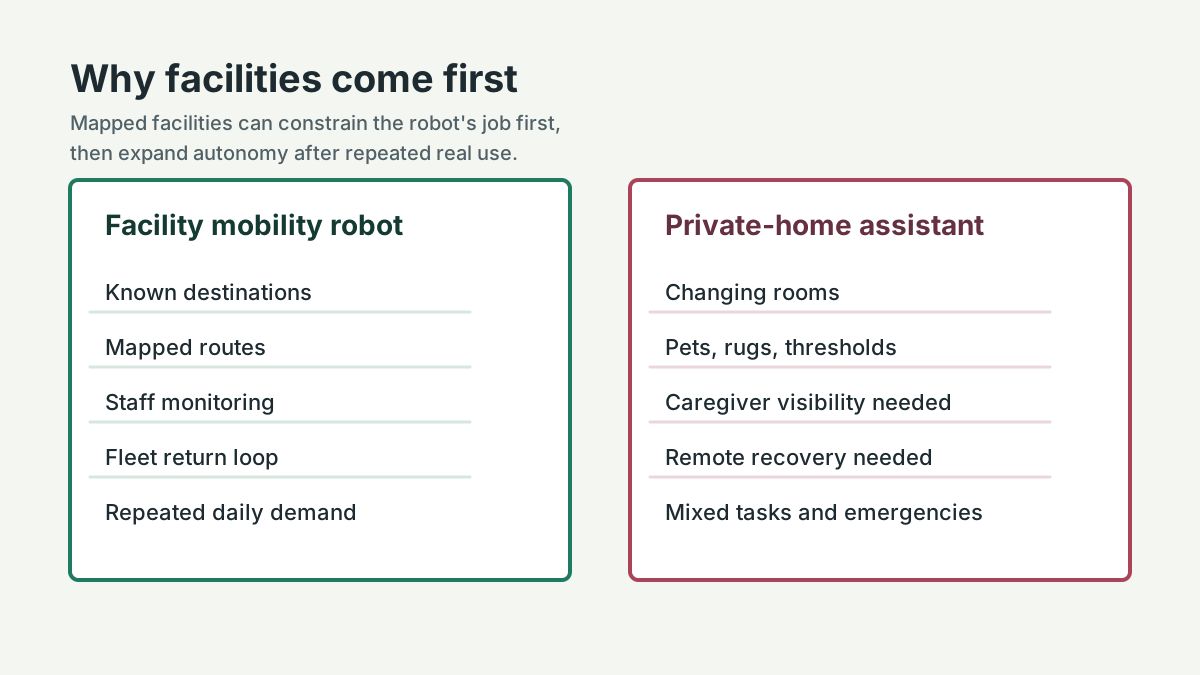
This is also why some of the most credible care robots in the ui44 database start outside the private home. Moxi has completed hospital logistics work, not elder-care companionship. Kairo is positioned for guided navigation and service workflows in healthcare, hospitality, enterprise, and public environments, with hardware details still undisclosed. Abi is aimed at aged-care facilities, where staff, schedules, and shared spaces can be part of the deployment. PARO succeeds because it does not try to move through the house at all; it narrows the problem to therapeutic interaction.
The pattern is consistent: autonomy becomes practical when the robot's job is narrow enough that users and operators know what success looks like.
Why Automatic Return Matters More Than It Sounds
Automatic return sounds like a convenience feature. For assistive robotics, it is closer to a business model requirement.
In WHILL's airport service, the chair has to be available when the next passenger needs it. If each ride ends with a staff member walking the chair back manually, the service saves less labor and scales poorly. WHILL's release explicitly points to lower physical burden and reduced work involved in manually returning wheelchairs. The system is not only moving people; it is closing the loop after the ride.
Home robots have the same loop problem in a different form. If a robot can bring medication but then ends the task blocking the bathroom door, autonomy has not really finished. If it can patrol the house but cannot dock reliably, the family inherits battery anxiety. If it can escort someone to the kitchen but cannot handle a rug edge or a pet bed in the route, the robot becomes another thing to supervise.
That is why "return to dock" and "recover from failure" should be treated as assistive features, not just maintenance details. For a home robot serving older adults, the task is not done when the robot starts moving. The task is done when the human is safe, the robot is out of the way, the caregiver can see the state, and the system is ready for the next request.
What This Means For Buying Or Tracking Home Assistive Robots
The buyer's question should not be "is it autonomous?" It should be "where does the autonomy hold up?"
Here is a practical filter:
Question to ask
What routes can it handle?
- Strong answer
- Specific rooms, maps, boundaries, and recovery behavior
- Weak answer
- "Whole home" with no detail
Question to ask
What happens after the task?
- Strong answer
- Docks, returns, reports state, or waits in a defined place
- Weak answer
- Stops wherever the task ended
Question to ask
Who can recover it remotely?
- Strong answer
- Caregiver, operator, or support workflow is defined
- Weak answer
- User must physically rescue it
Question to ask
What is the human fallback?
- Strong answer
- Teleoperation, staff handoff, or clear escalation
- Weak answer
- Autonomy is implied to solve everything
Question to ask
What evidence exists?
- Strong answer
- Real deployments, ride counts, facility pilots, or measured task volumes
- Weak answer
- Stage demos and future roadmaps
| Question to ask | Strong answer | Weak answer |
|---|---|---|
| What routes can it handle? | Specific rooms, maps, boundaries, and recovery behavior | "Whole home" with no detail |
| What happens after the task? | Docks, returns, reports state, or waits in a defined place | Stops wherever the task ended |
| Who can recover it remotely? | Caregiver, operator, or support workflow is defined | User must physically rescue it |
| What is the human fallback? | Teleoperation, staff handoff, or clear escalation | Autonomy is implied to solve everything |
| What evidence exists? | Real deployments, ride counts, facility pilots, or measured task volumes | Stage demos and future roadmaps |
In ui44's database, Robody is interesting because Devanthro does not pretend autonomy is already enough for every home-care task. The current Robody Cares positioning combines AI for routine support with VR teleoperation for tasks needing human judgment. That is less flashy than a fully autonomous humanoid, but it maps better to the WHILL lesson: high-stakes care needs an operating model, not just a body.
Astro is different. It is already a consumer-priced home robot, but its useful care angle is remote monitoring and home patrol rather than hands-on assistance. Its $1,599 price is far below humanoid care platforms, but the trade-off is clear: no arms, no physical transfer support, and no wheelchair-style mobility help. Abi and PARO narrow the problem even further, focusing on companionship, engagement, or calming interaction rather than moving through a home with a payload.
Fourier GR-3 is more ambitious physically. A 165 cm, 71 kg humanoid with tactile sensing and a care-bot direction could eventually address higher-touch assistance. But that scale also raises the operational stakes. A large robot in a private home must prove not just intelligence, but safe movement, predictable recovery, physical softness, and caregiver visibility.
The Market Signal: Facilities Come Before Homes
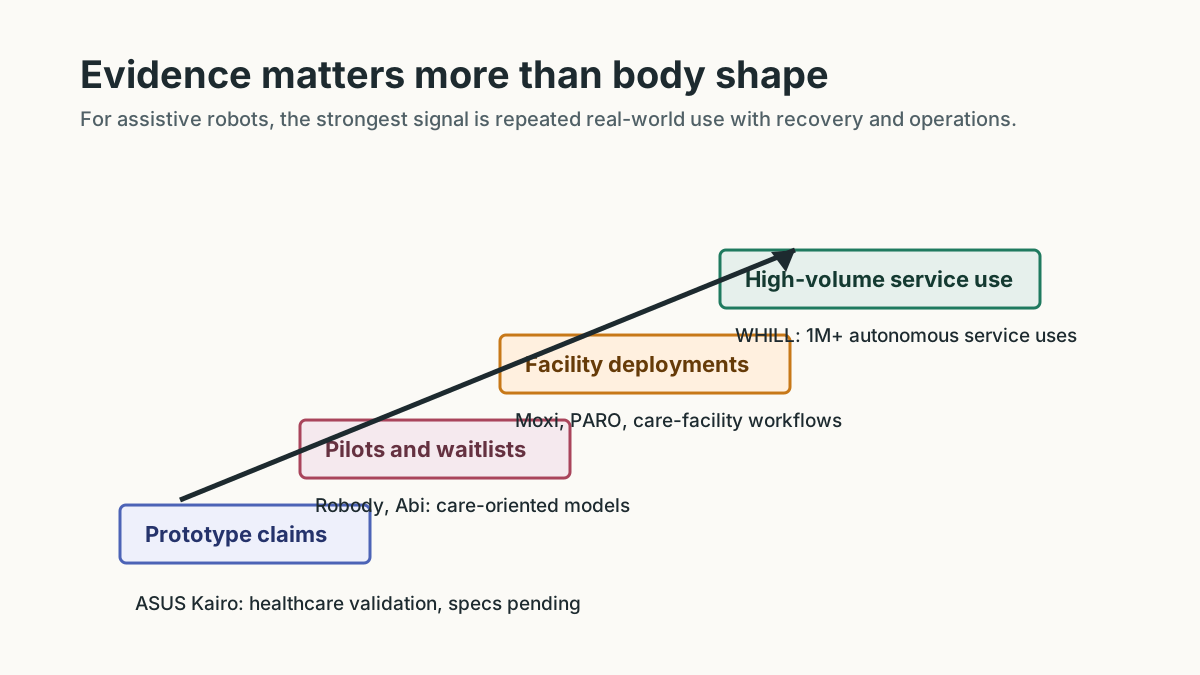
WHILL's 1 million rides are a reminder that assistive robots can scale before they become household products. Airports, hospitals, warehouses, and aged-care facilities have three advantages over homes.
First, they can standardize routes. A facility can map paths, control no-go zones, and update routes when the layout changes. Second, they can justify utilization. A chair, delivery robot, or guide robot used dozens of times per day can pay back differently from a home robot used intermittently. Third, they can assign operators. Staff can monitor fleets, reset devices, and intervene when something goes wrong.
The same pattern appears in the broader robotics market. Moxi is credible because hospital deliveries are repetitive and measurable. Abi's aged-care positioning makes sense because staff can integrate it into activities and resident engagement. Kairo's healthcare and hospitality framing is easier to validate than a generic home assistant. WHILL's airport service fits that same path: a specific job, a controlled environment, and enough repeated demand to learn from real use.
That does not make home robots unimportant. It means the home market may inherit the best pieces from facility robotics: mapped navigation, fleet dashboards turned into caregiver dashboards, automatic return, remote recovery, and evidence-based safety cases.
What Would A WHILL-Like Home Assistive Robot Need?
A credible home version would not simply be an autonomous wheelchair in a living room. It would need to solve a few specific problems.
It would need room-level route confidence: bedroom to bathroom, living room to kitchen, entryway to charger. It would need threshold handling and obstacle behavior that works with rugs, cords, narrow hallways, and pets. It would need a caregiver view showing where the robot is, whether it is carrying someone or something, and whether it is blocked. It would need a graceful fallback, such as remote control, teleoperation, or a clear request for help. Most of all, it would need the discipline to say no when the route or task is unsafe.
For buyers, that means the most trustworthy home assistive robots may initially feel modest. A robot that reliably monitors, reminds, escorts, returns, and reports may be more useful than one that claims broad household labor but lacks recovery. A companion robot that improves daily routines may be more valuable than a manipulator that cannot yet operate unsupervised.
For manufacturers, WHILL's example argues for proof before breadth. Get one workflow to 1 million uses. Then expand.
Bottom Line
WHILL's autonomous airport mobility service is not a home robot, and that is the point. It shows the kind of constrained autonomy that can actually accumulate real-world usage: mapped spaces, selected destinations, collision avoidance, fleet monitoring, automatic return, and staff integration.
The lesson for home assistive robots is blunt. The future is not just humanoid hardware. It is operational reliability. Before a robot can be trusted with elder care or mobility support at home, it has to prove that it can finish the whole job: understand the route, move safely, handle interruptions, recover cleanly, and leave the human with less work than before.
That is a higher bar than a demo video. WHILL's airport deployments show a practical way to approach it.
Sources: WHILL Heathrow autonomous service release, WHILL autonomous-drive service page, WHILL warehouse mobility award release.
Related in the database
Use this article as a buyer workflow
Turn the article into a real verification pass grounded in the robots, manufacturers, categories, components, and countries it actually references.
WHILL Airport Robots and Home Assistive Autonomy already points you toward 7 linked robots, 7 manufacturers, and 6 countries inside the ui44 database. That matters because strong buyer guidance is easier to apply when you can move immediately from a claim or warning into concrete product pages, manufacturer directories, component explainers, and country-level context instead of treating the article as an isolated opinion piece. The fastest next step is to turn the article into a shortlist workflow: open the linked robot pages, verify which specs are actually published for those models, then compare the surrounding manufacturer and component context before you decide whether the underlying claim changes your buying plan.
For this topic, the useful discipline is to separate the editorial lesson from the catalog evidence. The article gives you the framing, but the robot pages tell you what each product actually ships with today: sensor stack, connectivity methods, listed price, release timing, category, and support-relevant compatibility notes. The manufacturer pages then show whether you are looking at a one-off launch, a broader lineup pattern, or a company that spans multiple categories. That layered workflow reduces the risk of buying on a single marketing phrase or a single support FAQ.
The fastest win is to keep the article’s editorial framing tied to real product pages. That way you can test whether Astro, Robody, and Abi still make sense once price, category, release timing, and surrounding manufacturer context are visible in one place. If you want a quick working shortlist, open Compare Astro, Robody, and Abi next, then keep this article open as the reasoning layer while you compare structured data side by side.
Practical Takeaway
Every robot, manufacturer, category, component, and country reference below resolves to a real ui44 page, keeping the follow-up path grounded in database records rather than generic advice.
Suggested next steps in ui44
- Open Astro first so the article’s main point is anchored to a real robot page.
- Use Amazon to see the broader company context around the products linked in the article.
- Open the linked component pages when you want to separate a shared technology pattern from a single-brand story.
- Build a working shortlist with Compare Astro, Robody, and Abi.
- Keep a short note of what is already verified in the article and what still needs live confirmation from current vendor documentation.
Robot profiles worth opening next
Use the linked product pages as the evidence layer
The linked robot pages are where this article becomes operational. Instead of asking whether the headline is interesting, use the robot entries to inspect the actual mix of sensors, connectivity options, batteries, pricing, release timing, and stated capabilities attached to the products mentioned in the article. That is the easiest way to see whether the warning or opportunity described here affects one product family, a specific design pattern, or an entire buying lane.
Astro is tracked on ui44 as a active security & patrol robot from Amazon. The database currently records a listed price of $1,599, a release date of 2021, Not officially disclosed battery life, Not officially disclosed charging time, and a published stack that includes 5MP Bezel Camera, 1080p Periscope Camera (132° FOV), and Infrared Vision plus Wi-Fi 802.11ac and Bluetooth.
For general buyer research, this route gives you the concrete profile that the article alone cannot. Compare the published capabilities of Autonomous Home Patrol, Visual ID (face recognition), and Remote Home Monitoring with the linked alternatives so the final decision is based on actual product fit, not just the framing of the article.
Robody is tracked on ui44 as a pre-order home assistants robot from Devanthro. The database currently records a listed price of Price TBA, a release date of 2024-11, 6 hours battery life, Self-docking; full charge time not officially disclosed charging time, and a published stack that includes 4K fisheye RGB cameras, mm-wave radar, and Stereo microphones plus 5G and Wi-Fi 6.
For general buyer research, this route gives you the concrete profile that the article alone cannot. Compare the published capabilities of VR telepresence for family members and caregivers, Medication reminders, and Meal preparation assistance with the linked alternatives so the final decision is based on actual product fit, not just the framing of the article.
Abi
Andromeda Robotics · Companions · Available
Abi is tracked on ui44 as a available companions robot from Andromeda Robotics. The database currently records a listed price of Price TBA, a release date of 2024, AC-powered for long sessions (battery not published) battery life, N/A (plugged in) charging time, and a published stack that includes Front Camera, Face Recognition Camera, and Far-field Microphone Array plus Wi-Fi and Cloud-based AI Backend.
For general buyer research, this route gives you the concrete profile that the article alone cannot. Compare the published capabilities of Personalized Conversation, Face Recognition, and Emotion Recognition & Mood Adaptation with the linked alternatives so the final decision is based on actual product fit, not just the framing of the article.
PARO is tracked on ui44 as a active companions robot from AIST. The database currently records a listed price of Price TBA, a release date of 2003, Not officially disclosed battery life, Not officially disclosed charging time, and a published stack that includes Tactile sensors, Light sensor, and Audition (audio) sensor plus Not publicly detailed.
For general buyer research, this route gives you the concrete profile that the article alone cannot. Compare the published capabilities of Therapeutic companionship, Responds to touch, voice direction, and handling, and Learns preferred user interactions with the linked alternatives so the final decision is based on actual product fit, not just the framing of the article.
GR-3 is tracked on ui44 as a active humanoid robot from Fourier. The database currently records a listed price of Price TBA, a release date of 2025-08, ≈3 hours (hot-swappable) battery life, Not officially disclosed (current official page only says faster charging with fewer swaps) charging time, and a published stack that includes RGB Camera, Structured-Light Depth Camera, and 4-Microphone Array (voice localization, echo cancellation) plus Wi-Fi and Ethernet.
For general buyer research, this route gives you the concrete profile that the article alone cannot. Compare the published capabilities of Bipedal Walking, Object Manipulation, and Emotional Interaction with the linked alternatives so the final decision is based on actual product fit, not just the framing of the article.
Manufacturer context behind the article
Check whether this is one product story or a broader company pattern
Manufacturer pages add the market context that individual product pages cannot show on their own. They help you check whether the article is centered on a brand with a deep lineup, whether that brand spans several categories, and how much of its ui44 footprint depends on one flagship model versus a broader product strategy.
Amazon
ui44 currently tracks 1 robot from Amazon across 1 category. The company is grouped under USA, and the current catalog footprint on ui44 includes Astro.
That wider brand context matters because the best buying decision usually depends on lineup depth and adjacent options, not just the one model featured most prominently in the article. The category mix here currently points toward Security & Patrol as the most useful next route if you want to see whether this article reflects a wider pattern inside the brand.
Devanthro
ui44 currently tracks 1 robot from Devanthro across 1 category. The company is grouped under Germany, and the current catalog footprint on ui44 includes Robody.
That wider brand context matters because the best buying decision usually depends on lineup depth and adjacent options, not just the one model featured most prominently in the article. The category mix here currently points toward Home Assistants as the most useful next route if you want to see whether this article reflects a wider pattern inside the brand.
Andromeda Robotics
ui44 currently tracks 1 robot from Andromeda Robotics across 1 category. The company is grouped under Australia, and the current catalog footprint on ui44 includes Abi.
That wider brand context matters because the best buying decision usually depends on lineup depth and adjacent options, not just the one model featured most prominently in the article. The category mix here currently points toward Companions as the most useful next route if you want to see whether this article reflects a wider pattern inside the brand.
AIST
ui44 currently tracks 3 robots from AIST across 2 categorys. The company is grouped under Japan, and the current catalog footprint on ui44 includes HRP-4C, HRP-5P, PARO.
That wider brand context matters because the best buying decision usually depends on lineup depth and adjacent options, not just the one model featured most prominently in the article. The category mix here currently points toward Research, Companions as the most useful next route if you want to see whether this article reflects a wider pattern inside the brand.
Broaden the scan without leaving the database
Categories, components, and countries add the wider context
Category framing
Category pages are useful when the article touches a buying pattern that shows up across brands. A category route helps you confirm whether the linked products sit in a narrow niche or whether the same question should be tested across a larger field of alternatives.
Security & Patrol
The Security & Patrol category page currently groups 5 tracked robots from 5 manufacturers. ui44 describes this lane as: Autonomous surveillance and patrol robots that monitor homes, businesses, and perimeters — keeping watch without an operator on site.
That makes the category route a practical follow-up when you want to check whether the products linked in this article are typical for the lane or whether they sit at one edge of the market. Useful starting examples currently include Astro, Vision 60, K7 Autonomous Security Robot.
Home Assistants
The Home Assistants category page currently groups 16 tracked robots from 14 manufacturers. ui44 describes this lane as: Arm-based household helpers — laundry folders, kitchen robots, and mobile manipulators that take on hands-on physical tasks around the home.
That makes the category route a practical follow-up when you want to check whether the products linked in this article are typical for the lane or whether they sit at one edge of the market. Useful starting examples currently include Robody, Futuring 2 (F2), Stretch 3.
Country and ecosystem context
Country pages give extra context when support practices, launch sequencing, regulatory posture, or manufacturer mix matter. They are not a substitute for model-level verification, but they do help you see which ecosystems cluster together and which manufacturers sit in the same regional field when you broaden the search beyond the article headline.
USA
The USA route currently groups 89 tracked robots from 69 manufacturers in ui44. That gives you a useful regional lens when the article points toward support practices, launch sequencing, or brand clusters that may share similar ecosystem assumptions.
On the current route, manufacturers like Faraday Future, iRobot, Boston Dynamics make the page a good way to broaden the scan without losing the regional context that often shapes availability, documentation style, and adjacent alternatives.
Germany
The Germany route currently groups 13 tracked robots from 9 manufacturers in ui44. That gives you a useful regional lens when the article points toward support practices, launch sequencing, or brand clusters that may share similar ecosystem assumptions.
On the current route, manufacturers like NEURA Robotics, Bosch, Agile Robots make the page a good way to broaden the scan without losing the regional context that often shapes availability, documentation style, and adjacent alternatives.
Australia
The Australia route currently groups 2 tracked robots from 2 manufacturers in ui44. That gives you a useful regional lens when the article points toward support practices, launch sequencing, or brand clusters that may share similar ecosystem assumptions.
On the current route, manufacturers like Andromeda Robotics, GMEX Robotics make the page a good way to broaden the scan without losing the regional context that often shapes availability, documentation style, and adjacent alternatives.
Questions to answer before you move from reading to buying
A follow-up FAQ built from the entities already linked in this article
Frequently Asked Questions
Which page should I open first after reading “WHILL Airport Robots and Home Assistive Autonomy”?
Start with Astro. That gives you a concrete product anchor for the article’s main claim. From there, branch into the manufacturer and component pages so you can tell whether the article is describing one specific model, a repeated brand pattern, or a wider technology issue that affects multiple shortlist options.
How do the manufacturer pages change the buying decision?
Amazon help you zoom out from one article and one product. On ui44 they show lineup breadth, category spread, and the neighboring robots tied to the same company. That context is useful when you are deciding whether a risk belongs to a single model, whether it shows up across a brand’s portfolio, and whether you should keep looking at alternatives before committing.
When should I switch from reading to side-by-side comparison?
Move into Compare Astro, Robody, and Abi as soon as you understand the article’s main warning or promise. The article explains what to watch for, but the compare view is where you can check whether price, status, battery life, connectivity, sensors, and category fit still make the robot a good match for your own home and budget.
Where to go next in ui44
Keep the research chain inside the database
If you want to keep going, these follow-on pages give you the cleanest expansion path from article to research session. Open the comparison route first if you are deciding between products today. Open the manufacturer, category, and component routes if you still need to understand the broader pattern behind the claim.
Written by
ui44 Team
Published June 23, 2026
Share this article
Open a plain share link on X or Bluesky. No embeds, no widgets, no cookie baggage.