That is why Pudu Robotics is worth watching. PUDU D9 is a full-size bipedal humanoid. PUDU FlashBot Arm is a semi-humanoid service robot with real manipulation hardware. PUDU D5 is a quadruped. BellaBot and PUDU T150 are already in the commercial-robot lane. Put those together and Pudu starts to look less like a single humanoid announcement and more like a service-robot company trying to climb toward general embodied AI.
The buyer question is not "should I buy a Pudu humanoid for my living room?" You probably cannot, and you should not assume it is home-ready. The better question is whether companies with deployed service fleets have a more credible path to future household helpers than demo-first humanoid startups.
Are service-robot companies credible home-humanoid contenders?
They can be, but only if we separate two ideas that are often blended together: robotics competence and home readiness.
Pudu has stronger evidence for the first than the second. In its April 2026 financing release, Pudu said it had raised nearly USD 150 million, crossed a USD 1.5 billion valuation, and exceeded USD 300 million in cumulative funding. The same release said 2025 revenue grew 100% year over year, commercial cleaning had grown to more than 70% of total revenue, and industrial delivery robots had shipped more than 4,000 units within a year of market launch. Pudu's Dallas U.S. headquarters announcement also claimed nearly 15,000 Pudu robots deployed across the Americas and 285% year-over-year regional revenue growth.
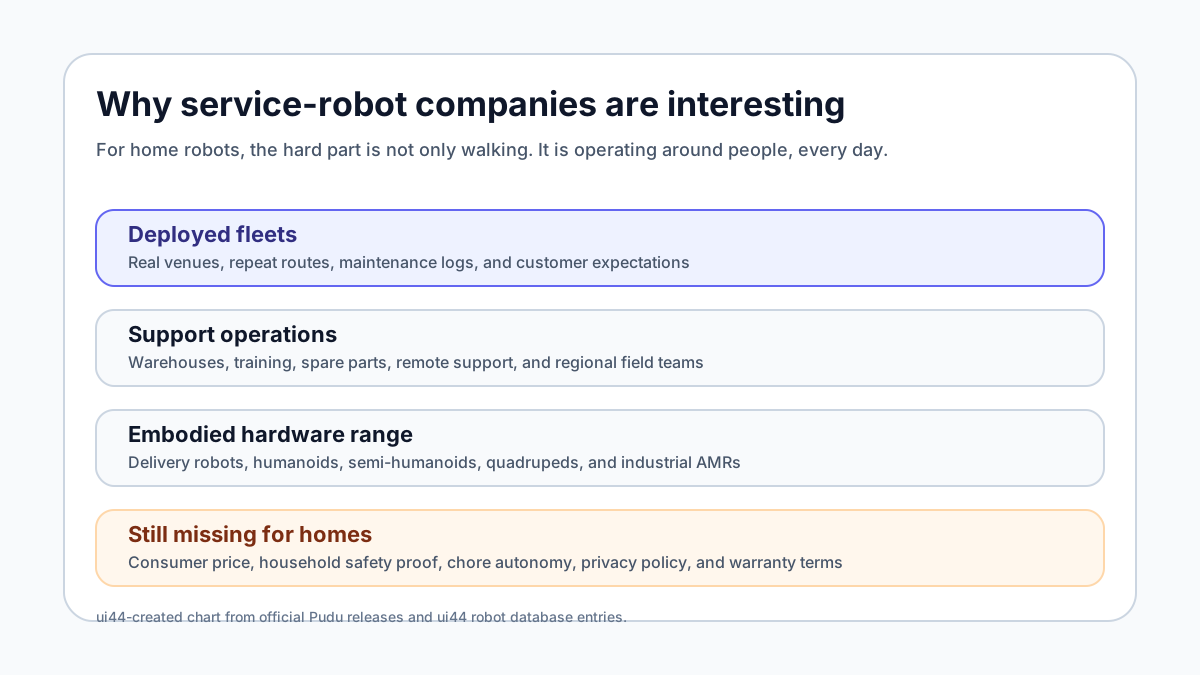
Those numbers do not prove the company can make a safe home humanoid. They do show something many home-robot startups still lack: a commercial operating base. A robot company learns different lessons when customers expect robots to show up for shifts, avoid guests, map buildings, use elevators, recharge, survive cleaning schedules, and get repaired without drama.
That operating base matters because homes are not just smaller factories. Homes are worse in many ways: cluttered, emotionally sensitive, filled with children, pets, rugs, stairs, glassware, bathrooms, thresholds, visitors, and owners who do not want to read an operations manual. A company that already supports robots in public human environments starts with some useful muscle memory. It still has to prove household autonomy.
What Pudu D9 actually adds
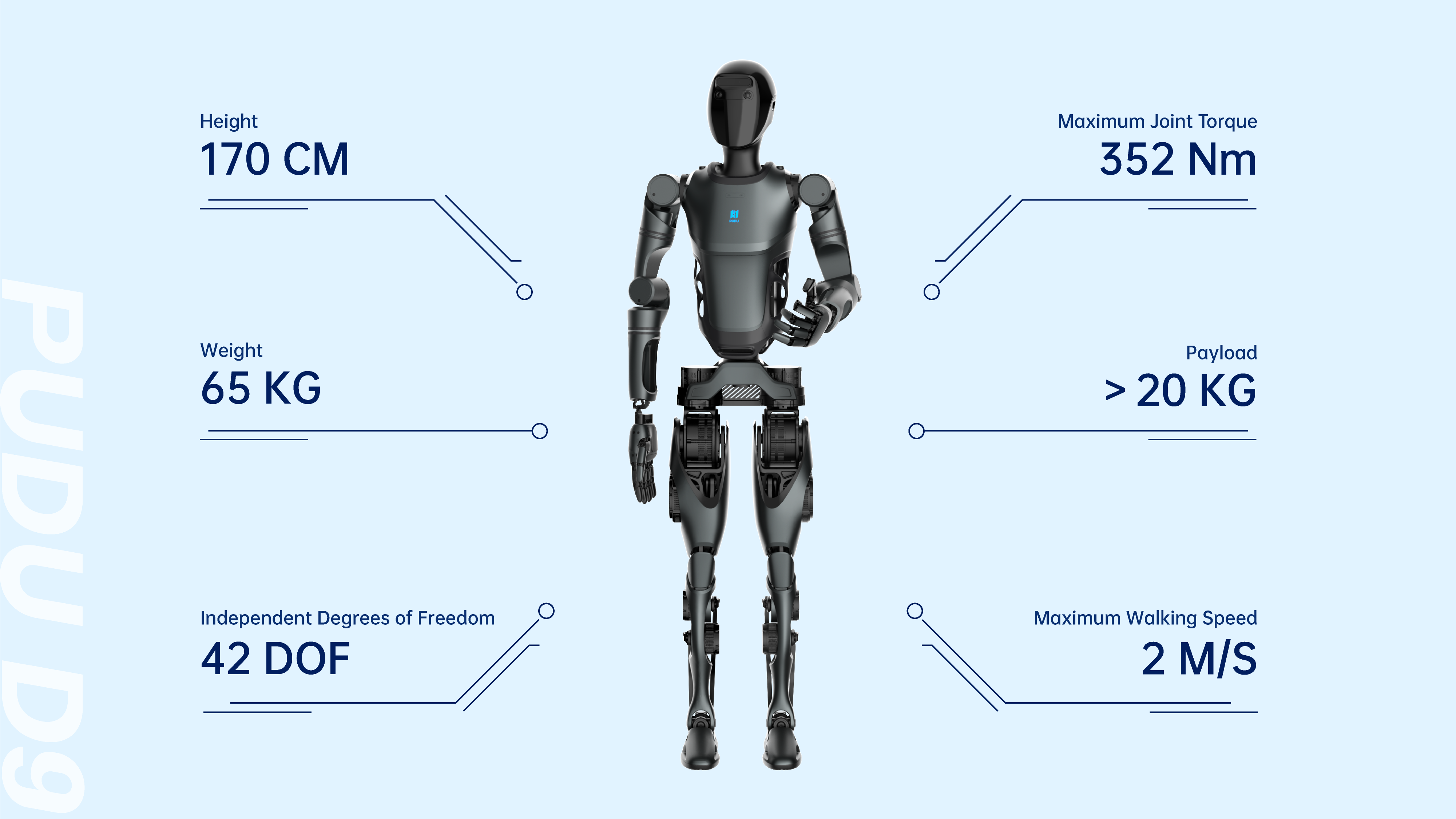
PUDU D9 is not a waiter robot with legs glued on. In ui44's database, it is listed as a development-stage humanoid with no public price, a 170 cm height, and speed up to 2 m/s. The weight needs an asterisk: Pudu's live D9 product page and original launch materials list 65 kg, while the April 30, 2026 ongoing-development update says the latest iteration weighs 58 kg. That is not a reason to dismiss the robot, but it is a reason to avoid treating any one D9 weight as a final shipping spec.
Pudu's own D9 product page adds that the robot has 42 degrees of freedom, a maximum joint torque of 352 Nm, two 7-DOF arms, the PUDU DH11 dexterous hand, and a payload capacity up to 20 kg in a testing environment. Pudu also describes visual semantic navigation, real-time 3D semantic mapping, stair and slope navigation, autonomous route planning, and reinforcement-learning-based task planning.
That is a serious humanoid spec sheet. It is also a reminder that humanoid specs can sound more consumer-ready than they are. A 170 cm robot in the 58-65 kg range, with powerful joints, is exactly the kind of machine that needs strong evidence for safe force control, fall handling, emergency stops, privacy boundaries, child and pet behavior, insurance, service response, and repair logistics before anyone should welcome it into a normal house.
The interesting part is where Pudu positions D9: not as a cute consumer gadget, but as an embodied-intelligence platform for logistics and operational assistance in service environments. That is more plausible as a bridge market. If a humanoid can first move supplies, open simple doors, use elevators, clean a controlled area, or assist staff in hotels and offices, the company gets a feedback loop before promising kitchen-table magic.
Why FlashBot Arm may be the more important clue
PUDU FlashBot Arm may matter more for home robotics than D9's bipedal walking. ui44 now tracks it as a Pudu commercial service robot with no public price, a 144 cm body height, a 15 kg delivery capacity, 4-hour charging time, up to 8 hours of no-load working duration, VSLAM plus LiDAR SLAM mapping, and a 65 cm minimum path width. Those figures come from Pudu's official FlashBot Arm product page, not from third-party spec scraping.
The manipulation hardware is the real clue. Pudu says FlashBot Arm has two 7-DOF arms, PUDU DH11 dexterous hands with 6 active plus 5 passive hand degrees of freedom, and a maximum reach range of 1600 × 2000 × 1600 mm. The same page lists RGBD cameras, LiDAR, panoramic cameras, and pressure-sensitive skin for dynamic perception and safer human-robot interaction.
That is not a household laundry robot. But it is a very relevant form factor: mobile base, enclosed delivery compartment, arms, hands, mapping, charging, and human-facing interaction. In other words, it attacks the practical middle ground between "rolling cabinet" and "full humanoid."
For homes, that middle ground could be more useful than a biped for a long time. Most household chores do not require human-like legs. They require reaching, grasping, carrying, sorting, opening, placing, and knowing when not to touch something. A wheeled or semi-humanoid robot with safe arms may be easier to stabilize, cheaper to maintain, and more predictable indoors than a full-size biped.
The deployed-fleet advantage is boring, but real
The strongest Pudu argument is not that D9 walks. It is that Pudu already has robots doing repetitive service work.
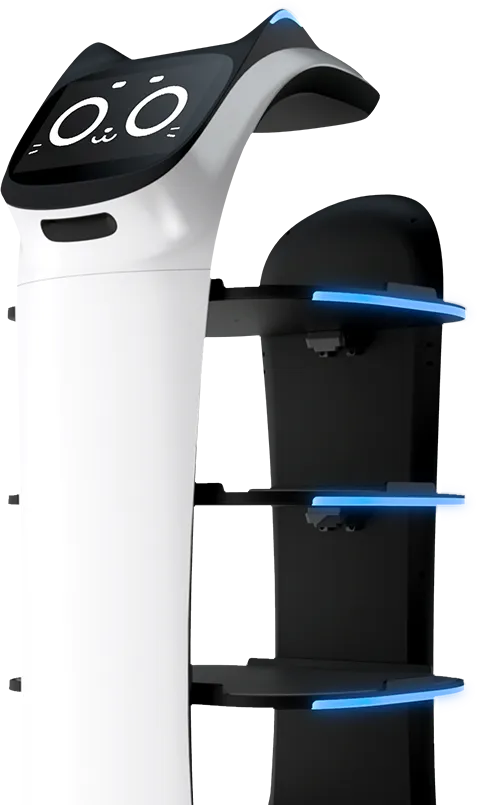
ui44 tracks BellaBot as an active commercial robot with 13 hours of no-load battery life, a 40 kg maximum tray payload, 3D omnidirectional obstacle avoidance with RGBD cameras and LiDAR, dual SLAM navigation, elevator integration, multi-robot coordination, and hot-swappable batteries. That is not a home robot, but it is a lot of experience in moving through human spaces with food, objects, staff, guests, furniture, timing constraints, and support needs.
ui44 also tracks PUDU T150, an active industrial delivery AMR with a 150 kg payload, up to 12 hours no-load runtime, VSLAM plus LiDAR SLAM localization, dual RGBD cameras, 360-degree dual LiDAR, automatic charging, rapid battery swapping, 10-minute onboard mapping, and deployment without local fleet servers. Again, not a home robot. But it is exactly the kind of logistics discipline future household robots will need in miniature.
The difference between a lab demo and a fleet is that fleets punish edge cases. A single impressive video can hide reset time, operator help, fragile lighting, network dependency, and cherry-picked success. A deployed service robot has to survive floor changes, route edits, impatient users, dirty sensors, dead zones, spare-parts delays, software updates, and confused humans. Those are not glamorous robotics milestones, but they are the milestones that decide whether a robot stays useful after week two.
How Pudu compares with home-humanoid favorites
Pudu's path looks different from the robots consumers usually search for. A few ui44 database entries make the contrast clearer:
Robot
- Current buyer signal
- Development-stage full-size humanoid; no public price; 170 cm; official weight sources now vary between 58 and 65 kg
- Home-readiness lesson
- Strong embodied-AI ambition, but not consumer-ready proof
Robot
- Current buyer signal
- Product-page semi-humanoid service robot; no public price; 144 cm; 15 kg delivery capacity; dual 7-DOF arms
- Home-readiness lesson
- Wheeled manipulation may be the more practical bridge toward homes
Robot
- Current buyer signal
- Active commercial service robot; 40 kg tray payload; 13-hour no-load runtime
- Home-readiness lesson
- Fleet operations and support may matter as much as humanoid form
Robot
- Current buyer signal
- Active industrial AMR; 150 kg payload; fast mapping and fleet features
- Home-readiness lesson
- Logistics reliability is a foundation for useful household carrying
Robot
- Current buyer signal
- Available compact humanoid from $13,500; 132 cm, 35 kg, about 2 hours runtime
- Home-readiness lesson
- Affordable research access is not the same as domestic support
Robot
- Current buyer signal
- Available compact humanoid at $24,240; 131 cm, 35-39 kg, up to 1.8 m/s
- Home-readiness lesson
- Strong developer platform, still not a chore appliance
Robot
- Current buyer signal
- Home-focused preorder at $20,000; 167 cm, 30 kg, about 4 hours runtime
- Home-readiness lesson
- Home positioning is promising, but service model and autonomy matter
Robot
- Current buyer signal
- Industrial humanoid predecessor, now discontinued after Figure 03
- Home-readiness lesson
- Factory runtime helps, but product cycles are moving fast
| Robot | Current buyer signal | Home-readiness lesson |
|---|---|---|
| PUDU D9 | Development-stage full-size humanoid; no public price; 170 cm; official weight sources now vary between 58 and 65 kg | Strong embodied-AI ambition, but not consumer-ready proof |
| PUDU FlashBot Arm | Product-page semi-humanoid service robot; no public price; 144 cm; 15 kg delivery capacity; dual 7-DOF arms | Wheeled manipulation may be the more practical bridge toward homes |
| BellaBot | Active commercial service robot; 40 kg tray payload; 13-hour no-load runtime | Fleet operations and support may matter as much as humanoid form |
| PUDU T150 | Active industrial AMR; 150 kg payload; fast mapping and fleet features | Logistics reliability is a foundation for useful household carrying |
| Unitree G1 | Available compact humanoid from $13,500; 132 cm, 35 kg, about 2 hours runtime | Affordable research access is not the same as domestic support |
| AGIBOT X2 | Available compact humanoid at $24,240; 131 cm, 35-39 kg, up to 1.8 m/s | Strong developer platform, still not a chore appliance |
| 1X NEO | Home-focused preorder at $20,000; 167 cm, 30 kg, about 4 hours runtime | Home positioning is promising, but service model and autonomy matter |
| Figure 02 | Industrial humanoid predecessor, now discontinued after Figure 03 | Factory runtime helps, but product cycles are moving fast |
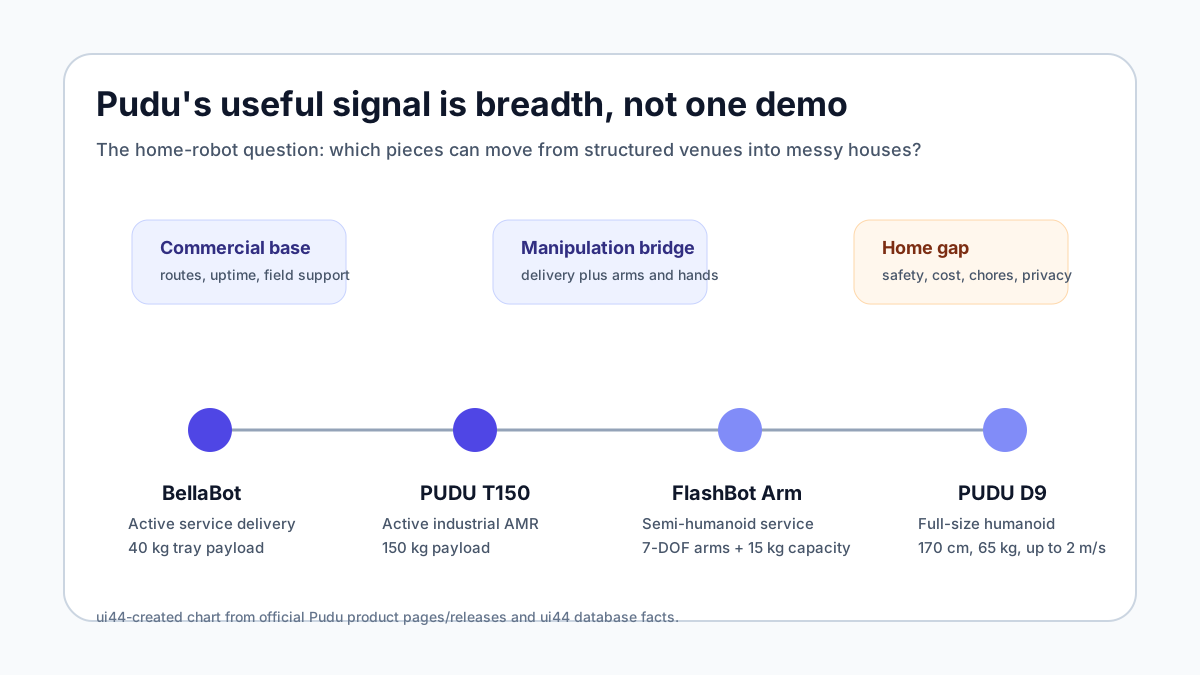
This is why the Pudu story is not "Pudu will beat everyone." It is more useful than that. Pudu shows one plausible pattern for the industry: commercial service robots first, manipulation second, humanoids and quadrupeds as extensions of an existing operating business.
That path has advantages. It can create revenue before home robots work. It can fund field support. It can turn customer workflows into training data. It can teach a company which robot tasks people actually pay for. It can also keep the company grounded, because commercial buyers tend to ask brutal questions about uptime, return on investment, training, liability, and support.
The path has limits too. Hotel corridors are not living rooms. Restaurants are not bedrooms. Warehouses are not kitchens. Service robots often depend on structured spaces, staff training, controlled routes, labeled areas, elevator integrations, and business processes. Bringing that into the home means stripping away professional operators while adding more emotional and safety complexity.
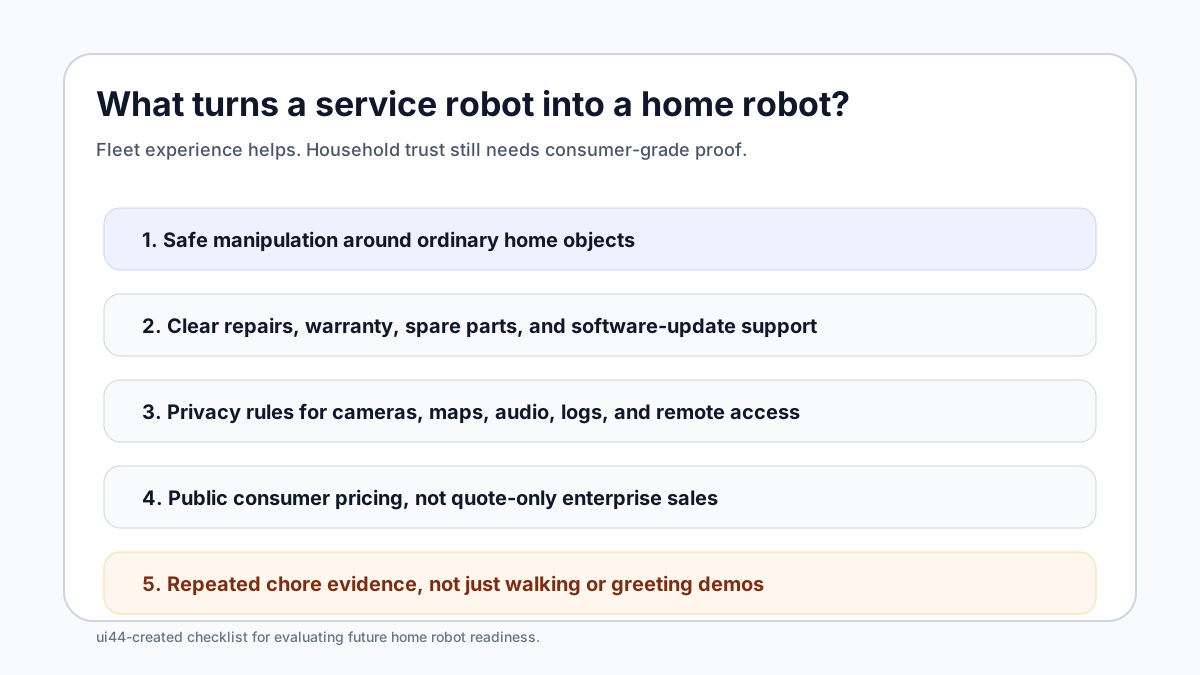
What would make a service-robot company home-ready?
A service-robot background is a useful signal, not a pass. Before treating Pudu, Keenon, Bear Robotics, LG, Samsung, or any other service-robot company as a credible home-helper contender, look for five proofs.
First, look for safe manipulation around ordinary objects. Carrying trays is not loading a dishwasher. A useful home robot needs reliable grasping, force limits, object recognition, refusal behavior, and recovery when something slips.
Second, look for support that matches consumer expectations. Commercial buyers can handle onboarding, site surveys, and service contracts. Home buyers need clear warranties, predictable repairs, spare parts, software-update policies, and a way to recover from mapping or account failures without calling a field engineer.
Third, look for home-specific privacy boundaries. A robot that maps a hotel hallway is one thing. A robot that sees bedrooms, medication, children, visitors, calendars, voices, and personal routines is another. Home readiness needs clear rules for camera data, cloud processing, remote access, teleoperation, logs, and model training.
Fourth, look for price transparency. Pudu's core commercial robots are usually quote-based, and PUDU D9 has no public price in the ui44 database. That is normal for enterprise robotics. It is not normal for consumer shopping. A household robot category will not become mainstream while every serious option requires a sales call.
Fifth, look for chore-level evidence, not body-form evidence. Walking, waving, and greeting are not enough. The milestones that matter are dull: carrying a cup without spilling it, putting the right object in the right room, knowing when a counter is unsafe to touch, using a drawer without pinching fingers, and asking for help before making a mess worse.
Bottom line: dark horse, not home robot yet
Pudu deserves attention because it combines several ingredients that home-robot watchers should care about: deployed service robots, a commercial support base, manipulation work through PUDU FlashBot Arm, a full-size humanoid in PUDU D9, and an expanding embodied-AI product range that also includes quadrupeds and industrial AMRs.
That does not make Pudu D9 a home robot. It does make Pudu a useful reality check. The future of household robotics may not arrive as a startup suddenly solving every chore in a suburban kitchen. It may arrive through companies that first learn how robots fail in public, paid, structured environments — then slowly bring the reliable parts home.
For now, the honest verdict is simple: Pudu is a credible service-robot dark horse for future home robotics, not a household humanoid you should plan to buy this year.
Related in the database
Use this article as a setup-friction workflow
Turn the article into a first-day setup pass grounded in the robots, manufacturers, and countries it actually references.
Pudu D9: Service Robots' Humanoid Advantage already points you toward 8 linked robots, 5 manufacturers, and 3 countries inside the ui44 database. Treat those links as a first-day setup trail: open the robot pages, check what is actually published about charging, battery life, control method, app or OTA support, and recovery, then use the surrounding manufacturer and country context to judge whether the article describes a low-friction product path or a still-specialist deployment.
For setup topics, the useful discipline is to separate a polished demo from the work required after the box arrives. The article gives you the narrative, but the robot pages show the operational clues: dimensions, weight, battery runtime, charging time, controller support, listed availability, and the capabilities that might need supervision. Manufacturer pages then reveal whether the same setup assumptions repeat across a wider lineup.
Use the robot pages to verify what happens between delivery and the first useful task: size, weight, battery, charger or dock path, controller, app, OTA support, and recovery cues. On this route cluster, PUDU D9, PUDU FlashBot Arm, and BellaBot form the fastest setup-friction reality check. If you want a quick working shortlist, open Compare PUDU D9, PUDU FlashBot Arm, and BellaBot next, then keep this article open while you compare first-day setup evidence side by side.
Practical Takeaway
The links below stay tied to the robots, manufacturers, and countries actually referenced by this setup article, so the checklist remains grounded in published ui44 records rather than generic humanoid advice.
Suggested next steps in ui44
- Open PUDU D9 and check the concrete first-day fields: box contents, charger or dock path, battery life, controller, app, OTA support, and recovery options.
- Use Pudu Robotics to see whether the company’s broader lineup looks appliance-like, developer-first, or still closer to a pilot deployment.
- Run Compare PUDU D9, PUDU FlashBot Arm, and BellaBot with the article open and compare battery, size, weight, price path, status, and support cues side by side.
- Write down the first realistic task each robot can plausibly attempt on day one, then separate low-friction setup signals from impressive but still lab-style demos.
Robot profiles worth opening next
Use the linked product pages as the evidence layer
The linked robot pages are where this setup article becomes operational. Use the robot entries to inspect the actual mix of size, weight, battery runtime, charging path, control method, pricing, availability, and stated capabilities attached to the products mentioned in the article. That is the easiest way to see whether the first useful task looks appliance-like, developer-led, or still dependent on supervised experimentation.
PUDU D9
Pudu Robotics · Humanoid · Pre-order
PUDU D9 is tracked on ui44 as a pre-order humanoid robot from Pudu Robotics. The database currently records a listed price of Price TBA, a release date of 2024-12, Not publicly disclosed battery life, Not publicly disclosed charging time, and a published stack that includes Visual sensors, Tactile sensors, and Force sensors plus Not publicly disclosed.
For setup-friction reading, this page matters because it shows the physical and support burden behind the demo. Use it to verify whether PUDU D9 has a credible day-one path across charging, control, recovery, battery limits, and listed capabilities such as Bipedal walking, Stair and slope navigation, and Real-time 3D semantic mapping.
PUDU FlashBot Arm
Pudu Robotics · Commercial · Active
PUDU FlashBot Arm is tracked on ui44 as a active commercial robot from Pudu Robotics. The database currently records a listed price of Price TBA, a release date of 2025-03, Up to 8 hours (no-load) battery life, 4 hours charging time, and a published stack that includes RGBD cameras, LiDAR, and Panoramic cameras plus Not publicly disclosed.
For setup-friction reading, this page matters because it shows the physical and support burden behind the demo. Use it to verify whether PUDU FlashBot Arm has a credible day-one path across charging, control, recovery, battery limits, and listed capabilities such as Autonomous delivery, Two 7-DOF robotic arms, and PUDU DH11 dexterous hands.
BellaBot
Pudu Robotics · Commercial · Active
BellaBot is tracked on ui44 as a active commercial robot from Pudu Robotics. The database currently records a listed price of Price TBA, a release date of 2020-01, 13 hours (no load) battery life, 4.5 hours (or instant with battery swap) charging time, and a published stack that includes LiDAR, 3 × RGBD Depth Cameras, and Cliff Sensors plus Wi-Fi.
For setup-friction reading, this page matters because it shows the physical and support burden behind the demo. Use it to verify whether BellaBot has a credible day-one path across charging, control, recovery, battery limits, and listed capabilities such as Autonomous Food & Item Delivery, Dual SLAM Navigation (LiDAR + Visual), and 3D Omnidirectional Obstacle Avoidance.
PUDU T150
Pudu Robotics · Commercial · Active
PUDU T150 is tracked on ui44 as a active commercial robot from Pudu Robotics. The database currently records a listed price of Price TBA, a release date of 2026-01, Up to 12 hours (no-load) battery life, 2 hours (0–90%) charging time, and a published stack that includes Dual RGBD cameras, 360° dual LiDAR, and VSLAM + LiDAR SLAM localization plus PUDU Link and Open API.
For setup-friction reading, this page matters because it shows the physical and support burden behind the demo. Use it to verify whether PUDU T150 has a credible day-one path across charging, control, recovery, battery limits, and listed capabilities such as Autonomous industrial material delivery, 150 kg payload transport, and 10-minute onboard mapping.
G1 is tracked on ui44 as a available humanoid robot from Unitree. The database currently records a listed price of $13,500, a release date of 2024-05-13, ~2 hours battery life, Not disclosed charging time, and a published stack that includes Depth Camera, 3D LiDAR, and 4 Microphone Array plus Wi-Fi 6 and Bluetooth 5.2.
For setup-friction reading, this page matters because it shows the physical and support burden behind the demo. Use it to verify whether G1 has a credible day-one path across charging, control, recovery, battery limits, and listed capabilities such as Bipedal Walking, Object Manipulation, and Dexterous Hands (optional Dex3-1).
Manufacturer context behind the article
Check whether this is one product story or a broader company pattern
Manufacturer pages add the setup context that individual product pages cannot show on their own. They help you check whether a brand repeats the same controller, battery, update, support, and availability patterns across multiple robots, or whether the article is really describing one early product path. That matters for humanoids because first-day friction usually comes from the surrounding ecosystem as much as from the robot itself.
Pudu Robotics
ui44 currently tracks 6 robots from Pudu Robotics across 3 categorys. The company is grouped under China, and the current catalog footprint on ui44 includes BellaBot, PUDU D9, PUDU D7.
That wider brand context matters because setup friction is rarely just a box problem. A manufacturer route helps you see whether the company has repeated controller, battery, support, and update patterns across its lineup, or whether the article is really about one early product story. The category mix here currently points toward Commercial, Humanoid, Quadruped as the most useful next route if you want to see whether this article reflects a wider pattern inside the brand.
Unitree
ui44 currently tracks 2 robots from Unitree across 1 category. The company is grouped under China, and the current catalog footprint on ui44 includes H1, G1.
That wider brand context matters because setup friction is rarely just a box problem. A manufacturer route helps you see whether the company has repeated controller, battery, support, and update patterns across its lineup, or whether the article is really about one early product story. The category mix here currently points toward Humanoid as the most useful next route if you want to see whether this article reflects a wider pattern inside the brand.
AGIBOT
ui44 currently tracks 10 robots from AGIBOT across 3 categorys. The company is grouped under China, and the current catalog footprint on ui44 includes A2 Ultra, X2, Expedition A3.
That wider brand context matters because setup friction is rarely just a box problem. A manufacturer route helps you see whether the company has repeated controller, battery, support, and update patterns across its lineup, or whether the article is really about one early product story. The category mix here currently points toward Humanoid, Quadruped, Commercial as the most useful next route if you want to see whether this article reflects a wider pattern inside the brand.
1X Technologies
ui44 currently tracks 2 robots from 1X Technologies across 1 category. The company is grouped under Norway, and the current catalog footprint on ui44 includes NEO, EVE.
That wider brand context matters because setup friction is rarely just a box problem. A manufacturer route helps you see whether the company has repeated controller, battery, support, and update patterns across its lineup, or whether the article is really about one early product story. The category mix here currently points toward Humanoid as the most useful next route if you want to see whether this article reflects a wider pattern inside the brand.
Broaden the scan without leaving the database
Categories, components, and countries add the wider context
Category framing
Category pages are useful when the article touches a buying pattern that shows up across brands. A category route helps you confirm whether the linked products sit in a narrow niche or whether the same question should be tested across a larger field of alternatives.
Humanoid
The Humanoid category page currently groups 129 tracked robots from 92 manufacturers. ui44 describes this lane as: Full-size bipedal humanoid robots built to work alongside people — from factory floors to household tasks. Compare the cutting edge of humanoid robotics.
That makes the category route a practical follow-up when you want to check whether the products linked in this article are typical for the lane or whether they sit at one edge of the market. Useful starting examples currently include NEO, EVE, Mornine M1.
Commercial
The Commercial category page currently groups 44 tracked robots from 38 manufacturers. ui44 describes this lane as: Delivery robots, warehouse automation, and hospitality service bots — robots built for business and commercial operations.
That makes the category route a practical follow-up when you want to check whether the products linked in this article are typical for the lane or whether they sit at one edge of the market. Useful starting examples currently include G2 Air, aeo, Pepper.
Country and ecosystem context
Country pages give extra context when support practices, launch sequencing, regulatory posture, or manufacturer mix matter. They are not a substitute for model-level verification, but they do help you see which ecosystems cluster together and which manufacturers sit in the same regional field when you broaden the search beyond the article headline.
China
The China route currently groups 189 tracked robots from 87 manufacturers in ui44. That gives you a useful regional lens when the article points toward support practices, launch sequencing, or brand clusters that may share similar ecosystem assumptions.
On the current route, manufacturers like AGIBOT, Dreame, Unitree Robotics make the page a good way to broaden the scan without losing the regional context that often shapes availability, documentation style, and adjacent alternatives.
Norway
The Norway route currently groups 2 tracked robots from 1 manufacturers in ui44. That gives you a useful regional lens when the article points toward support practices, launch sequencing, or brand clusters that may share similar ecosystem assumptions.
On the current route, manufacturers like 1X Technologies make the page a good way to broaden the scan without losing the regional context that often shapes availability, documentation style, and adjacent alternatives.
USA
The USA route currently groups 89 tracked robots from 69 manufacturers in ui44. That gives you a useful regional lens when the article points toward support practices, launch sequencing, or brand clusters that may share similar ecosystem assumptions.
On the current route, manufacturers like Faraday Future, iRobot, Boston Dynamics make the page a good way to broaden the scan without losing the regional context that often shapes availability, documentation style, and adjacent alternatives.
Questions to answer before you move from reading to buying
A follow-up FAQ built from the entities already linked in this article
Frequently Asked Questions
Which page should I open first after reading “Pudu D9: Service Robots' Humanoid Advantage”?
Start with PUDU D9. That gives you a concrete product anchor for the article’s main claim. From there, branch into the manufacturer and component pages so you can tell whether the article is describing one specific model, a repeated brand pattern, or a wider technology issue that affects multiple shortlist options.
How do the manufacturer pages change the buying decision?
Pudu Robotics help you zoom out from one article and one product. On ui44 they show lineup breadth, category spread, and the neighboring robots tied to the same company. That context is useful when you are deciding whether a risk belongs to a single model, whether it shows up across a brand’s portfolio, and whether you should keep looking at alternatives before committing.
When should I switch from reading to side-by-side comparison?
Move into Compare PUDU D9, PUDU FlashBot Arm, and BellaBot as soon as you understand the article’s main warning or promise. The article explains what to watch for, but the compare view is where you can check whether price, status, battery life, connectivity, sensors, and category fit still make the robot a good match for your own home and budget.
Where to go next in ui44
Keep the research chain inside the database
If you want to keep going, these follow-on pages give you the cleanest expansion path from article to research session. Open the comparison route first if you are deciding between products today. Open the manufacturer, category, and component routes if you still need to understand the broader pattern behind the claim.
Written by
ui44 Team
Published May 1, 2026
Share this article
Open a plain share link on X or Bluesky. No embeds, no widgets, no cookie baggage.