That makes LG CLOiD home robot coverage worth taking seriously. It also makes the hype easy to overread. In the ui44 database, LG CLOiD is still a development-stage robot with no announced price, no retail launch date, and many undisclosed specs. The useful question is not "Did LG show a futuristic housework demo?" It did. The useful question is: what would have to be true before a normal buyer should believe the Zero Labor Home pitch?
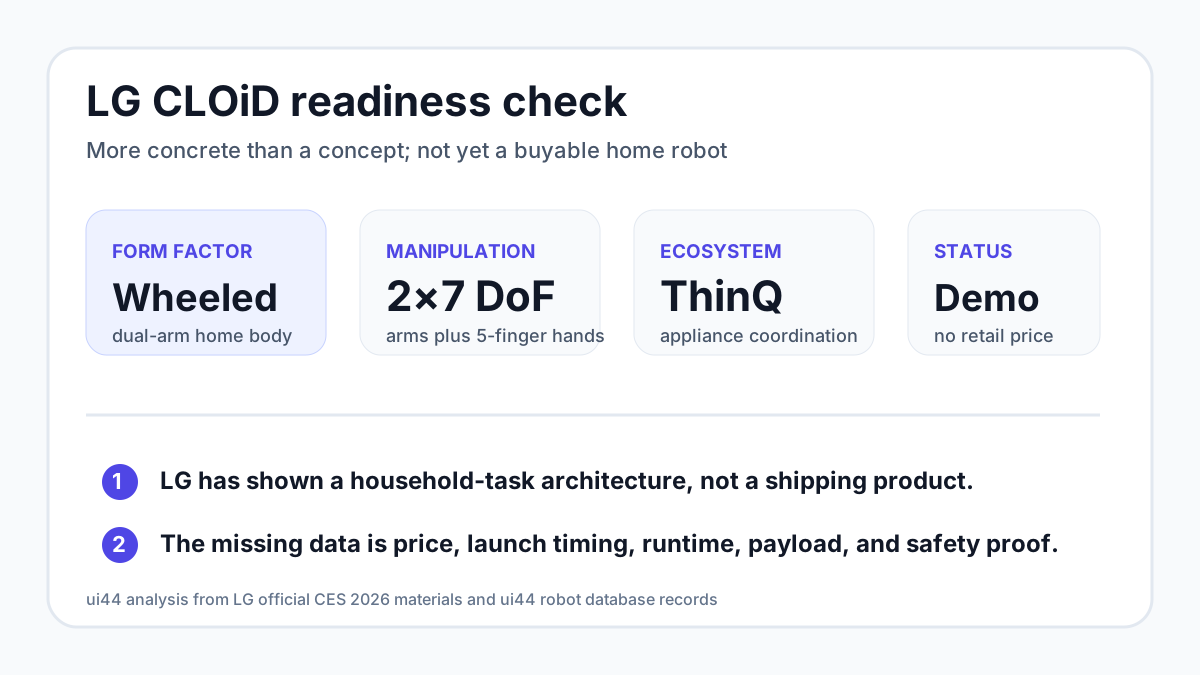
The short version: CLOiD is one of the more credible home-humanoid directions because it starts with appliances and a wheeled base instead of pretending that bipedal walking solves every chore. But until LG publishes pricing, pilots, safety limits, autonomy boundaries, runtime, payload, and service terms, it is a promising platform rather than a robot you should plan your household around.
What is LG CLOiD?
LG CLOiD is LG Electronics' wheeled home robot for its Zero Labor Home vision. LG publicly announced it for CES 2026 and described it as an AI-enabled home robot built to coordinate household tasks across connected appliances.
The official demo scenarios are deliberately domestic. LG says CLOiD can retrieve milk from a refrigerator, place a croissant in an oven, initiate laundry cycles, and fold or stack garments after drying. Those are exactly the tasks buyers imagine when they hear "home robot": kitchen help, laundry help, and appliance coordination.
The hardware is more specific than many concept launches. ui44 tracks CLOiD as a wheeled robot with a tilting torso, two articulated arms, and five independently actuated fingers on each hand. LG says each arm has seven degrees of freedom, roughly matching the movement categories of a human arm. The head works as a mobile AI hub with cameras, sensors, a display, a speaker, and voice-based generative AI.
That design is important because it is not a full bipedal humanoid. It is closer to a mobile manipulator: a robot that can move around a floor, reach household objects, and coordinate with appliances. For many homes, that may be more useful than a robot that can walk impressively but cannot reliably pick up a wet towel.
The catch is that LG has not disclosed the buyer-level facts that normally make a robot feel real: price, order timing, regions, battery life, charging time, maximum speed, payload, warranty, repair model, safety certifications, or what exactly works without human supervision.
What does Zero Labor Home actually mean?
Zero Labor Home should not be read as "a robot will do every chore tomorrow." A better reading is: LG wants the home itself to become easier for a robot to understand.
That is the strongest part of CLOiD. A standalone robot has to infer everything from cameras, microphones, force feedback, and trial-and-error. A robot inside an LG smart-home ecosystem could receive context from a washer, dryer, oven, refrigerator, air conditioner, hub, and user routine history. That does not make manipulation easy, but it can reduce ambiguity.
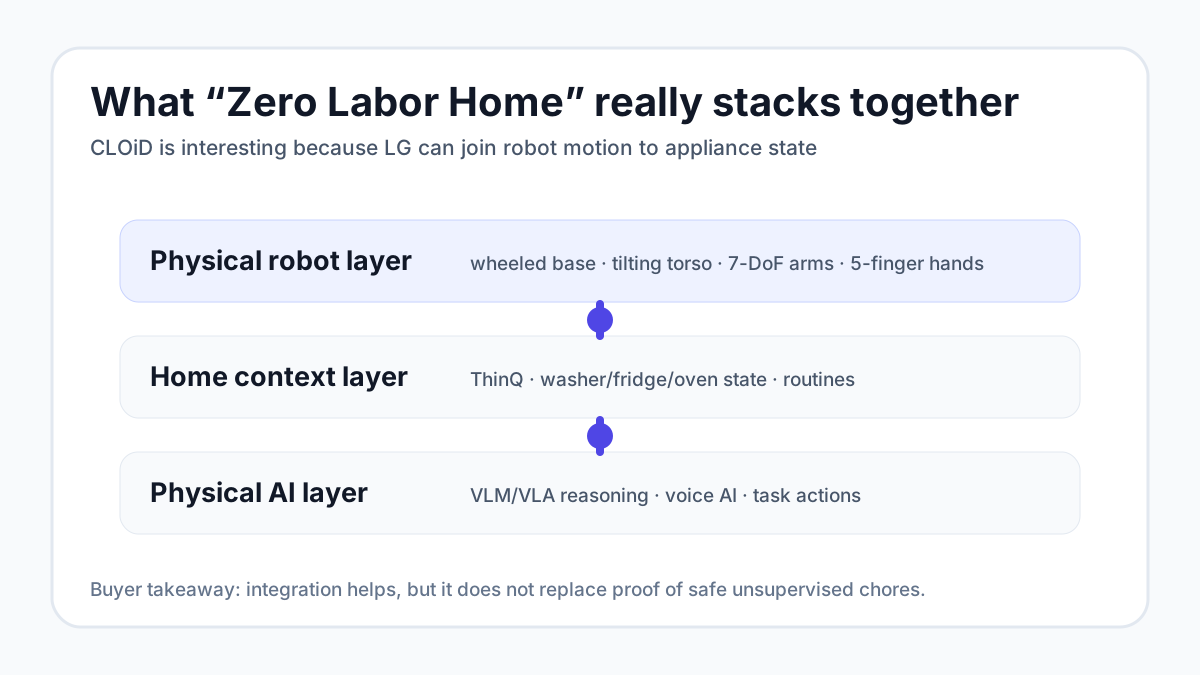
LG describes CLOiD's Physical AI as a combination of a Vision Language Model (VLM) and a Vision Language Action (VLA) system. In simple terms, the VLM helps the robot interpret what it sees, while the VLA is supposed to translate visual and verbal context into physical actions. LG also says the models were trained on tens of thousands of hours of household task data.
The appliance layer matters because many chores are half physical and half contextual. A laundry robot does not merely grab fabric; it needs to know whether clothes are wet, dry, delicate, clean, or waiting for a specific user. A kitchen robot does not merely move a carton; it needs to know where food belongs, whether an oven is ready, and whether a human changed the plan.
That is why CLOiD's integration with LG ThinQ and ThinQ ON is more than a marketing detail. If it works, a connected appliance network can tell the robot things that vision alone may miss. If it only works inside a narrow set of LG appliances and carefully staged routines, the Zero Labor Home remains a premium demo environment rather than a broadly useful buyer proposition.
Why does the wheeled dual-arm design matter?
CLOiD's most sensible choice may be the wheeled base. A robot does not need legs to help with many single-floor home tasks. Wheels are usually simpler, more stable, quieter, cheaper, and less alarming around children or pets. LG says the low center of gravity was chosen for stability and to reduce tip-over risk if a child or pet makes contact.
That trade-off is honest. A wheeled robot cannot climb stairs like a good biped might. It may struggle with thresholds, rugs, cluttered bathrooms, or multi-level homes. But it can be a better platform for manipulation on one floor, especially if the real goal is reaching appliances and countertops rather than walking like a person.
The two 7-DoF arms and five-finger hands are the part to watch. Arms are what separate CLOiD from mobile companions like Samsung Ballie, Amazon Astro, or Enabot EBO X. Those robots can monitor, communicate, project, patrol, or act as a mobile interface. They cannot physically transfer laundry from a dryer or handle items on a counter.
But arms also raise the difficulty. Household objects are irregular. Clothing folds, snags, and hides its own shape. Refrigerator shelves are cramped. Oven trays are hot. Children and pets move unpredictably. A robot hand that looks humanlike in a demo still has to prove force control, error recovery, object recognition, and safe behavior in messy homes.
That is why CLOiD should be judged less like a gadget and more like a domestic appliance plus robotics platform. If LG can publish clear task envelopes—what it can lift, how long it can work, what appliances it can operate, and when it asks for help—the wheeled design could be a strength. If those limits stay vague, the arms mostly create higher expectations.
How does CLOiD compare with real home robot options?
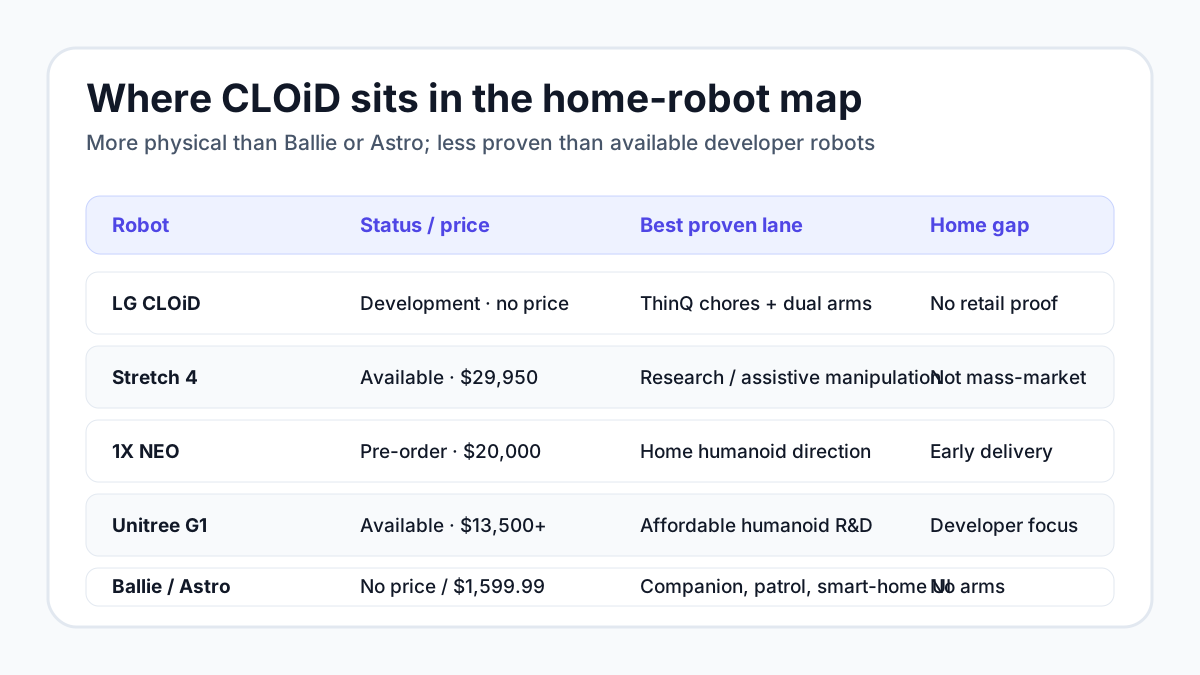
The ui44 database makes CLOiD easier to place. It is not competing with robot vacuums. It is competing with three different ideas of a home robot: available mobile manipulators, humanoid pre-orders, and lower-cost companion or patrol robots.
Robot
- ui44 status and price
- Development; no price announced
- What it proves today
- A serious appliance-company route to wheeled home manipulation
- What it does not prove
- Retail price, real-home autonomy, runtime, payload, service model
Robot
- ui44 status and price
- Available; $29,950
- What it proves today
- A real mobile manipulator for homes, research, and assistive pilots
- What it does not prove
- Mass-market consumer pricing or polished appliance-like ownership
Robot
- ui44 status and price
- Pre-order; $20,000
- What it proves today
- A home-focused humanoid body with soft design and roughly 4-hour battery claim
- What it does not prove
- Broad delivery evidence and everyday unsupervised chore capability
Robot
- ui44 status and price
- Available; from $13,500
- What it proves today
- Affordable humanoid research hardware, 132 cm body, 35 kg weight
- What it does not prove
- Consumer support and reliable household manipulation
Robot
- ui44 status and price
- Development; no price announced
- What it proves today
- A mobile smart-home companion with SmartThings, projector, and Gemini story
- What it does not prove
- Any physical manipulation at all
Robot
- ui44 status and price
- Active; $1,599.99 by invitation
- What it proves today
- Home patrol, Alexa, Ring, remote monitoring
- What it does not prove
- Chores, arms, appliance manipulation
| Robot | ui44 status and price | What it proves today | What it does not prove |
|---|---|---|---|
| LG CLOiD | Development; no price announced | A serious appliance-company route to wheeled home manipulation | Retail price, real-home autonomy, runtime, payload, service model |
| Hello Robot Stretch 4 | Available; $29,950 | A real mobile manipulator for homes, research, and assistive pilots | Mass-market consumer pricing or polished appliance-like ownership |
| 1X NEO | Pre-order; $20,000 | A home-focused humanoid body with soft design and roughly 4-hour battery claim | Broad delivery evidence and everyday unsupervised chore capability |
| Unitree G1 | Available; from $13,500 | Affordable humanoid research hardware, 132 cm body, 35 kg weight | Consumer support and reliable household manipulation |
| Samsung Ballie | Development; no price announced | A mobile smart-home companion with SmartThings, projector, and Gemini story | Any physical manipulation at all |
| Amazon Astro | Active; $1,599.99 by invitation | Home patrol, Alexa, Ring, remote monitoring | Chores, arms, appliance manipulation |
This comparison is useful because CLOiD sits in the middle. It is more physical than Ballie or Astro. It is more appliance-native than Stretch. It is less commercially concrete than Stretch, Unitree G1, or Astro. It is more home-shaped than an industrial humanoid such as Figure 03, but less specified than many research platforms.
For a buyer, that means CLOiD's promise is not "best robot today." The promise is "maybe the most coherent home-appliance-company answer to chores." That is a very different claim, and it needs different evidence.
Why are LG AXIUM actuators part of the story?
The most overlooked part of LG's robot push may be LG Actuator AXIUM, the company's actuator brand. Actuators are the joints that turn electrical power into controlled motion. For a home robot, they affect cost, weight, torque, noise, heat, reliability, repairability, and safety.
Korea Times reporting says market expectations around LG's robotics business are focused heavily on actuators, and notes that actuators can account for more than 40 percent of robot production costs. The same report says LG Electronics has planned an in-house actuator mass-production system and has moved CLOiD proof-of-concept timing toward the first half of 2026.
That matters more than a stock-market rally. A robot company can make a slick prototype with expensive parts. A home-appliance company has to build something that can be manufactured, supported, repaired, and sold at a price ordinary households can understand. If LG can use its appliance-component experience to make compact, efficient, reliable actuators, CLOiD becomes more plausible.
But AXIUM also changes the story from a buyer story to a platform story. LG may make money supplying components, robotized appliances, or business-to-business systems before CLOiD becomes a normal home product. Korea Times also reported LG cooperation with Nvidia around robotics and physical AI reference-model work. That is strategically interesting, but it is not the same as a product page with an order button.
The buyer takeaway is simple: actuator work is a good signal that LG is serious. It is not proof that CLOiD will be affordable, durable, or allowed to fold your laundry without supervision.
What is still missing before buyers should believe CLOiD?
CLOiD needs a boring spec sheet. That sounds less exciting than a robot folding laundry, but it is exactly what separates a credible product from a staged home robotics demo.
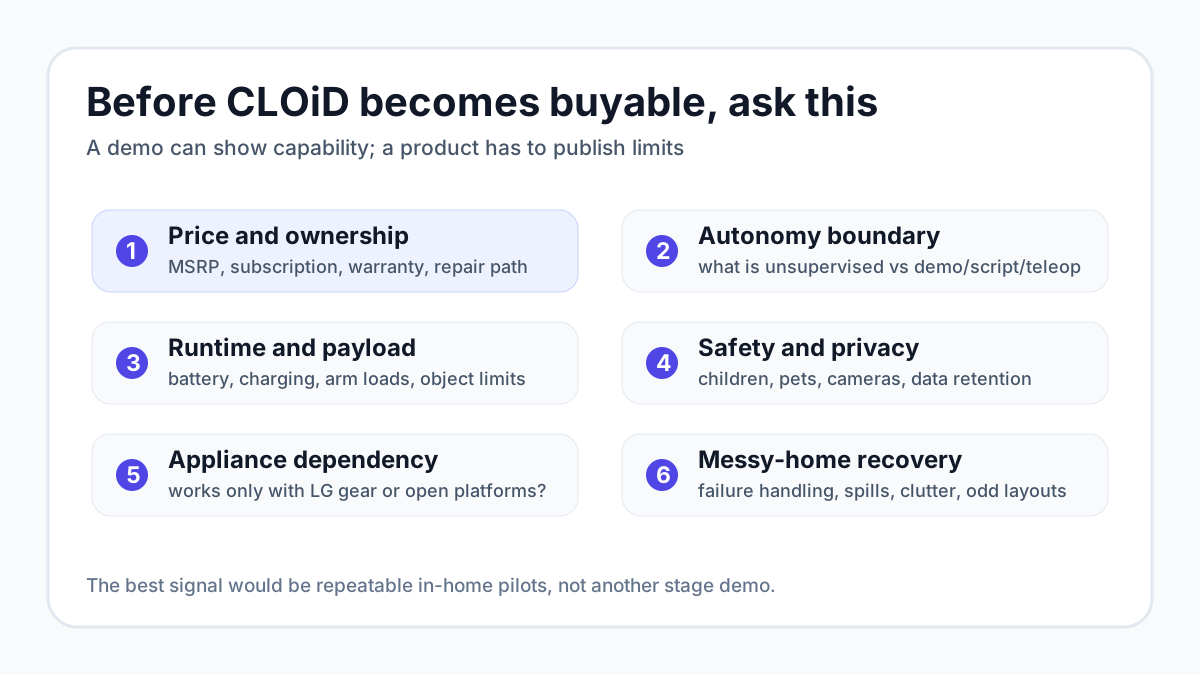
The first missing item is price. Without price, CLOiD cannot be compared fairly with Stretch 4 at $29,950, 1X NEO at $20,000, Unitree G1 at $13,500, or lower-cost home companions. A $5,000 CLOiD would be shocking. A $25,000 CLOiD would be a premium early-adopter platform. A subscription-heavy CLOiD would raise different questions about cloud dependency and long-term cost.
The second missing item is autonomy. LG should spell out which tasks CLOiD can do unsupervised, which tasks require confirmation, which tasks are scripted demos, and which tasks depend on teleoperation, pre-mapped appliances, or a specially arranged kitchen. "Can fold laundry" is less useful than "can fold these garment types after this dryer cycle, with this failure rate, under these safety limits."
The third missing item is hardware endurance. Buyers need battery life, charging time, payload, gripper limits, speed, noise, and maintenance intervals. A robot that can perform one breakfast demo may still be impractical if it needs frequent charging, cannot lift common household items, or requires careful setup for each appliance.
The fourth missing item is safety and privacy. CLOiD has cameras, sensors, voice interaction, and appliance access. That creates obvious questions: where is video processed, what data is stored, who can access it, how appliance permissions are managed, and how the robot behaves around pets, children, guests, fragile objects, hot surfaces, and wet floors.
The fifth missing item is home compatibility. If CLOiD works best only with LG's own appliances, that may still be useful for committed LG households, but it would narrow the audience. If it can coordinate with broader standards or third-party smart-home systems, the buyer case gets much stronger.
Should you wait for LG CLOiD?
You should watch CLOiD closely, but you should not wait for it as if a general household helper is guaranteed.
Wait for CLOiD news if you already live in the LG ecosystem, care about appliance coordination, and want a robot that might eventually handle kitchen and laundry steps rather than merely patrol or chat. CLOiD is also worth watching if you think the first useful home robot will be a wheeled manipulator, not a walking humanoid.
Do not delay a practical purchase for CLOiD if your current need is narrower. If you need home monitoring, Astro or EBO-style companion robots are closer to real products. If you need mobile manipulation for research, assistive pilots, or developer work, Stretch 4 is much more concrete. If you want humanoid hardware for experimentation, Unitree G1, Unitree R1, and similar platforms are already priced and specified more clearly than CLOiD.
The best buyer stance is skepticism without cynicism. LG has advantages that many robotics startups do not: appliance integration, component manufacturing, service infrastructure, and a real reason to make robots fit homes rather than warehouses. CLOiD's wheeled body and ThinQ strategy are sensible. The AXIUM actuator work suggests LG is thinking below the demo layer.
But the burden of proof is still on LG. A believable next step would be a public pilot with real households, clear limits, published task success rates, safety rules, appliance-compatibility lists, privacy documentation, and a price range. Until then, CLOiD is best understood as a serious home-robot signal—not a reason to believe housework is solved.
Sources & References
- LG official newsroom, "LG Electronics Presents LG CLOiD Home Robot To Demonstrate Zero Labor Home at CES 2026": https://www.lg.com/global/newsroom/news/home-appliance-solution/lg-electronics-presents-lg-cloid-home-robot-to-demonstrate-zero-labor-home-at-ces-2026/
- Korea Times, "LG Group enjoys rosy market outlook for robot business": https://www.koreatimes.co.kr/business/tech-science/20260525/lg-group-enjoys-rosy-market-outlook-for-robot-business
- Korea Times, "LG Electronics seeks growth momentum with humanoid robots": https://www.koreatimes.co.kr/business/tech-science/20251229/lg-electronics-seeks-growth-momentum-with-humanoid-robots
- ui44 robot database pages: LG CLOiD, Hello Robot Stretch 4, 1X NEO, Unitree G1, Samsung Ballie, Amazon Astro, and Enabot EBO X.
Written by
ui44 Team
Published May 31, 2026
Share this article
Open a plain share link on X or Bluesky. No embeds, no widgets, no cookie baggage.