That is a very different promise from "this robot can move boxes." It also needs a more careful reading. A robot can be emotionally responsive without being a safe, affordable, autonomous home-care product.

The useful way to think about GR-3 is not "humanoid companion robot: solved." It is this: Fourier is testing whether a full-size humanoid can borrow the comfort cues of companion robots while keeping the reach, walking, teleoperation, and manipulation hardware of a service robot. That puts GR-3 in a narrow middle lane between LOVOT, ElliQ 3, 1X NEO, and Hello Robot Stretch 4.
What is the Fourier GR-3?
Fourier GR-3 is the third-generation member of Fourier's GRx humanoid line and the first one the company explicitly frames around care, companionship, and human-centered service. In the ui44 database it sits in the Humanoid category with Active status, no public price, and a release date of August 2025.
The core public specs are concrete enough to compare:
GR-3 spec
Height
- Public figure
- 165 cm
GR-3 spec
Weight
- Public figure
- 71 kg
GR-3 spec
Joints
- Public figure
- 55
GR-3 spec
Hands
- Public figure
- 12-DoF dexterous hands
GR-3 spec
Battery
- Public figure
- About 3 hours, hot-swappable
GR-3 spec
Touch sensing
- Public figure
- 31 distributed pressure sensors
GR-3 spec
Audio
- Public figure
- Four-microphone array with voice localization
GR-3 spec
Vision
- Public figure
- RGB + structured-light facial tracking
GR-3 spec
Price
- Public figure
- Not publicly disclosed
| GR-3 spec | Public figure |
|---|---|
| Height | 165 cm |
| Weight | 71 kg |
| Joints | 55 |
| Hands | 12-DoF dexterous hands |
| Battery | About 3 hours, hot-swappable |
| Touch sensing | 31 distributed pressure sensors |
| Audio | Four-microphone array with voice localization |
| Vision | RGB + structured-light facial tracking |
| Price | Not publicly disclosed |
Fourier's official product page also says the GR-3 Series supports whole-body teleoperation, an upgraded backend UI, algorithm development on a client-server architecture, and future interaction APIs. That tells us a lot about the real market: this is still a platform for labs, integrators, care pilots, public service demos, and enterprise research teams. It is not a boxed consumer robot you buy for a parent this weekend.
The shift is in the product language. Fourier GR-2 was mostly a research and enterprise humanoid: 175 cm, 63 kg, 53 joints, 12-DoF hands, 2 hours of battery life, ROS/Isaac/MuJoCo support, and no public price. GR-3 keeps the humanoid-platform DNA but adds a softer shell, more social interfaces, and a care-first story.
Why does Fourier call GR-3 a Care-bot?
Fourier's care claim has three layers.
First, the body is intentionally less industrial. The official materials describe warm neutral tones, cushioned surfaces, and upholstery-like coverings. That may sound cosmetic, but physical design matters when a robot is 71 kg and moving near children, older adults, or clinical patients. A softer-looking robot is not automatically safe, but it is less intimidating than a bare metal lab platform.
Second, GR-3 has a multimodal interaction stack. Fourier says it combines vision, audio, and touch into a real-time emotional processing engine. In practical terms, that means the robot can orient toward a speaker, track a face, respond to touch, blink, move its eyes, and trigger gestures that look more social than a standard utility robot.
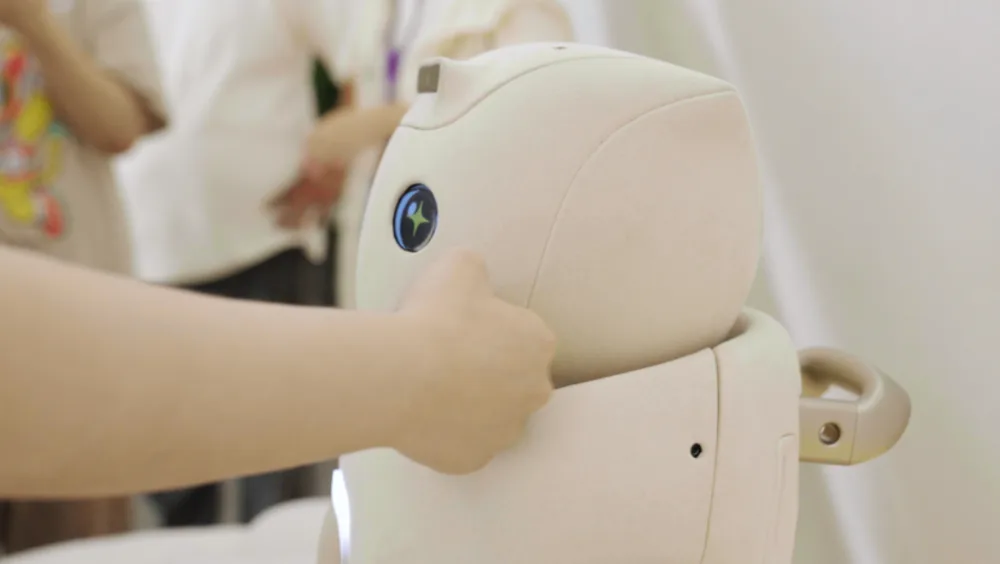
Third, GR-3 uses what Fourier describes as a dual-path response architecture: fast rule-based reactions for reflexive behavior, plus slower LLM-based contextual dialogue for more complex conversation. That split is important. A care robot cannot wait for a cloud-style chat response before reacting to touch, balance, or proximity. It needs fast local behaviors for physical interaction and slower reasoning for conversation.
The limitation is equally important: none of this proves eldercare autonomy. The official language says GR-3 can act as a service assistant or responsive companion in public settings, while assistive care applications such as mobility support, health monitoring, and rehabilitation are described as future or potential applications. That wording is worth preserving. GR-3 is care-centric in positioning and interface design, not a verified replacement for a caregiver.
How is GR-3 different from companion robots like ElliQ and LOVOT?
Most companion robots avoid the hardest physical problems. ElliQ 3 is a stationary AI companion for older adults. It focuses on proactive conversation, medication reminders, wellness programs, video calling, photo and message sharing, games, and social connection. Its pricing is subscription-based: ui44 tracks a $249 one-time lease initiation fee plus membership options such as $49/month, $468/year, or $696 for 24 months.
LOVOT goes the other direction: it is mobile, warm, sensor-rich, and emotionally expressive, but it is not trying to manipulate the world. ui44's current LOVOT 3.0 record lists ¥577,500 plus a required monthly care plan from ¥9,900/month in Japan. It has over 50 sensors, a 43 cm body, a 4.6 kg weight, touch response, room mapping, person recognition, and a charging nest. It exists to be loved, not to lift a cup or support a person standing up.
Casio Moflin and Mirumi make the same trade-off in smaller forms: tiny, low-pressure companionship over physical utility. Familiar, planned for 2027, is a dog-sized quadruped that emphasizes body language, local processing, and emotional presence without voice or a screen.
GR-3 is trying to merge some of that social-emotional design language with a full-size humanoid body. The upside is obvious: it has hands, legs, height, and the potential to interact with human-scale spaces. The downside is just as obvious: every kilogram, joint, and moving limb raises the safety and reliability bar.
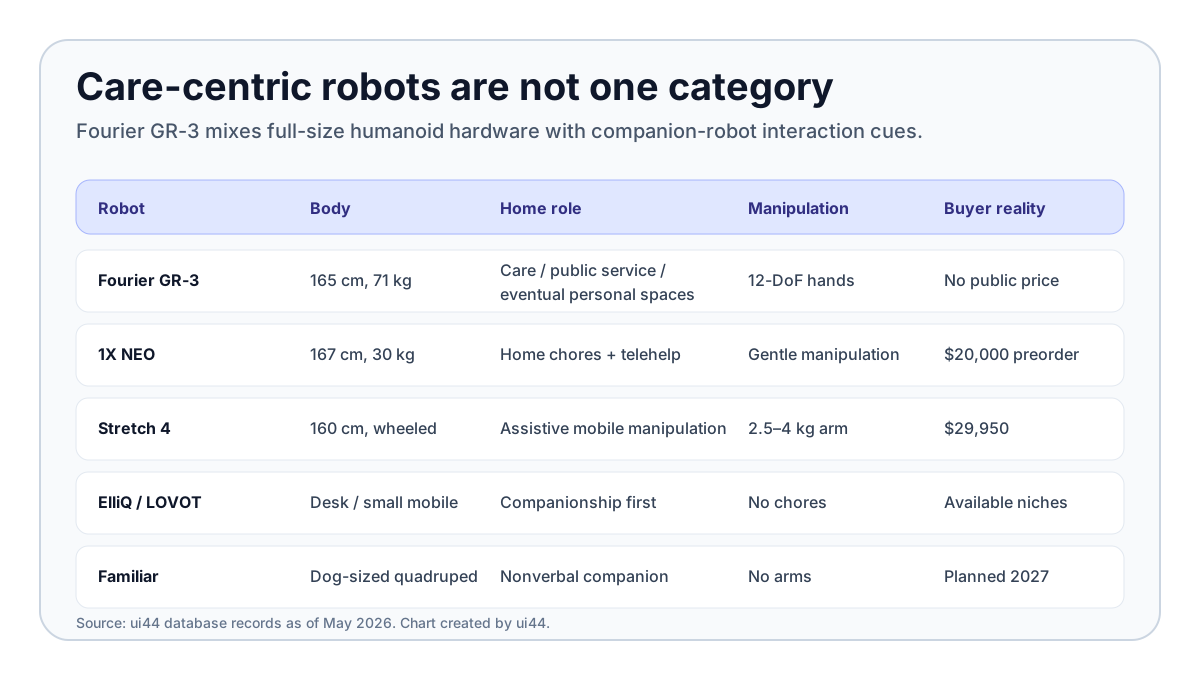
That is why GR-3 should not be judged by the same standard as a tabletop companion. A robot that chats from a desk mostly has to be engaging, private, reliable, and easy to maintain. A full-size care humanoid has to be all of that while also proving it can move safely around people and recover from physical failures.
Is GR-3 closer to 1X NEO or Hello Robot Stretch 4?
For home buyers, the more useful comparison is with robots that can physically help.
1X NEO is the most obvious consumer-facing contrast. ui44 lists NEO as a 167 cm, 30 kg humanoid with a $20,000 early-adopter price, preorder status, about 4 hours of battery life, tactile skin, depth sensors, a microphone array, and a home-first chore pitch. 1X also markets Expert Mode, where a human operator can guide chores the robot cannot yet do by itself.
That is a very different bet from GR-3. NEO is lighter, explicitly home-focused, and framed around household chores. GR-3 is heavier, less transparent on price, and framed around care, public service, clinical use, research, and eventually personal spaces. NEO's biggest question is whether home chore autonomy arrives quickly enough. GR-3's biggest question is whether a care-centric full-size humanoid can be accepted in real human spaces before it is priced or packaged for private homes.
Hello Robot Stretch 4 is the cleaner assistive comparison. Stretch 4 is not humanoid, but it is available now at $29,950 for research, enterprise, and in-home assistive pilot deployments. It has an omnidirectional wheeled base, a telescoping arm, a 2.5 kg extended / 4 kg retracted payload rating, self-charging, about 8 hours of light-load runtime, open ROS 2/Python support, and a compact 45 cm footprint.
Stretch 4 is less emotionally expressive than GR-3, but its design is focused: mobile manipulation in real homes. For assistive tasks, that focus can be more valuable than a human-shaped body. A wheeled base is easier to stabilize. A single arm is easier to supervise. A robot that can reach shelves, pick objects, and dock itself may be more useful than a humanoid that looks caring but still needs careful teleoperation.
What does GR-3 prove for home robotics?
GR-3 proves that the companion-robot category is expanding upward. It is no longer just small pets, tabletop displays, and rolling smart-home cameras. The same design goals are moving into full-size humanoids:
- a body that feels less threatening
- touch response instead of touch avoidance only
- eye contact, blinking, and social timing
- conversation that can adapt to context
- teleoperation and APIs for supervised real-world use
- a hardware path toward actual assistance, not just companionship
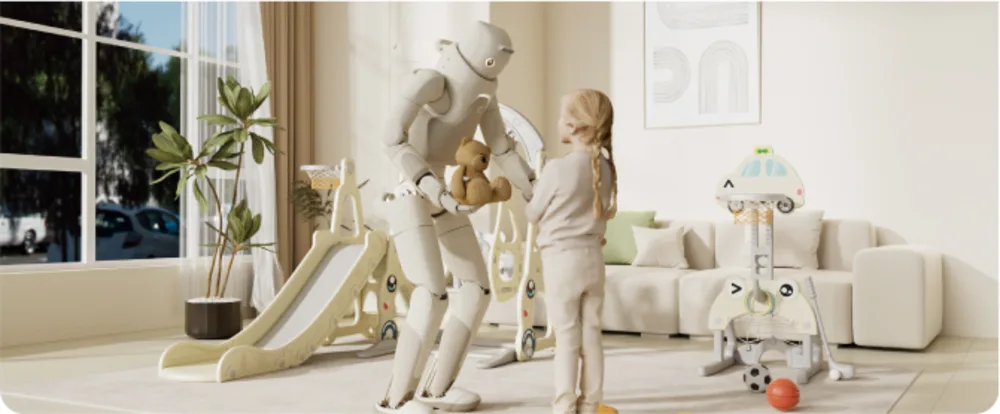
That is meaningful. Home robots have a trust problem. People do not only ask "Can it do the task?" They ask whether they can relax around it. A care robot that moves through eldercare, rehab, or family spaces needs emotional legibility: people should understand when it sees them, hears them, is about to move, or is asking for help.
But GR-3 does not yet prove that a full-size companion humanoid is the best home robot shape. Its current facts point to a platform stage:
Buyer question
Can I buy it with a listed price?
- GR-3 answer today
- Not publicly disclosed
Buyer question
Is it framed as a consumer home product?
- GR-3 answer today
- No, not primarily
Buyer question
Does it have manipulation hardware?
- GR-3 answer today
- Yes, 12-DoF hands
Buyer question
Does it have social/touch interaction?
- GR-3 answer today
- Yes, officially claimed
Buyer question
Does it have home-care certification evidence?
- GR-3 answer today
- Not publicly shown in the ui44 record
Buyer question
Is it more mature than GR-2 socially?
- GR-3 answer today
- Yes, in positioning and interface design
| Buyer question | GR-3 answer today |
|---|---|
| Can I buy it with a listed price? | Not publicly disclosed |
| Is it framed as a consumer home product? | No, not primarily |
| Does it have manipulation hardware? | Yes, 12-DoF hands |
| Does it have social/touch interaction? | Yes, officially claimed |
| Does it have home-care certification evidence? | Not publicly shown in the ui44 record |
| Is it more mature than GR-2 socially? | Yes, in positioning and interface design |
For comparison, HumanoidHub's current production tracker treats Fourier as a production-stage humanoid maker through GR-1, while Unitree G1 is the only tracked humanoid listed as mass production. That context matters: Fourier is not just a speculative render company, but GR-3 itself still needs deployment proof specific to care and personal environments.
What should buyers ask before trusting a care humanoid?
If GR-3 or a similar care-centric humanoid appears in a pilot, showroom, or future preorder flow, the right questions are practical:
- What tasks are autonomous today? Conversation, greeting, and gesture are not the same as safe transfer assistance, object retrieval, or health monitoring.
- What happens when it is uncertain? A care robot needs graceful refusal, handoff, or teleoperation, not improvisation near a vulnerable person.
- Where does perception data go? GR-3's pitch depends on face tracking, voice input, touch sensing, and LLM dialogue. Buyers should ask what is processed locally, what is uploaded, and how long data is retained.
- What safety evidence exists beyond soft materials? Cushioned surfaces and pressure sensors are helpful design choices, but they are not the same as an independently validated care environment.
- Who maintains it? A 71 kg humanoid with 55 joints is not a gadget. Homes and care facilities need service contracts, spare parts, remote diagnostics, and clear downtime expectations.
These questions are not meant to dismiss GR-3. They are the difference between a credible robotics pilot and a marketing demo.
Should you care about Fourier GR-3 now?
Yes, if you follow the future of home and care robots. GR-3 is a useful signal that humanoid makers are learning from companion robots: touch, expression, softness, social timing, and emotional context are becoming part of the hardware roadmap, not just app-layer decoration.
No, if you are shopping for a practical home-care robot today. For an older adult who needs daily social support, ElliQ 3 is far more available and purpose-built. For emotional companionship, LOVOT, Moflin, Mirumi, or future Familiar-style robots are closer to real consumer products. For assistive manipulation research, Stretch 4 is more transparent on price and deployment status. For a humanoid home-helper preorder, 1X NEO is the clearer consumer-facing bet, even with its own autonomy and operator-handoff caveats.
Fourier GR-3 matters because it asks the right product question: can a humanoid be accepted as a caring presence, not just a worker? The answer is not proven yet. But the question itself is important, and it is exactly where the next phase of home robotics is heading.
Related in the database
Use this article as a market-reality workflow
Turn the article into a market-reality pass grounded in the robots, manufacturers, and countries it actually references.
Fourier GR-3: Can a Humanoid Be a Companion? already points you toward 9 linked robots, 8 manufacturers, and 5 countries inside the ui44 database. That matters because strong buyer guidance is easier to apply when you can move immediately from a claim or warning into concrete product pages, manufacturer directories, component explainers, and country-level context instead of treating the article as an isolated opinion piece. The fastest next step is to turn the article into a shortlist workflow: open the linked robot pages, verify which specs are actually published for those models, then compare the surrounding manufacturer and component context before you decide whether the underlying claim changes your buying plan.
For this topic, the useful discipline is to separate the editorial lesson from the catalog evidence. The article gives you the framing, but the robot pages tell you what each product actually ships with today: sensor stack, connectivity methods, listed price, release timing, category, and support-relevant compatibility notes. The manufacturer pages then show whether you are looking at a one-off launch, a broader lineup pattern, or a company that spans multiple categories. That layered workflow reduces the risk of buying on a single marketing phrase or a single support FAQ.
Launch claims age fast. The safest move is to pair the article with robot status, price, and manufacturer breadth checks inside ui44 so you can see whether LOVOT, ElliQ 3, and NEO are actually ready for a shortlist or still mostly launch-stage signals. If you want a quick working shortlist, open Compare LOVOT, ElliQ 3, and NEO next, then keep this article open as the reasoning layer while you compare structured data side by side.
Practical Takeaway
Every robot, manufacturer, category, component, and country reference below resolves to a real ui44 page, keeping the follow-up path grounded in database records rather than generic advice.
Suggested next steps in ui44
- Check each linked robot page for listed price, status, and release timing before you treat a launch announcement as a shipping reality.
- Open GROOVE X to see whether the company’s ui44 footprint already shows a mature product lane or only a small launch cluster.
- Use country pages when the article spans several ecosystems, because launch timing and lineup depth often differ by region even when the headline sounds global.
- Finish with Compare LOVOT, ElliQ 3, and NEO so availability claims sit next to real product data.
- Treat every article as a live market snapshot. Re-check status and pricing before you move from interest to purchase intent.
Robot profiles worth opening next
Use the linked product pages as the evidence layer
The linked robot pages are where this article becomes operational. Instead of asking whether the headline is interesting, use the robot entries to inspect the actual mix of sensors, connectivity options, batteries, pricing, release timing, and stated capabilities attached to the products mentioned in the article. That is the easiest way to see whether the warning or opportunity described here affects one product family, a specific design pattern, or an entire buying lane.
LOVOT is tracked on ui44 as a available companions robot from GROOVE X. The database currently records a listed price of ¥577,500, a release date of 2019, 30-45 minutes active, then returns to nest battery life, 15-30 minutes (on charging nest) charging time, and a published stack that includes Horn Top Camera (half-sphere), Horn Front Camera, and Depth Camera plus Wi-Fi and Bluetooth.
For market and launch stories, this entry grounds the article in real product data. Use the combination of status, release timing, price, and published capabilities like Emotional Companionship, Person Recognition, and Touch Response (full body sensors) to decide whether LOVOT belongs on a live shortlist or should stay in the watchlist bucket a little longer.
ElliQ 3
Intuition Robotics · Companions · Available
ElliQ 3 is tracked on ui44 as a available companions robot from Intuition Robotics. The database currently records a listed price of Price TBA, a release date of 2024-01, Mains powered battery life, N/A (plugged in) charging time, and a published stack that includes 4-mic array, 12 MP camera for images, and 1080p HD video at 30 fps with 120° horizontal FoV plus Wi-Fi 802.11b/g/n/ac (2.4 GHz and 5 GHz) and Bluetooth 5+.
For market and launch stories, this entry grounds the article in real product data. Use the combination of status, release timing, price, and published capabilities like Proactive Conversation, Medication Reminders, and Health & Pain Tracking to decide whether ElliQ 3 belongs on a live shortlist or should stay in the watchlist bucket a little longer.
NEO
1X Technologies · Humanoid · Pre-order
NEO is tracked on ui44 as a pre-order humanoid robot from 1X Technologies. The database currently records a listed price of $20,000, a release date of 2025-10-28, ~4 hours battery life, Not disclosed charging time, and a published stack that includes RGB Cameras, Depth Sensors, and Tactile Skin plus Wi-Fi and Bluetooth.
For market and launch stories, this entry grounds the article in real product data. Use the combination of status, release timing, price, and published capabilities like Household Chores, Tidying Up, and Safe Human Interaction to decide whether NEO belongs on a live shortlist or should stay in the watchlist bucket a little longer.
Stretch 4
Hello Robot · Home Assistants · Available
Stretch 4 is tracked on ui44 as a available home assistants robot from Hello Robot. The database currently records a listed price of $29,950, a release date of 2026-05-12, 8 hours (light CPU load) battery life, Not officially disclosed charging time, and a published stack that includes Wide-FOV depth sensing, High-resolution RGB cameras, and Calibrated RGB + depth perception plus its listed connectivity stack.
For market and launch stories, this entry grounds the article in real product data. Use the combination of status, release timing, price, and published capabilities like Mobile Manipulation, Omnidirectional Indoor Mobility, and Autonomous Mapping and Navigation to decide whether Stretch 4 belongs on a live shortlist or should stay in the watchlist bucket a little longer.
GR-3 is tracked on ui44 as a active humanoid robot from Fourier. The database currently records a listed price of Price TBA, a release date of 2025-08, ≈3 hours (hot-swappable) battery life, Not officially disclosed (current official page only says faster charging with fewer swaps) charging time, and a published stack that includes RGB Camera, Structured-Light Depth Camera, and 4-Microphone Array (voice localization, echo cancellation) plus Wi-Fi and Ethernet.
For market and launch stories, this entry grounds the article in real product data. Use the combination of status, release timing, price, and published capabilities like Bipedal Walking, Object Manipulation, and Emotional Interaction to decide whether GR-3 belongs on a live shortlist or should stay in the watchlist bucket a little longer.
Manufacturer context behind the article
Check whether this is one product story or a broader company pattern
Manufacturer pages add the market context that individual product pages cannot show on their own. They help you check whether a launch headline is backed by a deeper tracked lineup, a visible order path, and adjacent products that make the company look committed rather than opportunistic.
GROOVE X
ui44 currently tracks 1 robot from GROOVE X across 1 category. The company is grouped under Japan, and the current catalog footprint on ui44 includes LOVOT.
That wider brand context matters because launch headlines can obscure how deep or shallow a company’s actual product footprint is. The manufacturer route helps you tell the difference between a growing ecosystem and a single high-visibility announcement. The category mix here currently points toward Companions as the most useful next route if you want to see whether this article reflects a wider pattern inside the brand.
Intuition Robotics
ui44 currently tracks 1 robot from Intuition Robotics across 1 category. The company is grouped under Israel, and the current catalog footprint on ui44 includes ElliQ 3.
That wider brand context matters because launch headlines can obscure how deep or shallow a company’s actual product footprint is. The manufacturer route helps you tell the difference between a growing ecosystem and a single high-visibility announcement. The category mix here currently points toward Companions as the most useful next route if you want to see whether this article reflects a wider pattern inside the brand.
1X Technologies
ui44 currently tracks 2 robots from 1X Technologies across 1 category. The company is grouped under Norway, and the current catalog footprint on ui44 includes NEO, EVE.
That wider brand context matters because launch headlines can obscure how deep or shallow a company’s actual product footprint is. The manufacturer route helps you tell the difference between a growing ecosystem and a single high-visibility announcement. The category mix here currently points toward Humanoid as the most useful next route if you want to see whether this article reflects a wider pattern inside the brand.
Hello Robot
ui44 currently tracks 2 robots from Hello Robot across 1 category. The company is grouped under USA, and the current catalog footprint on ui44 includes Stretch 3, Stretch 4.
That wider brand context matters because launch headlines can obscure how deep or shallow a company’s actual product footprint is. The manufacturer route helps you tell the difference between a growing ecosystem and a single high-visibility announcement. The category mix here currently points toward Home Assistants as the most useful next route if you want to see whether this article reflects a wider pattern inside the brand.
Broaden the scan without leaving the database
Categories, components, and countries add the wider context
Category framing
Category pages are useful when the article touches a buying pattern that shows up across brands. A category route helps you confirm whether the linked products sit in a narrow niche or whether the same question should be tested across a larger field of alternatives.
Companions
The Companions category page currently groups 53 tracked robots from 48 manufacturers. ui44 describes this lane as: Social robots, robot pets, and elderly-care companions designed for emotional connection and everyday support at home.
That makes the category route a practical follow-up when you want to check whether the products linked in this article are typical for the lane or whether they sit at one edge of the market. Useful starting examples currently include PARO, Abi, Next-Generation Companion Robot.
Humanoid
The Humanoid category page currently groups 129 tracked robots from 92 manufacturers. ui44 describes this lane as: Full-size bipedal humanoid robots built to work alongside people — from factory floors to household tasks. Compare the cutting edge of humanoid robotics.
That makes the category route a practical follow-up when you want to check whether the products linked in this article are typical for the lane or whether they sit at one edge of the market. Useful starting examples currently include NEO, EVE, Mornine M1.
Country and ecosystem context
Country pages give extra context when support practices, launch sequencing, regulatory posture, or manufacturer mix matter. They are not a substitute for model-level verification, but they do help you see which ecosystems cluster together and which manufacturers sit in the same regional field when you broaden the search beyond the article headline.
Japan
The Japan route currently groups 26 tracked robots from 17 manufacturers in ui44. That gives you a useful regional lens when the article points toward support practices, launch sequencing, or brand clusters that may share similar ecosystem assumptions.
On the current route, manufacturers like AIST, SoftBank Robotics, Toyota make the page a good way to broaden the scan without losing the regional context that often shapes availability, documentation style, and adjacent alternatives.
Israel
The Israel route currently groups 5 tracked robots from 5 manufacturers in ui44. That gives you a useful regional lens when the article points toward support practices, launch sequencing, or brand clusters that may share similar ecosystem assumptions.
On the current route, manufacturers like Flytrex, Intuition Robotics, Maytronics make the page a good way to broaden the scan without losing the regional context that often shapes availability, documentation style, and adjacent alternatives.
Norway
The Norway route currently groups 2 tracked robots from 1 manufacturers in ui44. That gives you a useful regional lens when the article points toward support practices, launch sequencing, or brand clusters that may share similar ecosystem assumptions.
On the current route, manufacturers like 1X Technologies make the page a good way to broaden the scan without losing the regional context that often shapes availability, documentation style, and adjacent alternatives.
Questions to answer before you move from reading to buying
A follow-up FAQ built from the entities already linked in this article
Frequently Asked Questions
Which page should I open first after reading “Fourier GR-3: Can a Humanoid Be a Companion?”?
Start with LOVOT. That gives you a concrete product anchor for the article’s main claim. From there, branch into the manufacturer and component pages so you can tell whether the article is describing one specific model, a repeated brand pattern, or a wider technology issue that affects multiple shortlist options.
How do the manufacturer pages change the buying decision?
GROOVE X help you zoom out from one article and one product. On ui44 they show lineup breadth, category spread, and the neighboring robots tied to the same company. That context is useful when you are deciding whether a risk belongs to a single model, whether it shows up across a brand’s portfolio, and whether you should keep looking at alternatives before committing.
When should I switch from reading to side-by-side comparison?
Move into Compare LOVOT, ElliQ 3, and NEO as soon as you understand the article’s main warning or promise. The article explains what to watch for, but the compare view is where you can check whether price, status, battery life, connectivity, sensors, and category fit still make the robot a good match for your own home and budget.
Where to go next in ui44
Keep the research chain inside the database
If you want to keep going, these follow-on pages give you the cleanest expansion path from article to research session. Open the comparison route first if you are deciding between products today. Open the manufacturer, category, and component routes if you still need to understand the broader pattern behind the claim.
Written by
ui44 Team
Published May 18, 2026
Share this article
Open a plain share link on X or Bluesky. No embeds, no widgets, no cookie baggage.