The clearest current answer is Agility Digit. Agility now has public commercial agreements with Toyota Motor Manufacturing Canada and Mercado Libre, says Digit has moved more than 100,000 totes at GXO's Flowery Branch facility, and describes Digit as commercially deployed with customers including GXO, Schaeffler, Amazon, Toyota, and Mercado Libre. That does not make Digit a home robot. It does make Digit one of the best public tests of whether humanoid robotics has moved beyond stage demos.
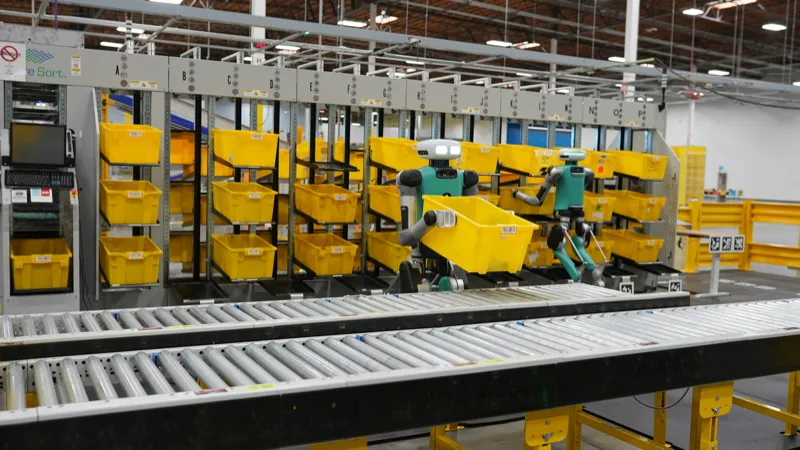
For home robot buyers, this matters because factory and warehouse deployments are the proving ground before household claims become believable. A robot that cannot survive repetitive paid work in a controlled facility is not ready to fold laundry, carry dishes, work around pets, and recover from everyday home chaos.
Which humanoid robots are already doing paid work?
There are several levels of evidence. A humanoid robot can have a press demo, a pilot, a commercial agreement, a paid deployment, or measured production work. Those should not be treated as the same thing.
Robot in ui44 database
- Public work evidence
- Toyota and Mercado Libre commercial agreements; GXO 100,000+ tote milestone; Agility Arc fleet platform
- Buyer interpretation
- Strongest public paid-work proof among humanoids tracked by ui44
Robot in ui44 database
- Public work evidence
- Figure says it ran 1,250+ hours at BMW, loaded 90,000+ parts, and contributed to 30,000+ X3 vehicles
- Buyer interpretation
- Strong industrial runtime proof, now retired into Figure 03 learnings
Robot in ui44 database
- Public work evidence
- Mercedes-Benz commercial agreement to pilot Apollo in manufacturing logistics
- Buyer interpretation
- Serious customer signal, but less public measured throughput than Digit or Figure 02
Robot in ui44 database
- Public work evidence
- UBTECH product page highlights mass production/delivery, 15 kg payload, and autonomous battery swapping
- Buyer interpretation
- Important industrial-scale claim, especially around uptime, but buyer-facing metrics remain limited
Robot in ui44 database
- Public work evidence
- Industrial-grade Phoenix positioning for automotive, manufacturing, and logistics; past pilots in ui44 database
- Buyer interpretation
- Strong dexterity story, less transparent public throughput data
Robot in ui44 database
- Public work evidence
- Enterprise robot listed as active in ui44 with commercial use history; official page is now sparse
- Buyer interpretation
- Relevant precursor to 1X NEO, but deployment proof is less detailed publicly
| Robot in ui44 database | Public work evidence | Buyer interpretation |
|---|---|---|
| Agility Digit | Toyota and Mercado Libre commercial agreements; GXO 100,000+ tote milestone; Agility Arc fleet platform | Strongest public paid-work proof among humanoids tracked by ui44 |
| Figure 02 | Figure says it ran 1,250+ hours at BMW, loaded 90,000+ parts, and contributed to 30,000+ X3 vehicles | Strong industrial runtime proof, now retired into Figure 03 learnings |
| Apptronik Apollo | Mercedes-Benz commercial agreement to pilot Apollo in manufacturing logistics | Serious customer signal, but less public measured throughput than Digit or Figure 02 |
| UBTECH Walker S2 | UBTECH product page highlights mass production/delivery, 15 kg payload, and autonomous battery swapping | Important industrial-scale claim, especially around uptime, but buyer-facing metrics remain limited |
| Sanctuary AI Phoenix | Industrial-grade Phoenix positioning for automotive, manufacturing, and logistics; past pilots in ui44 database | Strong dexterity story, less transparent public throughput data |
| 1X EVE | Enterprise robot listed as active in ui44 with commercial use history; official page is now sparse | Relevant precursor to 1X NEO, but deployment proof is less detailed publicly |
The pattern is obvious: the best public evidence is not a cinematic video. It is a named customer, a paid or commercial relationship, a specific worksite, a task that happens repeatedly, and metrics that include time, volume, failures, or interventions.
That is why Digit is the useful case study. It has named customers, a repeatable logistics task, a fleet software layer, charging and safety updates, and enough public detail to ask serious buying questions.
What does Digit's deployment prove for home robot buyers?
Digit proves that a humanoid form factor can be useful in some human-designed workplaces without rebuilding the whole environment around a robot. Agility's official Toyota announcement says Toyota Motor Manufacturing Canada signed a commercial agreement after a successful pilot and plans to deploy Digit in its facilities for manufacturing, supply-chain, and logistics operations.
The Mercado Libre agreement is even more explicit about logistics. Agility says Digit will enter Mercado Libre's San Antonio, Texas facility, initially focusing on commerce-fulfillment tasks, with the companies exploring additional logistics use cases across Latin America. The same announcement says Digit has already moved more than 100,000 totes in live commerce operations.
Those are not home tasks. They are controlled industrial workflows. But they are exactly the kind of proof that should come before home marketing claims:
- A customer pays or signs a commercial agreement. That is stronger than a founder saying the robot is nearly ready.
- The robot repeats boring work. Totes, parts, and workcells expose uptime, calibration, gripper wear, networking, charging, and support issues.
- The deployment has a support stack. Agility positions Digit with Agility Arc, a cloud automation platform for fleet management, workflow monitoring, AMR coordination, and enterprise-system integration.
- Safety is part of the product, not an afterthought. Agility's 2025 Digit update added Category 1 stop behavior, safety PLC support, on-robot E-stop, wireless teach-pendant E-stop, and Functional Safety over EtherCAT.
The takeaway for home buyers is not "buy Digit for the house." ui44 lists Digit as an active humanoid with enterprise deployment only, no public price, and an RaaS/contact-sales model. The takeaway is that paid work gives buyers a better question set. If a future home humanoid company cannot explain deployment history, support, charging, uptime, intervention rates, and safety boundaries, it is asking for trust before it has earned it.
The numbers that separate proof from hype
The ui44 database keeps the comparison grounded. Digit is not cheap consumer electronics. It is a 175 cm, 65 kg humanoid with about 4 hours of battery life, roughly 2 hours of charging time, 3.4 mph maximum speed, LiDAR, RGB-D cameras, force sensing, and Agility Arc as its planning and fleet layer. Its listed capabilities include 16 kg box carrying, autonomous navigation, warehouse operations, stair navigation, and fleet coordination.
That spec sheet explains why warehouse work is the starting point. A 65 kg biped carrying boxes around people needs managed routes, task rules, safety systems, operators, maintenance, and charging plans. Homes need all of that too, but with less structure and less tolerance for mistakes.
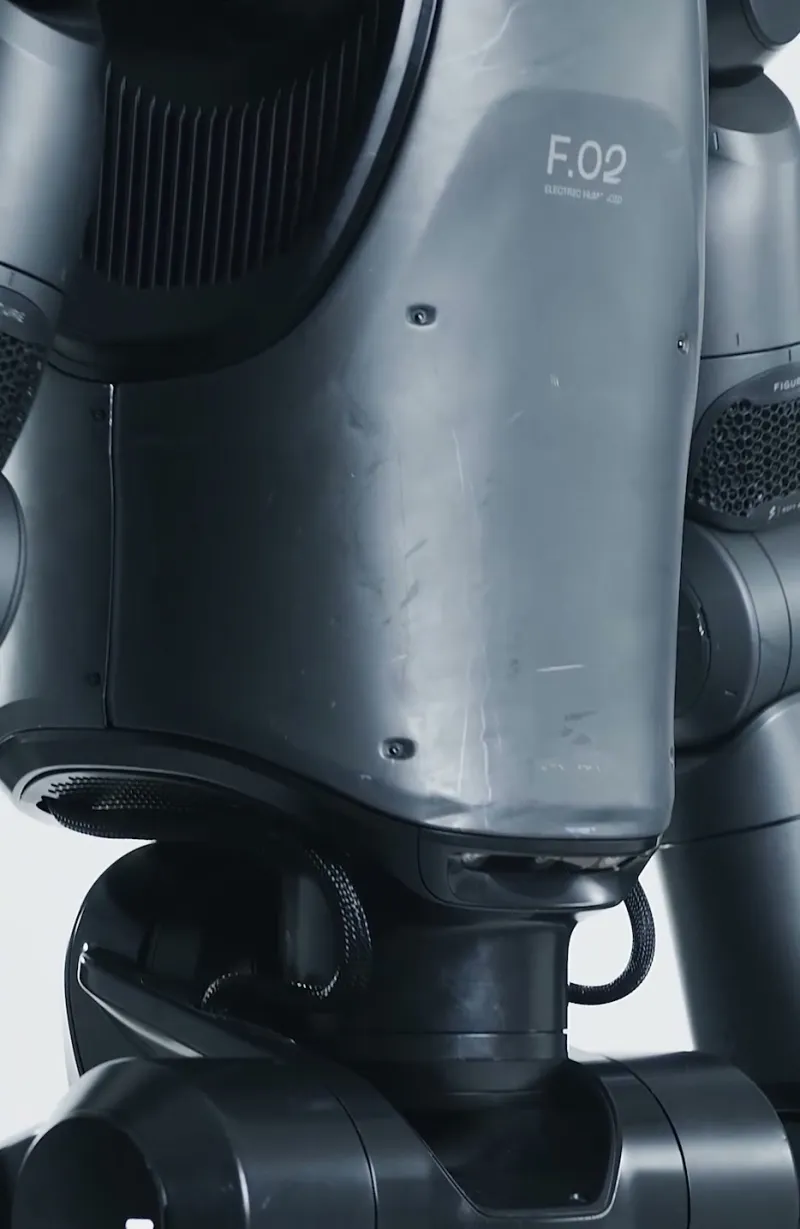
Figure's BMW data shows what better proof looks like. Figure says Figure 02 ran 10-hour shifts Monday-Friday, loaded 90,000+ parts, accumulated 1,250+ hours of runtime, contributed to 30,000+ BMW X3 vehicles, and logged about 1.2 million steps. It also published the specific assembly-line KPIs: 84-second total cycle time, 37-second load time, greater than 99% target placement success per shift, and zero human interventions per shift as the goal.
That is the right direction for humanoid transparency. A buyer can inspect the claim, compare it with the robot's status, and ask what changed in the next generation. In ui44, Figure 02 is now discontinued, while Figure 03 is active with no public price, about 173 cm height, 61 kg weight, about 5 hours of battery life, and a 20 kg payload. The important point is not that Figure 03 is a home product today. It is that Figure can point to a real industrial learning loop behind the next robot.
Digit's public proof is similar in spirit but different in task. The GXO tote milestone is about long-running logistics throughput. Toyota and Mercado Libre are about named commercial expansion. Agility Arc is about fleet operations. Put together, they make a stronger case than a one-off humanoid dance, speech demo, or carefully edited kitchen clip.
A paid deployment still is not home readiness
A warehouse robot gets help from the environment. The bins are standardized. The workflow is repeated. Lighting, floor surfaces, object classes, paths, and handoff points are relatively controlled. A home is the opposite. It has cables, loose clothes, pets, stairs, narrow furniture gaps, family preferences, fragile objects, and social rules that are hard to encode.
That is why paid industrial work should be treated as a necessary but not sufficient step toward home robots. It can prove hardware durability, manipulation repeatability, support economics, and safety discipline. It cannot by itself prove that a robot can decide whether a glass belongs in the sink, a dog toy belongs in a basket, or a child's school paper should never be thrown away.
The gap shows up in pricing and support too. Digit has no consumer price in the ui44 database. Apptronik Apollo has no public price. Figure 03 has no public price. UBTECH Walker S2 has no public price. Sanctuary Phoenix has no public price. Even 1X NEO, the rare home-focused humanoid with a listed early-adopter price in ui44, is a $20,000 pre-order rather than a normal mass-market appliance.
For a home buyer, that means the honest question is not "which humanoid can do paid work?" It is "which company's paid-work evidence transfers to my home?" A warehouse tote workflow transfers some lessons: uptime, grasping, charging, fleet monitoring, and support. It does not transfer household judgment.
How to read the next commercial humanoid announcement
When a company announces a humanoid deployment, look for five details before you believe the headline.
1. Is there a named customer? "A Fortune 500 company" is weaker than Toyota, Mercado Libre, BMW, Mercedes-Benz, GXO, Schaeffler, or Amazon. Named customers put reputation behind the claim.
2. Is it a pilot, commercial agreement, paid deployment, or scaled rollout? A pilot can be valuable, but it is not the same as recurring paid work. A commercial agreement is stronger, and measured customer throughput is stronger again.
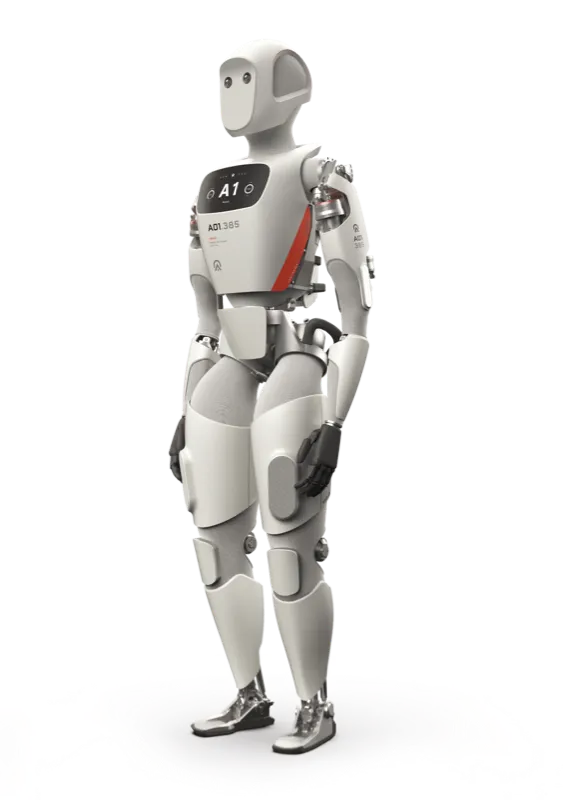
3. What is the repeated task? "General purpose" means little without a task. Digit's useful public examples are totes, logistics handoffs, AMR integration, and manufacturing support. Figure's BMW proof is sheet-metal loading. Apollo's Mercedes-Benz use case is assembly-kit and tote delivery. Those are specific enough to evaluate.
4. What are the boring metrics? Hours, cycles, parts moved, totes moved, interventions, charging, failed grasps, emergency stops, and maintenance windows matter more than a dramatic clip. If a company will not share any denominator, the evidence is weak.
5. What happens when the robot fails? Home buyers should care deeply about recovery policy. Does the robot stop safely, retry, call an operator, hand off to a human, or keep pushing? Industrial customers demand this because downtime costs money. Homes need it because mistakes can become safety problems.
This is where Digit's industrial focus is instructive. Agility talks about cooperative safety, fleet monitoring, remote support, integration with AMRs, chargers, workcell emergency-stop systems, and enterprise software. Those are not glamorous details, but they are exactly the details a future home robot needs in a consumer-friendly form.
Why charging and uptime may matter more than walking
Humanoid marketing loves walking. Buyers should pay equal attention to charging. A robot that can walk for four hours and then needs supervised recovery is not a worker; it is a demo schedule.
Digit's current ui44 entry lists about 4 hours of battery life and about 2 hours of charging. Agility's 2025 update says Digit gained more efficient battery capabilities up to four hours plus autonomous docking onto a charging station. That matters because a paid deployment needs shifts, not clips.
UBTECH Walker S2 pushes the same issue from another direction. Its official product page centers the claim that Walker S2 can swap its own battery in about 3 minutes, uses a dual-battery design, and targets 24/7 continuous operation. ui44 tracks Walker S2 as an active industrial humanoid with 15 kg payload, RGB binocular stereo vision, BrainNet 2.0 plus Co-Agent task planning, and no public price.

The home version of this question is simple: can the robot keep itself useful without becoming another device the owner has to babysit? Autonomous docking, battery swapping, diagnostics, remote support, and predictable service plans may sound less exciting than walking up stairs. They are probably more important for real ownership.
The practical buyer checklist
Related in the database
Use this article as a setup-friction workflow
Turn the article into a first-day setup pass grounded in the robots, manufacturers, and countries it actually references.
Humanoid Robots Doing Paid Work: Digit Proof already points you toward 8 linked robots, 6 manufacturers, and 4 countries inside the ui44 database. Treat those links as a first-day setup trail: open the robot pages, check what is actually published about charging, battery life, control method, app or OTA support, and recovery, then use the surrounding manufacturer and country context to judge whether the article describes a low-friction product path or a still-specialist deployment.
For setup topics, the useful discipline is to separate a polished demo from the work required after the box arrives. The article gives you the narrative, but the robot pages show the operational clues: dimensions, weight, battery runtime, charging time, controller support, listed availability, and the capabilities that might need supervision. Manufacturer pages then reveal whether the same setup assumptions repeat across a wider lineup.
Use the robot pages to verify what happens between delivery and the first useful task: size, weight, battery, charger or dock path, controller, app, OTA support, and recovery cues. On this route cluster, Digit, Figure 02, and Figure 03 form the fastest setup-friction reality check. If you want a quick working shortlist, open Compare Digit, Figure 02, and Figure 03 next, then keep this article open while you compare first-day setup evidence side by side.
Practical Takeaway
The links below stay tied to the robots, manufacturers, and countries actually referenced by this setup article, so the checklist remains grounded in published ui44 records rather than generic humanoid advice.
Suggested next steps in ui44
- Open Digit and check the concrete first-day fields: box contents, charger or dock path, battery life, controller, app, OTA support, and recovery options.
- Use Agility to see whether the company’s broader lineup looks appliance-like, developer-first, or still closer to a pilot deployment.
- Run Compare Digit, Figure 02, and Figure 03 with the article open and compare battery, size, weight, price path, status, and support cues side by side.
- Write down the first realistic task each robot can plausibly attempt on day one, then separate low-friction setup signals from impressive but still lab-style demos.
Robot profiles worth opening next
Use the linked product pages as the evidence layer
The linked robot pages are where this setup article becomes operational. Use the robot entries to inspect the actual mix of size, weight, battery runtime, charging path, control method, pricing, availability, and stated capabilities attached to the products mentioned in the article. That is the easiest way to see whether the first useful task looks appliance-like, developer-led, or still dependent on supervised experimentation.
Digit is tracked on ui44 as a active humanoid robot from Agility. The database currently records a listed price of Price TBA, a release date of 2023, ~4 hours battery life, ~2 hours charging time, and a published stack that includes LiDAR, RGB-D Cameras, and IMU plus Wi-Fi and 5G.
For setup-friction reading, this page matters because it shows the physical and support burden behind the demo. Use it to verify whether Digit has a credible day-one path across charging, control, recovery, battery limits, and listed capabilities such as Box Carrying (16kg), Stair Navigation, and Warehouse Operations.
Figure 02 is tracked on ui44 as a discontinued humanoid robot from Figure AI. The database currently records a listed price of Price TBA, a release date of 2024-08-06, Not disclosed (50% greater capacity than Figure 01) battery life, Not disclosed charging time, and a published stack that includes 6 RGB Cameras, Onboard Vision Language Model, and Microphones plus Wi-Fi and Bluetooth.
For setup-friction reading, this page matters because it shows the physical and support burden behind the demo. Use it to verify whether Figure 02 has a credible day-one path across charging, control, recovery, battery limits, and listed capabilities such as Autonomous Task Execution, Speech-to-Speech Conversation, and Pick and Place, with voice support noted as OpenAI Custom Model.
Figure 03 is tracked on ui44 as a active humanoid robot from Figure AI. The database currently records a listed price of Price TBA, a release date of 2025-10-09, ~5 hours battery life, Not disclosed charging time, and a published stack that includes Stereo Vision, Depth Cameras, and Force Sensors plus Wi-Fi and Bluetooth.
For setup-friction reading, this page matters because it shows the physical and support burden behind the demo. Use it to verify whether Figure 03 has a credible day-one path across charging, control, recovery, battery limits, and listed capabilities such as Complex Manipulation, Warehouse Work, and Manufacturing Tasks.
Apollo is tracked on ui44 as a active humanoid robot from Apptronik. The database currently records a listed price of Price TBA, a release date of TBD, ~4 hours battery life, Not disclosed charging time, and a published stack that includes Vision System, Force/Torque Sensors, and IMU plus Wi-Fi and Ethernet.
For setup-friction reading, this page matters because it shows the physical and support burden behind the demo. Use it to verify whether Apollo has a credible day-one path across charging, control, recovery, battery limits, and listed capabilities such as Warehouse Operations, Manufacturing Tasks, and Heavy Payload (~25kg).
Walker S2 is tracked on ui44 as a active humanoid robot from UBTECH. The database currently records a listed price of Price TBA, a release date of 2025-07-17, Designed for 24/7 continuous operation with autonomous battery swapping battery life, Autonomous battery swap in about 3 minutes charging time, and a published stack that includes Pure RGB Binocular Stereo Vision System, Stereo Depth Estimation System, and Real-Time Battery Monitoring plus Gigabit Ethernet Port and USB 3.0.
For setup-friction reading, this page matters because it shows the physical and support burden behind the demo. Use it to verify whether Walker S2 has a credible day-one path across charging, control, recovery, battery limits, and listed capabilities such as Autonomous Battery Swapping, 24/7 Continuous Operation, and Industrial Handling and Assembly.
Manufacturer context behind the article
Check whether this is one product story or a broader company pattern
Manufacturer pages add the setup context that individual product pages cannot show on their own. They help you check whether a brand repeats the same controller, battery, update, support, and availability patterns across multiple robots, or whether the article is really describing one early product path. That matters for humanoids because first-day friction usually comes from the surrounding ecosystem as much as from the robot itself.
Agility
ui44 currently tracks 1 robot from Agility across 1 category. The company is grouped under USA, and the current catalog footprint on ui44 includes Digit.
That wider brand context matters because setup friction is rarely just a box problem. A manufacturer route helps you see whether the company has repeated controller, battery, support, and update patterns across its lineup, or whether the article is really about one early product story. The category mix here currently points toward Humanoid as the most useful next route if you want to see whether this article reflects a wider pattern inside the brand.
Figure AI
ui44 currently tracks 2 robots from Figure AI across 1 category. The company is grouped under USA, and the current catalog footprint on ui44 includes Figure 03, Figure 02.
That wider brand context matters because setup friction is rarely just a box problem. A manufacturer route helps you see whether the company has repeated controller, battery, support, and update patterns across its lineup, or whether the article is really about one early product story. The category mix here currently points toward Humanoid as the most useful next route if you want to see whether this article reflects a wider pattern inside the brand.
Apptronik
ui44 currently tracks 2 robots from Apptronik across 1 category. The company is grouped under USA, and the current catalog footprint on ui44 includes Apollo, Apollo 2.
That wider brand context matters because setup friction is rarely just a box problem. A manufacturer route helps you see whether the company has repeated controller, battery, support, and update patterns across its lineup, or whether the article is really about one early product story. The category mix here currently points toward Humanoid as the most useful next route if you want to see whether this article reflects a wider pattern inside the brand.
UBTECH
ui44 currently tracks 5 robots from UBTECH across 2 categorys. The company is grouped under China, and the current catalog footprint on ui44 includes Walker S, Walker S2, Alpha Mini.
That wider brand context matters because setup friction is rarely just a box problem. A manufacturer route helps you see whether the company has repeated controller, battery, support, and update patterns across its lineup, or whether the article is really about one early product story. The category mix here currently points toward Humanoid, Companions as the most useful next route if you want to see whether this article reflects a wider pattern inside the brand.
Broaden the scan without leaving the database
Categories, components, and countries add the wider context
Category framing
Category pages are useful when the article touches a buying pattern that shows up across brands. A category route helps you confirm whether the linked products sit in a narrow niche or whether the same question should be tested across a larger field of alternatives.
Humanoid
The Humanoid category page currently groups 129 tracked robots from 92 manufacturers. ui44 describes this lane as: Full-size bipedal humanoid robots built to work alongside people — from factory floors to household tasks. Compare the cutting edge of humanoid robotics.
That makes the category route a practical follow-up when you want to check whether the products linked in this article are typical for the lane or whether they sit at one edge of the market. Useful starting examples currently include NEO, EVE, Mornine M1.
Country and ecosystem context
Country pages give extra context when support practices, launch sequencing, regulatory posture, or manufacturer mix matter. They are not a substitute for model-level verification, but they do help you see which ecosystems cluster together and which manufacturers sit in the same regional field when you broaden the search beyond the article headline.
USA
The USA route currently groups 89 tracked robots from 69 manufacturers in ui44. That gives you a useful regional lens when the article points toward support practices, launch sequencing, or brand clusters that may share similar ecosystem assumptions.
On the current route, manufacturers like Faraday Future, iRobot, Boston Dynamics make the page a good way to broaden the scan without losing the regional context that often shapes availability, documentation style, and adjacent alternatives.
China
The China route currently groups 189 tracked robots from 87 manufacturers in ui44. That gives you a useful regional lens when the article points toward support practices, launch sequencing, or brand clusters that may share similar ecosystem assumptions.
On the current route, manufacturers like AGIBOT, Dreame, Unitree Robotics make the page a good way to broaden the scan without losing the regional context that often shapes availability, documentation style, and adjacent alternatives.
Canada
The Canada route currently groups 2 tracked robots from 2 manufacturers in ui44. That gives you a useful regional lens when the article points toward support practices, launch sequencing, or brand clusters that may share similar ecosystem assumptions.
On the current route, manufacturers like Clearpath Robotics, Sanctuary AI make the page a good way to broaden the scan without losing the regional context that often shapes availability, documentation style, and adjacent alternatives.
Questions to answer before you move from reading to buying
A follow-up FAQ built from the entities already linked in this article
Frequently Asked Questions
Which page should I open first after reading “Humanoid Robots Doing Paid Work: Digit Proof”?
Start with Digit. That gives you a concrete product anchor for the article’s main claim. From there, branch into the manufacturer and component pages so you can tell whether the article is describing one specific model, a repeated brand pattern, or a wider technology issue that affects multiple shortlist options.
How do the manufacturer pages change the buying decision?
Agility help you zoom out from one article and one product. On ui44 they show lineup breadth, category spread, and the neighboring robots tied to the same company. That context is useful when you are deciding whether a risk belongs to a single model, whether it shows up across a brand’s portfolio, and whether you should keep looking at alternatives before committing.
When should I switch from reading to side-by-side comparison?
Move into Compare Digit, Figure 02, and Figure 03 as soon as you understand the article’s main warning or promise. The article explains what to watch for, but the compare view is where you can check whether price, status, battery life, connectivity, sensors, and category fit still make the robot a good match for your own home and budget.
Where to go next in ui44
Keep the research chain inside the database
If you want to keep going, these follow-on pages give you the cleanest expansion path from article to research session. Open the comparison route first if you are deciding between products today. Open the manufacturer, category, and component routes if you still need to understand the broader pattern behind the claim.
Written by
ui44 Team
Published May 18, 2026
Share this article
Open a plain share link on X or Bluesky. No embeds, no widgets, no cookie baggage.