Article 20 min read 4,488 words

UBTECH Uworld: Home Humanoid Breakthrough?

UBTECH's Uworld launch is one of the clearest signs yet that a major humanoid maker wants to move from factories and demos toward ordinary buyers. The company is not just talking about "someday" home robotics. It has put a consumer brand in public, tied it to a full-size humanoid companion concept, and opened a reservation path in China before a planned June 30, 2026 launch.

ui44 Team All articles

That does not mean a practical home humanoid has arrived. The useful reading is more cautious: Uworld is a roadmap marker. It says UBTECH thinks the consumer market is worth preparing for now, while the actual buyer decision still depends on missing details such as final price, safety limits, payload, sensors, warranty terms, and what the robot can do without a controlled showroom.
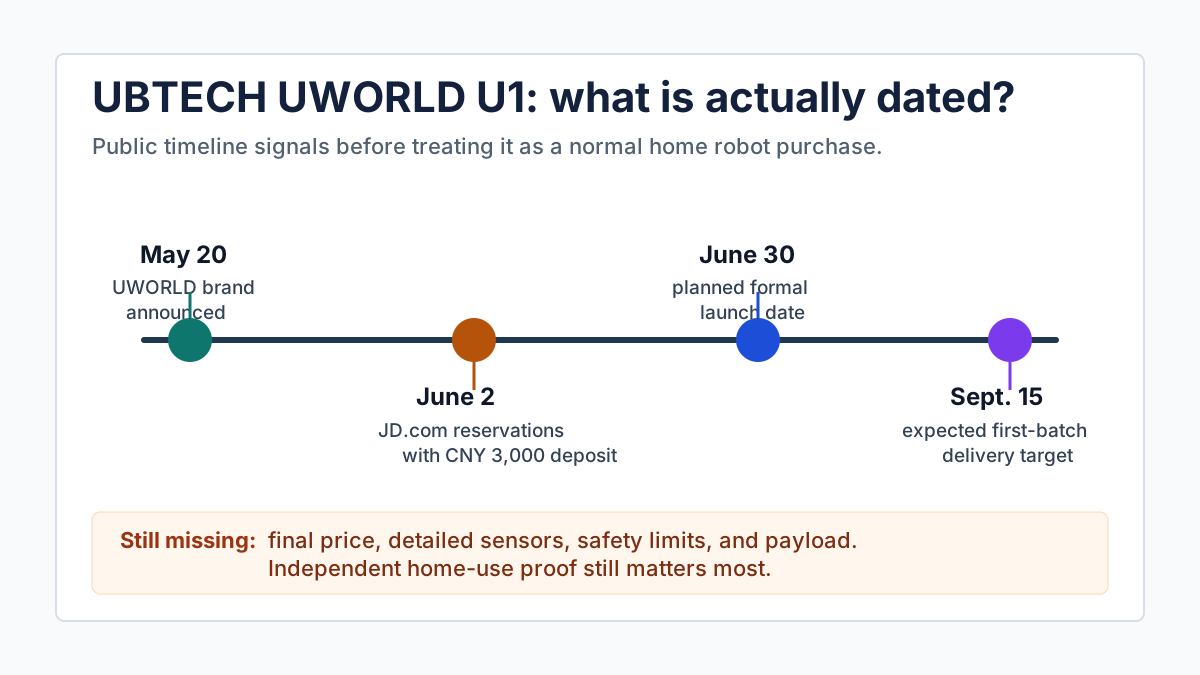
UBTECH Uworld U1 consumer humanoid robot roadmap timeline showing launch and delivery milestones
Scroll sideways to inspect the full chart.

If you are tracking home robots rather than stock-market narratives, the question is simple: should Uworld change your buying expectations today? The answer is yes for market direction, no for immediate purchase confidence. It raises the probability that consumer humanoids will become a real category, but it is not yet enough to treat a full-size companion humanoid like a normal appliance.

What UBTECH Has Actually Put On The Table

The public Uworld story has three layers.

First, UBTECH launched Uworld as a consumer-facing humanoid brand. CnTechPost reported on May 20, 2026 that the new brand targets family companionship, educational assistance, and daily life services. That matters because UBTECH already sells and deploys humanoids in industrial and commercial settings; the new brand frames a more direct household path rather than another factory pilot.

Second, the ui44 database now tracks UBTECH UWORLD U1 Series as a pre-order humanoid. Public pre-sale material describes male and female full-size variants, 88 degrees of freedom, Wi-Fi connectivity, 2 to 4 hours of battery life, an emotional AI interaction system with locally encrypted memory, appearance customization, and a first-batch delivery target of September 15, 2026. The reservation program requires a CNY 3,000 deposit, while the final public price has not been announced.

Third, UBTECH's existing site already separates humanoids, AI education, commercial robots, healthcare, industry, and consumer-grade smart hardware. Its consumer section includes humanoid robots, smart cleaning, smart pet products, and robotic lawn mowers. In other words, Uworld is not appearing from nowhere. It sits on top of an existing consumer hardware lane and a much more serious industrial humanoid program.

That mix is promising and awkward. A full-size biped aimed at emotional companionship is far more ambitious than a toy robot or robot vacuum. But the first public details lean heavily on appearance, companionship, memory, and reservation timing. The buyer-critical facts are still thin.

The Consumer Signal Is Real

The strongest argument for taking Uworld seriously is UBTECH's manufacturing and deployment background. The company is not a tiny startup rendering a humanoid in a video. It has public industrial humanoid products in ui44's database, including Walker S and Walker S2.

Walker S2 is the important comparison. It is not a home robot, but it shows what UBTECH has been trying to solve before entering the consumer story. In ui44's database, Walker S2 is an active industrial humanoid with no public pricing, a 15 kg payload, RGB binocular stereo vision, UBTECH BrainNet 2.0 with an industrial Co-Agent system, and an autonomous battery swap process described at about three minutes. UBTECH frames it around near-continuous operation for factories and logistics.

That does not transfer directly to a living room. A robot that can keep working on a production line is not automatically safe around pets, children, clutter, stairs, glassware, or guests. Still, industrial deployment gives UBTECH something many consumer-humanoid pitches lack: experience with uptime, service, fleet operations, and real customer environments.

Uworld also fits UBTECH's older consumer history. Alpha Mini is a compact companion and education robot, not a chore robot, but it shows that UBTECH has shipped smaller home-facing humanoid hardware before. Alpha Mini's 24.5 cm body, 700 g weight, 13 MP camera, 4-microphone array, voice interaction, face and object recognition, and app-based graphical coding put it in a very different class from Uworld U1. The point is that UBTECH has experience with both ends of the spectrum: small companion robots and full-size industrial humanoids.

Uworld appears to be an attempt to connect those worlds.

The Buyer Risk Is Also Real
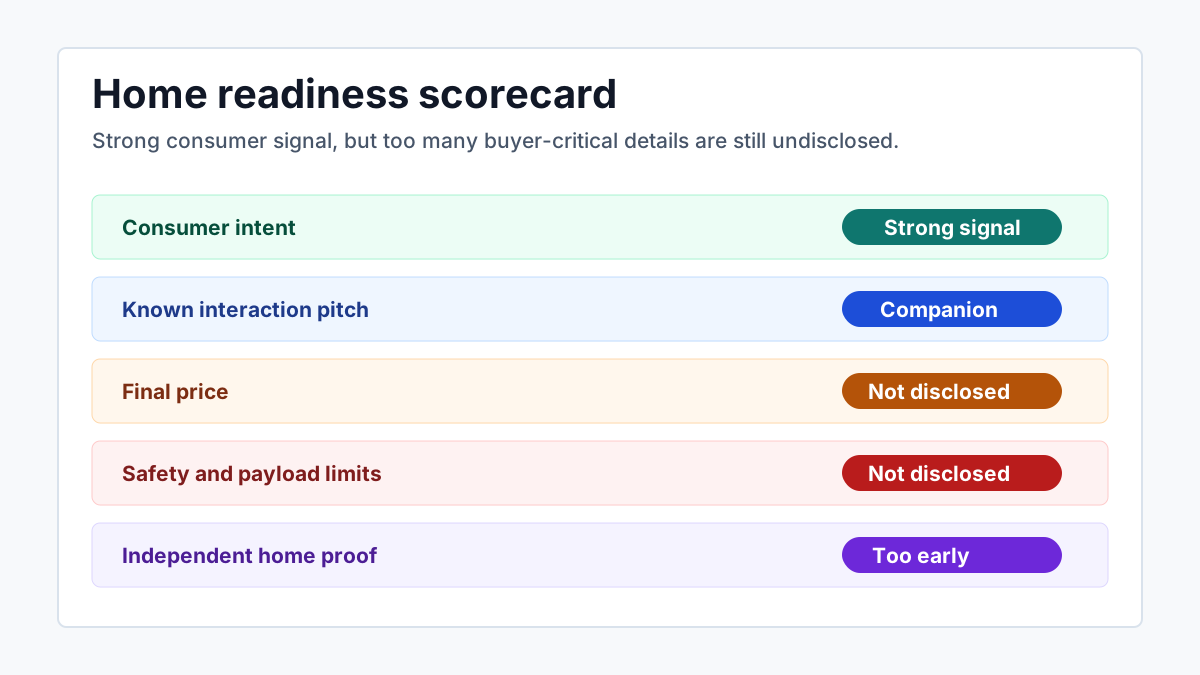
UBTECH Uworld U1 home robot readiness scorecard showing disclosed and missing buyer details
Scroll sideways to inspect the full chart.

The hardest part of evaluating Uworld is that the most important home-buyer questions are not the most visible ones.

An 88-DoF full-size robot is visually impressive. Male and female body variants at 183 cm and 168 cm make the product feel less like a lab platform and more like a domestic presence. Two to four hours of battery life sounds plausible for interaction sessions. Local encrypted memory is a better pitch than a cloud-only companion if it is implemented well.

But a buyer does not live with a spec sheet. A buyer lives with the robot's failure modes.

The missing details are the decision point:

Question

Final price

Why it matters at home
Determines whether this is a niche luxury device or a broad category signal
Current Uworld status
Not announced

Question

Safety limits

Why it matters at home
Full-size robots need clear force, speed, fall, and contact behavior
Current Uworld status
Not disclosed

Question

Payload

Why it matters at home
Shows whether it can manipulate useful household objects
Current Uworld status
Not disclosed

Question

Sensor stack

Why it matters at home
Determines navigation, person awareness, object handling, and privacy trade-offs
Current Uworld status
Detailed package not disclosed

Question

Charging workflow

Why it matters at home
A 2-4 hour robot needs a credible recharge or dock story
Current Uworld status
Charging time not disclosed

Question

Warranty and support

Why it matters at home
Home buyers need service terms, not just launch excitement
Current Uworld status
Not disclosed

Those unknowns do not make Uworld fake. They make it early. They also make the reservation period different from buying a shipping home appliance. A deposit is a signal of interest, not enough evidence that the product will be a reliable home helper.

Price Is The Number To Watch

Final price will decide how to interpret Uworld. The CNY 3,000 deposit tells us that UBTECH is collecting reservations, but it does not tell us whether Uworld U1 competes with developer humanoids, luxury entertainment products, high-end healthcare equipment, or future household appliances.

That price question matters because the humanoid market is splitting into very different bands.
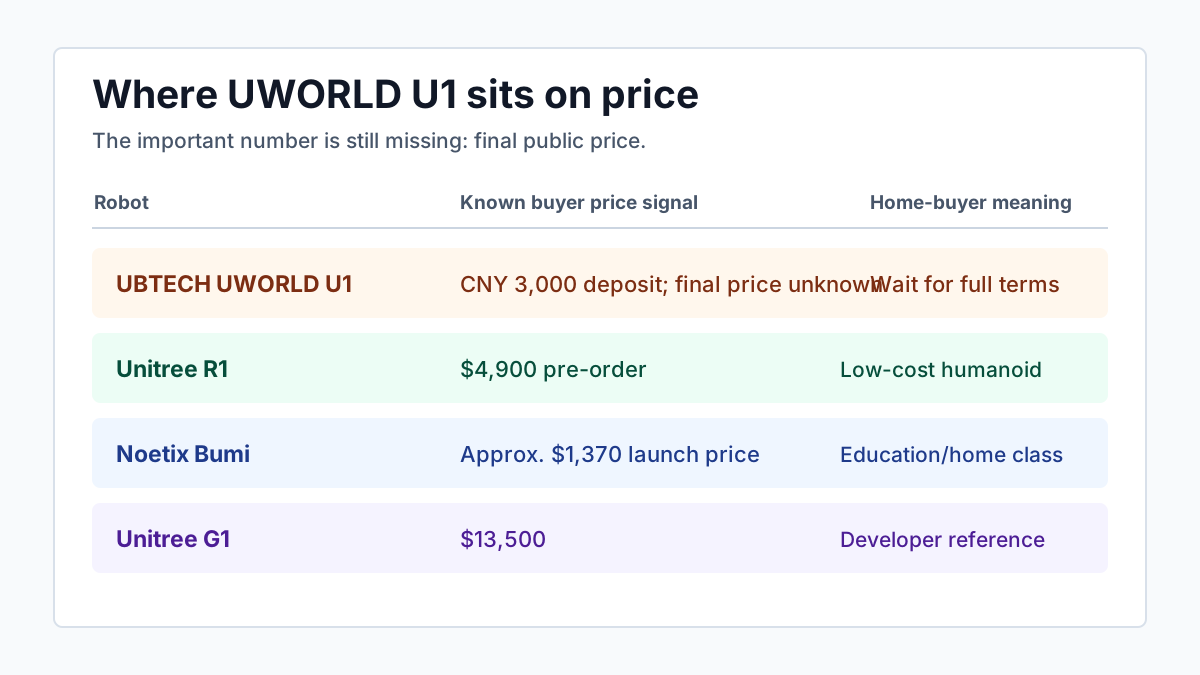
UBTECH Uworld U1 price context chart comparing home humanoid robot price signals
Scroll sideways to inspect the full chart.

Noetix Bumi is a compact education and home humanoid at an approximate launch price of $1,370. It is 98 cm tall, about 17 kg, has 21 total degrees of freedom, Wi-Fi and Bluetooth, camera and IMU sensing, and 2 to 3 hours of runtime. It is not a full-size household worker, but it shows how low the small-humanoid category can go.

Unitree R1 sits in a more aggressive humanoid price lane, with a $4,900 pre-order signal in ui44's database. Unitree G1 is a stronger developer reference point at $13,500, 132 cm tall, 35 kg, and about 2 hours of battery life. G1 is not a domestic appliance either, but it anchors expectations for compact biped hardware that a developer or lab can actually buy.

UBTECH's Walker S2, by contrast, has no public price and belongs to enterprise deployment. CnTechPost reported that the current unit cost of UBTECH's Walker series is about 500,000 yuan, and that UBTECH expects to reduce cost per robot to around $20,000 between 2028 and 2032 through supply-chain integration and mass production. That cost path is exactly why Uworld is interesting: if a company with industrial humanoid revenue is publicly preparing a consumer brand now, it may be trying to build demand before costs are truly household-friendly.

For buyers, the final Uworld price should be judged against the job. A high price can still make sense for a carefully supported companion, therapy, entertainment, or showroom role. It is much harder to justify for vague "daily life services" unless the robot can prove safe, repeatable tasks in unstructured homes.

What Would Make Uworld A Breakthrough?

A consumer humanoid breakthrough is not the same thing as a humanoid launch. Uworld would become meaningfully important for home buyers if UBTECH can prove five things after the formal launch.

First, the robot needs a clear domestic task envelope. "Companionship" can be real value, but the product should define what it does every day: conversation, reminders, guided learning, telepresence, entertainment, basic object interaction, elder check-ins, or something else. A home robot with a narrow, dependable job is more useful than a humanoid that promises everything and does nothing reliably.

Second, safety needs to be specific. Full-size bipedal robots need published limits for motion, force, collision response, fall behavior, child interaction, emergency stop, privacy, and restricted zones. A friendly appearance does not remove the need for machine safety.

Third, the charging story needs to match the runtime. Two to four hours can work for scheduled interaction. It is not enough for all-day autonomous service unless the robot has a reliable dock, charger, or managed use model. Walker S2's autonomous battery swapping is a reminder that UBTECH understands uptime in industry; Uworld needs a home-appropriate equivalent.

Fourth, support needs to be appliance-grade. A full-size humanoid is not something most buyers can troubleshoot like a smart speaker. Delivery, setup, repairs, remote diagnostics, parts, battery replacement, software updates, and data controls all need to be clear before broad consumer adoption makes sense.

Fifth, the robot needs honest demos in normal rooms. Not stage choreography. Not a perfect studio. A buyer should see the robot handle lighting changes, floor transitions, tight spaces, interruptions, and ordinary household mess.

How It Compares With Other Home-Humanoid Signals

Uworld is different from the low-cost humanoid wave because it is starting from brand and companionship rather than open development. Unitree's G1 and R1 signals are hardware-forward: affordable biped platforms, developer interest, and a path toward secondary development. Noetix Bumi is education-forward: small, lower cost, child-friendly programming, and companion interactions. Galbot G1 and AGIBOT's larger systems are more commercial and service-oriented.

UBTECH Uworld is trying to be more emotionally legible to consumers. That can be a strength. People who would never buy a developer kit might understand a companion robot. But it can also be a weakness if the product becomes a high-cost novelty without practical boundaries.

The most useful comparison inside UBTECH's own lineup is not whether Uworld is "better" than Walker S2. They solve different problems. Walker S2 is a factory and logistics humanoid built around uptime and manipulation. Uworld U1 is a consumer companion pitch with disclosed appearance variants, emotional memory, and a reservation timeline. The key question is whether enough of UBTECH's industrial learning flows into the consumer product without bringing industrial cost and complexity with it.

Should You Reserve Or Wait?

For most home robot buyers, the sensible move is to wait for the June 30 launch details and then wait again for early owner evidence.

Uworld is worth watching closely if you care about the future of home humanoids. It is not yet a buy-with-confidence product based on the public information available today. A CNY 3,000 deposit may be reasonable for collectors, early adopters in China, or people comfortable with first-batch risk. It is not the same as a clear consumer recommendation.

Before treating Uworld as a serious purchase, look for:

  • Final price and refund terms
  • Confirmed delivery regions
  • Published safety limits
  • Full sensor and privacy disclosures
  • Charging and docking details
  • Warranty and repair process
  • Independent videos in ordinary homes
  • A list of supported tasks on day one

If those details are strong, Uworld could become one of the first full-size consumer humanoids that buyers can evaluate as a product rather than a concept. If they stay vague, it remains a brand signal: useful for understanding where the market is going, but too early to put in a normal home robot shortlist.

Bottom Line

UBTECH Uworld is a real market signal because it comes from a company with active humanoid programs, a consumer hardware channel, and enough public momentum to put a full-size companion robot into reservation. It is not yet proof that practical home humanoids have arrived.

The fair read is this: Uworld makes the consumer humanoid category harder to dismiss, but final price and home safety proof will decide whether it becomes a breakthrough or just an expensive preview of a category still waiting for its first truly useful household robot.

Sources checked for this draft include CnTechPost's May 20, 2026 Uworld report, UBTECH's official English site, UBTECH's Chinese news/navigation pages, and public Sina-hosted posts from UBTECH leadership and related coverage. The robot specifications and comparison prices above come from ui44's database records for UWORLD U1, Walker S2, Alpha Mini, Unitree R1, Unitree G1, Noetix Bumi, and Galbot G1.

Database context

Use this article as a setup-friction workflow

Turn the article into a real verification pass

UBTECH Uworld: Home Humanoid Breakthrough? already points you toward 8 linked robots, 5 manufacturers, and 1 country inside the ui44 database. Treat those links as a first-day setup trail: open the robot pages, check what is actually published about charging, battery life, control method, app or OTA support, and recovery, then use the surrounding manufacturer and country context to judge whether the article describes a low-friction product path or a still-specialist deployment.

For setup topics, the useful discipline is to separate a polished demo from the work required after the box arrives. The article gives you the narrative, but the robot pages show the operational clues: dimensions, weight, battery runtime, charging time, controller support, listed availability, and the capabilities that might need supervision. Manufacturer pages then reveal whether the same setup assumptions repeat across a wider lineup.

Use the robot pages to verify what happens between delivery and the first useful task: size, weight, battery, charger or dock path, controller, app, OTA support, and recovery cues. On this route cluster, UWORLD U1 Series, Walker S, and Walker S2 form the fastest setup-friction reality check. If you want a quick working shortlist, open Compare UWORLD U1 Series, Walker S, and Walker S2 next, then keep this article open while you compare first-day setup evidence side by side.

Practical Takeaway

The links below stay tied to the robots, manufacturers, and countries actually referenced by this setup article, so the checklist remains grounded in published ui44 records rather than generic humanoid advice.

Suggested next steps in ui44

  1. Open UWORLD U1 Series and check the concrete first-day fields: box contents, charger or dock path, battery life, controller, app, OTA support, and recovery options.
  2. Use UBTECH to see whether the company’s broader lineup looks appliance-like, developer-first, or still closer to a pilot deployment.
  3. Run Compare UWORLD U1 Series, Walker S, and Walker S2 with the article open and compare battery, size, weight, price path, status, and support cues side by side.
  4. Write down the first realistic task each robot can plausibly attempt on day one, then separate low-friction setup signals from impressive but still lab-style demos.

Database context

Robot profiles worth opening next

Use the linked product pages as the evidence layer

The linked robot pages are where this setup article becomes operational. Use the robot entries to inspect the actual mix of size, weight, battery runtime, charging path, control method, pricing, availability, and stated capabilities attached to the products mentioned in the article. That is the easiest way to see whether the first useful task looks appliance-like, developer-led, or still dependent on supervised experimentation.

UWORLD U1 Series

UBTECH · Humanoid · Pre-order

Price TBA

UWORLD U1 Series is tracked on ui44 as a pre-order humanoid robot from UBTECH. The database currently records a listed price of Price TBA, a release date of 2026-06-30, 2-4 hours per charge battery life, Not officially disclosed charging time, and a published stack that includes Multimodal perception for emotional interaction and Detailed sensor package not officially disclosed plus Wi-Fi.

For setup-friction reading, this page matters because it shows the physical and support burden behind the demo. Use it to verify whether UWORLD U1 Series has a credible day-one path across charging, control, recovery, battery limits, and listed capabilities such as Full-size Bipedal Humanoid Interaction, Emotional Companionship, and Personalized Conversation and Memory.

Walker S

UBTECH · Humanoid · Active

Price TBA

Walker S is tracked on ui44 as a active humanoid robot from UBTECH. The database currently records a listed price of Price TBA, a release date of 2023, Not disclosed battery life, Not disclosed charging time, and a published stack that includes Vision System, LiDAR, and Force Sensors plus Wi-Fi and Bluetooth.

For setup-friction reading, this page matters because it shows the physical and support burden behind the demo. Use it to verify whether Walker S has a credible day-one path across charging, control, recovery, battery limits, and listed capabilities such as Bipedal Walking, Object Manipulation, and Factory Tasks.

Walker S2

UBTECH · Humanoid · Active

Price TBA

Walker S2 is tracked on ui44 as a active humanoid robot from UBTECH. The database currently records a listed price of Price TBA, a release date of 2025-07-17, Designed for 24/7 continuous operation with autonomous battery swapping battery life, Autonomous battery swap in about 3 minutes charging time, and a published stack that includes Pure RGB Binocular Stereo Vision System, Stereo Depth Estimation System, and Real-Time Battery Monitoring plus Gigabit Ethernet Port and USB 3.0.

For setup-friction reading, this page matters because it shows the physical and support burden behind the demo. Use it to verify whether Walker S2 has a credible day-one path across charging, control, recovery, battery limits, and listed capabilities such as Autonomous Battery Swapping, 24/7 Continuous Operation, and Industrial Handling and Assembly.

Alpha Mini

UBTECH · Companions · Available

Price TBA

Alpha Mini is tracked on ui44 as a available companions robot from UBTECH. The database currently records a listed price of Price TBA, a release date of 2018, Not publicly specified battery life, Not publicly specified charging time, and a published stack that includes Distance Sensor, Acceleration Sensor, and Gyroscope plus 2G/3G/4G and Wi-Fi (802.11a/b/g/n).

For setup-friction reading, this page matters because it shows the physical and support burden behind the demo. Use it to verify whether Alpha Mini has a credible day-one path across charging, control, recovery, battery limits, and listed capabilities such as Voice Interaction, Face and Object Recognition, and Walking and Dynamic Motions.

Bumi

Noetix Robotics · Humanoid · Active

$1,370

Bumi is tracked on ui44 as a active humanoid robot from Noetix Robotics. The database currently records a listed price of $1,370, a release date of 2025-10, 2–3 hours (48 V, 3.5 Ah smart battery) battery life, Not officially disclosed charging time, and a published stack that includes Camera and IMU plus Wi-Fi and Bluetooth.

For setup-friction reading, this page matters because it shows the physical and support burden behind the demo. Use it to verify whether Bumi has a credible day-one path across charging, control, recovery, battery limits, and listed capabilities such as Bipedal Walking, Running, and Dancing, with voice support noted as Voice interaction (proprietary).

Database context

Manufacturer context behind the article

Check whether this is one product story or a broader company pattern

Manufacturer pages add the setup context that individual product pages cannot show on their own. They help you check whether a brand repeats the same controller, battery, update, support, and availability patterns across multiple robots, or whether the article is really describing one early product path. That matters for humanoids because first-day friction usually comes from the surrounding ecosystem as much as from the robot itself.

UBTECH

ui44 currently tracks 5 robots from UBTECH across 2 categorys. The company is grouped under China, and the current catalog footprint on ui44 includes Walker S, Walker S2, Alpha Mini.

That wider brand context matters because setup friction is rarely just a box problem. A manufacturer route helps you see whether the company has repeated controller, battery, support, and update patterns across its lineup, or whether the article is really about one early product story. The category mix here currently points toward Humanoid, Companions as the most useful next route if you want to see whether this article reflects a wider pattern inside the brand.

Noetix Robotics

ui44 currently tracks 2 robots from Noetix Robotics across 2 categorys. The company is grouped under China, and the current catalog footprint on ui44 includes Hobbs W1, Bumi.

That wider brand context matters because setup friction is rarely just a box problem. A manufacturer route helps you see whether the company has repeated controller, battery, support, and update patterns across its lineup, or whether the article is really about one early product story. The category mix here currently points toward Commercial, Humanoid as the most useful next route if you want to see whether this article reflects a wider pattern inside the brand.

Unitree Robotics

ui44 currently tracks 9 robots from Unitree Robotics across 3 categorys. The company is grouped under China, and the current catalog footprint on ui44 includes B2, B1, Go2.

That wider brand context matters because setup friction is rarely just a box problem. A manufacturer route helps you see whether the company has repeated controller, battery, support, and update patterns across its lineup, or whether the article is really about one early product story. The category mix here currently points toward Quadruped, Humanoid, Research as the most useful next route if you want to see whether this article reflects a wider pattern inside the brand.

Unitree

ui44 currently tracks 2 robots from Unitree across 1 category. The company is grouped under China, and the current catalog footprint on ui44 includes H1, G1.

That wider brand context matters because setup friction is rarely just a box problem. A manufacturer route helps you see whether the company has repeated controller, battery, support, and update patterns across its lineup, or whether the article is really about one early product story. The category mix here currently points toward Humanoid as the most useful next route if you want to see whether this article reflects a wider pattern inside the brand.

Database context

Broaden the scan without leaving the database

Categories, components, and countries add the wider context

Category framing

Category pages are useful when the article touches a buying pattern that shows up across brands. A category route helps you confirm whether the linked products sit in a narrow niche or whether the same question should be tested across a larger field of alternatives.

Humanoid

The Humanoid category page currently groups 113 tracked robots from 82 manufacturers. ui44 describes this lane as: Full-size bipedal humanoid robots designed to work alongside humans. From factory floors to household tasks, these machines represent the cutting edge of robotics.

That makes the category route a practical follow-up when you want to check whether the products linked in this article are typical for the lane or whether they sit at one edge of the market. Useful starting examples currently include NEO, EVE, Mornine M1.

Companions

The Companions category page currently groups 50 tracked robots from 45 manufacturers. ui44 describes this lane as: Social robots, robot pets, and elderly care companions designed for emotional connection and daily support.

That makes the category route a practical follow-up when you want to check whether the products linked in this article are typical for the lane or whether they sit at one edge of the market. Useful starting examples currently include PARO, Abi, Next-Generation Companion Robot.

Country and ecosystem context

Country pages give extra context when support practices, launch sequencing, regulatory posture, or manufacturer mix matter. They are not a substitute for model-level verification, but they do help you see which ecosystems cluster together and which manufacturers sit in the same regional field when you broaden the search beyond the article headline.

China

The China route currently groups 175 tracked robots from 82 manufacturers in ui44. That gives you a useful regional lens when the article points toward support practices, launch sequencing, or brand clusters that may share similar ecosystem assumptions.

On the current route, manufacturers like Dreame, AGIBOT, Unitree Robotics make the page a good way to broaden the scan without losing the regional context that often shapes availability, documentation style, and adjacent alternatives.

Database context

Questions to answer before you move from reading to buying

A follow-up FAQ built from the entities already linked in this article

Frequently Asked Questions

Which page should I open first after reading “UBTECH Uworld: Home Humanoid Breakthrough?”?

Start with UWORLD U1 Series. That gives you a concrete product anchor for the article’s main claim. From there, branch into the manufacturer and component pages so you can tell whether the article is describing one specific model, a repeated brand pattern, or a wider technology issue that affects multiple shortlist options.

How do the manufacturer pages change the buying decision?

UBTECH help you zoom out from one article and one product. On ui44 they show lineup breadth, category spread, and the neighboring robots tied to the same company. That context is useful when you are deciding whether a risk belongs to a single model, whether it shows up across a brand’s portfolio, and whether you should keep looking at alternatives before committing.

When should I switch from reading to side-by-side comparison?

Move into Compare UWORLD U1 Series, Walker S, and Walker S2 as soon as you understand the article’s main warning or promise. The article explains what to watch for, but the compare view is where you can check whether price, status, battery life, connectivity, sensors, and category fit still make the robot a good match for your own home and budget.

Database context

Where to go next in ui44

Keep the research chain inside the database

If you want to keep going, these follow-on pages give you the cleanest expansion path from article to research session. Open the comparison route first if you are deciding between products today. Open the manufacturer, category, and component routes if you still need to understand the broader pattern behind the claim.

UT

Written by

ui44 Team

Published June 9, 2026

Share this article

Open a plain share link on X or Bluesky. No embeds, no widgets, no cookie baggage.

Explore the database

Go beyond the headlines

Compare specs, features, and prices across 100+ robots from leading manufacturers worldwide.