That makes Reachy Mini one of the most useful case studies in the ui44 database. It is small, relatively inexpensive, open-source, and built around an app ecosystem from Pollen Robotics and Hugging Face. It is also physically limited: no arms, no wheels, no gripper, no room-scale chores. That combination is exactly why it is interesting. It shows where AI-generated robot apps can work first, and where they still become unsafe wishful thinking.

The short answer: yes, AI coding agents can already help build home-robot apps for constrained robots like Reachy Mini. No, that does not mean buyers should expect agent-built apps to safely control a full humanoid around a messy home. The difference is hardware reach, safety review, support, and the kind of failure an app can cause.
What changed with Reachy Mini?
Reachy Mini was already notable as a $299 open-source desktop robot. In ui44 data, the Lite version starts at $299 and the wireless model is $449 before taxes and shipping. The robot is 28 cm tall, weighs 1.5 kg, has a wide-angle camera, four microphones, a speaker, six-degree-of-freedom head movement, full body rotation, and animated antennas. The wireless version adds onboard Raspberry Pi 4 compute, Wi-Fi, a battery, and an accelerometer.
That is enough body for expression, conversation, tutoring, games, simple perception demos, and human-robot interaction experiments. It is not enough body for chores. That distinction keeps the risk envelope small enough for an app store to make sense.
Hugging Face's official app-store announcement says the Reachy Mini community has shipped more than 200 apps from 150+ creators, with an install base near 10,000 robots and more units shipping. The more important detail is the workflow: a user describes a behavior, an AI agent reads the open-source code and docs, writes or modifies an app, tests it, and publishes it as something others can fork.
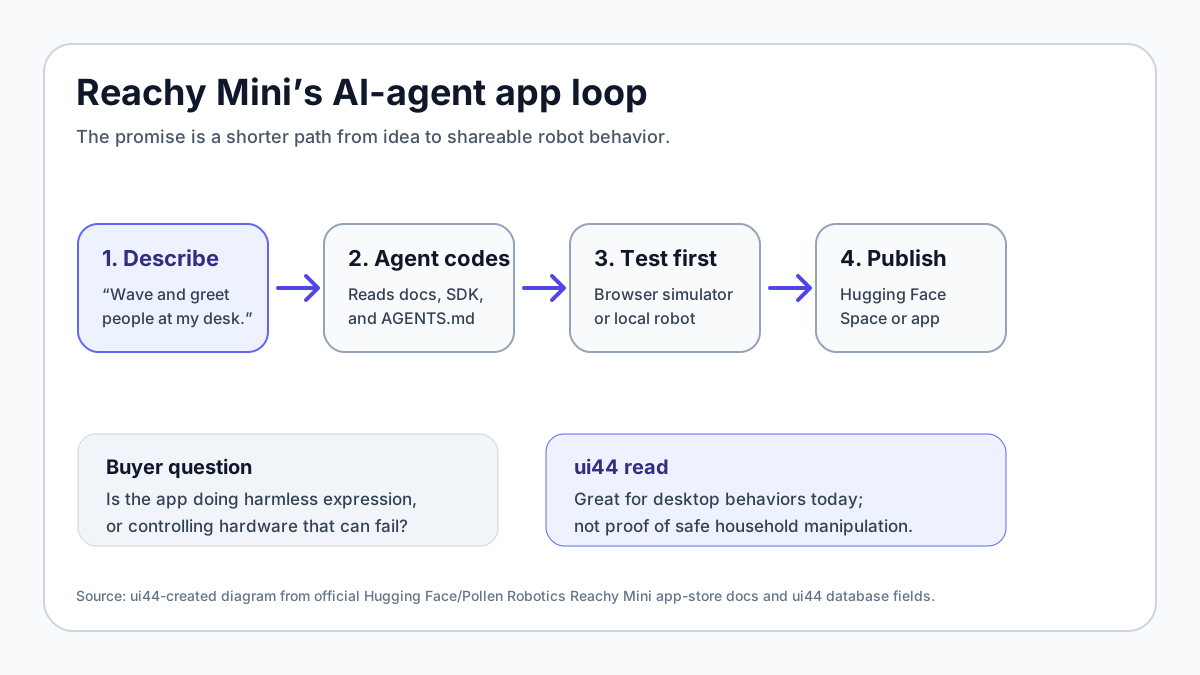
That is different from the usual robot-vacuum firmware update. It is closer to a small, open robot becoming a software platform. The buyer question becomes: what can an owner safely customize after purchase?
The key detail: not every robot app runs the same way
The official Reachy Mini AI-agent guide is unusually explicit about app types. It tells agents to default to a JavaScript Live/Web app for end users unless the user has a reason to use Python. That is a sensible default, because a web app can be shared by URL, opened from a phone, run as a static Hugging Face Space, and connect to the robot over WebRTC through a signaling server.
In plain English: JavaScript Live/Web Reachy Mini apps are not installed like phone apps on the robot itself. They are web experiences that can reach the robot the owner has authorized through the documented WebRTC route. That is powerful for sharing, but it also means buyers should ask normal connected-device questions: who can access the app, what permissions it needs, whether camera and microphone use is obvious, and what happens if the app breaks mid-session.
Python apps sit in a deeper lane. The official packaging guide describes the Reachy Mini app assistant, local checks, dashboard testing, and publishing to Hugging Face Spaces. Python makes sense for developers, educators, local tools, or richer control loops. It also raises the support burden. If an app controls motion more directly, the difference between a fun demo and a frustrating robot becomes smaller.
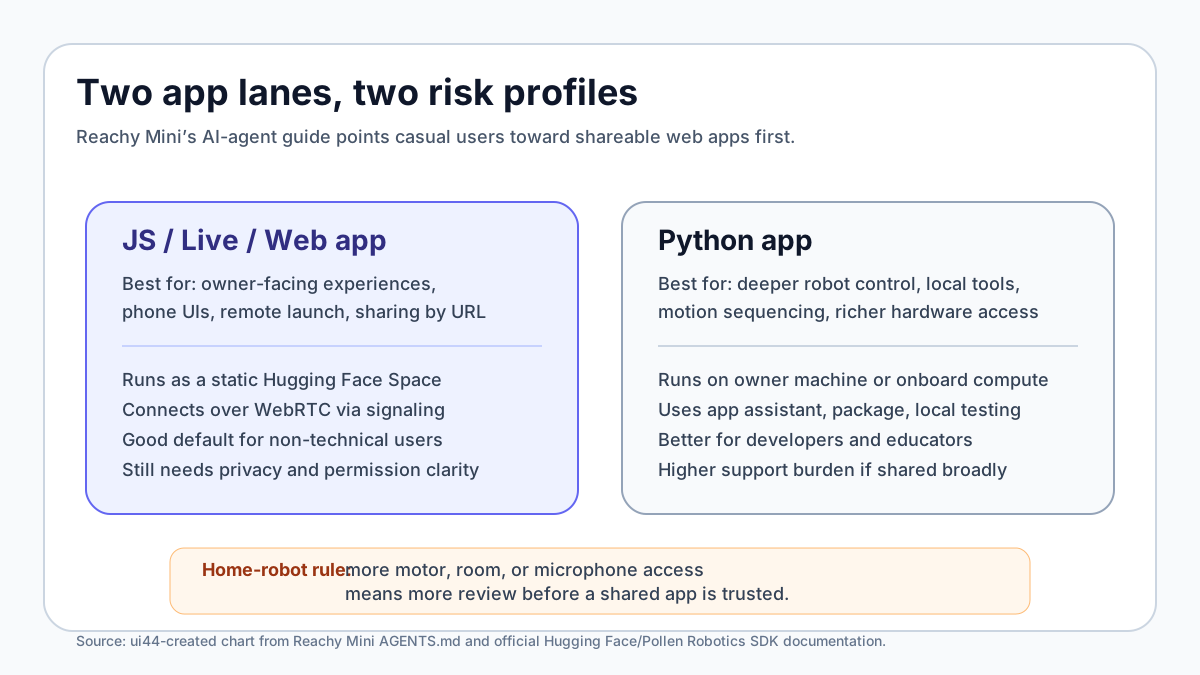
For Reachy Mini, the physical downside is modest. A bad app can annoy you, fail to connect, use the microphone in a confusing way, or move the robot's head and antennas at the wrong time. Because Reachy Mini lacks arms, wheels, and a gripper, it cannot create high-consequence manipulation or navigation failures like carrying a knife, falling down stairs, or causing room-scale collisions. That is why desktop robots and simulators are the right place for AI-agent app creation to mature before the same idea moves into larger household robots.
What can an AI-built Reachy Mini app actually do?
A useful Reachy Mini app usually combines three ingredients:
- Expression: head movement, body rotation, antennas, sound, and timing.
- Input: camera, microphones, buttons, dashboard controls, or a web UI.
- Cloud or local intelligence: an LLM, speech model, vision model, scheduling logic, or game state.
That covers more real use cases than it sounds like. A desk robot can become a language-practice partner, a meeting facilitator, a children's coding teacher, a timer with personality, a quiz host, a companion for remote family check-ins, or a visible interface for smart-home routines. It can also be a robot-specific way to teach kids that AI is not just a chat window.
But a Reachy Mini app cannot compensate for missing hardware. No AI agent can turn it into a mobile security robot, a vacuum, a laundry helper, or a robot arm. If a task needs locomotion, payload, grip force, navigation, or safe contact with people, the app-store model hits a wall.
That is the biggest lesson for home-robot buyers. Software openness makes a robot more adaptable, but hardware determines the ceiling. A buyer should not ask only whether a robot has an SDK. They should ask what the SDK is allowed to move, sense, store, and publish.
How Reachy Mini compares with other modifiable robots
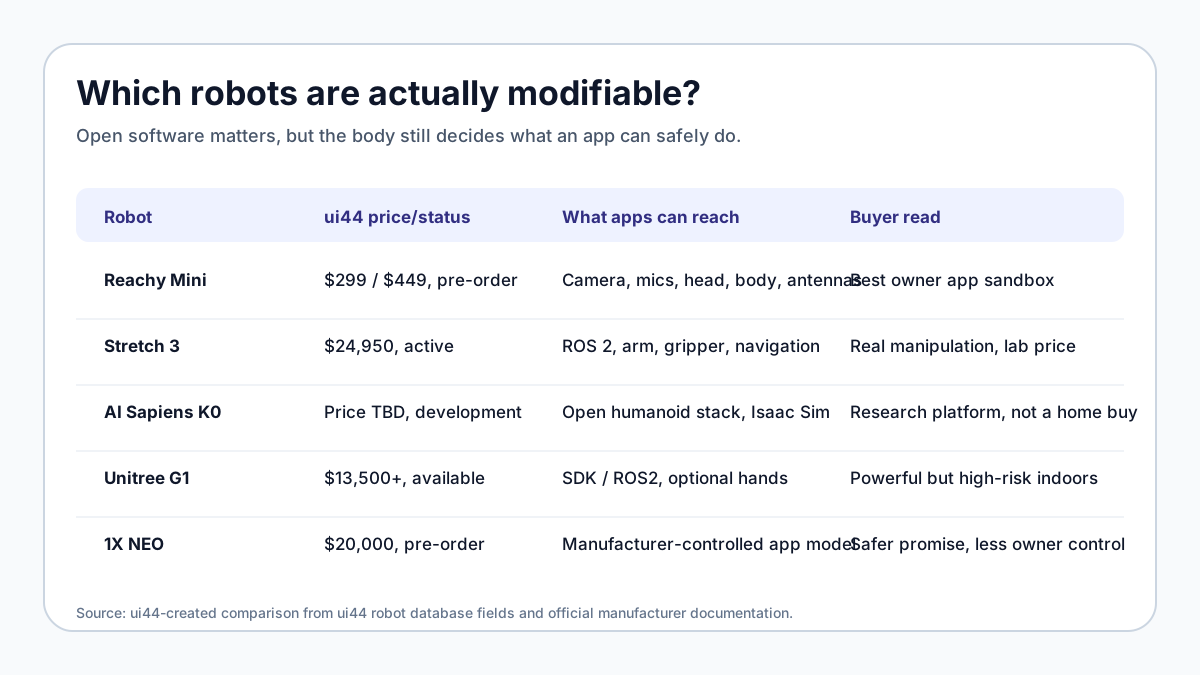
The ui44 database makes the difference clear. Reachy Mini is the friendliest owner-app sandbox because it is small, cheap by robot standards, and designed around sharing behaviors. Other modifiable robots have more useful bodies, but they are either much more expensive, more dangerous indoors, or less consumer oriented.
Robot
- ui44 data point
- $299 Lite / $449 wireless, 28 cm, 1.5 kg, pre-order
- Why it matters for apps
- Best fit for owner-created expressive apps, education, and AI experiments
Robot
- ui44 data point
- Research robot, ~50 kg, about $70,000, two 7-DoF arms, ROS 2 / Python
- Why it matters for apps
- Shows what open manipulation can look like, but not a normal home purchase
Robot
- ui44 data point
- $24,950, 24.5 kg, 2 kg payload, ROS 2 / Python SDK
- Why it matters for apps
- Real home-oriented manipulation platform, priced for labs and assistive research
Robot
- ui44 data point
- 1.3 m, 34 kg, 23 DoF, 3 kg arm payload, open-source research stack
- Why it matters for apps
- Strong open humanoid direction, but development-stage and not a consumer appliance
Robot
- ui44 data point
- Starts around $13,500, 132 cm, 35 kg, SDK / ROS2, optional dexterous hands
- Why it matters for apps
- Powerful enough to be risky; buyer-created apps need far more safety gates
Robot
- ui44 data point
- $20,000 early-adopter price, 167 cm, 30 kg, home-focused humanoid
- Why it matters for apps
- More chore-relevant body, but likely manufacturer-controlled skill rollout
| Robot | ui44 data point | Why it matters for apps |
|---|---|---|
| Reachy Mini | $299 Lite / $449 wireless, 28 cm, 1.5 kg, pre-order | Best fit for owner-created expressive apps, education, and AI experiments |
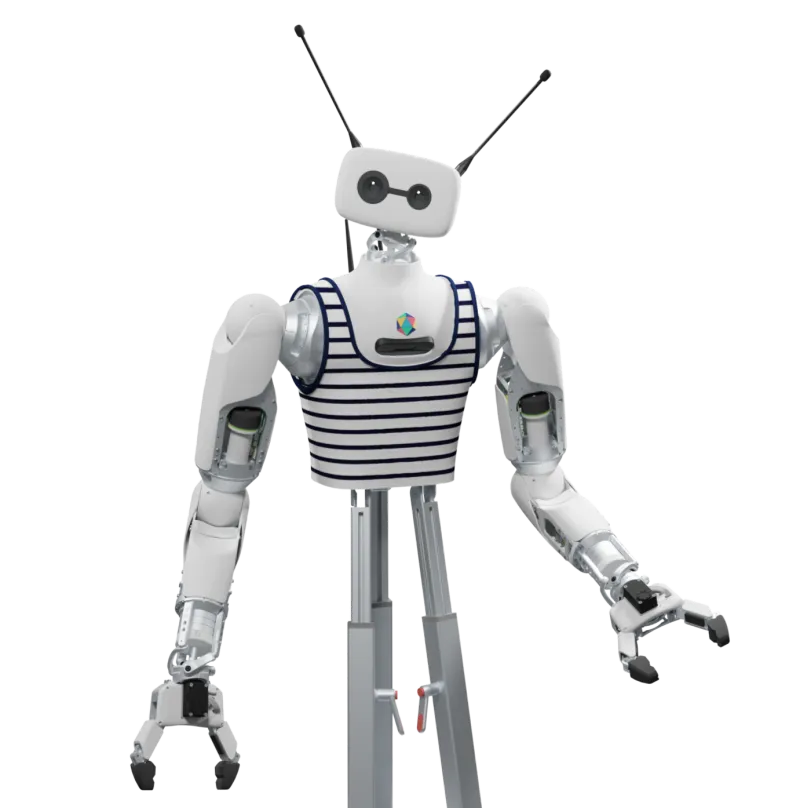
| Reachy 2 | Research robot, ~50 kg, about $70,000, two 7-DoF arms, ROS 2 / Python | Shows what open manipulation can look like, but not a normal home purchase |
| Stretch 3 | $24,950, 24.5 kg, 2 kg payload, ROS 2 / Python SDK | Real home-oriented manipulation platform, priced for labs and assistive research |
| AI Sapiens K0 | 1.3 m, 34 kg, 23 DoF, 3 kg arm payload, open-source research stack | Strong open humanoid direction, but development-stage and not a consumer appliance |
| Unitree G1 | Starts around $13,500, 132 cm, 35 kg, SDK / ROS2, optional dexterous hands | Powerful enough to be risky; buyer-created apps need far more safety gates |
| 1X NEO | $20,000 early-adopter price, 167 cm, 30 kg, home-focused humanoid | More chore-relevant body, but likely manufacturer-controlled skill rollout |
This is where Reachy Mini's limitations become a feature. A 1.5 kg desk robot is a better first platform for thousands of agent-assisted experiments than a 30 kg or 35 kg humanoid walking through a home. The agent can be creative while the hardware keeps the consequences bounded.
For bigger robots, the same app-store metaphor needs stricter rules. A new voice personality is low risk. A new hand-tracking demo is moderate risk. A new "load the dishwasher" behavior is a full physical safety problem involving wet objects, sharp utensils, collision recovery, torque limits, and household privacy. Those should not be treated as casual community downloads.
What should buyers look for before trusting robot apps?
If AI-generated robot apps become common, buyers should evaluate the platform, not just the demo. A good home-robot app ecosystem needs at least six things:
- Clear permissions. Camera, microphone, speaker, motor, network, and cloud access should be visible before launch.
- Simulation or preview. The owner should be able to test behavior before running it on hardware.
- Version pinning. Shared apps should not silently break because an SDK or model changed underneath them.
- Stop and recovery controls. The robot needs an obvious way to pause, stop, sleep, disconnect, or roll back.
- Human-readable code and logs. Open-source apps are easier to audit, inspect, fork, and repair than black-box skills.
- Safety tiers. Talking, displaying, and small gestures should not be reviewed the same way as navigation, grasping, lifting, or contact tasks.
Reachy Mini already points at several of these. Its docs emphasize simulation, one-click app installation, community sharing, an open SDK, and an agent guide that tries to steer users toward sensible app types. The open-source approach is a real advantage because buyers are not locked into a single company's idea of what the robot can become.
But openness is not the same as appliance reliability. Open-source software can be brilliant, messy, under-supported, insecure, or all of those at once. A buyer who wants a dependable family product should judge the app ecosystem by update quality, moderation, recovery tools, and support history, not by the number of apps alone.
Does this replace official robot skills?
No. For home robots with arms, wheels, or access to private rooms, official skills still matter. A manufacturer can test on known hardware revisions, set motor limits, enforce privacy policies, and support customers when something fails. Community apps and AI-agent apps are better treated as a second layer: great for customization, education, prototyping, and niche behaviors, but not a replacement for validated core functions.
The most likely future is a split model:
- Owner-created apps for expression, games, dashboards, tutoring, smart-home triggers, and low-risk behaviors.
- Reviewed community apps for camera, microphone, remote-access, or recurring automations.
- Manufacturer-approved skills for navigation, manipulation, lifting, contact-rich chores, and anything involving children, pets, or fragile items.
That split is healthy. A home robot should be more customizable than a sealed appliance, but less casually extensible than a browser extension. Physical movement changes the ethics of software distribution.
Bottom line
Reachy Mini is not proof that AI agents can build safe apps for every home robot. It is proof that the first credible wave of owner-created robot apps will probably start small: desktop robots, simulators, open docs, web interfaces, and bounded motion.
For buyers, that makes Reachy Mini interesting even if you never plan to write Python. It is a signal for where the market is heading. The robots that age well will not just ship with a fixed feature list. They will have understandable developer tools, safe permission models, good simulation, and a way for owners and communities to add behaviors after purchase.
If you are comparing robots today, use a simple test: would you trust a random AI-generated app to run this robot in your home? For a small desk companion, maybe. For a humanoid that can lift objects, not without serious review. That is the line Reachy Mini helps make visible.
Related in the database
Use this article as a privacy verification workflow
Turn the article into a privacy verification pass grounded in the robots, manufacturers, and components it actually references.
Can AI Coding Agents Build Home Robot Apps? already points you toward 6 linked robots, 5 manufacturers, and 5 countries inside the ui44 database. That matters because strong buyer guidance is easier to apply when you can move immediately from a claim or warning into concrete product pages, manufacturer directories, component explainers, and country-level context instead of treating the article as an isolated opinion piece. The fastest next step is to turn the article into a shortlist workflow: open the linked robot pages, verify which specs are actually published for those models, then compare the surrounding manufacturer and component context before you decide whether the underlying claim changes your buying plan.
For this topic, the useful discipline is to separate the editorial lesson from the catalog evidence. The article gives you the framing, but the robot pages tell you what each product actually ships with today: sensor stack, connectivity methods, listed price, release timing, category, and support-relevant compatibility notes. The manufacturer pages then show whether you are looking at a one-off launch, a broader lineup pattern, or a company that spans multiple categories. That layered workflow reduces the risk of buying on a single marketing phrase or a single support FAQ.
Use the robot pages to confirm which products actually expose cameras, microphones, Wi-Fi, or voice systems, then use the manufacturer pages to decide how much of the privacy question seems product-specific versus brand-wide. On this route cluster, Reachy Mini, Reachy 2, and Stretch 3 form the fastest reality check. If you want a quick working shortlist, open Compare Reachy Mini, Reachy 2, and Stretch 3 next, then keep this article open as the reasoning layer while you compare structured data side by side.
Practical Takeaway
Every robot, manufacturer, category, component, and country reference below resolves to a real ui44 page, keeping the follow-up path grounded in database records rather than generic advice.
Suggested next steps in ui44
- Open Reachy Mini and note the listed sensors, connectivity methods, and voice stack before you interpret any policy claim.
- Cross-check the wider brand context on Pollen Robotics so you can see whether the privacy question touches one model or a broader lineup.
- Use the linked component pages to confirm how common the relevant sensors and connectivity layers are across the database.
- Keep a short note of which policy layers you checked, which device features are actually present on the robot page, and which items still depend on region- or app-level confirmation.
- Finish with Compare Reachy Mini, Reachy 2, and Stretch 3 so the policy reading sits next to structured product data.
Robot profiles worth opening next
Use the linked product pages as the evidence layer
The linked robot pages are where this article becomes operational. Instead of asking whether the headline is interesting, use the robot entries to inspect the actual mix of sensors, connectivity options, batteries, pricing, release timing, and stated capabilities attached to the products mentioned in the article. That is the easiest way to see whether the warning or opportunity described here affects one product family, a specific design pattern, or an entire buying lane.
Reachy Mini
Pollen Robotics · Companions · Available
Reachy Mini is tracked on ui44 as a available companions robot from Pollen Robotics. The database currently records a listed price of $299, a release date of 2025-07, Not officially disclosed battery life, Not officially disclosed charging time, and a published stack that includes 120° 12 MP autofocus wide-angle camera, 4 PDM MEMS digital microphones, and 5 W speaker plus USB (Reachy Mini Lite via host computer) and Wi-Fi (wireless Reachy Mini).
For privacy-focused reading, this page matters because it shows the concrete device surface behind the policy discussion. Use it to verify whether Reachy Mini combines sensors and connectivity in a way that could change the in-home data footprint, and compare the listed capabilities such as 6-DoF head movement, Full body rotation, and Animated antennas for expressive interaction with any cloud, app, or voice layers.
Reachy 2
Pollen Robotics · Research · Active
Reachy 2 is tracked on ui44 as a active research robot from Pollen Robotics. The database currently records a listed price of $70,000, a release date of 2024, 8 hours (mobile base, per official hardware docs) battery life, Not disclosed charging time, and a published stack that includes Stereo RGB Cameras (fish-eye), Time-of-Flight Depth Sensor (OAK-FFC ToF 33D), and RGB-D Camera (Orbbec Gemini 336) plus Wi-Fi and Ethernet.
For privacy-focused reading, this page matters because it shows the concrete device surface behind the policy discussion. Use it to verify whether Reachy 2 combines sensors and connectivity in a way that could change the in-home data footprint, and compare the listed capabilities such as Object manipulation (pick and place), VR teleoperation, and Autonomous navigation with any cloud, app, or voice layers.
Stretch 3
Hello Robot · Home Assistants · Active
Stretch 3 is tracked on ui44 as a active home assistants robot from Hello Robot. The database currently records a listed price of $24,950, a release date of 2024, 2–5 hours battery life, Not disclosed charging time, and a published stack that includes Intel D405 RGBD Camera (gripper), Intel D435if RGBD Camera (head), and Wide-Angle RGB Camera (head) plus Wi-Fi 6E and Bluetooth.
For privacy-focused reading, this page matters because it shows the concrete device surface behind the policy discussion. Use it to verify whether Stretch 3 combines sensors and connectivity in a way that could change the in-home data footprint, and compare the listed capabilities such as Mobile Manipulation, Autonomous Navigation, and Teleoperation (Web / Gamepad / Dexterous) with any cloud, app, or voice layers.
AI Sapiens K0
ROBOTIS · Research · Development
AI Sapiens K0 is tracked on ui44 as a development research robot from ROBOTIS. The database currently records a listed price of Price TBA, a release date of 2026, Not officially disclosed (46.8 V, 9000 mAh battery) battery life, Not disclosed charging time, and a published stack that includes IMU (inferred from locomotion capability) plus Wi-Fi 5 and Bluetooth 5.0.
For privacy-focused reading, this page matters because it shows the concrete device surface behind the policy discussion. Use it to verify whether AI Sapiens K0 combines sensors and connectivity in a way that could change the in-home data footprint, and compare the listed capabilities such as Bipedal locomotion research, Reinforcement learning training in NVIDIA Isaac Sim, and Imitation learning via leader-follower data collection with any cloud, app, or voice layers.
G1 is tracked on ui44 as a available humanoid robot from Unitree. The database currently records a listed price of $13,500, a release date of 2024-05-13, ~2 hours battery life, Not disclosed charging time, and a published stack that includes Depth Camera, 3D LiDAR, and 4 Microphone Array plus Wi-Fi 6 and Bluetooth 5.2.
For privacy-focused reading, this page matters because it shows the concrete device surface behind the policy discussion. Use it to verify whether G1 combines sensors and connectivity in a way that could change the in-home data footprint, and compare the listed capabilities such as Bipedal Walking, Object Manipulation, and Dexterous Hands (optional Dex3-1) with any cloud, app, or voice layers.
Manufacturer context behind the article
Check whether this is one product story or a broader company pattern
Manufacturer pages add the privacy context that individual product pages cannot show on their own. They help you check whether cameras, microphones, cloud accounts, app controls, and policy assumptions appear across a broader lineup or stay tied to one specific product story.
Pollen Robotics
ui44 currently tracks 2 robots from Pollen Robotics across 2 categorys. The company is grouped under France, and the current catalog footprint on ui44 includes Reachy 2, Reachy Mini.
That wider brand context matters because privacy questions rarely stop at one FAQ page. A manufacturer route helps you see whether the article is centered on one premium model or on a company that has several relevant products and therefore more than one place where the same policy or app assumptions might matter. The category mix here currently points toward Research, Companions as the most useful next route if you want to see whether this article reflects a wider pattern inside the brand.
Hello Robot
ui44 currently tracks 2 robots from Hello Robot across 1 category. The company is grouped under USA, and the current catalog footprint on ui44 includes Stretch 3, Stretch 4.
That wider brand context matters because privacy questions rarely stop at one FAQ page. A manufacturer route helps you see whether the article is centered on one premium model or on a company that has several relevant products and therefore more than one place where the same policy or app assumptions might matter. The category mix here currently points toward Home Assistants as the most useful next route if you want to see whether this article reflects a wider pattern inside the brand.
ROBOTIS
ui44 currently tracks 2 robots from ROBOTIS across 1 category. The company is grouped under South Korea, and the current catalog footprint on ui44 includes ROBOTIS OP3, AI Sapiens K0.
That wider brand context matters because privacy questions rarely stop at one FAQ page. A manufacturer route helps you see whether the article is centered on one premium model or on a company that has several relevant products and therefore more than one place where the same policy or app assumptions might matter. The category mix here currently points toward Research as the most useful next route if you want to see whether this article reflects a wider pattern inside the brand.
Unitree
ui44 currently tracks 2 robots from Unitree across 1 category. The company is grouped under China, and the current catalog footprint on ui44 includes H1, G1.
That wider brand context matters because privacy questions rarely stop at one FAQ page. A manufacturer route helps you see whether the article is centered on one premium model or on a company that has several relevant products and therefore more than one place where the same policy or app assumptions might matter. The category mix here currently points toward Humanoid as the most useful next route if you want to see whether this article reflects a wider pattern inside the brand.
Broaden the scan without leaving the database
Categories, components, and countries add the wider context
Category framing
Category pages are useful when the article touches a buying pattern that shows up across brands. A category route helps you confirm whether the linked products sit in a narrow niche or whether the same question should be tested across a larger field of alternatives.
Companions
The Companions category page currently groups 53 tracked robots from 48 manufacturers. ui44 describes this lane as: Social robots, robot pets, and elderly-care companions designed for emotional connection and everyday support at home.
That makes the category route a practical follow-up when you want to check whether the products linked in this article are typical for the lane or whether they sit at one edge of the market. Useful starting examples currently include PARO, Abi, Next-Generation Companion Robot.
Research
The Research category page currently groups 49 tracked robots from 39 manufacturers. ui44 describes this lane as: Academic and research robotics platforms pushing the boundaries of what machines can learn and do in the lab and beyond.
That makes the category route a practical follow-up when you want to check whether the products linked in this article are typical for the lane or whether they sit at one edge of the market. Useful starting examples currently include HRP-4C, HRP-5P, NAO6.
Country and ecosystem context
Country pages give extra context when support practices, launch sequencing, regulatory posture, or manufacturer mix matter. They are not a substitute for model-level verification, but they do help you see which ecosystems cluster together and which manufacturers sit in the same regional field when you broaden the search beyond the article headline.
France
The France route currently groups 8 tracked robots from 7 manufacturers in ui44. That gives you a useful regional lens when the article points toward support practices, launch sequencing, or brand clusters that may share similar ecosystem assumptions.
On the current route, manufacturers like Pollen Robotics, Aldebaran / Maxtronics, Aldebaran Robotics make the page a good way to broaden the scan without losing the regional context that often shapes availability, documentation style, and adjacent alternatives.
USA
The USA route currently groups 89 tracked robots from 69 manufacturers in ui44. That gives you a useful regional lens when the article points toward support practices, launch sequencing, or brand clusters that may share similar ecosystem assumptions.
On the current route, manufacturers like Faraday Future, iRobot, Boston Dynamics make the page a good way to broaden the scan without losing the regional context that often shapes availability, documentation style, and adjacent alternatives.
South Korea
The South Korea route currently groups 9 tracked robots from 7 manufacturers in ui44. That gives you a useful regional lens when the article points toward support practices, launch sequencing, or brand clusters that may share similar ecosystem assumptions.
On the current route, manufacturers like ROBOTIS, Samsung, GenON make the page a good way to broaden the scan without losing the regional context that often shapes availability, documentation style, and adjacent alternatives.
Questions to answer before you move from reading to buying
A follow-up FAQ built from the entities already linked in this article
Frequently Asked Questions
Which page should I open first after reading “Can AI Coding Agents Build Home Robot Apps?”?
Start with Reachy Mini. That gives you a concrete product anchor for the article’s main claim. From there, branch into the manufacturer and component pages so you can tell whether the article is describing one specific model, a repeated brand pattern, or a wider technology issue that affects multiple shortlist options.
How do the manufacturer pages change the buying decision?
Pollen Robotics help you zoom out from one article and one product. On ui44 they show lineup breadth, category spread, and the neighboring robots tied to the same company. That context is useful when you are deciding whether a risk belongs to a single model, whether it shows up across a brand’s portfolio, and whether you should keep looking at alternatives before committing.
When should I switch from reading to side-by-side comparison?
Move into Compare Reachy Mini, Reachy 2, and Stretch 3 as soon as you understand the article’s main warning or promise. The article explains what to watch for, but the compare view is where you can check whether price, status, battery life, connectivity, sensors, and category fit still make the robot a good match for your own home and budget.
Where to go next in ui44
Keep the research chain inside the database
If you want to keep going, these follow-on pages give you the cleanest expansion path from article to research session. Open the comparison route first if you are deciding between products today. Open the manufacturer, category, and component routes if you still need to understand the broader pattern behind the claim.
Written by
ui44 Team
Published May 13, 2026
Share this article
Open a plain share link on X or Bluesky. No embeds, no widgets, no cookie baggage.