That is the useful lens for DOBOT Atom. DOBOT is best known for collaborative robot arms, education robots, and industrial automation, not for friendly kitchen helpers. Atom changes the shape of that story: it puts DOBOT's manipulation, motion-control, and automation background into a full-size humanoid platform.
This does not mean Atom is ready to load your dishwasher. It means cobot makers may have an advantage in the part of home robotics that matters most after the demo video ends: reliable manipulation around people.

The short version: DOBOT Atom is a stronger signal for the future of home humanoids than another walking demo, because it starts from arms, repeatability, task programming, safety culture, and service networks. The catch is just as important: Atom is still an industrial and commercial platform first. Home buyers should treat it as evidence of where the market is going, not as a consumer product to put in a laundry room.
What is DOBOT Atom?
DOBOT describes Atom as a full-size embodied AI humanoid robot built around three ideas: dexterous manipulation, straight-knee walking, and cross-scenario work.
The details matter because they are different from the usual humanoid pitch. On its official product page, DOBOT says Atom uses a Neuro-Driven Dexterity System to control 28 upper-body degrees of freedom with binocular RGB vision, servo-level vibration suppression, and 200 Hz high-frequency control. The company claims ±0.05 mm manipulation precision, which is the kind of spec you expect from a precision automation company, not a toy-like social robot.
For locomotion, DOBOT emphasizes its Anthropomorphic Walking System. The claim is not only that Atom can walk; it is that straight-knee walking can reduce energy consumption by 42% compared with bent-knee walking, while adapting to narrow industrial spaces and workstation heights around 700-1000 mm.
For autonomy, DOBOT says Atom runs Robot Operator Model-1, or ROM-1, combining base and vertical-industry models trained with imitation and reinforcement learning. The official page describes 100 million parameters and 24 Hz end-to-end control for task decomposition and decision-making in unstructured environments such as automotive assembly, beverage preparation, and pharmacy operations.
In ui44's database, Atom is listed as Available, with a caveated $79,000 price record: the official product page no longer lists public pricing, and the $79,000 figure may still be accurate but is unverifiable as of April 2026. The database also deliberately marks several buyer-relevant specs as unknown: height, weight, battery life, charging time, speed, and payload are not publicly disclosed.
That mix is the whole story. Atom has unusually concrete manipulation claims, but it still lacks the consumer-style disclosure that a household buyer would need.
Why cobot heritage matters more than the humanoid shape
A home humanoid is not useful because it has legs and a face. It is useful if it can safely interact with a messy, changing house.
That makes collaborative-robot experience valuable. Cobots are designed for shared workspaces, repetitive tasks, precise motion, force limits, end effectors, deployment support, and maintenance. None of that automatically turns into a home robot, but it is closer to the hard part than a pure entertainment robot is.
DOBOT's company background is relevant here. Its official materials describe the company as China's number-one collaborative-robot exporter, with more than 100,000 cobots sold or deployed worldwide across over 100 countries and regions. The June 2025 Atom delivery announcement said DOBOT had entered global mass production and delivered the first batch live in Nagoya, Japan, with Japanese system integrator ASKA Corporation involved.
That does not prove household readiness. It does prove DOBOT is not starting from zero on manufacturing, partner support, or industrial service.
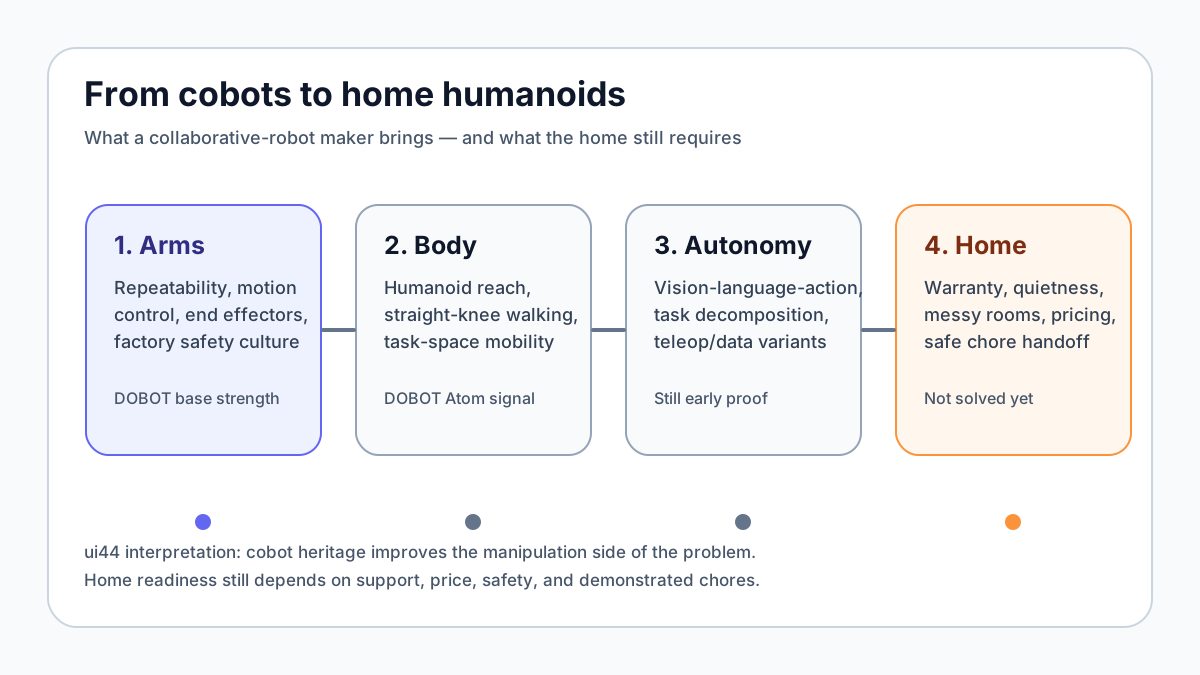
For home robotics, this changes the question. Instead of asking, "Which humanoid looks most human?" a better question is: which company understands reliable manipulation, safe deployment, field support, and task iteration?
That is where cobot makers deserve attention.
What Atom says about future home robots
Atom's most home-relevant lesson is not that one robot will go from factories to kitchens unchanged. It is that household robotics may inherit more from industrial automation than from smart speakers.
A useful home robot needs to do boring physical work. It needs to pick up dishes, operate handles, move laundry, carry items, retrieve objects, and deal with surfaces that were not designed for robots. That requires more than language understanding. It requires arm control, perception, grasp planning, and safe contact.
DOBOT Atom is explicitly framed around those areas. The product page mentions tool use, assembly, multi-specification handling, automotive material handling, coffee-shop beverage preparation, and pharmacy dispensing. Those are not home chores, but they are closer to home chores than a robot dancing on a stage.
The straight-knee walking claim also matters, but in a narrower way. A household robot does not need to sprint. It needs enough mobility to move between counters, tables, appliances, doorways, and cluttered paths without burning through its battery. If DOBOT's 42% energy-saving claim holds in real deployments, it points to a practical design problem: efficient standing and walking may matter more than maximum speed.
The third signal is data. DOBOT's Atom series includes Max, Trainer, and Data Collection variants. That tells us where the industry is going: companies know that humanoid autonomy will require teleoperation, demonstrations, task data, simulation, and repeated deployment loops. A robot that only ships as a sealed appliance may struggle to learn enough real-world edge cases.
For buyers, the implication is simple: the first useful home humanoids may come from companies that already know how to deploy boring robots into boring jobs.
How DOBOT Atom compares with home-adjacent robots
Atom is not the only robot trying to bridge industrial robotics and future household usefulness. The ui44 database shows several different paths:
Robot
- What it proves today
- Cobot-maker manipulation and industrial delivery
- Key ui44 data point
- 28 upper-body DoF, ±0.05 mm precision claim, ROM-1 AI, $79,000 caveated price
- Home-readiness caveat
- Consumer specs such as height, weight, battery, speed, and payload are still not public
Robot
- What it proves today
- Publicly buyable humanoid research platform
- Key ui44 data point
- Starts around $13,500, 132 cm, 35 kg, about 2 hours battery
- Home-readiness caveat
- More developer platform than home appliance
Robot
- What it proves today
- Compact humanoid with official store access
- Key ui44 data point
- $24,240, 131 cm, 35-39 kg, up to 30 DoF, 1.8 m/s
- Home-readiness caveat
- Research/commercial buyer fit; household tasks are not proven
Robot
- What it proves today
- Larger deployed humanoid platform
- Key ui44 data point
- 169 cm, 69 kg, 1.5h+ walking or 3h standing, enterprise pricing
- Home-readiness caveat
- More service/commercial than home
Robot
- What it proves today
- Real manipulation in retail-like environments
- Key ui44 data point
- 173 cm, 85 kg, 5 kg carry, 15 kg arm strength, VLA models for grasping
- Home-readiness caveat
- Enterprise retail robot, not a household product
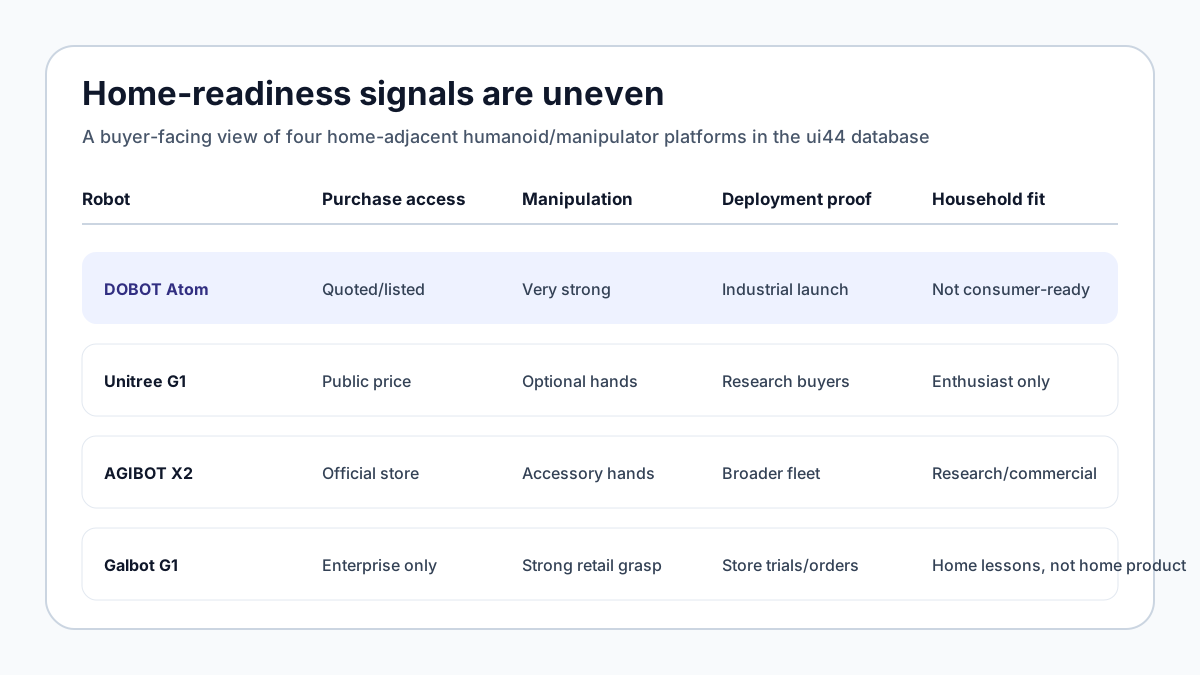
| Robot | What it proves today | Key ui44 data point | Home-readiness caveat |
|---|---|---|---|
| DOBOT Atom | Cobot-maker manipulation and industrial delivery | 28 upper-body DoF, ±0.05 mm precision claim, ROM-1 AI, $79,000 caveated price | Consumer specs such as height, weight, battery, speed, and payload are still not public |
| Unitree G1 | Publicly buyable humanoid research platform | Starts around $13,500, 132 cm, 35 kg, about 2 hours battery | More developer platform than home appliance |
| AGIBOT X2 | Compact humanoid with official store access | $24,240, 131 cm, 35-39 kg, up to 30 DoF, 1.8 m/s | Research/commercial buyer fit; household tasks are not proven |
| AGIBOT A2 Ultra | Larger deployed humanoid platform | 169 cm, 69 kg, 1.5h+ walking or 3h standing, enterprise pricing | More service/commercial than home |
| Galbot G1 | Real manipulation in retail-like environments | 173 cm, 85 kg, 5 kg carry, 15 kg arm strength, VLA models for grasping | Enterprise retail robot, not a household product |
This comparison is why Atom is interesting despite the high price. Unitree has the clearest public purchase path. AGIBOT has a strong lineup and visible deployment momentum. Galbot shows how manipulation can work in constrained retail environments. Atom brings a different credential: a cobot maker's precision-and-deployment mindset inside a humanoid shell.
No single path is obviously the winner. A home robot needs all of them eventually: affordable hardware, manipulation, autonomy, support, safety, and useful tasks.
The home-use blockers are still large
This is where the hype needs to slow down.
Atom is not currently positioned as a consumer home robot. DOBOT's own examples are automotive assembly, coffee service, pharmacy operations, research, data collection, and industrial/service scenarios. Those are meaningful, but they are not the same as a robot that can work safely around a toddler, a dog, a rug, a pile of laundry, and a half-open dishwasher.
The missing specs also matter. A buyer cannot evaluate a home humanoid without knowing basics like weight, runtime, charging behavior, noise, footprint, payload, fall behavior, service plan, warranty, and repair support. ui44 tracks these fields because they separate a demo from a product.
There is also the software gap. A robot can have an impressive model name and still fail at household work if it cannot recover from small mistakes. Dropping a sock, misidentifying a glass, bumping a cabinet, losing Wi-Fi, or encountering an unexpected object should not require an engineer. For more on why this matters, see our guide to why tidying a living room is the real home robot benchmark.
Finally, there is the price. Even if Atom's caveated $79,000 database record proves accurate, that is commercial equipment money. The current official page no longer lists a public price, so household buyers should treat the number as unverified rather than as a live checkout offer. It may be reasonable for a lab, a factory, or a systems integrator. It is not a normal home-robot purchase.
What buyers should watch next
If you are trying to judge whether cobot makers will shape home humanoids, do not watch only the stage demos. Watch for these signals:
- Public manipulation tasks with recovery. A controlled pick-and-place demo is not enough. Look for dishes, laundry, cabinets, awkward objects, and explicit failure recovery.
- Transparent physical specs. Weight, payload, runtime, charging, footprint, speed, and noise should be published before any product is described as home-ready.
- Safety and service model. Cobot companies understand safety, but homes are less controlled than factories. Support, warranty, emergency stop behavior, and remote-assist boundaries matter.
- Real deployment loops. A humanoid that can collect data, learn from teleoperation, and improve in repeated customer environments has a better chance than a one-off demo robot.
- Reasonable task scope. The first good home humanoid probably will not "do everything." It may start with carrying, fetching, simple tidying, or assisted chores. That is fine if the company is honest about it.
DOBOT is worth watching because it checks some of the upstream boxes. It has cobot experience, a global partner/service footprint, and a humanoid platform that emphasizes manipulation. It still needs the downstream home proof.
Should a home buyer care about DOBOT Atom now?
Yes — but not as a shopping recommendation.
A normal household should not look at Atom as the next appliance after a robot vacuum. It is too industrial, too expensive, and too underspecified for consumer use. If you are a lab, integrator, or enterprise buyer, Atom may belong on a short list with active platforms such as Figure 03, AGIBOT X2, and other manipulation-focused humanoids. If you are a home buyer, Atom is more useful as a market signal.
That signal is important. The race for home humanoids is not just a race to make robots walk. It is a race to make robots manipulate the world safely and repeatedly. Cobot makers have spent years solving pieces of that problem in factories, classrooms, labs, and shared workspaces.
The home is harder because it is less structured. But that is exactly why DOBOT Atom is interesting: it reminds us that the winning home robot may come from the company that makes the least flashy claim and solves the most repetitive physical work.
For now, the best way to read Atom is this: not home-ready, but directionally important. It is one more sign that future household robots will be judged less by how human they look and more by whether their arms can do useful work without making the owner become a robotics technician.
Related in the database
Use this article as a setup-friction workflow
Turn the article into a first-day setup pass grounded in the robots, manufacturers, and countries it actually references.
DOBOT Atom: Can Cobots Shape Home Humanoids? already points you toward 6 linked robots, 5 manufacturers, and 2 countries inside the ui44 database. Treat those links as a first-day setup trail: open the robot pages, check what is actually published about charging, battery life, control method, app or OTA support, and recovery, then use the surrounding manufacturer and country context to judge whether the article describes a low-friction product path or a still-specialist deployment.
For setup topics, the useful discipline is to separate a polished demo from the work required after the box arrives. The article gives you the narrative, but the robot pages show the operational clues: dimensions, weight, battery runtime, charging time, controller support, listed availability, and the capabilities that might need supervision. Manufacturer pages then reveal whether the same setup assumptions repeat across a wider lineup.
Use the robot pages to verify what happens between delivery and the first useful task: size, weight, battery, charger or dock path, controller, app, OTA support, and recovery cues. On this route cluster, DOBOT Atom, G1, and X2 form the fastest setup-friction reality check. If you want a quick working shortlist, open Compare DOBOT Atom, G1, and X2 next, then keep this article open while you compare first-day setup evidence side by side.
Practical Takeaway
The links below stay tied to the robots, manufacturers, and countries actually referenced by this setup article, so the checklist remains grounded in published ui44 records rather than generic humanoid advice.
Suggested next steps in ui44
- Open DOBOT Atom and check the concrete first-day fields: box contents, charger or dock path, battery life, controller, app, OTA support, and recovery options.
- Use DOBOT to see whether the company’s broader lineup looks appliance-like, developer-first, or still closer to a pilot deployment.
- Run Compare DOBOT Atom, G1, and X2 with the article open and compare battery, size, weight, price path, status, and support cues side by side.
- Write down the first realistic task each robot can plausibly attempt on day one, then separate low-friction setup signals from impressive but still lab-style demos.
Robot profiles worth opening next
Use the linked product pages as the evidence layer
The linked robot pages are where this setup article becomes operational. Use the robot entries to inspect the actual mix of size, weight, battery runtime, charging path, control method, pricing, availability, and stated capabilities attached to the products mentioned in the article. That is the easiest way to see whether the first useful task looks appliance-like, developer-led, or still dependent on supervised experimentation.
DOBOT Atom
DOBOT · Humanoid · Available
DOBOT Atom is tracked on ui44 as a available humanoid robot from DOBOT. The database currently records a listed price of $79,000, a release date of 2025-06, Not publicly disclosed battery life, Not publicly disclosed charging time, and a published stack that includes Binocular RGB Vision, Intel RealSense D455 Depth Camera, and 360° LiDAR plus Ethernet.
For setup-friction reading, this page matters because it shows the physical and support burden behind the demo. Use it to verify whether DOBOT Atom has a credible day-one path across charging, control, recovery, battery limits, and listed capabilities such as 28 upper-body degrees of freedom (DoF), ±0.05 mm manipulation precision, and Straight-knee walking.
G1 is tracked on ui44 as a available humanoid robot from Unitree. The database currently records a listed price of $13,500, a release date of 2024-05-13, ~2 hours battery life, Not disclosed charging time, and a published stack that includes Depth Camera, 3D LiDAR, and 4 Microphone Array plus Wi-Fi 6 and Bluetooth 5.2.
For setup-friction reading, this page matters because it shows the physical and support burden behind the demo. Use it to verify whether G1 has a credible day-one path across charging, control, recovery, battery limits, and listed capabilities such as Bipedal Walking, Object Manipulation, and Dexterous Hands (optional Dex3-1).
X2 is tracked on ui44 as a available humanoid robot from AGIBOT. The database currently records a listed price of $24,240, a release date of 2025, ~2 hours at 0.5 m/s walking battery life, ~1.5 hours charging time, and a published stack that includes 3D LiDAR (Ultra), RGB-D Camera (Ultra), and RGB Cameras plus Wi-Fi and Bluetooth.
For setup-friction reading, this page matters because it shows the physical and support burden behind the demo. Use it to verify whether X2 has a credible day-one path across charging, control, recovery, battery limits, and listed capabilities such as Bipedal Walking, 25-30 DOF Articulation, and Object Manipulation (with OmniHand accessory).
A2 Ultra is tracked on ui44 as a available humanoid robot from AGIBOT. The database currently records a listed price of $999,999, a release date of 2024, Standing: 3h, Walking: 1.5h+ battery life, 2 hours charging time, and a published stack that includes 3D LiDAR, RGB-D Camera, and RGB Camera plus Wi-Fi and 4G/5G.
For setup-friction reading, this page matters because it shows the physical and support burden behind the demo. Use it to verify whether A2 Ultra has a credible day-one path across charging, control, recovery, battery limits, and listed capabilities such as Bipedal Walking, Autonomous Navigation, and Intelligent Obstacle Avoidance.
G1 is tracked on ui44 as a active commercial robot from Galbot. The database currently records a listed price of Price TBA, a release date of 2025, 10 hours battery life, Not disclosed charging time, and a published stack that includes Binocular camera x1, Wrist depth cameras x2, and 6-axis force sensors x2 plus Wi-Fi (2.4/5 GHz) and Ethernet.
For setup-friction reading, this page matters because it shows the physical and support burden behind the demo. Use it to verify whether G1 has a credible day-one path across charging, control, recovery, battery limits, and listed capabilities such as Autonomous Retail Store Operation, Generalizable Object Grasping (5,000+ product types), and Shelf Replenishment & Inventory Management, with voice support noted as Natural Language Voice Commands.
Manufacturer context behind the article
Check whether this is one product story or a broader company pattern
Manufacturer pages add the setup context that individual product pages cannot show on their own. They help you check whether a brand repeats the same controller, battery, update, support, and availability patterns across multiple robots, or whether the article is really describing one early product path. That matters for humanoids because first-day friction usually comes from the surrounding ecosystem as much as from the robot itself.
DOBOT
ui44 currently tracks 2 robots from DOBOT across 2 categorys. The company is grouped under China, and the current catalog footprint on ui44 includes DOBOT Atom, Rover X1.
That wider brand context matters because setup friction is rarely just a box problem. A manufacturer route helps you see whether the company has repeated controller, battery, support, and update patterns across its lineup, or whether the article is really about one early product story. The category mix here currently points toward Humanoid, Quadruped as the most useful next route if you want to see whether this article reflects a wider pattern inside the brand.
Unitree
ui44 currently tracks 2 robots from Unitree across 1 category. The company is grouped under China, and the current catalog footprint on ui44 includes H1, G1.
That wider brand context matters because setup friction is rarely just a box problem. A manufacturer route helps you see whether the company has repeated controller, battery, support, and update patterns across its lineup, or whether the article is really about one early product story. The category mix here currently points toward Humanoid as the most useful next route if you want to see whether this article reflects a wider pattern inside the brand.
AGIBOT
ui44 currently tracks 10 robots from AGIBOT across 3 categorys. The company is grouped under China, and the current catalog footprint on ui44 includes A2 Ultra, X2, Expedition A3.
That wider brand context matters because setup friction is rarely just a box problem. A manufacturer route helps you see whether the company has repeated controller, battery, support, and update patterns across its lineup, or whether the article is really about one early product story. The category mix here currently points toward Humanoid, Quadruped, Commercial as the most useful next route if you want to see whether this article reflects a wider pattern inside the brand.
Galbot
ui44 currently tracks 2 robots from Galbot across 2 categorys. The company is grouped under China, and the current catalog footprint on ui44 includes G1, S1.
That wider brand context matters because setup friction is rarely just a box problem. A manufacturer route helps you see whether the company has repeated controller, battery, support, and update patterns across its lineup, or whether the article is really about one early product story. The category mix here currently points toward Commercial, Humanoid as the most useful next route if you want to see whether this article reflects a wider pattern inside the brand.
Broaden the scan without leaving the database
Categories, components, and countries add the wider context
Category framing
Category pages are useful when the article touches a buying pattern that shows up across brands. A category route helps you confirm whether the linked products sit in a narrow niche or whether the same question should be tested across a larger field of alternatives.
Humanoid
The Humanoid category page currently groups 129 tracked robots from 92 manufacturers. ui44 describes this lane as: Full-size bipedal humanoid robots built to work alongside people — from factory floors to household tasks. Compare the cutting edge of humanoid robotics.
That makes the category route a practical follow-up when you want to check whether the products linked in this article are typical for the lane or whether they sit at one edge of the market. Useful starting examples currently include NEO, EVE, Mornine M1.
Commercial
The Commercial category page currently groups 44 tracked robots from 38 manufacturers. ui44 describes this lane as: Delivery robots, warehouse automation, and hospitality service bots — robots built for business and commercial operations.
That makes the category route a practical follow-up when you want to check whether the products linked in this article are typical for the lane or whether they sit at one edge of the market. Useful starting examples currently include G2 Air, aeo, Pepper.
Country and ecosystem context
Country pages give extra context when support practices, launch sequencing, regulatory posture, or manufacturer mix matter. They are not a substitute for model-level verification, but they do help you see which ecosystems cluster together and which manufacturers sit in the same regional field when you broaden the search beyond the article headline.
China
The China route currently groups 189 tracked robots from 87 manufacturers in ui44. That gives you a useful regional lens when the article points toward support practices, launch sequencing, or brand clusters that may share similar ecosystem assumptions.
On the current route, manufacturers like AGIBOT, Dreame, Unitree Robotics make the page a good way to broaden the scan without losing the regional context that often shapes availability, documentation style, and adjacent alternatives.
USA
The USA route currently groups 89 tracked robots from 69 manufacturers in ui44. That gives you a useful regional lens when the article points toward support practices, launch sequencing, or brand clusters that may share similar ecosystem assumptions.
On the current route, manufacturers like Faraday Future, iRobot, Boston Dynamics make the page a good way to broaden the scan without losing the regional context that often shapes availability, documentation style, and adjacent alternatives.
Questions to answer before you move from reading to buying
A follow-up FAQ built from the entities already linked in this article
Frequently Asked Questions
Which page should I open first after reading “DOBOT Atom: Can Cobots Shape Home Humanoids?”?
Start with DOBOT Atom. That gives you a concrete product anchor for the article’s main claim. From there, branch into the manufacturer and component pages so you can tell whether the article is describing one specific model, a repeated brand pattern, or a wider technology issue that affects multiple shortlist options.
How do the manufacturer pages change the buying decision?
DOBOT help you zoom out from one article and one product. On ui44 they show lineup breadth, category spread, and the neighboring robots tied to the same company. That context is useful when you are deciding whether a risk belongs to a single model, whether it shows up across a brand’s portfolio, and whether you should keep looking at alternatives before committing.
When should I switch from reading to side-by-side comparison?
Move into Compare DOBOT Atom, G1, and X2 as soon as you understand the article’s main warning or promise. The article explains what to watch for, but the compare view is where you can check whether price, status, battery life, connectivity, sensors, and category fit still make the robot a good match for your own home and budget.
Where to go next in ui44
Keep the research chain inside the database
If you want to keep going, these follow-on pages give you the cleanest expansion path from article to research session. Open the comparison route first if you are deciding between products today. Open the manufacturer, category, and component routes if you still need to understand the broader pattern behind the claim.
Written by
ui44 Team
Published May 1, 2026
Share this article
Open a plain share link on X or Bluesky. No embeds, no widgets, no cookie baggage.