That headline is real, but it is also the easiest way to misunderstand what the event proved.
The second Beijing E-Town Humanoid Robot Half-Marathon was not a test of who is ready to fold laundry, load a dishwasher, or safely move around your home. It was a brutal public test of locomotion, cooling, battery strategy, and reliability under real outdoor stress. Those things matter for home robots. They just are not the whole product.
If you read our earlier preview of the Beijing humanoid half-marathon, the follow-up is even more interesting: the robots got dramatically faster, but the gap between "can run a road race" and "can help in a home" is still huge.
What actually happened in Beijing
Across the coverage, four facts mattered most.
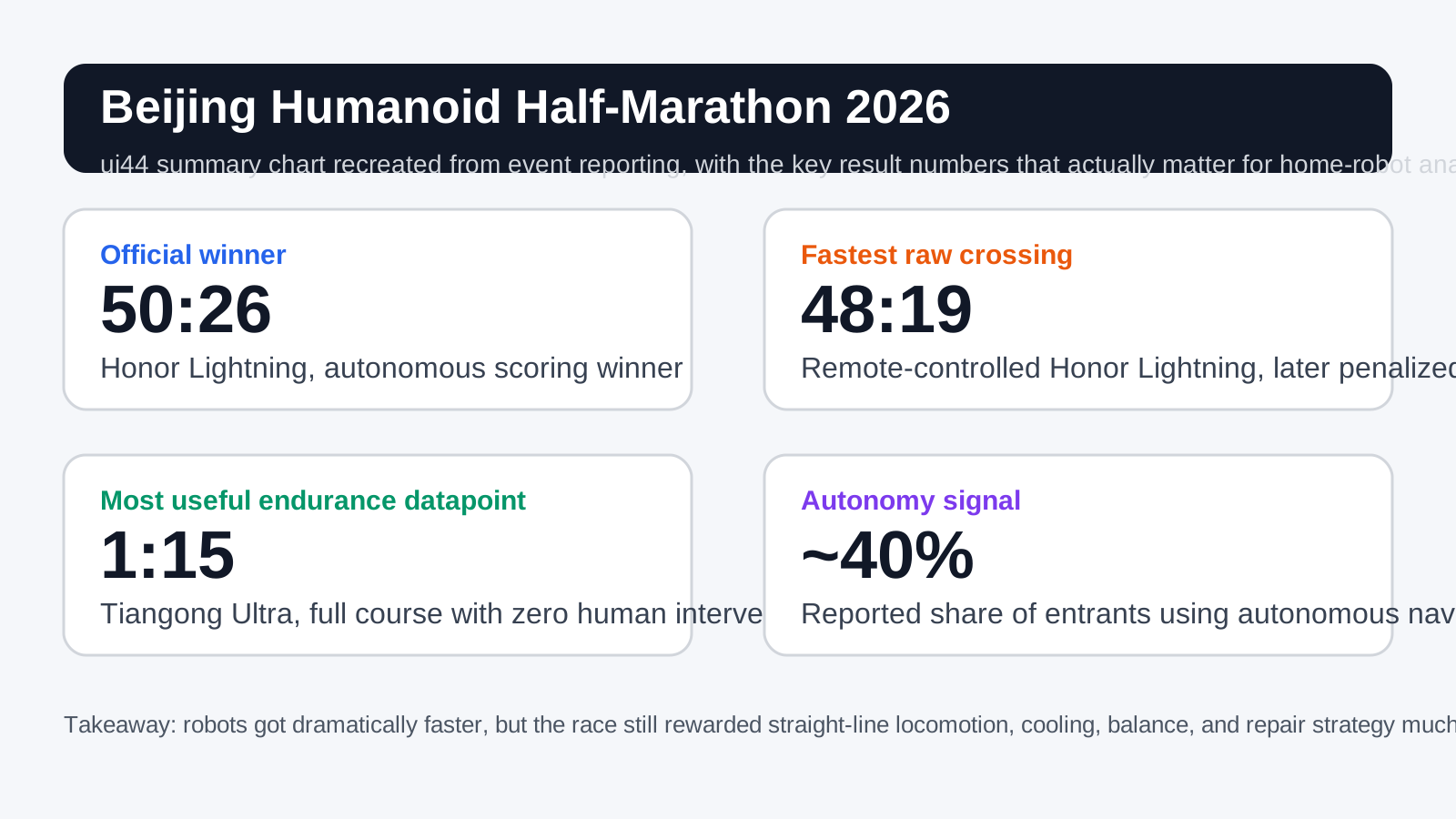
First, Honor's Lightning was the big result. AP reported that the official winning robot finished the 21 km course in 50 minutes and 26 seconds using autonomous navigation. State-media summaries cited by AP also said a separate remote-controlled Honor robot crossed even faster, in 48:19, but did not take the title because the event used weighted scoring that favored autonomy.
Second, the field was much bigger than last year. Reports described more than 100 humanoid runners in the race itself and more than 300 robots tied to the broader event ecosystem, spanning 26 brands and 76 institutions. That scale matters because it turns the marathon from a stunt into a more meaningful public benchmark.
Third, failure was still visible. AP, CBS, and WIRED all described robots that fell, hit barriers, or needed assistance. One broke apart badly enough to be carried away on a stretcher. That is not a side note. It is the story. When you move from lab demos to a 21 km outdoor course, edge cases become the product.
Fourth, autonomy is improving, but not universal. AP said Beijing E-Town put autonomous participation at about 40% of entrants. That is a serious step up from the "human nearby at all times" feel of earlier humanoid demos. It is also nowhere near the reliability bar a real home robot will need.
One of the most useful non-winning datapoints came from Tiangong Ultra. Humanoids Daily reported that the platform completed the full course in 1:15 with zero human intervention, even though it did not repeat as overall winner. For home-readiness analysis, that may be more interesting than the absolute fastest time, because it highlights consistency rather than a best-case sprint.
What the winning times do and do not mean
The fastest robot in Beijing did not prove that humanoids are suddenly ready for your kitchen. It proved something narrower and still important: Chinese humanoid teams have pushed straight-line outdoor locomotion much further, much faster, than most casual observers realized.
Here is the clean way to read the result:
Race result
50:26 autonomous official winner
- What it shows
- Strong gait control, balance, speed, thermal management, and course navigation
- What it does not show
- Fine manipulation, home safety, task planning, or clutter handling
Race result
48:19 remote-controlled crossing
- What it shows
- Raw hardware performance can be even higher with human help
- What it does not show
- Consumer-grade autonomy
Race result
Tiangong Ultra 1:15 zero-intervention run
- What it shows
- Reliability and consistency over a full distance
- What it does not show
- That the same robot can do household chores
Race result
Visible crashes and breakdowns
- What it shows
- The test was real, not a staged showroom demo
- What it does not show
- That the category is ready for unsupervised home deployment
| Race result | What it shows | What it does not show |
|---|---|---|
| 50:26 autonomous official winner | Strong gait control, balance, speed, thermal management, and course navigation | Fine manipulation, home safety, task planning, or clutter handling |
| 48:19 remote-controlled crossing | Raw hardware performance can be even higher with human help | Consumer-grade autonomy |
| Tiangong Ultra 1:15 zero-intervention run | Reliability and consistency over a full distance | That the same robot can do household chores |
| Visible crashes and breakdowns | The test was real, not a staged showroom demo | That the category is ready for unsupervised home deployment |
That distinction matters because homes are hostile environments for robots in ways a road race is not. A half-marathon gives you a known route, predictable surface, and no laundry baskets, pets, table legs, toys, rugs, or wet floors. It is still valuable because locomotion is foundational. A robot that cannot stay upright and cool for an hour outside is not going to become trustworthy in an apartment.
But a robot that can do those things has only cleared the first serious filter.
The hardware lessons look clearer when you cross-reference ui44's database
The marathon winner is not yet one of the robots in ui44's tracked public consumer-facing database. That makes our database more useful here, not less. Instead of obsessing over a single winner, we can compare the kinds of hardware traits that matter next.
1. Speed still matters, and Unitree's H1 remains the clearest reference point
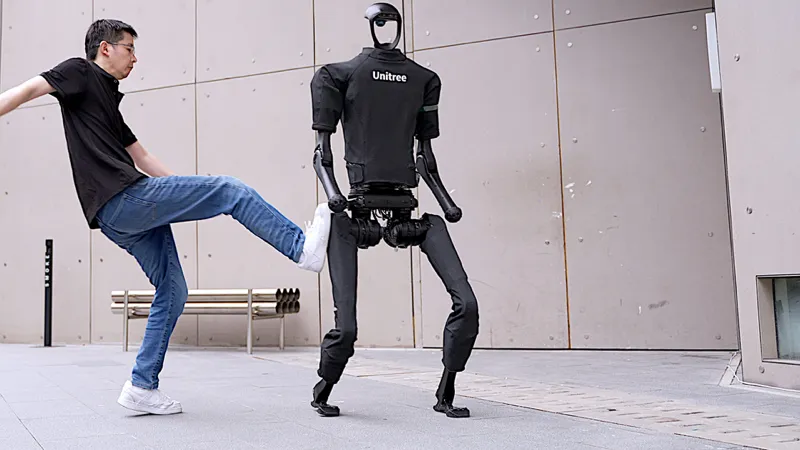
Unitree H1 is still one of the best public reference robots for understanding the marathon's speed logic. In ui44's database, H1 is listed at 180 cm tall, 47 kg, with a top speed of 3.3 m/s and about two hours of battery life. That combination explains why Unitree kept showing up in pre-race conversations even without taking the headline result.
Humanoids Daily reported that Unitree H1 teams were using ice-filled backpacks for thermal management during the event. That sounds improvised, but it also captures a real truth: once you ask a biped to run hard for a sustained period, heat becomes a first-class design constraint.
For home robots, that lesson carries over directly. A platform that overheats while moving cannot be trusted for long chore sessions, repeated patrol loops, or multi-room assistive work.
2. Endurance may matter more than a one-off speed record
AGIBOT's A2 Ultra is almost the opposite case. In ui44's database it is 169 cm tall, 69 kg, walks for 1.5 hours or more, peaks at 1.2 m/s, and holds a Guinness-certified 106.286 km distance record. That is nowhere near Lightning's race pace, but it is exactly the kind of endurance profile that matters for a robot expected to work through long, repetitive household routines.
A2 Ultra is a reminder that the best home robot may not be the flashiest race robot. Buyers should care less about who wins the sprint headline and more about which platforms can sustain useful work without constant recovery breaks.

3. Battery serviceability is arguably more important than race pace
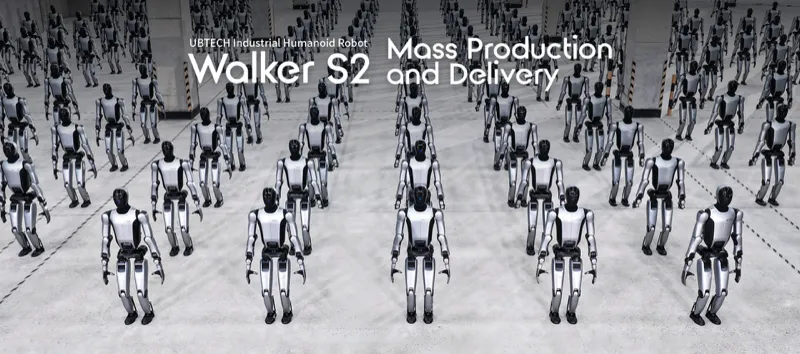
If I had to pick one ui44 datapoint that screams "future home value" more than a 50-minute race, it is UBTECH Walker S2. Our database notes that Walker S2 is designed for 24/7 operation, can swap its own batteries in about three minutes, and handles payloads up to 15 kg.
That is industrial positioning, not living-room polish. But it addresses a real problem that home humanoids will hit quickly: downtime. A robot that needs long, fragile charge breaks is much less useful than one that can recover its runtime cleanly and predictably.
The Beijing race rewarded machines that survived a fixed course. Home use will reward machines that can recover, recharge, and resume normal work without turning every long task into a manual babysitting session.
4. The most interesting home-readiness signals come from balanced platforms
Below is the more useful buyer table, built from ui44's database rather than the marathon podium alone.
Robot in ui44
- Speed / endurance signal
- 3.3 m/s top speed, ~2h battery
- Why it matters after Beijing
- Best reference for speed-first locomotion and thermal stress
Robot in ui44
- Speed / endurance signal
- 1.5h+ walking, 106.286 km distance record
- Why it matters after Beijing
- Better proxy for sustained usefulness than a sprint result
Robot in ui44
- Speed / endurance signal
- 3.6 m/s top speed, ~4h battery
- Why it matters after Beijing
- Suggests how fast biped speed ceilings are moving
Robot in ui44
- Speed / endurance signal
- 5 km/h, 53 joints, 2h battery
- Why it matters after Beijing
- More relevant to durability and controlled service work than racing spectacle
Robot in ui44
- Speed / endurance signal
- Up to 8h battery, 1h charging, $30,000 base
- Why it matters after Beijing
- Shows where longer-duty commercial humanoids may become more practical
Robot in ui44
- Speed / endurance signal
- Autonomous 3-minute battery swaps, 24/7 design goal
- Why it matters after Beijing
- A stronger serviceability benchmark than a one-day race win
| Robot in ui44 | Speed / endurance signal | Why it matters after Beijing |
|---|---|---|
| Unitree H1 | 3.3 m/s top speed, ~2h battery | Best reference for speed-first locomotion and thermal stress |
| AGIBOT A2 Ultra | 1.5h+ walking, 106.286 km distance record | Better proxy for sustained usefulness than a sprint result |
| RobotEra STAR1 | 3.6 m/s top speed, ~4h battery | Suggests how fast biped speed ceilings are moving |
| Fourier GR-2 | 5 km/h, 53 joints, 2h battery | More relevant to durability and controlled service work than racing spectacle |
| Kepler Forerunner K2 | Up to 8h battery, 1h charging, $30,000 base | Shows where longer-duty commercial humanoids may become more practical |
| UBTECH Walker S2 | Autonomous 3-minute battery swaps, 24/7 design goal | A stronger serviceability benchmark than a one-day race win |
If you are comparing robots on ui44, our humanoid category and compare tool now make the marathon easier to interpret. The event did not suddenly crown one inevitable home winner. It revealed which engineering trade-offs are becoming impossible to ignore.
Why the race still does not prove home readiness
This is the part that matters for real buyers.
A home robot does not win by running 21 km in a straight line. It wins by being boring in the best possible way. It should avoid hurting people, avoid breaking your stuff, understand simple instructions, cope with messy rooms, and recover from small failures without turning you into unpaid technical support.
The Beijing course did not test most of that.
It did not test:
- picking up varied household objects
- opening doors or drawers
- safe behavior around children or pets
- navigation through furniture-heavy rooms
- quiet operation over long indoor sessions
- trustworthy voice interaction
- service logistics, warranty, or consumer setup
That is why I think the most honest takeaway is this: the marathon made humanoids look more credible as machines, but not yet mature as household products.
The gap is still wide enough that buyers should separate three questions that headlines tend to mash together:
- Can a humanoid move impressively? Increasingly, yes.
- Can a humanoid work reliably for long periods? Sometimes, under narrow conditions.
- Can a humanoid deliver calm, safe, affordable value in a home? That is still the open question.
What I would watch next instead of just replaying the finish line
If Beijing got you excited about home humanoids, these are the signals that will matter more over the next 12 to 24 months than one race time.
Autonomous recovery
Can the robot resume after a stumble, interruption, or low-battery event without an engineer stepping in?
Battery turnover
Can it charge or swap batteries fast enough to feel useful over a day, not just one demo?
Quiet whole-home navigation
Can it move around rugs, thresholds, tables, and low-light rooms without drama?
Manipulation under uncertainty
Can it pick up objects that are not perfectly placed or pre-scripted?
Price and service reality
Can buyers actually order it, service it, and understand the failure model?
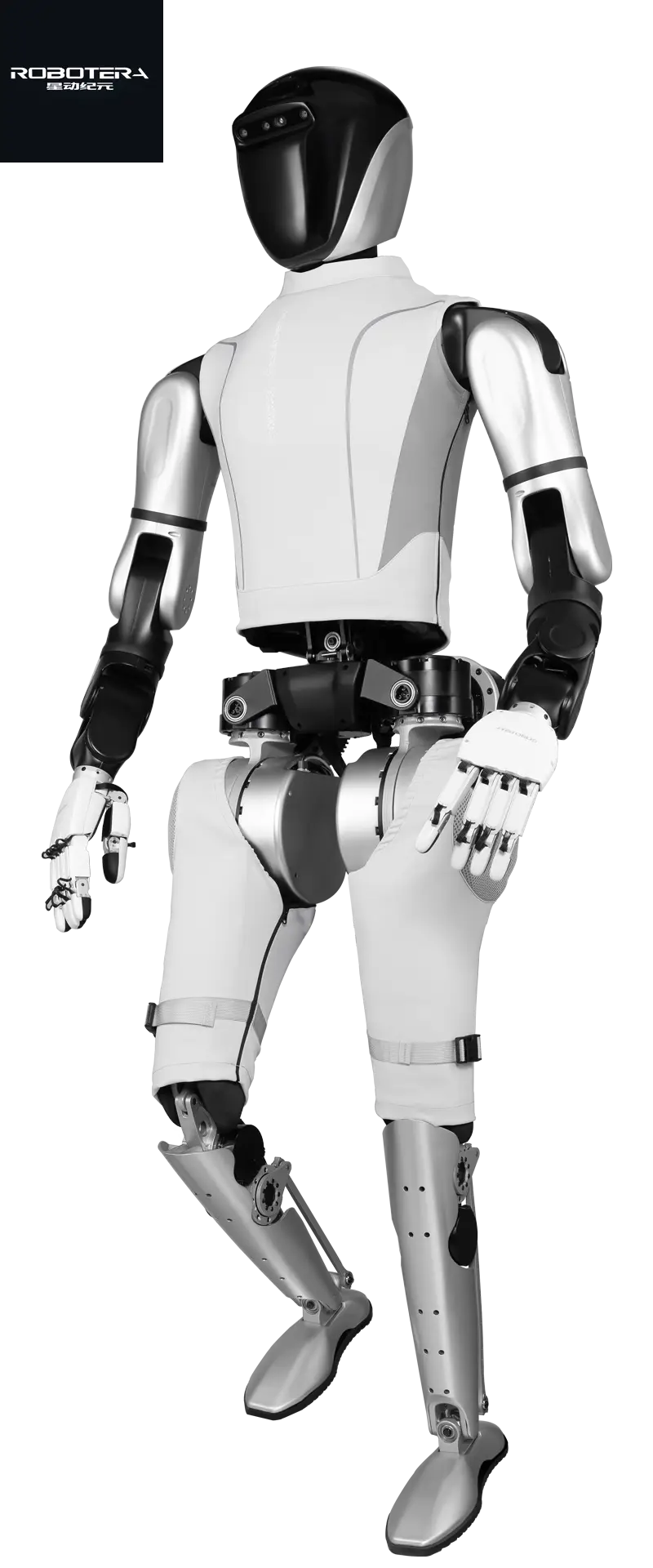
That is also where robots like RobotEra STAR1, with its 3.6 m/s top speed and roughly four-hour battery, become interesting. Not because it won Beijing, but because it shows how quickly mobility ceilings are rising across the field. The faster the locomotion layer matures, the more the market's bottleneck shifts to manipulation, autonomy, and support.
Bottom line
Beijing's humanoid half-marathon was not just a viral moment. It was a very good stress test for one slice of robot capability: sustained outdoor locomotion.
And on that slice, progress is real.
Honor's Lightning showed that autonomous humanoids can now run shockingly fast. Tiangong Ultra showed that zero-intervention completion may be the more useful signal for practical reliability. The visible crashes reminded everyone that the category is still early. And ui44's database makes the bigger point easier to see: the robots that win headlines are not automatically the robots that will win homes.
For now, the marathon says this: humanoids are getting legs that look more and more real. The hands, judgment, safety, and service model still have more to prove.
Frequently Asked Questions
Did a robot really beat the human half-marathon world record?
Under this event's conditions, yes. Multiple reports said Honor's Lightning
posted an official autonomous winning time of 50:26, faster than the men's human
world record of 57:20. That does not mean a household humanoid is suddenly ready
for consumer use.
Why does the remote-controlled 48:19 result matter?
It shows the hardware ceiling may already be even higher than the official
winner's time. But it also shows why autonomy rules matter. A fast robot with a
human pilot is not the same product as a robot that can navigate by itself.
What was the most useful result for home-robot analysis?
I would argue Tiangong Ultra's reported 1:15 zero-intervention full-course
finish was the most revealing practical signal, because consistent autonomy is
usually more transferable to real-world usefulness than a best-case raw speed
number.
Which ui44 robots look most relevant after the race?
The clearest reference platforms are Unitree H1,
and Kepler Forerunner K2. Together they show the
trade-off between speed, endurance, serviceability, and commercial practicality
much better than the podium alone.
Sources & References
Source
https://apnews.com/article/humanoid-robots-half-marathon-beijing-302d0c4781bab20100d6a0bb4e77b629
- Type
- AP results report
- Accessed
- 2026-04-21
Source
https://www.cbsnews.com/news/humanoid-robot-half-marathon-beijing-human-world-record/
- Type
- CBS results summary
- Accessed
- 2026-04-21
Source
https://www.wired.com/story/a-humanoid-robot-set-a-half-marathon-record-in-china/
- Type
- WIRED results analysis
- Accessed
- 2026-04-21
Source
https://www.humanoidsdaily.com/news/beijing-humanoid-half-marathon-honor-sweeps-podium-as-robots-shatter-human-world-record
- Type
- Industry roundup / secondary reporting
- Accessed
- 2026-04-21
Source
https://english.beijing.gov.cn/consuminginbeijing/onedayinbeijing/sportshealth/newsofsportshealth/202604/t20260413_4580603.html
- Type
- Official preview / event context
- Accessed
- 2026-04-21
Source
https://www.unitree.com/h1
- Type
- Official manufacturer page
- Accessed
- 2026-04-21
Source
https://www.agibot.com/products/A2_Ultra
- Type
- Official manufacturer page
- Accessed
- 2026-04-21
Source
https://www.ubtrobot.com/en/humanoid/products/walker-s2
- Type
- Official manufacturer page
- Accessed
- 2026-04-21
Source
https://www.robotera.com/en/
- Type
- Official manufacturer page
- Accessed
- 2026-04-21
Source
https://www.gotokepler.com/productDetailK2?id=2
- Type
- Official manufacturer page
- Accessed
- 2026-04-21
| Source | Type | Accessed |
|---|---|---|
| https://apnews.com/article/humanoid-robots-half-marathon-beijing-302d0c4781bab20100d6a0bb4e77b629 | AP results report | 2026-04-21 |
| https://www.cbsnews.com/news/humanoid-robot-half-marathon-beijing-human-world-record/ | CBS results summary | 2026-04-21 |
| https://www.wired.com/story/a-humanoid-robot-set-a-half-marathon-record-in-china/ | WIRED results analysis | 2026-04-21 |
| https://www.humanoidsdaily.com/news/beijing-humanoid-half-marathon-honor-sweeps-podium-as-robots-shatter-human-world-record | Industry roundup / secondary reporting | 2026-04-21 |
| https://english.beijing.gov.cn/consuminginbeijing/onedayinbeijing/sportshealth/newsofsportshealth/202604/t20260413_4580603.html | Official preview / event context | 2026-04-21 |
| https://www.unitree.com/h1 | Official manufacturer page | 2026-04-21 |
| https://www.agibot.com/products/A2_Ultra | Official manufacturer page | 2026-04-21 |
| https://www.ubtrobot.com/en/humanoid/products/walker-s2 | Official manufacturer page | 2026-04-21 |
| https://www.robotera.com/en/ | Official manufacturer page | 2026-04-21 |
| https://www.gotokepler.com/productDetailK2?id=2 | Official manufacturer page | 2026-04-21 |
Written by
ui44 Team
Published April 22, 2026
Share this article
Open a plain share link on X or Bluesky. No embeds, no widgets, no cookie baggage.