The more useful reading is narrower and more important: this is a reference stack. If enough labs, developers, and robot companies test on a common body-hand-brain setup, future home humanoid claims may become easier to compare. Instead of asking whether one polished video proves a robot can do chores, buyers can ask whether the robot uses a known workflow, publishes known safety limits, and reports performance on tasks other teams can reproduce.
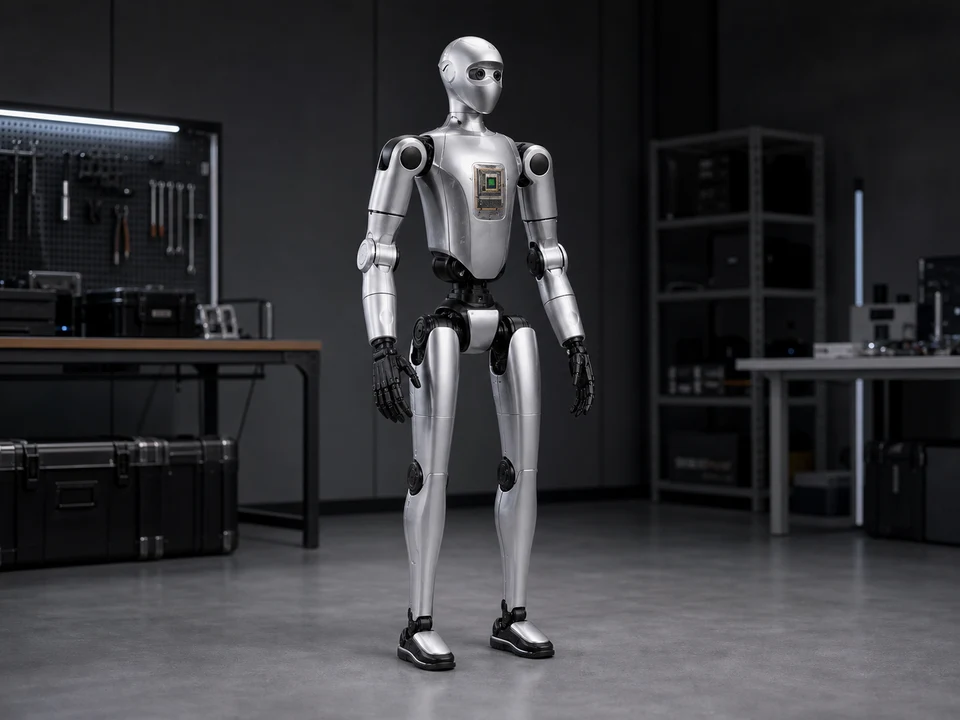
What NVIDIA And Unitree Actually Announced
The announcement is not a retail launch for living rooms. Unitree describes H2 Plus as an NVIDIA Isaac GR00T reference humanoid for academic research. NVIDIA's Isaac GR00T platform is a developer stack for building, training, testing, and deploying humanoid robot AI. It includes open models and workflows, data pipelines, simulation tools, middleware, runtime libraries, and Jetson Thor for robot inference and control.
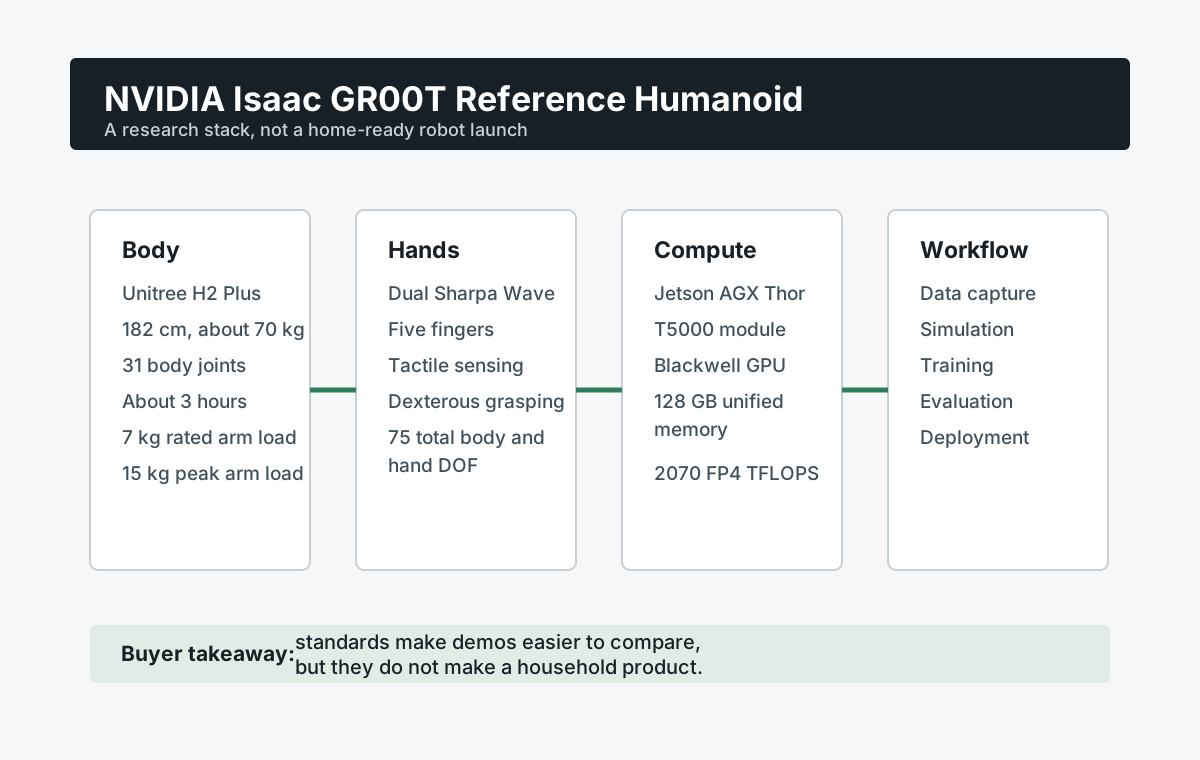
The body is where the announcement becomes concrete. In the ui44 database, H2 Plus is listed as a full-size 182 cm, about 70 kg development robot with a roughly 3-hour battery estimate. Its arm payload is listed at about 7 kg rated and about 15 kg peak. It has 31 body joint-motor degrees of freedom and 75 total body-and-hand degrees of freedom when the Sharpa Wave tactile hands are included.
The compute stack is also more specific than the usual "AI robot" phrasing. H2 Plus uses an NVIDIA Jetson AGX Thor T5000 module with a Blackwell GPU, 14-core Arm CPU, 128 GB unified memory, and 2,070 FP4 TFLOPS listed in the robot data. That does not prove household autonomy. It does tell developers what kind of onboard compute budget the reference design expects.
Why Does A Reference Design Matter For Home Robots?
Humanoid robot demos are hard to compare because almost every demo hides a different stack. One robot may use a custom body, another may use remote teleoperation, another may run a lab-only policy, and another may rely on a controlled set. Without standard pieces, buyers have no clean way to tell whether a better demo came from better AI, better hands, a lighter object, a better camera setup, or more human assistance.
A reference design can make the comparison less slippery. If two teams train against the same body class, similar tactile hands, similar onboard compute, and similar evaluation workflow, differences in performance become more meaningful. That is why H2 Plus should interest home-robot watchers even if it is not meant for homes yet.
For buyers, the biggest upside is not that a future H2 Plus will fold laundry in a kitchen. The upside is that a common research stack could pressure companies to publish more comparable numbers: task success rate, setup time, battery drain under manipulation, payload by arm pose, teleoperation hours required, recovery rate after mistakes, and how often a human had to step in.
This is the same shift that made robot vacuums easier to compare once docking, mapping, obstacle avoidance, and mop-washing claims became common enough to test side by side. Humanoids are much earlier and much more dangerous, but the market still needs comparable claims.
How H2 Plus Compares With Robots Buyers Can Track Now
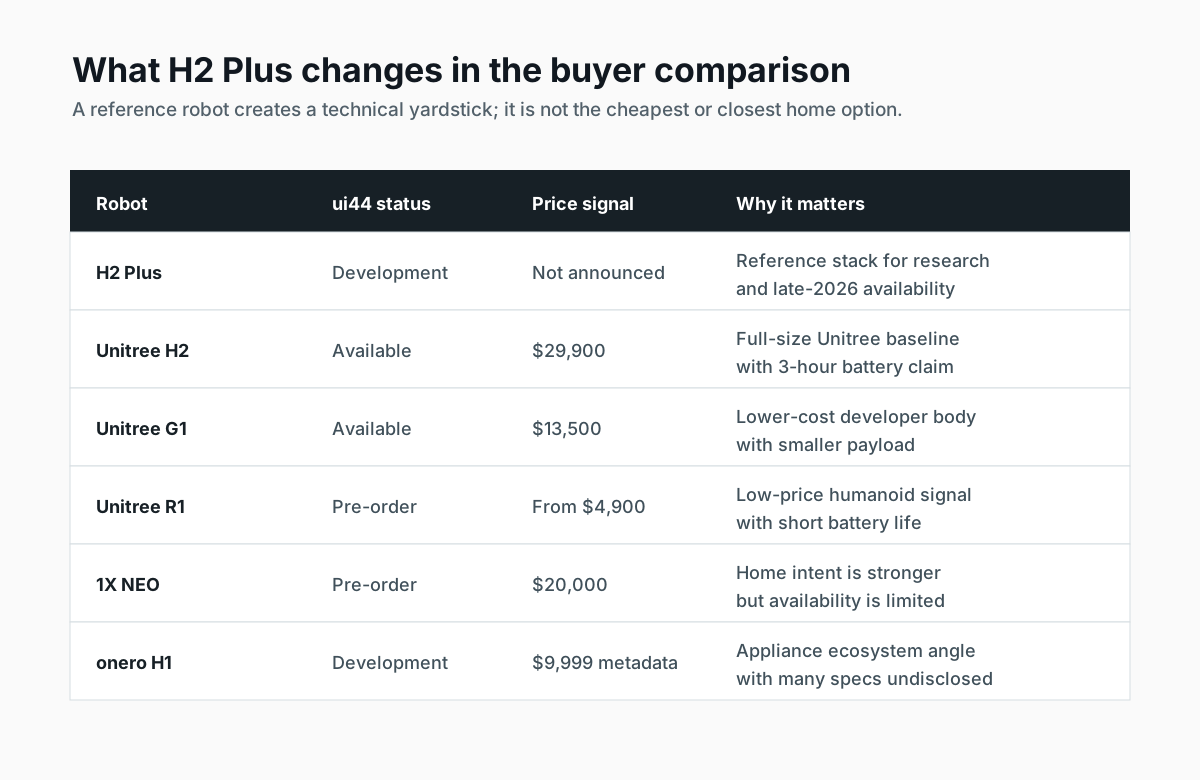
ui44 lists H2 Plus as a development platform with no public price announced and late-2026 availability from Unitree noted in the price field. That puts it in a different category from a buyer-facing robot, even when its body looks close to products already in Unitree's lineup.
The Unitree H2 is the closest baseline in the database. It is also 182 cm and about 70 kg, with about 3 hours of battery life, a listed $29,900 base price, 31 degrees of freedom, and peak arm payload around 15 kg. The Unitree G1 is smaller and cheaper at $13,500, with 132 cm standing height, 35 kg weight, about 2 hours of battery life, and a much smaller arm payload. The Unitree R1 starts from $4,900 in the database, but it is listed as pre-order, around 123 cm tall, about 29 kg, and roughly 1 hour of mixed-activity battery life.
Those numbers matter because a home humanoid is not only a software problem. A robot that can lift a pan in one pose may not be able to carry laundry safely with arms extended. A robot that can walk for three hours may drain faster when using both arms, cameras, microphones, and onboard inference. A robot that costs less than a high-end appliance may still need developer support, spare parts, insurance, and a controlled environment.
Other home-leaning humanoids make the contrast clearer. 1X NEO is listed at $20,000 for early adopters, 167 cm, 30 kg, and about 4 hours of battery life, with household chores as an explicit capability. SwitchBot onero H1 is listed at $9,999 in product-page metadata, but many specs are still undisclosed. H2 Plus sits beside those robots as a standardization signal, not as the obvious near-term purchase.
The Buyer Questions This Stack Should Force
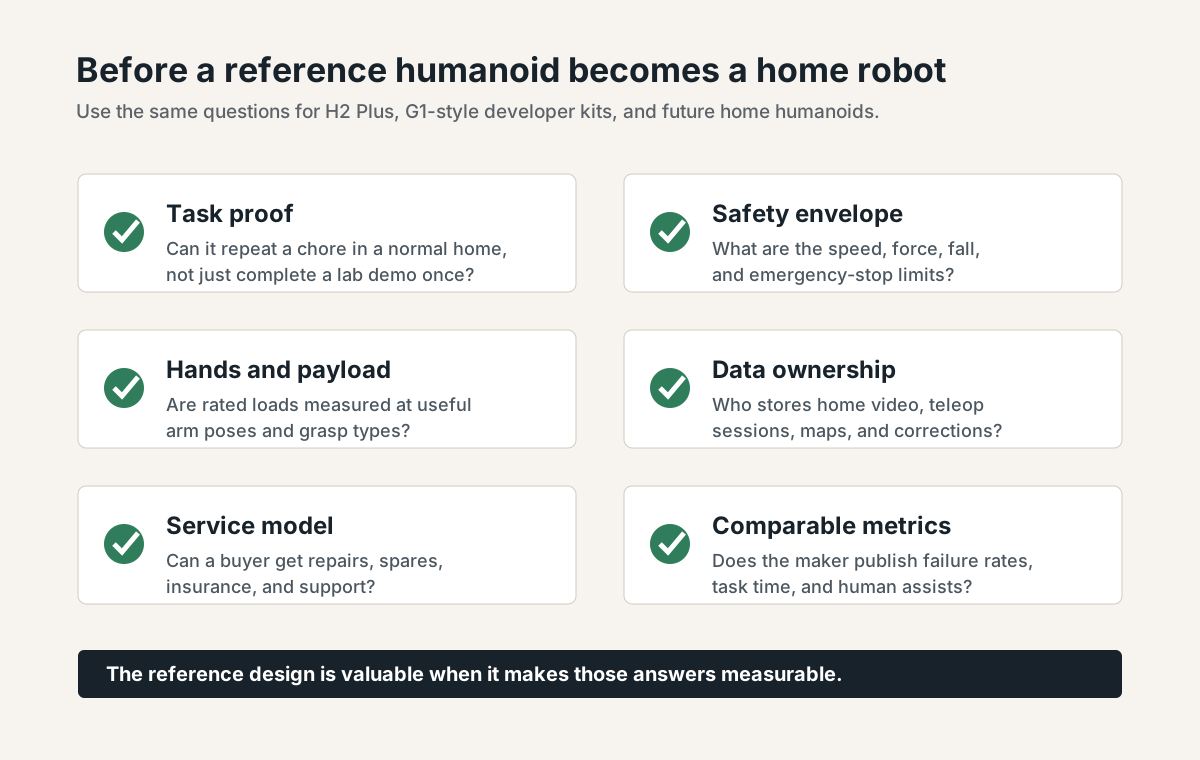
The most important home-robot question is not "does it use GR00T?" It is "what does that let me verify?" A model name or chip name is not enough. A future home robot should make the following claims measurable.
First, task proof. Can the robot repeat a household task in a normal room with normal clutter, or did the demo use a prepared scene? If a company uses Isaac GR00T workflows, it should be able to describe training data, evaluation conditions, task success rates, and failure recovery.
Second, manipulation safety. H2 Plus lists a 7 kg rated arm payload and 15 kg peak arm payload. Those are impressive numbers for a humanoid arm, but home buyers need the details: arm pose, object shape, grip type, speed, proximity to people, and what happens when the grasp fails. A rated payload with the arm tucked close to the body is not the same as safely carrying a heavy pot away from a counter.
Third, compute and privacy. Jetson Thor-class onboard compute is useful because home robots should not need to stream every sensory decision to the cloud. But a real product still needs a data policy. Who stores camera video, maps, voice interactions, teleoperation sessions, and user corrections? Can the buyer delete them? Are remote operators involved? A reference platform can standardize AI development without answering consumer privacy questions by itself.
Fourth, serviceability. Research teams can tolerate downtime, command-line tools, and component swaps. Home buyers need repairs, replacement batteries, fall damage policies, software support windows, child and pet safety guidance, and a way to recover when the robot cannot self-rescue.
What Would Make This Home-Relevant
H2 Plus becomes relevant to home buyers if its reference metrics leak into the consumer market. That could happen in a few practical ways.
One route is developer benchmarking. If research teams publish repeatable results on H2 Plus, buyers and reviewers can start asking consumer robot makers why their claims are not measured the same way. That does not require every home robot to use Unitree hardware. It requires the industry to stop treating every demo as a one-off.
Another route is component pressure. If Sharpa-style tactile hands become part of a recognizable reference setup, future home robot makers may need to explain their own hand choices. Do they have tactile sensing? What fingertip force can they apply? What happens when an object slips? Do they publish household grasp tests, or only show the best take?
A third route is software portability. If Isaac GR00T workflows make it easier to move a skill from simulated training to a physical robot, then the market can ask which chores transfer across rooms and which still require house-by-house tuning. That matters for future robots that claim to tidy, fetch, load, wipe, or assist someone with limited mobility.
The risk is that "reference humanoid" becomes another branding phrase. If companies use the association to imply home readiness without publishing task, safety, and privacy evidence, buyers should treat it as marketing.
What To Watch Next
The most useful near-term milestone is not a home preorder page. It is evidence. Watch for late-2026 Unitree availability, developer documentation, open workflows for the G1 and H2 Plus class, independent lab results, and videos that include failed attempts or task counts rather than only polished success clips.
Also watch whether competitors respond with comparable disclosures. A home humanoid spec sheet should eventually include more than height, weight, battery life, and price. It should include payload at useful arm positions, safe speed near people, emergency-stop behavior, perception blind spots, remote-assist policy, task success rates, and service terms.
For now, H2 Plus is best understood as a yardstick. It gives researchers a common body, tactile hands, onboard compute, and GR00T workflow to test against. That is valuable. It also means buyers should be more skeptical, not less, when the next humanoid demo claims to be ready for the home.
Bottom Line
NVIDIA's Isaac GR00T reference humanoid does not make a consumer home robot arrive overnight. It does make the road to useful home humanoids easier to measure. The distinction matters.
If a future robot is built on a known stack, buyers should ask for known evidence: repeatable chores, safe manipulation limits, clear data ownership, real service support, and transparent failure reporting. H2 Plus is not the answer to those questions. It is a reason to start asking them in a more disciplined way.
Sources: NVIDIA Isaac GR00T, Unitree H2 Plus announcement, Unitree H2 Plus product page.
Related in the database
Use this article as a privacy verification workflow
Turn the article into a privacy verification pass grounded in the robots, manufacturers, and components it actually references.
NVIDIA GR00T Humanoid: What H2 Plus Means already points you toward 6 linked robots, 4 manufacturers, and 3 countries inside the ui44 database. That matters because strong buyer guidance is easier to apply when you can move immediately from a claim or warning into concrete product pages, manufacturer directories, component explainers, and country-level context instead of treating the article as an isolated opinion piece. The fastest next step is to turn the article into a shortlist workflow: open the linked robot pages, verify which specs are actually published for those models, then compare the surrounding manufacturer and component context before you decide whether the underlying claim changes your buying plan.
For this topic, the useful discipline is to separate the editorial lesson from the catalog evidence. The article gives you the framing, but the robot pages tell you what each product actually ships with today: sensor stack, connectivity methods, listed price, release timing, category, and support-relevant compatibility notes. The manufacturer pages then show whether you are looking at a one-off launch, a broader lineup pattern, or a company that spans multiple categories. That layered workflow reduces the risk of buying on a single marketing phrase or a single support FAQ.
Use the robot pages to confirm which products actually expose cameras, microphones, Wi-Fi, or voice systems, then use the manufacturer pages to decide how much of the privacy question seems product-specific versus brand-wide. On this route cluster, H2 Plus, Unitree H2, and G1 form the fastest reality check. If you want a quick working shortlist, open Compare H2 Plus, Unitree H2, and G1 next, then keep this article open as the reasoning layer while you compare structured data side by side.
Practical Takeaway
Every robot, manufacturer, category, component, and country reference below resolves to a real ui44 page, keeping the follow-up path grounded in database records rather than generic advice.
Suggested next steps in ui44
- Open H2 Plus and note the listed sensors, connectivity methods, and voice stack before you interpret any policy claim.
- Cross-check the wider brand context on Unitree Robotics so you can see whether the privacy question touches one model or a broader lineup.
- Use the linked component pages to confirm how common the relevant sensors and connectivity layers are across the database.
- Keep a short note of which policy layers you checked, which device features are actually present on the robot page, and which items still depend on region- or app-level confirmation.
- Finish with Compare H2 Plus, Unitree H2, and G1 so the policy reading sits next to structured product data.
Robot profiles worth opening next
Use the linked product pages as the evidence layer
The linked robot pages are where this article becomes operational. Instead of asking whether the headline is interesting, use the robot entries to inspect the actual mix of sensors, connectivity options, batteries, pricing, release timing, and stated capabilities attached to the products mentioned in the article. That is the easiest way to see whether the warning or opportunity described here affects one product family, a specific design pattern, or an entire buying lane.
H2 Plus
Unitree Robotics · Research · Development
H2 Plus is tracked on ui44 as a development research robot from Unitree Robotics. The database currently records a listed price of Price TBA, a release date of 2026-06-01, About 3 hours battery life, Not officially disclosed charging time, and a published stack that includes Head-mounted stereo camera with wide field of view, Wrist cameras, and IMU plus Ethernet and Wi-Fi 6.
For privacy-focused reading, this page matters because it shows the concrete device surface behind the policy discussion. Use it to verify whether H2 Plus combines sensors and connectivity in a way that could change the in-home data footprint, and compare the listed capabilities such as NVIDIA Isaac GR00T Reference Humanoid, Full-Size Humanoid Research Platform, and 31 Body Joint-Motor Degrees of Freedom with any cloud, app, or voice layers, including Voice interaction via array microphones and speakers.
Unitree H2
Unitree Robotics · Humanoid · Available
Unitree H2 is tracked on ui44 as a available humanoid robot from Unitree Robotics. The database currently records a listed price of $29,900, a release date of 2025-10-20, About 3 hours battery life, Not officially disclosed charging time, and a published stack that includes Binocular Camera (Wide FOV), Array Microphone, and IMU plus Wi-Fi 6 and Bluetooth 5.2.
For privacy-focused reading, this page matters because it shows the concrete device surface behind the policy discussion. Use it to verify whether Unitree H2 combines sensors and connectivity in a way that could change the in-home data footprint, and compare the listed capabilities such as 31 Degrees of Freedom, 360 N·m Peak Leg Joint Torque, and 120 N·m Peak Arm Joint Torque with any cloud, app, or voice layers, including Built-in Voice Interaction.
G1 is tracked on ui44 as a available humanoid robot from Unitree. The database currently records a listed price of $13,500, a release date of 2024-05-13, ~2 hours battery life, Not disclosed charging time, and a published stack that includes Depth Camera, 3D LiDAR, and 4 Microphone Array plus Wi-Fi 6 and Bluetooth 5.2.
For privacy-focused reading, this page matters because it shows the concrete device surface behind the policy discussion. Use it to verify whether G1 combines sensors and connectivity in a way that could change the in-home data footprint, and compare the listed capabilities such as Bipedal Walking, Object Manipulation, and Dexterous Hands (optional Dex3-1) with any cloud, app, or voice layers.
R1
Unitree Robotics · Humanoid · Pre-order
R1 is tracked on ui44 as a pre-order humanoid robot from Unitree Robotics. The database currently records a listed price of $4,900, a release date of 2025, ~1 hour (mixed activity) battery life, Not officially disclosed charging time, and a published stack that includes Monocular camera (R1 Air); binocular camera (R1/R1 EDU), 4-Mic Array, and Dual 6-Axis IMU plus Wi-Fi 6 and Bluetooth 5.2.
For privacy-focused reading, this page matters because it shows the concrete device surface behind the policy discussion. Use it to verify whether R1 combines sensors and connectivity in a way that could change the in-home data footprint, and compare the listed capabilities such as Bipedal Walking & Running, Cartwheels & Handstands, and Push Recovery with any cloud, app, or voice layers, including UnifoLM (voice + image commands).
NEO
1X Technologies · Humanoid · Pre-order
NEO is tracked on ui44 as a pre-order humanoid robot from 1X Technologies. The database currently records a listed price of $20,000, a release date of 2025-10-28, ~4 hours battery life, Not disclosed charging time, and a published stack that includes RGB Cameras, Depth Sensors, and Tactile Skin plus Wi-Fi and Bluetooth.
For privacy-focused reading, this page matters because it shows the concrete device surface behind the policy discussion. Use it to verify whether NEO combines sensors and connectivity in a way that could change the in-home data footprint, and compare the listed capabilities such as Household Chores, Tidying Up, and Safe Human Interaction with any cloud, app, or voice layers.
Manufacturer context behind the article
Check whether this is one product story or a broader company pattern
Manufacturer pages add the privacy context that individual product pages cannot show on their own. They help you check whether cameras, microphones, cloud accounts, app controls, and policy assumptions appear across a broader lineup or stay tied to one specific product story.
Unitree Robotics
ui44 currently tracks 9 robots from Unitree Robotics across 3 categorys. The company is grouped under China, and the current catalog footprint on ui44 includes B2, B1, Go2.
That wider brand context matters because privacy questions rarely stop at one FAQ page. A manufacturer route helps you see whether the article is centered on one premium model or on a company that has several relevant products and therefore more than one place where the same policy or app assumptions might matter. The category mix here currently points toward Quadruped, Humanoid, Research as the most useful next route if you want to see whether this article reflects a wider pattern inside the brand.
Unitree
ui44 currently tracks 2 robots from Unitree across 1 category. The company is grouped under China, and the current catalog footprint on ui44 includes H1, G1.
That wider brand context matters because privacy questions rarely stop at one FAQ page. A manufacturer route helps you see whether the article is centered on one premium model or on a company that has several relevant products and therefore more than one place where the same policy or app assumptions might matter. The category mix here currently points toward Humanoid as the most useful next route if you want to see whether this article reflects a wider pattern inside the brand.
1X Technologies
ui44 currently tracks 2 robots from 1X Technologies across 1 category. The company is grouped under Norway, and the current catalog footprint on ui44 includes NEO, EVE.
That wider brand context matters because privacy questions rarely stop at one FAQ page. A manufacturer route helps you see whether the article is centered on one premium model or on a company that has several relevant products and therefore more than one place where the same policy or app assumptions might matter. The category mix here currently points toward Humanoid as the most useful next route if you want to see whether this article reflects a wider pattern inside the brand.
SwitchBot
ui44 currently tracks 3 robots from SwitchBot across 3 categorys. The company is grouped under USA, and the current catalog footprint on ui44 includes K20+ Pro, onero H1, KATA Friends.
That wider brand context matters because privacy questions rarely stop at one FAQ page. A manufacturer route helps you see whether the article is centered on one premium model or on a company that has several relevant products and therefore more than one place where the same policy or app assumptions might matter. The category mix here currently points toward Cleaning, Home Assistants, Companions as the most useful next route if you want to see whether this article reflects a wider pattern inside the brand.
Broaden the scan without leaving the database
Categories, components, and countries add the wider context
Category framing
Category pages are useful when the article touches a buying pattern that shows up across brands. A category route helps you confirm whether the linked products sit in a narrow niche or whether the same question should be tested across a larger field of alternatives.
Research
The Research category page currently groups 49 tracked robots from 39 manufacturers. ui44 describes this lane as: Academic and research robotics platforms pushing the boundaries of what machines can learn and do in the lab and beyond.
That makes the category route a practical follow-up when you want to check whether the products linked in this article are typical for the lane or whether they sit at one edge of the market. Useful starting examples currently include HRP-4C, HRP-5P, NAO6.
Humanoid
The Humanoid category page currently groups 129 tracked robots from 92 manufacturers. ui44 describes this lane as: Full-size bipedal humanoid robots built to work alongside people — from factory floors to household tasks. Compare the cutting edge of humanoid robotics.
That makes the category route a practical follow-up when you want to check whether the products linked in this article are typical for the lane or whether they sit at one edge of the market. Useful starting examples currently include NEO, EVE, Mornine M1.
Country and ecosystem context
Country pages give extra context when support practices, launch sequencing, regulatory posture, or manufacturer mix matter. They are not a substitute for model-level verification, but they do help you see which ecosystems cluster together and which manufacturers sit in the same regional field when you broaden the search beyond the article headline.
China
The China route currently groups 189 tracked robots from 87 manufacturers in ui44. That gives you a useful regional lens when the article points toward support practices, launch sequencing, or brand clusters that may share similar ecosystem assumptions.
On the current route, manufacturers like AGIBOT, Dreame, Unitree Robotics make the page a good way to broaden the scan without losing the regional context that often shapes availability, documentation style, and adjacent alternatives.
Norway
The Norway route currently groups 2 tracked robots from 1 manufacturers in ui44. That gives you a useful regional lens when the article points toward support practices, launch sequencing, or brand clusters that may share similar ecosystem assumptions.
On the current route, manufacturers like 1X Technologies make the page a good way to broaden the scan without losing the regional context that often shapes availability, documentation style, and adjacent alternatives.
USA
The USA route currently groups 89 tracked robots from 69 manufacturers in ui44. That gives you a useful regional lens when the article points toward support practices, launch sequencing, or brand clusters that may share similar ecosystem assumptions.
On the current route, manufacturers like Faraday Future, iRobot, Boston Dynamics make the page a good way to broaden the scan without losing the regional context that often shapes availability, documentation style, and adjacent alternatives.
Questions to answer before you move from reading to buying
A follow-up FAQ built from the entities already linked in this article
Frequently Asked Questions
Which page should I open first after reading “NVIDIA GR00T Humanoid: What H2 Plus Means”?
Start with H2 Plus. That gives you a concrete product anchor for the article’s main claim. From there, branch into the manufacturer and component pages so you can tell whether the article is describing one specific model, a repeated brand pattern, or a wider technology issue that affects multiple shortlist options.
How do the manufacturer pages change the buying decision?
Unitree Robotics help you zoom out from one article and one product. On ui44 they show lineup breadth, category spread, and the neighboring robots tied to the same company. That context is useful when you are deciding whether a risk belongs to a single model, whether it shows up across a brand’s portfolio, and whether you should keep looking at alternatives before committing.
When should I switch from reading to side-by-side comparison?
Move into Compare H2 Plus, Unitree H2, and G1 as soon as you understand the article’s main warning or promise. The article explains what to watch for, but the compare view is where you can check whether price, status, battery life, connectivity, sensors, and category fit still make the robot a good match for your own home and budget.
Where to go next in ui44
Keep the research chain inside the database
If you want to keep going, these follow-on pages give you the cleanest expansion path from article to research session. Open the comparison route first if you are deciding between products today. Open the manufacturer, category, and component routes if you still need to understand the broader pattern behind the claim.
Written by
ui44 Team
Published June 23, 2026
Share this article
Open a plain share link on X or Bluesky. No embeds, no widgets, no cookie baggage.