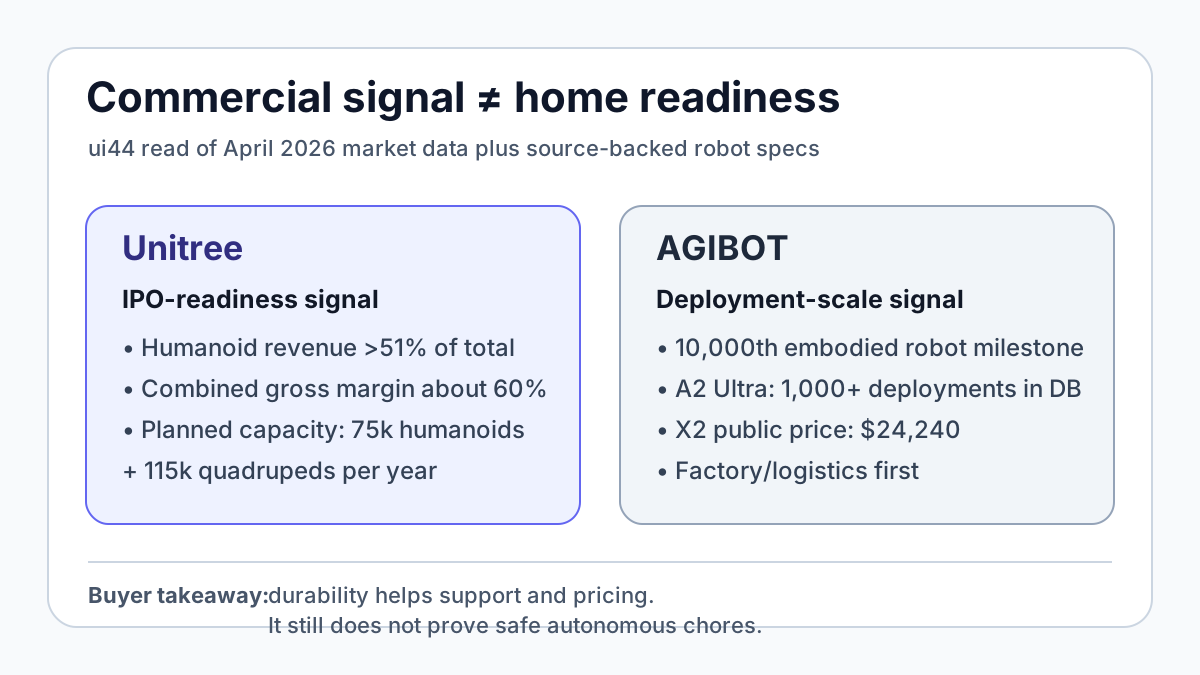
Unitree's China STAR Market IPO process makes that question less theoretical. TrendForce says Unitree's humanoid robot revenue surpassed its quadruped robot revenue in 2025, reaching more than 51% of total revenue, while combined gross margin across the two robot segments reached about 60%. AGIBOT, meanwhile, has crossed a public 10,000 embodied-robot milestone. That is not normal startup-demo language. It is commercialization language.
But profitable does not mean home-ready. A company can build a strong robotics business by selling research platforms, robot dogs, factory pilots, exhibition humanoids, and developer machines long before ordinary households should buy a robot for chores. For ui44 readers, the right interpretation is narrower and more useful: profitability is a trust signal about support, supply chains, and iteration speed. It is not proof that a robot can safely unload your dishwasher.
Why does Unitree's IPO matter for home robots?
Unitree matters because it is one of the few humanoid companies where the public evidence includes both products and business metrics.
ui44 tracks several Unitree machines that make the company's range unusually concrete. Unitree G1 is an available compact humanoid listed from $13,500, standing 132 cm tall and weighing 35 kg, with about 2 hours of battery life. Unitree R1 is even more aggressive on price, with R1 Air pre-sale pricing from $4,900 and the standard R1 at $5,900, though it is still a pre-order / early platform rather than a proven household worker. Unitree H2, at $29,900, looks more like a full-size flagship: 182 cm, about 70 kg, and about 3 hours of battery life.
The quadruped side matters too. Unitree Go2 starts at $2,800 in ui44's database, weighs about 15 kg, uses 4D LiDAR, and is one of the clearest examples of a robot dog becoming a real product category rather than just a lab prop. Unitree B2 is enterprise-grade, heavier, and less home-relevant, but it shows why Unitree is not a one-product humanoid bet.
That portfolio is why the IPO signal deserves attention. A company with a priced humanoid, low-cost quadrupeds, industrial quadrupeds, and public capacity plans is easier to evaluate than a company with only renderings and partnership announcements.
What does profitability prove — and what does it not prove?
Profitability proves less than fans want, but more than skeptics admit.
The bullish read is straightforward: if Unitree can sell thousands of robots at a high gross margin, it may have enough commercial gravity to keep improving hardware, software, service, batteries, spare parts, and manufacturing. That matters for home buyers because robots are not one-time gadgets. A $5,000 to $30,000 robot needs updates, replacement parts, safety fixes, warranty service, and a company that is still alive two years later.
The skeptical read is just as important. Gross margin does not tell you whether a robot is autonomous in a kitchen. IPO proceeds do not make a dexterous hand reliably handle glassware. Capacity targets do not prove demand outside research, education, exhibitions, security, and factories.
Signal
Humanoid revenue above 51% of Unitree revenue
- What it suggests
- Humanoids are no longer just a side demo
- What it does not prove
- That households are buying useful chore robots
Signal
About 60% combined gross margin
- What it suggests
- Hardware may be less cash-burning than assumed
- What it does not prove
- That service, warranty, and safety costs are solved
Signal
75,000 humanoid / 115,000 quadruped capacity target
- What it suggests
- Suppliers may be preparing for serious volume
- What it does not prove
- That the market will absorb that volume
Signal
AGIBOT 10,000 embodied-robot milestone
- What it suggests
- Production scale is becoming visible
- What it does not prove
- That the robots are mostly in homes
Signal
Public robot prices in ui44
- What it suggests
- Buyers can benchmark real machines
- What it does not prove
- That the machines are good buys for normal households
| Signal | What it suggests | What it does not prove |
|---|---|---|
| Humanoid revenue above 51% of Unitree revenue | Humanoids are no longer just a side demo | That households are buying useful chore robots |
| About 60% combined gross margin | Hardware may be less cash-burning than assumed | That service, warranty, and safety costs are solved |
| 75,000 humanoid / 115,000 quadruped capacity target | Suppliers may be preparing for serious volume | That the market will absorb that volume |
| AGIBOT 10,000 embodied-robot milestone | Production scale is becoming visible | That the robots are mostly in homes |
| Public robot prices in ui44 | Buyers can benchmark real machines | That the machines are good buys for normal households |
This is the useful middle ground. The Unitree IPO signal weakens the lazy claim that humanoid robotics is only a money pit. It also weakens the lazy claim that profitable robotics instantly means consumer-ready autonomy.
How strong is Unitree's commercial evidence?
TrendForce says China humanoid output could rise 94% in 2026, with Unitree and AGIBOT together projected to capture nearly 80% of shipments. That is a big claim, but it fits the public shape of the market: Chinese manufacturers are moving fast on price, productization, and supply-chain integration.
RobotToday's IPO coverage, citing Unitree's prospectus and exchange disclosures, adds a more detailed picture: estimated 2025 revenue of RMB 1.7 billion, RMB 600 million in adjusted net profit, more than 5,500 humanoid shipments in 2025, a production-to-sales rate above 95%, and planned IPO proceeds of RMB 4.2 billion. Treat those as reported prospectus-derived figures rather than independent field verification, but they are still material because they are far more specific than the usual robotics funding headline.
The most interesting number may be the revenue mix. If humanoids really produced more revenue than quadrupeds in 2025, Unitree is no longer just a robot-dog company dabbling in bipeds. It is a multi-form-factor robot company where humanoids have become commercially central.
That does not mean G1 or R1 should be treated like appliances. Unitree's own R1 and G1 pages warn that the global humanoid industry remains early and that individual users should understand the limitations before purchase. That warning is exactly right. The company's strongest commercial signal may come from selling research and development platforms, not from cleaning homes.
Where does AGIBOT fit into the same story?
AGIBOT is the other half of TrendForce's commercialization signal. It may be less familiar to Western consumers, but ui44's database makes its product line hard to ignore.
AGIBOT A2 Ultra is an available full-size humanoid, 169 cm tall and 69 kg, with 1.5 hours+ walking battery life and a source-backed ui44 note of 1,000+ units deployed in real-world operations. AGIBOT X2 is smaller and more buyer-legible: 131 cm, 35 kg for X2 / 39 kg for X2 Ultra, up to 1.8 m/s, roughly 2 hours of walking battery at 0.5 m/s, and an official-store price of $24,240. AGIBOT Expedition A3 is a newer performance and engagement platform in ui44 with a listed $45,000 price, 175 cm height, 55 kg weight, and up to 8 hours of battery life via a dual-battery torso system.
AGIBOT's April 2026 partner-conference materials also make the company's real strategy clearer: not just one humanoid body, but robot bodies, foundation models, datasets, simulation, manipulation systems, and deployment workflows. The company talks about industrial handling, logistics sorting, retail services, security inspection, and commercial operations before it talks like a household appliance maker.

That is not a weakness. It may be the more believable route. Homes are messy, unstructured, emotionally sensitive, and legally complicated. Warehouses, retail zones, guided-service deployments, and controlled industrial tasks are often better places to build the data and support systems that later home robots need.
Why business durability matters to buyers
Most home-robot buying advice focuses on specs: height, payload, speed, camera, runtime, and price. Those matter. But company durability may matter just as much for expensive embodied AI.
A humanoid or quadruped is not like buying a speaker. It has motors, batteries, gearboxes, sensors, safety logic, remote support needs, app dependencies, and software models that may change after purchase. If the company disappears, the robot may lose updates, parts, service, cloud features, and resale value. That is why the profitability question belongs on a buyer site, even though it sounds like an investor topic.
For a household or school considering a robot like G1, R1, X2, or A2 Ultra, the business questions are practical:
- Does the manufacturer have enough volume to stock spare parts?
- Are batteries, chargers, hands, controllers, and joints available separately?
- Is pricing public, or does every sale require enterprise negotiation?
- Does the company have a track record beyond one viral demo?
- Are updates local, cloud-dependent, or tied to a subscription?
- Is the robot being used by real customers in repeatable settings?
That is why Unitree and AGIBOT look more interesting than many louder humanoid names. Not because they have solved home chores, but because they are generating more of the boring evidence that durable robot businesses usually need.
The home-readiness gap is still large
A profitable humanoid company can still sell robots that are wrong for most homes.
The missing layer is task reliability. Can the robot identify a half-empty cup, know whether it is trash or someone's drink, pick it up without spilling it, open the dishwasher, place it safely, recover when the rack is full, and stop when a child or pet enters the scene? That is a much harder benchmark than walking quickly or doing a stage performance.
This is where readers should connect the Unitree IPO story to broader ui44 coverage. Shipment and valuation evidence matter, but they are not the same as household utility. The gap shows up in our valuation-vs-shipments breakdown, our Unitree vs AGIBOT comparison, and our look at when humanoids might fall below $10,000.
A strong balance sheet can help close that gap. It can fund better hands, safer joints, more testing, better simulation, richer datasets, and local service networks. But the gap has to be closed by engineering and operations, not by IPO language.
What should buyers watch next?
The next useful signals are not more dancing videos. Watch for these instead:
- Service evidence: spare parts, repair centers, documented warranty paths, and realistic shipping timelines.
- Deployment mix: less research-and-education revenue, more repeat customers using robots for productive tasks.
- Manipulation proof: repeatable lifting, grasping, placement, and recovery in cluttered rooms, not just locomotion.
- Home-specific safety: soft hardware, force limits, fall behavior, privacy controls, emergency stops, and clear supervised-use rules.
- Transparent autonomy claims: what the robot can do alone, what needs teleoperation, and what remains a demo.
If Unitree's IPO proceeds cleanly and AGIBOT continues scaling deployments, the home-robot market gets stronger suppliers. That could lower component costs, standardize repair channels, and make early humanoids less fragile as products. It could also concentrate the market around a few Chinese leaders, which raises policy, support, and geographic-availability questions for buyers outside China.
Bottom line
Yes, humanoid robot companies can start to look profitable. Unitree's IPO signal and AGIBOT's shipment-scale evidence make that increasingly hard to dismiss.
But the buyer takeaway is not "buy a home humanoid now." It is more specific: commercial durability is becoming a meaningful filter. A robot from a company with revenue, margins, volume, and support infrastructure is more credible than a robot from a company with only a beautiful demo. That credibility matters because home robots need years of iteration after the first sale.
The catch is that business success can arrive before household usefulness. In 2026, Unitree and AGIBOT look commercially serious. They do not yet make the average home ready for an autonomous humanoid helper.
Sources checked
- TrendForce, "China's Humanoid Robot Output to Surge 94% in 2026"
- RobotToday IPO coverage citing Unitree STAR Market prospectus disclosures
- Unitree official G1, R1, Go2, H2, and B2 product pages
- AGIBOT official A2 Ultra and X2 product pages, plus AGIBOT 2026 Partner Conference release
- ui44 robot database records for Unitree and AGIBOT robots listed above
Related in the database
Use this article as a privacy verification workflow
Turn the article into a privacy verification pass grounded in the robots, manufacturers, and components it actually references.
Unitree IPO: Are Humanoid Robots Profitable? already points you toward 8 linked robots, 3 manufacturers, and 1 country inside the ui44 database. That matters because strong buyer guidance is easier to apply when you can move immediately from a claim or warning into concrete product pages, manufacturer directories, component explainers, and country-level context instead of treating the article as an isolated opinion piece. The fastest next step is to turn the article into a shortlist workflow: open the linked robot pages, verify which specs are actually published for those models, then compare the surrounding manufacturer and component context before you decide whether the underlying claim changes your buying plan.
For this topic, the useful discipline is to separate the editorial lesson from the catalog evidence. The article gives you the framing, but the robot pages tell you what each product actually ships with today: sensor stack, connectivity methods, listed price, release timing, category, and support-relevant compatibility notes. The manufacturer pages then show whether you are looking at a one-off launch, a broader lineup pattern, or a company that spans multiple categories. That layered workflow reduces the risk of buying on a single marketing phrase or a single support FAQ.
Use the robot pages to confirm which products actually expose cameras, microphones, Wi-Fi, or voice systems, then use the manufacturer pages to decide how much of the privacy question seems product-specific versus brand-wide. On this route cluster, G1, R1, and Unitree H2 form the fastest reality check. If you want a quick working shortlist, open Compare G1, R1, and Unitree H2 next, then keep this article open as the reasoning layer while you compare structured data side by side.
Practical Takeaway
Every robot, manufacturer, category, component, and country reference below resolves to a real ui44 page, keeping the follow-up path grounded in database records rather than generic advice.
Suggested next steps in ui44
- Open G1 and note the listed sensors, connectivity methods, and voice stack before you interpret any policy claim.
- Cross-check the wider brand context on Unitree so you can see whether the privacy question touches one model or a broader lineup.
- Use the linked component pages to confirm how common the relevant sensors and connectivity layers are across the database.
- Keep a short note of which policy layers you checked, which device features are actually present on the robot page, and which items still depend on region- or app-level confirmation.
- Finish with Compare G1, R1, and Unitree H2 so the policy reading sits next to structured product data.
Robot profiles worth opening next
Use the linked product pages as the evidence layer
The linked robot pages are where this article becomes operational. Instead of asking whether the headline is interesting, use the robot entries to inspect the actual mix of sensors, connectivity options, batteries, pricing, release timing, and stated capabilities attached to the products mentioned in the article. That is the easiest way to see whether the warning or opportunity described here affects one product family, a specific design pattern, or an entire buying lane.
G1 is tracked on ui44 as a available humanoid robot from Unitree. The database currently records a listed price of $13,500, a release date of 2024-05-13, ~2 hours battery life, Not disclosed charging time, and a published stack that includes Depth Camera, 3D LiDAR, and 4 Microphone Array plus Wi-Fi 6 and Bluetooth 5.2.
For privacy-focused reading, this page matters because it shows the concrete device surface behind the policy discussion. Use it to verify whether G1 combines sensors and connectivity in a way that could change the in-home data footprint, and compare the listed capabilities such as Bipedal Walking, Object Manipulation, and Dexterous Hands (optional Dex3-1) with any cloud, app, or voice layers.
R1
Unitree Robotics · Humanoid · Pre-order
R1 is tracked on ui44 as a pre-order humanoid robot from Unitree Robotics. The database currently records a listed price of $4,900, a release date of 2025, ~1 hour (mixed activity) battery life, Not officially disclosed charging time, and a published stack that includes Monocular camera (R1 Air); binocular camera (R1/R1 EDU), 4-Mic Array, and Dual 6-Axis IMU plus Wi-Fi 6 and Bluetooth 5.2.
For privacy-focused reading, this page matters because it shows the concrete device surface behind the policy discussion. Use it to verify whether R1 combines sensors and connectivity in a way that could change the in-home data footprint, and compare the listed capabilities such as Bipedal Walking & Running, Cartwheels & Handstands, and Push Recovery with any cloud, app, or voice layers, including UnifoLM (voice + image commands).
Unitree H2
Unitree Robotics · Humanoid · Available
Unitree H2 is tracked on ui44 as a available humanoid robot from Unitree Robotics. The database currently records a listed price of $29,900, a release date of 2025-10-20, About 3 hours battery life, Not officially disclosed charging time, and a published stack that includes Binocular Camera (Wide FOV), Array Microphone, and IMU plus Wi-Fi 6 and Bluetooth 5.2.
For privacy-focused reading, this page matters because it shows the concrete device surface behind the policy discussion. Use it to verify whether Unitree H2 combines sensors and connectivity in a way that could change the in-home data footprint, and compare the listed capabilities such as 31 Degrees of Freedom, 360 N·m Peak Leg Joint Torque, and 120 N·m Peak Arm Joint Torque with any cloud, app, or voice layers, including Built-in Voice Interaction.
Go2
Unitree Robotics · Quadruped · Available
Go2 is tracked on ui44 as a available quadruped robot from Unitree Robotics. The database currently records a listed price of $1,600, a release date of 2023-07-12, 1–2h (standard) / 2–4h (EDU long endurance) battery life, Not officially disclosed charging time, and a published stack that includes 4D LiDAR L2 (360°×96° hemispherical), HD Wide-angle Camera, and Depth Camera (EDU) plus Wi-Fi 6 and Bluetooth 5.2.
For privacy-focused reading, this page matters because it shows the concrete device surface behind the policy discussion. Use it to verify whether Go2 combines sensors and connectivity in a way that could change the in-home data footprint, and compare the listed capabilities such as Quadruped Walking & Running, Advanced AI Gaits (roll-over, obstacle climbing), and 3D LiDAR Mapping with any cloud, app, or voice layers, including Offline voice interaction (Pro/X/EDU).
B2
Unitree Robotics · Quadruped · Active
B2 is tracked on ui44 as a active quadruped robot from Unitree Robotics. The database currently records a listed price of Price TBA, a release date of 2023-11-03, 4–6 hours (unloaded walking >5h / 20km; 20kg load >4h / 15km) battery life, Not disclosed (plug-in battery swap supported) charging time, and a published stack that includes 3D LiDAR, Depth Camera ×2, and Optical Camera ×2 plus 1000M Ethernet ×4 and USB 3.0 ×4.
For privacy-focused reading, this page matters because it shows the concrete device surface behind the policy discussion. Use it to verify whether B2 combines sensors and connectivity in a way that could change the in-home data footprint, and compare the listed capabilities such as Industrial Inspection, Emergency Rescue, and Power Line Patrol with any cloud, app, or voice layers.
Manufacturer context behind the article
Check whether this is one product story or a broader company pattern
Manufacturer pages add the privacy context that individual product pages cannot show on their own. They help you check whether cameras, microphones, cloud accounts, app controls, and policy assumptions appear across a broader lineup or stay tied to one specific product story.
Unitree
ui44 currently tracks 2 robots from Unitree across 1 category. The company is grouped under China, and the current catalog footprint on ui44 includes H1, G1.
That wider brand context matters because privacy questions rarely stop at one FAQ page. A manufacturer route helps you see whether the article is centered on one premium model or on a company that has several relevant products and therefore more than one place where the same policy or app assumptions might matter. The category mix here currently points toward Humanoid as the most useful next route if you want to see whether this article reflects a wider pattern inside the brand.
Unitree Robotics
ui44 currently tracks 9 robots from Unitree Robotics across 3 categorys. The company is grouped under China, and the current catalog footprint on ui44 includes B2, B1, Go2.
That wider brand context matters because privacy questions rarely stop at one FAQ page. A manufacturer route helps you see whether the article is centered on one premium model or on a company that has several relevant products and therefore more than one place where the same policy or app assumptions might matter. The category mix here currently points toward Quadruped, Humanoid, Research as the most useful next route if you want to see whether this article reflects a wider pattern inside the brand.
AGIBOT
ui44 currently tracks 10 robots from AGIBOT across 3 categorys. The company is grouped under China, and the current catalog footprint on ui44 includes A2 Ultra, X2, Expedition A3.
That wider brand context matters because privacy questions rarely stop at one FAQ page. A manufacturer route helps you see whether the article is centered on one premium model or on a company that has several relevant products and therefore more than one place where the same policy or app assumptions might matter. The category mix here currently points toward Humanoid, Quadruped, Commercial as the most useful next route if you want to see whether this article reflects a wider pattern inside the brand.
Broaden the scan without leaving the database
Categories, components, and countries add the wider context
Category framing
Category pages are useful when the article touches a buying pattern that shows up across brands. A category route helps you confirm whether the linked products sit in a narrow niche or whether the same question should be tested across a larger field of alternatives.
Humanoid
The Humanoid category page currently groups 129 tracked robots from 92 manufacturers. ui44 describes this lane as: Full-size bipedal humanoid robots built to work alongside people — from factory floors to household tasks. Compare the cutting edge of humanoid robotics.
That makes the category route a practical follow-up when you want to check whether the products linked in this article are typical for the lane or whether they sit at one edge of the market. Useful starting examples currently include NEO, EVE, Mornine M1.
Quadruped
The Quadruped category page currently groups 25 tracked robots from 16 manufacturers. ui44 describes this lane as: Four-legged robot dogs and quadrupeds built for rough terrain, inspection, and exploration — going where wheels can't.
That makes the category route a practical follow-up when you want to check whether the products linked in this article are typical for the lane or whether they sit at one edge of the market. Useful starting examples currently include Argos X1, D1 Pro, D2 Max.
Country and ecosystem context
Country pages give extra context when support practices, launch sequencing, regulatory posture, or manufacturer mix matter. They are not a substitute for model-level verification, but they do help you see which ecosystems cluster together and which manufacturers sit in the same regional field when you broaden the search beyond the article headline.
China
The China route currently groups 189 tracked robots from 87 manufacturers in ui44. That gives you a useful regional lens when the article points toward support practices, launch sequencing, or brand clusters that may share similar ecosystem assumptions.
On the current route, manufacturers like AGIBOT, Dreame, Unitree Robotics make the page a good way to broaden the scan without losing the regional context that often shapes availability, documentation style, and adjacent alternatives.
Questions to answer before you move from reading to buying
A follow-up FAQ built from the entities already linked in this article
Frequently Asked Questions
Which page should I open first after reading “Unitree IPO: Are Humanoid Robots Profitable?”?
Start with G1. That gives you a concrete product anchor for the article’s main claim. From there, branch into the manufacturer and component pages so you can tell whether the article is describing one specific model, a repeated brand pattern, or a wider technology issue that affects multiple shortlist options.
How do the manufacturer pages change the buying decision?
Unitree help you zoom out from one article and one product. On ui44 they show lineup breadth, category spread, and the neighboring robots tied to the same company. That context is useful when you are deciding whether a risk belongs to a single model, whether it shows up across a brand’s portfolio, and whether you should keep looking at alternatives before committing.
When should I switch from reading to side-by-side comparison?
Move into Compare G1, R1, and Unitree H2 as soon as you understand the article’s main warning or promise. The article explains what to watch for, but the compare view is where you can check whether price, status, battery life, connectivity, sensors, and category fit still make the robot a good match for your own home and budget.
Where to go next in ui44
Keep the research chain inside the database
If you want to keep going, these follow-on pages give you the cleanest expansion path from article to research session. Open the comparison route first if you are deciding between products today. Open the manufacturer, category, and component routes if you still need to understand the broader pattern behind the claim.
Written by
ui44 Team
Published April 30, 2026
Share this article
Open a plain share link on X or Bluesky. No embeds, no widgets, no cookie baggage.