That distinction matters for buyers. The next wave of home robots will sell learning as a core feature, but "learns over time" can mean at least four different things: cloud software updates, human teleoperation, learning from demonstrations, or local practice. Only the last one feels like the robot is improving in your home.
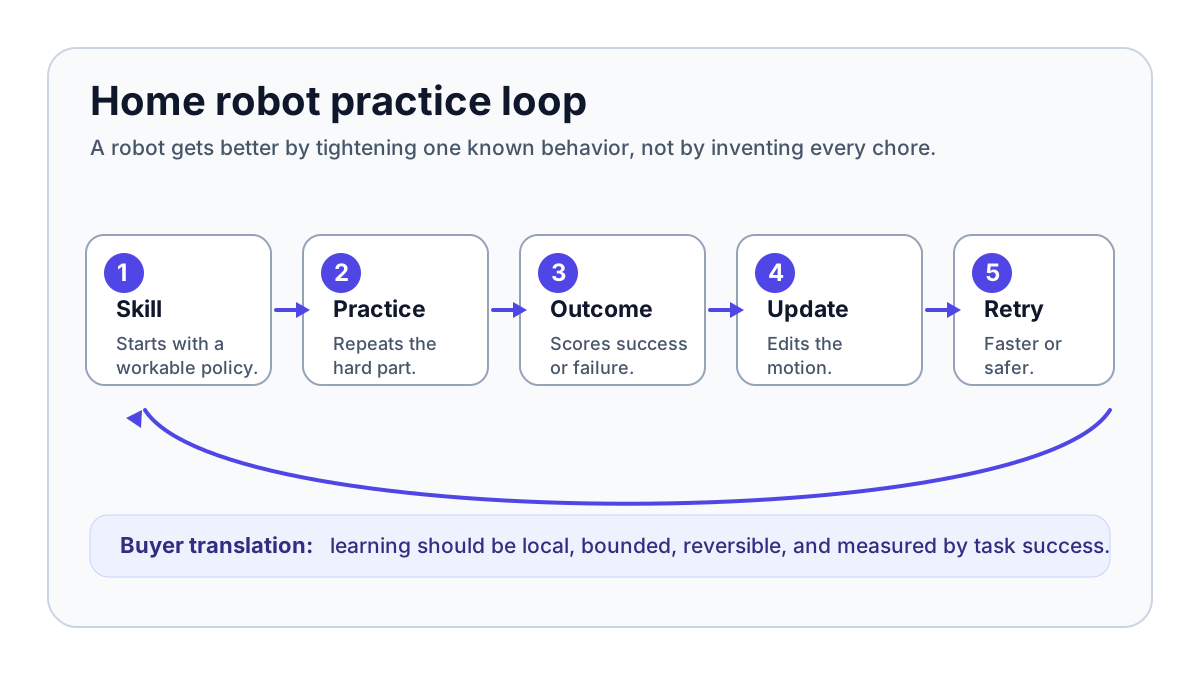
The useful question is not whether robot learning exists. It does. Physical Intelligence's March 2026 RL Tokens work shows a robot improving precise manipulation with minutes or hours of real robot experience. The buyer question is narrower: which parts of that research are close to consumer robots, and which parts are still lab infrastructure wearing a friendly name?
Do home robots get better the more they practice?
Yes, but only inside a bounded task and only when the robot has a way to measure whether practice helped.
Physical Intelligence's RL Tokens research is the clearest recent example. The company started with a vision-language-action model that could do broad parts of a task, then added a compact "RL token" so a much smaller reinforcement learning policy could tune the hard final phase. Instead of retraining the whole robot brain, the smaller actor-and-critic policy learns from the robot's own attempts and edits the base model's action.
The results are intentionally narrow but important. The tasks were not vague "household help" demos. They were contact-rich, fussy actions: driving a tiny M3 screw, fastening a zip tie, inserting an ethernet cable, and plugging in a power cord. Physical Intelligence says the approach sped up the most precise stages by up to 3x, could learn from as little as 15 minutes of real-world data, and on the ethernet task produced final-policy trials whose median length beat both the base model and human teleoperation.
That is the right mental model for a future home robot. Practice should first make a robot less clumsy at the last centimeter of a known chore. It should not be treated as proof that the robot can invent new chores without supervision.
The three kinds of "learning" buyers should separate
When a robot company says a product gets better, ask which kind of improvement it means.
Claim
OTA updates
- What it really means
- The company ships new software to many robots.
- Buyer risk
- Useful, but not personalized to your home.
Claim
Demonstration learning
- What it really means
- A person shows the robot how to do a task.
- Buyer risk
- Powerful, but may need many examples and clean recovery tools.
Claim
Practice learning
- What it really means
- The robot repeats a task and updates a policy from outcomes.
- Buyer risk
- Promising, but needs strong success detection and rollback.
Claim
Human expert mode
- What it really means
- A remote or local human intervenes when autonomy fails.
- Buyer risk
- Practical, but privacy and availability matter.
| Claim | What it really means | Buyer risk |
|---|---|---|
| OTA updates | The company ships new software to many robots. | Useful, but not personalized to your home. |
| Demonstration learning | A person shows the robot how to do a task. | Powerful, but may need many examples and clean recovery tools. |
| Practice learning | The robot repeats a task and updates a policy from outcomes. | Promising, but needs strong success detection and rollback. |
| Human expert mode | A remote or local human intervenes when autonomy fails. | Practical, but privacy and availability matter. |
This is why the topic sits between ui44's earlier guides on teaching a home robot new chores, VLA models, and on-device AI. Imitation learning teaches the basic behavior. A VLA links vision, language, and action. On-device AI decides how much of the loop can happen locally. Practice learning is the next layer: the robot tries, measures, adjusts, and tries again.
What the ui44 database says about current robots
No consumer home humanoid in the ui44 database should be treated as a fully self-improving household worker today. The interesting part is that several robots now expose pieces of the stack.

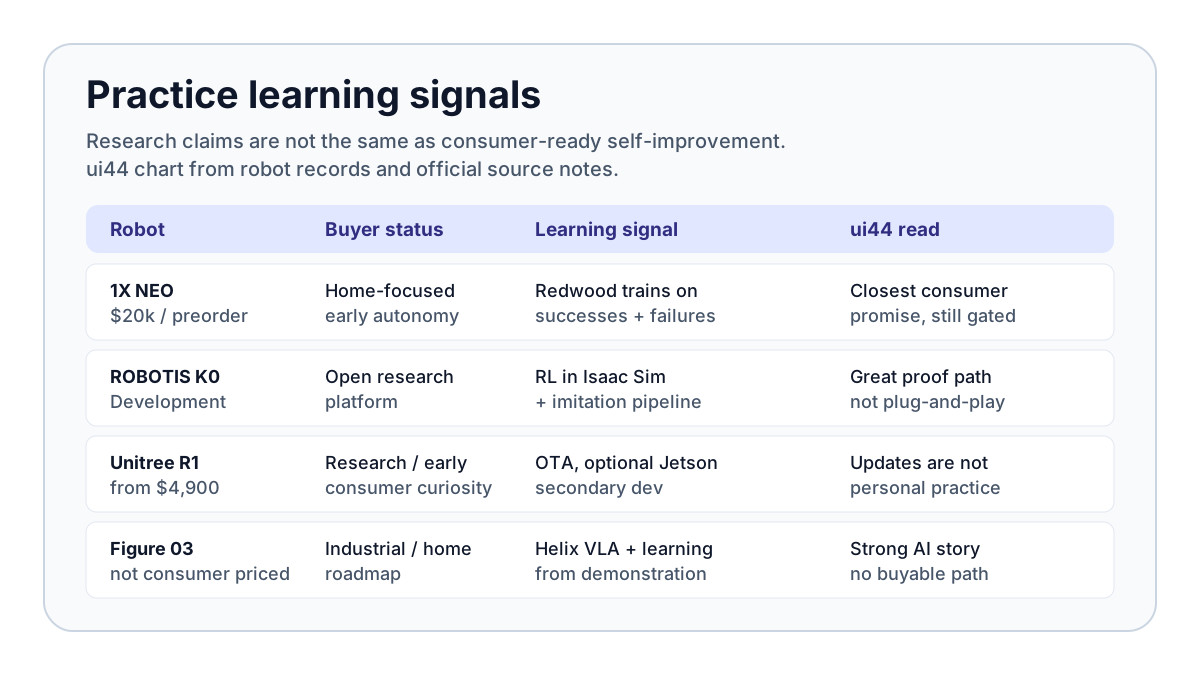
1X NEO is the most direct home-facing example. The ui44 record lists NEO as a $20,000 pre-order humanoid with a 167 cm, 30 kg soft body, about four hours of battery life, RGB and depth sensing, tactile skin, a microphone array, and "Adaptive Learning" in its capability list. 1X's own AI page says Redwood trains on both successes and failures, uses context from failure data, and is among the first VLAs to control locomotion jointly with manipulation. The NEO order page also says early owners get basic autonomy and that the robot "grows in capability over time."
That is exactly the promise buyers care about. It is also why the details matter. If NEO learns from every interaction, buyers should ask what data leaves the home, what counts as a successful attempt, whether failed practice can be undone, and whether a remote 1X Expert is involved. The promise is closer to home use than a pure lab platform, but it is still a pre-order product whose real household learning behavior has to be proven after delivery.
ROBOTIS AI Sapiens K0 is the opposite kind of evidence: less consumer-friendly, more transparent. ui44 lists K0 as a development humanoid: 1.3 m tall, 34 kg, 23 degrees of freedom, a 3 kg arm payload, a 46.8 V battery, and onboard compute with a 6 TOPS NPU. ROBOTIS says K0 is built around reinforcement learning in NVIDIA Isaac Sim and an imitation learning pipeline using a leader-follower data collection system. It is designed so researchers can train, refine, and deploy policies on real hardware rather than treat the robot as a closed appliance.
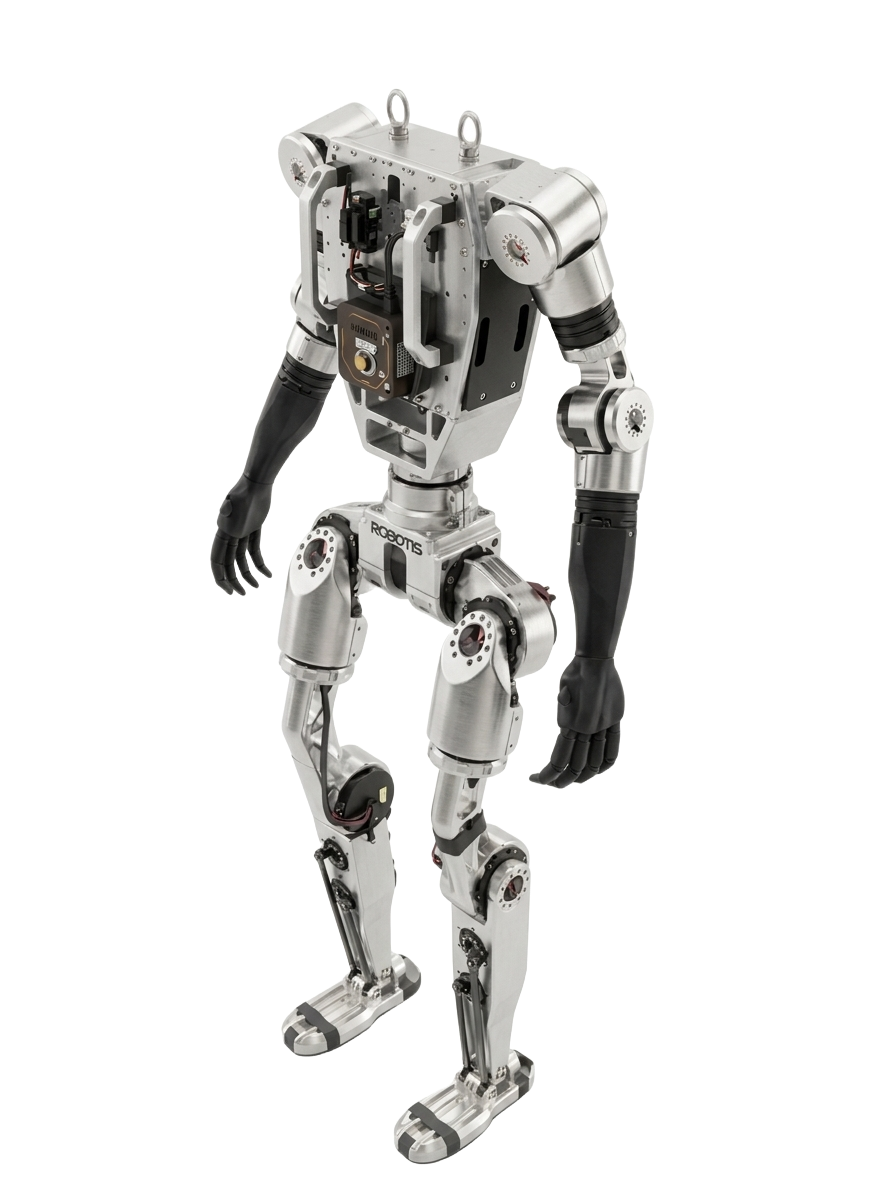
For buyers, K0 is a reminder that self-improvement is not one feature toggle. It needs logs, simulation, policy training, deployment tools, and a body that can survive repeated attempts. Open research platforms may get there earlier than polished consumer robots, but they ask the buyer to become part of the robotics team.
Unitree R1 is a good caution case. It starts at $4,900 for the R1 Air, with the standard R1 at $5,900 and EDU pricing on request. The robot is 123 cm tall, about 27-29 kg depending on version, has roughly one hour of battery life, and offers 20 to 26 degrees of freedom on consumer versions, with the EDU line listing 26-40 DOF and optional Jetson Orin compute. Unitree also lists upgraded intelligent OTA, open interfaces, simulation-platform support, and secondary development for EDU.
Those are valuable ingredients, but they are not the same as personal practice learning. OTA means the company can improve algorithms for everyone. Secondary development means a capable team can build or train behaviors. Neither proves that your own robot will safely adapt to your own kitchen after ten failed attempts.
Figure 03 belongs in the conversation for a different reason. ui44 records it as an active humanoid with no public consumer price, a 173 cm body, 61 kg weight, about five hours of battery life, stereo vision, depth cameras, force sensors, tactile arrays, a 20 kg payload, and Figure's in-house Helix VLA. Its capabilities include learning from demonstration and multi-step planning. That is a strong learning stack, but the current public path is not "buy one for your apartment and let it practice."
Why success detection is the hidden feature
A robot cannot improve from practice unless it can tell whether practice worked. That sounds obvious, but it is one of the hardest parts of home robotics.
Physical Intelligence's RL Tokens work focused on tasks where outcomes can be measured: the cable is inserted, the charger is plugged in, the zip tie is fastened. Google's Gemini Robotics-ER 1.6 announcement makes the same point from a reasoning angle. Google describes success detection as a cornerstone of autonomy because a robot needs to know whether to retry a failed attempt or move to the next step. Multi-view reasoning matters because a wrist camera, an overhead camera, and a body camera may each see a different part of the chore.
For a home buyer, this is where vague AI claims fall apart. "Learns from practice" is credible for a bounded skill like aligning a plug, placing a cup in a known rack, or closing a drawer. It is much less credible for open-ended chores where the robot cannot reliably judge the result: did it clean the counter well enough, sort laundry correctly, or make the room safer for a child?
Where practice learning will show up first at home
The first useful self-improvement will probably be boring. That is good.
Expect gains in small, repeatable motions:
- docking with a charger more reliably;
- grasping familiar household objects from a known shelf;
- improving the final alignment of plugs, handles, and drawers;
- reducing the number of human interventions during a scheduled chore;
- choosing safer body positions before a reach.
Do not expect near-term robots to self-teach broad chores from scratch. Physical Intelligence's π0.7 work shows impressive compositional generalization, including language coaching for new appliance tasks and cross-embodiment transfer. That is important research, but the company is still describing model capability, not a retail home robot warranty.
This also explains why Unitree Go2 and other robot dogs can be genuinely impressive without being self-improving home assistants. Unitree's current official Go2 page lists the Air at $1,600, Pro at $2,800, and X at $4,500, with EDU pricing by sales contact; the ui44 record now treats OTA gait updates as software improvements, not personal practice learning. A gait update can make a robot dog move better. It does not mean the dog has learned your household routine.
The buyer checklist
- What exactly adapts? A grasp policy, a navigation route, a whole chore,
- Where does learning happen? On the robot, on a home hub, in the company's
- How is success measured? The robot needs a concrete outcome signal, not
- Can bad learning be rolled back? A robot that practices the wrong
- What proof is public? Look for before-and-after success rate, speed,
- Does the hardware survive practice? Repeated failed attempts are
What to believe in 2026
Robot self-improvement is real. It is one of the reasons home robotics feels different now than it did during the first social-robot wave. The strongest research systems are no longer limited to copying demonstrations. They can use corrections, outcomes, and practice to improve speed and reliability.
But buyers should treat self-improvement as a narrow capability until proven otherwise. A self-improving home robot still needs a safe body, a useful task, local perception, privacy boundaries, success detection, and a company willing to show failure data. Without those, "gets better over time" is just another way to say "software updates someday."
The practical verdict: if you are comparing robots in 2026, give extra credit to platforms that explain their learning loop. NEO has the clearest home-facing story. K0 has the clearest open research path. R1 shows why affordable hardware and OTA updates are not enough by themselves. Figure 03 shows that advanced VLA claims can still sit outside the consumer market.
Use the ui44 robot database and compare tool to keep those claims separate. The first robot that truly gets better in your home will probably not be the one with the loudest AI branding. It will be the one that can show a boring chart where yesterday's failure becomes tomorrow's routine success.
Sources & References
- Physical Intelligence, "Precise Manipulation with Efficient Online RL" / RL Tokens, published March 19, 2026: https://www.pi.website/research/rlt
- Physical Intelligence, "π0.7: a Steerable Model with Emergent Capabilities," published April 16, 2026: https://www.pi.website/blog/pi07
- Physical Intelligence, "π0.6*: a VLA that Learns from Experience," published November 17, 2025: https://www.pi.website/blog/pistar06
- 1X AI and NEO order pages: https://www.1x.tech/ai and https://www.1x.tech/order
- ROBOTIS AI Sapiens K0 official page: https://ai.robotis.com/ai_sapiens/introduction_ai_sapiens.html
- Unitree R1 official page: https://www.unitree.com/R1/
- Unitree Go2 official page: https://www.unitree.com/go2/
- Google DeepMind Gemini Robotics-ER 1.6 announcement: https://deepmind.google/blog/gemini-robotics-er-1-6/
- ui44 database records checked for 1X NEO, ROBOTIS AI Sapiens K0, Unitree R1, Unitree Go2, and Figure 03 on May 7, 2026.
Related in the database
Use this article as a privacy verification workflow
Turn the article into a privacy verification pass grounded in the robots, manufacturers, and components it actually references.
Do Home Robots Get Better with Practice? already points you toward 5 linked robots, 4 manufacturers, and 4 countries inside the ui44 database. That matters because strong buyer guidance is easier to apply when you can move immediately from a claim or warning into concrete product pages, manufacturer directories, component explainers, and country-level context instead of treating the article as an isolated opinion piece. The fastest next step is to turn the article into a shortlist workflow: open the linked robot pages, verify which specs are actually published for those models, then compare the surrounding manufacturer and component context before you decide whether the underlying claim changes your buying plan.
For this topic, the useful discipline is to separate the editorial lesson from the catalog evidence. The article gives you the framing, but the robot pages tell you what each product actually ships with today: sensor stack, connectivity methods, listed price, release timing, category, and support-relevant compatibility notes. The manufacturer pages then show whether you are looking at a one-off launch, a broader lineup pattern, or a company that spans multiple categories. That layered workflow reduces the risk of buying on a single marketing phrase or a single support FAQ.
Use the robot pages to confirm which products actually expose cameras, microphones, Wi-Fi, or voice systems, then use the manufacturer pages to decide how much of the privacy question seems product-specific versus brand-wide. On this route cluster, NEO, AI Sapiens K0, and R1 form the fastest reality check. If you want a quick working shortlist, open Compare NEO, AI Sapiens K0, and R1 next, then keep this article open as the reasoning layer while you compare structured data side by side.
Practical Takeaway
Every robot, manufacturer, category, component, and country reference below resolves to a real ui44 page, keeping the follow-up path grounded in database records rather than generic advice.
Suggested next steps in ui44
- Open NEO and note the listed sensors, connectivity methods, and voice stack before you interpret any policy claim.
- Cross-check the wider brand context on 1X Technologies so you can see whether the privacy question touches one model or a broader lineup.
- Use the linked component pages to confirm how common the relevant sensors and connectivity layers are across the database.
- Keep a short note of which policy layers you checked, which device features are actually present on the robot page, and which items still depend on region- or app-level confirmation.
- Finish with Compare NEO, AI Sapiens K0, and R1 so the policy reading sits next to structured product data.
Robot profiles worth opening next
Use the linked product pages as the evidence layer
The linked robot pages are where this article becomes operational. Instead of asking whether the headline is interesting, use the robot entries to inspect the actual mix of sensors, connectivity options, batteries, pricing, release timing, and stated capabilities attached to the products mentioned in the article. That is the easiest way to see whether the warning or opportunity described here affects one product family, a specific design pattern, or an entire buying lane.
NEO
1X Technologies · Humanoid · Pre-order
NEO is tracked on ui44 as a pre-order humanoid robot from 1X Technologies. The database currently records a listed price of $20,000, a release date of 2025-10-28, ~4 hours battery life, Not disclosed charging time, and a published stack that includes RGB Cameras, Depth Sensors, and Tactile Skin plus Wi-Fi and Bluetooth.
For privacy-focused reading, this page matters because it shows the concrete device surface behind the policy discussion. Use it to verify whether NEO combines sensors and connectivity in a way that could change the in-home data footprint, and compare the listed capabilities such as Household Chores, Tidying Up, and Safe Human Interaction with any cloud, app, or voice layers.
AI Sapiens K0
ROBOTIS · Research · Development
AI Sapiens K0 is tracked on ui44 as a development research robot from ROBOTIS. The database currently records a listed price of Price TBA, a release date of 2026, Not officially disclosed (46.8 V, 9000 mAh battery) battery life, Not disclosed charging time, and a published stack that includes IMU (inferred from locomotion capability) plus Wi-Fi 5 and Bluetooth 5.0.
For privacy-focused reading, this page matters because it shows the concrete device surface behind the policy discussion. Use it to verify whether AI Sapiens K0 combines sensors and connectivity in a way that could change the in-home data footprint, and compare the listed capabilities such as Bipedal locomotion research, Reinforcement learning training in NVIDIA Isaac Sim, and Imitation learning via leader-follower data collection with any cloud, app, or voice layers.
R1
Unitree Robotics · Humanoid · Pre-order
R1 is tracked on ui44 as a pre-order humanoid robot from Unitree Robotics. The database currently records a listed price of $4,900, a release date of 2025, ~1 hour (mixed activity) battery life, Not officially disclosed charging time, and a published stack that includes Monocular camera (R1 Air); binocular camera (R1/R1 EDU), 4-Mic Array, and Dual 6-Axis IMU plus Wi-Fi 6 and Bluetooth 5.2.
For privacy-focused reading, this page matters because it shows the concrete device surface behind the policy discussion. Use it to verify whether R1 combines sensors and connectivity in a way that could change the in-home data footprint, and compare the listed capabilities such as Bipedal Walking & Running, Cartwheels & Handstands, and Push Recovery with any cloud, app, or voice layers, including UnifoLM (voice + image commands).
Figure 03 is tracked on ui44 as a active humanoid robot from Figure AI. The database currently records a listed price of Price TBA, a release date of 2025-10-09, ~5 hours battery life, Not disclosed charging time, and a published stack that includes Stereo Vision, Depth Cameras, and Force Sensors plus Wi-Fi and Bluetooth.
For privacy-focused reading, this page matters because it shows the concrete device surface behind the policy discussion. Use it to verify whether Figure 03 combines sensors and connectivity in a way that could change the in-home data footprint, and compare the listed capabilities such as Complex Manipulation, Warehouse Work, and Manufacturing Tasks with any cloud, app, or voice layers.
Go2
Unitree Robotics · Quadruped · Available
Go2 is tracked on ui44 as a available quadruped robot from Unitree Robotics. The database currently records a listed price of $1,600, a release date of 2023-07-12, 1–2h (standard) / 2–4h (EDU long endurance) battery life, Not officially disclosed charging time, and a published stack that includes 4D LiDAR L2 (360°×96° hemispherical), HD Wide-angle Camera, and Depth Camera (EDU) plus Wi-Fi 6 and Bluetooth 5.2.
For privacy-focused reading, this page matters because it shows the concrete device surface behind the policy discussion. Use it to verify whether Go2 combines sensors and connectivity in a way that could change the in-home data footprint, and compare the listed capabilities such as Quadruped Walking & Running, Advanced AI Gaits (roll-over, obstacle climbing), and 3D LiDAR Mapping with any cloud, app, or voice layers, including Offline voice interaction (Pro/X/EDU).
Manufacturer context behind the article
Check whether this is one product story or a broader company pattern
Manufacturer pages add the privacy context that individual product pages cannot show on their own. They help you check whether cameras, microphones, cloud accounts, app controls, and policy assumptions appear across a broader lineup or stay tied to one specific product story.
1X Technologies
ui44 currently tracks 2 robots from 1X Technologies across 1 category. The company is grouped under Norway, and the current catalog footprint on ui44 includes NEO, EVE.
That wider brand context matters because privacy questions rarely stop at one FAQ page. A manufacturer route helps you see whether the article is centered on one premium model or on a company that has several relevant products and therefore more than one place where the same policy or app assumptions might matter. The category mix here currently points toward Humanoid as the most useful next route if you want to see whether this article reflects a wider pattern inside the brand.
ROBOTIS
ui44 currently tracks 2 robots from ROBOTIS across 1 category. The company is grouped under South Korea, and the current catalog footprint on ui44 includes ROBOTIS OP3, AI Sapiens K0.
That wider brand context matters because privacy questions rarely stop at one FAQ page. A manufacturer route helps you see whether the article is centered on one premium model or on a company that has several relevant products and therefore more than one place where the same policy or app assumptions might matter. The category mix here currently points toward Research as the most useful next route if you want to see whether this article reflects a wider pattern inside the brand.
Unitree Robotics
ui44 currently tracks 9 robots from Unitree Robotics across 3 categorys. The company is grouped under China, and the current catalog footprint on ui44 includes B2, B1, Go2.
That wider brand context matters because privacy questions rarely stop at one FAQ page. A manufacturer route helps you see whether the article is centered on one premium model or on a company that has several relevant products and therefore more than one place where the same policy or app assumptions might matter. The category mix here currently points toward Quadruped, Humanoid, Research as the most useful next route if you want to see whether this article reflects a wider pattern inside the brand.
Figure AI
ui44 currently tracks 2 robots from Figure AI across 1 category. The company is grouped under USA, and the current catalog footprint on ui44 includes Figure 03, Figure 02.
That wider brand context matters because privacy questions rarely stop at one FAQ page. A manufacturer route helps you see whether the article is centered on one premium model or on a company that has several relevant products and therefore more than one place where the same policy or app assumptions might matter. The category mix here currently points toward Humanoid as the most useful next route if you want to see whether this article reflects a wider pattern inside the brand.
Broaden the scan without leaving the database
Categories, components, and countries add the wider context
Category framing
Category pages are useful when the article touches a buying pattern that shows up across brands. A category route helps you confirm whether the linked products sit in a narrow niche or whether the same question should be tested across a larger field of alternatives.
Humanoid
The Humanoid category page currently groups 129 tracked robots from 92 manufacturers. ui44 describes this lane as: Full-size bipedal humanoid robots built to work alongside people — from factory floors to household tasks. Compare the cutting edge of humanoid robotics.
That makes the category route a practical follow-up when you want to check whether the products linked in this article are typical for the lane or whether they sit at one edge of the market. Useful starting examples currently include NEO, EVE, Mornine M1.
Research
The Research category page currently groups 49 tracked robots from 39 manufacturers. ui44 describes this lane as: Academic and research robotics platforms pushing the boundaries of what machines can learn and do in the lab and beyond.
That makes the category route a practical follow-up when you want to check whether the products linked in this article are typical for the lane or whether they sit at one edge of the market. Useful starting examples currently include HRP-4C, HRP-5P, NAO6.
Country and ecosystem context
Country pages give extra context when support practices, launch sequencing, regulatory posture, or manufacturer mix matter. They are not a substitute for model-level verification, but they do help you see which ecosystems cluster together and which manufacturers sit in the same regional field when you broaden the search beyond the article headline.
Norway
The Norway route currently groups 2 tracked robots from 1 manufacturers in ui44. That gives you a useful regional lens when the article points toward support practices, launch sequencing, or brand clusters that may share similar ecosystem assumptions.
On the current route, manufacturers like 1X Technologies make the page a good way to broaden the scan without losing the regional context that often shapes availability, documentation style, and adjacent alternatives.
South Korea
The South Korea route currently groups 9 tracked robots from 7 manufacturers in ui44. That gives you a useful regional lens when the article points toward support practices, launch sequencing, or brand clusters that may share similar ecosystem assumptions.
On the current route, manufacturers like ROBOTIS, Samsung, GenON make the page a good way to broaden the scan without losing the regional context that often shapes availability, documentation style, and adjacent alternatives.
China
The China route currently groups 189 tracked robots from 87 manufacturers in ui44. That gives you a useful regional lens when the article points toward support practices, launch sequencing, or brand clusters that may share similar ecosystem assumptions.
On the current route, manufacturers like AGIBOT, Dreame, Unitree Robotics make the page a good way to broaden the scan without losing the regional context that often shapes availability, documentation style, and adjacent alternatives.
Questions to answer before you move from reading to buying
A follow-up FAQ built from the entities already linked in this article
Frequently Asked Questions
Which page should I open first after reading “Do Home Robots Get Better with Practice?”?
Start with NEO. That gives you a concrete product anchor for the article’s main claim. From there, branch into the manufacturer and component pages so you can tell whether the article is describing one specific model, a repeated brand pattern, or a wider technology issue that affects multiple shortlist options.
How do the manufacturer pages change the buying decision?
1X Technologies help you zoom out from one article and one product. On ui44 they show lineup breadth, category spread, and the neighboring robots tied to the same company. That context is useful when you are deciding whether a risk belongs to a single model, whether it shows up across a brand’s portfolio, and whether you should keep looking at alternatives before committing.
When should I switch from reading to side-by-side comparison?
Move into Compare NEO, AI Sapiens K0, and R1 as soon as you understand the article’s main warning or promise. The article explains what to watch for, but the compare view is where you can check whether price, status, battery life, connectivity, sensors, and category fit still make the robot a good match for your own home and budget.
Where to go next in ui44
Keep the research chain inside the database
If you want to keep going, these follow-on pages give you the cleanest expansion path from article to research session. Open the comparison route first if you are deciding between products today. Open the manufacturer, category, and component routes if you still need to understand the broader pattern behind the claim.
Written by
ui44 Team
Published May 7, 2026
Share this article
Open a plain share link on X or Bluesky. No embeds, no widgets, no cookie baggage.