That still makes Cinnamon Mini useful for home-robot buyers to understand. A small humanoid may reach useful reliability earlier than a full-size helper because it can be cheaper, lighter, easier to supervise, and less dangerous when it makes a mistake. But those advantages only matter if the robot proves more than choreography.
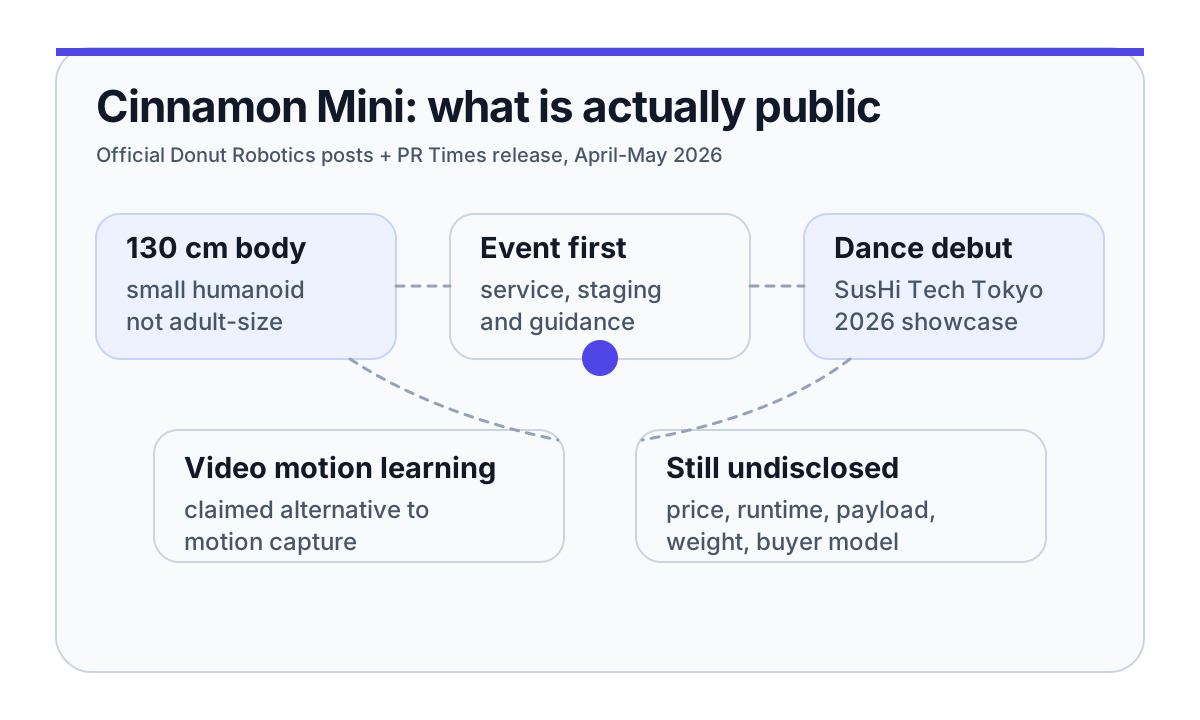
The short version: Cinnamon Mini is a credible signal that Japanese humanoid robotics may split into two tracks. Full-size humanoids chase physical labor. Small humanoids chase presence, guidance, interaction, entertainment, education, and supervised public-space jobs. For many households, that second track may be more realistic sooner.
What did Donut Robotics announce about Cinnamon Mini?
Donut Robotics' official April and May posts say Cinnamon Mini was first shown around SusHi Tech Tokyo 2026, the innovation conference held at Tokyo Big Sight from April 27 to 29. The April announcement said Cinnamon Mini would be unveiled publicly and appear in a live dance collaboration with Atarashii Gakko on the final day. The May follow-up summarized the same point more simply: Cinnamon Mini was announced at SusHi Tech 2026.
The more detailed official release adds the important buyer-facing facts. Donut positions Cinnamon Mini as the follow-up to Cinnamon 1, but with a different job. Where Cinnamon 1 is a roughly 170 cm, 70 kg full-size humanoid framed around factory and construction-site labor, Cinnamon Mini is described as a 130 cm small humanoid that is more lightweight, more agile, lower cost, and focused on entertainment use.
That framing matters. Donut is not saying Cinnamon Mini is a kitchen robot, a laundry robot, or an eldercare assistant you can buy next month. The official language points to customer service, staging, events, store traffic guidance, and dance-based spatial performance. It is a public interaction robot first.
The release also says Cinnamon Mini uses "motion learning from video" rather than relying on conventional motion capture. If that becomes robust, it could lower the cost of teaching humanoids new motions. For now, treat it as a promising development claim, not proof that a small humanoid can learn arbitrary household chores from YouTube.
Why a 130 cm humanoid could be more practical than a full-size one
A smaller humanoid gives up reach and payload. It also avoids some of the scary parts of putting an adult-size biped in a normal home.
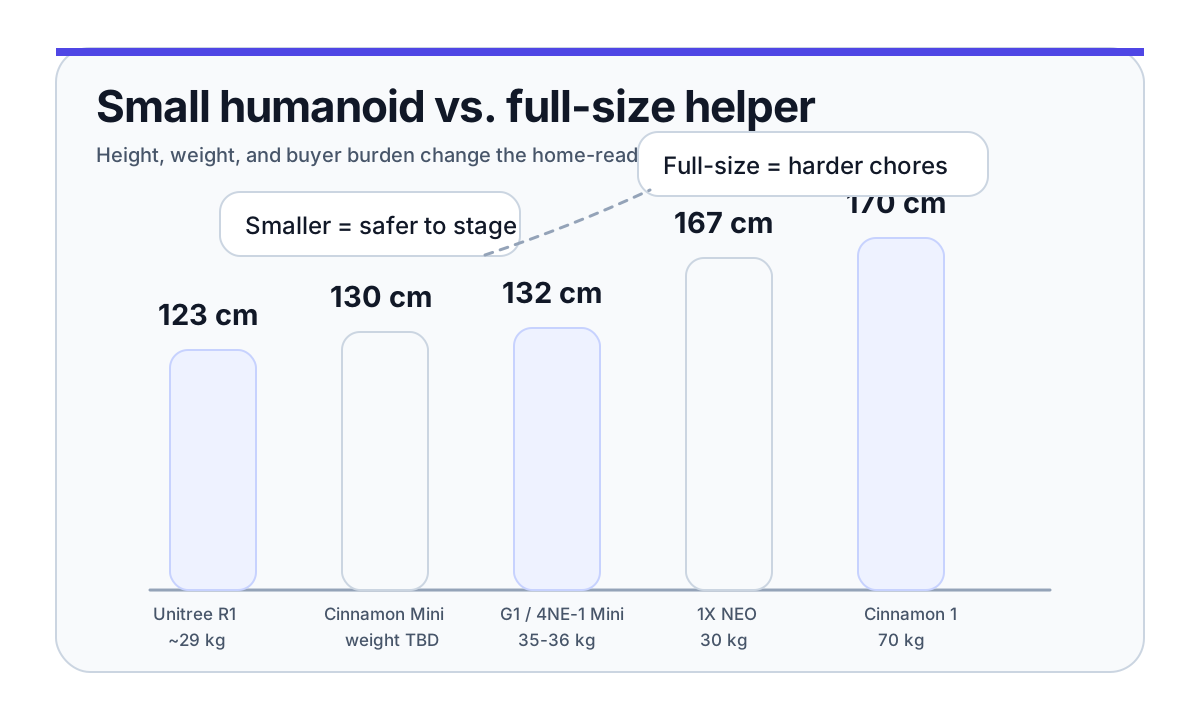
A full-size humanoid like 1X NEO is closer to household work surfaces. ui44 tracks NEO at 167 cm, 30 kg, about 4 hours of battery life, and a $20,000 early-adopter price. That height makes sense for counters, appliances, shelves, and human-scale chores. But it also increases the safety burden: the robot has to move around people, pets, stairs, rugs, glass, chairs, and narrow hallways without causing physical harm.
By contrast, the existing compact-humanoid field is already crowded with robots that are interesting but limited. Unitree R1 starts around $4,900, stands 123 cm, weighs about 29 kg, and has about 1 hour of mixed-activity battery life. Unitree G1 is 132 cm and 35 kg, with a starting price of $13,500 and about 2 hours of battery life. NEURA 4NE-1 Mini is also 132 cm, 36 kg, from €19,999, and has about 2.5 hours of battery life with a listed 3 kg payload.
Cinnamon Mini sits conceptually in that compact group, but Donut has not yet published the key numbers that would make a real comparison possible: weight, runtime, payload, hand design, sensor package, price, shipping region, warranty, or buyer availability. So the honest read is simple. The 130 cm size claim is meaningful. The rest is still mostly an event-demo story.
The job may be performance before chores
The most interesting thing about Cinnamon Mini is that Donut is not pretending that every humanoid has to start by doing dishes. The official release talks about entertainment, event appearances, traffic guidance inside stores, and stage performance. That is a narrow lane, but it may be a sensible lane.
Robots fail less when the environment is controlled. A stage, shop entrance, event booth, museum lobby, school demo, or retail queue is easier to structure than an apartment. The floor can be cleared. The lighting can be controlled. The script can be rehearsed. A human can supervise. The robot can be useful even if it only handles a few repeatable behaviors.
That pattern already shows up in ui44's database. Pepper, the 120 cm social humanoid, survived in public and semi-public jobs because greeting, explaining, translating, entertaining, and scripted interaction are easier to package than general-purpose home labor. LOVOT, at 43 cm and 4.6 kg, succeeds in a different way: it is openly a companion, not a chore robot. SwitchBot KATA Friends is an available $699 AI pet companion, and Loona is a $429 small wheeled companion with face recognition, voice commands, games, and auto-docking.
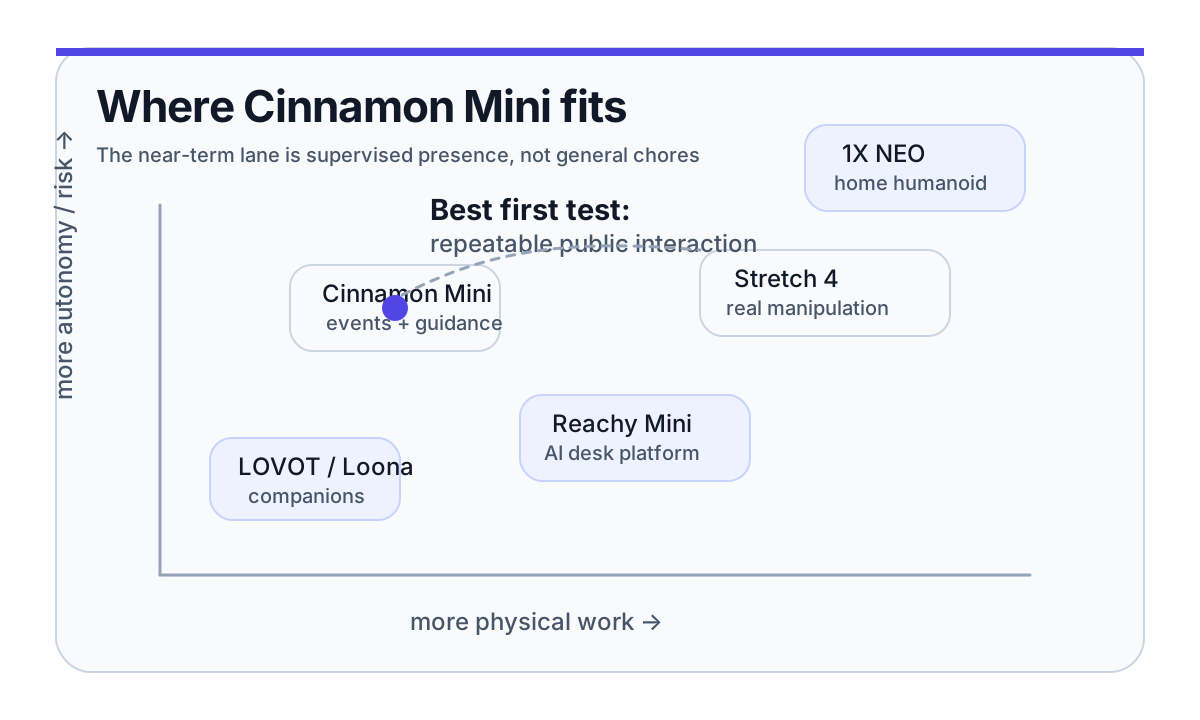
Those robots are not substitutes for a humanoid helper. They are evidence that homes often accept robots when the promise is clear. Companionship is clear. Education is clear. Entertainment is clear. Store greeting is clear. "Maybe a humanoid can do anything" is not clear.
Cinnamon Mini's best near-term path may be to become extremely good at a few public-facing behaviors: moving with performers, welcoming visitors, guiding people through a space, responding to gestures, presenting information, and being safe around crowds. If it does that reliably, the robot can teach buyers something useful about compact humanoids even before it touches laundry.
Video learning is the claim to watch
Donut's most ambitious Cinnamon Mini claim is not the height. It is the statement that the robot can learn motion from video instead of conventional motion capture. In theory, that matters because motion capture is expensive, staged, and hard to scale. Video is everywhere. If a humanoid can turn video into safe, repeatable movement, the training pipeline gets much cheaper.
But buyers should separate three levels of evidence.
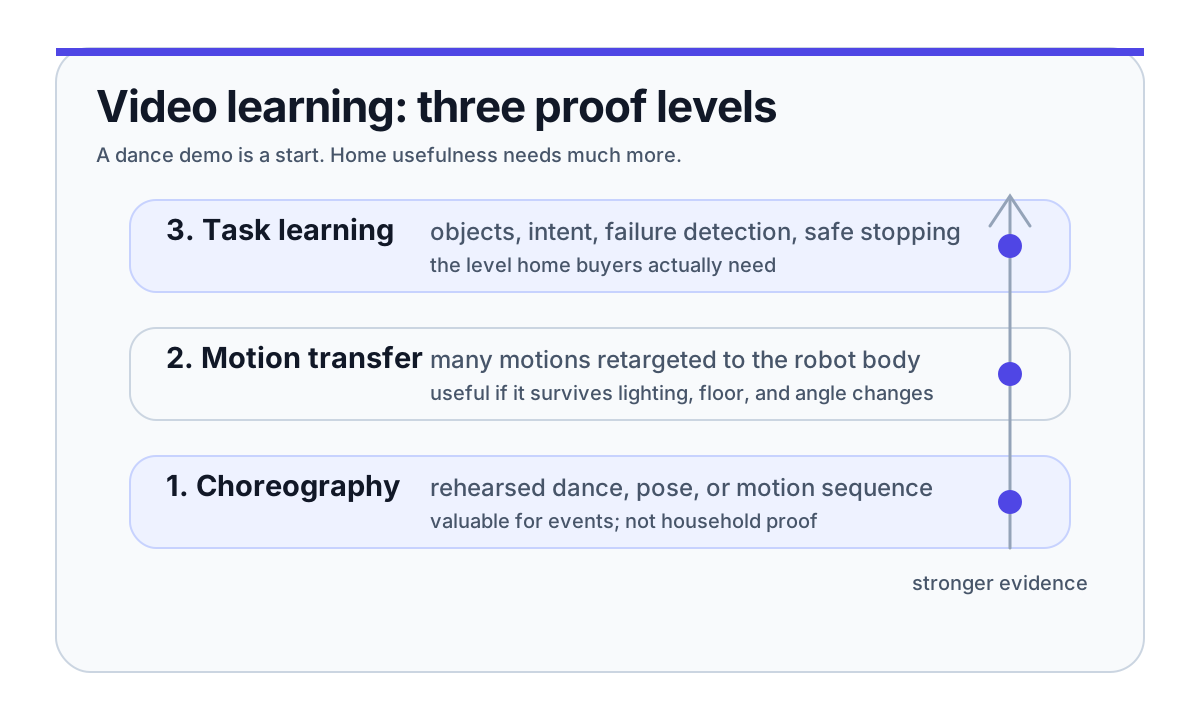
Level one is choreography. A robot copies a dance, pose, or rehearsed motion sequence. That is impressive, especially for a biped, but it does not prove household usefulness.
Level two is robust motion transfer. The robot can learn many motions from ordinary video, retarget them to its body, and repeat them under slightly different lighting, camera angles, and floor conditions. That would be valuable for entertainment and education.
Level three is task learning. The robot watches a human perform a practical job, understands the objects, adapts the motion to its own body, detects when the attempt is failing, and stops safely. That is the level home buyers actually care about. It is also the level that current public Cinnamon Mini evidence does not yet prove.
The distinction matters because the same phrase, "learns from video," can mean very different things. A dance routine is not a dishwasher routine. A public stage is not a cluttered kitchen. A scripted event appearance is not autonomous help in a home where a chair moved, a pet is underfoot, and a child interrupts the robot.
Cinnamon Mini vs. desk robots and mobile manipulators
For a buyer, the useful comparison is not only Cinnamon Mini versus full-size humanoids. It is Cinnamon Mini versus every smaller robot already trying to earn a place indoors.
Robot
Cinnamon Mini
- ui44 data point
- Donut says 130 cm, small, low-cost, high-mobility, event/customer-service/performance focus; price and runtime not public.
- What it teaches about Cinnamon Mini
- A small humanoid can start with supervised presence instead of chores.
Robot
- ui44 data point
- From $4,900, 123 cm, ~29 kg, about 1 hour, pre-order.
- What it teaches about Cinnamon Mini
- Low-cost bipedal hardware gets attention, but useful manipulation is still the hard part.
Robot
- ui44 data point
- $13,500, 132 cm, 35 kg, about 2 hours, available research humanoid.
- What it teaches about Cinnamon Mini
- Similar size does not automatically mean home-ready. Developer support and safety matter.
Robot
- ui44 data point
- From €19,999, 132 cm, 36 kg, about 2.5 hours, 3 kg payload.
- What it teaches about Cinnamon Mini
- A compact humanoid can publish practical specs; Cinnamon Mini still needs that sheet.
Robot
- ui44 data point
- $2,899 pre-order, 49.4 cm, about 2 hours, bipedal/wheeled companion.
- What it teaches about Cinnamon Mini
- Smaller robots can target family presence without claiming general labor.
Robot
- ui44 data point
- From $299, 28 cm, open-source desktop robot kit.
- What it teaches about Cinnamon Mini
- If the job is interaction and AI experimentation, a desk robot may be enough.
Robot
- ui44 data point
- $29,950, wheeled mobile manipulator, 8 hours light-load runtime, 2.5-4 kg arm payload.
- What it teaches about Cinnamon Mini
- Non-humanoid manipulators may reach real assistive work before small bipeds.
| Robot | ui44 data point | What it teaches about Cinnamon Mini |
|---|---|---|
| Cinnamon Mini | Donut says 130 cm, small, low-cost, high-mobility, event/customer-service/performance focus; price and runtime not public. | A small humanoid can start with supervised presence instead of chores. |
| Unitree R1 | From $4,900, 123 cm, ~29 kg, about 1 hour, pre-order. | Low-cost bipedal hardware gets attention, but useful manipulation is still the hard part. |
| Unitree G1 | $13,500, 132 cm, 35 kg, about 2 hours, available research humanoid. | Similar size does not automatically mean home-ready. Developer support and safety matter. |
| NEURA 4NE-1 Mini | From €19,999, 132 cm, 36 kg, about 2.5 hours, 3 kg payload. | A compact humanoid can publish practical specs; Cinnamon Mini still needs that sheet. |
| Zeroth M1 | $2,899 pre-order, 49.4 cm, about 2 hours, bipedal/wheeled companion. | Smaller robots can target family presence without claiming general labor. |
| Reachy Mini | From $299, 28 cm, open-source desktop robot kit. | If the job is interaction and AI experimentation, a desk robot may be enough. |
| Hello Robot Stretch 4 | $29,950, wheeled mobile manipulator, 8 hours light-load runtime, 2.5-4 kg arm payload. | Non-humanoid manipulators may reach real assistive work before small bipeds. |
That last row is the uncomfortable comparison for every small humanoid. If a buyer wants real physical help, Stretch 4 is ugly in the way serious tools are ugly: wheeled base, telescoping arm, sensors, open software, and a clear assistive/research role. A small biped has to prove that its human shape creates enough value to offset instability, lower payload, and harder control.
Cinnamon Mini may not need to win that comparison. It may be competing more with Pepper, KATA Friends, Loona, Reachy Mini, and event robots than with Stretch 4 or 1X NEO. That is a different market and a more believable first step.
What home buyers should ask before caring
Cinnamon Mini is worth following, but not because it is a near-term home purchase. It is worth following because it may show whether compact humanoids can become safe, expressive, and trainable enough to leave the lab.
Before treating it as a real home-robot candidate, wait for these specifics:
- Price and availability: whether Donut plans public sales, enterprise-only deployments, rentals, or event bookings.
- Runtime and charging: whether it can work through a normal event session without constant battery management.
- Weight and fall behavior: a 130 cm robot can still hurt people if it falls badly.
- Hands and payload: whether the robot can carry, point, gesture, grip, or only perform body motions.
- Sensor and safety stack: cameras, depth sensing, force limits, emergency stop, crowd behavior, and remote supervision.
- Video-learning proof: many learned motions, not one rehearsed routine.
- Privacy model: what cameras record, what goes to cloud AI, and whether a human operator can connect during demos or deployments.
The privacy question is easy to overlook because Cinnamon Mini is being shown as an entertainer. It should not be overlooked. A robot that moves through stores, venues, schools, or homes with cameras and microphones needs a plain data policy.
Bottom line: small humanoid, smaller promise, better test
Cinnamon Mini should not be read as proof that a small Japanese humanoid can beat full-size home robots at chores. It is more interesting than that. It is a test of whether a compact humanoid can pick a narrower promise and execute it better: perform, guide, interact, learn motions cheaply, and operate safely in supervised human spaces.
That is not the dream version of home robotics. It is not a robot butler. It is not a general housekeeper. But it may be a more realistic bridge than another full-size humanoid demo promising everything.
For now, the right verdict is cautious optimism. Cinnamon Mini has a sensible size, a clear event-first use case, and a genuinely important training claim in video-based motion learning. It still needs the boring spec sheet, safety data, runtime, price, buyer model, and repeated real-world demos before it belongs in a home-robot buying shortlist.
Related in the database
Use this article as a privacy verification workflow
Turn the article into a privacy verification pass grounded in the robots, manufacturers, and components it actually references.
Cinnamon Mini: Small Humanoid Reality Check already points you toward 11 linked robots, 11 manufacturers, and 6 countries inside the ui44 database. That matters because strong buyer guidance is easier to apply when you can move immediately from a claim or warning into concrete product pages, manufacturer directories, component explainers, and country-level context instead of treating the article as an isolated opinion piece. The fastest next step is to turn the article into a shortlist workflow: open the linked robot pages, verify which specs are actually published for those models, then compare the surrounding manufacturer and component context before you decide whether the underlying claim changes your buying plan.
For this topic, the useful discipline is to separate the editorial lesson from the catalog evidence. The article gives you the framing, but the robot pages tell you what each product actually ships with today: sensor stack, connectivity methods, listed price, release timing, category, and support-relevant compatibility notes. The manufacturer pages then show whether you are looking at a one-off launch, a broader lineup pattern, or a company that spans multiple categories. That layered workflow reduces the risk of buying on a single marketing phrase or a single support FAQ.
Use the robot pages to confirm which products actually expose cameras, microphones, Wi-Fi, or voice systems, then use the manufacturer pages to decide how much of the privacy question seems product-specific versus brand-wide. On this route cluster, NEO, R1, and G1 form the fastest reality check. If you want a quick working shortlist, open Compare NEO, R1, and G1 next, then keep this article open as the reasoning layer while you compare structured data side by side.
Practical Takeaway
Every robot, manufacturer, category, component, and country reference below resolves to a real ui44 page, keeping the follow-up path grounded in database records rather than generic advice.
Suggested next steps in ui44
- Open NEO and note the listed sensors, connectivity methods, and voice stack before you interpret any policy claim.
- Cross-check the wider brand context on 1X Technologies so you can see whether the privacy question touches one model or a broader lineup.
- Use the linked component pages to confirm how common the relevant sensors and connectivity layers are across the database.
- Keep a short note of which policy layers you checked, which device features are actually present on the robot page, and which items still depend on region- or app-level confirmation.
- Finish with Compare NEO, R1, and G1 so the policy reading sits next to structured product data.
Robot profiles worth opening next
Use the linked product pages as the evidence layer
The linked robot pages are where this article becomes operational. Instead of asking whether the headline is interesting, use the robot entries to inspect the actual mix of sensors, connectivity options, batteries, pricing, release timing, and stated capabilities attached to the products mentioned in the article. That is the easiest way to see whether the warning or opportunity described here affects one product family, a specific design pattern, or an entire buying lane.
NEO
1X Technologies · Humanoid · Pre-order
NEO is tracked on ui44 as a pre-order humanoid robot from 1X Technologies. The database currently records a listed price of $20,000, a release date of 2025-10-28, ~4 hours battery life, Not disclosed charging time, and a published stack that includes RGB Cameras, Depth Sensors, and Tactile Skin plus Wi-Fi and Bluetooth.
For privacy-focused reading, this page matters because it shows the concrete device surface behind the policy discussion. Use it to verify whether NEO combines sensors and connectivity in a way that could change the in-home data footprint, and compare the listed capabilities such as Household Chores, Tidying Up, and Safe Human Interaction with any cloud, app, or voice layers.
R1
Unitree Robotics · Humanoid · Pre-order
R1 is tracked on ui44 as a pre-order humanoid robot from Unitree Robotics. The database currently records a listed price of $4,900, a release date of 2025, ~1 hour (mixed activity) battery life, Not officially disclosed charging time, and a published stack that includes Monocular camera (R1 Air); binocular camera (R1/R1 EDU), 4-Mic Array, and Dual 6-Axis IMU plus Wi-Fi 6 and Bluetooth 5.2.
For privacy-focused reading, this page matters because it shows the concrete device surface behind the policy discussion. Use it to verify whether R1 combines sensors and connectivity in a way that could change the in-home data footprint, and compare the listed capabilities such as Bipedal Walking & Running, Cartwheels & Handstands, and Push Recovery with any cloud, app, or voice layers, including UnifoLM (voice + image commands).
G1 is tracked on ui44 as a available humanoid robot from Unitree. The database currently records a listed price of $13,500, a release date of 2024-05-13, ~2 hours battery life, Not disclosed charging time, and a published stack that includes Depth Camera, 3D LiDAR, and 4 Microphone Array plus Wi-Fi 6 and Bluetooth 5.2.
For privacy-focused reading, this page matters because it shows the concrete device surface behind the policy discussion. Use it to verify whether G1 combines sensors and connectivity in a way that could change the in-home data footprint, and compare the listed capabilities such as Bipedal Walking, Object Manipulation, and Dexterous Hands (optional Dex3-1) with any cloud, app, or voice layers.
4NE-1 Mini
NEURA Robotics · Humanoid · Pre-order
4NE-1 Mini is tracked on ui44 as a pre-order humanoid robot from NEURA Robotics. The database currently records a listed price of €19,999, a release date of 2026-01-05, ~2.5 hours battery life, Not disclosed charging time, and a published stack that includes Multi-camera Array, Force/Torque Sensors, and 3D Vision plus Wi-Fi 6 and Gigabit Ethernet.
For privacy-focused reading, this page matters because it shows the concrete device surface behind the policy discussion. Use it to verify whether 4NE-1 Mini combines sensors and connectivity in a way that could change the in-home data footprint, and compare the listed capabilities such as 25 Degrees of Freedom, Autonomous Navigation, and Object Manipulation (Pro tier: 12-DOF dexterous hands) with any cloud, app, or voice layers, including Built-in Multi-language Voice Recognition.
Pepper
Aldebaran Robotics · Commercial · Available
Pepper is tracked on ui44 as a available commercial robot from Aldebaran Robotics. The database currently records a listed price of Price TBA, a release date of 2014-06, ~12 hours (shop use) battery life, ~8 hours 20 minutes charging time, and a published stack that includes RGB Camera ×2 (forehead + mouth), 3D Depth Sensor, and Microphone ×4 plus Wi-Fi 802.11 a/b/g/n (2.4/5 GHz) and Ethernet.
For privacy-focused reading, this page matters because it shows the concrete device surface behind the policy discussion. Use it to verify whether Pepper combines sensors and connectivity in a way that could change the in-home data footprint, and compare the listed capabilities such as Emotion Recognition, Facial Expression Analysis, and Natural Conversation with any cloud, app, or voice layers, including Multilingual Speech Recognition & Synthesis.
Manufacturer context behind the article
Check whether this is one product story or a broader company pattern
Manufacturer pages add the privacy context that individual product pages cannot show on their own. They help you check whether cameras, microphones, cloud accounts, app controls, and policy assumptions appear across a broader lineup or stay tied to one specific product story.
1X Technologies
ui44 currently tracks 2 robots from 1X Technologies across 1 category. The company is grouped under Norway, and the current catalog footprint on ui44 includes NEO, EVE.
That wider brand context matters because privacy questions rarely stop at one FAQ page. A manufacturer route helps you see whether the article is centered on one premium model or on a company that has several relevant products and therefore more than one place where the same policy or app assumptions might matter. The category mix here currently points toward Humanoid as the most useful next route if you want to see whether this article reflects a wider pattern inside the brand.
Unitree Robotics
ui44 currently tracks 9 robots from Unitree Robotics across 3 categorys. The company is grouped under China, and the current catalog footprint on ui44 includes B2, B1, Go2.
That wider brand context matters because privacy questions rarely stop at one FAQ page. A manufacturer route helps you see whether the article is centered on one premium model or on a company that has several relevant products and therefore more than one place where the same policy or app assumptions might matter. The category mix here currently points toward Quadruped, Humanoid, Research as the most useful next route if you want to see whether this article reflects a wider pattern inside the brand.
Unitree
ui44 currently tracks 2 robots from Unitree across 1 category. The company is grouped under China, and the current catalog footprint on ui44 includes H1, G1.
That wider brand context matters because privacy questions rarely stop at one FAQ page. A manufacturer route helps you see whether the article is centered on one premium model or on a company that has several relevant products and therefore more than one place where the same policy or app assumptions might matter. The category mix here currently points toward Humanoid as the most useful next route if you want to see whether this article reflects a wider pattern inside the brand.
NEURA Robotics
ui44 currently tracks 4 robots from NEURA Robotics across 3 categorys. The company is grouped under Germany, and the current catalog footprint on ui44 includes 4NE-1, 4NE-1 Mini, MiPA.
That wider brand context matters because privacy questions rarely stop at one FAQ page. A manufacturer route helps you see whether the article is centered on one premium model or on a company that has several relevant products and therefore more than one place where the same policy or app assumptions might matter. The category mix here currently points toward Humanoid, Home Assistants, Quadruped as the most useful next route if you want to see whether this article reflects a wider pattern inside the brand.
Broaden the scan without leaving the database
Categories, components, and countries add the wider context
Category framing
Category pages are useful when the article touches a buying pattern that shows up across brands. A category route helps you confirm whether the linked products sit in a narrow niche or whether the same question should be tested across a larger field of alternatives.
Humanoid
The Humanoid category page currently groups 129 tracked robots from 92 manufacturers. ui44 describes this lane as: Full-size bipedal humanoid robots built to work alongside people — from factory floors to household tasks. Compare the cutting edge of humanoid robotics.
That makes the category route a practical follow-up when you want to check whether the products linked in this article are typical for the lane or whether they sit at one edge of the market. Useful starting examples currently include NEO, EVE, Mornine M1.
Commercial
The Commercial category page currently groups 44 tracked robots from 38 manufacturers. ui44 describes this lane as: Delivery robots, warehouse automation, and hospitality service bots — robots built for business and commercial operations.
That makes the category route a practical follow-up when you want to check whether the products linked in this article are typical for the lane or whether they sit at one edge of the market. Useful starting examples currently include G2 Air, aeo, Pepper.
Country and ecosystem context
Country pages give extra context when support practices, launch sequencing, regulatory posture, or manufacturer mix matter. They are not a substitute for model-level verification, but they do help you see which ecosystems cluster together and which manufacturers sit in the same regional field when you broaden the search beyond the article headline.
Norway
The Norway route currently groups 2 tracked robots from 1 manufacturers in ui44. That gives you a useful regional lens when the article points toward support practices, launch sequencing, or brand clusters that may share similar ecosystem assumptions.
On the current route, manufacturers like 1X Technologies make the page a good way to broaden the scan without losing the regional context that often shapes availability, documentation style, and adjacent alternatives.
China
The China route currently groups 189 tracked robots from 87 manufacturers in ui44. That gives you a useful regional lens when the article points toward support practices, launch sequencing, or brand clusters that may share similar ecosystem assumptions.
On the current route, manufacturers like AGIBOT, Dreame, Unitree Robotics make the page a good way to broaden the scan without losing the regional context that often shapes availability, documentation style, and adjacent alternatives.
Germany
The Germany route currently groups 13 tracked robots from 9 manufacturers in ui44. That gives you a useful regional lens when the article points toward support practices, launch sequencing, or brand clusters that may share similar ecosystem assumptions.
On the current route, manufacturers like NEURA Robotics, Bosch, Agile Robots make the page a good way to broaden the scan without losing the regional context that often shapes availability, documentation style, and adjacent alternatives.
Questions to answer before you move from reading to buying
A follow-up FAQ built from the entities already linked in this article
Frequently Asked Questions
Which page should I open first after reading “Cinnamon Mini: Small Humanoid Reality Check”?
Start with NEO. That gives you a concrete product anchor for the article’s main claim. From there, branch into the manufacturer and component pages so you can tell whether the article is describing one specific model, a repeated brand pattern, or a wider technology issue that affects multiple shortlist options.
How do the manufacturer pages change the buying decision?
1X Technologies help you zoom out from one article and one product. On ui44 they show lineup breadth, category spread, and the neighboring robots tied to the same company. That context is useful when you are deciding whether a risk belongs to a single model, whether it shows up across a brand’s portfolio, and whether you should keep looking at alternatives before committing.
When should I switch from reading to side-by-side comparison?
Move into Compare NEO, R1, and G1 as soon as you understand the article’s main warning or promise. The article explains what to watch for, but the compare view is where you can check whether price, status, battery life, connectivity, sensors, and category fit still make the robot a good match for your own home and budget.
Where to go next in ui44
Keep the research chain inside the database
If you want to keep going, these follow-on pages give you the cleanest expansion path from article to research session. Open the comparison route first if you are deciding between products today. Open the manufacturer, category, and component routes if you still need to understand the broader pattern behind the claim.
Written by
ui44 Team
Published May 24, 2026
Share this article
Open a plain share link on X or Bluesky. No embeds, no widgets, no cookie baggage.