That makes Mirokaï worth a careful look. A senior-living robot does not have to fold laundry or lift a person to matter. It may create conversation, draw people into group activities, guide a visitor, or give staff a more engaging way to run a trivia session. But the same robot can be oversold quickly if “companion” turns into “caregiver” without evidence.
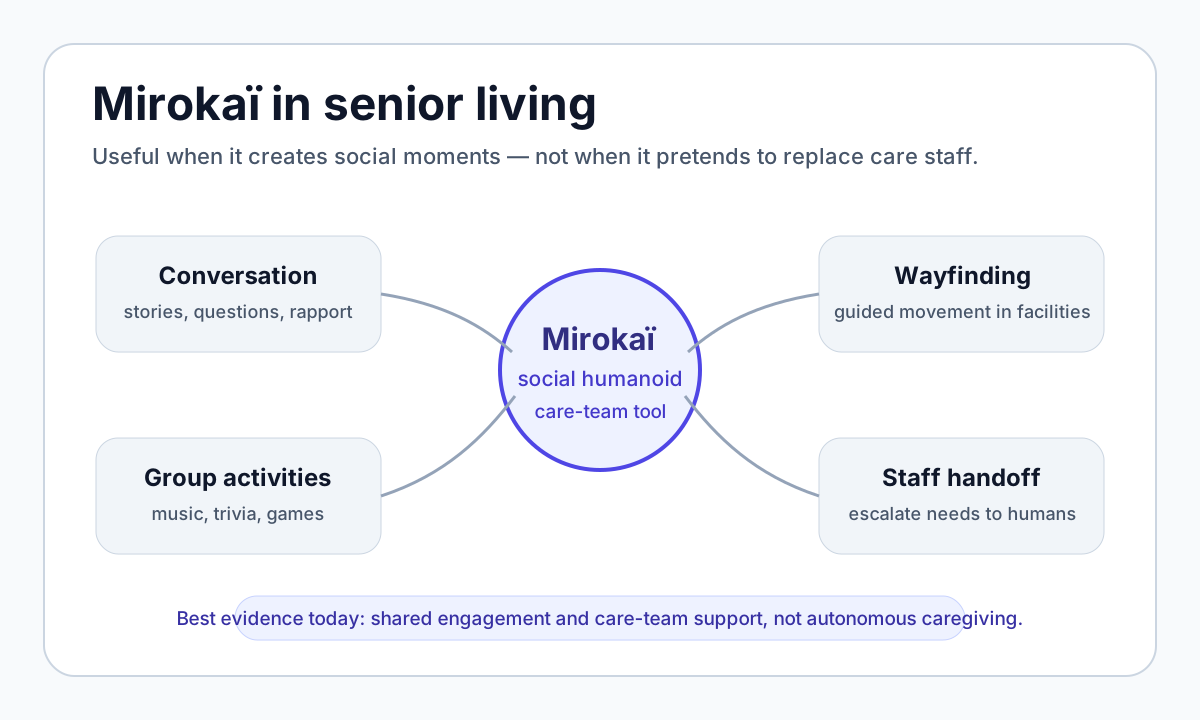
The short version: Mirokaï looks like a credible social-catalyst robot for supervised care environments. It is not evidence that a humanoid can replace human elder care at home. The buyer question is not “is the robot charming?” It is “which jobs are safe, repeatable, measurable, and supported by the care team?”
What is Mirokaï?
Mirokaï is the social humanoid family from Enchanted Tools, a French robotics startup founded by Jérôme Monceaux, who previously helped create NAO and Pepper at Aldebaran/SoftBank Robotics. The company uses character names such as Miroki and Miroka for individual robots, but ui44 tracks the product family as Mirokaï.
The hardware is deliberately not a bipedal humanoid. ui44 lists Mirokaï at about 123 cm tall and 26 kg, rolling on a patented omnidirectional globe instead of walking on legs. That matters in senior-living settings: a wheeled base is usually easier to control indoors than a full biped, while the humanoid-like upper body still gives residents a face, arms, and a social presence.
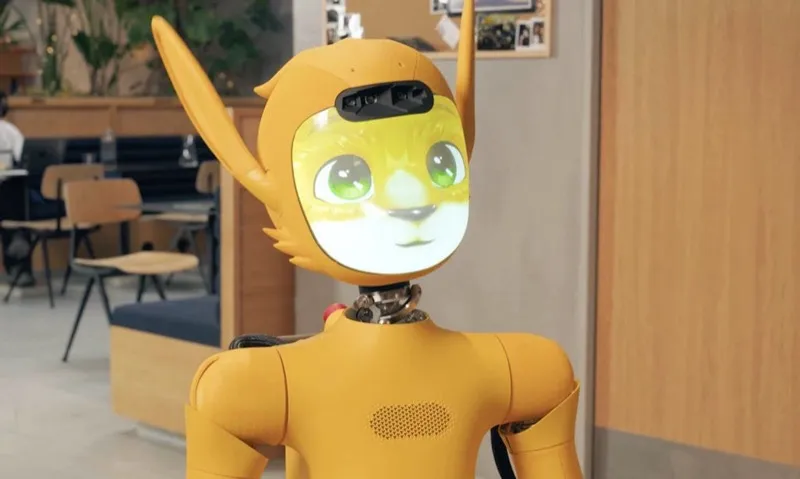
The robot’s current Explorer Suit pitch includes natural conversation with multi-LLM integration, real-time speech recognition and synthesis, emotional prosody, vision-language models for context, GDPR-compliant face tracking, autonomous VSLAM navigation, 3D/ToF/ultrasonic sensing for 360-degree coverage, and AI-driven grasping. In ui44’s database, the robot has 26 degrees of freedom, an estimated 4-hour battery life, 3.2 km/h top speed, Wi‑Fi/Bluetooth, CE certification, torque-controlled arms, and a configuration-dependent payload note.
Those are useful specs, but they point to a supervised facility robot more than a plug-and-play home caregiver. There is no public consumer price. Enchanted Tools appears to sell through partnerships and inquiry flows, not a normal checkout page. For a senior-living operator, that is not automatically bad. For a family expecting to buy one for a parent’s apartment, it is a signal that the service model is not yet consumer-simple.
Why senior living is a better first market than private homes
Private homes are hard for social robots because every household has different routines, privacy expectations, floor plans, Wi‑Fi reliability, medication rules, family boundaries, and emergency protocols. Senior-living communities are still complex, but they offer a more structured environment: trained staff, shared activity rooms, repeatable schedules, accessible spaces, and a clear handoff path when a resident needs a human.
That is where Mirokaï’s early evidence is strongest. Enchanted Tools says it worked with Mather Institute on a pilot at The Mather in Evanston, Illinois, where Miroka interacted daily with residents and staff through conversations, group activities, and shared experiences. The pilot was not framed as a robot replacing caregivers. It asked a narrower and better question: how can a robot in a shared environment influence social dynamics?
Mather Institute’s public robot-report page describes a one-week pilot in a Life Plan Community studying how a social companion robot named Miroka could function in a senior-living community and affect staff and residents. Enchanted Tools’ summary emphasizes storytelling, games, discussions, laughter, and collective experiences. The important phrase is “social presence.” That is different from a medical outcome claim.
Live Oak Adult Day Services gives a second useful clue. Enchanted Tools says Miroki supported seniors living with mild to moderate dementia through music, trivia, and conversation, creating stimulating moments while allowing staff to focus on hands-on care. That is exactly the kind of bounded use case a buyer can inspect: what activity, what supervision, how often, what resident group, and what happened when the robot was not novel anymore?
The social value is real, but it is not the same as caregiving
The most believable Mirokaï use case is not one-to-one robot therapy in a vacuum. It is a robot as a shared object of attention. In a group setting, a characterful robot can prompt a resident to tell a story, answer a trivia question, sing along, or talk with another person nearby. If that happens, the robot is acting less like a replacement companion and more like a facilitator.
That distinction matters because senior loneliness is often social and organizational, not just technological. A tablet can play music. A smart speaker can answer questions. A human activity director can run a much richer session. A mobile social humanoid earns its keep only if the body changes the room: more attention, more laughter, more willingness to participate, easier transitions, or less setup burden for staff.
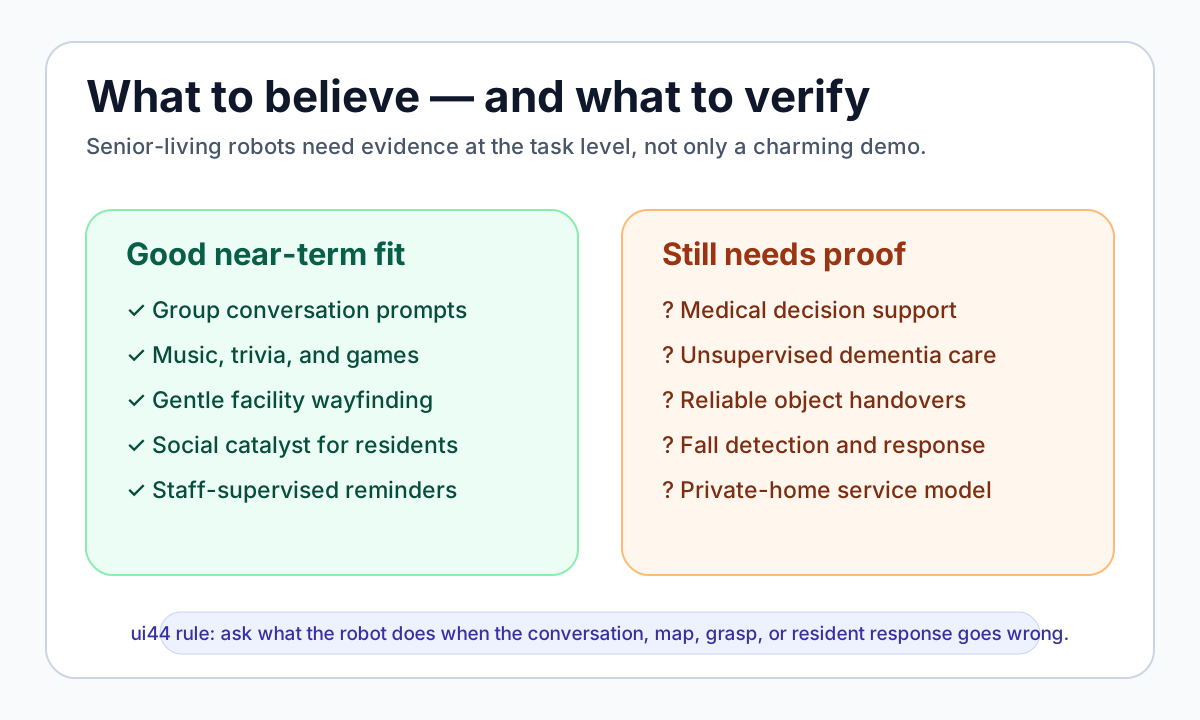
That is why the right standard is task evidence. “Residents liked it” is a good start. Better evidence would include attendance lift for group activities, repeat engagement after the novelty period, staff time saved per session, resident opt-out rates, privacy incidents, maintenance downtime, and clear handoff rules when the robot misunderstands someone.
Mirokaï’s charm is part of the product. It should not be the whole proof.
How Mirokaï compares with other companion and care robots
ui44’s database helps put Mirokaï in context. It sits between stationary companion devices, animal-like therapeutic robots, classic social humanoids, and heavier assistive humanoids.
Robot
- What ui44 tracks
- Active social humanoid; 123 cm; ~26 kg; rolling globe; ~4h battery; multi-LLM conversation; VSLAM; face tracking; arms and grasping; no public price
- Senior-living lesson
- Best judged as a supervised social and facility robot, not a consumer home caregiver.
Robot
- What ui44 tracks
- Available older-adult companion; leased with $249 initiation plus $59/mo monthly option; stationary screen/body; video calls, reminders, wellness programs
- Senior-living lesson
- Stronger fit for in-home conversation and routines, but it does not move around or physically assist.
Robot
- What ui44 tracks
- Available Japanese companion from ¥577,500 plus care plan; 43 cm; 4.6 kg; touch response, thermal person detection, auto-charging
- Senior-living lesson
- Emotional presence can matter even with no practical chores, but it is not a care-team workflow robot.
Robot
- What ui44 tracks
- Therapeutic baby-seal companion; FDA Class II medical device in the US; touch, sound, posture, and light sensing
- Senior-living lesson
- Proven care-context category, but intentionally narrow: calming interaction, not humanoid assistance.
Robot
- What ui44 tracks
- Care-centric humanoid; 165 cm; 71 kg; hot-swappable ~3h battery; 31 pressure sensors; 12-DoF hands
- Senior-living lesson
- More physically capable, but also heavier, more complex, and still not a normal consumer home product.
Robot
- What ui44 tracks
- Classic 120 cm social humanoid; ~27,000 units manufactured; retail, hospital, airport, and education history
- Senior-living lesson
- A cautionary precedent: social robots can be famous and widely deployed without becoming home staples.
| Robot | What ui44 tracks | Senior-living lesson |
|---|---|---|
| Mirokaï | Active social humanoid; 123 cm; ~26 kg; rolling globe; ~4h battery; multi-LLM conversation; VSLAM; face tracking; arms and grasping; no public price | Best judged as a supervised social and facility robot, not a consumer home caregiver. |
| ElliQ 3 | Available older-adult companion; leased with $249 initiation plus $59/mo monthly option; stationary screen/body; video calls, reminders, wellness programs | Stronger fit for in-home conversation and routines, but it does not move around or physically assist. |
| LOVOT | Available Japanese companion from ¥577,500 plus care plan; 43 cm; 4.6 kg; touch response, thermal person detection, auto-charging | Emotional presence can matter even with no practical chores, but it is not a care-team workflow robot. |
| PARO | Therapeutic baby-seal companion; FDA Class II medical device in the US; touch, sound, posture, and light sensing | Proven care-context category, but intentionally narrow: calming interaction, not humanoid assistance. |
| Fourier GR-3 | Care-centric humanoid; 165 cm; 71 kg; hot-swappable ~3h battery; 31 pressure sensors; 12-DoF hands | More physically capable, but also heavier, more complex, and still not a normal consumer home product. |
| Pepper | Classic 120 cm social humanoid; ~27,000 units manufactured; retail, hospital, airport, and education history | A cautionary precedent: social robots can be famous and widely deployed without becoming home staples. |
The comparison is not “which robot is best?” The better question is what form factor matches the job. ElliQ is designed for older adults at home and can be part of a daily routine, but it is stationary. LOVOT and PARO are primarily emotional or therapeutic companions. Familiar points to another branch of the same problem: a planned dog-sized companion with local multimodal AI, 23 degrees of freedom, and no announced price yet. Pepper and NAO show the long history of social humanoid deployments in public and educational settings. Fourier GR-3 moves closer to physical care, but the added size and manipulation capability raise safety, cost, and service questions.
Mirokaï’s niche is different: a mobile character that can inhabit a shared space, draw attention, navigate around people, talk, and potentially handle small objects or trays under supervision. That is more interesting than another chatbot in a screen. It is also harder to validate than a stationary companion, because movement changes the safety case.
What buyers should ask before a pilot
A care community should not buy Mirokaï, or any senior-living robot, on demo energy alone. The pilot plan matters more than the launch video.
Start with the activity design. Which exact sessions will the robot support: music, trivia, memory prompts, lobby greeting, meal reminders, wayfinding, or one-to-one conversation? Who starts and stops the session? Can residents opt out? Does the robot remember individuals, and if so, where is that data stored? How does staff correct it when it gets a name, preference, or room wrong?
Then inspect safety. Mirokaï’s rolling base, sensors, compliant actuators, and social navigation are relevant, but a care facility still needs rules for crowded hallways, walkers, wheelchairs, pets, dropped objects, battery charging, network outages, and residents who may grab the robot unexpectedly. Ask for the near-miss log, not only the happy demo.
Finally, inspect service. Who repairs the projector face, battery, wheels, actuators, cameras, microphones, and hands? Is there a local technician? What happens if a software update makes conversation worse? How are recordings, photos, face tracking, and interaction logs deleted or exported? What is the minimum staffing level required when the robot is operating?
A good pilot should have exit criteria as well as success metrics. If the robot only works when an Enchanted Tools specialist is nearby, that is useful research, not procurement proof.

Is Mirokaï a home robot?
Not in the normal buyer sense yet. It is home-relevant because the same problems will eventually matter in private houses: companionship, social prompting, navigation around people, privacy, trust, graceful failure, and the boundary between reminder and manipulation. But today the credible path runs through professional care environments first.
That is not a criticism. It may be the right route. Senior-living communities can gather feedback from residents, families, activity directors, nurses, therapists, administrators, and maintenance teams in a way a single household cannot. They can also decide when a robot is useful as a shared tool rather than a permanent companion assigned to one person.
For families, the takeaway is to be specific. If you want reminders, video calling, and daily check-ins, look at older-adult companion devices such as ElliQ 3 and compare privacy, subscription, and caregiver dashboard terms. If you want calming tactile interaction, compare therapeutic robots such as PARO. If you want a mobile social humanoid for a care community, Mirokaï belongs on the shortlist — but only with a pilot that measures staff workflow, resident consent, and sustained engagement.
Bottom line
Mirokaï is promising because it is chasing a use case where social presence can matter before full household autonomy is solved. Its senior-living story is not about a robot doing all elder care. It is about whether a well-designed robotic character can make group activities easier, reduce some social friction, and support staff without pretending to be staff.
That is a narrower claim than the usual home-humanoid hype, and a more useful one. If Enchanted Tools can show repeatable engagement beyond novelty, transparent privacy controls, safe facility navigation, dependable support, and clear staff workflows, Mirokaï could become one of the more practical examples of social robotics in care.
Until then, treat it as a senior-living pilot platform with real potential and real unanswered questions — exactly the kind of robot ui44 should track closely.
Related in the database
Use this article as a privacy verification workflow
Turn the article into a privacy verification pass grounded in the robots, manufacturers, and components it actually references.
Mirokaï: Social Humanoid for Senior Living? already points you toward 7 linked robots, 7 manufacturers, and 5 countries inside the ui44 database. That matters because strong buyer guidance is easier to apply when you can move immediately from a claim or warning into concrete product pages, manufacturer directories, component explainers, and country-level context instead of treating the article as an isolated opinion piece. The fastest next step is to turn the article into a shortlist workflow: open the linked robot pages, verify which specs are actually published for those models, then compare the surrounding manufacturer and component context before you decide whether the underlying claim changes your buying plan.
For this topic, the useful discipline is to separate the editorial lesson from the catalog evidence. The article gives you the framing, but the robot pages tell you what each product actually ships with today: sensor stack, connectivity methods, listed price, release timing, category, and support-relevant compatibility notes. The manufacturer pages then show whether you are looking at a one-off launch, a broader lineup pattern, or a company that spans multiple categories. That layered workflow reduces the risk of buying on a single marketing phrase or a single support FAQ.
Use the robot pages to confirm which products actually expose cameras, microphones, Wi-Fi, or voice systems, then use the manufacturer pages to decide how much of the privacy question seems product-specific versus brand-wide. On this route cluster, Mirokaï, ElliQ 3, and LOVOT form the fastest reality check. If you want a quick working shortlist, open Compare Mirokaï, ElliQ 3, and LOVOT next, then keep this article open as the reasoning layer while you compare structured data side by side.
Practical Takeaway
Every robot, manufacturer, category, component, and country reference below resolves to a real ui44 page, keeping the follow-up path grounded in database records rather than generic advice.
Suggested next steps in ui44
- Open Mirokaï and note the listed sensors, connectivity methods, and voice stack before you interpret any policy claim.
- Cross-check the wider brand context on Enchanted Tools so you can see whether the privacy question touches one model or a broader lineup.
- Use the linked component pages to confirm how common the relevant sensors and connectivity layers are across the database.
- Keep a short note of which policy layers you checked, which device features are actually present on the robot page, and which items still depend on region- or app-level confirmation.
- Finish with Compare Mirokaï, ElliQ 3, and LOVOT so the policy reading sits next to structured product data.
Robot profiles worth opening next
Use the linked product pages as the evidence layer
The linked robot pages are where this article becomes operational. Instead of asking whether the headline is interesting, use the robot entries to inspect the actual mix of sensors, connectivity options, batteries, pricing, release timing, and stated capabilities attached to the products mentioned in the article. That is the easiest way to see whether the warning or opportunity described here affects one product family, a specific design pattern, or an entire buying lane.
Mirokaï
Enchanted Tools · Commercial · Active
Mirokaï is tracked on ui44 as a active commercial robot from Enchanted Tools. The database currently records a listed price of Price TBA, a release date of 2025, ~4 hours battery life, Not disclosed charging time, and a published stack that includes 2 RGBD Cameras, 2 Infrared Cameras, and 9 Time-of-Flight Cameras plus Wi-Fi and Bluetooth.
For privacy-focused reading, this page matters because it shows the concrete device surface behind the policy discussion. Use it to verify whether Mirokaï combines sensors and connectivity in a way that could change the in-home data footprint, and compare the listed capabilities such as 26 Degrees of Freedom, Omnidirectional Rolling Globe Locomotion, and Expressive Animated Face (projector-based) with any cloud, app, or voice layers, including Multi-language speech recognition & synthesis with emotional prosody.
ElliQ 3
Intuition Robotics · Companions · Available
ElliQ 3 is tracked on ui44 as a available companions robot from Intuition Robotics. The database currently records a listed price of Price TBA, a release date of 2024-01, Mains powered battery life, N/A (plugged in) charging time, and a published stack that includes 4-mic array, 12 MP camera for images, and 1080p HD video at 30 fps with 120° horizontal FoV plus Wi-Fi 802.11b/g/n/ac (2.4 GHz and 5 GHz) and Bluetooth 5+.
For privacy-focused reading, this page matters because it shows the concrete device surface behind the policy discussion. Use it to verify whether ElliQ 3 combines sensors and connectivity in a way that could change the in-home data footprint, and compare the listed capabilities such as Proactive Conversation, Medication Reminders, and Health & Pain Tracking with any cloud, app, or voice layers, including ElliQ Voice AI.
LOVOT is tracked on ui44 as a available companions robot from GROOVE X. The database currently records a listed price of ¥577,500, a release date of 2019, 30-45 minutes active, then returns to nest battery life, 15-30 minutes (on charging nest) charging time, and a published stack that includes Horn Top Camera (half-sphere), Horn Front Camera, and Depth Camera plus Wi-Fi and Bluetooth.
For privacy-focused reading, this page matters because it shows the concrete device surface behind the policy discussion. Use it to verify whether LOVOT combines sensors and connectivity in a way that could change the in-home data footprint, and compare the listed capabilities such as Emotional Companionship, Person Recognition, and Touch Response (full body sensors) with any cloud, app, or voice layers.
PARO is tracked on ui44 as a active companions robot from AIST. The database currently records a listed price of Price TBA, a release date of 2003, Not officially disclosed battery life, Not officially disclosed charging time, and a published stack that includes Tactile sensors, Light sensor, and Audition (audio) sensor plus Not publicly detailed.
For privacy-focused reading, this page matters because it shows the concrete device surface behind the policy discussion. Use it to verify whether PARO combines sensors and connectivity in a way that could change the in-home data footprint, and compare the listed capabilities such as Therapeutic companionship, Responds to touch, voice direction, and handling, and Learns preferred user interactions with any cloud, app, or voice layers.
GR-3 is tracked on ui44 as a active humanoid robot from Fourier. The database currently records a listed price of Price TBA, a release date of 2025-08, ≈3 hours (hot-swappable) battery life, Not officially disclosed (current official page only says faster charging with fewer swaps) charging time, and a published stack that includes RGB Camera, Structured-Light Depth Camera, and 4-Microphone Array (voice localization, echo cancellation) plus Wi-Fi and Ethernet.
For privacy-focused reading, this page matters because it shows the concrete device surface behind the policy discussion. Use it to verify whether GR-3 combines sensors and connectivity in a way that could change the in-home data footprint, and compare the listed capabilities such as Bipedal Walking, Object Manipulation, and Emotional Interaction with any cloud, app, or voice layers.
Manufacturer context behind the article
Check whether this is one product story or a broader company pattern
Manufacturer pages add the privacy context that individual product pages cannot show on their own. They help you check whether cameras, microphones, cloud accounts, app controls, and policy assumptions appear across a broader lineup or stay tied to one specific product story.
Enchanted Tools
ui44 currently tracks 1 robot from Enchanted Tools across 1 category. The company is grouped under France, and the current catalog footprint on ui44 includes Mirokaï.
That wider brand context matters because privacy questions rarely stop at one FAQ page. A manufacturer route helps you see whether the article is centered on one premium model or on a company that has several relevant products and therefore more than one place where the same policy or app assumptions might matter. The category mix here currently points toward Commercial as the most useful next route if you want to see whether this article reflects a wider pattern inside the brand.
Intuition Robotics
ui44 currently tracks 1 robot from Intuition Robotics across 1 category. The company is grouped under Israel, and the current catalog footprint on ui44 includes ElliQ 3.
That wider brand context matters because privacy questions rarely stop at one FAQ page. A manufacturer route helps you see whether the article is centered on one premium model or on a company that has several relevant products and therefore more than one place where the same policy or app assumptions might matter. The category mix here currently points toward Companions as the most useful next route if you want to see whether this article reflects a wider pattern inside the brand.
GROOVE X
ui44 currently tracks 1 robot from GROOVE X across 1 category. The company is grouped under Japan, and the current catalog footprint on ui44 includes LOVOT.
That wider brand context matters because privacy questions rarely stop at one FAQ page. A manufacturer route helps you see whether the article is centered on one premium model or on a company that has several relevant products and therefore more than one place where the same policy or app assumptions might matter. The category mix here currently points toward Companions as the most useful next route if you want to see whether this article reflects a wider pattern inside the brand.
AIST
ui44 currently tracks 3 robots from AIST across 2 categorys. The company is grouped under Japan, and the current catalog footprint on ui44 includes HRP-4C, HRP-5P, PARO.
That wider brand context matters because privacy questions rarely stop at one FAQ page. A manufacturer route helps you see whether the article is centered on one premium model or on a company that has several relevant products and therefore more than one place where the same policy or app assumptions might matter. The category mix here currently points toward Research, Companions as the most useful next route if you want to see whether this article reflects a wider pattern inside the brand.
Broaden the scan without leaving the database
Categories, components, and countries add the wider context
Category framing
Category pages are useful when the article touches a buying pattern that shows up across brands. A category route helps you confirm whether the linked products sit in a narrow niche or whether the same question should be tested across a larger field of alternatives.
Commercial
The Commercial category page currently groups 44 tracked robots from 38 manufacturers. ui44 describes this lane as: Delivery robots, warehouse automation, and hospitality service bots — robots built for business and commercial operations.
That makes the category route a practical follow-up when you want to check whether the products linked in this article are typical for the lane or whether they sit at one edge of the market. Useful starting examples currently include G2 Air, aeo, Pepper.
Companions
The Companions category page currently groups 53 tracked robots from 48 manufacturers. ui44 describes this lane as: Social robots, robot pets, and elderly-care companions designed for emotional connection and everyday support at home.
That makes the category route a practical follow-up when you want to check whether the products linked in this article are typical for the lane or whether they sit at one edge of the market. Useful starting examples currently include PARO, Abi, Next-Generation Companion Robot.
Country and ecosystem context
Country pages give extra context when support practices, launch sequencing, regulatory posture, or manufacturer mix matter. They are not a substitute for model-level verification, but they do help you see which ecosystems cluster together and which manufacturers sit in the same regional field when you broaden the search beyond the article headline.
France
The France route currently groups 8 tracked robots from 7 manufacturers in ui44. That gives you a useful regional lens when the article points toward support practices, launch sequencing, or brand clusters that may share similar ecosystem assumptions.
On the current route, manufacturers like Pollen Robotics, Aldebaran / Maxtronics, Aldebaran Robotics make the page a good way to broaden the scan without losing the regional context that often shapes availability, documentation style, and adjacent alternatives.
Israel
The Israel route currently groups 5 tracked robots from 5 manufacturers in ui44. That gives you a useful regional lens when the article points toward support practices, launch sequencing, or brand clusters that may share similar ecosystem assumptions.
On the current route, manufacturers like Flytrex, Intuition Robotics, Maytronics make the page a good way to broaden the scan without losing the regional context that often shapes availability, documentation style, and adjacent alternatives.
Japan
The Japan route currently groups 26 tracked robots from 17 manufacturers in ui44. That gives you a useful regional lens when the article points toward support practices, launch sequencing, or brand clusters that may share similar ecosystem assumptions.
On the current route, manufacturers like AIST, SoftBank Robotics, Toyota make the page a good way to broaden the scan without losing the regional context that often shapes availability, documentation style, and adjacent alternatives.
Questions to answer before you move from reading to buying
A follow-up FAQ built from the entities already linked in this article
Frequently Asked Questions
Which page should I open first after reading “Mirokaï: Social Humanoid for Senior Living?”?
Start with Mirokaï. That gives you a concrete product anchor for the article’s main claim. From there, branch into the manufacturer and component pages so you can tell whether the article is describing one specific model, a repeated brand pattern, or a wider technology issue that affects multiple shortlist options.
How do the manufacturer pages change the buying decision?
Enchanted Tools help you zoom out from one article and one product. On ui44 they show lineup breadth, category spread, and the neighboring robots tied to the same company. That context is useful when you are deciding whether a risk belongs to a single model, whether it shows up across a brand’s portfolio, and whether you should keep looking at alternatives before committing.
When should I switch from reading to side-by-side comparison?
Move into Compare Mirokaï, ElliQ 3, and LOVOT as soon as you understand the article’s main warning or promise. The article explains what to watch for, but the compare view is where you can check whether price, status, battery life, connectivity, sensors, and category fit still make the robot a good match for your own home and budget.
Where to go next in ui44
Keep the research chain inside the database
If you want to keep going, these follow-on pages give you the cleanest expansion path from article to research session. Open the comparison route first if you are deciding between products today. Open the manufacturer, category, and component routes if you still need to understand the broader pattern behind the claim.
Written by
ui44 Team
Published May 27, 2026
Share this article
Open a plain share link on X or Bluesky. No embeds, no widgets, no cookie baggage.