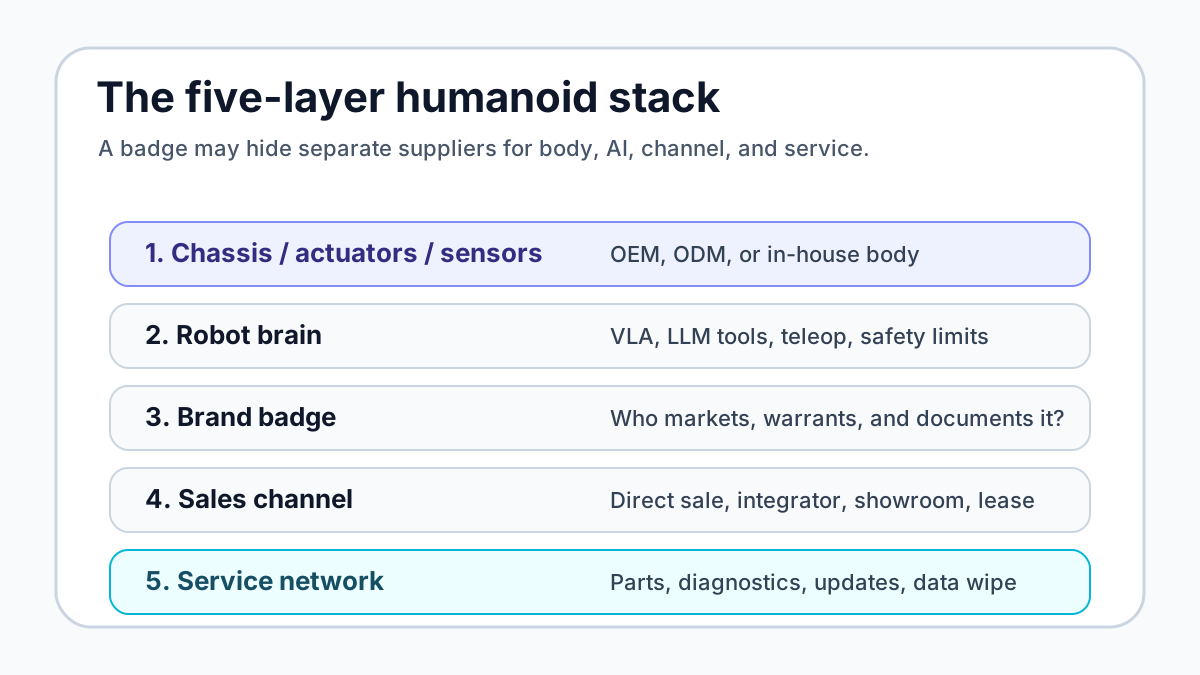
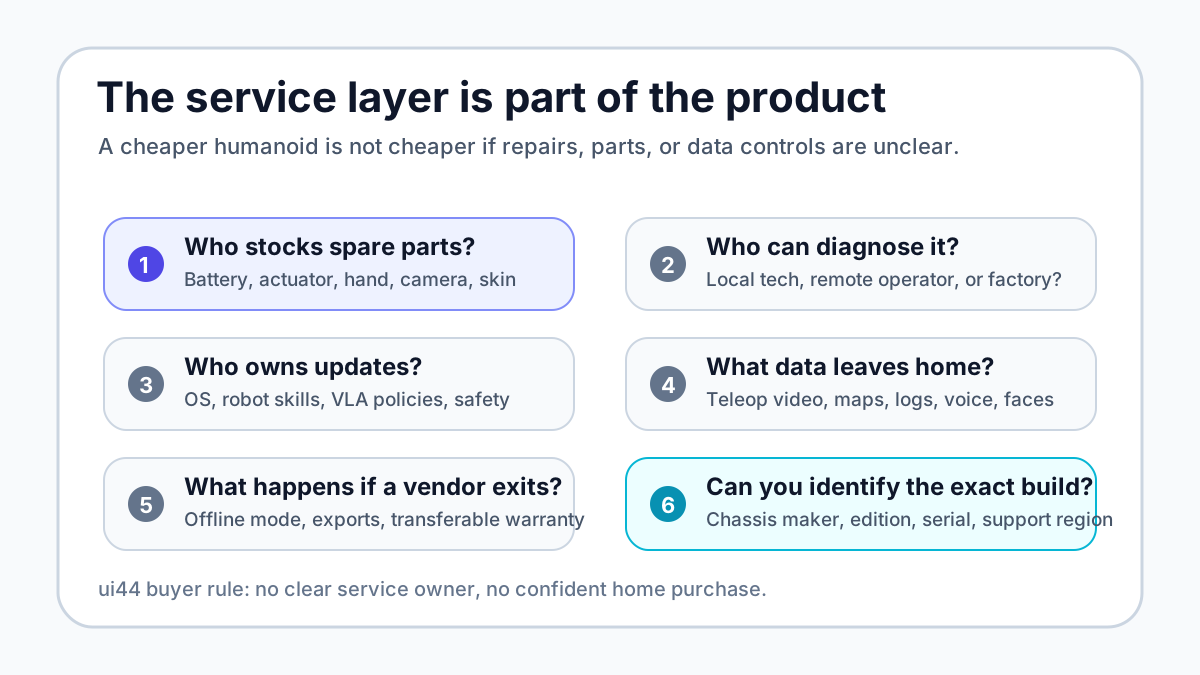
That is what "white-label humanoid robot" really means for buyers. The badge may be consumer friendly. The product behind it can be a stack of separate companies: an OEM body maker, a software or VLA team, a local brand, an integrator, a sales channel, and a service partner.
The short version: white-label is not automatically bad. It is only risky when the layers are hidden. A home buyer should not judge a robot only by the logo, the demo video, or the word "AI." The better question is: if this robot enters a real house, which company is accountable for each layer of the product?
What does white-label mean in humanoid robots?
In consumer electronics, white-label products are familiar. A factory or platform company makes the underlying hardware, while another brand sells, configures, or supports it. In robotics, the same idea is harder because the product is not just a speaker, camera, or tablet. A humanoid includes high-torque motors, batteries, force-sensitive joints, cameras, microphones, maps of private spaces, cloud services, teleoperation tools, and updateable motion policies.
Donut Robotics made the split unusually explicit with Cinnamon 1. The company's Japanese PR Times release says the current robot body is supplied by an overseas OEM and equipped with Donut's own AI, while Donut aims to produce a more domestic humanoid in the future. Donut's official product page also frames Cinnamon 1 as a Japanese-brand mass-produced bipedal humanoid with VLM/VLA work, Silent Gesture Control, about 170 cm height, about 70 kg weight, and initial use in construction sites and factories.
That is a useful disclosure, not a red flag by itself. It tells buyers what to ask next. Who validates the walking controller? Who updates the VLA? Who services the joints? If Donut changes the body supplier later, do early units keep the same parts path? If a future household version arrives, will support come from the brand, the OEM, a dealer, or a local integrator?
Why the body/brain split is happening now
The split is happening because humanoid hardware is becoming more available before household autonomy is solved.
ui44 tracks Unitree G1 as an available compact humanoid starting at $13,500, with a 132 cm, 35 kg body, about 2 hours of battery life, 23 degrees of freedom in the base model, optional Dex3-1 hands, depth camera, 3D LiDAR, Wi-Fi 6, Bluetooth 5.2, Unitree SDK, ROS 2, and EDU variants that can add NVIDIA Jetson Orin compute. Unitree R1 pushes the entry price even lower, with the R1 Air listed from $4,900 and a standard R1 from $5,900, though it is more movement-first than chore-ready.
Those prices change the market. A startup, retailer, senior-living operator, or regional brand no longer has to invent every actuator and joint from scratch to experiment with humanoid services. But the body is only one part of the buyer's risk. The AI layer still needs task data, recovery behavior, safe limits around people, and a service model that works outside a lab.

NEURA MiPA shows the platform version of this trend. NEURA calls MiPA a fully open platform with real-time data access and APIs, and its product page says the robot has "full white-label flexibility." ui44 tracks MiPA Home at €9,999 with a refundable €100 reservation fee, 16 degrees of freedom for the base robot, 2-8 hours of motion endurance, SLAM/LiDAR, AI-driven planning, 360-degree perception, person recognition up to three meters, Wi-Fi, Bluetooth, automatic recharging, and modular attachments including a backpack, shelf, table, hook, clip system, and tool-change modules.
MiPA is not a full biped with dexterous hands. That is exactly why it is useful as a white-label example. It is closer to a configurable service/home platform: safer mobility first, attachments instead of humanlike arms, and a pitch that explicitly includes integrators and businesses. For some buyers, that may be a better near-term path than a more dramatic humanoid body with unclear support.
The service network may matter more than the logo
China's robot 4S-store model is another sign that humanoid robots are becoming a channel and service-network problem, not only a hardware problem.
Beijing's official English portal described the Robot Mall in E-Town as a four-floor, roughly 4,000 square meter venue with more than 50 robot brands across medical, industrial, bionic, and humanoid categories. It says the third floor shows a one-stop process for part replacement, diagnostics, and remote operation and maintenance. The same report says the store offers full-process services from selection to operation and maintenance, including display, after-sales service, spare parts, and user feedback.
China Daily's earlier report explained why this matters: the 4S model combines sales, service, spare parts, and survey/customer feedback. It also said the store planned standardized delivery, after-sales services, a nationwide rapid-response spare-parts network, and a professional maintenance team.
For a home buyer, that is the hidden product. A robot without local diagnostics, spare batteries, actuator replacement, software rollback, map export, data wipe, and warranty clarity is not a finished home product. It is a machine plus a promise.
A ui44 buyer table for the body/brain/service split
Here is how several robots in the ui44 database illustrate the split. None of these examples should be treated as identical, but together they show why a badge-only comparison is too shallow.
Robot
- Public position in ui44 data
- Pre-order home/service assistant; €9,999 MiPA Home reservation; 16 DOF; 2-8h motion endurance; open APIs; modular attachments
- What the split teaches buyers
- A platform can be configurable and useful without pretending to be a full humanoid. Ask who builds each application and who supports the attachments.
Robot
- Public position in ui44 data
- Available compact humanoid from $13,500; 132 cm; 35 kg; ~2h battery; optional hands; SDK/ROS 2
- What the split teaches buyers
- Affordable hardware can become a base for third-party skills or integrators, but the buyer must separate shipped hardware from finished home autonomy.
Robot
- Public position in ui44 data
- Pre-order humanoid line from $4,900; 123 cm; about 29 kg; ~1h mixed activity; voice/image interaction
- What the split teaches buyers
- Low price expands experimentation, but movement-first demos are not the same as reliable household manipulation.
Robot
- Public position in ui44 data
- Home-focused humanoid pre-order at $20,000; 167 cm; 30 kg; ~4h battery; soft body
- What the split teaches buyers
- A vertically branded home robot can still involve teleoperation, subscriptions, and update policy questions. The brand must explain data and support.
Robot
- Public position in ui44 data
- Available mobile manipulator at $29,950; 160 cm working height; 8h light-load runtime; ROS 2/Python SDK
- What the split teaches buyers
- A non-humanoid body with open software may be easier to validate than a human-shaped robot if the task is actual indoor manipulation.
Robot
- Public position in ui44 data
- Active retail mobile manipulator; 10h battery; 5 kg single-arm / 10 kg dual-arm payload; VLA grocery/retail models
- What the split teaches buyers
- Commercial deployments can train the body/brain/service stack before private homes see the product.
Robot
- Public position in ui44 data
- Available wheeled embodied-intelligence platform; pricing undisclosed; 3 kg one-arm continuous handling; teleop/data-collection tooling
- What the split teaches buyers
- A robot can be both task platform and data platform. Buyers need to know whether they are buying labor, data collection, or both.
| Robot | Public position in ui44 data | What the split teaches buyers |
|---|---|---|
| NEURA MiPA | Pre-order home/service assistant; €9,999 MiPA Home reservation; 16 DOF; 2-8h motion endurance; open APIs; modular attachments | A platform can be configurable and useful without pretending to be a full humanoid. Ask who builds each application and who supports the attachments. |
| Unitree G1 | Available compact humanoid from $13,500; 132 cm; 35 kg; ~2h battery; optional hands; SDK/ROS 2 | Affordable hardware can become a base for third-party skills or integrators, but the buyer must separate shipped hardware from finished home autonomy. |
| Unitree R1 | Pre-order humanoid line from $4,900; 123 cm; about 29 kg; ~1h mixed activity; voice/image interaction | Low price expands experimentation, but movement-first demos are not the same as reliable household manipulation. |
| 1X NEO | Home-focused humanoid pre-order at $20,000; 167 cm; 30 kg; ~4h battery; soft body | A vertically branded home robot can still involve teleoperation, subscriptions, and update policy questions. The brand must explain data and support. |
| Hello Robot Stretch 4 | Available mobile manipulator at $29,950; 160 cm working height; 8h light-load runtime; ROS 2/Python SDK | A non-humanoid body with open software may be easier to validate than a human-shaped robot if the task is actual indoor manipulation. |
| Galbot G1 | Active retail mobile manipulator; 10h battery; 5 kg single-arm / 10 kg dual-arm payload; VLA grocery/retail models | Commercial deployments can train the body/brain/service stack before private homes see the product. |
| AGIBOT G1 | Available wheeled embodied-intelligence platform; pricing undisclosed; 3 kg one-arm continuous handling; teleop/data-collection tooling | A robot can be both task platform and data platform. Buyers need to know whether they are buying labor, data collection, or both. |
This is why the right comparison page is often not "which robot is smarter?" It is which robot has the clearest ownership stack: body, software, updates, privacy, local support, parts, and realistic task proof.
Six questions to ask before buying a white-label humanoid
1. Who made the exact chassis? Ask for the chassis maker, model revision, serial-number scheme, battery type, actuator family, hand configuration, sensor package, and supported regions. If the seller will not identify the hardware, you cannot evaluate repair risk.
2. Who controls the robot brain? A brand may add a VLA, LLM interface, app, teleoperation layer, or skill store on top of another company's body. That can be good. But you need to know who ships safety updates, who can remotely disable features, and whether skills continue working if the brand changes suppliers.
3. Who is responsible for physical safety? Do not accept a vague answer like "the AI handles it." A home robot needs speed limits, force limits, fall behavior, emergency stop, child/pet assumptions, and clear boundaries for stairs, wet floors, reflective surfaces, pets, rugs, glassware, and fragile furniture.
4. Who repairs it near your home? Shipping a 30-80 kg robot back across a border is not a normal support path. Ask about spare batteries, hands, cameras, actuators, covers, wheels or feet, software diagnostics, service appointments, warranty labor, and turnaround time.
5. What data leaves the house? White-label stacks can blur responsibility. One vendor may collect app logs, another may process video, another may provide remote assistance, and another may train models. Before buying, ask about video, audio, maps, faces, object labels, teleoperation sessions, retention, deletion, and whether data is shared with the OEM or only the seller.
6. What is the exit plan? If the seller stops operating, can the robot still walk, dock, map, and run local skills? Can you export data? Can another service partner repair it? Can the battery be replaced? Can the robot be safely wiped before resale or disposal?
When white-label can be good
A white-label or platform approach can be the right answer in several cases. Senior-living operators may want a local care workflow on top of a safer base. Hotels and hospitals may want a branded assistant tied into their own service software. Universities may prefer a lower-cost body with open SDK access. A regional service company may be better at deployment, maintenance, and training than the original hardware manufacturer.
That is especially true if the alternative is a beautiful vertically branded humanoid that has no local service plan. The home-robot market needs boring infrastructure: parts catalogs, diagnostics, warranty workflows, support regions, training data governance, safety test reports, and realistic task contracts. White-label models can help build that infrastructure faster if everyone is honest about their role.
The danger is pretending that a badge turns an integrator bundle into a finished consumer appliance. If the robot falls, breaks a finger, loses mapping, cannot get an update, or needs remote help at 11 p.m., the buyer does not care which company wrote which layer. They need one accountable support path.
Bottom line
For home buyers, the question is not whether white-label humanoid robots are "real" or "fake." The question is whether the stack is visible.
A credible seller should be able to explain the body supplier, software owner, AI/data boundaries, service partner, spare-parts path, update policy, warranty, and exact home tasks the robot is allowed to attempt. If those answers are clear, a white-label humanoid or configurable service robot may be perfectly reasonable. If those answers are vague, the robot is not ready for a home purchase no matter how polished the demo looks.
Use the logo as a starting point. Use the ownership stack as the decision.
Database context
Use this article as a privacy verification workflow
Turn the article into a real verification pass
White-Label Humanoid Robots: Buyer Reality Check already points you toward 7 linked robots, 7 manufacturers, and 4 countries inside the ui44 database. That matters because strong buyer guidance is easier to apply when you can move immediately from a claim or warning into concrete product pages, manufacturer directories, component explainers, and country-level context instead of treating the article as an isolated opinion piece. The fastest next step is to turn the article into a shortlist workflow: open the linked robot pages, verify which specs are actually published for those models, then compare the surrounding manufacturer and component context before you decide whether the underlying claim changes your buying plan.
For this topic, the useful discipline is to separate the editorial lesson from the catalog evidence. The article gives you the framing, but the robot pages tell you what each product actually ships with today: sensor stack, connectivity methods, listed price, release timing, category, and support-relevant compatibility notes. The manufacturer pages then show whether you are looking at a one-off launch, a broader lineup pattern, or a company that spans multiple categories. That layered workflow reduces the risk of buying on a single marketing phrase or a single support FAQ.
Use the robot pages to confirm which products actually expose cameras, microphones, Wi-Fi, or voice systems, then use the manufacturer pages to decide how much of the privacy question seems product-specific versus brand-wide. On this route cluster, G1, R1, and MiPA form the fastest reality check. If you want a quick working shortlist, open Compare G1, R1, and MiPA next, then keep this article open as the reasoning layer while you compare structured data side by side.
Practical Takeaway
Every robot, manufacturer, category, component, and country reference below resolves to a real ui44 page, keeping the follow-up path grounded in database records rather than generic advice.
Suggested next steps in ui44
- Open G1 and note the listed sensors, connectivity methods, and voice stack before you interpret any policy claim.
- Cross-check the wider brand context on Unitree so you can see whether the privacy question touches one model or a broader lineup.
- Use the linked component pages to confirm how common the relevant sensors and connectivity layers are across the database.
- Keep a short note of which policy layers you checked, which device features are actually present on the robot page, and which items still depend on region- or app-level confirmation.
- Finish with Compare G1, R1, and MiPA so the policy reading sits next to structured product data.
Database context
Robot profiles worth opening next
Use the linked product pages as the evidence layer
The linked robot pages are where this article becomes operational. Instead of asking whether the headline is interesting, use the robot entries to inspect the actual mix of sensors, connectivity options, batteries, pricing, release timing, and stated capabilities attached to the products mentioned in the article. That is the easiest way to see whether the warning or opportunity described here affects one product family, a specific design pattern, or an entire buying lane.
G1 is tracked on ui44 as a available humanoid robot from Unitree. The database currently records a listed price of $13,500, a release date of 2024, ~2 hours battery life, Not disclosed charging time, and a published stack that includes Depth Camera, 3D LiDAR, and 4 Microphone Array plus Wi-Fi 6 and Bluetooth 5.2.
For privacy-focused reading, this page matters because it shows the concrete device surface behind the policy discussion. Use it to verify whether G1 combines sensors and connectivity in a way that could change the in-home data footprint, and compare the listed capabilities such as Bipedal Walking, Object Manipulation, and Dexterous Hands (optional Dex3-1) with any cloud, app, or voice layers.
R1
Unitree Robotics · Humanoid · Pre-order
R1 is tracked on ui44 as a pre-order humanoid robot from Unitree Robotics. The database currently records a listed price of $4,900, a release date of 2025, ~1 hour (mixed activity) battery life, Not officially disclosed charging time, and a published stack that includes Binocular Cameras, 4-Mic Array, and Dual 6-Axis IMU plus Wi-Fi and Bluetooth 5.2.
For privacy-focused reading, this page matters because it shows the concrete device surface behind the policy discussion. Use it to verify whether R1 combines sensors and connectivity in a way that could change the in-home data footprint, and compare the listed capabilities such as Bipedal Walking & Running, Cartwheels & Handstands, and Push Recovery with any cloud, app, or voice layers, including UnifoLM (voice + image commands).
MiPA
NEURA Robotics · Home Assistants · Pre-order
MiPA is tracked on ui44 as a pre-order home assistants robot from NEURA Robotics. The database currently records a listed price of €9.999, a release date of 2025, 2-8 hours motion endurance (official datasheet) battery life, Automatic recharging capability; charging time not officially disclosed charging time, and a published stack that includes SLAM-based mapping, LiDAR, and 360° perception plus Wi-Fi and Bluetooth.
For privacy-focused reading, this page matters because it shows the concrete device surface behind the policy discussion. Use it to verify whether MiPA combines sensors and connectivity in a way that could change the in-home data footprint, and compare the listed capabilities such as 16 Degrees of Freedom (base robot, without end-effectors), Autonomous Mobility, and SLAM Mapping and Path Planning with any cloud, app, or voice layers, including Multilanguage voice recognition.
NEO
1X Technologies · Humanoid · Pre-order
NEO is tracked on ui44 as a pre-order humanoid robot from 1X Technologies. The database currently records a listed price of $20,000, a release date of 2025-10-28, ~4 hours battery life, Not disclosed charging time, and a published stack that includes RGB Cameras, Depth Sensors, and Tactile Skin plus Wi-Fi and Bluetooth.
For privacy-focused reading, this page matters because it shows the concrete device surface behind the policy discussion. Use it to verify whether NEO combines sensors and connectivity in a way that could change the in-home data footprint, and compare the listed capabilities such as Household Chores, Tidying Up, and Safe Human Interaction with any cloud, app, or voice layers.
Stretch 4
Hello Robot · Home Assistants · Available
Stretch 4 is tracked on ui44 as a available home assistants robot from Hello Robot. The database currently records a listed price of $29,950, a release date of 2026-05-12, 8 hours (light CPU load) battery life, Not officially disclosed charging time, and a published stack that includes Wide-FOV depth sensing, High-resolution RGB cameras, and Calibrated RGB + depth perception plus its listed connectivity stack.
For privacy-focused reading, this page matters because it shows the concrete device surface behind the policy discussion. Use it to verify whether Stretch 4 combines sensors and connectivity in a way that could change the in-home data footprint, and compare the listed capabilities such as Mobile Manipulation, Omnidirectional Indoor Mobility, and Autonomous Mapping and Navigation with any cloud, app, or voice layers.
Database context
Manufacturer context behind the article
Check whether this is one product story or a broader company pattern
Manufacturer pages add the privacy context that individual product pages cannot show on their own. They help you check whether cameras, microphones, cloud accounts, app controls, and policy assumptions appear across a broader lineup or stay tied to one specific product story.
Unitree
ui44 currently tracks 2 robots from Unitree across 1 category. The company is grouped under China, and the current catalog footprint on ui44 includes H1, G1.
That wider brand context matters because privacy questions rarely stop at one FAQ page. A manufacturer route helps you see whether the article is centered on one premium model or on a company that has several relevant products and therefore more than one place where the same policy or app assumptions might matter. The category mix here currently points toward Humanoid as the most useful next route if you want to see whether this article reflects a wider pattern inside the brand.
Unitree Robotics
ui44 currently tracks 8 robots from Unitree Robotics across 2 categorys. The company is grouped under China, and the current catalog footprint on ui44 includes B2, B1, Go2.
That wider brand context matters because privacy questions rarely stop at one FAQ page. A manufacturer route helps you see whether the article is centered on one premium model or on a company that has several relevant products and therefore more than one place where the same policy or app assumptions might matter. The category mix here currently points toward Quadruped, Humanoid as the most useful next route if you want to see whether this article reflects a wider pattern inside the brand.
NEURA Robotics
ui44 currently tracks 3 robots from NEURA Robotics across 2 categorys. The company is grouped under Germany, and the current catalog footprint on ui44 includes 4NE-1, 4NE-1 Mini, MiPA.
That wider brand context matters because privacy questions rarely stop at one FAQ page. A manufacturer route helps you see whether the article is centered on one premium model or on a company that has several relevant products and therefore more than one place where the same policy or app assumptions might matter. The category mix here currently points toward Humanoid, Home Assistants as the most useful next route if you want to see whether this article reflects a wider pattern inside the brand.
1X Technologies
ui44 currently tracks 2 robots from 1X Technologies across 1 category. The company is grouped under Norway, and the current catalog footprint on ui44 includes NEO, EVE.
That wider brand context matters because privacy questions rarely stop at one FAQ page. A manufacturer route helps you see whether the article is centered on one premium model or on a company that has several relevant products and therefore more than one place where the same policy or app assumptions might matter. The category mix here currently points toward Humanoid as the most useful next route if you want to see whether this article reflects a wider pattern inside the brand.
Database context
Broaden the scan without leaving the database
Categories, components, and countries add the wider context
Category framing
Category pages are useful when the article touches a buying pattern that shows up across brands. A category route helps you confirm whether the linked products sit in a narrow niche or whether the same question should be tested across a larger field of alternatives.
Humanoid
The Humanoid category page currently groups 98 tracked robots from 70 manufacturers. ui44 describes this lane as: Full-size bipedal humanoid robots designed to work alongside humans. From factory floors to household tasks, these machines represent the cutting edge of robotics.
That makes the category route a practical follow-up when you want to check whether the products linked in this article are typical for the lane or whether they sit at one edge of the market. Useful starting examples currently include NEO, EVE, Mornine M1.
Home Assistants
The Home Assistants category page currently groups 15 tracked robots from 14 manufacturers. ui44 describes this lane as: Arm-based household helpers — laundry folders, kitchen robots, and mobile manipulators that handle physical tasks at home.
That makes the category route a practical follow-up when you want to check whether the products linked in this article are typical for the lane or whether they sit at one edge of the market. Useful starting examples currently include Robody, Futuring 2 (F2), Stretch 3.
Country and ecosystem context
Country pages give extra context when support practices, launch sequencing, regulatory posture, or manufacturer mix matter. They are not a substitute for model-level verification, but they do help you see which ecosystems cluster together and which manufacturers sit in the same regional field when you broaden the search beyond the article headline.
China
The China route currently groups 154 tracked robots from 70 manufacturers in ui44. That gives you a useful regional lens when the article points toward support practices, launch sequencing, or brand clusters that may share similar ecosystem assumptions.
On the current route, manufacturers like AGIBOT, Dreame, Unitree Robotics make the page a good way to broaden the scan without losing the regional context that often shapes availability, documentation style, and adjacent alternatives.
Germany
The Germany route currently groups 8 tracked robots from 5 manufacturers in ui44. That gives you a useful regional lens when the article points toward support practices, launch sequencing, or brand clusters that may share similar ecosystem assumptions.
On the current route, manufacturers like NEURA Robotics, Bosch, Agile Robots make the page a good way to broaden the scan without losing the regional context that often shapes availability, documentation style, and adjacent alternatives.
Norway
The Norway route currently groups 2 tracked robots from 1 manufacturers in ui44. That gives you a useful regional lens when the article points toward support practices, launch sequencing, or brand clusters that may share similar ecosystem assumptions.
On the current route, manufacturers like 1X Technologies make the page a good way to broaden the scan without losing the regional context that often shapes availability, documentation style, and adjacent alternatives.
Database context
Questions to answer before you move from reading to buying
A follow-up FAQ built from the entities already linked in this article
Frequently Asked Questions
Which page should I open first after reading “White-Label Humanoid Robots: Buyer Reality Check”?
Start with G1. That gives you a concrete product anchor for the article’s main claim. From there, branch into the manufacturer and component pages so you can tell whether the article is describing one specific model, a repeated brand pattern, or a wider technology issue that affects multiple shortlist options.
How do the manufacturer pages change the buying decision?
Unitree help you zoom out from one article and one product. On ui44 they show lineup breadth, category spread, and the neighboring robots tied to the same company. That context is useful when you are deciding whether a risk belongs to a single model, whether it shows up across a brand’s portfolio, and whether you should keep looking at alternatives before committing.
When should I switch from reading to side-by-side comparison?
Move into Compare G1, R1, and MiPA as soon as you understand the article’s main warning or promise. The article explains what to watch for, but the compare view is where you can check whether price, status, battery life, connectivity, sensors, and category fit still make the robot a good match for your own home and budget.
Database context
Where to go next in ui44
Keep the research chain inside the database
If you want to keep going, these follow-on pages give you the cleanest expansion path from article to research session. Open the comparison route first if you are deciding between products today. Open the manufacturer, category, and component routes if you still need to understand the broader pattern behind the claim.
Written by
ui44 Team
Published May 31, 2026
Share this article
Open a plain share link on X or Bluesky. No embeds, no widgets, no cookie baggage.